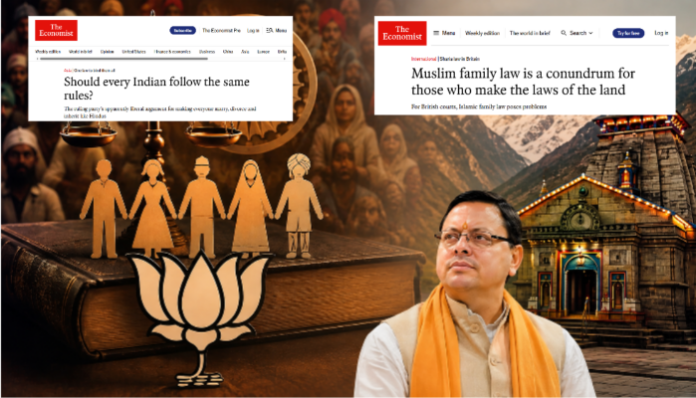
The mainstream media, particularly in the West, has never held a uniform position when it comes to matters concerning India or Hindus. The coverage often swings between sympathy and scepticism, praise and criticism, depending only on the issue and the preferred narrative. Hence, expecting complete honesty, impartiality or objectivity from such institutions is unrealistic, but they are at least expected to maintain the appearance of neutrality even when their agendas have been evident.
However, that facade appears to be fading fast. On 12th August (Wednesday), The Economist, which seemed to believe it was perfectly within its remit to sermonise India, effectively ventured into the internal matter of the country on the subject of the Uniform Civil Code (UCC). The tone carried an unmistakable whiff of colonialism, as though New Delhi were still expected to listen politely from the other end of the table.
Unfortunately for them, the calendar has moved on along with the nation. However, the episode became even more revealing with the British publication’s 2016 article. In a classic example of preach what you never practice, it was far less accommodating when discussing the existence of Sharia courts in the United Kingdom and argued firmly against the creation of a parallel legal system alongside the established judicial framework. However, such opinions tend to perform a backflip when the country is India.
When equality is framed as oppression
The piece, titled “Should Every Indian Follow the Same Rules,” paints a dramatic picture around the UCC, starting with the remarks of a man named Ahmed who insisted that one cannot truly be a Muslim without following Sharia law, before ominously declaring, “This is what awaits much of India,” implying that the government is stripping the minority citizens of their religious identity.
The Economist lists Assam, Gujarat and Madhya Pradesh, adding that other states could soon follow suit. If West Bengal also decided to pass this law, it warned, nearly “30 million more Muslims will face Ahmed’s dilemma.” Of course, the Bharatiya Janata Party, the “Hindu nationalist outfit’ that has already become a favourite target of these media houses, is declared the culprit, since all these states and the country are run by its governments.
The piece reads, “The BJP presents the new codes as a matter of universal human rights, in particular women’s rights. But look more closely and what is actually going on is a process of imposing on religious minorities the laws and customs that Hindus already follow.”
It mourns the loss of privileges that were extended to Muslims after the partition, under the guise of calming the apprehensions of the minority community, which are on the verge of being rescinded, resulting in them being treated similarly to their fellow citizens. This outcry is quite representative of the phrase, “When you are accustomed to privilege, equality feels like oppression.”
“The universal codes extend to Muslim daughters the same equal inheritance rights that Hindu daughters won in 2005. They criminalise polygamy for Muslim men. Talk to Muslim women in Uttarakhan,d and many are pleased to see such fixes,” it states, adding, “That makes it easy to dismiss critics as conservative cranks,” because The Economi, st which allegedly believes in the values of liberalism and human rights, cannot afford to support equality, gender justice, or rights of women and children if it hampers the propaganda.
Reality is ignored to defend discrimination
“But the reality is that the codes are not an instrument of women’s liberation, or indeed liberalism of any kind. One of the Uttarakhand code’s provisions, for instance, requires all couples to register a live-in relationship with the state within 30 days or risk a prison sentence. State and party officials insist that the aim is to protect women from exploitative men by bringing informal liaisons out of the shadows,” the column argues, conveniently overlooking the necessity of addressing the growing menace of love jihad and grooming jihad in India and even the United Kingdom. Nevertheless, the agenda takes precedence over all else.
Afterwards, the piece began to extol the virtues of Muslim personal law, asserting, “Under its dictates, women can generally escape toxic marriages faster than Hindu wives can. And they are also protected by mehr, a payment that a husband-to-be must make at the time of marriage to ensure his wife’s financial independence.”
If this is indeed the case, should not Muslim women be contesting the law rather than celebrating it, as the column itself indicated? Obviously, triple talaq, polygamy, child marriages and other notorious practices that deeply affect women in the Muslim community are left out of the column.
It subsequently begins to criticise Hindu law for being rife with injustices, frequently excluding widows, wives, and mothers from inheriting ancestral property. The Economist, in its disdain for Hinduism and the saffron party, neglects to acknowledge the existence of the Succession Act. This is not to imply that there are no legitimate issues, but at least there are provisions in the legal system aimed at protecting the rights of Hindu women.
Stoking tensions and fear
The Economist then seeks to downplay the reality of changing demographics due to the influx of illegal Bangladeshi Muslims and Rohingyas, who have taken possession of public land unlawfully and even attempt to coerce local girls into marriage with them. This is an even more pressing concern for a place like Uttarakhand, which is of great religious significance to the Hindu community. The scenes that transpired in Haldwani in 2024 act as a notable cautionary tale.
Furthermore, the grave and abhorrent practice of halala is reduced to merely “an archaic Muslim divorce custom” by the platform, which soon jumps onto its all-time favourite bandwagon of charging the BJP with trying to turn India into a “Hindu nation” with Uttarakhand serving as its testing site.
It then shifts to alarmist rhetoric, stoking fears over West Bengal and its sizeable Muslim population, which does “vibrant and violent politics,” suggesting that the state could become another battleground if it too moves towards implementing the UCC.
When The Economist opposed special laws in Britain
A few years back, the challenge of special laws was not merely about complying or coming to an understanding with the Muslim community, as pointed out by The Economist on 12th November 2016, in its column, “Muslim family law is a conundrum for those who make the laws of the land.”
It underscored the risks presented to a nation founded on a secular democratic framework and countered the assertions made by proponents of Sharia councils, arguing, “Critics retort that the Sharia councils are already beginning to resemble a parallel legal system. If they are now regulated and licensed by the government (with the implication that some of them are doing a decent job), that problem will merely worsen.”
The media outlet took a proactive stance on the sanctity of British law, mentioning, “If any change was made, it should be firmer insistence that the (secular) law of the land was supreme.” However, it is unwilling to extend that same principle to India.
The media house is far more comfortable with Indian laws being shaped around the personal regulations of the very community whose parallel legal mechanisms it had questioned in Britain. The hypocrisy does not end there and only continues to expose itself in increasingly glaring and grotesque form.
In India, The Economist wants Muslims to avoid the courtroom and address issues with the Muslim community,y but the same was presented as a concern in relation to Britain as it conveyed, “Whatever policymakers laid down, ultra-zealous Muslim groups might in any case try forming their own semi-secret tribunals. Given that Jewish religious courts known as Beth Din already have some standing in British case law, there was a risk of a proliferation of religious tribunals challenging the authority of secular justice.”
What is good for the goose apparently is not good for the gander. The publication, which has become a mouthpiece for Muslim personal law in India, wrote, “Any legitimisation of sharia councils will lead to the set-up of tribunals for Hindu, Sikh, and perhaps even other Christian denominations. Differing laws will mean inequality of legal rights and obligations, with some rights being better than others and plain discrimination based simply based on religious identity.”
It clearly signifies that British law should be considered the highest authority, with no religious law able to override it, but Muslim personal law should be accommodated and permitted to thrive in India even at the expense of rights, equality and justice.
The article delved into fearmongering and referenced a prediction made by Rowan Williams in 2008, who was the archbishop of Canterbury at the time. He stated that it was “almost inevitable” for certain forms of sharia law to be enforced in the UK, and The Economist declared the statement to be “quite accurate.”
Conclusion
At the risk of sounding repetitive, the doublespeak and dual standards of Western media towards India are simply too glaring to ignore. When Indian laws are imposed, Muslim or minority rights are displayed as being under threat. However, religious or personal laws are expected to take a back seat to the sanctity and supremacy of British law.
The hypocrisy is not specific to any matter, but it runs through their broader approach and becomes visible time and again in the attempts to attack India or Hindus. This is how it has been for years, and being called out would not change anything. They have no love lost for India, but the BJP government at the centre adds further fuel to the anti-India sentiment already simmering beneath the surface, and The Economist’s recent hit job is another example of the same familiar pattern.