

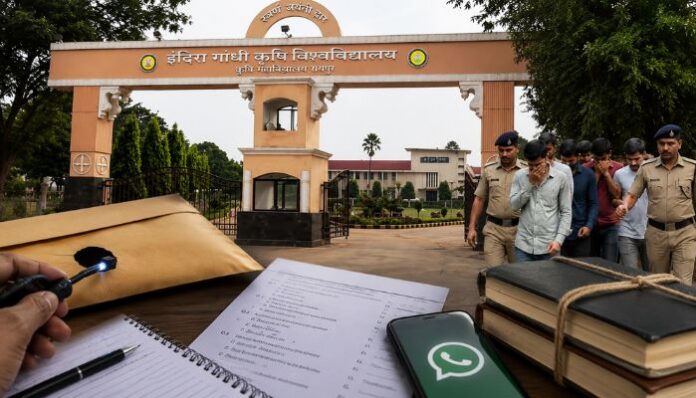
A question paper leak at Indira Gandhi Krishi Vishwavidyalaya (IGKV) in Raipur has turned into a major controversy after police arrested a professor from a private college in Durg and five students in connection with the case. The investigation has revealed a surprising method used to copy the question paper: an endoscopy camera was reportedly inserted through a tiny hole made in a sealed envelope.
#WATCH | Raipur, Chhattisgarh: On the Indira Gandhi Krishi Vishwavidyalaya (IGKV) Entomology paper leak case, DCP (Crime) Smruthik Rajanala says, "On the 20th, the case came to light at the Agricultural University where the Controller of Examinations reported a suspected leak of… pic.twitter.com/BFXaLP6dEy
— ANI (@ANI) August 22, 2026
The matter came to light on 20th August, when the university’s B.Sc. Agriculture second-year, second-semester entomology examination was being held. The paper, AENT 221 Pest Management in Crops and Stored Grains-I (Rabi Crops), was scheduled from 10 am to 1 pm. The examination was conducted at 34 colleges across Chhattisgarh.
The controversy began after a document circulated on WhatsApp was found to have questions that closely matched the actual examination paper. Initially, the university said it could not confirm whether there had been an internal leak. However, after protests by student groups and a complaint to the police, an investigation was launched.
The university later cancelled the examination and announced that it would be conducted again in the first week of September. While the initial report said nearly 70% of the circulated document matched the actual paper, the police investigation eventually led to the arrest of six people.
Endoscopy camera used to copy the paper
The police investigation has brought out the method used to obtain the question paper before the examination. According to DCP (Crime and Cyber) Smruthik Rajanala, 38-year-old Yogesh Sonkesariya, a professor at Bharti Agriculture College in Durg, received the question paper in a sealed envelope on 17th August.
Instead of opening the envelope, Sonkesariya reportedly made a very small hole at the bottom of it. He then inserted an endoscopic camera through the opening and used it to capture images of the question paper inside.
The question paper was a one-page document, with the entire content printed on one side. After taking the images, the opening in the envelope was covered with glue so that it could appear sealed.
Police said the professor did not simply keep the information for himself. He manually copied 15 questions from the paper and sold them to students. Investigators said the questions were then passed from one student to another before the examination.
According to the police, the investigation also found a link between the professor and students at the same college. Officials said some students paid around ₹12,000 for the questions.
The police have also said that the accused were connected with another examination that was scheduled for 7th August, and that this aspect is being examined as part of the investigation.
How police traced the source
The investigation started after the university received information that questions from the examination paper were circulating before the test. The Agriculture College and Research Centre at Kawardha received an email at around 8.41 am on 20th August claiming that the paper had been leaked. Other university officials received similar information shortly after.
Students and their representatives also contacted the university through WhatsApp and reported that some questions were already in circulation.
Following the complaint, police registered a case against unidentified persons under the Chhattisgarh Public Examination (Prevention of Unfair Means) Act, 2008, and Section 316 of the Bharatiya Nyaya Sanhita, 2023, which deals with criminal breach of trust.
A team of more than 100 police personnel was then formed. It included officers from the Anti-Crime and Cyber Unit, the Crime Branch and Telibandha police station.
Investigators examined the question paper that had gone viral, along with screenshots, photographs, messages and social media posts. These digital clues helped police trace the source to a student in Durg. The investigation then led them to Professor Sonkesariya and the other students.
DCP Rajanala said the police followed the trail from students who had received the copied questions to the professor who had accessed the sealed paper.
BJP government and police take strict action
The paper leak case has also put the focus on the action taken by the BJP-led Chhattisgarh government and the state police. Rather than treating the matter only as an examination irregularity, the authorities moved to investigate it as a criminal case.
The university lodged a formal police complaint after cancelling the examination, allowing the police to investigate whether the paper had been accessed from inside the examination system and identify everyone involved.
The police formed a large investigation team involving specialised cyber and crime units. More than 100 personnel were involved in tracing the source of the leaked questions, checking digital evidence and questioning people connected with the circulation of the paper.
The investigation resulted in the arrest of six people: Professor Yogesh Sonkesariya and five students. Police said the professor had obtained access to the sealed question paper, copied questions using an endoscopic camera and then passed them on for money.
The arrests indicate that the police investigation is not limited to the person who first circulated the questions. The role of the students who received and further shared the material is also being examined.
The case has been registered under the Chhattisgarh Public Examination (Prevention of Unfair Means) Act, 2008, along with the relevant provision of the Bharatiya Nyaya Sanhita. The legal action is aimed at establishing how the paper was accessed, who benefited from it and how widely the questions were circulated.
The police are also looking into the possibility of the accused being involved in another examination paper leak. This could widen the investigation if evidence establishes a similar pattern.
Student protests add pressure
The controversy had already led to protests on the university campus before the arrests were announced. The National Students’ Union of India (NSUI) staged a protest demanding action, while the Akhil Bharatiya Vidyarthi Parishad (ABVP) also protested and submitted a complaint to the university.
Both groups sought cancellation of the examination and a detailed investigation into the matter.
The university eventually cancelled the AENT 221 examination, saying it had been cancelled for administrative reasons, and announced that a fresh examination would be held in the first week of September.
The decision affected students across the university’s affiliated colleges. While the initial account referred to around 500 students at the Raipur examination, the later police account said around 1,500 students enrolled in different IGKV-affiliated colleges were scheduled to take the examination.
Chhattisgarh has faced paper leak cases before
The latest case has also brought attention to previous examination paper leaks in the State. Earlier this year, the Chhattisgarh Board of Secondary Education cancelled the Class 12 Hindi examination held on March 14 after a WhatsApp-based paper leak was confirmed and an FIR was registered.
The issue has also reached the Chhattisgarh High Court in another major examination case. Earlier this month, the court rejected the bail plea of a retired IAS officer arrested by the CBI in connection with alleged corruption in the recruitment process of the CGPSC State Civil Services Examination, 2021. His son, who was also accused in the case, had been selected as a deputy collector.
The High Court had described examination paper leaks as a crime that affects the wider society and observed that their impact goes far beyond the students who appear for an examination.
The IGKV case now adds another chapter to the debate over the security of examination papers in Chhattisgarh. With six arrests, a large police team working on the case and a probe into the possible involvement of the accused in another examination, the focus is now on finding out whether others were involved in obtaining, buying or circulating the questions.
For the students, the immediate result is a cancelled examination and a fresh test in September. For the authorities, the bigger challenge is to ensure that the system used to prepare, transport and store question papers does not become vulnerable to similar attempts in the future.


