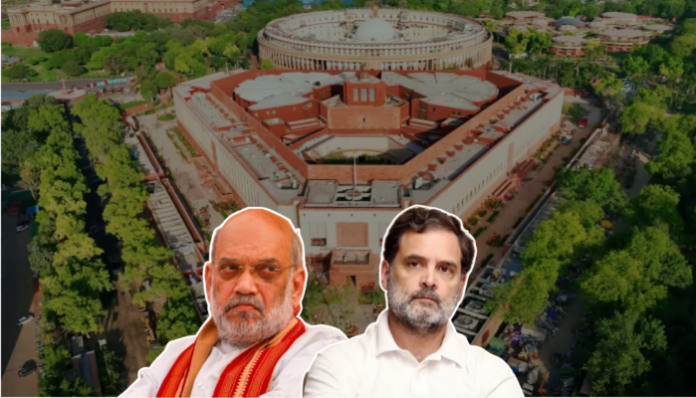
Parliament is meant to be the place where disagreements are argued out and not avoided. The government can be challenged, policies questioned and demands pressed, but all of that requires the house to function. However, the Indian National Congress-led opposition appears to have transformed the disruption of Parliament into a political strategy, choosing repeated obstruction over meaningful deliberation.
They have turned their protests into an obstacle to the very parliamentary process and democracy it claims to defend by repeatedly preventing debate and discussion. They have allowed political confrontation to take precedence over constructive engagement instead of using the House to debate issues and work towards solutions.
Notably, the central government headed by the Bharatiya Janata Party has repeatedly shown willingness to consider and address several of the opposition’s demands and objections. However, the latter continues to hold up parliamentary proceedings, wasting both precious time and public resources rather than using the opportunity to move the discussion forward.
A functioning democracy requires the government and opposition to engage. Of course, political differences are inevitable, but Parliament cannot become collateral damage in the battle to score political points. The country’s lawmakers need to focus on the challenges at hand, but the opposition’s tactic serves little purpose beyond deepening the impasse, especially when the government has been open to accommodating them.
Vocal protests and sloganeering caused the Lok Sabha and Rajya Sabha’s business to reach a multi-year low, making the Monsoon Session of Parliament a near washout, specifically regarding debates and discourse. During the 25-day session, which commenced on 20th July and concluded on 13th August, the Rajya Sabha recorded 39% productivity, compared to 19% for the Lok Sabha.
The Rajya Sabha was only allowed to run for 33% of its allotted time, and the figure was 15% for the Lok Sabha. The findings from Question Hour revealed a similar story, with only 1% of the authorised time being utilised for the session in the lower house, whereas the upper house dedicated 12% of its time.
A total of 12 bills were approved in each house, while discussions took place only in relation to the “Public Examination (Prevention of Unfair Means) Amendment Bill, 2026,” also known as the anti-paper leak legislation.
Predictably, the opposition attributed the situation to the government, alleging it was “unprecedented” and accusing Prime Minister Narendra Modi and Union Home Minister Amit Shah of staying away from Parliament. On the other hand, the government firmly held the opposition accountable for the disappointing performance.
“For the first time, we have seen the opposition running away from debate in Parliament when the government wanted discussions. Congress is solely responsible for unfairly disrupting the proceedings. They did not allow the House to take up the Question Hour. Another thing I observed, especially in the Congress, was that its MPs now seem to think their job is just to raise slogans and create a ruckus while brandishing placards and banners,” stated Parliamentary Affairs Minister Kiren Rijiju.
Opposition’s political posturing comes at parliament’s expense
The opposition’s political uproar initially centred on the NEET paper-leak controversy and the reported embezzlement of donations at Ram Mandir. They were quick to express their supposed concerns over the use of “violence” against protesters during the Cockroach Janta Party’s (CJP) march to Parliament and pushed for a discussion on the matter. They wanted PM Modi and Amit Shah to make a statement in the House.
The opposition sought to cast the episode as an example of the government’s purported intolerance towards dissent, placing the disputed conduct of the police and security forces at the centre of the political debate. Naturally, the brutal attack on the authorities which resulted in the injuries of at least 250 cops did not raise even an iota of similar alarm.
The government proposed a debate on the paper leak along with a reply from Shah in a bid to resolve the standoff, but the Congress turned it down. He again agreed to have a detailed discussion on the police action and charges surrounding the agitation to break the stalemate.
“The government is ready to discuss every aspect of the student protests over NEET. I am also ready to answer any question in Parliament,” Shah conveyed, remarking that the centre had “nothing to hide.” Shah also slammed the opposition for blocking Parliament for their political shenanigans
However, Leader of the Opposition, Rahul Gandhi, declined the offer, arguing that he and the opposition had no interest in attending his “imagination and lecture” or speech. This is clearly indicative of how the opposition desires to orchestrate a political drama to prevent Parliament from functioning. It merely aims to seem concerned about student issues but retreats the moment the government nods.
It is the first sign of exposure of their underlying motives. If the intention was genuinely to seek answers, why walk away once the opportunity to hear them was actually provided? How did the Gandhi scion already know that he would be lectured rather than given a substantive response without even allowing the minister to speak?
Different issues, same political script
The opposition has embraced disruption of Parliament as its political manual. The introduction of the Foreign Contribution (Regulation) Amendment Bill 2026 drew strong reactions from Congress and other opposition parties. However, the legislation’s history makes the convenient criticism difficult to overlook.
The FCRA was first introduced under the Indira Gandhi government and later strengthened by Prime Minister Rajiv Gandhi, while the UPA (United Progressive Alliance) government brought in an even more restrictive framework. The same party that once tightened the rules controlling the foreign-funded NGOs (non-governmental organisations) now objects when the current government wants to regulate the flow of such financial assistance.
More importantly, this “aid” facilitates religious conversions, protests to undermine India’s development and efforts to influence internal affairs. However, for the opposition, the politics of “minority victimhood” for electoral gain seems to overshadow its own track record as well as the broader interests and security of the country.
The government did pay heed to their contentions and referred the bill to a 31-member Joint Parliamentary Committee (JPC) for further scrutiny. However, the opposition remained adamant and insisted instead that it should be withdrawn altogether because it purportedly targeted minority institutions.
Congress also tried to make a comparison with the Rashtriya Swayamsevak Sangh (RSS), announcing that the group receives donations from overseas while the government was selectively imposing regulations on NGOs. The pursuit of minority votes is increasingly coming at the expense of national interest, both within and beyond the Parliament.
Conclusion
Rahul Gandhi often presents himself as a champion of democracy, demanding accountability from the government while his own record in Parliament tells a rather different story. His attendance in the Lok Sabha stood at just 51%, well below the national average of 79%. He participated in only eight debates, compared with the national average of 46.7, and asked 99 questions against the national average of 210. He also introduced no Private Member’s Bills.
The Raebareli MP and his party have honed a special political strategy known as shoot-and-scoot: raise an allegation, create a political uproar and retreat at the slightest hint of being countered. He seems to have diminished Congress to a mere entity of slogans and disorder, as the opposition appears to be unable to differentiate between a street demonstration and behaviour appropriate on the floor of Parliament.
Moreover, these antics not only disrupt Parliament but also deprive newly elected members of the opportunity to learn, gain experience and understand the functioning of the revered House.