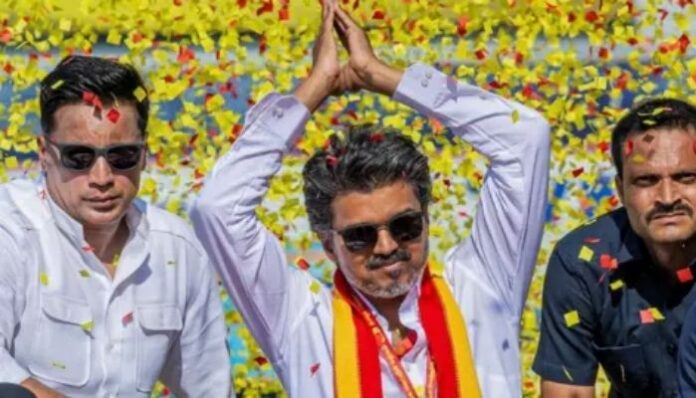
The Tamilaga Vettri Kazhagam (TVK) party swept the Tamil Nadu state assembly elections earlier this year, defeating the incumbent Dravida Munetra Kazhagam (DMK) government. The party led by actor-turned-politician Chandrashekhar Joseph Vijay, popularly known as Thalapathy Vijay, promised politics and policies different from conventional political parties; however, just four months in power, the CM Vijay-led government appears to be following the disastrous path of freebies and appeasement.
Free tuition for Muslim undergrad girls, Waqf scholarship expansion: Vijay government resorts to Muslim appeasement
The Congress-ruled Himachal Pradesh, erstwhile Aam Aadmi Party-ruled Delhi, and the AAP-ruled Punjab perfectly exemplify how unrealistic freebies exacerbate economic crisis, empty the state exchequer, and overburden the state with high debt. Despite the present cases, the TVK government led by CM Joseph Vijay is announcing religion-specific schemes.
On 27th August, the Minister for Minorities Welfare A M Shahjahan announced that the state government will cover the full Under-Graduate tuition fees for Muslim female students admitted under the government quota in government, government-aided, and self-financing colleges.
For this, the ministry has made an initial allocation of ₹20 crore.
Minister A M Shahjahan also announced the expansion of the Tamil Nadu Waqf Board scholarship for Muslim girls, from Classes 1-8 to Classes 9-10 at ₹2,000 per year. The scheme is expected to benefit 41,384 Muslim schoolgirls at a cost of Rs 8.28 crore.
A M Shahjahan said, “To further promote higher education access in the capital, the Tamil Nadu Waqf Board will establish a new dedicated Minorities Women’s Arts and Science College in Chennai with a starting grant of Rs 2.45 crore. The state will set up a Rs 100 crore revolving fund to offer interest-free loans aimed at developing income-generating assets such as commercial complexes and marriage halls on Muslim Wakf and Christian religious properties”.
An announcement has also been made about a ‘minorities’ women’s college in Chennai through the Waqf Board, with an initial grant of ₹2.45 crore.
Questions are rightly being raised: are only Muslim girls in need of financial support for their education? Are all Hindus in the state too rich to require state financial aid for the education of their daughters?
Why is the Vijay government providing full tuition fee support only for Muslim girls under the government quota rather than a means-tested expansion of higher-education support for all the girls regardless of their religion?
Why do Muslims get special treatment based on faith, while Hindus and others don’t? Doesn’t this mean that Muslims are being rewarded for being Muslims and the State is incentivising conversion to Islam in a way? Doesn’t this sort of religion-based policymaking amount to the State recognising Islam as a preferred religion, if not an official State religion?
It won’t be surprising if in the near future the government starts rewarding Muslim ‘minorities’ for even attending college.
A significant portion of the state’s wealth comes from Hindu taxpayers and temples. And yet, Hindus are neglected in such welfare schemes merely because of their faith and population size.
TVK government announces ₹100 crore revolving fund for Waqf and Christian properties, Waqf Board HQ construction
The Vijay government in Tamil Nadu has also announced a ₹100 crore interest-free revolving fund for loans to develop income-generating assets like marriage halls, commercial complexes, etc. on Muslim and Christian properties.
In addition, the state government will also construct a new headquarters for the Tamil Nadu Waqf Board at an estimated cost of ₹40 crore.
Moreover, reports say that the administrative grant for the state Waqf Board will be raised to ₹5 crore.
TVK’s expensive one-gram gold ring poll promise for babies born in government hospitals to add a new burden to the state exchequer
The most expensive promise made by TVK in its election manifesto was to give 8 grams (one sovereign) of gold to babies born in government hospitals. After forming the government, CM Vijay has crafted the Thaimaman Thanga Mothiram scheme to give a 1-gram 22-carat gold ring to eligible newborn babies of state residents, delivered in government hospitals.
This expensive freebie will be provided with an annual allocation of ₹756 crore for roughly 4.42 lakh rings. Applying from 22nd June 2026, the birthday of CM Vijay, and it will be formally launched on 15th September.
Vijay government dropped Chennai’s second airport
Portrayed as the ‘super CM’ and the ‘real-life Shivaji Rao from Nayak film’ in Instagram reels, CM Vijay is too busy squandering state funds to appease Muslims that he is apparently indifferent to the fact that Tamil Nadu’s overall debt stands at ₹13.18 lakh.
Recently, the Vijay government cancelled the Parandur greenfield airport project that was advanced under the previous DMK government even as land acquisition was already underway. With this, the TVK fulfilled its poll promise to the protesting farmers.
Notably, Chennai is in dire need of a second airport because passenger traffic and cargo movement are increasingly outpacing the capacity of the existing Chennai International Airport in Meenambakkam.
Currently, the Chennai International Airport handles about 30 million passengers every year. While future upgrades can raise capacity to around 35 or 55 million passengers, it would only be a medium-term fix.
Industrial growth and increasing travel demand will fully saturate the current facility in the near future. Thus, there is a serious need for a second airport.
By cancelling the Parandur airport project, which advanced to the stage of land acquisition after years of planning and clearances, CM Vijay essentially pushed Chennai’s second-airport project back to the initial site-selection phase.
Calling the cancellation a “setback that further delays Chennai’s quest for a world-class airport”, the Confederation of Real Estate Developers’ Associations of India’s (CREDAI) Chennai chapter said that Chennai is at risk of losing big investments, industrial relocation and talent to other competing hubs which already have better aviation infrastructure.
While the Vijay government has confirmed that the second airport project has not been fully abandoned and a search for an alternative site is ongoing, finding an alternative site, its feasibility tests, land acquisition, and environmental clearances from the Airport Authority of India (AAI) would take years before the construction could even commence.
White paper on Tamil Nadu Electricity Board’s health revealed ₹2.47 lakh crore outstanding debt, yet TVK says freebies shall be dolled out uninterrupted
In late June 2025, the Tamil Nadu Electricity Minister CTR Nirmal Kumar released a white paper on the condition of the state’s electricity board. The document stated that Tamil Nadu’s power sector carries an outstanding debt of Rs 2.47 lakh crore.
The total debt of Tamil Nadu’s power sector has exceeded Rs 2,47,130 crore. This accounts for 77.6% of the total debt accumulated by Tamil Nadu’s public sector undertakings, the white paper states.
The power sector-specific white paper was released days after the TVK government released a broader white paper revealing that the state overall debt stands at Rs 13.18 lakh crore.
Despite the massive debt burden, the TVK government said that there will be no electricity tariff hike and that the electricity scheme for farmers would continue.
This came despite the government’s own admission that the state’s power distribution company, the Tamil Nadu Power Distribution Corporation Limited (TNPDCL), is facing a “persistent monthly structural” cash shortfall of ₹2,500, which results in the annual liquidity gap of about ₹30,000 crore, financed via short-term borrowings, delayed payments to power purchase counterparties, and deferred capital expenditure.
Free cylinders, bus travel for women and more: For TVK, freebies are the way
In late August 2026, CM Joseph Vijay announced three free LPG cylinders a year for every family with an annual income below ₹2.5 lakh, under the Annapoorni Super Six scheme. While the scheme is likely to benefit 1.30 families, it will cost the state exchequer over ₹4,000 crore annually.
Moreover, the Tamil Nadu CM also announced free bus travel for transgender persons. CM Vijay also expanded the scope of the ‘Vettri Payana Thittam’ scheme for women. Now, women will not only be allowed to travel for free on ordinary buses but also on Express, LSS and Deluxe services.
Tamil Nadu’s financial health is deteriorating, but the Vijay government is prioritising freebies and appeasement
In June this year, the TVK government released a financial white paper. It covered the period from 2021-2022 to 2025-26. The document revealed that the total debt of Tamil Nadu has reached ₹13.18 lakh crore, including ₹10 lakh crore in direct state borrowings and ₹3.18 lakh crore in public sector undertaking (PSU) liabilities.
The per capita burden has also risen, with every Tamil Nadu resident effectively carrying a debt share of nearly ₹1.29 lakh.
Meanwhile, direct state debt has also nearly doubled from ₹5.13 lakh crore in April 2021 to about ₹10 lakh crore by March 2026.
The state’s revenue deficit, as per the white paper, has also hit a record high of ₹78,324 crore, making up to nearly 2.2% of the GSDP. In addition, the annual interest payments crossed ₹67,050 crore, surpassing the state’s total capital expenditure.
Despite the alarming numbers, the Vijay government is prioritising freebies and Muslim appeasement.
Indifferent to the struggling economy and an emptied state exchequer, the Congress government in Himachal Pradesh promised free electricity, monthly financial assistance for women, restoration of the Old Pension Scheme, government jobs and several subsidy-based schemes.
Following the initial chest thumping, now the situation for the government is such that it is trapped in the spiral of borrowing, higher charges, reduced subsidies or new taxes and cess. The Congress government in Himachal Pradesh called on even Hindu temple trusts to contribute funds towards welfare schemes. A notification encouraged temple trusts to provide money for programmes including the Mukhyamantri Sukh-Aashray Yojana and Mukhyamantri Sukh Shiksha Yojana.
After Congress’s ‘Khatakhat’ model of freebies destroyed the economy, the Himachal government is inventing unique cesses and taxes.
Similar is the state of affairs in AAP-ruled Punjab wherein outstanding liabilities have crossed ₹4.5 lakh crore, a debt-GSDP ratio around 44-46%, one of the highest in the country; in addition, the state is also struggling with revenue and fiscal deficits, and surging debt-servicing costs.
While Punjab’s plunge into the bottomless quagmire of economic crisis cannot solely be blamed on the AAP government, despite the financial challenges and dependence on borrowing, the AAP government doled out several freebies, including 300 units of free electricity.
Besides freebies, the AAP government in Punjab has also been accused of squandering taxpayers’ money, essentially the funds from the state exchequer for needless advertising and even for AAP’s electoral victory marches. Now the situation is such that the AAP government is struggling to clear even the Dearness Allowance of state employees and is playing delay tactics.
Tamil Nadu also runs a structural revenue deficit, with a massive share of its revenue already going to salaries, pensions, and interest. With new recurring commitments, be it gold rings or minority freebie packages, the Vijay government is overburdening the state.
While the TVK might give political justifications, including compulsion to fulfil poll promises, today’s freebies will tomorrow create an unbearable financial burden for the state’s future generations.