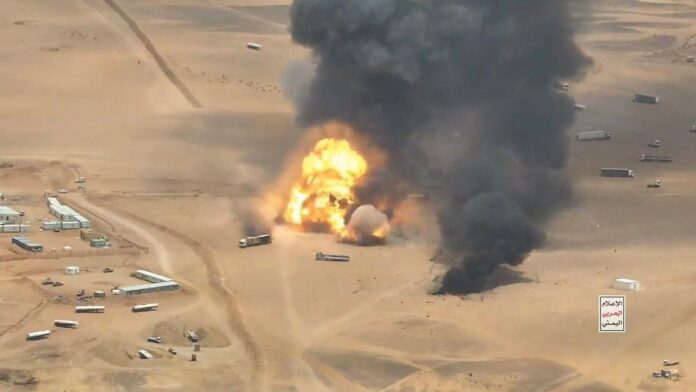
The Middle East is once again staring at the possibility of a major regional conflagration, but what makes the present situation particularly dangerous is that the region is not dealing with a single isolated conflict anymore, with the United States and Iran already locked in a confrontation around the strategically vital Strait of Hormuz while Iran-backed Houthis in Yemen have simultaneously escalated their attacks against Saudi Arabia, striking civilian and economic infrastructure and threatening to turn another long-running proxy conflict into a much wider war.
At least 73 people were injured after the Houthis launched a series of missile and drone attacks against Saudi Arabia, with the strikes targeting several locations in the southern part of the kingdom, including energy installations, Abha International Airport and King Khalid air base, while Saudi authorities reported fires and temporary disruptions at some energy facilities.
The Houthis have claimed responsibility for the attacks, saying they targeted Saudi military and economic infrastructure, including facilities belonging to Saudi Aramco, while Riyadh has vowed to take all necessary measures to defend its sovereignty and neutralise what it describes as a growing threat from the Iran-backed militia.
On the surface, this may appear to be another escalation in Yemen’s decade-long civil war, but that would be a dangerously simplistic reading of what is happening because the Houthi-Saudi confrontation is unfolding at precisely the moment when another and potentially far more consequential confrontation is taking place between Washington and Tehran around the Strait of Hormuz.
The Middle East is therefore beginning to look less like a collection of separate conflicts and increasingly like one interconnected battlefield.
The Houthis have reopened the Saudi front
The Houthi movement seized Yemen’s capital, Sanaa, in 2014 and subsequently became one of the most powerful armed groups in the region, receiving extensive political and military backing from Iran while fighting Yemen’s internationally recognised government, which has in turn received support from Saudi Arabia and its regional allies.
Saudi Arabia led a military coalition that intervened in Yemen in 2015, beginning a conflict that quickly became one of the most prominent examples of the wider Saudi-Iranian rivalry playing out through proxy forces, although a UN-backed truce in 2022 substantially reduced the intensity of fighting and created hopes that the two sides might eventually move towards a political settlement.
Those hopes are now looking increasingly fragile.
The Saudi-backed Yemeni government has launched a counteroffensive against Houthi forces, while the Houthis have responded by expanding their attacks beyond Yemen and striking targets inside Saudi Arabia, with the latest barrage being particularly significant because the militants did not restrict themselves to military targets but also targeted civilian and economic infrastructure.
That distinction matters because Saudi Arabia is not merely another country involved in the Yemen conflict; it is the world’s largest oil exporter and one of the central pillars of the global energy market, which means that attacks on its energy infrastructure can have consequences far beyond the immediate battlefield.
Why Riyadh cannot simply absorb the attacks
Saudi Arabia has repeatedly demonstrated that it will not tolerate sustained attacks on its territory, particularly when those attacks threaten the country’s oil infrastructure, airports and other strategic economic assets, and the latest strikes have therefore created a situation in which Riyadh faces considerable pressure to retaliate.
Saudi authorities have already described the latest escalation as dangerous, while the Saudi-led coalition has warned that it will take necessary operational measures to neutralise the threat posed by the Houthis.
The problem is that retaliation itself could become the trigger for another round of escalation, because a Saudi strike against Houthi positions could lead the militants to launch another barrage against Saudi cities or energy facilities, which could then force Riyadh to respond even more forcefully.
This is the classic escalation trap that has repeatedly transformed limited confrontations in the Middle East into prolonged wars, with each side insisting that it is merely responding to the other while simultaneously increasing the scale and intensity of its own military operations.
And there is another reason the latest attacks are particularly worrying: the Houthis have demonstrated that they are willing to use economic warfare as part of their military strategy.
Iran’s shadow over the Houthi escalation
It would be inaccurate to claim, without evidence, that Iran directly ordered every Houthi attack against Saudi Arabia, because the Houthis have their own political objectives, military command structure and calculations concerning Yemen.
At the same time, it would be equally naive to pretend that Iran’s role is irrelevant.
The Houthis are one of the most important components of Iran’s regional network of armed partners, and their position along the Red Sea gives Tehran an important strategic pressure point against Saudi Arabia and against international shipping moving through one of the world’s most important maritime corridors.
This means that even when Tehran is not directly involved in a particular Houthi operation, the existence of a powerful Iran-backed force capable of threatening Saudi territory and Red Sea shipping inevitably complicates the strategic calculations of Riyadh, Washington and other Gulf states.
The timing becomes even more significant because Iran itself is currently under intense pressure from the United States.
The Strait of Hormuz is already another battlefield
The United States and Iran are locked in a confrontation around the Strait of Hormuz, the narrow waterway connecting the Persian Gulf with the Gulf of Oman, through which a huge share of the world’s oil supplies traditionally passes.
The conflict has already spilt into maritime operations, with American and Iranian forces confronting each other around commercial shipping and energy transportation, creating fears that a prolonged confrontation could disrupt one of the world’s most important energy corridors.
This is what makes the Houthi escalation so dangerous.
The Houthis operate on the western side of the Arabian Peninsula, near the Red Sea and Bab el-Mandeb, while Iran and the United States are confronting each other on the eastern side around Hormuz.
These are not two completely disconnected theatres.
The Bab el-Mandeb Strait connects the Red Sea to the Gulf of Aden, while the Gulf of Aden opens into the Arabian Sea and the wider Indian Ocean, creating a maritime chain that ultimately links the Red Sea to the Persian Gulf through the surrounding waterways.
If both Hormuz and Bab el-Mandeb become seriously disrupted at the same time, the consequences for global energy markets and international shipping could be enormous.
The real danger is the merging of conflicts
For years, policymakers could treat the Yemen war, the Iran-Saudi rivalry and the US-Iran confrontation as separate geopolitical problems, but the latest developments make that separation increasingly difficult because the same actors, alliances, shipping routes and energy infrastructure are now appearing across multiple theatres.
The Houthis have already threatened Red Sea shipping and launched attacks against Saudi Arabia, while Iran remains locked in its confrontation with Washington, and Saudi Arabia finds itself attempting to protect its territory and energy infrastructure without allowing the conflict to spiral completely out of control.
If Saudi Arabia responds with a major military campaign against the Houthis, the militants could intensify their attacks, potentially drawing Iran more directly into the confrontation or prompting the United States to increase military assistance to Riyadh.
At that stage, what began as a Saudi-Houthi confrontation could rapidly become another front in the wider US-Iran conflict.
That is the scenario that should worry the world.
Saudi oil infrastructure is the biggest vulnerability
The targeting of Saudi energy infrastructure is particularly significant because Saudi Arabia sits at the centre of the global oil market, and even temporary disruptions can create uncertainty among traders, insurers and energy companies.
The latest attacks reportedly caused fires at several locations and temporarily halted operations at some energy facilities.
A sustained campaign against Saudi oil infrastructure would be an entirely different proposition, however, because repeated attacks on refineries, pipelines, processing facilities or export infrastructure could create a genuine supply shock at precisely the moment when global energy markets are already dealing with uncertainty around Hormuz.
That could push crude prices higher, increase transportation and manufacturing costs and create another wave of inflation across countries that are already struggling with elevated energy and commodity prices.
In other words, the Houthis do not need to destroy Saudi Arabia’s entire oil industry to create global economic damage; they merely need to convince markets that Saudi energy infrastructure is no longer reliably secure.
The Red Sea could become a war zone again
The other major concern is international shipping.
The Houthis have already demonstrated their ability to threaten commercial vessels operating around the Red Sea, and any sustained expansion of their attacks could once again force shipping companies to avoid the Suez route and send vessels around the Cape of Good Hope.
That would add days or even weeks to shipping journeys, increase fuel consumption, raise insurance premiums and ultimately increase the cost of transporting goods between Asia and Europe.
For India, which has significant commercial and energy interests in the Gulf and relies heavily on maritime trade, this is not an abstract geopolitical problem happening somewhere far away.
A simultaneous disruption of Hormuz and the Red Sea would put pressure on both India’s energy imports and its shipping costs, while any sustained increase in global crude prices could also affect the country’s import bill, inflation and broader economic stability.
Could this become another Middle Eastern war?
There are several possible outcomes, and the least dangerous would involve Saudi Arabia carrying out limited retaliatory strikes while simultaneously using diplomatic channels to prevent the confrontation from escalating into a full-scale campaign.
The more dangerous possibility is that the Yemen war simply returns to the intensity seen during its worst years, with Saudi-backed forces advancing inside Yemen while the Houthis respond with increasingly sophisticated missile and drone attacks against Saudi territory and shipping.
But the nightmare scenario is the third one: the conflicts merge.
If the US-Iran confrontation around Hormuz continues to intensify, while the Houthis simultaneously increase pressure on Saudi Arabia and Red Sea shipping, Riyadh could find itself pulled deeper into the wider confrontation, potentially bringing the United States and other Gulf states into an increasingly interconnected military conflict.
At that point, the world would no longer be dealing with a series of separate Middle Eastern crises.
It would be dealing with a regional war.
The Middle East is once again playing with fire
The most dangerous feature of the current situation is not simply that the Houthis have attacked Saudi Arabia, nor that Saudi Arabia has promised retaliation, but that these events are occurring in an already unstable regional environment in which Iran, the United States, Saudi Arabia and multiple armed groups are operating across interconnected theatres.
One attack can trigger another, a retaliation can provoke a counter-retaliation, and a conflict that begins with missiles and drones can eventually draw in air forces, naval assets and entire countries that initially had every intention of staying out.
The Middle East has witnessed this pattern repeatedly, and there is little reason to assume that the present crisis will automatically remain contained.
The Houthi attack on Saudi Arabia could therefore prove to be much more consequential than another episode in Yemen’s endless war, because it has the potential to connect the Yemen conflict with the US-Iran confrontation, threaten Saudi Arabia’s critical energy infrastructure and place both the Red Sea and Strait of Hormuz under simultaneous pressure.
The world should therefore not make the mistake of looking at the Houthi attacks as an isolated Yemen story.
Because if the Houthis continue striking Saudi Arabia, if Riyadh responds with overwhelming force, if Iran’s confrontation with Washington continues to intensify and if shipping through the region is increasingly threatened, the Middle East could find itself moving from multiple contained conflicts towards one interconnected regional war.
And when that happens, the consequences will not stop at the borders of the Middle East; they will arrive at petrol pumps, shipping terminals, factories and household budgets across the world.