

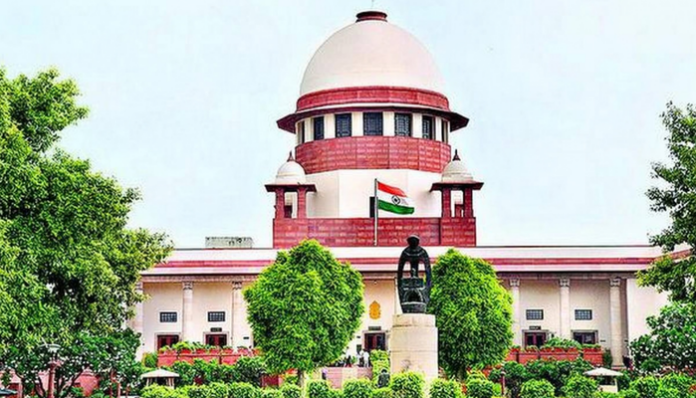
The Supreme Court on Monday (October 5, 2026) refused to pass an ex parte order of suspension against the Chief Election Commissioner (CEC) Gyanesh Kumar during the hearing of a petition that specifically sought the suspension of the CEC. A bench of Chief Justice of India Surya Kant, Justice Joymalya Bagchi, and Justice V Mohana turned down the petitioner’s request for the suspension of Kumar and refused to pass an interim order without hearing the respondents, including the CEC.
The Bench went on to issue notice to the Union of India, the Election Commission of India, CEC Gyanesh Kumar, Election Commissioners Dr Sukhbir Singh Sindhu, Dr Vivek Joshi, Dy Election Commissioner Maneesh Garg IAS, and DG(IT) Seema Khanna on the petition. The petition was filed by Advocate Rakesh Kumar through Senior Advocate Vikas Singh.
#WATCH | Delhi: Petitioner Advocate Rakesh Kumar says, "There were so many irregularities, and the entire country was in turmoil over this issue… Regarding this, we filed a petition; today, our lawyer, Vikas Singh, raised the matter and sought an interim order. He argued that the CEC should be suspended until the hearing concludes, noting that the other two Election Commissioners constitute a majority and could carry on the work, since two out of three is a majority. However, the Chief Justice stated that the court would issue notices and examine the matter. He directed that the relevant documents and electronic records be secured to prevent any tampering, and scheduled the hearing for next week to consider the issue further… Notices have been issued to the Union of India and the Chief Election Commissioner; in fact, all 7 respondents have been served notices, and the hearing is set for next week…"
— ANI (@ANI) October 5, 2026
During the hearing of the petition, Senior Advocate Vikas Singh tried to press the apex court to order the suspension of CEC Gyanesh Kumar, without first giving him the opportunity to be heard. Singh tried to hold the Supreme Court at ransom with the threat that the entire country would burn down if the court did not pass the interim order immediately.
“We are dealing with a grave situation which can undermine the very basis of our democracy. The elections were conducted with the ECI having some respect. But today we are having a situation where the CEC is acting in a manner which is completely contrary to the statutory framework,” the senior advocate claimed. “The Court has to pass some interim orders, otherwise the country will burn,” he said, threatening the Supreme Court.
“Some interim measures are needed as every citizen was now feeling unsafe about their voting rights,” Singh asserted. The senior advocate threatened the top court of the country, attempting to pressure it into passing an order bypassing the procedure.
Singh alleged that the electoral roll prepared after the SIR was vitiated as certain decisions regarding the electoral roll were taken by the CEC unilaterally. However, the Supreme Court refused to give in to the pressure tactics and questioned Singh as to how it could reach the conclusion that all decisions were taken unilaterally without first hearing the CEC.
“If records show some decision was not unanimous, etc., we will injunct those decisions and say they are ultra vires. Can we ex parte come to the decision that all decisions were unilateral? We expect them to respond in a clear, transparent manner,” Justice Bagchi said. CJI Surya Kant told Singh that it cannot pass an order solely based on newspaper reports.
A bunch of petitions have been filed before the Supreme Court alleging that several decisions were taken by CEC Kumar unanimously, despite the other two election commissioners raising at least 14 objections between October 2025 and August 2026.
The petitions have been filed amid the growing chaos manufactured by the Opposition alleging irregularities in the SIR exercise undertaken by the Election Commission. While the Opposition parties have been organising demonstrations to mount pressure on the government and the CEC, some of the anti-government elements have been trying to use the judiciary to get their whimsical demands met. The threat to burn down the country shows how certain people opposed to the government have been desperately trying to pressure the courts to pass favourable orders, which can be used to corner the government.
Ever since the Election Commission made an announcement to undertake a Special Intensive Revision (SIR) exercise across several states, the opposition parties have been casting aspersions on the process. They vehemently opposed the exercise using countrywide protests and petitions before courts. The SIR exercise is intended to update the electoral rolls and eliminate bogus and invalid voters from the voter list. The SIR process led to a large number of ineligible voters, including illegal immigrants, being deleted from the electoral roll, which hurt the voter base of certain opposition parties.
Some of the opposition politicians and so-called civil rights activists even tried to halt the SIR process by challenging it before the Supreme Court. However, the apex court refused to stop the exercise, holding that it was a routine electoral exercise which the Election Commission was constitutionally empowered to undertake.


