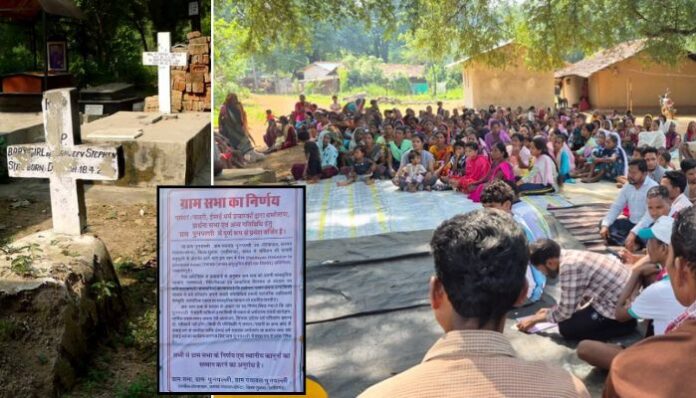
A controversy has erupted in Chhattisgarh’s Sukma district after a tribal village denied the use of its traditional Hindu cremation ground for Christian funeral rituals. What began as a dispute over whether Christians could bury their dead at a community cremation ground has now escalated into accusations from Christian groups against the Hindu tribal residents who opposed the practice.
The controversy centres on Punpalli village, where the Gram Sabha has passed resolutions restricting religious activities and refusing to provide village land for the burial of tribal residents who have converted to Christianity. Christian representatives have objected to the move and accused the villagers of discrimination, while the Gram Sabha has defended its decision as an effort to protect traditional customs, community spaces and tribal identity.
At the heart of the dispute is a deceptively simple question: does the right to practise Christianity also give a converted resident the right to conduct Christian funeral rituals at a cremation ground traditionally used by Hindu tribals? For the villagers, the answer is no, and they argue that allowing such practices could turn a sacred community space into another flashpoint of religious conflict.
The villagers are drawing a line. Christian groups call it discrimination
Punpalli has around 2,000 residents, including 21 Christian families comprising approximately 75 people.
The Gram Sabha passed 12 resolutions on October 2. One of them states that the village will not provide land for the burial of tribal people who follow Christianity.
Christian representatives have highlighted the distances involved, pointing out that families may have to travel more than 13 kilometres to Dhornapal or over 40 kilometres to Sukma to bury their dead.
But the argument being advanced by the villagers is not that Christians cannot conduct their funeral rites.
It is that they cannot simply claim a traditional Hindu tribal cremation ground as a venue for Christian rituals.
There is a distinction that Christian groups appear unwilling to acknowledge.
Religious freedom guarantees an individual the right to practise their faith. It does not automatically confer a right to take over every community institution historically associated with another faith and use it for one’s own religious rituals.
What happens when conversion changes the community’s traditional spaces?
This is where the larger issue of religious conversion enters the picture.
The Punpalli Gram Sabha has explicitly cited concerns about preserving tribal culture, traditions and social heritage. It has also raised concerns about religious conversion through inducement, pressure or other means.
Across India’s tribal regions, Christian missionary groups have used differing tactics to lure locals into converting to Christianity. Material assistance, inducements or promises of healing are among methods employed by Christian missionaries to wean locals away from their birth faith and bring them into the fold of Christianity.
But the underlying concern expressed by the villagers is clear.
If conversion changes an individual’s religion, should it also automatically change the character and ownership of the community’s traditional religious spaces?
The villagers’ answer is no.
They want their traditional Hindu tribal institutions to remain protected even when some members of the community choose to adopt another faith.
The cremation ground is not just another piece of land
This is perhaps the most important point being lost in the noise over the Punpalli resolution.
A traditional cremation ground is not merely an empty plot where anyone can conduct any religious ceremony.
For the tribal Hindu community that has traditionally used it, the site is connected to generations of funeral rites, ancestors, customs and religious practices.
Allowing Christian funeral ceremonies at such a site can therefore be seen by local residents as more than an administrative arrangement. It can alter the religious character of a community space.
And villagers have a legitimate reason to worry about what happens next.
If Christian families are permitted to conduct Christian burial or funeral rituals at a Hindu tribal cremation ground, every subsequent dispute could become a fresh flashpoint: over access, rituals, control of the land and the right to determine how the space is used.
The Punpalli Gram Sabha appears to be trying to prevent precisely that situation before it becomes entrenched.
The Subhash Baghel case is now being invoked
The controversy has been linked to the Supreme Court proceedings concerning Christian pastor Subhash Baghel, who died in January 2025.
His son, Ramesh Baghel, wanted to conduct his father’s final rites according to Christian customs at the traditional cremation ground in their native village.
The local tribal Hindu community objected and asked the family to use a Christian cremation facility around 20 kilometres away. Police officials also suggested the alternative location to prevent a law-and-order situation.
The dispute eventually reached the Supreme Court.
The bench differed on the appropriate location for the funeral. Justice B V Nagarathna permitted burial on private agricultural land, while Justice S C Sharma favoured a common Christian burial ground serving several villages.
The funeral was eventually conducted at Karkapal under heavy security.
The case subsequently became a significant reference point in disputes involving Christian burials in Bastar.
Christian groups now accuse the ‘right wing’
Christian representatives have claimed that “right-wing activists” are visiting tribal villages and encouraging Gram Sabhas to restrict Christian burials.
Nukesh Baghel, vice president of the Bastar District Rural Christian Service Committee, claimed that Punpalli was at least the 10th village in the region to adopt such a measure.
But the “right-wing conspiracy” narrative does not answer the basic question being raised by the villagers.
Why should a Hindu tribal community be compelled to permit Christian religious rituals at a cremation ground it has traditionally used?
The villagers’ position is not necessarily about preventing Christians from having burial grounds. It is about preventing a traditional Hindu community space from being repurposed for another religion without the community’s consent.
That distinction matters.
PESA invoked to protect tribal customs
The Gram Sabha has invoked the Panchayats (Extension to Scheduled Areas) Act, 1996, or PESA, in support of its resolutions.
Punpalli falls under the Fifth Schedule framework, which recognises the distinctive character of Scheduled Areas and provides Gram Sabhas an important role in protecting community traditions and practices.
Madkam Bhima, a Janpat member elected from Punpalli, defended the resolution and said the village was acting under PESA.
The villagers’ argument is essentially this: if Gram Sabhas cannot protect their traditional customs and community institutions from being altered without their consent, what meaning does tribal self-governance actually have?
That question deserves to be answered instead of dismissing every such village resolution as the handiwork of “right-wing” forces.
The real flashpoint may be what happens next
The immediate dispute concerns burials. But the villagers are looking at the larger trajectory.
Today, the demand may be for permission to conduct Christian funeral rituals at a traditional Hindu cremation ground. Tomorrow, disputes could arise over who controls the space, which rituals are permitted, whether Christian symbols can be installed, or whether the community can continue enforcing its traditional practices.
Once such competing claims become institutionalised, a site meant for the peaceful final rites of the dead can quickly become a site of confrontation between Hindu tribals and converted Christians.
The Punpalli Gram Sabha’s resolution can therefore be viewed as an attempt to draw a boundary before the dispute reaches that stage.
Religious freedom does not mean appropriation of community institutions
There is nothing inherently contradictory about defending religious freedom while also defending the right of a traditional community to preserve its religious spaces.
A tribal resident who becomes Christian should be free to practise Christianity and perform Christian funeral rites.
But that does not automatically settle the separate question of which land those rites should take place on.
If a separate Christian burial or cremation facility is available, or can be established, the issue can be resolved without forcing two competing religious claims onto the same traditional community space.
That is precisely the distinction the current debate risks losing.
The Christian groups’ allegations of persecution and their invocation of the Supreme Court case may generate headlines, but they do not erase the villagers’ concerns about conversion, tribal identity, community ownership and preservation of traditional Hindu spaces.
Punpalli’s Gram Sabha has drawn a line.
The larger question now is whether India’s commitment to religious freedom also includes the right of tribal Hindu communities to say: our traditional religious spaces cannot simply be claimed by another faith in the name of religious freedom.