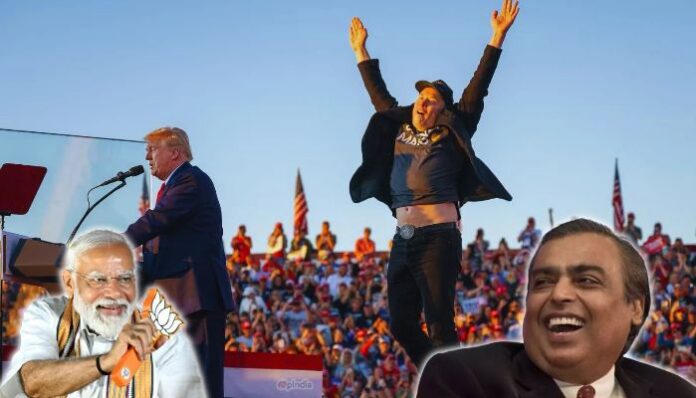
Months after rattling the Trump administration officials launching rhetorical attacks on India over Russian oil purchases, and pushing back against China’s online anti-India racism, India’s online ‘1.5 GB Battalion’ has now taken American billionaire and SpaceX CEO Elon Musk to the cleaners over the Starlink regulatory impasse. After the initial ‘oligarchs’ attack, Elon Musk descended into behaving like an anti-BJP troll and targeted businessman Mukesh Ambani. Musk’s own political spending and cooperation with US government agencies suggest that, if we go by his logic, he should be called America’s de facto ruler, ‘President Musk’.
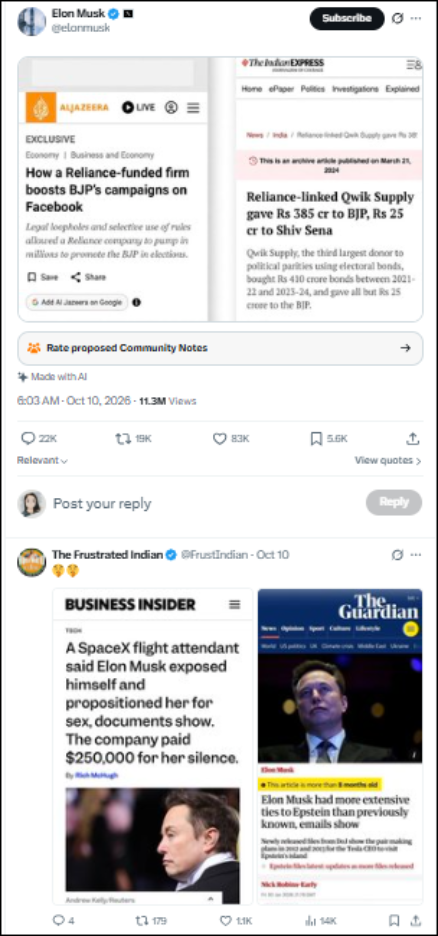
On 10th October, Elon Musk shared screenshots of media reports alleging a close nexus between Reliance and the ruling party. He shared a 2022 Al Jazeera report titled “How a Reliance-funded firm boosts BJP’s campaigns on Facebook” alongside an archived 2024 Indian Express article about Qwik Supply Chain Private Limited. Sharing these articles was part of Musk’s attempt to portray Indian telecom regulations as an insider’s game rigged to protect domestic giants.
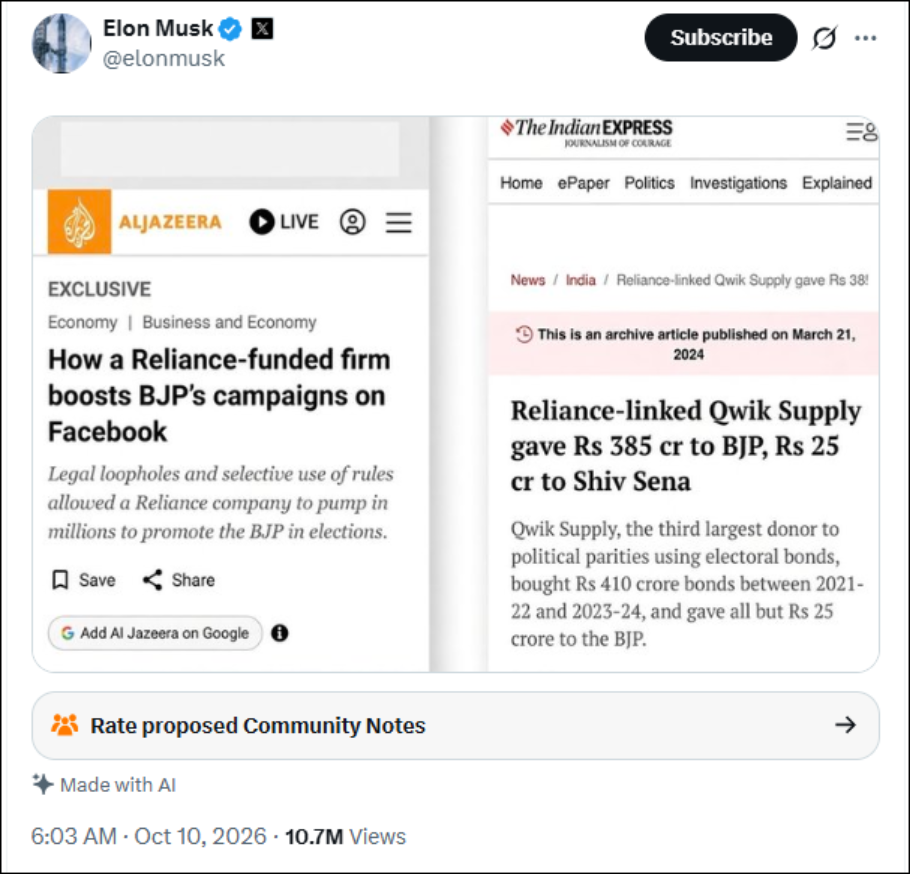
Before this, Musk had taken a direct jab at Mukesh Ambani, calling him the “Prime Minister Ambani” and “real boss of India” and issued a sarcastic ‘apology’.
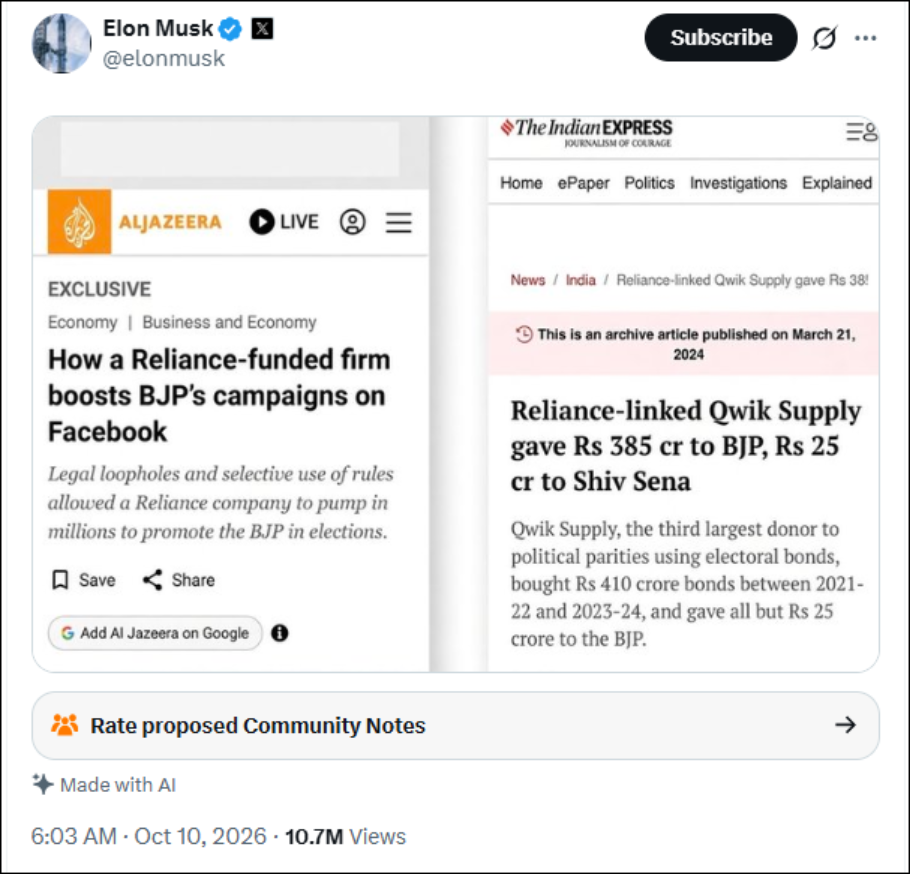
Elon Musk suggests Ambani is the ‘real boss’ since an entity linked to him made donations to the BJP; by that logic, isn’t the Trump loyalist America’s ‘President Musk’?
While Elon Musk highlighted old news reports on an Ambani-linked entity giving funds to the BJP to suggest that Mukesh Ambani is the de facto Prime Minister of India, his own political spending indicates that he is the de facto President of the United States.
In the 2024 US presidential election cycle, Elon Musk was the largest individual political donor. Federal Election Commission (FEC) filings show that Musk spent over $288–290 million, primarily through his super PAC, America PAC and related groups to support Donald Trump and other Republicans.
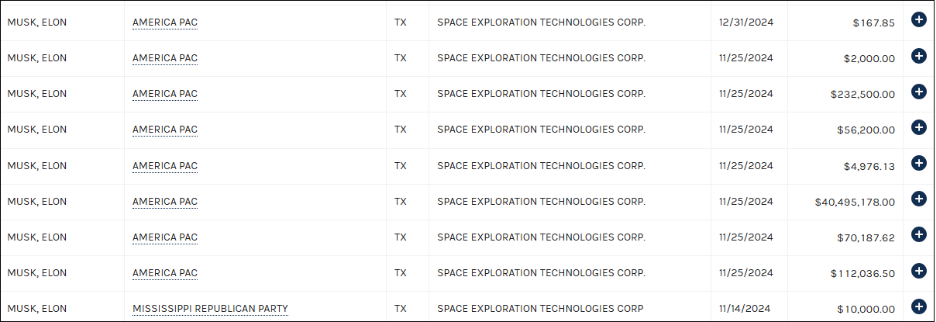
Elon Musk has donated millions of dollars to back various Republican Party candidates. The reported amounts far exceed typical donor levels and include get-out-the-vote efforts plus later lottery-style incentives.
In fact, the FEC filings show that despite his brief public fallout with President Trump last year, Elon Musk continued substantial donations to Trump-aligned GOP super PACs.
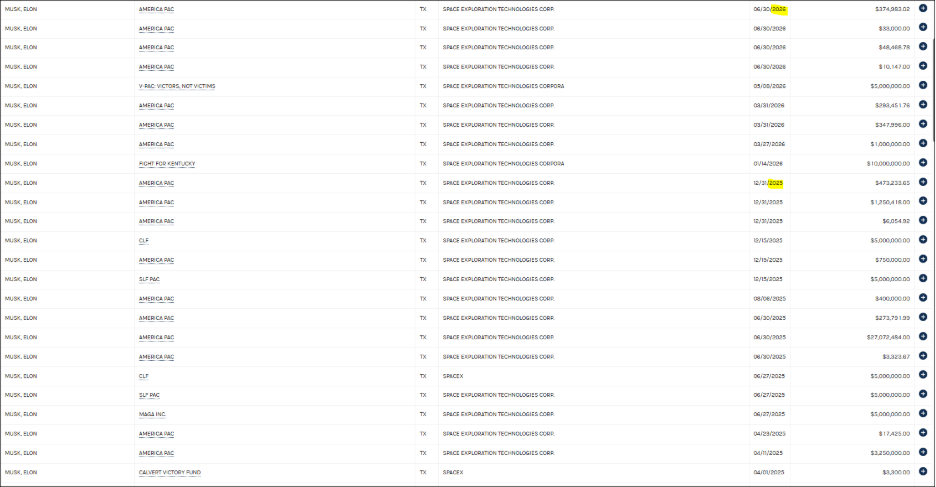
Besides whopping donations, the camaraderie between America’s ruling dispensation and Elon Musk extends to non-political investments as well.
Policy decisions being manipulated so Elon Musk could benefit
President Trump’s financial disclosures indicate that his accounts purchased SpaceX stock, up to $50,000 range post-IPO, and, on 18th August 2026, between $1 million and $5 million in SpaceX senior unsecured notes, 5.35% due 2031.
Just two days later, President Donald Trump signed a national space transportation policy aimed at over 1,000 annual US launches or reentries by 2030. With this, Trump expanded the US space transportation policy to commercial access and infrastructure, essentially the areas wherein SpaceX is dominant.
More recently, Donald Trump awarded Elon Musk the National Medal of Science for engineering achievements in space exploration, intelligent systems, communications, and manufacturing, on 8th October.
Musk’s SpaceX holds billions in NASA and defence contracts. In addition, Musk enjoys a strong backing from the Trump administration.
Moreover, the Trump administration has also been accused of trading away public lands for corporate benefits, particularly by selling off public lands to well-connected corporate interests.
In fact, it was only after a bipartisan outrage that compelled President Trump’s congressional allies to remove public land sell-off provisions from the final version of the One Big Beautiful Bill Act in 2025. However, low-profile land swaps have emerged as a loophole to keep the game going.
In June 2026, the Trump government approved a land exchange with Elon Musk’s SpaceX, which provides 715 acres of the Lower Rio Grande Valley National Wildlife Refuge for expansion of the company’s rocket production and launch facilities in Starbase, Texas. In exchange, the US Fish and Wildlife Service received only 683 acres of formerly SpaceX-owned land, a portion of which will expand the Laguna Atascosa National Wildlife Refuge. This land exchange was unrealistically expedited, as revealed in the internal government email.
Elon Musk’s Starshield building spy satellites network for US National Reconnaissance Office
In 2024, Reuters reported that Starshield, the military and intelligence arm of Starlink run by SpaceX, was producing a massive network of spy satellites for the US National Reconnaissance Office (NRO). This program is being undertaken as per a classified contract signed in 2021 worth $1.8 billion.
Moreover, SpaceX has also secured contracts to build satellites that track ballistic and hypersonic missiles.
Despite closely working with a national-security regime in his country by holding classified contracts, secrecy requirements, and government control, Musk does not label NRO an ‘oligarchy’.
However, when Indians say that they want that traffic from Indian users to be monitorable and controllable within India, and that the state be able to suspend Starlink service in case of national emergency, Musk cries ‘monopolistic chokehold’, ‘Prime Minister Ambani’, and resorts to behaving like a petty political troll.
Musk either fails to comprehend what the real concern Indian netizens are raising or is deliberately dodging the question by making the issue about the impact on Ambani’s profits if Starlink enters the Indian market.
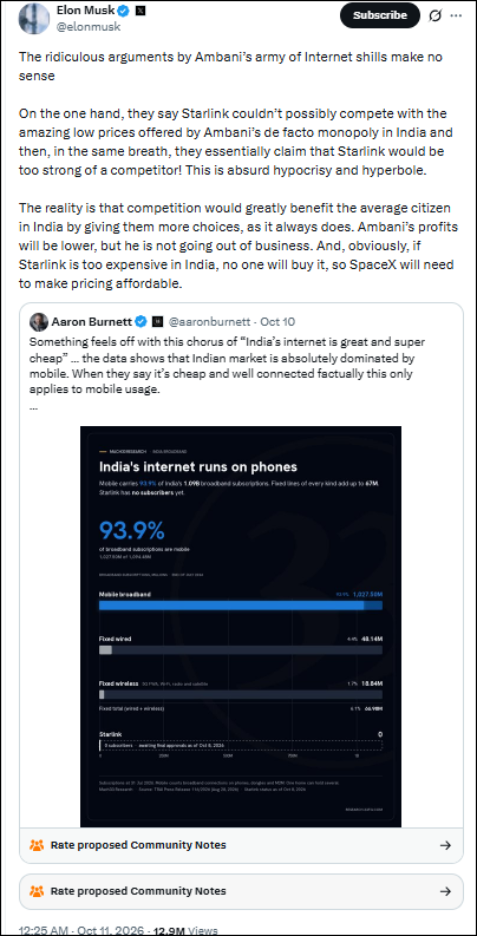
Starlink approval is not an oligarch or monopolistic chokehold issue; it’s a national security question
While Starlink facing regulatory scrutiny in India has caused unease for Elon Musk, New Delhi’s national security concerns are rooted in the country’s past experiences.
In 2008, the 26/11 Mumbai terror attacks resulted in the brutal killing of over 200 innocent civilians by Pakistani Islamic terrorists. What ensured uninterrupted communication between the Jihadis and their handlers, who were issuing real-time instructions while sitting in Pakistan, was a satellite phone manufactured by a UAE-based manufacturer, Thuraya Telecommunications Company. These satellite phones totally bypassed the Indian surveillance system.
India’s geographical location is such that the country is surrounded by problematic neighbours, an outright cross-border Islamic terror sponsor Pakistan, Bangladesh, which is undergoing rapid Islamisation and tilting against India, and China, a rival that lays claim over India’s northeastern state of Arunachal Pradesh.
Separatists, infiltrators, and homegrown terrorists alike would easily have their hands on Starlink internet units, making it an extra burden on India’s national security architecture. This is particularly problematic because, unlike conventional telecom in India, which involves equipment manufactured by Indian companies and operates strictly under Indian laws, Starlink remove the centre of control from India, essentially making it beyond the range of interception by Indian security agencies.
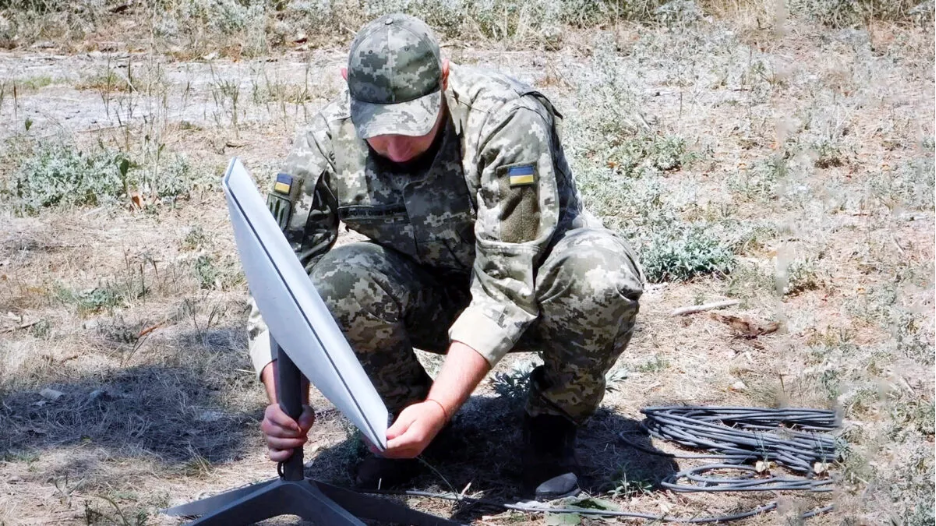
Not to forget, Indian security forces in Manipur recovered Starlink satellite equipment from Kuki terrorist groups, raising alarm bells over how advanced communication systems are being smuggled across borders into sensitive conflict zones.
In Myanmar, signal intelligence reports revealed that transnational crime syndicates rely heavily on Starlink systems to run massive online scamming hubs targeting victims worldwide. Security forces raiding a Chinese-run scam centre in Myanmar seized 30 Starlink satellite units that provided high-speed connectivity for international fraud operations.
In Africa, Islamic terror groups, including Jama’at Nasr al-Islam wal-Muslimin (JNIM), Boko Haram, and the Islamic State West Africa Province (ISWAP), actively smuggle portable Starlink terminals across the borders of Nigeria and Libya into the Sahel region. By deploying these satellite kits across Mali, Niger, and Burkina Faso, terrorist organisations circumvent traditional telecom blackouts and enhance their command-and-control capabilities.
In South America, Brazilian authorities found Starlink terminals installed at illegal gold mining sites deep within remote Amazonian rainforests, where wildcat miners used the internet connection to evade police raids and organise logistics.
In fact, it was seen in January this year how SpaceX activated its satellite internet, Starlink, in Iran to help protesters bypass the internet ban imposed by the Mullah regime.
As Elon Musk’s SpaceX enabled Starlink in Iran for free on 9th January, protesters with smuggled Starlink terminals bypassed government-imposed restrictions and gained access to an uncensored internet. It must be recalled that Starlink has been a major workaround in the 2022 Mahsa Amini and the 2019 anti-government demonstrations in Iran. Tens of thousands of Starlink terminals were smuggled into Iran, as there is a ban on owning the device or using SpaceX’s satellite internet.
It was estimated that there were around 40,000 to 50,000 Starlink subscribers in Iran.
All this when the Iranian authorities had not officially approved Starlink in the country. This episode perfectly exemplifies how Starlink, in times of crisis or political instability in a country, can be weaponised as a tool stoking unrest in a country or facilitating regime change.
Elon Musk has been quite a vocal critic or ardent supporter of political leaders and heads of state across the world.
Currently, Musk is using his social media platform X for political messaging about Ukrainian President Volodymyr Zelenskyy and even calling for his ouster from power ahead of elections.
Not to forget, Starlink became essential for civilian and military use in Ukraine after the war with Russia broke out. Now that Trump has struck a diesel deal with Russia, it is likely that Zelenskyy is going to get dumped by the US and painted as the reason behind the delays in the end of the war.
With Musk, Trump’s billionaire lapdog, echoing his boss on Zelenskyy, Ukraine fears a Starlink outage.
The 1.5 GB Battalion in action
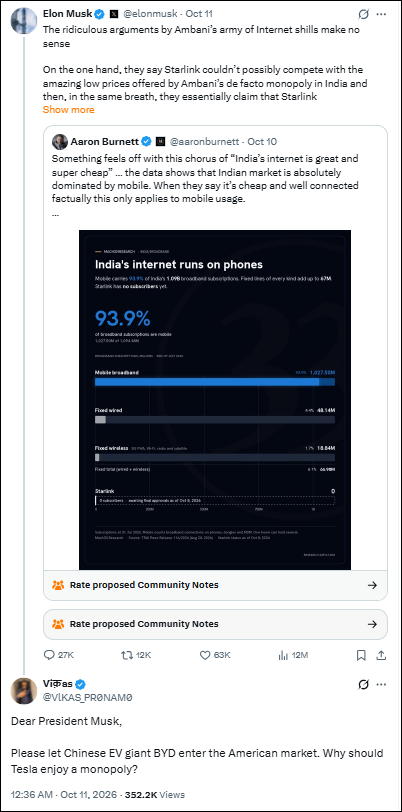
There is a famous X post which says, “Never attack Russia in winter. Never attack India by Twitter”. The Indian netizens, ironically, powered by the Ambani-owned Jio’s 1.5 GB data per day, are trolling Elon Musk with memes, facts, questions, and sarcasm. The bigger irony? This whole episode has been ongoing on the social media platform Musk owns.
In response to Musk’s ‘Ambani monopoly’ rhetoric, one Indian X user asked, “Dear President Musk, Please let Chinese EV giant BYD enter the American market. Why should Tesla enjoy a monopoly?”
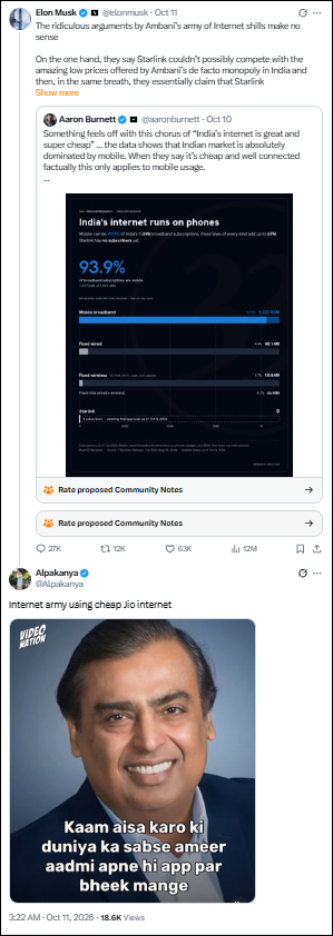
Another one posted a meme which says, “Do such a work that even the world’s richest man is reduced to a beggar on his own app”
Another X user highlighted news reports about Elon Musk’s connections with convicted sex offender Jeffrey Epstein.
Beyond memes, India’s security concerns about Starlink are real. Elon Musk and SpaceX should focus on compliance with Indian laws and addressing the concerns the Modi government is raising instead of whining about supposed ‘cronyism’, ‘monopolistic chokehold’, and weaponising X as a pressure campaign tool.