


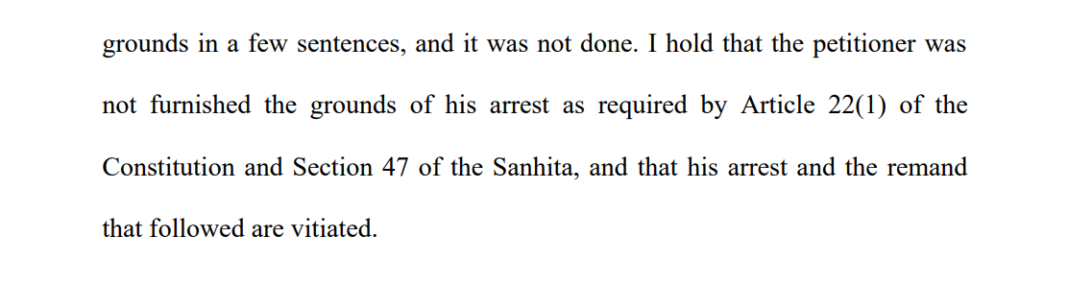
The Madras High Court recently pulled up the Tamil Nadu Police for arresting a man named Ankur Kumar Jain without furnishing written grounds of arrest. The court held that the arrest was vitiated and violated Article 22(1) of the Constitution and Section 47 of the BNSS. “I hold that the petitioner was not furnished the grounds of his arrest as required by Article 22(1) of the Constitution and Section 47 of the Sanhita, and that his arrest and the remand that followed are vitiated,” the court said, granting bail to the petitioner.
Being “North Indian” not a ground for arrest
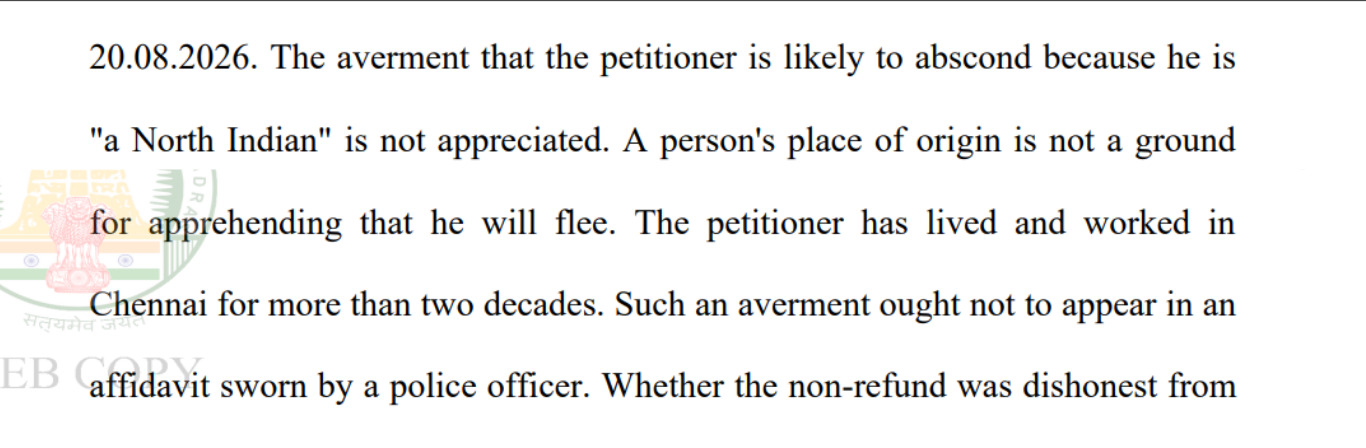
A Single Bench of Justice N. Ramesh also came down heavily on the police for opposing his regular bail petition, citing that he was a “North Indian” and therefore was likely to abscond. The Court reprimanded the police, stating that a person’s place of origin is not a ground for arrest, pointing out that the petitioner had lived and worked in the state for over two decades. “The petitioner has lived and worked in Chennai for more than two decades. Such an averment ought not to appear in an affidavit sworn by a police officer,” the High Court asserted in its order dated October 7, 2026.
Legal lapse by arresting officer will attract departmental proceedings
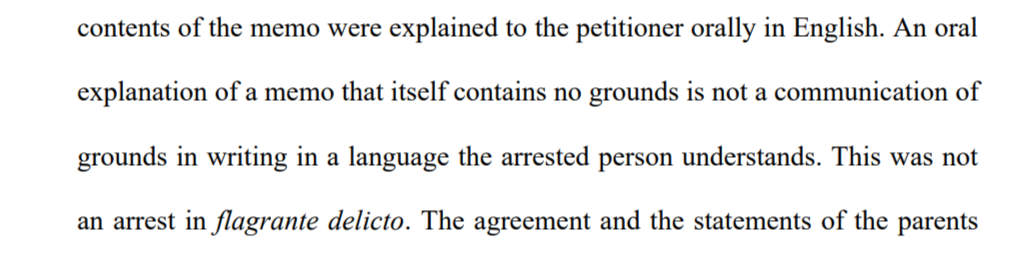
The arrest memo served by the police on the petitioner only stated the offence committed under Section 420 IPC but did not explain the acts alleged against him and the grounds of his arrest. The police only read out the contents of the memo to him in English. “An oral explanation of a memo that itself contains no grounds is not a communication of grounds in writing in a language the arrested person understands. This was not an arrest in flagrante delicto,” the court observed.
Expressing concern over the lack of legal compliance by the police, the High Court said that such lapses by the police lead to the accused getting released even in serious offences. The court emphasised that police officers need to be sensitised, trained and educated. “Either way, the police need to be sensitised, trained and educated on this point, and the officer who commits the lapse must answer for it,” the court said.
The High Court ruled that such failure to furnish written grounds of arrest by the arresting officer will be treated as a dereliction of duty, and he will be liable to departmental proceedings.
Background of the case
The case relates to an arrangement made between FIITJEE Limited and Suguna PIP School, Coimbatore, to conduct integrated coaching for students preparing for the JEE and NEET entrance examinations. Parents of students willing to enrol in the classes were required to pay a refundable caution deposit of ₹1 lakh. The amount was to be refunded within 60 days of the course’s completion.
However, the failure to refund the said amount led to the filing of a complaint against FIITJEE Limited and Suguna PIP School. An FIR was subsequently registered based on the complaint against concerned officials of FIITJEE Limited and Suguna PIP School. Notably, the petitioner, who was a salaried employee of FIITJEE Limited, was neither named in the complaint nor in the FIR. He was implicated on the basis of an agreement dated Feb 26, 2011, which he is said to have signed on behalf of FIITJEE with the school.
The petitioner’s counsel pointed out before the High Court that he had been a salaried employee of FIITJEE since 2000, and not a director or shareholder. He said that the money taken from the parents had been deposited into the company’s account and not paid to him personally.
The petitioner was arrested on July 15, 2026, in a separate case registered by the Economic Offences Wing in Chennai and lodged in Puzhal Central Prison. While he was in prison, he was formally arrested by the police in the present case on August 11, 2026. He was later produced before the Judicial Magistrate No. II, Coimbatore, and remanded to judicial custody and one day of police custody. The final report had not been filed when the High Court considered his bail application.
The High Court allowed Jain’s petition and ordered his release on regular bail, subject to certain conditions, including executing a bond of ₹50,000 with two sureties, each for the same amount.


