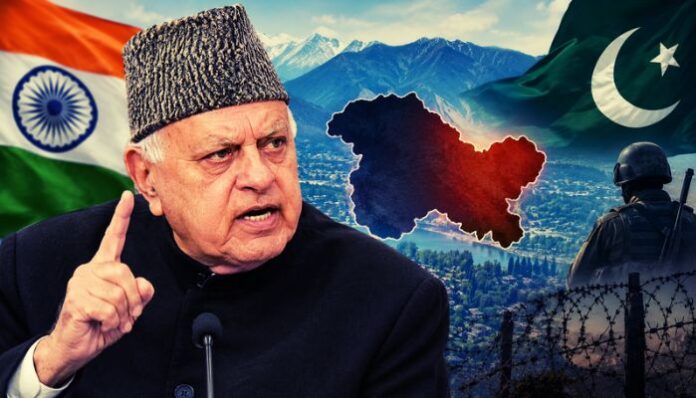
Farooq Abdullah, the former Chief Minister of Jammu and Kashmir, and National Conference supremo, Farooq Abdullah laid bare his traitorous intentions when claimed that it is Pakistan, which is keeping the supposed Kashmir issue alive, or else New Delhi’s plans are not good. Abdullah resorted to blatant fear-mongering and instigation, saying that Kashmiris should fight or be ready to perish into oblivion.
Contempt for the Indian government, approbation for Pakistan: Farooq Abdullah has lost the plot or is scribing a seditious one?
Addressing his party workers on 24th October, Farooq Abdullah said, “What hope will you (people of Jammu and Kashmir) have from them (Delhi)? Will you expect that they will do justice for you? Have the courage to fight, or you will be wiped out, and your identity will disappear. They are silent today because there is noise in the world, and our neighbour (Pakistan) is constantly behind this. Everywhere they say, ‘the decision regarding Kashmir has not been made. That is what is saving us. Otherwise, their intentions are not good.”
Baramulla, Jammu and Kashmir: National Conference President Farooq Abdullah says, "They are completely independent. When I saw those documents, what can you expect from Delhi? Do you expect them to deliver justice for you? Have the courage to fight, or you will be wiped out, and your identity will disappear. They are silent today because of the pressure from the world. Our neighbour is constantly after them. He goes everywhere saying that the Kashmir issue has not been resolved. He is protecting us; otherwise, their intentions are not good."
— IANS (@ians_india) October 24, 2026
To balance out his outrageous remarks, Abdullah affirmed that the people of Jammu and Kashmir “never said that we are not Indians”.
In the same breath, Farooq Abdullah conveyed dissatisfaction with the very BJP-led Central government that abrogated Article 370, over statehood restoration, and approval for Pakistan’s efforts are raking up the supposed Kashmir issue on international forums.
The former Jammu and Kashmir Chief Minister essentially resorted to instilling fear into the minds of Kashmiris and inciting them to ‘fight against Delhi’. His statement carried a threatening undertone: if Delhi doesn’t ‘listen’, Kashmiris are ready to fight with Islamabad by their side.
Pakistan’s efforts to internationalise Kashmir and pressure India are as futile as Farooq Abdullah’s whining against the Modi government
There is no doubt that not only Farooq Abdullah, but a significant section of Jammu and Kashmir’s political circles continues to harbour the chagrin of Article 370’s abrogation.
While terrorists never abandoned their violence pursuits against India, it is also true that there also is a section of people in the Union Territory, who still cling to the idea of separating Kashmir from India, when the ‘Nizam’ changes.
However, Pakistan has for decades been trying to keep the Kashmir issue on the international agenda across various forums, including the United Nations General Assembly, the Organisation of Islamic Cooperation (OIC) and lobbying manoeuvres that yield no substantial results.
A Pakistani PM raking up the Kashmir ‘plebiscite’ issue in the UN General Assembly, farcical OIC resolutions, and the ‘Kashmir is our jugular vein’ rhetoric of Pakistan’s Madarsa-bred de facto ruler, Field Marshal Asim Munir, have produced little beyond ritualistic statements.
In the UN, Indian diplomats regularly counter Pakistan’s ‘Kashmir under siege’ cries and propaganda with facts on Kashmir’s progress and development.
After the August 2019 abrogation of Article 370, Pakistan’s attempts to force UNSC action or any international pressure on India have failed.
Most countries in the world treat the issue as bilateral.
Although the OIC regularly makes references to Kashmir, given that Saudi Arabia, Azerbaijan and Turkey are its important members, with both having good relations with Islamabad, and Turkish President Recep Erdogan ritualistically reiterates his “Kashmir self-determination” rhetoric in UNGA speeches, India, however, has repeatedly rejected any such references as interference in internal affairs and without locus standi.
Besides, even though the Mecca Defence Pact might force Saudi Arabia to lean towards Pakistan further, even Riyadh would not want to antagonise India, countries like the United Arab Emirates (UAE) do not allow Saudi Arabia and Turkey dictate its foreign policy in the name of the Islamic Ummah, particularly when it comes to relations with India.
In fact, India and the UAE are building formidable ties, with the India–Middle East–Europe Economic Corridor in central focus.
Simply put, while the OIC may, in its resolutions, rake up Kashmir performatively to keep Pakistan content, each of the member countries wants good, rather, strong relations with India bilaterally.
Pakistan often cries hoarse about India ‘arbitrarily’ abrogating Article 370, and cites UN Security Council resolutions on Kashmir, particularly Resolution 47 of 1948 and the UNCIP resolutions of 13th August 1948 and 5th January 1949 to push for a plebiscite and internationalise the Kashmir issue. However, those very resolutions required Pakistan first to withdraw its troops, proxy tribesmen, and others who entered to fight, only after which Indian military presence would be reduced.
Since Pakistan never fully complied with the precondition and maintained its forces and administration in Pakistan-occupied Kashmir, a status quo prevailed for decades. Given that the Instrument of Accession signed by Maharaja Hari Singh in 1948 acceded all of Jammu and Kashmir to the Indian Union, Pakistan has no legal claim to Kashmir, let alone having locus standi to advocate a plebiscite or right to self-determination.
If Pakistan truly cared about Kashmiris on the Indian side, it would have stopped sponsoring cross-border terrorism in Jammu and Kashmir. However, Islamabad continues to harbour this delusion that continuing proxy jihad and destabilising Kashmir will help it sustain its claim.
However, of the much-highlighted ‘Kashmir issue ‘, the only issue that remains unresolved is Pakistan’s departure from PoK and its integration into India.
Farooq Abdullah praising Pakistan for somehow keeping the Kashmir issue ‘alive’ is a massive self-goal. Abdullah wants the Modi government to restore statehood for Jammu and Kashmir. However, his pro-Pakistan rhetoric only contributes to exacerbating the delay.
Indian Kashmir is a ‘jugular vein’; PoK is ground for persecuting Kashmiris: The Ummah rhetoric and hypocrisy of Pakistan
Besides the UNSC resolutions, Pakistan’s [illegal] claim to Kashmir also rests on the claim that Raja Hari Singh was a Hindu while the majority of Kashmiris were Muslims, and that Singh did not take the wishes of Kashmiri Muslims, especially those from the dominant Valley, while acceding J&K to India.
However, Pakistan’s inhumane treatment of Kashmiris, who are largely Muslims, exposes its hypocrisy and hollowness of the ‘Ummah unity’ and ‘Tera Mera rishta kya, la ilaha ill Allah’ rhetoric.
While Pakistani leaders, including Army Chief Asim Munir and puppet Prime Minister Shehbaz Sharif, routinely call Indian Kashmir Pakistan’s “jugular vein” and claim solidarity with Kashmiris, it continues to deprive Kashmiris in PoK of even basic rights, development and dignity.
The ongoing suppression of dissent in PoK demonstrates how the ‘Islamic Republic’ of Pakistan, the self-declared Riyasat-e-Medina, has no qualms about brutalising and killing Kashmiri Muslims in territories under its occupation merely for demanding basic rights and dignity.
The Pakistan-occupied Jammu and Kashmir (PoJK) has been on a boil ever since the local people rose in protests against the oppressive Pakistan Army-controlled regime in June 2026.
The protests began after the Pakistani authorities banned the Joint Awami Action Committee (JAAC) under the Anti-Terrorism Act 2014, declaring it a proscribed organisation, citing threats to peace and security. Soon after, internet and mobile services were also suspended in parts of the region.
The unrest in PoJK began with a dispute over 12 assembly seats in the 45-seat PoK Legislative Assembly, which are reserved for refugees from Indian Jammu and Kashmir. Local groups allege that Islamabad uses these seats to influence elections and install governments of its choice, essentially diluting local representation.
On 7th June, the PoK ‘Supreme Court’ ruled that the 12 seats are ‘constitutionally protected’ and cannot be abolished without a constitutional amendment. Since the Pakistani regime uses these 12 reserved seats for installing its puppets in the PoK Assembly to retain strong control over the region, they are reluctant to accept the JKAAC’s demand.
It is ironic that Pakistan calls PoK ‘Azad Kashmir’ while stripping PoK residents of fair electoral rights.
So much for the love and solidarity with Kashmiris on both sides that, after guns failed to silence the people of PoK, Islamabad resorted to blocking the region’s food, fuel, and healthcare supplies. Pakistani forces have killed more than 80 PoK residents so far, including Usman Nazir, the brother of Jammu and Kashmir Joint Awami Action Committee (JAAC) leader Sardar Umar Nazir.
In late July 2026, Pakistan’s Defence Minister Khawaja Asif branded protesters in Pakistan-occupied Kashmir as “enemies like India” while defending Islamabad’s violent crackdown.
In fact, Asif had called the residents of PoK’s Rawalakot and Mirpur “not proper Kashmiris” just because they demand basic rights and dignity.
There is nothing ‘Azad’ about the Pakistan-occupied Kashmir. Pakistani occupying authorities maintain strict control not only over the Kashmiri people and institutions but also over the narrative about the occupied territory.
All this while, Pakistan claims that it wants to ‘liberate’ Indian Kashmiris, who enjoy freedoms unimaginable for PoK Kashmiris.
While on the Indian side of Kashmir post-Article 370 abrogation, free and fair assembly elections have been held, tourism has boomed, infrastructure development and economic activity are witnessing an unprecedented surge; on the side under Pakistani occupation, even basic facilities and life with dignity are a luxury.
Clearly, Pakistan’s manoeuvres for “keeping the issue alive” regarding Indian Kashmir, while it continues to suppress the Kashmiri population in PoK, are all aimed at serving its own political ambitions and not any Ummah-driven solidarity.
Farooq Abdullah and his ‘Mere Pakistan-Ummah aayenge’ dream is a recurring one
NC leader Farooq Abdullah has a track record of making statements that are useful for Pakistan to sharpen its rhetorical attacks on India.
In August 2026, Abdullah questioned why terrorist attacks seem to occur whenever the demand for restoring Jammu and Kashmir’s statehood gathers momentum. The remarks came in the wake of the Kulgam terror attack, where terrorists killed two migrant labourers from Chhattisgarh.
Farooq Abdullah alluded that terror attacks are orchestrated whenever there are talks demanding restoration of Jammu and Kashmir’s statehood.
Abdullah’s controversial remarks came even as he knew that restoring statehood immediately after terrorist attacks would risk creating the perception that violence can influence constitutional outcomes, handing Pakistan-backed terror groups exactly the psychological win they seek.
In September 2024, Farooq Abdullah reiterated his party’s stand, saying that the alliance would try to restore the special status if voted to power.
“How many years BJP took to abrogate it (Article 370)? By God willing, we will also restore it. It (Article 370) is the heartbeat of the people of Jammu and Kashmir. Article 370 and 35 A will be restored,” Abdullah said.
Soon after, speaking on Geo News to senior journalist Hamid Mir, the Pakistan Defence Minister was asked whether Pakistan and the National Conference-Congress alliance are on the same page on the restoration of Article 370 and 35A in Jammu and Kashmir.
Khwaja Asif replied, “Absolutely. Even our demand is also the same…”
Asif had even expressed hope that Article 370 could return should the NC-Congress alliance come to power in JK.
“I think it is possible. Currently, the National Conference and Congress have very great importance over there. The population of the valley has been motivated a lot on this issue, and I believe there is a chance that the Conference (National Conference) will come to power. They have made this an election issue that the status of Jammu and Kashmir should be restored,” the Pakistani defence minister said back then.
Months before, in May 2024, Farooq Abdullah spoke like a Pakistan loyalist and said that “Pakistan is not wearing bangles” and “has atom bombs”.
“If the defence minister is saying it, then go ahead. Who are we to stop? But remember, they (Pakistan) are also not wearing bangles. It has atom bombs, and unfortunately, that atom bomb will fall on us,” Farooq Abdullah said during a media interaction on 5th May 2024.
#WATCH | Srinagar, J&K: On Defence Minister Rajnath Singh’s statement that ‘PoK will be merged with India’, JKNC Chief Farooq Abdullah says, "If the defence minister is saying it then go ahead. Who are we to stop. But remember, they (Pakistan) are also not wearing bangles. It has atom bombs, and unfortunately, that atom bomb will fall on us."
— ANI (@ANI) May 5, 2024
The Gupkar gang member’s statement came after Union Defence Minister Rajnath Singh, in an interview, said that India will continue to assert its legitimate claim on PoK; however, he emphasised that India will not have to use force and the occupied region will eventually choose to merge with India, seeing unprecedented development in Jammu and Kashmir and return of peace in the region.
Abdullah has batted for Pakistan. Abdullah has time and again emphasised that the Modi government should resume ‘talks’ with Pakistan to resolve disputes and ensure peace in J&K.
In December 2023, Abdullah claimed that Kashmir would become Gaza if the Indian government didn’t resume talks with Pakistan, even as the Modi government maintained that it will not hold any talks with Pakistan unless the country stops cross-border terrorism against India.
“If we do not find a solution through dialogue, we will meet the same fate as Gaza and Palestine, which are being bombed by Israel,” Farooq Abdullah said.
Interestingly, Abdullah had once batted even for China, saying that Kashmiris would prefer to be ruled by China rather than India, adding that the people of Kashmir “do not feel or want to be Indian”.
With his ‘Pakistan is keeping the Kashmir issue alive and that is saving us [Kashmiris]’, remarks, while maintaining absolute silence of Pakistan’s persecution of PoK residents, Farooq Abdullah may have toned down his anti-India rhetoric, his itch to bat for Pakistan has not subsided yet.
The statements coming from top Kashmiri politicians approbating Pakistan indicate it may still not be the right time to restore Jammu and Kashmir’s statehood, and that restoration under any political pressure might reignite the dormant flame of separatism.