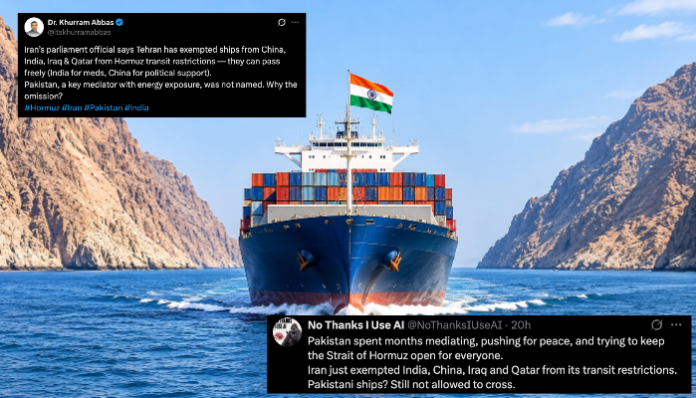
Indian vessels are excluded from restrictions on passage through the Strait of Hormuz. Amir Hayat Moqaddam, the deputy head of the National Security and Foreign Policy Committee of the Iranian parliament, shared the information in an interview with the Iranian Students News Agency on 3rd November (Tuesday).
He revealed, “We have currently exempted India, China, Iraq and Qatar from transit restrictions in the Strait of Hormuz. Ships from these countries pass freely, and the Americans do not intercept them either.” The agreement with Beijing is intended to win its political support while Indian ships are permitted to secure medicines from the country.
However, their ships are required to pay a fee for conveyance through the area. “We are doing business,” Moqaddam expressed. He also conveyed that the move is meant to strengthen “mutual interests.”
Sanctions and the ongoing conflict have made it harder for Iran to access several foreign markets and financial systems. On the other hand, India is a significant prospective provider of medicines and medical products due to its huge pharmaceutical manufacturing industry. Tehran wants to facilitate the flow of these necessities by authorising Indian ships to cross the strait.
The strait, a narrow stretch of water between Iran and Oman that connects the Persian Gulf, the Gulf of Oman, and the Arabian Sea, is a crucial route for the transportation of gas and oil from Gulf suppliers to outside markets, which makes it one of the most critical maritime chokepoints in the world.
A large part of India’s shipments of crude oil, liquefied petroleum gas (LPG), and liquefied natural gas (LNG) traverse the strait, turning it into a vital energy lifeline. According to the Union Petroleum Ministry, over 45% of India’s imports of crude oil and nearly 90% of its purchases of LPG went through the channel prior to the present dispute. The International Energy Agency estimates that in 2025, almost two-thirds of India’s LNG purchases, mostly from Qatar and the United Arab Emirates, arrived via the strait.
Earlier in March, Iran’s Ambassador to India, Mohammad Fathali, confirmed that the Islamic regime will provide a secure route to vessels destined for India using the strait, emphasising the long-time friendship and common interests between the two nations.
“Yes. Because India and I are friends. You can see in the future, and I think that after two or three hours. Because we believe that. We believe that Iran and India are friends. We have common interests; we have a common fate,” he articulated, adding that “the suffering of the people of India is our suffering and vice versa.”
Notably, Indian tankers carrying essential energy cargo have continued to enter the country even as tensions in West Asia escalated.
Furthermore, Iran’s Embassy in India recently showed gratitude to India for saving 20 Iranian sailors from pirates in the Arabian Sea. “The Embassy of the Islamic Republic of Iran in New Delhi expresses its sincere appreciation to the Government of India, the Indian Navy and the Indian Air Force for their successful operation to rescue the 20 Iranian crew members of the fishing vessel Azini from pirates,” it communicated.
Why are we not included: Baffled Pakistanis complain
Meanwhile, Iran’s latest announcement has frustrated India’s neighbours, who are struggling to understand why New Delhi, rather than Islamabad, which allegedly played a pivotal role in mediating talks between Islamabad and Tehran, did not feature on the list. Dr Khuraam Abbas, who is Director, India Study Centre (ISSI) and a columnist in Dawn, questioned, “Pakistan, a key mediator with energy exposure, was not named. Why the omission?”
Iran’s parliament official says Tehran has exempted ships from China, India, Iraq & Qatar from Hormuz transit restrictions — they can pass freely (India for meds, China for political support). Pakistan, a key mediator with energy exposure, was not named. Why the omission? #Hormuz #Iran #Pakistan #India
— Dr. Khurram Abbas (@itskhurramabbas) November 4, 2026
A Pakistani wrote that Federal Interior Minister Syed Mohsin Raza Naqvi should be answerable for the country being denied the same consideration.
Only @MohsinnaqviC42 can answer this question.
— Ali Asad (@aliasad466517) November 4, 2026
Another wondered why Pakistani vessels were not granted this concession even after “months of mediating, pushing for peace, and trying to keep the strait open for everyone.”
Pakistan spent months mediating, pushing for peace, and trying to keep the Strait of Hormuz open for everyone. Iran just exempted India, China, Iraq and Qatar from its transit restrictions. Pakistani ships? Still not allowed to cross. https://t.co/9pigf1Zjk9
— No Thanks I Use AI (@NoThanksIUseAI) November 4, 2026
Pakistan’s widely publicised but failed mediation bid
Interestingly, the dialogue hosted by Islamabad and hailed as a major diplomatic achievement was, in reality, mired in major controversies, allegations of underhanded tactics and failed attempts to broker peace, which only resulted in fragile ceasefires but yielded no meaningful breakthrough, with hostilities continuing relentlessly.
Iran was extremely reluctant to participate in the dialogue, as it considered the terms put forward by the United States unacceptable and maintained that any ceasefire would have to be on its own terms. Tehran also harboured deep mistrust towards both Washington and Islamabad.
Johns Hopkins professor Vali Nasr, regarded as an expert on Iran, even stated that it suspected the other two parties of being in cahoots and seeking to lure Iranian politicians into negotiations under the pretext of a peace deal, only to target and kill them.
Sardar Hossein Nejat of the Islamic Revolutionary Guard Corps (IRGC) had previously lashed out at Pakistan for sanctioning the use of its airspace for strikes on Iran and warned that it would “pay the price” and face an onslaught of Iranian missiles. The country has itself admitted to doing the West’s “dirty work” for decades and received billions of US dollars for acting as its proxy in the region.
The meeting eventually went ahead, but the Islamic Republic, notorious for its duplicity, was accused of presenting different versions of the agreement to Iran and the US. The White House emphasised that the offer presented by President Donald Trump and Iran’s 10-point plan were different.
Trump also asserted that he had never consented to certain elements of the arrangement that were making the rounds in the media, such as extending the ceasefire in Lebanon and accepting nuclear enrichment by Iran, which appeared in the Farsi copy of the agreement but was absent from the version handed over to the US.
In fact, Prime Minister Shehbaz Sharif had even boasted that both sides and their allies had nodded to an “immediate ceasefire everywhere, including Lebanon and elsewhere.” However, Trump made no such mention in his original ceasefire post on Truth Social, where he described the plan merely as a “workable basis to negotiate.”
Israel had also declared that “there will be no ceasefire in the north. We will continue to fight against the Hezbollah terrorist organisation with all our strength until victory and the safe return of the residents of the north to their homes,” transforming the moment of self-aggrandisement into a major embarrassment for Pakistan. Moreover, Iran’s assertion of permanent authority over the strait was likewise rejected by the US.
A second round of similar meetings was also scheduled to take place in Pakistan, but it collapsed after Iran refused to join, charging “Washington’s excessive demands, unrealistic expectations, constant shifts in stance, repeated contradictions and the ongoing naval blockade.”
A memorandum of understanding (MoU) was later signed between the two sides in June to end the war. It was reportedly brokered by Pakistan, with the help of Qatar, Saudi Arabia, Turkey and Egypt. The accord did not even last a month, as Iran suspended its ceasefire commitments and Trump conveyed, “As far as I’m concerned, it’s over. I don’t want to deal with them,” and the two countries have remained at loggerheads.
The entire episode was driven by Pakistan’s desperation to repair its image after the drubbing it suffered at the hands of India during “Operation Sindoor” to win Trump’s favour. Therefore, it was also eager to credit him with the ceasefire with India, going as far as nominating him for the Nobel Peace Prize.
External Affairs Minister S Jaishankar, shedding light on Pakistan’s involvement at the time, had mentioned, “We will not interfere (the way Pakistan is meddling in the internal affairs of a country). We aren’t like Pakistan; we aren’t a dalal.” The armed face-off was triggered after a joint US-Israel military operation assassinated Iranian Supreme Leader Ali Khamenei alongside the top commanders of the country in February.
Conclusion
Pakistan, an economically struggling state infamous as a breeding ground of terrorism and the use of terrorist groups as instruments of foreign policy, especially against India, has often sought to project itself as India’s equal on the international stage. Hence, Pakistanis, who have long viewed it as a competitor, are acting shocked as their country is sidelined by a fellow Islamic nation.
More importantly, they have been unable to shake off this fixation despite the vast disparity between the two nations and its consistent humiliations both on and off the battlefield. Islamabad’s persistent pursuits to place itself alongside New Delhi, even when the circumstances never supported such comparisons, are basically a reflection of a deep-seated sense of insecurity.
The present reaction is just another instance of this recurring pattern, with Pakistanis once again trying to claim a place alongside India where they never belonged.