

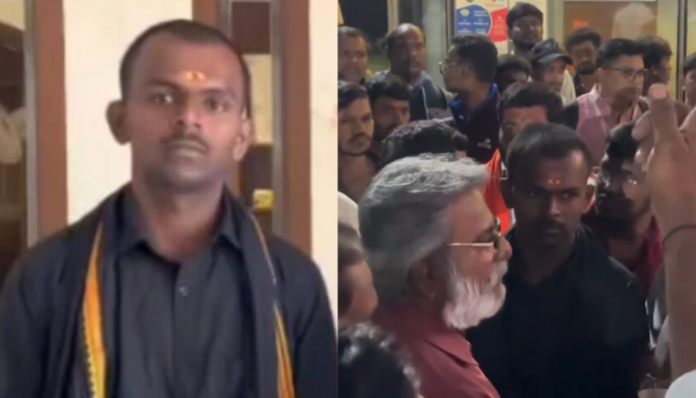
Protests erupted outside Tata Consultancy Services (TCS), Adibatla (Hyderabad) in the Rangareddy district, Telangana on Thursday (November 19, 2026) after a Hindu employee was denied entry into the office for showing up wearing religious attire.
The employee, named Manish, had taken Ayyappa Deeksha and came to the office wearing an Ayyappa Mala (garland), but he was not allowed entry because of his attire. After the incident, Ayyappa devotees and members of local Hindu organisations gathered outside TCS Aditbala in large numbers and staged a protest.
Manish has been working at TCS for the past two years. He had informed the company’s management about two months ago that he would take Ayyappa Deeksha. But when he showed up at the office wearing Ayyappa Mala, he was denied entry by his Team Lead, Sikandar Shah, who is a Muslim.
“I informed the management two months ago that I would take Ayyappa Deeksha. Today, they did not allow me inside, saying I could not enter without following the dress code. But they are allowing other people without a dress code. I do not understand why they are stopping me after I took Ayyappa Deeksha,” Manish said.
The employee said that he was not allowed inside the office in the name of dress code, while other employees not following the dress code were allowed. According to Manish, several employees who work in other teams are allowed to enter the office despite wearing Ayyappa Mala, but his Manager/Team Lead, Sikandar Shah, did not allow him. Manish accused Shah of religious discrimination.
ఆదిబట్ల TCSలో అయ్యప్ప మాలధారిని అడ్డుకున్నారంటూ ఆరోపణలు.. నిరసనకు పిలుపు! –> అయ్యప్ప మాల ధరించి కార్యాలయానికి వెళ్లిన ఉద్యోగి మనీష్ యాదవ్కు అనుమతి నిరాకరించారని ఆరోపణ –> 2024 నుంచి TCSలో పనిచేస్తున్నానని.. ఆగస్టు నుంచే మాలధారణ గురించి TL, మేనేజర్లకు తెలిపానని ఉద్యోగి వెల్లడి –> మేనేజర్, హెడ్ సికిందర్ అడ్డంకులు సృష్టించారని ఆరోపణ –> ఇతర ప్రాజెక్టుల్లో అనుమతిస్తున్నా.. తమ ప్రాజెక్టులోనే అభ్యంతరాలంటూ ఆగ్రహం –> సంస్థలో అందరికీ ఒకే డ్రెస్ కోడ్ పాలసీ అమలు చేయాలని డిమాండ్ –> సాయంత్రం 4 గంటలకు అయ్యప్ప మాలధారణతో TCS కార్యాలయం వద్దకు రావాలని స్థానికులు, హిందూ సంఘాలు, బీజేపీ శ్రేణులకు పిలుపు –> ఆరోపణలపై TCS అధికారిక వివరణ రావాల్సి ఉంది #Adibatla #TCS #AyyappaMala #ManishYadav #Hyderabad #Telangana #RTV
— RTV (@RTVnewsnetwork) November 19, 2026
Meanwhile, certain publications tried to downplay the incident as a case of TCS dress code violation. Siasat quoted an unnamed senior Police Officer, who said that the incident stemmed from a “misunderstanding”. The police officer said that the employee was wearing a Mundu (dhoti), which his HR manager asked him to change to formal pants, saying that their non-Indian clients might disapprove of the attire. The Police reportedly dismissed any communal angle in the incident. No formal complaint has yet been filed in connection with the incident.
Notably, employees routinely wear religious attire like the hijab and the Sikh turban (dastar) in multinational corporations (MNCs) across India and globally. Most large MNCs promote inclusive, secular work environments and formally protect religious expression through Diversity, Equity, and Inclusion (DEI) policies. Thus, the objection to Manish wearing an Ayyappa Mala does not seem to align with the practices that MNCs usually follow.
Earlier workplace harassment and religious coercion case involving TCS
This is not the first time that the company’s name has emerged in connection with religious discrimination against Hindu employees. A major workplace harassment and religious coercion scandal came to light at a TCS BPO facility in Nashik, Maharashtra, in March this year. The case involved sexual harassment and religious discrimination by Muslim employees against female Hindu employees at the BPO.
The scandal came to light after a 23-year-old Dalit Hindu woman employee approached the Nashik police and accused her Muslim colleague, Danish Sheikh, of sexually exploiting her on the false promise of marriage, despite being married, and attempting to influence her to convert to Islam. She also accused other Muslim colleagues, including HR manager Nida Khan, of making derogatory remarks about Hindu deities and religious practices.
Subsequently, several other female Hindu employees came forward with similar accusations. The accusations included pressuring Hindu employees to offer namaz, observe Ramzan fasts, consume non-vegetarian food, wear Islamic attire and abandon Hindu religious practices. This led to the filing of 9 FIRs covering multiple complaints. A total of nine accused, including 2 women, were identified by the police in the cases.


