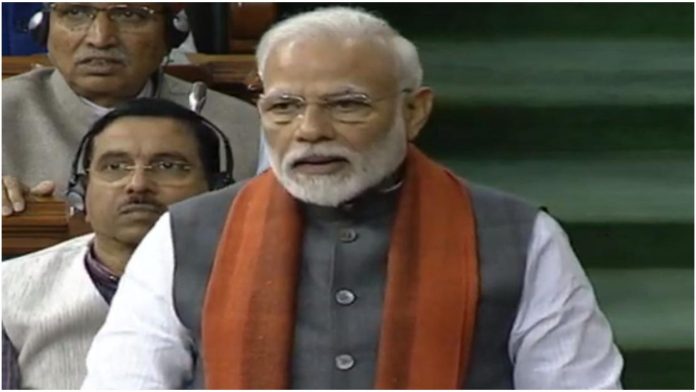
Prime Minister Narendra Modi announced setting up of a trust for building the Ram temple in Ayodhya on Wednesday along with the offer of land for a mosque in Uttar Pradesh’s temple town as mandated by the Supreme Court verdict on the Ram Janmabhoomi-Babri Masjid issue.
Addressing the Lok Sabha, the Prime Minister said, “We have readied a scheme for the development of Ram Temple in Ayodhya. An autonomous trust has been formed, it is called Sri Ram Janambhoomi Tirath Kshetra.”
WATCH: PM Modi speaking in Lok Sabha on Ram temple https://t.co/g1wnBrOXt2
— ANI (@ANI) February 5, 2020
Reportedly, PM Modi also said that after the verdict on the Ram Janmabhoomi issue came out, the people of India displayed remarkable faith in democratic processes and procedures. “I salute the 130 crore people of India,” he added.
The PM added that the trust will have the power to decide on matters related to the construction of the temple. He added that the government has also asked the UP state government to allocate 5 acres of land to the Sunni Waqf Board, which the state government has accepted.
“Let us all support construction of grand Ram Temple in Ayodhya,” he said, to shouts of “Jai Shri Ram” reverberating around the Parliament house.
The PM also announced that the entire 67 acres of the land will be handed over to the newly formed trust to develop for the benefit of devotees.
He further said, “In India, be it Hindu, Muslim, Sikh, Christian, Buddhist, Parsi or Jain, everyone is a part of one family. Development must take place for every member of the family. Our govt is moving forward with ‘sabka sath sabka vikas’ policy so that everyone is happy.”
In a historic judgment on November 9, the Supreme Court had established that the Hindus have a right on the entire 67-acre Ram Janmabhoomi and ordered the construction of a Ram temple by a government trust at the disputed site in Ayodhya. It had also granted an alternate 5-acre land to the Muslims to build their Masjid in the Hindu holy town.
As per the November 9 Supreme Court judgment, the central government had been directed to formulate a scheme with necessary provisions for the setting up of trust with a board of trustees to supervise the building of the Ram Temple at the Ram Janmabhoomi site.
The Prime Minister is expected to lay the foundation stone of both the Ram Temple and Ram Statue projects in Ayodhya on Ram Navami on April 2, 2020, and the construction is expected to start soon after.
Earlier, The Vishwa Hindu Parishad had urged the Central Government to adopt the model suggested by the Ram Janmabhoomi Nyas for the proposed Ram Temple in Ayodhya, as this would speed up its construction