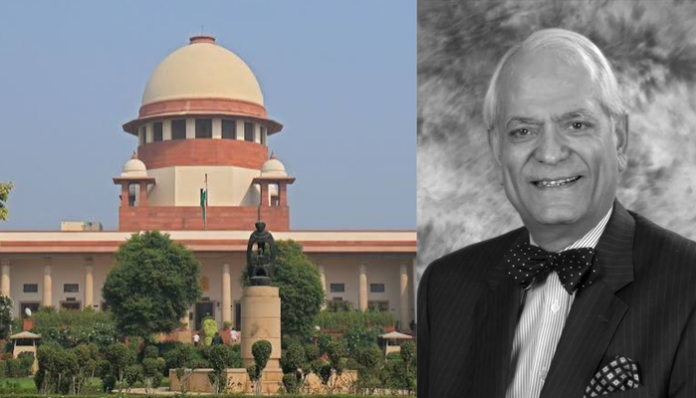
The Supreme Court on Friday (November 27) asked the Centre to consider allowing US-based separatist Khalid Jahangir Qazi, whose Overseas Citizen of India (OCI) status was cancelled, to visit India subject to strict restrictions.
Qazi has approached the Supreme Court after the Delhi High Court refused to grant him interim relief on his plea seeking permission to travel to India to visit his family in Jammu and Kashmir. A Bench of Justices Joymalya Bagchi and V Mohana heard Qazi’s plea and suggested that he could be allowed a conditional visit with restricted movement to the town where his sisters live.
The Supreme Court Bench took a softer approach to Qazi’s plea and said it required humane consideration, given his old age. It clarified that any interim arrangement permitting his entry would not prejudge the legal dispute or give either side any advantage in the pending proceedings.
While hearing his plea, the Apex Court noted that a Single Judge of the Delhi High Court set aside the Centre’s order cancelling his OCI registration and blacklisting him in 2024. It further noted that the 2024 Delhi High Court order was not stayed and questioned how the Centre could stop him from coming to the country in light of the Delhi High Court decision.
Opposing Qazi’s plea in the Supreme Court, Additional Solicitor General SV Raju, appearing for the Centre, said that he was a “rank separatist” who had links with Pakistan’s ISI. He argued that Qazi’s claim to visit his family in India was a pretext to engage in anti-India activities. The ASG pointed out before the court that Qazi had initially sought permission to attend family wedding celebrations, which had since concluded.
Notably, Qazi’s Overseas Citizen of India (OCI) card was cancelled by the Union government in May 2023, under Section 7D(e) of the Citizenship Act, 1955, on the ground that he engaged in anti-India and pro-Pakistan propaganda inimical to sovereignty, integrity & security of India.
Qazi’s pleas before the Delhi High Court
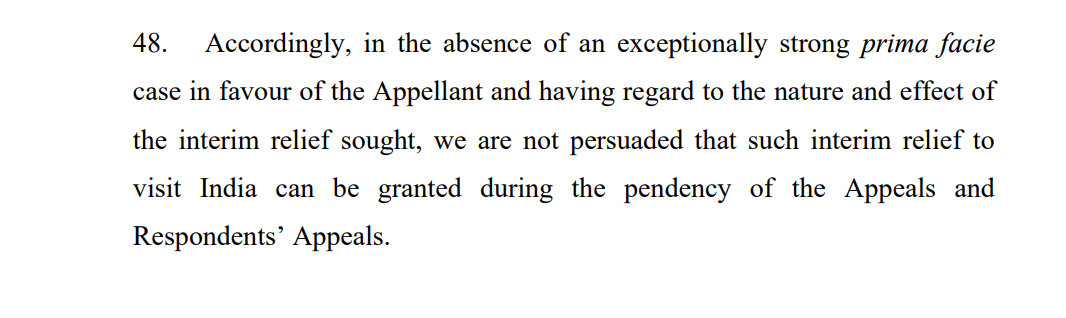
A Delhi High Court Division Bench comprising Chief Justice Devendra Kumar Upadhyaya and Justice Tejas Karia passed an order on August 11, 2026, refusing to grant Qazi permission to travel to India. The Division Bench refused to comment on the merits of the case, considering the pendency of connected appeals. However, the court observed that Qazi failed to make a “prima facie case” in his favour and therefore refused to grant him interim relief allowing him to visit India.
“…in the absence of an exceptionally strong prima facie case in favour of the Appellant and having regard to the nature and effect of the interim relief sought, we are not persuaded that such interim relief to visit India can be granted during the pendency of the Appeals and Respondents’ Appeals,” the Division Bench said.
In an earlier proceeding, Qazi had challenged the cancellation of his OCI card in the Delhi High Court in 2024 and sought interim relief in the form of permission to travel to India. A Single-Judge Bench Justice Snajeev Narula, who heard his plea, set aside the cancellation of his OCI card and the order blacklisting him, citing procedural discrepancies. The High Court said that the Union government failed to disclose to Qazi the grounds for the action and he was not given an opportunity to be heard.
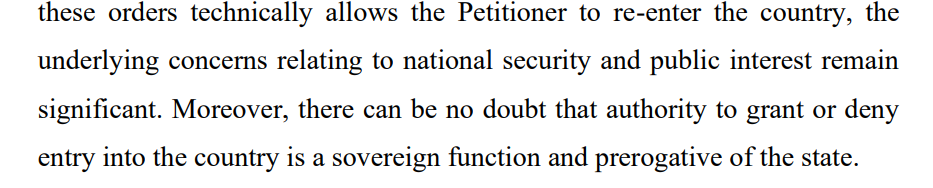
However, the court did not declare the material placed before it in a sealed envelope that detailed the grounds for the government’s action against Qazi as invalid. It adopted a balanced approach between individual rights and national security concerns. The court refused to comment upon the validity of the material and upheld the Union government’s sovereign right to grant or deny entry to any individual in India. “…there can be no doubt that authority to grant or deny entry into the country is a sovereign function and prerogative of the state,” the High Court noted.
The High Court directed that before Qazi is allowed entry into India, the Union government should issue a fresh notice to him regarding his OCI card, clearly specifying the grounds for intended restrictions or cancellations. It further said that Qazi should be granted a reasonable opportunity to file a reply. The Union Government challenged the decision before a Division Bench, and the appeals remain pending.
Notably, neither the Division Bench nor the Single-Judge Bench of the Delhi High Court rejected the allegations and the national security concerns raised by the Union government against Qazi. In both decisions, the High Court declined to permit Qazi to enter India. Now, the Supreme Court is considering whether his pleas seeking permission to travel to India should be granted.
Who is Khalid Jahangir Qazi?
Khalid Jahangir Qazi is an octogenarian, US-based, Kashmir-born physician and academic who was born in Jammu and Kashmir. He completed his medical education at Government Medical College, Srinagar, Kashmir, and migrated to the United States in the 1970s. He obtained his OCI registration in 2018 and regularly visited Srinagar to meet his family members, including his three sisters, who continued to reside in India.
In an article dated November 15, 2020, containing Qazi’s interview given to Authority Magazine, Qazi is described as a Buffalo, NY-based internist, Professor, and Board member of the World Kashmir Awareness Forum (WKA). The article also stated that he served as Chairman of the town of Amherst’s Community Diversity Commission and was Founding President and Senior Adviser of the Muslim Public Affairs Council of Western New York.
Maligns Indian security forces deployed in J&K
Qazi has openly peddled an anti-India agenda in the name of speaking for the rights of the people of Jammu & Kashmir. In the interview, Qazi blatantly maligns the reputation of India’s security forces deployed in Jammu and Kashmir to maintain peace, as well as the Indian government.
Qazi recounts how he and his family used to listen to news broadcasts from Radio Pakistan by shutting their windows, drawing the curtains, and turning off all the lights. He said that all this was done to avoid the “wrath of the armed military men patrolling the neighbourhoods”.
He further claimed that Kashmiri Muslims were discriminated against and were denied government jobs, including military services. He cites a story to back his bogus claim, claiming that one of his friends was not rejected for recruitment to the Indian Air Force for being a Kashmiri Muslim. Qazi justified his hatred for India and his anti-India propaganda, saying that such incidents left an “indelible mark” on his psyche.
Accuses the Indian government of committing a genocide in Kashmir
Qazi accused the Indian government of committing a “genocide” in J&K and described the Indian security forces’ anti-terror operations in the region as “state-sponsored terror and repression”. He cites these as the reason that turned him into a “lifelong activist and an advocate for Kashmir”.
He is also disturbed by the removal of Article 370 from the Constitution and terms it an “arbitrary abrogation” and raised objections to the laws that allowed what he described as “unconstitutional settlements in the disputed territory of Kashmir for people of Indian origin”.
The WKA and its anti-India propaganda
Considering his vitriolic views against India and the Indian security forces, his association with the WKA totally makes sense. The organisation’s stated goal is “to raise awareness and confront the human rights abuses perpetrated in Kashmir and support the region’s right to peace and self-determination”. However, its social media pages act as platforms for Pakistan’s anti-India agenda. WKA’s YouTube channel and X profile look like repositories of content villainising the Indian government and maligning the BJP and the RSS.
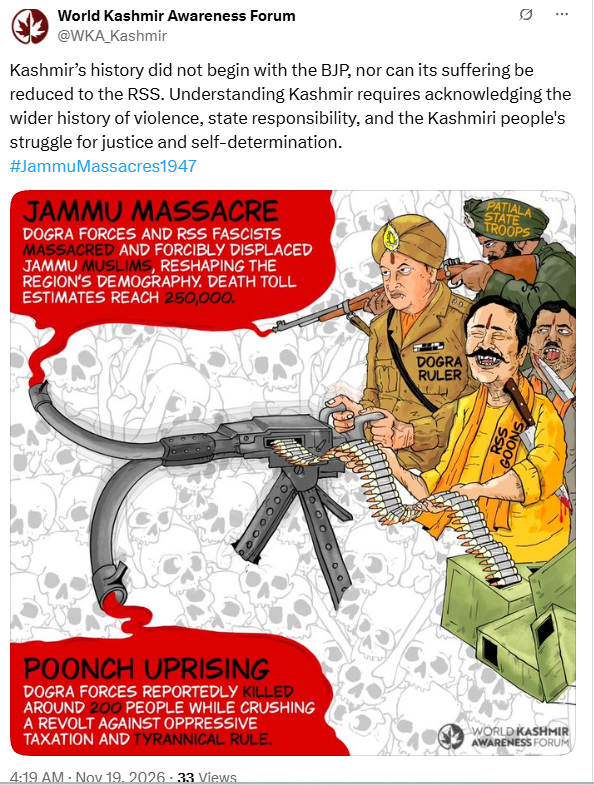
The organisation’s YouTube channel has several videos that present a distorted version of the history of Jammu and Kashmir that favours Pakistan’s narrative with respect to the region.
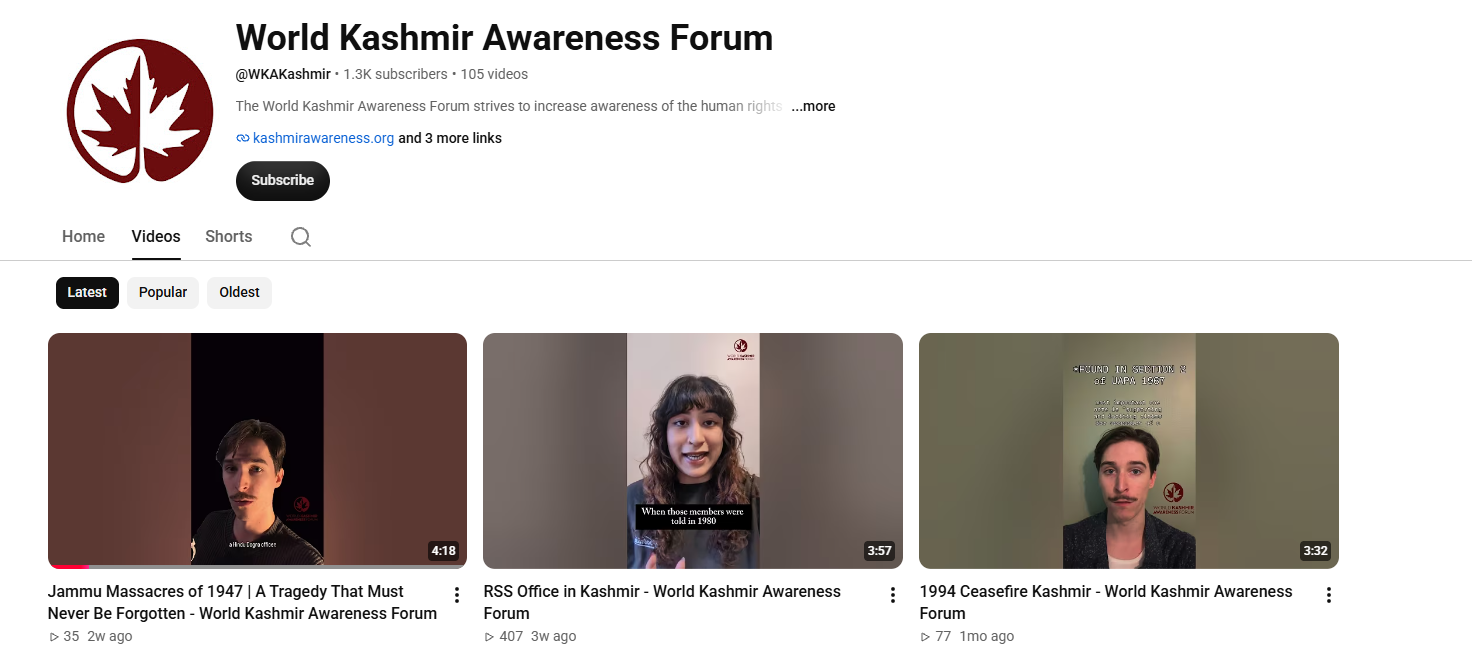
In the name of amplifying Kashmiri voices, the organisation actively spreads lies and highly biased content in the name of facts and history. It describes Jammu and Kashmir as an India-occupied territory and advocates for the region’s right to self-determination.
Considering the information mentioned above regarding Khalid Jahangir Qazi and his association with the WKA, the Union government’s reservations regarding his entry into India appear legitimate. It is also noteworthy how the two Delhi High Court rulings decided against allowing him entry into India despite setting aside his OCI card cancellation and blacklisiting on procedural grounds.