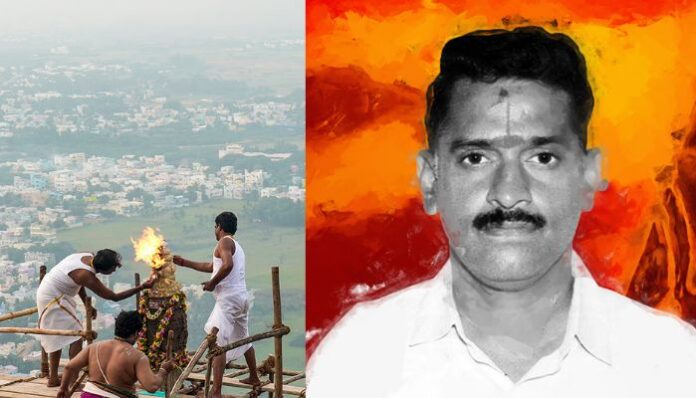
The sacred Karthigai Deepam was finally lit on Saturday, 28th November, at the disputed Deepathoon stone pillar atop Thiruparankundram Hill in Madurai, Tamil Nadu, following years of legal battles and a prolonged struggle by Hindu devotees to uphold their religious traditions. Executed in strict compliance with the Supreme Court’s directive after years of protracted court battles, the ceremonial lamp was kindled using 30 kilograms of ghee, 50 metres of cotton wick, and 5 kilograms of camphor.
The sacred Deepam has finally been lit atop the Deepathoon pillar, delivering a major setback to Joseph Vijay’s government. A resounding victory for Hindus in Tamil Nadu! Those who tried to deny devotees their religious rights have been forced to face the power of their faith. #KarthigaiDeepam
— OpIndia.com (@OpIndia_com) November 28, 2026
The historic ritual took place amid heightened security, with CRPF personnel deployed in the presence of temple priests and the Supreme Court-appointed receivers, retired High Court judges Justices S. Vaidyanathan and V. Parthiban.
The development came after a sharp reprimand from the Supreme Court against the Joseph Vijay-led Tamilaga Vettri Kazhagam (TVK) government for failing to implement its 20th November directive, which had permitted the lighting of the traditional lamp at the Deepathoon on 24th November. Following the state administration’s refusal to comply, the Supreme Court suspended the temple’s Board of Trustees and appointed the court receivers to oversee the proceedings. The ceremony eventually took place under the security cover of the Central Reserve Police Force (CRPF).
From Ram Mandir to Karthigai Deepam: Hindus’ long struggle to reclaim religious rights
The events atop Thiruparankundram Hill underscore a recurring reality: Hindus continually have to fight for their religious rights even in a Hindu-majority country. The struggle to reclaim the birthplace of Bhagwan Ram for the Ram Mandir in Ayodhya, which continued for decades before the Supreme Court delivered its historic verdict in 2019, remains one of the most prominent examples.
The exact same pattern of institutional resistance repeated itself for the right to light the Karthigai Deepam at Thiruparankundram. Just like the Ram Mandir movement, the struggle for Karthigai Deepam witnessed prolonged legal battles and demanded the ultimate sacrifice from Hindus who stood up for their ancestral traditions.
At the forefront of this movement was Madurai lawyer Rajagopalan ji, who initiated the campaign to light the Deepam at Thiruparankundram in the early 1990s. For daring to champion the rights of Hindus, Rajagopalan ji had to sacrifice his own life when he was brutally murdered by a Muslim mob.
The date was 10 Oct 1994. Venue – Home at Aavani Moolam St, Madurai Balidan of Lawyer Rajagopal ji by Cheeni Mohd + 5 others (now all got life sentence) His crime? – He started the movement to light Deepam in Tiruparankundram. Lets pay homage to the great Poraali on this day 🙏 https://t.co/dRuHRcrl8b
— Gajamani | கஜாಮಣಿ | ಗಜಾમણિ (@gajamani) November 28, 2026
Who was Advocate P.Rajagopalan?
P.Rajagopalan was a lawyer, social activist and the second president of the Hindu Munnani in Tamil Nadu. It is impossible to examine the strife between Hindu devotees and Islamist groups at Thiruparankundram without evoking the indomitable spirit of Rajagopalan ji, the fearless advocate whose unwavering resolve against religious extremism became both his legacy and the cause of his assassination.
In the early 1990s, he launched an intense campaign to erect and light the Karthigai lamp at the traditional stone pillar atop Thiruparankundram Hill, a sacred right blocked by the state administration due to the presence of a dargah on the hill.
The movement to light the Karthigai Deepam at the upper reaches of Thiruparankundram Hill gained renewed momentum in the early 1990s, when Hindu Munnani took up the issue under Rajagopalan’s leadership. He was at the forefront of agitations demanding that the traditional lamp be lit at the Deepathoon, rather than restricting the ceremony to the Deepam Mandapam near the Uchipillaiyar Temple.
According to the historical account recorded in a December 2025 order of the Madras High Court, Rajagopalan led the agitation during this period and was murdered in October 1994. Following his death, efforts continued to light the festival lamp at the top of the hill. However, the dispute also went to court. A separate organisation, Hindu Bakthajana Sabhai, filed Writ Petition No. 18884 of 1994 seeking to restrain the temple administration from lighting the lamp at the hilltop. The matter was disposed of in November 1996, with the court referring to the earlier 1920 civil court decree concerning ownership and the traditional location of the ritual.
For years, the Deepam continued to be lit at the lower mandapam, while devotees and Hindu organisations maintained that the Deepathoon was an important location where the ritual should also be performed. The issue repeatedly resurfaced through protests and legal proceedings.
Rajagopalan’s activism was not confined to the Thiruparankundram Deepam dispute. Rajagopalan also played an important role in defending Hindu religious processions and traditions in Madurai, where tensions between Hindu organisations and Islamist groups had periodically disrupted public religious activities.
One notable confrontation occurred during a Ganesha procession on the lower banks of Madurai. When Islamists attempted to obstruct the procession, Rajagopalan led efforts to ensure that it continued. During the confrontation, he was struck on the head by a clay ball filled with glass powder, sustaining serious injuries. However, the incident did not deter him from continuing his activism.
Rajagopalan also entered electoral politics. In 1991, he contested the Assembly election from the Triplicane (Thiruvallikeni) constituency, campaigning on issues concerning Hindu society and religious rights. His public activism increasingly brought him into confrontation with groups opposed to the activities of Hindu organisations.
Always dressed in khadar with a tilak on his forehead, he worked tirelessly alongside grassroots volunteers, collecting small donations by day and pasting campaign posters himself at night to address community issues.
Brutally hacked to death by Islamists
Rajagopalan’s resolute leadership angered Islamic fundamentalists, who conspired to eliminate him. On 10th October 1994, at around 6:30 am, a Muslim mob attacked him outside his residence in Madurai while he was reading the morning newspaper. They hacked him to death. Despite initial attempts by political authorities to divert the assassination into a localised dispute, persistent pressure from the Hindu Munnani forced the case to be recognised as a targeted jihadi attack and prosecuted under the Terrorist and Disruptive Activities (Prevention) Act (TADA).
The investigation initially handled by the Tamil Nadu Police was subsequently transferred to the Central Bureau of Investigation (CBI) in 1996. The agency filed its chargesheet in September 1997, which uncovered the wider conspiracy driven by radicalised jihadist preachers. The case was eventually tried by a designated Terrorist and Disruptive Activities (Prevention) Act (TADA) court in Tirunelveli.
In September 2011, following years of legal hurdles, a special TADA court in Tirunelveli convicted six Islamists, Shahul Hameed, Raja Hussain, Mohamed Subair, Zakir Hussain, Abdul Aziz, and Seeni Nainar Mohammed. All six were sentenced to life imprisonment, with fines imposed on them.
However, an important subsequent development in the case must also be noted. In April 2017, the Supreme Court set aside the convictions and acquitted all six accused, holding that the proceedings under TADA were vitiated because the statutory sanction for prosecution was invalid and the confessions relied upon were involuntary.
A sacrifice that illuminated Deepathoon
Rajagopalan ji’s relentless struggle laid the moral and legal foundation for every devotee who fought to restore the sacred tradition atop Thiruparankundram Hill. When he first raised the demand in the early 1990s, institutional apathy and political hostility treated the lighting of the Karthigai Deepam at the stone pillar as an impossible provocation.
Yet Rajagopalan refused to yield, enduring physical assaults, state obstruction, and ultimately martyrdom so that future generations could reclaim their rightful heritage. His blood was not shed in vain; the awareness he awakened transformed a suppressed local grievance into an enduring constitutional battle.
It is directly because of the movement Rajagopalan ji started and the supreme price he paid that the sacred flame finally burned atop Deepathoon on 28th November, fulfilling his lifelong resolve.
Vijay government defies Supreme Court order for political appeasement, CRPF deployed to protect devotees’ rights
Even after three decades, the path to lighting the lamp was obstructed by the Joseph Vijay-led TVK government, which defied binding judicial mandates in pursuit of appeasement politics.
During a contempt hearing on Friday, 27th November, a bench comprising Justices Aravind Kumar and Vipul Pancholi took stern action against state officials and the administration of the Arulmigu Subramaniaswamy Temple over their failure to execute the court’s 20th November order, which had permitted the lighting of the sacred lamp at the Deepathoon on 24th November.
Expressing deep “pain and anguish” over the deliberate defiance, the apex court warned that “time has come to deal with such situations with an iron hand, as otherwise it may lead to Constitutional chaos”. The bench declared that executive authorities, including the Madurai District Collector and the temple’s Board of Trustees, had wilfully violated judicial mandates and acted “according to their political bosses”.
Consequently, the Supreme Court suspended the temple’s Board of Trustees, issued contempt notices to senior state officials, and appointed former judges Justice S. Vaidyanathan and Justice V. Parthiban as court receivers to oversee the ritual. Modifying earlier restrictions, the bench ruled that every devotee would be permitted to light the lamp during the Tamil month of Karthigai, provided it is done at least 50 metres away on all sides from the nearby Sikandar Dargah.
Nearly 32 years after the brutal murder of Rajagopalan, the Deepam has finally been lit at the disputed stone pillar following the intervention of the country’s highest court. The Supreme Court had to deploy Central Reserve Police Force (CRPF) personnel alongside the court receivers to facilitate a Hindu religious ritual in Tamil Nadu, where Hindus constituted 87.58% of the population according to the 2011 Census.