

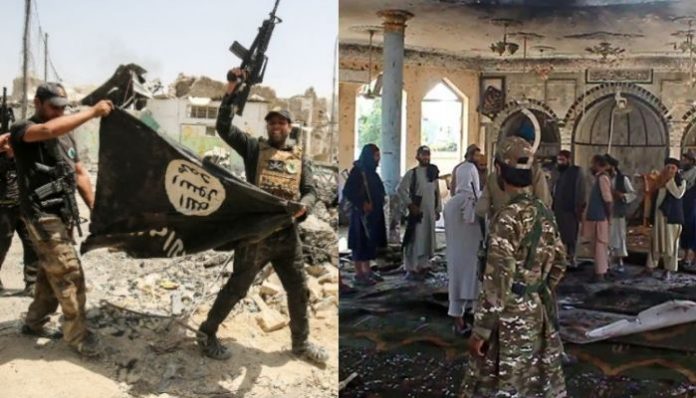
Hours after a suicide bomber targeted a Shia mosque in Kunduz, where 300 Muslims were offering their Friday prayers (Jumma Namaz), the ‘Sunni’ terror outfit Islamic State of Khorasan Province (ISKP) has claimed responsibility for the dastardly attack.
Initial reports suggested that the number of people who were injured and died stood at 100. However, Talib Matullah Rohani informed that about 43 people had died and an additional 140 people were injured. On the other hand, Shia leader Sayed Ahmad Shah Hashemi put the death toll to 70. “This deadly incident has caused trauma among Shiites and other sectors of the society,” he emphasised.
Reportedly, the attacker has been identified as one Muhammad al-Uyguri, and hailed from the Muslim Uyghur minority in China. He detonated his explosive vest inside the mosque premises during the Friday prayers killing an estimated 50-100 people.
ISKP and the targetting of Shia Muslims
The recent rise of the Taliban to power in Afghanistan has accentuated the fear of the Hazara community who had earlier been targeted by ISKP. Islamic State of Khorasan Province follows the extremist Sunni ideology and has been involved in several terror activities, including the bombing at the Kabul airport on August 26 that claimed the lives of 13 US soldiers. ISKP is an offshoot of the Islamic State terror group (ISIS) that operates in Afghanistan, Pakistan and India.
Khorasan refers to a historical region comprising of Afghanistan, Iran, Pakistan and Turkmenistan, the territories once controlled by a caliphate. The terrorist group was first formed in 2015 after several dissatisfied fighters of the Afghan Taliban and Tehrik-i-Taliban Pakistan, who viewed their own organisation as moderate outfits, joined the Islamic State, swearing to create a caliphate. The ISKP also influenced several radical Islamists studying in madrasas in Afghanistan and Pakistan.
ISKP had orchestrated attacks on girls’ schools, hospitals where they had shot dead pregnant women and nurses. However, their primary target has been the Shia Muslims (20% of Afghanistan’s population), who come from the Hazara community in a predominantly Sunni country. Although the Hazaras despised the US-backed Ashraf Ghani government for its inability to provide protection to them, life under Sunni ISKP and Deobandi Taliban had become even more difficult.
The newly installed Taliban government, having overthrown the country’s Western-backed administration in August, is struggling to contain an invigorated Islamic State. The group has grown increasingly antagonistic in recent weeks, conducting guerrilla-style attacks and bombings that have included Taliban fighters among the dead. The new government is also struggling with a collapsing economy as foreign funding remains largely frozen.


