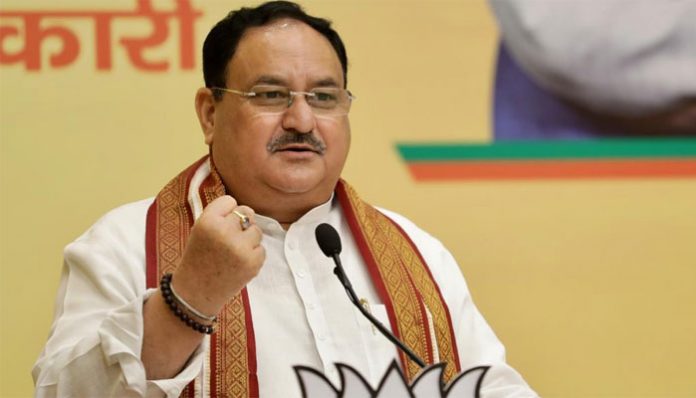
On April 18, Bharatiya Janata Party President Jagat Prakash Nadda wrote a letter to the nation in which he blamed the opposition for fueling communal tensions in the country. His letter came a day after the opposition had signed a letter for communal harmony.
BJP President Shri @JPNadda ji’s message to the nation. pic.twitter.com/EoC5lceV3H
— BJP (@BJP4India) April 18, 2022
In his letter, Nadda said while India is celebrating 75 years of Independence and the ruling party has dusted and rusted the approach to vote bank politics, divisive politics, and selective politics, the opposition parties were bitter. He said such ‘rejected and dejected’ parties are taking refuge in vote bank and divisive politics.
Nadda pointed out several instances where opposition parties fueled or turned blind eyes towards communal violence when they were in power. He pointed out how, in November 1966, then-PM Indira Gandhi had ordered firing at Hindu Sadhus, who were protesting against cow slaughter. Nadda mentioned the infamous speech of former PM Rajiv Gandhi where he said, “When a big tree falls, the earth shakes”, justifying the massacre of Sikhs posts PM Indira Gandhi’s assassination. From Gujarat 1969 to Bhiwandi 1984, Meerut 1987, Muzaffarnagar 2013, Assam 2012 and incidents against Kashmiri Pandits throughout the 1980s leading to their exodus from the valley, Nadda mentioned many major incidents that took place under Congress and other parties’ regimes at the centre and in states.
Speaking on the political killings in West Bengal and Kerala, he said, “The shameful political violence in West Bengal and Kerala, and the repeated killing and targeting of BJP workers offers a glimpse of how some of our political parties view democracy.” He also pointed out how two cabinet ministers in Maharashtra are facing serious charges of corruption, extortion and links with anti-social elements.
He said, “The youth of India want opportunities, not obstacles. They want development, not divisions. Today, when people across all faiths, all age groups, as well as from all walks of life have come together to defeat poverty and take India to new heights of progress, I would urge the opposition to change track and embrace the politics of development. We owe this to our coming generations.”
Opposition parties’ joint statement on peace
On April 16, thirteen political parties had joined hands to issue a joint statement urging everyone to maintain peace.
We reiterate our commitment to combat and confront the poisonous ideologies which are attempting to entrench divisiveness in our society.
— Congress (@INCIndia) April 16, 2022
– Joint appeal by like-minded political parties to the people to maintain peace & harmony, demanding stringent punishment to perpetrators pic.twitter.com/SPz4rdHNQf
Signed by Sonia Gandhi, Sharad Pawar, Mamata Banerjee, ML Stalin, Sitaram Yechury, Hemant Soren, Farooq Abdullah, D Raja, Tejaswi Yadav, and others, the statement blamed Prime Minister Narendra Modi for silence over recent incidents of violence. They also pointed out the alleged misuse of social media to spread hate and prejudice.