

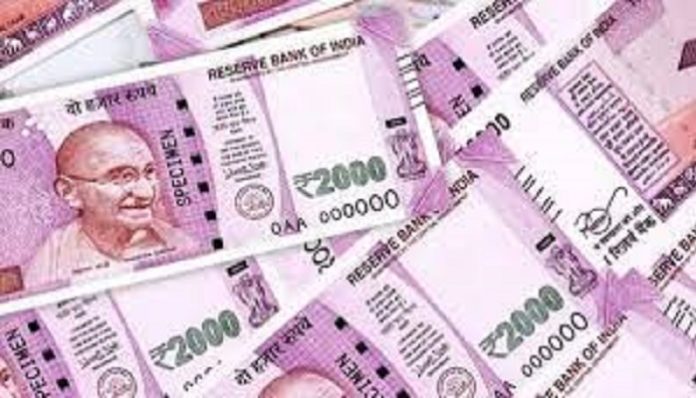
RBI Governor Shaktikanta Das has announced that nearly two-thirds of Rs 2000 notes have been deposited or exchanged in banks within just a month of its withdrawal decision.
Now, within just a month of making a significant announcement to withdraw Rs 2,000 notes from circulation, the RBI has stated that 72 per cent of the pink notes have been deposited or exchanged in banks.
Last week, RBI Governor informed this when he sat for an interview with PTI Bhasha at the RBI Headquarters. He said, “More than two-thirds or ₹ 2.41 lakh crore worth of the ₹ 3.62 lakh crore (as of March 31, 2023) of the now-recalled 2000 banknotes have come back to the system as of mid-last week.”
He added that out of the total money that has returned to the system, nearly 85 percent came in the form of deposits, while the remaining Rs 2000 notes were exchanged in the form of currency.
Although the RBI has set September 30th as the last day for exchanges and deposits, Governor Das stressed that the deadline is not fixed in stone. Consequently, he urged people not to rush in exchanging or deposing their money.
Nevertheless, he expressed uncertainty regarding whether he would request the government to revoke the legal tender status of these ₹2000 currency notes once the September 30 deadline passes.
During the previous monetary policy review on June 8, the RBI governor announced that approximately ₹1.8 lakh crore worth of Rs 2,000 notes had been returned or deposited with the banks. This was around 50 per cent of the notes that were in circulation as of March 31st.
RBI’s May 19th decision
Earlier, on the 19th of May, the RBI announced its decision to withdraw Rs 2,000 notes from circulation. The RBI, however, gave sufficient time for depositing or exchanging these now-recalled 2000 currency notes. For this purpose, it asked citizens to exchange them at banks by the 30th of September.
Back then, the Bankers Bank said, “To complete the exercise in a time-bound manner and to provide adequate time to the members of the public, all banks shall provide deposit and/or exchange facility for Rs 2,000 banknotes until September 30, 2023.”
However, to ensure operational convenience and to avoid disruption of the regular activities of bank branches, the RBI had set an exchange limit of Rs 20,000 at a time at any branch which commenced on the 23rd of May.
In its notification, RBI explained that about 89 percent of the Rs 2000 denomination banknotes were issued prior to March 2017 and are at the end of their estimated life span of 4 to 5 years.


