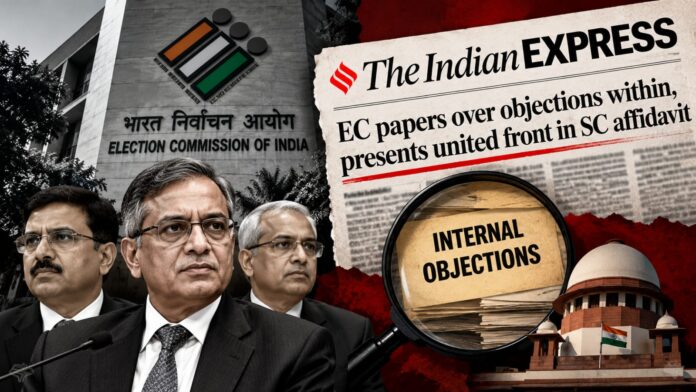
The Indian Express appears determined to sustain its narrative of alleged internal discord within the Election Commission of India (ECI), even after the poll panel filed a counter-affidavit before the Supreme Court asserting that its decisions on the Special Intensive Revision (SIR) of electoral rolls were unanimous.
On Monday, October 26, the Election Commission defended Chief Election Commissioner Gyanesh Kumar, maintaining that the three SIR orders issued in June 2025, October 2025 and May 2026 were approved unanimously by all three members of the Commission. The poll body also questioned the maintainability of a petition challenging the CEC’s functioning, arguing that it rested entirely on a media report.
The affidavit directly challenges the premise of the controversy that has fuelled opposition demands for action against Kumar. Yet, instead of acknowledging the significance of the Commission’s formal clarification, The Indian Express returned to the issue on Tuesday, October 27, with the headline, “EC papers over objections within, presents united front in SC affidavit on SIR.”
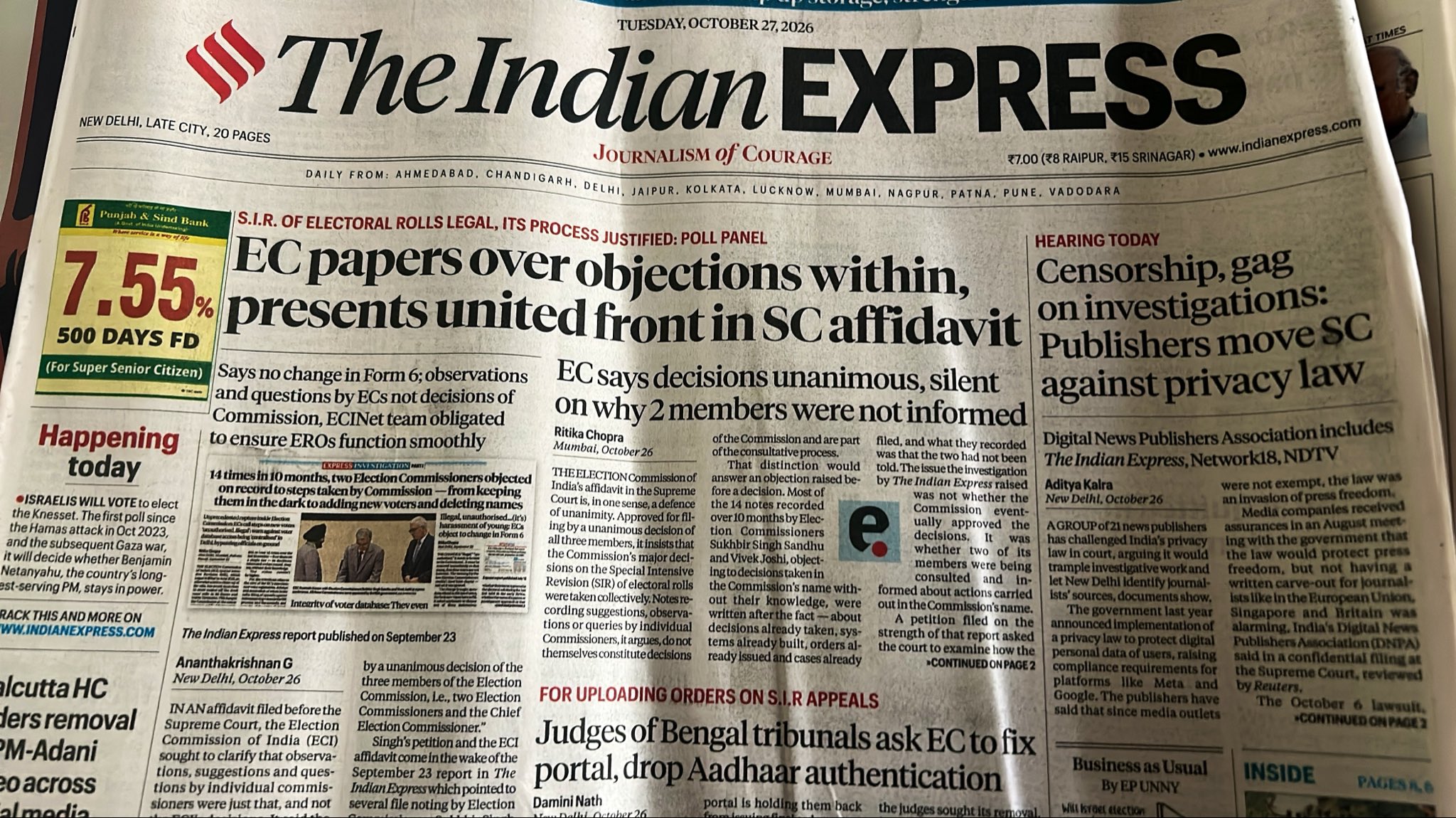
The newspaper’s word choice is revealing. It portrays the Commission’s affidavit as an attempt to conceal internal disagreements rather than engage with the poll panel’s central assertion: that the three orders were unanimously approved.
A newspaper is entitled to question an institution, demand answers and investigate its functioning. But when the institution concerned formally contests the allegations before the highest court, the response should be judged on the evidence it presents, not dismissed through suggestive headlines or rejected after diluting its own position, which seems to be the case with the Indian Express after it has been called out by the poll body in its affidavit submitted to the Supreme Court.
EC explains its decision-making process
In its affidavit, the Election Commission clarified that observations, queries, and suggestions made by individual members while examining files should not automatically be construed as the Commission’s decisions.
The poll body explained that files ordinarily pass sequentially through the two Election Commissioners before being placed before the Chief Election Commissioner. In urgent cases, approvals may be obtained electronically, with the relevant details subsequently recorded on the file.
The Commission’s position is straightforward: individual observations made during the examination of a file are part of the consultative process and do not necessarily indicate that a final decision was taken unilaterally.
The distinction matters. Administrative and institutional decision-making routinely involves questions, objections, suggestions and deliberations. The existence of disagreement at one stage does not, by itself, establish that the final decision was irregular, that the prescribed procedure was bypassed or that the institution acted without the required approval.
The ECI has asserted that the three SIR orders were unanimous decisions approved by the CEC and the two Election Commissioners, Sukhbir Singh Sandhu and Vivek Joshi. It has also sought permission to file a more detailed, paragraph-wise response to the petition.
The newspaper, meanwhile, has highlighted 14 instances over a period of 10 months in which the two Election Commissioners allegedly recorded objections to steps taken in the Commission’s name. Those records may merit examination, but their existence alone does not establish the conclusion that the newspaper appears to be drawing from them.
OpIndia had already exposed the holes in Indian Express’ narrative
This is not the first time the Indian Express’s sweeping claims about an alleged crisis within the Election Commission have been challenged. OpIndia had already dismantled the newspaper’s central arguments, pointing out that internal objections do not automatically establish institutional wrongdoing. In its earlier report, OpIndia spoke to two Electoral Registration Officers (EROs), who rejected the suggestion that the EC’s central administration had usurped their statutory powers. The newspaper’s claim that electoral-roll software had effectively transferred authority to Delhi was therefore far from established.
The distinction is crucial. The Indian Express took internal disagreements, concerns about Form 6 and questions about electoral-roll software and wove them into a larger narrative of centralisation and institutional breakdown. But OpIndia’s examination highlighted the gaps in that narrative: a Commissioner calling a decision “illegal” does not make it a judicially established illegality; a software limitation does not prove a transfer of statutory powers; and internal objections do not establish that the final decisions were taken unlawfully. The Election Commission’s latest affidavit reinforces the need to distinguish between what the documents actually establish and what the newspaper wants readers to infer from them.
Internal objections are not proof of unilateral decision-making
The crucial question is not whether an Election Commissioner ever objected while examining a file. It is whether the objection remained unresolved, whether the prescribed approval process was violated and whether the final order was issued without the requisite authorisation.
These are materially different questions.
An objection recorded during deliberations could be followed by a clarification, a modification, further consultation or a final decision approved by all members. Without establishing what happened subsequently, it would be premature to treat every internal disagreement as evidence of institutional wrongdoing.
The Indian Express has argued that the affidavit does not adequately explain why the two Commissioners were allegedly not informed about certain decisions. That claim, too, must be examined against the relevant files and the Commission’s explanation of its procedures. A newspaper report cannot substitute for that scrutiny.
The ECI has also denied releasing or authorising the release of any internal note or file to the media. Its affidavit therefore puts forward a formal institutional response to the allegations, rather than leaving the newspaper’s account uncontested.
The Commission’s explanation may be questioned, and the Supreme Court can examine the competing claims. But it is important not to confuse the existence of a controversy with proof that the allegations underlying it are true.
Indian Express cannot turn its allegations into facts
The larger concern is the way the newspaper appears to be treating its own interpretation of internal documents as the benchmark against which the Election Commission’s response must be judged.
The ECI has stated on affidavit that all three SIR orders were unanimous. The Indian Express disputes the adequacy of that explanation. That is a disagreement over the evidence and its interpretation—not proof that the Commission has concealed dissent or acted improperly.
Just because objections were recorded internally does not mean the newspaper’s allegations stand proven. An objection is evidence that a question or disagreement arose at a particular stage of the decision-making process. It is not, by itself, evidence that the final decision was unlawful, unilateral or contrary to the Commission’s established procedure. To establish that, the newspaper must demonstrate what the objections concerned, whether they remained unresolved and how they affected the final decisions.
The burden of substantiating an allegation cannot be discharged merely by pointing to the existence of internal notes and then dismissing the institution’s formal response as an attempt to paper over dissent. If the documentary record establishes wrongdoing, it should be presented and examined on its merits. If it does not, the allegations cannot be treated as proven simply because they have been published repeatedly.
The Election Commission is a constitutional body whose functioning deserves scrutiny. But scrutiny must be evidence-based, not driven by a presumption that every internal disagreement signifies misconduct. Personal prejudice and confirmation bias can’t be the premise to justify wrongdoing by a constitutional body. The same standards of accountability that journalists demand of public institutions must apply to their own reporting.
The Indian Express may stand by its investigation, but standing by a story does not make its conclusions indisputable. The ECI has placed its position before the Supreme Court and asserted that the decisions were unanimous. Until the evidence establishes otherwise, the newspaper’s allegations must remain allegations, not facts elevated to the status of established wrongdoing through repetition and insinuation.