

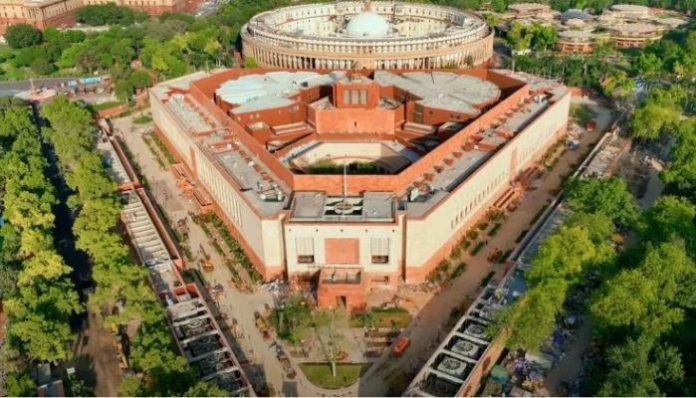
On Thursday, July 20, 2023, the monsoon session of the Parliament commenced amid the usual political ruckus, with various bills being discussed by the members of the Parliament. Despite the formal inauguration of the new Parliament building on May 28, 2023, by Prime Minister Narendra Modi, the session is still being held in the old building which was constructed in 1927 during British rule.
The new Parliament building, which has been under construction since December 2020, was expected to host the monsoon session. However, even before the session began, the government announced that it would start in the old building and eventually shift to the new one once the necessary arrangements were completed.
According to a report by The Indian Express, all systems in the new building, including sound, air conditioning, and automated security, were thoroughly tested before the session’s commencement. Additionally, the audio and video systems in both the Lok Sabha and Rajya Sabha were checked for functionality.
The delay in shifting the session to the new building appears to be due to a combination of ongoing finishing work and the complexity of relocating essential items and offices from the old building to the new one. Such a process requires considerable time and effort, leading to the decision to begin the session in the old Parliament building.
Opposition parties have also seized upon the delay, with Rashtriya Loktantrik Party president and MP Hanuman Beniwal propagating the claim that the new Parliament building was flooded, thus preventing the session from being held there. However, Union Parliamentary Affairs Minister Pralhad Joshi dismissed these claims, asserting that they were entirely false and baseless. He emphasised that the decision to hold the session in the old building was made by the Lok Sabha Speaker.
The ongoing monsoon session of Parliament, scheduled from 20th July 2023 to 11th August 2023, consists of 17 meetings spread across 23 days. Presently, both the Lok Sabha and Rajya Sabha are functioning in the old Parliament building. An official announcement from the government regarding the date of the session’s shift to the new building is still awaited.
The new Parliament building, which was inaugurated with chants of Vedic mantras on May 28, 2023, is triangular in shape and located adjacent to the old building. Unlike the old building’s three chambers, the new building has two chambers, one each for the Lok Sabha and Rajya Sabha. On occasions when both houses meet together, a joint session will take place in the Lok Sabha room, accommodating 1272 people. The state-of-the-art building cost 800 crores and spans an area of 64,500 square meters.
Despite the delay, the new Parliament building stands ready to serve as a symbol of India’s progress and modernity. As the finishing touches and logistical challenges are addressed, the government will soon transition the session to the new building, marking a new era in India’s parliamentary proceedings.


