

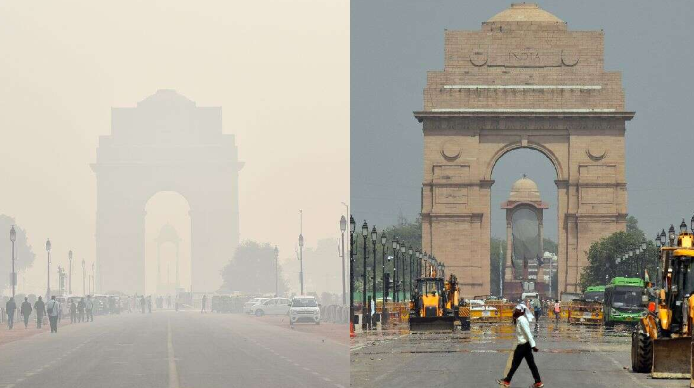
On Tuesday, August 29, the Energy Policy Institute at the University of Chicago released the Air Quality Life Index (AQLI) report for the year 2023 to assert that the city of Delhi is the world’s most polluted city and that its residents are on track to lose 11.9 years of life if the current levels of pollution continue to persist.
The analysis published on Tuesday uses particulate matter data from 2021 to assess the effect of particle pollution on life expectancy. AQLI analyses the impact of particulate pollution on life expectancy.
According to the analysis, Delhi’s yearly average PM2.5 level in 2021 was found to be 126.5 g/m3, which is more than 25 times the WHO’s recommended limit of 5 g/m3. This number was found to be a little lower in 2020, at 107 g/m3.
India has the highest health burden from air pollution of all the countries in the world because of the sheer number of people that high particulate matter levels affect there. According to the statistics, PM2.5 levels have increased across South Asia and particularly in India.
“In South Asia, particulate pollution has increased 9.7 percent from 2013 to 2021. In India, PM2.5 levels rose 9.5 percent, in Pakistan 8.8 percent, and in Bangladesh, levels rose by 12.4 percent over this same time interval,” the report noted.
According to satellite-derived PM 2.5 statistics for 2021, India’s pollution level increased from 56.2 g/m3 in 2020 to 58.7 g/m3 in 2021. This exceeds the WHO recommendation of 5 g/m3 by more than ten times.
According to the report, particulate matter pollution poses the greatest risk to human health in India, outpacing cardiovascular illnesses and child and maternal malnutrition in terms of reducing life expectancy. The average Indian loses 5.3 years of life expectancy due to particulate pollution, 4.5 years due to cardiovascular illness, and 1.8 years due to infant and maternal malnutrition.
“The average Indian resident is set to lose 5.3 years of life expectancy if the WHO guideline is not met,” the report stated.
According to the report, the country’s most polluted area is the plains, which include Bihar, Chandigarh, Delhi, Haryana, Punjab, Uttar Pradesh, and West Bengal. If current pollution levels continue, the average inhabitant there could lose about 8 years of their life expectancy.
An inhabitant of Delhi may live an additional 11.9 years if the PM 2.5 level is reduced to the WHO limit of 5 g/m3 on an annual average. According to the analysis, a Delhi resident’s life expectancy might increase by 8.5 years if the PM 2.5 concentration is lowered from its levels of 2021 to the national standard of 40 g/m3, which is far lower than the WHO recommendation.


