Home Blog Page 1002

Foreign trips, free education for children of journalists and more: How Chinese Communist regime is influencing Nepalese media

China has been increasing its influence on Nepalese media over the years. So much so, that its ambassadors openly threaten Nepalese journalists who don’t fall in line.

On 29th May, the Chinese ambassador to Nepal, Chen Song, faced backlash after demanding an apology from Nepali journalist Gajendra Budhathoki.

Song came down heavily on Budhathoki for revealing that Chinese loans for the Pokhara International Airport were secured at higher interest rates than the officials had stated.

According to Budhathoki, the interest rate was 5% and not 2%. Despite pressure from Song, Budhathoki stood by his report, promising to provide proof.

The way the Chinese ambassador reacted and demanded an apology was a clear indication that China believes it can influence Nepali media. But from where does the confidence come from?

Notably, in 2023, the Centre for Social Innovation and Foreign Policy (CSIFP) released a report on “China’s Influence in Nepali Media Amid Changing Nepal Policy”. It talked about how China was running propaganda to influence Nepali media using its own journalists.
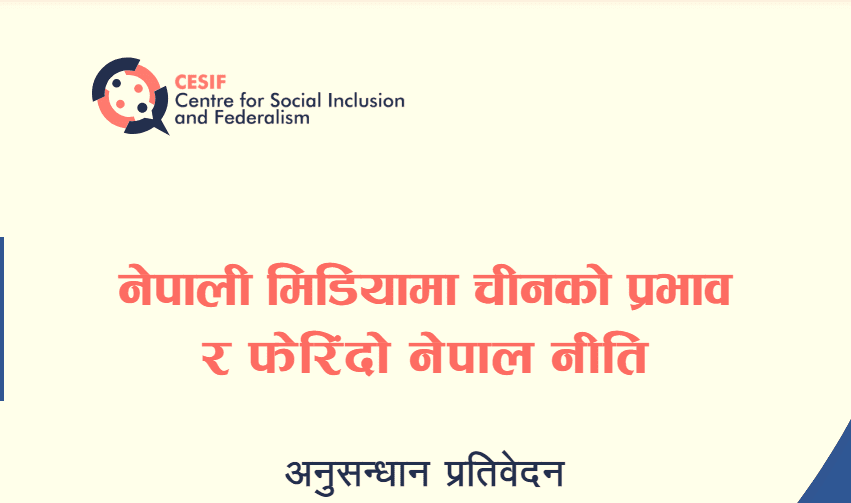
Screengrab of the CSIFP report

Over the past few years, there has been a systematic expansion of Chinese influence in the Nepalese media sector. China has been aggressively trying to control the geopolitical strategy in the media sector in the region by planting its stooges in countries like Nepal.

Notably, even in India, there have been reports that China has been funding media houses like Newsclick to influence the narrative around China.

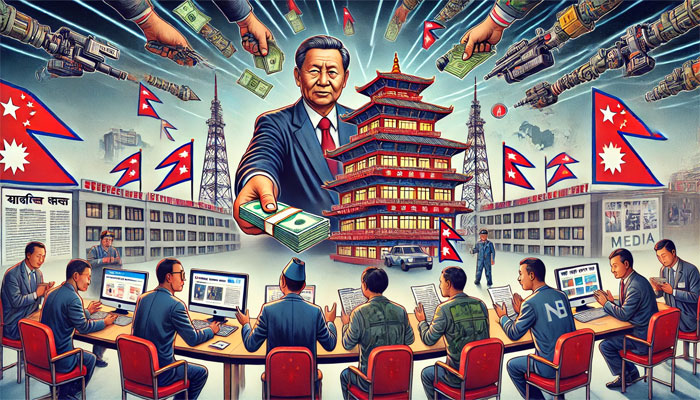
China is reshaping the media landscape in Nepal through a combination of educational incentives, direct investments and sophisticated propaganda campaigns. The aim is to reshape the Nepalese media in a way that serves China’s strategic interests in the region.

China’s Media Influence Strategies

China is using multiple strategies to influence the journalists working in the country. First and foremost, China sponsors trips for Nepalese journalists to China. These all-expenses-paid trips have been taken by an estimated 9,000 journalists till 2023.

These trips are designed in a way that they look like educational trips but in reality, they serve as indoctrination tours. When the journalists return, these journalists often espouse pro-China narratives. They attempt to downplay the issues such as democracy and freedom of expression.

Apart from trips, China also funds the education of the families of journalists. They provide scholarships and discounted educational opportunities at top Chinese universities for the children of these journalists.

It creates a favourable bias among the journalists. Furthermore, a new generation of pro-China Nepalese gets prepared in the form of the children of these journalists who are sympathetic towards China’s interests. If any of them become journalists, it is even better for China.

China is also establishing Chinese media outlets in Nepal that are operated by Chinese nationals. These channels have funding as well as advanced technology that Nepalese media houses cannot get their hands on easily.

These outlets act as mouthpieces of China disseminating content that promotes Chinese policies and interests while subtly or overtly undermining competing influences, particularly from the US and India.

China also actively promotes misinformation to shape public opinion in Nepal. A notable example if of the campaign against the Millennium Challenge Corporation (MCC) grant from the United States.

Chinese media outlets and social media channels produced numerous videos and articles against MCC calling it a threat to Nepal’s sovereignty. These campaigns have been effective in fostering a significant anti-MCC sentiment among the Nepalese populace.

CSIFP’s report talked particularly about a Facebook page of the Nepali online portal operated by China Radio International, which argued against the MCC, framing it as a neo-colonial tool of the US.

The video amassed substantial engagement, with 430,000 views, 16,000 likes, 523 comments, and 4,400 shares, highlighting the reach and influence of Chinese media operations in Nepal.

Geopolitical implications

China is increasing its influence on the media in Nepal and it is having significant geopolitical implications. China is seeking to curtail the influence of the US and India on Nepalese people and position itself as the dominant power in the region. This media influence extends to the political sphere, where China has cultivated relationships with key political figures and parties in Nepal.

Historical context and recent developments

One of the most influential projects that China has managed to sign with Nepal was the Belt and Road Initiative (BRI) agreement in 2017. However, its implementation has faced delays due to internal disagreement in Nepal. China’s media strategy, consolidated under China Media Group (CMG) in 2018, includes financial support and editorial control over local outlets.

The dragon is consistently making an effort to influence Nepalese media and it peaked during Chinese Ambassador Hou Yanqi’s tenure, promoting Chinese interests and unifying Nepal’s leftist parties.

Even the US State Department accused China of spreading false information about the MCC, highlighting a broader geopolitical contest in Nepal’s media landscape.

China encroaching on Nepal’s territory

From time to time, there have been reports that China is influencing Nepal against India. Interestingly, while it instigates Nepal against India, China continues to take over Nepalese land forcefully. In February 2022, a memorandum was handed over by the Rashtriya Ekata Abhiyan to the United Nations, informing them about the land encroachment in Humla, Nepal, by China.

The Nepali civil society group has urged the international community to intervene in the issue of land grabbing by China in neighbouring countries. According to a report in Khabarhub, Binay Yadav, chairperson Rastriya Ekata Abhiyan, approached the UN office in Kathmandu and handed over the memorandum to Richard Howard, Resident Coordinator, United Nations, via Rajendra Man Banepali, Information Officer at the UN office.

The study alongside the China-Nepal border found the area between pillar number 5(2) and the middle of the Kit Khola was marked as the border between the two countries according to the Boundary Protocol of 1963.

However, China had erected fences and wires on the Nepali land. Another report suggested China has been limiting grazing by Nepalese farmers. The report also noted that the surveillance activities by the Chinese security forces led to restrictions on religious activities in Lalungjong which falls on the Nepalese side of the border. This area is near Mount Kailash, which is sacred to both Hindus and Buddhists.

Pirates of the Caribbean actor Tamayo Perry dies after shark attack in Hawaii

Pirates of the Caribbean actor Tamayo Perry has died after a shark attack in Hawaii.

Perry, who also featured in Blue Crush and Hawaii Five-0, was surfing at Malaekahana Beach on Oahu when the incident occurred on Sunday afternoon.

Perry had been surfing near Mokuauia, close to Laie, Hawaii. He was discovered dead around 1 PM. An eyewitness reported seeing a man with severe shark bite injuries off Malaekahana Beach near Kahuku. Perry’s body had multiple shark bite wounds.

Local emergency services reported receiving a call at 1 pm about a person “fatally injured by a shark” and used a jetski to recover Perry’s body from the water.

Honolulu Ocean Safety acting chief Kurt Lager stated at a press conference that Perry was a beloved lifeguard and professional surfer known worldwide and throughout Oahu’s North Shore. “Tamayo’s personality was infectious, and as much as people loved him, he loved everyone else more,” Lager said, extending condolences to Perry’s family.

In Pirates of the Caribbean: On Stranger Tides, the fourth instalment starring Penélope Cruz and Johnny Depp, Perry played a buccaneer. He also worked as a stunt performer in the Owen Wilson surfing movie The Big Bounce, based on Elmore Leonard’s novel.

Mayor Rick Blangiardi described Perry’s death as “a tragic loss,” saying, “Tamayo was a legendary waterman and highly respected, [he] grew up right over here, and was a valued member of our ocean safety team.” Blangiardi urged the public and press to “honour and respect” Perry’s family during their time of grief.

Despite their high media profile, there were only 69 unprovoked shark attacks worldwide last year, 10 of which were fatal, according to the 2023 International Shark Attack File by the Florida Museum of Natural History. Florida had the highest number of unprovoked shark attacks with 16, none of which were fatal.

‘₹150 for 3 women’: Rajasthan police arrest man, who was seen putting price tags on female tourists, in viral video

The Rajasthan police have arrested the man who was seen misbehaving with female tourists in a viral social media video.

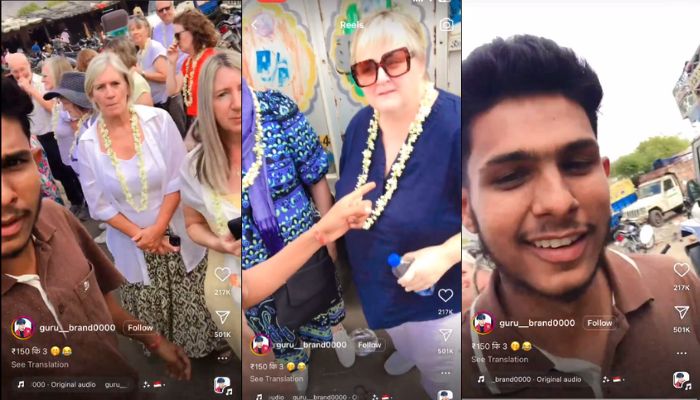
As per reports, the accused was identified as Vinod Meena. He had uploaded a video on his Instagram account (@guru__brand0000) wherein he was seen putting price tags on foreigners in Jaipur.

“This woman is for ₹150 and that woman is for ₹200. This woman here is available for ₹500 and this woman for ₹300,” he was heard saying while pointing his fingers at the female tourists.

The women, who were unaware of his malafide intentions, were seen waving at the camera. The controversial video created by Meena was re-posted by popular user Madhur Singh on X (formerly Twitter).

In a tweet, he said, “Guys like these are the reason why international tourists have bad experience in India.” Singh also sought immediate action from Jaipur police.

“Jaipur police should arrest this guy for harassing tourists and teach him basic civic sense and the meaning of Atithi Devo Bhava,” he further added.

On Monday (24rd June), the Jaipur police took cognisance of the matter and informed, “A reel is going viral on the internet through Instagram. The police took strict action against the accused who touched some foreign female tourists, behaved indecently and made baseless false statements.”

The police have arrested Vinod Meena and booked him under Indian Penal Code (IPC) Sections 354, 505(2) IPC, 66D IT Act, 13(1), 13(2) and relevant provisions of the Rajasthan Tourism Business Act.

CBSE city coordinator Ehsanul Haq, chairman Shabir Ahmed, and Sanjeev Mukhiya: Read how the NEET scam is linked to Jharkhand’s Hazaribagh

The investigation into alleged irregularities in the NEET-UG examination and paper leaks in certain ‘isolated incidents’ has revealed that an exam center in Jharkhand, along with an organized education mafia reportedly operated by a man named Sanjeev Mukhiya, masterminded the scheme. 

According to reports citing EOU sources, the paper leak mafia from Bihar exploited the examination centers in Jharkhand’s Hazaribagh as weak links. It is also believed that the racket accused of leaking the BPSC exam paper is involved in roping potential NEET aspirants, paper setters, and officials from educational institutions in Jharkhand for rigging the competitive exam.

According to EOU sources, Hazaribagh’s Oasis School was involved in the NEET paper leak where a question paper was found tampered with. The tampering evidence was submitted in a report to the Union Education Ministry. This report contained complete information about the investigation progress till June 21. The report mentions the evidence and facts as well as the confessional statements of the accused. This prompted the Ministry to involve the National Testing Agency (NTA) and hand over the matter to the CBI for further investigation.

The EOU said that this is the work of an organised interstate racket operating out of Bihar. 

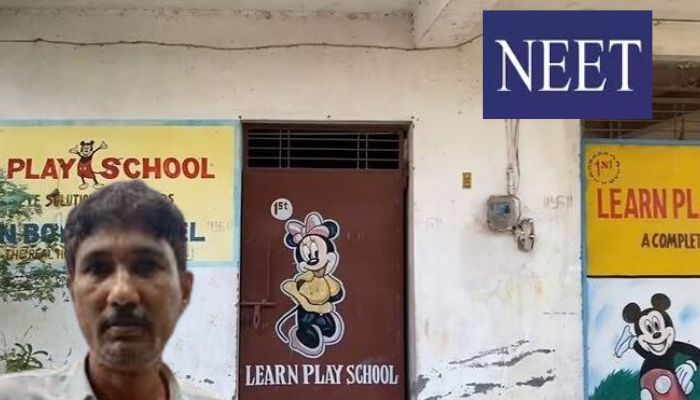
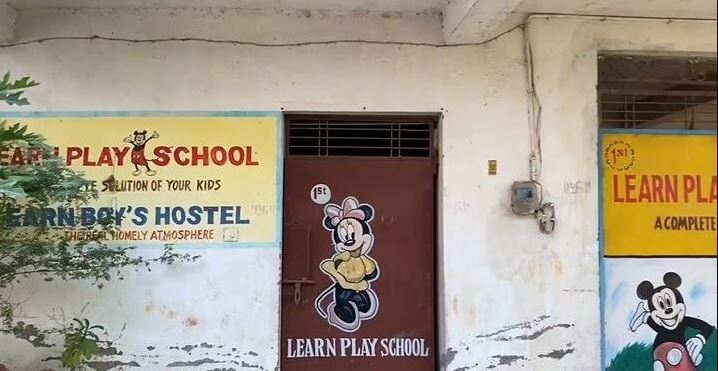
Additionally, on Sunday, the Bihar police said that the question papers were received by the accused at the now-closed Learn Play School that was used as a “safe house” by the accused. 

According to police, the accused, Chintu, who was arrested from Devghat was also present at the playschool when the question papers were received. 

Police stated that he got the solved question papers on the mobile phone. They added that Chintu received the solved question paper on his mobile phone on the morning of 5th May, the day of the examination, and took printouts of it via a WiFi printer. The students were made to memorise the question paper, they added. 

The Bihar police asserted that it was well-planned as a drop-off point was made 2 km from the playschool and the students were brought to the playschool in taxi cabs.

The Police noted that the question paper received by the accused came from Oasis Play School in Hazaribagh. There is evidence of tampering in the packaging of the question paper, they added. Click here, to read details about the events that transpired around the exam day and how, the accused got the exam paper through WhatsApp.  

As per reports, the investigation has raised questions on the role of the school’s management as the EOU has identified the involvement of Oasis school as suspicious in the paper leak case. According to EOU sources, NEET-UG paper booklet number 6136488 was leaked from Oasis School, Hazaribagh. Additionally, EOU also found evidence of tampering in the booklet box.

(As per the investigation findings reported in media, Sanjeev Mukhiya gang accommodated around 25 candidates at Learn Play School, where they were given exam paper and its solution, a day before the NEET exam, Image Source – Insider Live)

Shabbir Ahmed is the Chairman of the said school in question, Oasis School from where the paper is suspected to have leaked. Ehsanul Haque is the principal of this school. He also serves as the city coordinator of CBSE. Because of his position as city coordinator of CBSE, he oversees all centres in four districts in Jharkhand – Hazaribagh, Chatra, Koderma and Ramgarh – where NTA conducts exams. 

It is pertinent to note that earlier on 15th March, this year, the paper for the Bihar Public Service Commission (BPSC) teacher recruitment exam was also leaked from Hazaribagh. 

The modus operandi in that case involved relocating about 268 candidates, to various locations in Hazaribagh. Around 113 candidates were from Bihar’s Nalanda district, which is incidentally the native place of alleged mastermind, Sanjeev Mukhiya. 

In safe houses in Hazaribagh, the candidates were coached on the questions and answers the night before the exam. However, a Joint team comprising Jharkhand and Bihar Police apprehended candidates and individuals associated with the paper leak syndicate.

Investigation points out to the involvement of Sanjeev Mukhiya gang

The investigation so far has pointed out that the infamous Sanjeev Mukhiya gang could be involved in the NEET paper leak case. Sanjeev Mukhiya’s son, Dr Shiv, is already behind bars for involvement in the BPSC teacher recruitment exam paper leak. According to EOU sources, Sanjeev Mukhiya’s network uses Hazaribagh as a safe zone to operate across the Bihar border. 

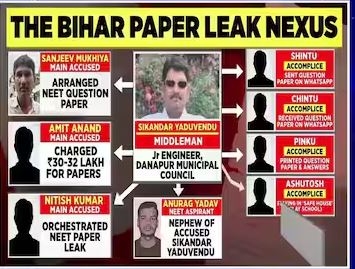
(Connection of key accused with each other, Image Credit – News18)

Sanjeev Mukhiya’s network

Currently, Bihar Police is actively pursuing Sanjeev Kumar, aka Sanjeev Mukhiya or Lutan, in connection with the NEET paper leak case. He is said to be the only prime accused absconding in this case. He is a resident of Shahpur Balwa village in Nalanda. 

Notably, he has been implicated in several exam paper leak incidents since 2010. Initially associated with Bihar’s biggest education mafia Ranjit Don, he later established his own criminal network. It is alleged that Sanjeev Mukhiya and his associates were recently involved in leaking the BPSC exam paper. 

His son, Dr. Shiv Kumar alias Bittu, was arrested in connection with the BPSC paper leak and is currently in custody. Sanjeev Mukhiya’s paper leak network is reportedly based in Nalanda, Bihar, with operations extending nationwide. In 2020, Sanjeev Mukhiya’s wife, Mamta Devi, contested elections on the Lok Jan Shakti Party ticket and has previously served as a Mukhiya.

On 21st April, Dr. Shiv Mukhiya was apprehended in Ujjain, Madhya Pradesh, along with four accomplices in connection with the NEET paper leak case. Previously, his name had surfaced in another NEET paper leak case reported at a police station in Patna back in 2017.

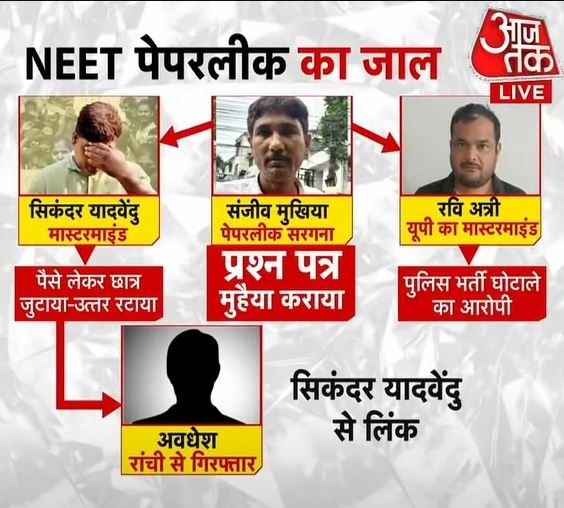
(Links between the arrested accused and mastermind of alleged NEET paper leak case in Bihar , Sanjeev Mukhiya, Image Source – Aaj Tak)

It is alleged that Sanjeev Mukhiya’s gang accommodated nearly 25 candidates at a boys’ hostel who had stayed at the Learn Play School in Patna on 4th May, a day before the NEET exam. Reportedly, the candidates were provided with the leaked question paper and answer sheets at the same hostel. The EOU has alerted police teams in Nalanda, Gaya, and Nawada districts in Bihar, and has printed pamphlets to trace him and arrest him.

Bihar Deputy CM and BJP leader accused Personal Secretary of Tejashwi Yadav to be part of the paper leak

Meanwhile Bihar’s Deputy Chief Minister Vijay Sinha has accused former Deputy Chief Minister Tejashwi Yadav’s personal secretary and Bihar Administrative Service officer Pritam Kumar for the leak. 

He said, “On May 1, Tejashwi Yadav’s personal secretary Pritam Kumar called guesthouse worker Pradip Kumar to book a room for Sikander Kumar Yadvendu. On May 4, Pritam Kumar called Pradip Kumar again to book the room. The word ‘Mantri’ was used for Tejashwi Yadav. Sikandar Yadvendu is a close relative of Tejashwi Yadav’s PS Pritam Kumar.” 

He added, “An NHAI guest house was booked for Sikandar’s sister Reena Yadav and son Anurag Yadav on May 4. A phone number and ‘Mantri Ji’ were mentioned in the NHAI guest house’s diary. The investigating agency is trying to identify this Mantri Ji.”

Latest development in the NEET-UG allegation probe case

Meanwhile, on Monday (24th June), a CBI team from Delhi reached the office of the Economic Offences Unit (EOU) of the Bihar Police in Patna in connection with its investigation into the allegations of irregularities in the medical entrance exam NEET-UG, officials said. They added that the EOU, which had been investigating the matter until the Centre ordered a probe by the CBI, has arrested 18 people in connection with the case. 

The CBI officers are collecting evidence related to the case from the EOU. An EOU officer said, “The evidence collected by the EOU during the course of investigation include pieces of the burnt question paper recovered from a house in Patna, mobile phones of those arrested, SIM cards, laptops, post-dated cheques and reference questions papers provided by the National Testing Agency (NTA).” 

He added, “All those arrested are in judicial custody in Patna, and the CBI team may take them to Delhi for detailed interrogation by obtaining transit remand from a court here.” 

A day earlier, the CBI filed a criminal case for irregularities in the exam and formed special teams to probe the matter. As per the agency’s FIR, certain “isolated incidents” occurred in a few states during the conduct of the NEET (UG) 2024 examination, which was held on May 5, 2024. In a shocking development in the case, a CBI team was allegedly attacked by locals in Bihar’s Nawada after which four persons were arrested by police on a complaint from the central agency. The incident occurred on Saturday evening when a team of CBI had gone to Kasiadeeh village in the area.

Nonetheless, as per reports, the CBI is also likely to file multiple FIRs to probe the destruction of evidence, and also register disproportionate assets (DA) cases against some of those accused who are public servants. 

CBI may probe other criminal antecedants of another prime suspect, Sikander Prasad Yadvendu

An officer stated that Yadvendu, a resident of Samastipur, has also been identified as the prime suspect in the case. He said, “A DA case may be registered against arrested accused Sikander Prasad Yadvendu, a junior engineer in Danapur Town Council, as he reportedly acquired huge assets that are disproportionate to his known source of income.” 

The officer added, “He has a history of involvement in criminal activities. Before becoming a junior engineer in 2012, he worked as a contractor in Ranchi. He was previously implicated in an LED scam worth Rs 3 crore. He has served a jail sentence for his role in that case.”

Meanwhile, the EOU is actively searching for 10 postgraduate doctors from the Patna-Ranchi Medical College, who allegedly assisted in solving the NEET question paper. 

This follows the detention of six additional individuals, including the prime suspect Chintu from Deoghar, Jharkhand. They were apprehended from a residence near AIIMS-Deoghar in the Devipur police station area on Friday night. Among those arrested were Chintu alias Baldeo Kumar, Paramjit Singh alias Bittu, Panku Kumar, Kaju alias Prashant Kumar, Ajit Kumar, and Rajiv Kumar alias Karu. Notably, the apprehended suspects Pintu and Chintu are said to be part of the network controlled by kingpin Sanjeev Mukhiya.

Pune: NCP MLA Dilip Mohite Patil’s nephew Mayur arrested after his speeding SUV runs over motorcycle leading to rider’s death

On Monday, 24th June, Maharashtra police arrested the nephew of a Nationalist Congress Party (NCP Ajit Pawar) MLA Dilip Mohite Patil after his speeding automobile collided with a bike, killing the 20-year-old rider in the Pune district on Saturday (23rd June) night. The arrested individual has been identified as Mayur Mohite Patil. 

According to police, the incident occurred on the Pune-Nashik national highway when an SUV driven by Mayur Mohite collided with Om Bhalerao’s motorcycle while driving on the wrong side of the road.

Bhalerao was severely injured during the incident. He was taken to a local hospital, where he died from his injuries, another individual who was on another bike is also said to have suffered severe injuries during the accident. He is being treated in the hospital. 

A case has been registered against Mayur Mohite Patil at Manchar Police Station under relevant sections of the law. “The accused was driving a Fortuner car on Pune-Nashik road. He was driving the car on the wrong side of the road while traveling to Manchar village when the vehicle had a head-on collision with the motorbike. The two-wheeler rider was seriously injured in the accident and lost his life,” the Pune Police authority was quoted as saying.

“Both the vehicles were badly damaged in the incident. The car driver has been arrested and a case has also been registered against him. We are conducting further probe into the incident,” he added.

Meanwhile, Dilip Mohite Patil commented on the matter and said that his nephew could not be said to be at fault and that he put the victim in the ambulance. “I am not trying to justify the accident. How did it happen is still a mystery as nobody saw what happened and whose mistake it was. My nephew who is in police custody is an engineer and he has never had alcohol. The police is investigating into the matter,” Patil said.

He also added that he would meet the family members of the deceased individual Om Bhalerao and pay his respects. As per the reports, the police were called to the spot by the locals after the incident happened on the Pune-Nashik highway on Saturday.

This comes months after the Porsche accident reported from Kalyani Nagar area of Pune. Last month an overspeeding Porsche, reportedly driven by a drunk teenager crashed into vehicles and killed two persons in East Avenue, Kalyani Nagar, Pune. A man and a woman named Anish Awadhia and Ashwini Costa were killed in the incident.

The drunk teenager’s speeding luxury car reportedly crashed into multiple vehicles before hitting a pavement. Locals rushed to the spot and assisted the injured persons. The teenager was also caught and thrashed by locals, allegedly for trying to flee the scene. Though the teenager, the son of a builder, was arrested, he was granted bail in just 15 hours.

Further, the 17-year-old, who was seen exiting a posh club in Pune at 2.30 AM that night, reportedly drunk and rashly driving his Porsche car, was asked by the Juvenile Justice Board to work with a traffic police official for 2 weeks and attend psychiatric counseling sessions. The teenager was also asked to write a 300-word essay on road accidents and create traffic awareness boards. However, after a massive social media outrage over the suspicious bail and questionable conduct of police and medical staffers, the bail was revoked. The teen was arrested and his rich family members who tried to sabotage the investigation were sent to jail too.

‘Nijjar ran terrorist training camps, visited Pakistan, and had contact with Khalistani terrorists’: Globe and Mail report shows how Canada protected a designated terrorist

On 22nd June, the Globe and Mail published a report on Khalistani terrorist Hardeep Singh Nijjar whose murder was remembered with a minute of silence in Canadian Parliament. In the report, the news portal explained how Nijjar was not only involved in running terrorist camps but also visited Pakistan, was on the no-fly list in Canada, had contacts with Khalistani terrorists and was involved in anti-India activities.

Hardeep Singh Nijjar was a controversial figure. He was designated as a Khalistani terrorist by the Government of India. He was killed on 18th June 2023 in a possible gang war. However, the Canadian government blamed the Government of India and Indian agents for killing him. Notably, four persons who were arrested in his murder case in May 2024 were associated with the Lawrance Bishnoi Gang.

Nijjar was a Sikh separatist leader who propagated the demand for a separate Sikh nation, Khalistan. He was living in Surrey, British Columbia Canada and was chief of Guru Nanak Gurdwara.

Early life and influence of Khalistani terrorist

Hardeep Singh Nijjar was born in Punjab in the 1970s. During his early life, his family used to provide shelter and food to Khalistani terrorists who were on the run from the law enforcement agencies. Globe and Mail talked to his associates and old friends who confirmed that Nijjar was highly influenced by Khalistani ideology and supported a separate Sikh nation.

In 1995, then-Chief Minister of Punjab, Beant Singh, was killed in a bomb blast. Following the assassination of the CM and 17 others by Khalistani terrorists, the law enforcement agencies came down heavy on the terrorists and their supporters. Nijjar escaped India and fled to Canada using the fake identity of a Hindu man. Ravi Sharma was the name on his passport. Reports revealed that he had trimmed his hair and beard to look like a Hindu man and conceal his Sikh identity.

After reaching Canada, he tried to get refugee status claiming he was tortured by the state police. However, as he consistently denied any involvement in Khalistani activities or association with armed terrorists, the immigration agencies did not provide him with refugee status. However, he continued to live in Canada and eventually was provided permanent residency followed by citizenship.

Life in Canada and association with Khalistani activities

With time, Nijjar became a significant figure within the local Sikh community. He ran a small plumbing business and became an active member of Guru Nanak Sikh Gurdwara. Over the years, he developed deep relations with pro-Khalistani elements and got involved in anti-India activities.

In 2015, he was accused of running a terror training camp in British Columbia, a claim that he had denied. However, an investigation was initiated against him by the RCMP but he was never charged. RCMP officials claimed while speaking to Globe and Mail that if he was associated with any terror activities, they would have taken action against him.

Khalistan advocacy

Nijjar wanted a separate Sikh state, Khalistan in India. He repeatedly called for violence and armed revolt against Indian authorities. Globe and Mail got access to a video from 2021 in which he urged Sikhs to take up arma and criticised those who preferred peaceful activism. This stance solidified his reputation as a dangerous figure in the eyes of the Indian government. However, his supporters argue that his rhetoric was a reflection of the warrior imagery prevalent in Sikh culture rather than actual incitement to violence.

Nijjar was a close associate of Gurpatwant Singh Pannun, a Khalistani terrorist and founder of the terrorist organisation Sikhs For Justice. Pannun poses as an advocate and practices law in New York. He was Nijjar’s counsel as well. Nijjar actively promoted the Khalistan Referendum that was initiated by Sikhs For Justice. Khalistan Referendum is a mock voting campaign initiated by Sikhs For Justice to show how many Sikhs around the world support the call for a separate Sikh nation.

India’s allegations against Hardeep Singh Nijjar

India has accused Nijjar of involvement in several violent incidents, including the 2007 bombing of a cinema in Ludhiana and an attempted murder in 2021. National Investigation Agency has named him in the case of the attempted murder of Hindu leader Kamaldeep Sharma.

In 2015, Indian agencies apprehended Mandeep Singh Dhaliwal who was a Surrey resident during his visit to India. A few days later, it was revealed that he was associated with a Khalistani terror training camp in Canada. He told Punjab police during interrogation that he had plans to carry out terror activities in Punjab and was sent by Nijjar to attack leaders of Sects. Furthermore, he informed the police that he was working with another terrorist to get arms and ammunition from Pakistan.

Globe and Mail talked to two people associated with Dhaliwal. They told on the condition of anonymity that Dhaliwal attended an arms training camp in 2015. Furthermore, five other Sikh radicals also took training at those camps. They were trained by Nijjar to operate weapons and GPS. They also learned how to communicate securely and did target practice at three different sites in the Lower Mainland.

Nijjar was also linked to gangster-turned-terrorist Arshdeep Singh Gill or Arsh Dala. He is the head of the Dala Lakhbir gang which uses Canada as a base for running an extortion ring in Punjab.

Hardeep Singh NIjjar visited Pakistan

In 1995, Jagtar Singh Tara, a Khalistani terrorist, was convicted and sentenced to life in the Beant Singh murder case. In 2004, he dug a 94-foot tunnel by hand and escaped from prison. Tara managed to flee to Pakistan where he spent years managing the terrorist group Khalistan Commando Force and its sister organisation Khalistan Tiger Force.

In 2013, Nijjar went to Pakistan and spent time with Tara. There are photographs available in the public domain where Nijjar was seen with Tara on the top of a Gurdwara in Pakistan. The t-shirt he was wearing in that photograph was the same one he was wearing in another photograph carrying an AK-47 assault rifle. According to Globe and Mail, the group photograph was taken outside Lahore in a Gurdwara. Another Sikh man from Surrey had gone with Nijjar whose daughter confirmed that the photograph was genuine.

Tara then appointed Nijjar to take over KTF. However, the Globe and Mail report claimed that Nijjar refused the offer. Later, in 2015, he told a group of senior Sikh community members that he was not “dumb enough” to take charge of a terrorist organisation in Canada. Contrary to this report, India has repeatedly accused Nijjar of being chief of KTF. KTF organised prayers for him after his death making it evident that Nijjar was associated with the terror outfit.

Assassination and diplomatic fallout

On 18th June 2023, Hardeep Singh Nijjar was killed by two gunmen as he was leaving the Gurdwara. His death prompted Canadian Prime Minister Justin Trudeau to claim that there were credible allegations of Indian government involvement. It led to a major diplomatic crisis between Canada and India. This accusation has been vehemently denied by Indian officials. India has repeatedly requested credible evidence of Indian agents’ involvement but Canada has failed to provide any. India has time and again called out Canada for allowing anti-India terrorist elements to flourish under Canadian political support.

While Canada accuses India of killing a Khalistani terrorist on Canadian soil, Canada’s own media houses are coming out with proof that he was indeed involved in terrorist activities. These reports are coming at a time when Canada remembered him with a minute of silence in its Parliament days ago.

“Have patience for 24-48 hours”: Supreme Court refuses to reverse HC order staying Arvind Kejriwal’s bail

On Monday (24th June), the Supreme Court refused to grant immediate relief to Delhi Chief Minister Arvind Kejriwal in his bid to reverse the High Court’s interim stay on a bail order given by a lower court last week. A vacation bench comprising Justices Manoj Misra and SVN Bhatti said it would like to wait for the High Court’s decision on the matter.

In place of issuing an order on Kejriwal’s plea today, the Supreme Court chose to defer it till June 26 to await the High Court’s final ruling. The Apex Court stated that it does not want to “pre-judge” the issue while the High Court’s order on the Enforcement Directorate’s stay application.

“If we pass order now, we will prejudge the issue. This is not a subordinate court…”, the Supreme Court said.

Representing Delhi CM Kejriwal, lawyer Abhishek Manu Singhvi contended that the “balance of convenience” favours Kejriwal since there is no reasonable ground for the Delhi CM to stay in jail. “If bail is reversed, he will certainly go back to jail… as he did after the Supreme Court’s interim release to campaign for the Lok Sabha election,” Singhvi argued.

Emphasising that the top court in its previous bail order has acknowledged that Kejriwal is not a “habitual offender” with no criminal antecedents, Singhvi said that since Kejriwal has a judgment in his favour, he should be allowed to stay out of jail in the interim.

Singhvi gave this argument when the court asked Kejriwal to remain patient for 24-48 hours till the High Court pronounces its order.

Notably, On 21st June, Justice Sudhir Kumar Jain and Ravinder Daudeja of the High Court issued an interim stay on the trial court’s ruling granting bail to CM Kejriwal. Today, the Supreme Court bench remarked that the High Court reserving order in stay cases is “unusual” adding that orders in such cases are given on the spot.

“In stay matters, judgments are not reserved but passed on the spot. What has happened here it is a bit unusual. We will have it day after,” the Supreme Court said.

To this, Singhvi argued that if the High Court can stay the lower court order from coming into effect without seeing it, why the Supreme Court judges can’t do the same. “If the HC can stay it without seeing the order, why can’t your lordships stay the HC order,” Singhvi argued.

The apex court, however, emphasised that it will not make the same mistake as the High Court, and deferred the hearing in the matter to 26th June when the High Court will announce its final order on ED’s application opposing the lower court’s order granting bail to the AAP supremo. “If HC has committed a mistake, why should we repeat it at our end?”, Justice Misra asked in response.

“The order impugned in this SLP is an order by which, after hearing the counsel of the parties, the order was reserved on the stay application, and till that, the operation of the bail order stayed. A perusal of the stay order would reveal that the parties were given the opportunity to file a short submission by 24th June 2024…Additional Solicitor General submits that the order on the stay application would be passed shortly and it would be appropriate if this Court adjourns the matter so that there is an opportunity…” the Supreme Court said.

Germany: Woman sentenced to prison for ‘offending’ convicted child rapist, who got away with probation

On Tuesday (18th June), a woman was convicted by a court in Germany for ‘offending’ a migrant, who was involved in the gang rape of a minor girl.

The Background of the Controversy

The case dates back to 19th September 2020 when a 15-year-old girl was gang raped in Hamburg city park in Northern Germany. The victim was heavily intoxicated at that time.

Four sexual predators took her to a nearby bush and took turns to rape her. The minor girl was then preyed upon by two other men who took advantage of her vulnerable state.

The rapists then called in other men to rape the victim in the Hamburg city park. The 15-year-old was subsequently raped for the third time by one man and then by 3 others for the fourth time in one night.

She later managed to escape the crime scene and seek assistance from people, who then called the police. The victim now suffers from PTSD (Post-traumatic stress disorder).

Justice delayed and denied

A total of 11 people were charged for the gang rape of the 15-year-old. However, two of them got away due to a lack of DNA evidence. The police were able to extract DNA evidence in the case of the remaining 9 accused.

However, the court handed 8 of them ‘probation’ ranging from 1-2 years. Only one of the accused was sentenced to a youth prison for two years and nine months without parole.

Interestingly, none of the rapists were of German origin. The ethnicity of the convicts included Polish, Egyptian, Libyan, Kuwaiti, Iranian, Armenian, Afghan, Syrian, and Montenegrin.

Woman sentenced for offending rapist

Following outrage over the brutal rape of a 15-year-old and the lenient nature of the sentencing by the court, the phone number and identity of one of the rapists were leaked on the social media platform Snapchat.

On learning about the matter, an angry 20-year-old woman dropped a message on the rapist’s number and labelled him a ‘dishonourable rapist pig’ and a ‘disgusting miscarriage.’

“Aren’t you ashamed when you look in the mirror?” she had texted the criminal. However, in a turn of events, the rape convict filed a complaint with the police who then booked the 20-year-old woman for making ‘harmful comments.’

On Tuesday (18th June), a court found the woman guilty and sentenced her to a weekend in prison for offending the convicted rapist, who got away with probation.

The police are now investigating 140 other people who made insulting remarks towards the criminal.

Keys to developing a successful Mobile Gaming App

In the ever-evolving landscape of mobile gaming, creating a successful app is both an art and a science. The mobile gaming market is highly competitive, with millions of apps competing for attention on various app stores. To stand out, developers need to focus on several key aspects that can make or break the success of their mobile gaming app. This editorial digs into the critical elements of developing successful mobile gaming, like a card gaming rummy app, providing insights into the entire process from conception to launch and beyond.

1. Understanding the Market and Target Audience

Before embarking on the development journey, it’s essential to conduct thorough market research. Here we will be talking more about researching and developing an app entirely based on the online card gaming industry. Understanding the current trends, popular genres, and the competitive landscape can provide valuable insights. Equally important is identifying and understanding the target audience. Knowing the preferences, demographics, and behavior of potential players who can play rummy or any other card game can help developers tailor the game to meet their expectations.

Market Analysis:

  • Study the most popular games in the market.
  • Analyze the features that make them successful.
  • Identify gaps or unmet needs that your game could fill.

Audience Profiling:

  • Define your target demographic (age, gender, location, etc.).
  • Understand their gaming habits and preferences.
  • Gather feedback through surveys or beta testing to refine your concept.

2. Crafting an Engaging Game Concept

A compelling game concept is the cornerstone of any successful mobile gaming app. The concept should be unique, engaging, and capable of capturing the player’s interest. This involves defining the core mechanics, storyline, and game objectives clearly.

Core Mechanics:

  • Decide on the genre (action, puzzle, online card, etc.).
  • Define the gameplay mechanics (e.g., match-3, endless runner, strategy).

Storyline and Characters:

  • Develop an engaging storyline that adds depth to the game.
  • Create memorable characters with distinct personalities.

Objectives and Rewards:

  • Clearly define the game’s objectives and how players can achieve them.
  • Implement a rewarding system to keep players motivated (e.g., levels, achievements, in-game currency).

3. Focusing on User Experience (UX) and User Interface (UI)

User experience and user interface design are critical to the success of a mobile gaming app. A game that is visually appealing and easy to navigate will retain players longer and encourage repeat play.

UI Design:

  • Ensure the interface is intuitive and easy to use.
  • Use attractive graphics and animations that enhance the gaming experience.
  • Optimize for different screen sizes and resolutions.

UX Design:

  • Make the game easy to learn but difficult to master.
  • Ensure smooth and responsive controls.
  • Provide clear instructions and feedback during gameplay.

4. Leveraging Advanced Technologies

Incorporating advanced technologies can significantly enhance the appeal of a mobile gaming app. These technologies can provide immersive experiences, seamless gameplay, and robust security.

Graphics and Animation:

  • Utilize high-quality graphics and animations to create visually stunning games.
  • Use game engines like Unity or Unreal Engine for robust and scalable development.

Artificial Intelligence (AI):

  • Implement AI to create challenging and adaptive gameplay.
  • Use AI for personalized user experiences and recommendations.

Augmented Reality (AR) and Virtual Reality (VR):

  • Consider incorporating AR or VR for a more immersive gaming experience.
  • Games like Pokémon Go have successfully leveraged AR to create engaging gameplay.

5. Ensuring Performance and Compatibility

Performance and compatibility are crucial for the success of a mobile gaming app. A game that crashes frequently or drains the battery quickly will frustrate users and lead to negative reviews.

Performance Optimization:

  • Optimize code to ensure the game runs smoothly on various devices.
  • Test for memory leaks and other performance issues.

Compatibility:

  • Ensure the game is compatible with multiple operating systems (iOS, Android).
  • Regularly update the game to support new OS versions and devices.

6. Implementing a Monetization Strategy

A well-thought-out monetization strategy is essential to generate revenue from the game. This can be achieved through various methods, such as in-app purchases, advertisements, and premium versions.

In-App Buys:

  • Offer items, tournaments, welcome bonus or rake backs, motivating players to join 
  • Ensure in-app purchases do not create an imbalance, maintaining fair play.

Advertisements:

  • Integrate ads in a way that does not disrupt the gameplay experience.
  • Consider rewarded ads, where players get in-game rewards for watching ads.

Freemium Model:

  • Offer a free version with limited features and a premium version with full features.
  • Provide a clear value proposition for upgrading to the premium version.

7. Rigorous Testing and Quality Assurance

Testing is a critical phase in game development. Rigorous testing helps identify and fix bugs, ensuring a smooth and enjoyable gaming experience.

Beta Testing:

  • Conduct beta testing with a small group of users to gather feedback.
  • Use the feedback to make necessary adjustments and improvements.

Quality Assurance:

  • Test the game on various devices and operating systems.
  • Ensure that all features work as intended and the game is free of critical bugs.

8. Effective Marketing and Launch Strategy

A successful launch is pivotal for the visibility and initial traction of the mobile gaming app. A well-planned marketing strategy can create buzz and attract a large user base from day one.

Pre-Launch Marketing:

  • Build a website and create social media profiles for the game.
  • Share teasers, trailers, and behind-the-scenes content to generate interest.

App Store Optimization (ASO):

  • Optimize the app’s title, description, and keywords for better visibility in app stores.
  • Use high-quality screenshots and an engaging video preview.

Launch Event:

  • Plan a launch event or campaign to maximize initial downloads.
  • Collaborate with influencers or gaming communities to promote the game.

9. Post-Launch Support and Updates

The journey doesn’t end at the launch. Continuous support and regular updates are essential to keep the game relevant and engaging.

Customer Support:

  • Provide robust customer support to address player issues promptly.
  • Use in-app feedback forms to gather player suggestions and complaints.

Regular Updates:

  • Release regular updates with new features, levels, and improvements.
  • Fix bugs and optimize performance based on player feedback.

Community Engagement:

  • Engage with the player community through social media and forums.
  • Organize events, contests, and challenges to keep players engaged.

Conclusion

Developing a successful mobile gaming app is a multifaceted process that requires careful planning, execution, and continuous improvement. By understanding the market, crafting an engaging game concept, focusing on UX/UI design, leveraging advanced technologies, optimizing performance, implementing a robust monetization strategy, conducting rigorous testing, and planning an effective marketing strategy, developers can create a game that stands out in the competitive mobile gaming industry. Post-launch support and regular updates further ensure the game remains relevant and enjoyable for players. With these keys to success, developers can navigate the complexities of the mobile gaming landscape and achieve their goals.

Outcry on thief Aurangzeb’s thrashing, silence on Dalit youth’s stabbing by Shahzad: Aligarh’s two cases exposes liberal hypocrisy

On Tuesday (18th June 2024), Mohammad Farid alias Aurangzeb was beaten to death on suspicion of theft in the Aligarh district of Uttar Pradesh. Subsequently, an FIR was registered against 10 named individuals and many other unknown persons on charges of murder. 6 accused have also been arrested so far in this matter. Many political parties, including the Samajwadi Party, have demanded compensation of Rs 50 lakh and even a government job to Aurangzeb’s family. Incidentally, on the same day in Aligarh, a Dalit youth was brutally stabbed by an accused from the Muslim community. The victim is currently undergoing treatment and is said to be in critical condition. Now his family members have come forward and raised questions about the ‘activism’ of so-called secular leaders for Aurangzeb and their stunned silence in the stabbing case.

The name of the Dalit victim is Nakul Jatav. His father, Dinesh, had complained to Sasni Gate police station on 18th June. The deceased Aurangzeb’s house also falls in the same police station area. In his complaint, Dinesh Bharti stated that on Tuesday evening, around 7 PM, his son had gone to Pathan Mohalla in the city for work. On the way, Naushad’s son Shahzad stopped Nakul and started hurling abuses at him. When Nakul objected, Shahzad got furious and said, “How dare you! Will you interject and quarrel with us?”

It is alleged that Shahzad then took out a knife he had hidden. He attacked Nakul repeatedly with it. Due to excessive bleeding, Nakul fell to the ground and lost consciousness. As soon as he was informed of the incident, Nakul’s father, Dinesh Jatav, arrived at the spot with the police. With the help of the police, he admitted Nakul to the hospital. Upon regaining consciousness, Nakul recounted the entire incident to the police. Seeing his serious condition, Nakul was referred to JN Medical College.

Dinesh Jatav has demanded strict action against the accused. Based on his complaint, the Police have named Shahzad in the FIR. He has been booked under IPC sections 504, 506, and 307, as well as section 3(2)(VA) of the SC/ST Act. OpIndia has a copy of the complaint. The police have arrested Shahzad. The investigation and other necessary actions are ongoing. 

The injured Nakul is undergoing treatment in the hospital and has undergone surgery.

A video has surfaced showing Nakul groaning in pain in the hospital

OpIndia has obtained a video of Nakul. In the video, the victim is lying on a hospital bed, crying. One of his hands is bandaged while the other is receiving glucose. His mother can be seen trying to calm her son while he is banging his legs on the bed in pain.

‘Why is the media speaking for the thief and silent for me?’

Nakul’s brother Pankaj told OpIndia that on the same day, the thief was beaten, and his brother was also stabbed. He mentioned that due to the attack, many veins in Nakul’s hands have been cut and a lot of blood has been lost. His brother questioned the media, asking why they had been raising Aurangzeb’s voice so loudly but was silent about his brother, even though both incidents happened on the same day and in the same city.

‘Am I at fault for being Hindu?’

Pankaj Jatav also sent a video message to OpIndia in which he can be heard saying, “Am I at fault for being Hindu?” Pankaj also lambasted politicians, mentioning that no one came to their house to see them. Pankaj Jatav described himself as alone in the fight for justice. He said, “All the leaders went there with the special community. No one came with me. They even threw stones, but we didn’t. Is all the pain only theirs? Do we not have any pain and distress?”

‘Compensation for them, we are indebted because of treatment expenses’

Pankaj also described the demand for compensation for the alleged thief Aurangzeb as one-sided. He mentioned that he had spent approximately Rs 40-50 thousand on his brother’s treatment. Pankaj has three brothers, of whom only two are earning and supporting the household expenses. Nakul’s father, Dinesh Jatav, is physically challenged in his legs. The brothers also shoulder the responsibility of caring for their mother and sister. The entire family lives in a very small house and struggles to manage. According to Pankaj, due to the expenses incurred on treatment, their family has incurred debt. They are unable to find a way to repay this debt.