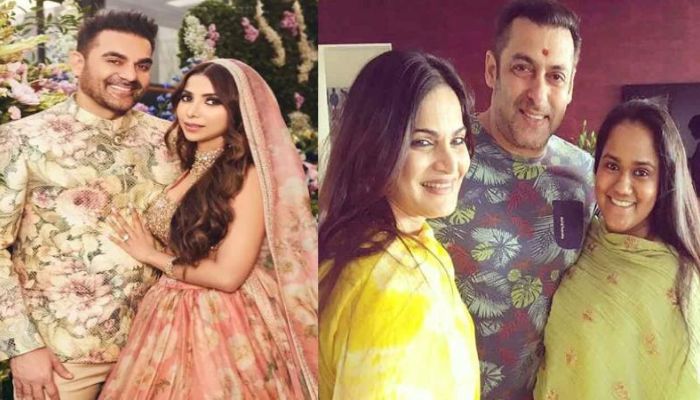
Bollywood actor Salman Khan’s younger brother, Arbaaz Khan, and make-up artist Sshura Khan married in December 2023. Their marriage is in discussion after a gap of three months. Reports suggest that when Arbaaz informed his family about his marriage to Sshura Khan, he was advised to reconsider his decision. Furthermore, it is claimed that both of Arbaaz’s sisters were not fond of Sshura.
According to a report by Zoom TV, Khan’s family was opposed to his marriage with Sshura because of her 8-year-old daughter from her previous marriage. The report suggests that following her separation from her husband, Sshura retained custody of her daughter and refrained from allowing her to meet her father.
In such a situation, when Arpita and Alvira came to know about it, they found it all very strange. They initially did not like Arbaaz’s choice. Salman Khan even asked his brother to think again before marriage. However, Arbaaz had already decided about this.
When Arbaaz Khan remained steadfast in his decision, the marriage ceremony was held at Arpita Khan’s residence. Arbaaz Khan and Sshura Khan followed the Nikah rituals under Islamic customs. Interestingly, during this occasion, the son of the separated couple, Malaika Arora Khan and Arbaaz Khan, was also present.
The report by Zoom TV also mentions that the actor has strongly refuted the speculations surrounding himself and Sshura Khan, labelling them as entirely fake and fabricated. He asserted that none of his family members objected to his marriage with Sshura. Expressing disappointment, he emphasised that the media reports are baseless. Furthermore, he clarified that the sources providing this information have no affiliation with his family.
While Arbaaz Khan has called this news false, his elder brother Salman Khan’s expression on the TV show Bigg Boss is also in discussion. When it came to advising Arbaaz in the finale, at that time, Salman Khan said- “No he does not listen to me, if he would have listened to me…” After this, Salman Khan became silent and everyone started laughing.
Arbaaz Khan and Sshura Khan tied the knot on 24th December 2023, with the presence of all their family members at the wedding ceremony. The 41-year-old Sshura first encountered the 56-year-old actor on the set of ‘Patna Shukla’, a film featuring Raveena Tandon in the lead role, where Sshura worked as a makeup artist. As their interactions progressed, they began dating.
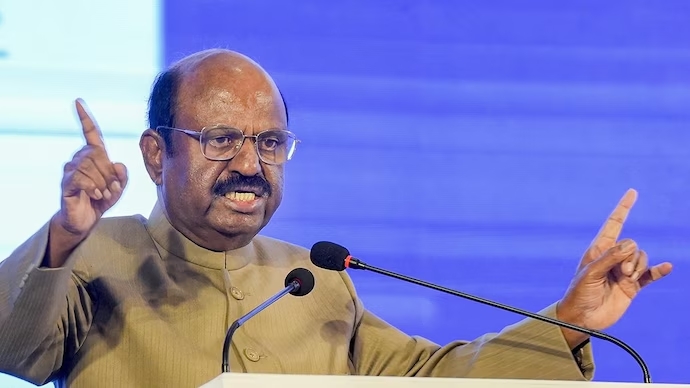
Governor CV Ananda Bose on Saturday said that his priorities are to combat violence and corruption during polling.
Elections in West Bengal will be conducted in seven phases on 42 seats according to the poll schedule announced today by the Election Commission of India for the 2024 Lok Sabha elections.
The elections will be held from April 19 to June 1 with counting of votes to be held on June 4.
Speaking to reporters here before the dates of the election were announced, the Governor said that he intends to be in the field from day one during the elections.
“My two priorities will be to see that violence is ended, corruption is ended during elections, that I will do to the best of my ability. I will be on the road by 6 am before others wake up.”
“I will be acting as part of the Jan Raj Bhavan, as a mobile Raj Bhavan and be available to the people,” Bose said.
Referring to his statement during the violence that took place during the Panchayat polls in the state last year, Bose said, “Political Holi with human blood will not be allowed in Bengal anymore.”
Amid tensions over the Sandeshkhali incident last month, Bose said that the Governor’s job is to see when the elected government takes action within the rule of law. If that is not done, then the governor will intervene.
(This news report is published from a syndicated feed. Except for the headline, the content has not been written or edited by OpIndia staff)
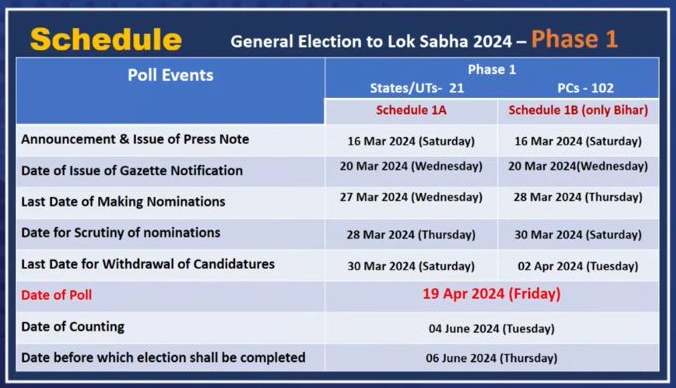
The Election Commission of India announced the dates for the general elections today, 16th March. The seven-phase elections will start on 19th April, and the last phase polls will be held on 1st June. The results of the elections will be counted on 4th June. Elections to 543 Lok Sabha constituencies in 37 states and union territories will be held in these seven phases.
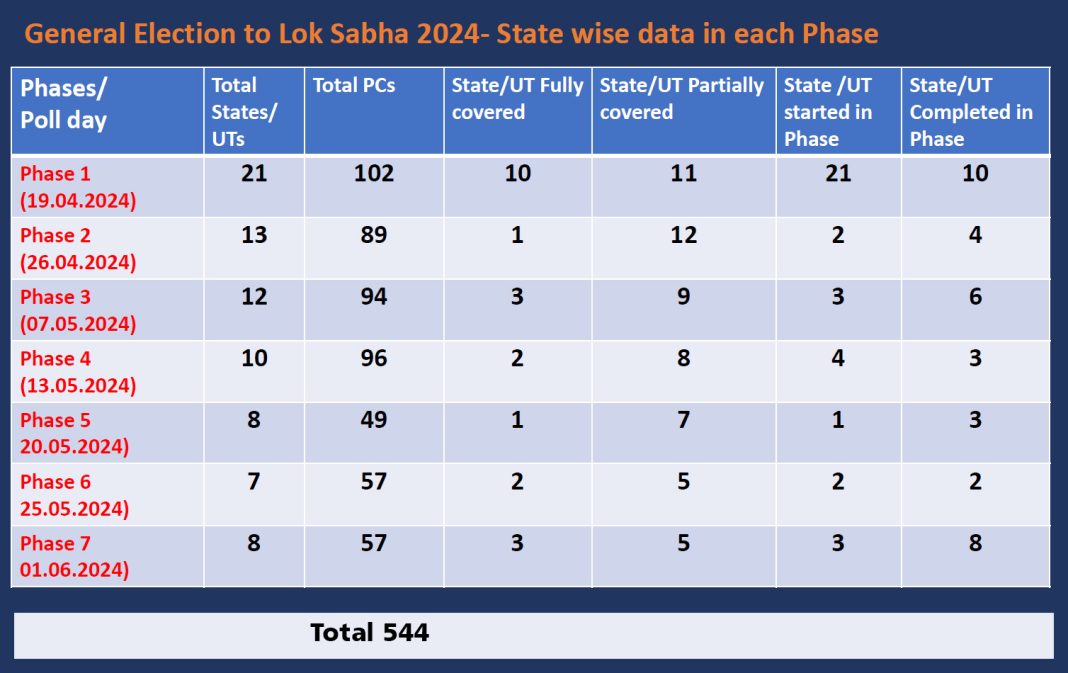
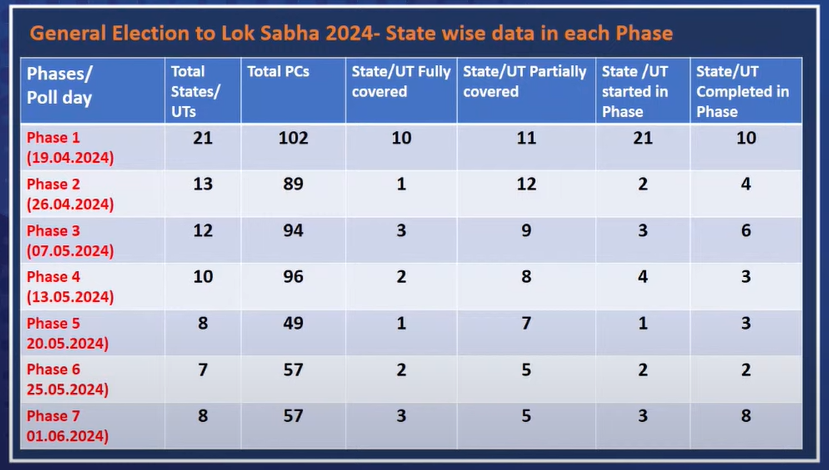
However, if one adds the number of seats going to polls in each phase, the total comes out to be 544. It is found both in the slide presented during the press conference, and the detailed schedule published by ECI on its website. The number of seats where polls will be held in each are 102, 89, 94, 96, 49, 57 and 57, totalling 544, which is 1 more than the total number of Lok Sabha seats.
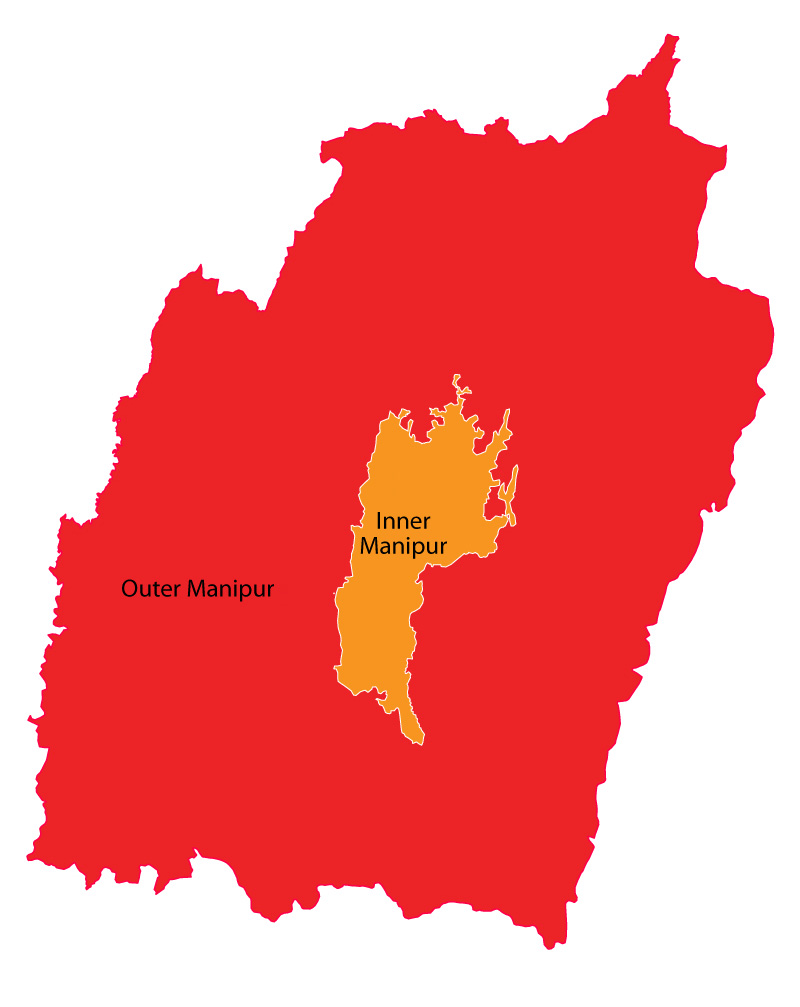
This is not an error, and the reason for this discrepancy is that for one Lok Sabha constituency, the elections are to be held in two phases. That constituency is Outer Manipur in Manipur, where elections will be held on two dates, 19th April and 26th April, first and second phases. Poll for the Inner Manipur constituency will be held in 1st Phase, along with parts of Outer Manipur.
Map of two Lok Sabha constituencies in Manipur
There are two parliamentary constituencies in Manipur, Inner Manipur and Outer Manipur. Inner Manipur largely consists of the Imphal valley at the middle of the state, while the Outer Manipur seat is made up of the surrounding hills, which is geographically much larger.
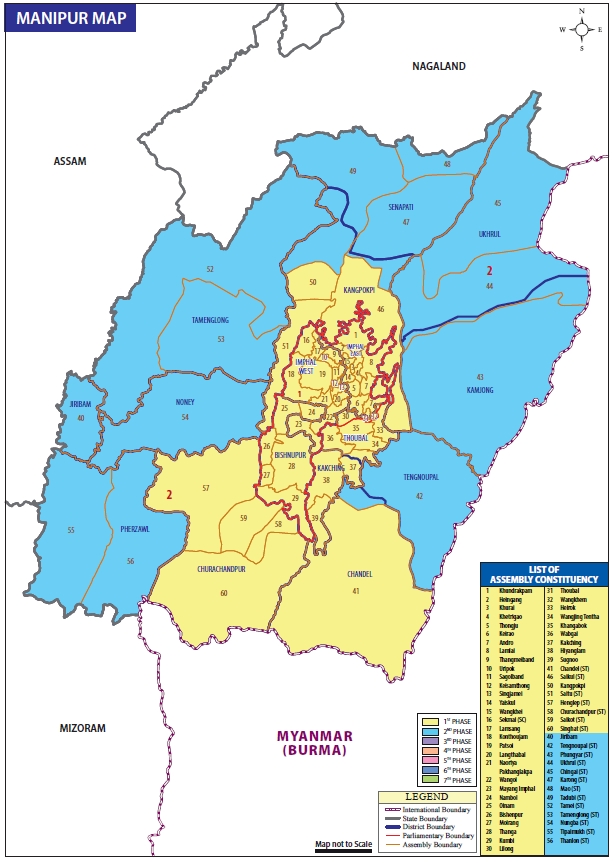
As per the ECI notification on the election schedule, Heirok, Wangjing Tentha, Khangabok, Wabgai, Kakching, Hiyanglam, Sugnoo, Chandel (ST), Saikul (ST), Kangpokpi, Saitu (ST), Henglep (ST), Churachandpur (ST), Saikot (ST) and Singhat (ST) assembly segments in Outer Manipur will vote on 19 April. For the for remaining assembly segments of Jiribam, Tengnoupal(ST), Phungyar(ST), Ukhrul(ST), Chingai(ST), Karong(ST), Mao(ST), Tadubi(ST), Tamei(ST), Tamenglong(ST), Nungba(ST), Tipaimukh(ST) and Thanlon(ST), the date of election is 26th April.
Map of two Lok Sabha constituencies in Manipur with dates of polls
Going by the map of these two constituencies and their elections dates, it is clear that Elections for Inner Manipur and the adjoining assembly segments of Outer Manipur will take place on 19 April, including Churachandpur, the epicentre of the violence last year. On the next phase, elections will be held in the remaining assembly segments in Outer Manipur, which are sparsely populated areas on the hills along the borders of the states.
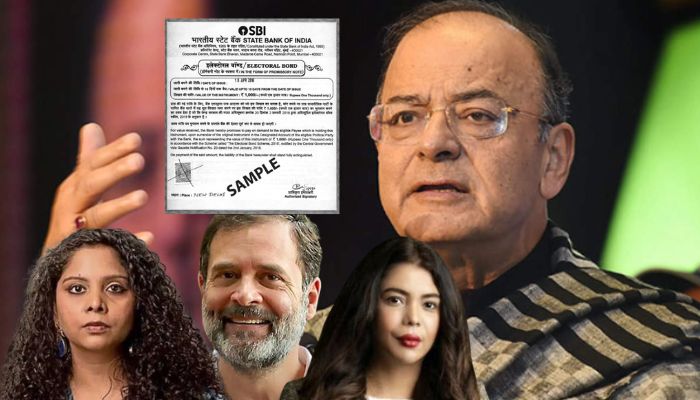
Following the disclosure of Electoral Bonds data by the Election Commission, the opposition and its friendly ecosystem went into a frenzy to churn canards and fake news in their perpetual smear campaign against the incumbent Modi government.
Conspicuously, the usual suspects suffered a massive setback in their original attempt to anyhow implicate Adanis and Ambanis in their conspiracy theories. Allegations of their corrupt nexus with PM Modi fell flat when their names were conspicuously absent from the list of donors who contributed money to political parties through the now-defunct Electoral Bond scheme.
Notably, spearheaded by Congress leader Rahul Gandhi, the coterie has been alleging that all policies of the Modi government are to benefit select business persons like Adanis and Ambanis. Despite failing in their planned scheme of things, the ecosystem led by Congress, however, went ahead to display its selective amnesia alleging that the ‘Electoral Bonds scheme is the biggest scam (extortion) in the history of Independent India’.
Narendra Modi ran the world’s largest Extortion racket in the name of electoral bonds.
नरेंद्र मोदी इलेक्टोरल बॉन्ड्स के नाम पर दुनिया का सबसे बड़ा वसूली रैकेट चला रहे थे।
Welcome to Karnataka, Prime Minister @narendramodi. Please answer why is @BJP4India silent about the electoral bond scam – the biggest corruption scandal in the world?
For a decade, you held power, promising to bring back black money from Swiss Bank, eliminate black money via…
Islamist propagandist Rana Ayyub ranted, “Astounding data from the Electoral Bonds to prove the deeply entrenched crony capitalism aided and enabled by Central agencies meant to contain corruption, led by a man who famously said ‘Na khaunga, Na khaane doonga’.”
Astounding data from the Electoral Bonds to prove the deeply entrenched crony capitalism aided and enabled by Central agencies meant to contain corruption, led by a man who famously said ‘Na khaunga, Na khaane doonga’
The Islamo-leftist coterie also alleged that the Modi government used coercion like using probing agencies ED, and CBI to solicit donations from scam-ridden firms. As usual, the coterie, however, applied their own conspiracy theory partially and selectively against their perennial adversary, Modi and the BJP. While they have alleged scams in the donation scheme and coercion by agencies, they granted immunity to opposition-ruled states and opposition parties for being the benefactors of this very scheme.
Incidentally, Santiago Martin of Future Gaming has come out to be the largest buyer of electoral bonds and has links to opposition parties in the likes of CPIM, DMK, Congress, and TMC.
Simple. Party against corruption aka BJP comes to power. Makes changes in many laws, allows companies to donate as much as they want, removes caps, allows Indian subsidiaries of foreign companies to donate. Also increases action by ED, IT etc. Who benefits the most? BJP. https://t.co/yMqLIf6OJ5
Megha Engineering and Infrastructure is one of the top donors of electoral bonds having donated 980 crores. CAG has recently pointed out to large scale irregularities in the 38,000 crores Kaleshwaram Lift Irrigation Scheme saying it was unviable and would bleed Telengana. MEIL…
‼️सबसे ज़्यादा Electoral Bond बनाने वाली जो Company है, Future Gaming Co. है, जिसने ₹1368 करोड़ के Bond ख़रीदे। उसके यहाँ ED छापा पड़ा 2 April, 2022 को। 5 दिन बाद उस Co. Electoral Bonds ख़रीदे।
Apart from baseless allegations, surmises, and conjectures that the corruption-strained firms donated to the Bhartiya Janata Party and not to the opposition parties, the cabal also retorted to using fake news. Notably, OpIndia had earlier busted how the Congress and DMK supporters were spreading fake news and lies about a ‘Pakistani company’ donating money to the BJP through electoral bonds. Click here, to read the truth.
It is pertinent to note that contrary to the cabal’s calibrated whining and grinning, several regional parties have garnered a substantive, in several cases, a disproportionate amount of donations through the Electoral bonds. For example, TMC which is at the helm only in one state, received Rs 1609 crores surpassing the national political party, Congress (Rs 1,422 crore).
Amidst the usual rhetorical tirade against the Modi government and canards around the Electoral Bond scheme, old videos of BJP stalwart Arun Jaitley defending and explaining the need for Electoral Bond schemes have surfaced on social media.
BJP lost many stalwarts in the last 10yrs but one Man who's immensely missed is Mr. Arun Jaitley! Not easy to find a worthy replacement. Here is AJ speaking about #ElectoralBondspic.twitter.com/mF94IXJPxv
Just listened to Arun Jaitley's 2017 speech at the Parliament House where he explained the importance of #ElectoralBonds with seriousness and simplicity.
In an era where seasoned leaders are scarce, his absence is still deeply felt. His ability to foster harmony and friendship… pic.twitter.com/Ug138WFhbI
Thank you late Shri Arun Jaitley ji for legalising the electoral bonds otherwise the public would have been kept in dark of the money that is involved for elections. How many Dhiraj Sahu with black money are there and still unknown? #ElectoralBondpic.twitter.com/9pxOcNZikX
— Gayatri ????(BharatKiBeti) (@changu311) March 15, 2024
Electoral Bond brought to curb black money for electoral funding
The electoral bond scheme was announced by the then finance minister Arun Jaitley in his Budget speech for 2017-18. He pitched it as an alternative to cash donations made to political parties as part of efforts to bring transparency to political funding.
He had said that there was a need to “cleanse the system of political funding in India”. Subsequently, he also went on to limit the cash donations to Rs 2,000 from one entity and proposed the electoral bond scheme.
Speaking about the electoral bond scheme that he had placed before Parliament, he said, “It envisages total clean money and substantial transparency coming into the system of political funding. A donor can purchase electoral bonds from a specified bank only by a banking instrument. He would have to disclose in his accounts the amount of political bonds that he has purchased.”
One of the viral videos pertains to April 2019 when the late Arun Jaitley, the then finance minister, defended the electoral bond scheme. He asserted that it was aimed at curbing the use of black money for funding elections, which the UPA-II regime sought to achieve through electoral trusts.
Jaitley had highlighted that both the electoral trusts – proposed by the then finance minister Pranab Mukherjee in 2010 — and electoral bonds brought by the Modi government assured total white money and improved transparency while masking the identity of the link between the donor and the party. Defending the anonymity clause for donors, the BJP stalwart emphasised, “If you ask people to disclose that (identity of a donor) also, then I am afraid the cash system will be back.”
He also highlighted that Pranab Mukherjee, the Finance Minister under the UPA II era also had made provisions for the anonymity of donors. According to Jaitley, Mukherjee had “masked” the identity by creating a pass-through electoral trust in 2010. A donor could donate to a registered electoral trust which in turn would donate to a political party.
Further, Jaitley also highlighted that people who are finding fault with the scheme were not coming up with any alternative to curb the use of black money in the electoral process.
On 7th January 2018, Arun Jaitley had also issued an official statement explaining the necessity of electoral bonds.
He had said that despite strengthening various institutions in the last seven decades, India had not been able to evolve a transparent political funding system.
(Excerpt from Arun Jaitley’s article titled – ‘Why Electoral Bonds are Necessary, Source – PIB)
He further said, “I do believe that donations made online or through cheques remain an ideal method of donating to political parties. However, these have not become very popular in India since they involve disclosure of donor’s identity.”
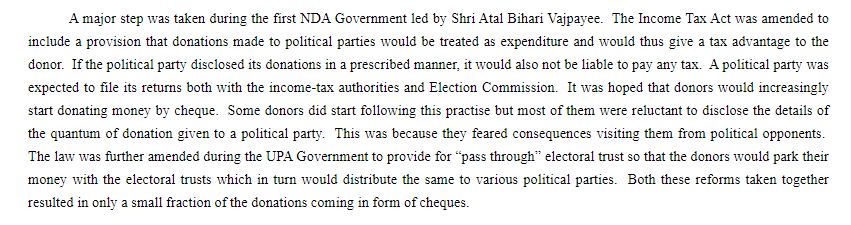
In fact, as part of political funding reforms, Arun Jaitley when he was the Law Minister in the Atal Bihari Vajpayee government, he had moved a Bill legitimising donations by cheque. However, the bill had a mandatory disclosure clause that the donor had to declare the same to Income-tax and the Election Commission.
Proponents of the anonymity clause have pointed out that in its absence, the donors would be susceptible to retributive and coercive measures by political parties that didn’t receive funding from them or for funding their rival party.
Return to cash donations would breed corruption: Union Home Minister Amit Shah
Recently, in an interaction with India Today’s Rahul Kanwal, Union Home Minister Amit Shah also strongly batted for the Electoral bonds. However, he noted that while he is ready to debate with anyone over the Electoral bond issue, he respects the Supreme Court’s ruling in the matter. He highlighted that the Electoral Bond scheme was brought to end the use of black money in the Electoral process. He also added that return to cash transactions for donations would result in corruption.
“Do you think the large corporate houses never donated to political parties until now? Where’s the data? Because of electoral bonds, those who donated, their names are out. We brought electoral bonds to end black money in politics. What secrecy are these people (opposition) talking about? They took thousands of crores in donations, did corruption to the tune of Rs 12 lakh crores, and are now demanding an explanation from us?” said Shah, hitting out at the allegations of corruption against the central government over electoral bonds.
Shah added, “I want to ask the people of the country. Before bonds were introduced, where did the political parties get money for elections? Was it black money or white money? The money donated through electoral bonds is white. Companies show in their balance sheets that they have donated money for elections. It is accounted for, unlike cash.”
Explaining the secrecy of the electoral bonds, the Home Minister stressed, “It was kept secret so that donors are assured that no one can harass them for donating to a particular political party. The electoral bonds are reflected on the party’s P&L sheet. It is also reflected in the company’s balance sheet. There is no secrecy about it. It was the earlier cash system where secrecy was needed and caused massive corruption.”
Conclusion
Contrary to the opposition’s shrill rhetoric, which relies on conjectures, surmises, and half-baked conspiracy theories, the Supreme Court struck down the Electoral Bond scheme citing a ‘lack of transparency.’ However, this does not necessarily imply that the scheme was a scam. In a nuanced debate between the need for secrecy (legally provided sanctity) to protect donors from witch hunts by rival parties following the disclosure of such data and the right of voters to have information about electoral funding for better judgment, the latter prevailed. This has sparked a possible redux of the Kesavananda Bharati judgment and a debate regarding the superiority of one fundamental right over another or Article 14 versus Article 368.
The usual suspects have used every possible permutation and combination to make preposterous allegations against the Modi government. From the Rafale deal to Adani and Ambani jibes, Agniveer, etc., desperately hoping that some of them will stick and deter the public from voting for the BJP. However, with no tangible evidence to pin the Modi government down, the usual suspects and their ecosystem is now grasping at the straws, relying on a combination of sensationalism, fear-mongering, and exaggeration to malign the Modi government. The outrage against electoral bonds is one such sordid attempt at undermining a democratically elected government, and it certainly won’t be last as Modi appears poised to return to power with an even greater majority.
A gruesome Pitbull dog attack has been reported from Haryana’s Sonipat, where the canine who was accompanied by its female owner, attacked a man’s genitals in an elevator. The entire incident was captured on CCTV camera. The victim has notified the authorities about the attack.
According to the information, the incident transpired at Kundli Parker Residency located on National Highway 44. A man named Sudarshan entered the society’s lift after he returned from his routine morning walk. Meanwhile, a woman named Poonam and her Pitbull were already there. The animal pounced on the male as soon as the lift’s doors opened and the latter entered.
Sudarshan suffered severe injuries as a result of the shocking dog attack on his private parts, and he was taken to a hospital for treatment. He is under medical care there. He informed that not one, but three to four canines of the same breed are kept as pets in the society. Pitbull dogs are being bred there even though the government has now proposed a ban on them.
Sudarshan complained that a report has been submitted to the authorities but the senior officials are not taking any strict action in the matter. A complaint has also been lodged with the Residents’ Welfare Association. They have promised that the dog’s owner will face consequences in addition to legal action in the case.
However, the matter at hand concerns how this breed of dog is being raised in spite of its impending ban. Sudarshan revealed that the society has at least three or four Pitbulls, and that too without permission. Notably, the administrative officers refused to say anything in front of the camera. The Kundli police station in-charge acknowledged that there had been a complaint but gave no specifics regarding the action taken.
The central government recently asked the states to prohibit the importation, breeding and sale of twenty-five “ferocious” dog breeds in order to combat the growing number of fatalities resulting from aggressive dog attacks. The breeds that are considered threatening to human life include Rottweilers, Pitbulls, Terriers, Wolf dogs and Mastiffs among others. Mixed breeds and crossbreeds of these species will also be banned. This ruling follows the submission of a report by an expert committee and animal welfare organisations in response to a Delhi High Court order.
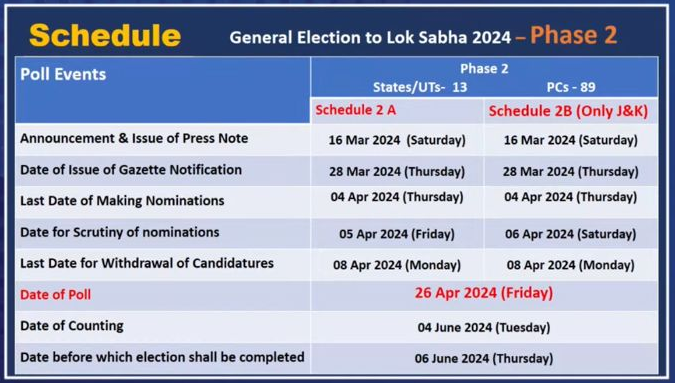
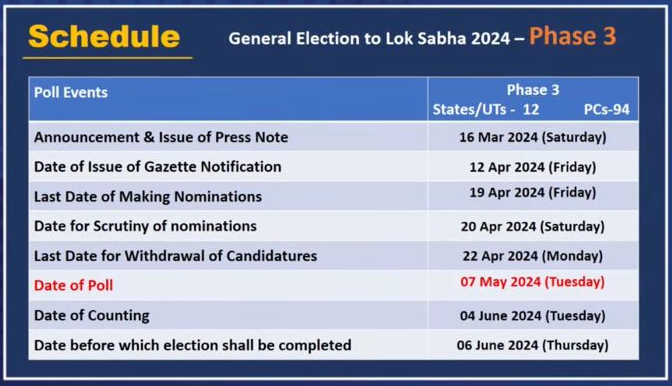
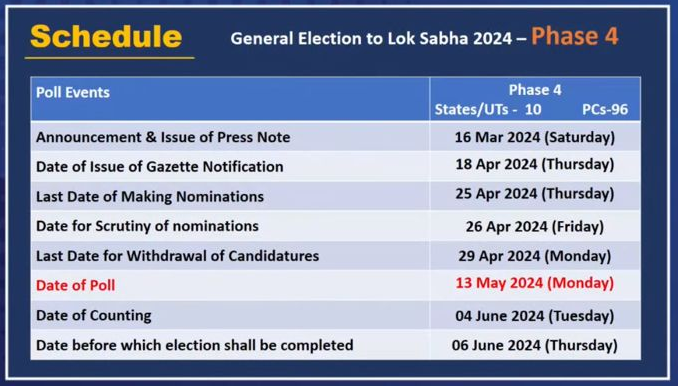
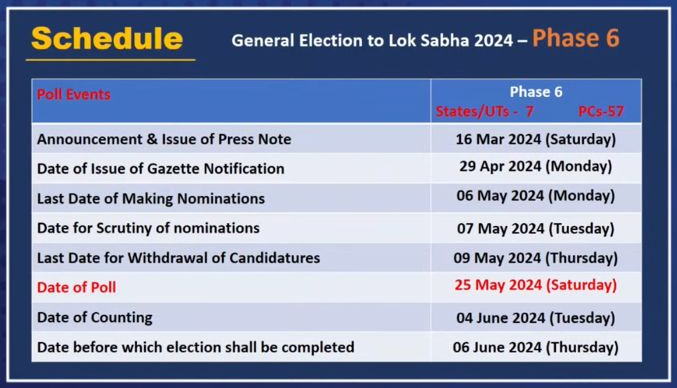
The Election Commission today announced the dates for the 2023 Lok Sabha elections, along with the dates of assembly elections in Andhra Pradesh, Sikkim, Arunachal Pradesh, and Odisha. The poll body held a press conference at the Vigyan Bhavan to announce the dates of the General Election 2024 with the model code of conduct coming into force immediately. The elections will be held in seven phases, starting from 19 April.
The votes will be counted on 4th June, and the results are expected on the same day.
Following are the dates of the Lok Sabha elections as announced by the Election Commission today:
First Phase – 19 April 2024
Second Phase – 26 April 2024
Third Phase – 7 May 2024
Fourth Phase – 13 May 2024
Fifth Phase – 20 May 2024
Sixth Phase – 25 May 2024
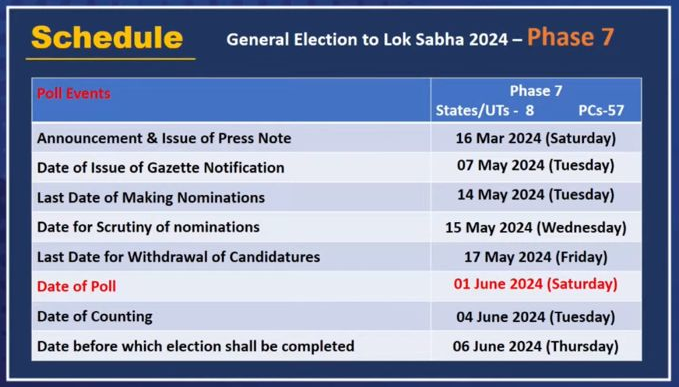
Seventh Phase – 1 June 2024
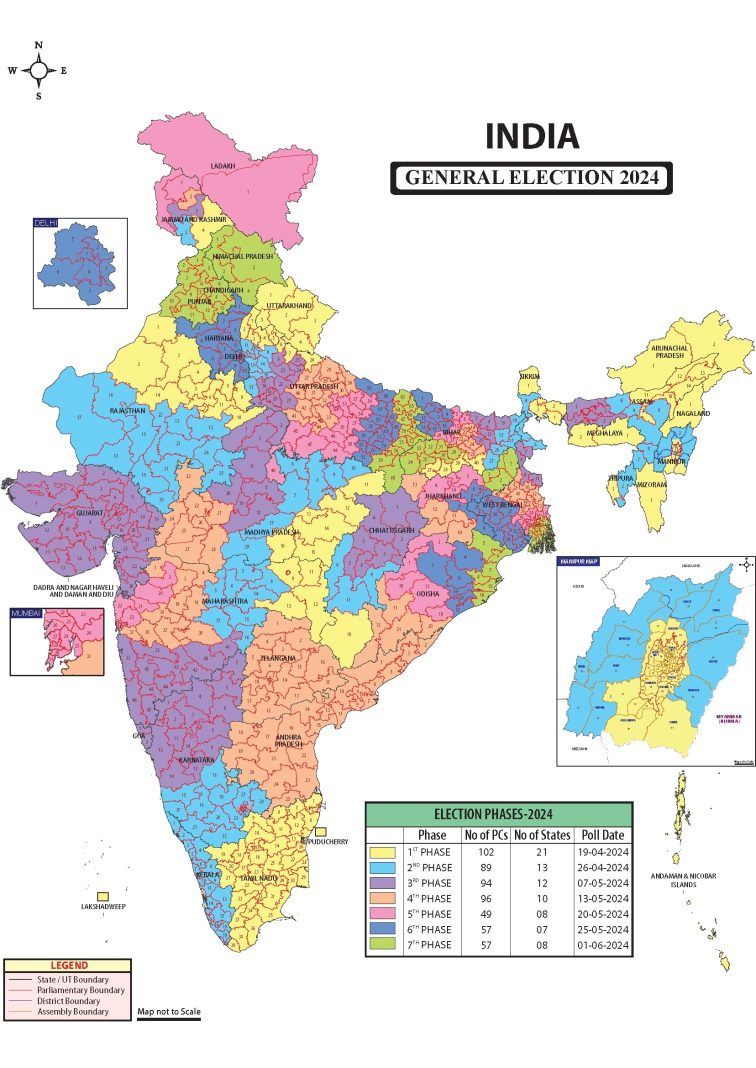
Here is the detailed schedule of all the phases of the elections, and the phase-wise map of the constituencies.
The detailed schedule of the elections for all the states and union territories is given below.
State/UT
No. of PCs
Poll Day No/ Date of Poll / Day of the week
1
2
3
4
5
6
7
19 Apr 2024
26 Apr 2024
07 May 2024
13 May 2024
20 May 2024
25 May 2024
01 June 2024
Friday
Friday
Tuesday
Monday
Monday
Saturday
Saturday
Andhra Pradesh
25
25
Arunachal Pradesh
2
2
Assam
14
5
5
4
Bihar
40
4
5
5
5
5
8
8
Chhattisgarh
11
1
3
7
Goa
2
2
Gujarat
26
26
Haryana
10
10
Himachal Pradesh
4
4
Jharkhand
14
4
3
4
3
Karnataka
28
14
14
Kerala
20
20
Madhya Pradesh
29
6
7
8
8
Maharashtra
48
5
8
11
11
13
Manipur
2
2
1
Meghalaya
2
2
Mizoram
1
1
Nagaland
1
1
Odisha
21
4
5
6
6
Punjab
13
13
Rajasthan
25
12
13
Sikkim
1
1
Tamil Nadu
39
39
Telangana
17
17
Tripura
2
1
1
Uttar Pradesh
80
8
8
10
13
14
14
13
Uttarakhand
5
5
West Bengal
42
3
3
4
8
7
8
9
Andaman and Nicobar Islands
1
1
Chandigarh
1
1
Dadra and Nagar Haveli and Daman and Diu
2
2
Jammu and Kashmir
5
1
1
1
1
1
Ladakh
1
1
Lakshadweep
1
1
NCT of Delhi
7
7
Puducherry
1
1
Total PCs
543
102
89
94
96
49
57
57
No. of States/UTs on each Poll Day
21
13
12
10
8
7
8
Date of Counting of Votes
04.06.2024
The detailed schedule of all the phases is given in the slides presented by the EC during the press conference.
With the announcement of the poll dates, the model code of conduct has come into force, and the govt will effectively work as a caretaker govt, unable to make any major policy decisions.
The dates of the assembly elections are as follows:
Andhra Pradesh – 13 May
Arunachal Pradesh – 19 April
Odisha – 13 May, 20 May, 25 May, 1 June
Sikkim – 19 April
Votes for the assembly elections will also be counted on 4th June.
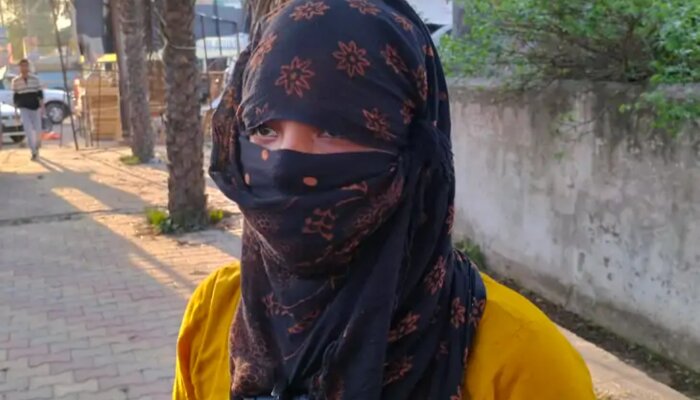
On 14th March, an alarming case of love jihad came to light in Gajraula Uttar Pradesh’s Amroha where a young woman from the Deehat police station area of Hapur district was befriended on Instagram by Nizam, a resident of Bhadaura which falls under the jurisdiction of Saidangali police station, by pretending to be Sanjay Kuma. The accused also took the victim to a hotel in Gajraula on 8th March and raped her. He has now been arrested.
The perpetrator not only used a fraudulent Hindu identification on his Instagram ID to trap the female but also duped her under the guise of a government job and sexually assaulted her in the hotel. Afterwards, she was shocked to learn the truth and his real name. She then narrated the entire ordeal to her family members.
Vishva Hindu Parishad and Bajrang Dal members also reached the police station with the girl and her family to submit a complaint as well as demanded strict action against the Muslim man on 14th March. The in-charge of the Brijghat police station who was present there reportedly misbehaved with them. The Hindu activists then started a protest in response and raised slogans against the official. They sat outside the police station’s gate and also demanded his transfer.
Enraged by the cop’s conduct, Hemant Kumar, Ashok Kumar, Vinod Garg, Vipin, Piyush, Kushal Chaudhary, Yogesh Chaudhary, Akhilesh Kumar, Abhishek, Pradeep Verma, Pritam Singh, Dinesh Agarwal and other Hindu activists started the demonstration. Circle Officer (CO) Swetabh Bhaskar and police station in-charge Harish Vardhan Singh pacified the people. The circle officer revealed that a report had been registered and the culprit was apprehended. He was sent to jail on 15th March.
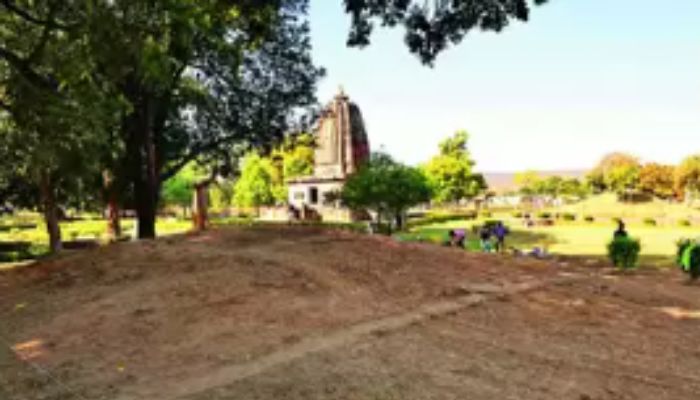
The Archaeological Survey of India (ASI) is excavating a site in a small village to uncover India’s oldest temples, which could predate the Gupta period. As per reports, the digging operations are underway in Nachne village on the Katni highway where the experts have identified two mounds.
These excavation sites are reportedly just 30 meters away from two ancient temples: a Gupta-era Parvati temple and the Chaumukhi temple (built by the Kalachuri Dynasty in the 6th-7th centuries CE). Additionally, these historically rich excavation sites are located less than 100 km from Khajuraho.
Speaking with the Times of India, ASI Superintending Archaeologist (Jabalpur circle) Shiva Kant Bajpayee said, “We are carrying out this excavation with the objective of finding the oldest temple in India.”
He added that the excavation work began on 4th March. According to him, it would take 3-4 months to complete the whole excavation process.
Bajpayee told TOI, “The oldest known temples in the country are from the Gupta era (4th to early 6th century CE). The majority of the earliest known temples of the country are in Madhya Pradesh — Temple No. 17 in Sanchi, the Nachne Parvati temple, Tigwa’s Vishnu Temple (in Katni district, 140km away) and Bhumara’s Shiva Temple (50km away, in Satna district). We are conducting these excavations with the hope of finding pre-Gupta-era temples.”
He added, “If we are not able to find it here, we will continue our exploration in the area as it cannot be that only Gupta-era temples exist. There can be temples older than that.”
According to the TOI report, sources with first-hand knowledge of the Nachne excavation site revealed that archaeologists believe what they have found so far indicates the discovery of the upper portion of a temple.
Bajpayee added, “There are eight archaeological mounds there. After seeking all requisite permissions, we have started excavation on two mounds. Both are around two metres in height and spread over 1,000 sqm.”
The Parvati temple was discovered in 1883-84 by Alexander Cunningham, the famed British military engineer. Cunningham is known for his excavations at Sanchi and Sarnath. Indian archaeologist R. D. Banerji visited the site in 1919. Nearly a century later, experts believe the area could uncover India’s oldest temple that would re-write history.
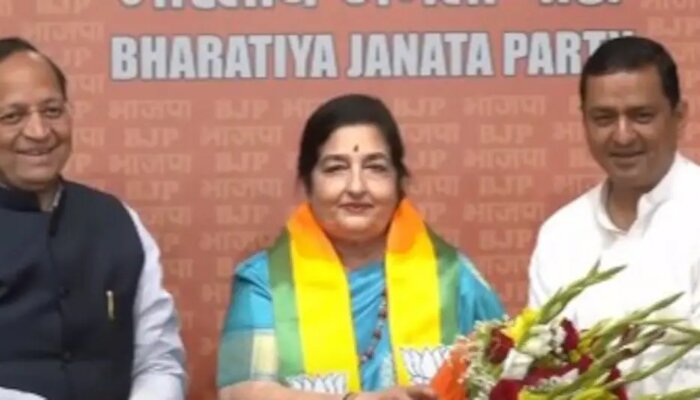
Renowned singer Anuradha Paudwal, who gained popularity in the 1980s and 1990s with her hit songs and devotional music, became a member of the Bharatiya Janata Party (BJP) on Saturday, 16th March, in New Delhi. Anuradha Paudwal expressed her happiness at joining a party with a “strong bond with Sanatan Dharma.”
“I am happy that I am joining the party which has a deep connection with Sanatan (Dharma). It is my good fortune that I am joining the BJP today,” she stated while addressing a press conference. Upon being asked if she would be contesting in the upcoming Lok Sabha elections, the seasoned singer responded, “I don’t know yet, (I will follow) whatever suggestion they give me.”
Anuradha Paudwal is a multilingual singer who has sung hundreds of bhajans and thousands of songs. She was born in Karwar, Karnataka and made her singing debut at the age of 19 in the popular film “Abhimaan,” in which she gave her melodious voice to Shiv Stuti “Omkaram Bindu Sanyuktam.” SD Burman, whom she would later collaborate with on multiple occasions, composed it.
Paudwal’s smash hit song “Tu Mera Hero Hai” from the Jackie Shroff-Meenakshi Sheshadri starrer ‘Hero’ established her reputation in Bollywood in 1983. She went on to win the first of her four Filmfare Awards three years later for “Mere Man Bajo Mridang” in Girish Karnad’s film Utsav. Her career peaked in the 1990s when her soundtracks for Aashiqui, Sadak, and Dil Hai Ki Manta Nahin mesmerised music fans.
Anuradha Paudwal concentrated mainly on spiritual music throughout the 2000s. She is recognised for her charitable endeavours as well. Anuradha Paudwal established the Suryoday Foundation in 2016 to help those in need of healthcare.
The recipient of several accolades, including a National Film Award, four Filmfare Awards (winning consecutively during 1990–92) and two Odisha State Film Awards, she has been honoured by the Government of India with the Padma Shri, the country’s fourth-highest civilian honour for her contribution in the field of arts. She was given the Mother Teresa Award in 2011 in recognition of her impressive work.
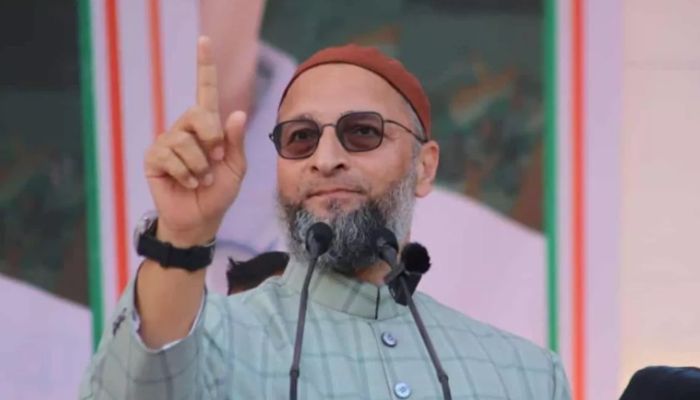
Asaduddin Owaisi, President of All India Majlis-e-Ittehadul Muslimeen (AIMIM), moved the Supreme Court on Saturday (16th March), urging for a halt on the implementation of the Citizenship Amendment Act (CAA). In his plea, Owaisi contended that the Act poses a threat to the Muslim community in India.
In his plea, Owaisi said, “The evil posed by the CAA is simply not one of under-inclusion of the grant of citizenship, but is very blatantly the isolation of a minority community to selectively take action against them consequential to the denial of citizenship.”
Asaduddin Owaisi contended that the government should refrain from entertaining or processing any applications for granting citizenship status under Section 6B of the Citizenship Act, 1955, as amended by the Citizenship (Amendment) Act, 2019, while the legal proceedings are ongoing.
Additionally, his petition also requested that no recourse be permitted under the proviso to Section 2(1)(b) of the Act. It is pertinent to note that in 2019, Owaisi submitted a petition to the Supreme Court, contending that the current Citizenship (Amendment) Act falls short of meeting the standards set by Article 14 of the Constitution.
AIMIM president Asaduddin Owaisi approaches the Supreme Court seeking to stay the implementation of the Citizenship Amendment Act (CAA), 2019 and the Rules, 2024.
Owaisi says no applications seeking grant of citizenship status be entertained or processed by the government under… pic.twitter.com/w8uQii4lyn
The petitions come amidst the implementation of the Citizenship Amendment Act (CAA) by the Central government. The Act, passed by Parliament in 2019, aims to expedite citizenship for non-Muslim refugees from Pakistan, Bangladesh, and Afghanistan, who arrived in India before December 31, 2014.
The notification of the Act has sparked criticism from opposition leaders. However, Union Home Minister Amit Shah has reiterated that the CAA does not strip anyone of their citizenship and is in line with the constitutional promise to grant refuge to persecuted religious minorities from neighbouring countries.
Asaduddin Owaisi’s move to challenge the CAA in the Supreme Court follows a series of developments, including the recent notification of the Citizenship Amendment Rules 2024 by the Central government. These rules aim to enforce the provisions of the CAA.
While the Supreme Court is set to hear the petitions on 19th March, the Government has defended the Act, emphasising its compliance with constitutional principles and its humanitarian intent to provide shelter to persecuted minorities from neighbouring Muslim countries.