Home Blog Page 1319

Pakistan: Mob assaults woman wearing dress with random Arabic words mistaking the text to be Quranic verses, woman apologises after police rescue her

In Lahore in Pakistan, Islamic fanatics assaulted a woman because they believed she committed blasphemy by wearing a dress with Arabic calligraphy. The mob, led by Tehreek-e-Labbaik Pakistan members, thought that the colourful Arabic text on the white dress was Quranic verses, and therefore she committed blasphemy, which is punishable by death in Pakistan.

The woman was spotted wearing the dress by the fanatics while she was dining at a restaurant in Ichhra Market in Lahore. A large group of people assembled soon after, who surrounded her, and hurled abuses and threats. Some of the crowd surrounded the woman, leaving her frozen in fear, while some bystanders attempted to protect her from lynching by the bloodthirsty mob.

As the situation escalated, police arrived at the scene and escorted the woman out from the spot. Videos of the incident have gone viral on social media, which show a female police officer escorting the woman, who was covered in a burqa by the cops. Reportedly, Assistant Superintendent of Police Gullberg (ASP) Syeda Shehrbano Naqvi took quick action to save the woman,

Punjab Police IG Dr. Usman Anwar praised the ASP for saving the woman, saying that the female police officer put her life in danger to rescue a woman from a violent crowd. “ASP Syeda Shehrbano Naqvi, the brave SDPO of Gulbarg Lahore, put her life in danger to rescue a woman from a violent crowd. For this heroic deed, the Punjab Police has recommended her name for the prestigious Quaid-e-Azam Police Medal (QPM), the highest gallantry award for law enforcement in Pakistan”, the IG said.

However, it was fund that the entire outrage was baseless, because there was no Islamic verse on the dress the woman was wearing. Those were just random Arabic words. It had words like beautiful, sweet etc in Arabic calligraphy.

ASP Syeda Shehrbano Naqvi said that they studied the dress on the dress and found that it didn’t have any Islamic verse. “It was a confusion,” she stated. Police said the woman and her husband had gone shopping when they were attacked by a mob who mistook the Arabic words on her dress as verses from the holy Quran.

Later it was revealed that the dress is from Saudi Arabian label Shalik Riyadh, which was launched during Ramazan in 2022. “The best Ramadan 2022 collection has arrived,” Shalik Riyadh had captioned while posting an image of the dress on Instagram.

On the other hand, the victim woman said that she wore the dress without knowing the content of the dress. She said that she thought the dress had just designer patterns, and didn’t know it was Arabic text. She apologised for wearing a dress with Arabic text, even though those were not religious verses.

“I didn’t have any such intention, it happened by mistake. Still I apologize for all that happened, and I’ll make sure it never happens again,” she said. The woman, who has not been identified, added, “As a Sunni Muslim, I could never think of doing any such action.”

She reiterated that she is a devoted Muslim and she will never commit any blasphemous act.

After the visuals went viral, some Pakistani netizens condemned the incident. However, some of them warned fashion labels against using such designs, as they are easily misunderstood, creating such incidents.

‘They are ending MSP under WTO policy’: As farmers justify demand to exit WTO, read how India is resisting western pressure to reduce farm subsidies

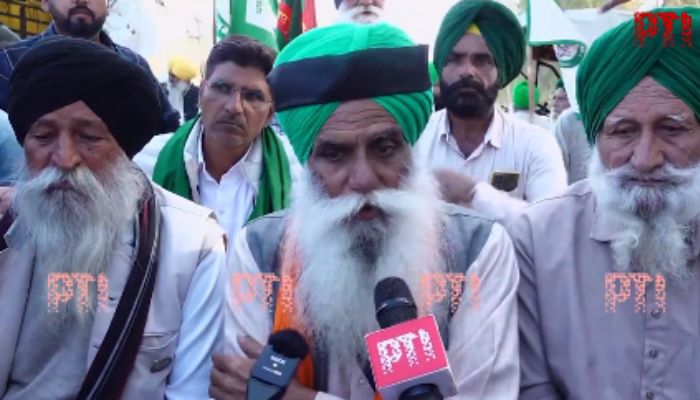
Apart from the enactment of a Law to ensure Minimum Support Price (MSP) for all crops, the protesting farmers also raised the demand that the Indian government should withdraw the agriculture sector from the World Trade Organisation (WTO). Speaking with media persons on Sunday (25th February), the leader of the protesting farmers Jagjit Singh Dallewal reiterated the same and explained the reason behind this demand.

He accused the Modi government of working under the WTO policy and trying to end the MSP at the multinational non-governmental forum adding that it will be harmful for Indian farmers.

He alleged, “We want MSP guarantee from the government, but under WTO policy, they are working to end MSP. If MSP ends under WTO, it will be harmful for our farmers as well, and we can’t let that happen. So, our demand is that the government should remove the agriculture sector from WTO’s agreement.”

Conspicuously, contrary to the allegations of the protestors, the Indian government has been resisting the pressure of several agriculture-exporting countries at the WTO and the multinational agency itself to reduce subsidies in agriculture, including MSP. Notably, an influential group of 19 agri-exporting countries – the Cairns Group has been trying to get India to “dismantle” the MSP scheme or “reduce its scope”, as per Abhijit Das, an expert on international trade and the former head, Centre for WTO Studies.  

The Cairns Group consists of countries such as Australia, Brazil, and Canada, which have accused India of heavily subsidising its public stockholding (PSH) program. They allege that India’s agricultural support distorts global food prices and negatively impacts the food security of other nations.

Despite their pressure on India to reduce agriculture subsidies including MSP, India has been maintaining it as per the Peace Clause of the Bali Declaration 2013 and fighting to get better legal protection for its MSP program.

Notably, Canada is one of the countries demanding the end of MSP in India at the WTO, while the same country is supporting the demand of legal guarantee of MSP by Punjab farmers.

The technicality explained

The peace clause was negotiated as a temporary solution at the Bali Ministerial Conference in 2013. It insulates developing nations against legal action in case they breach subsidy limits. 

However, it is restricted as it applies only to programs that existed before 2013. The existing Agreement on Agriculture puts a cap on public stockholding (PSH) programs of developing nations, including minimum support price (MSP), at 10 percent of the value of production of particular crops. This restricts developing countries from funding food security programs for millions of its poor and vulnerable population.

Additionally, the peace clause has many conditions or restrictions attached to it that make the country liable to legal proceedings in case of breaching the prescribed limit. 

India has invoked the ‘peace clause’ twice for exceeding the prescribed MSP limits. But, it faces scrutiny at the WTO over meeting conditions. At the WTO, India reported its rice production value for 2019-20 as $46.07 billion, with subsidies of $6.31 billion (13.7%), exceeding the 10% limit. However, the Government officials pointed out that India’s farmer subsidy is $300 per farmer, far lower than the US’s $40,000.

Farmers’ groups demand the government insist on a permanent solution to food security at Abu Dabi’s Ministerial conference

Pertinent to note that if the Union government agrees to the demands of the protesting farmers and if new schemes are implemented, then for those products, India will have to comply with the 10% subsidy ceiling and they will not be protected under the ‘Peace Clause’, as explained by Abhijit Das. 

According to Das, this means that if the government were to agree to farmers’ demands for an MSP law, it would not be covered under the peace clause that gives India protection from legal disputes at the WTO.

For this, the farmer groups have been demanding that the government push for a permanent solution to food security issues at the WTO’s 13th Ministerial Conference (MC13) because of the shortcomings and restrictions in the Peace clause. 

The Indian Coordination Committee of Farmers Movements (ICCFM) recently wrote a letter to Commerce and Industry Minister Piyush Goyal over this issue. It is a network of farmers’ organisations and includes farmers movements from Uttar Pradesh, Haryana, Punjab, Himachal Pradesh, Madhya Pradesh, Karnataka, Tamil Nadu, Kerala, and Maharashtra.

In its letter to Union Minister Piyush Goyal, the ICCFM wrote, “Attempts by agricultural export powerhouses to first allow only an onerous peace clause and then challenge the application of the peace clause highlight the need for a permanent solution. Amending the Agreement on Agriculture (allowing subsidies for food security under the Green Box without any limit) would provide greater legal certainty and address the limitations of the current clause.” 

India is working towards achieving more flexibility in providing agricultural support by advocating for a permanent solution at the upcoming inter-ministerial summit in Abu Dhabi, scheduled from February 26 to 29. India aims not only to revise the formula for calculating the food subsidy cap but also to ensure that programs implemented after 2013 are covered by the ‘Peace Clause.’

India will be represented by Union Minister Piyush Goyal at WTO MC13 in Abu Dhabi. At the meeting, many developed members, led by the US, would want to further postpone a permanent solution to public stockholding (PSH).

Read the grand history of Lord Krishna’s Dwarka where PM Modi performed underwater pooja, the divine city is older than the Indus Valley Civilization

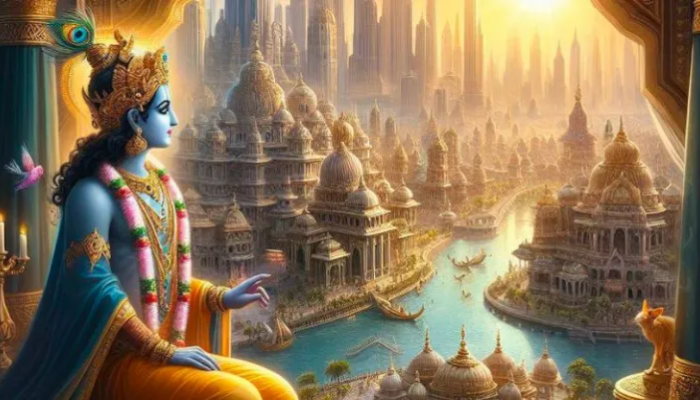
Four dhams (Hindu pilgrimage sites) and seven cities are regarded as exceedingly holy and sacred in Sanatan Dharma. Badrinath, Dwarka, Jagannathpuri and Rameshwaram are the four dhams whereas Ayodhya, Mathura, Maya (Haridwar), Kashi, Kanchi, Avanti (the former Malvani capital of Ujjain) and Dvaravati (Dwarka) are the seven holy cities. The 34th and 56th slokas of the Garuda Purana’s Pretkhand contain references to it. Furthermore, the Skandapuran’s Kashikhand also mentions the seven locations. It is stated that these four dhams and seven cities offer redemption. Dwaraka Dham is the most revered of them all. Dwarka is the only place that is both among the holy four dhams and the sacred seven cities. Dwarka possesses a fascinating and remarkable past of its own.

Prime Minister Narendra Modi visited the sacred city of Dwarka on 25th February. He worshipped Lord Krishna there and inaugurated the “Sudarshan Setu” which connects Bet Dwarka to the mainland. He later took a deep dive to offer prayers at the ancient submerged city of Dwarka where he offered a peacock feather in prayer. The Prime Minister remarked, “Praying in the water-filled Dwarka city was a divine experience. I experienced a sense of kinship with the ancient era of unending dedication and spiritual grandeur. May everyone be blessed by Lord Krishna.”

Lord Krishna built the great Dwarka, the most advanced and modern city of ancient India

Dwarka is regarded as a sacred and historic landmark. This gorgeous city’s illustrious past is also a fascinating subject. Dwarka was, at one point in time, the most developed and contemporary city in ancient India. Establishing a whole metropolis in the midst of the sea could have seemed extraordinary at the time. Remains of the underwater golden city of Dwarka have also been discovered on numerous recent expeditions.

Dwarka city is mentioned in all contemporary texts of Mahabharata. Following the killing of his maternal uncle and the despotic ruler of Mathura, Kansa by Lord Krishna, The former’s father-in-law and king of Magadha Jarasandha began a campaign of retaliation against the Yadavas. Lord Krishna decided to relocate to protect Vrajabhumi from constant assaults. He selected the Kushasthali region of Surashtra (present-day Saurashtra) for the purpose. Before arriving in Kushasthali, Lord Krishna battled and defeated the demons Kushaditya, Karnaditya, Sarvaditya, and Grihaditya and founded Dwarka on the shore.

As per the Srimad Bhagavatam, Lord Krishna asked for land and water to be diverted from the sea before building Dwarka. Varuna Dev gave a vast location in the heart of the ocean after realizing the Lord’s tenderness following which Vishwakarmaji constructed Dwarka. Dwarka was established by Lord Krishna, who also made it the main centre of his leela (divine play). Dwarka city itself hosted numerous significant events in the life of Lord Krishna, including Rukmani haran (elopement) and the marriage, Jambavati, Rohini, Satyabhama, Kalindi, Migvinda, Satya, Nagnajiti, Sushilamadri, Lakshmana, Datta Sushalya and Aniruddha among others. Other notable events included the management of the Mahabharata War, the protection of Draupadi from disrobing, Shishupala’s end and more. God performed all his leela from the Dwarka land.

Dwarka, a prosperous city of ancient India

Dwaraka’s material prosperity had reached its pinnacles of success during the period of Lord Krishna. Dwarka rose to prominence as ancient India’s most developed metropolis. Ancient Dwarka was a trailblazer in both science and international trade. Lord Krishna was also leading the Yadava dynasty to prosperity. Lord Krishna built a whole kingdom without the use of modern machinery amid the sea with vast mansions and palaces, as well as superior road and lighting systems. In ancient times, India was far ahead of the rest of the globe, and Dwarka had already reached the peak of urban development. Lord Krishna commanded the mightiest army in the ancient world. It was referred to as Narayani Sena (Army of Lord Vishnu). Great empires submitted in his name.

As time progressed, everything began to change, and the Yadavas began to indulge in pleasures as a result of advancements in material facilities. Tragedies began to occur often in Dwarka. The sages residing in the Pindtarana region were persecuted by the Yadavas but the sages pardoned them. However, the Yadavas began interfering with the religious practices of the sages. Therefore, the Yadavas were cursed by them. This was the first curse on the Yadava clan.

Gandhari’s curse and drowning of Dwarka

The curse of the sages was growing more potent by the day. Lord Krishna took part in the violent Mahabharata war at the same time. He arrived in Kurukshetra as Arjuna’s charioteer while the Kauravas were supported by his Narayani army. Throughout this intense, eighteen-day battle, Lord Krishna carried out numerous rituals. Arjuna received heavenly insight into the Srimad Bhagavad Gita. The Pandavas defeated the Narayani army because of the sages’ curse. The fierce war also resulted in the death of the Kauravas.

Gandhari broke down in tears upon learning that her and Dhritarashtra’s 100 sons had perished in this horrific clash. The Pandavas were being crowned at that moment. It was Yudhishthira who was going to take the throne, donning the auspicious Sangol. The mother of the Kauravas showed up in the Rajya Sabha (court) at the same moment. She cursed, “Just as the entire Kaurava dynasty collapsed, so will the Yadava dynasty succumb. Floods will inundate even the world’s most beautiful city, Dwarka,” blaming Lord Krishna for the war and the fate of her sons.

Lord Krishna gladly accepted her curse. However, when Gandhari realized her mistake and sought forgiveness from God. Lord Shri Krishna then remarked, “You have only become a mere object. The destruction of the Yadava dynasty was certain. A civilization that sleeps in greed and obscene luxury will surely perish.”

The Yadhuvanshi finally reached a point when they began to rebel and fight among themselves. In the meantime, Lord Krishna was dozing off one day in the Prabhas region’s forests. Unexpectedly, a hunter, who believed that there was an animal, fired an arrow that struck the feet of the Lord. As the hunter approached, he became aware of his error and started pleading with God for forgiveness. However, God told him at that moment that everything happens because of the former’s will. Lord Krishna abandoned his mortal form as a result. The Yadava dynasty crumbled as soon as Lord’s leela ended and Dwaraka was carried away in a massive tsunami. The lovely and divine city sank at that moment and thus the powerful empire of Lord Sri Krishna ceased to exist. There is other evidence to imply that the self-sacrifice of Lord Krishna marked the start of the Kali Yuga.

Dwarka is older than the Indus Valley Civilization

The illustrious past of Dwarka has been painstakingly researched by numerous historians. This comprises Jadunath Sarkar and a large number of international historians. However, no historian has been able to uncover its origins to date. Countless maritime expeditions have revealed the ruins of ancient Dwarka which also contain pillars, stones, vases and the complete celestial city of Lord Shri Krishna’s palace. It has been determined through testing that all of these findings date back more than 5000 years.

There is information about Dwarka in multiple contemporary Hindu texts. Dwarka’s literal meaning is ‘Gate of Heaven.’ Renowned historian AJ Chawda asserted that the empire of Lord Krishna predates the Indus Valley Civilization. The world’s oldest civilization is thought to have originated in the Indus Valley, with the Aryan culture. However, Dwarka City’s ruins date back more than 5,000 years. The Indus Valley Civilization expanded from the Sindh region to several Indian states, about 4,000 years ago.

AJ Chawda maintained that the Dwarka Civilization was what we refer to as the Indus Valley Civilization. Historians unearthed ancient sculptures of the Indus Valley Civilization which is estimated to be 4000-4500 years old. These idols include images of several deities as well as images of Lord Shiva and Goddess Parvati. Therefore, it is evident that the civilization rooted in Sindh was an Aryan civilization. He noted that Lord Krishna established Dwarika between 5500 and 6000 years ago and laid a foundation for Aryan culture at that point. The Dwaraka civilization covered parts of North and South India, as well as Saurashtra, Kutch, Sindh and many parts of Gujarat.

Dwarka was a sophisticated city in ancient India

Several scholars highlighted that Varanasi belonged to the Dwarka civilization as well. Varanasi is reputed to be the oldest city in the world. The unique aspect is that the cities of the Indus Valley Civilization, such as Mohenjo Daro, Lothal, Harappa, and Dholavira, were regarded as developed. Mohenjo Daro was seen as a highly advanced city. Its urban planning was excellent. However, there were similarities between the urban layouts of Mohenjo Daro and Dwarka but it was inferior to the latter in many aspects. However, Dwaraka is relegated to a minor role in the annals of history. The fact that Lord Krishna of Hinduism lived in Dwarka is one of the primary reasons behind it. However, the identity of the people who founded Mohenjo Daro is not known.

The field of history was dominated by left-wing historians from the British era till India gained independence. As a result, the existence of these holy cities and temples was kept a secret from the vast majority of the nation. Hindu animosity of the left-wing historians of that time is another reason as to why Dwarka’s name isn’t found in the venerable and old history books. Dwarka is mostly known as a holy destination, yet it has a 6000-year history. The Indian government has launched many missions and projects to bring the world’s attention to the underwater Dwarka. The glorious and divine history of the modern city of Dwarka in ancient India is gradually emerging through the initiatives of the Indian government.

Rajasthan Police rescues 125 cattle from forests in Karauli district after receiving a complaint of hearing strange sounds

0

The Rajasthan Police recently rescued around 125 cattle from the forests along the Gambhir River in Rajasthan’s Karauli district, as informed by the Police on Saturday (24th February). The Police carried out the rescue of these cattle under ‘Operation Nandi’. According to the Police, the cattle smugglers fled from there after noticing Police vehicles adding that a search operation is underway to nab them. 

According to reports, a person informed the police that strange noises had been heard for the past few days from the forests along the Gambhir River in Rajasthan’s Karauli. Subsequently, the police began patrolling and searching in the forest. Upon reaching the scene, the police team found around 125 hapless cattle tied in the forest along the Gambhir River. The police then released the cattle. 

Karauli district Police Superintendent Sumit Mehra stated that under Operation ‘Nandi,’ a team from the Hindoun City Police station in the New Mandi area freed 100 to 125 cattle from the forests near Khedli Gurjar village along the Gambhir River on Friday night. According to the police, as soon as the operation began, the cattle smugglers fled, and efforts are underway to apprehend them. 

In a statement, the SP mentioned that during the search operation in the forests along the Gambhir River near Khedli Gurjar village, the police found 100-125 cows and bulls tied together and in a starving and thirsty condition.

According to him, the villagers reported that the smugglers had gathered these cattle here and were planning to transport them to other states. According to the police, the smugglers likely fled upon seeing police vehicles. The police have handed over 32 cows and 26 bulls to the Banjar Gaushala in Phulwada.

The Karauli district SP stated that further investigation into the matter is underway.

Recently, the Alwar Police had carried out a crackdown operation after a ground report by Dainik Bhaskar journalists had busted a Beef Mandi operating in Kishangarh Bas of district Khairtal-Tijara. While the entire concerned Police Station was attached to the police line (line hazir), 4 Policemen were suspended in the Beef Mandi case. Additionally, the administration also carried out bulldozer action on the beef mandi. As per the FIR, Police booked Ibbar, Aslam, Saddam, Khalid, and others in Alwar’s illegal beef market case. 

PM Modi to lay foundation stone for over 2000 railway projects worth over ₹41,000 crore on 26 February, including 553 Amrit Bharat stations and 1500 overbridges

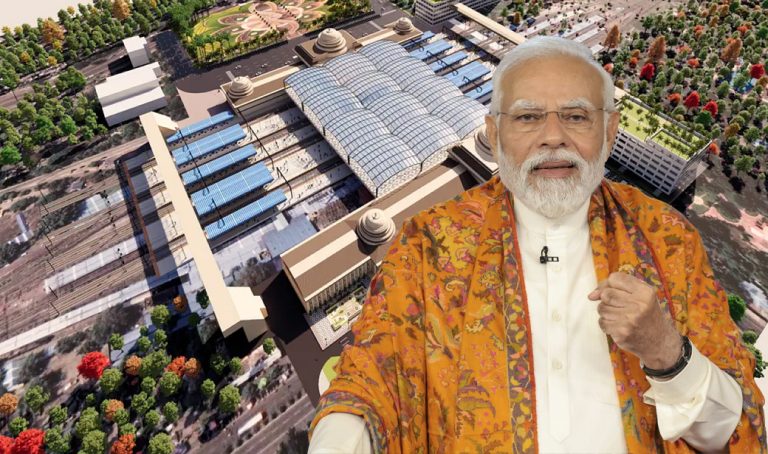
Prime Minister Shri Narendra Modi will lay the foundation stone, inaugurate and dedicate to the Nation around 2000 railway infrastructure projects worth more than Rs. 41,000 crores on 26th February at 12:30 PM via video conferencing.

In a major step in providing world class amenities at railway stations, PM Modi will lay the foundation stone for redevelopment of 553 railway stations under the Amrit Bharat Station Scheme. These stations, spread across 27 States and Union Territories, will be redeveloped at a cost of over Rs. 19,000 crores.

Over 1300 stations across the country have been selected for the Amrit Bharat Station Scheme, and foundation stones for 553 of them will be virtually laid by the PM tomorrow. Amrit Bharat Station scheme envisages development of stations on a continuous basis with a long-term approach.

It involves preparation of Master Plans and their implementation in phases to improve the amenities at the stations like improvement of station access, circulating areas, waiting halls, toilets, lift/escalators as necessary, cleanliness, free Wi-Fi, kiosks for local products through schemes like ‘One Station One Product’, better passenger information systems, Executive Lounges, nominated spaces for business meetings, landscaping etc. keeping in view the necessity at each station.

These redeveloped railway stations will act as ‘City Centres’ integrating both sides of the city. They will have modern passenger amenities like roof plaza, beautiful landscaping, inter modal connectivity, improved modern façade, kids play area, kiosks, food courts, etc. The stations will be redeveloped as environment friendly and also Divyang friendly. The design of these station buildings will be inspired by local culture, heritage and architecture.

One major feature of the Amrit Bharat stations will be that they will have accesses from both sides of the track. At present, most railway stations are accessible from only one side.

Further, Prime Minister will inaugurate Gomti Nagar station in Uttar Pradesh which has been redeveloped at a total cost of around Rs 385 crores. To cater to the increased future passenger footfall, this station has segregated arrival and departure facilities. It integrates both sides of the city. This centrally air-conditioned station has modern passenger amenities like Air Concourse, congestion free circulation, food courts and ample parking space in upper and lower basement.

Prime Minister Narendra Modi will also lay the foundation stone, inaugurate and dedicate to the nation 1500 Road Over Bridges and Underpasses in the country. These Road Over Bridges and Underpasses spread across 24 States and Union Territories, the total cost of these projects is around Rs. 21,520 crores. These projects will reduce congestion, enhance safety and connectivity, improve capacity, and efficiency of rail travel.

Rajkot: PM Modi inaugurates and lays foundation stone for projects worth over Rs. 48,100 crores including 5 AIIMS, over 200 health projects, power plants, pipelines and others

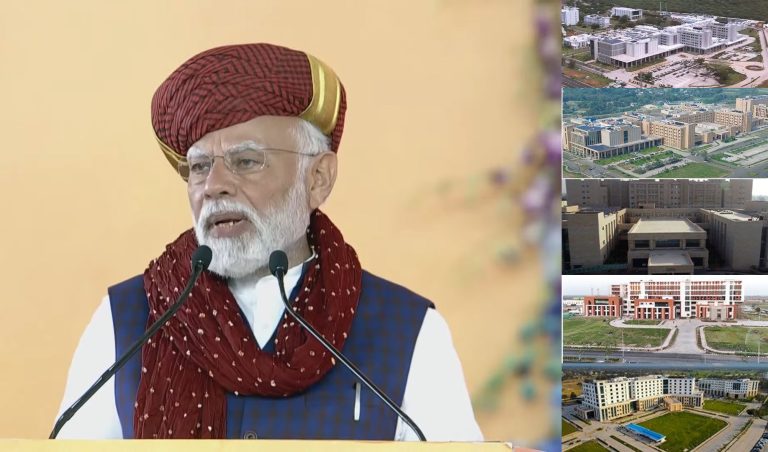
Prime Minister Narendra Modi dedicated to the nation and laid the foundation stone for multiple development projects worth more than Rs 48,100 crores in Rajkot, Gujarat today, 23 February. The projects encompass important sectors like health, road, rail, energy, petroleum & natural gas, and tourism among others.

Addressing the gathering, the Prime Minister acknowledged the virtual presence of Hon’ble Governors and Chief Ministers of States, Members of Parliament and Legislative Assemblies and Union Ministers and thanked them. The Prime Minister recalled the time when all key development programs were carried out in New Delhi alone and highlighted that the present government changed the trend and took the Government of India to every corner of the nation. “Today’s organization in Rajkot is a proof of this belief”, PM Modi said, underlining that the dedication and foundation stone laying ceremony is taking place in multiple locations in the country as it takes forward a new tradition. Recalling the inauguration of educational institutions of IIT Bhilai, IIT Tirupati, IIIT Kurnool, IIM Bodh Gaya, IIM Jammu, IIM Visakhapatnam and IIS Kanpur from a program in Jammu, Prime Minister Modi said that today marks the inauguration of AIIMS Rajkot, AIIMS Raebareli, AIIMS Mangalagiri, AIIMS Bathinda and AIIMS Kalyani. “The developing India is getting work done at a fast pace, especially when you look at these 5 AIIMSs”, Shri Modi added.

The Prime Minister recalled his long association with Rajkot and said that 22 years ago he was elected MLA from here. On 25th February 22 years ago, he took oath as the MLA. He said that he has done his best to live up to the trust of the people of Rajkot. “I can see that generations have changed but affection for Modi is beyond any age limit”, said a grateful Prime Minister.

Apologizing for the delay in today’s programme, the Prime Minister told the audience about his activities in Dwaraka earlier during the day where he inaugurated and laid the foundation stones of many development works including Sudarsan Setu. He once again narrated his divine experience of offering prayer at the submerged holy city of Dwarka. “Reading the archaeological and religious text fills us with wonder about Dwarka. Today I got an opportunity to see that holy scene with my own eyes and I could touch the holy remains. I offered prayers and offered ‘Mor-Pankh’ there. It is difficult to describe that feeling”, said the Prime Minister, still overcome with emotions from the experience. “In those depths, I was wondering about the glorious past of India. When I came out, I came out carrying the blessings of Bhagwan Krishna as well as the inspiration of Dwarka”, the Prime Minister said. “This gave a new strength and energy to my resolution of ‘Vikas aur Virasat’. A divine belief has become associated with my goal for Viksit Bharat”, he added.

Noting the development projects of today worth more than Rs 48,000 crores, the Prime Minister mentioned the New Mundra-Panipat pipeline commissioned to transport crude oil from the Gujarat coast to Indian Oil’s refinery in Panipat in Haryana. He also mentioned projects related to roads, railways, electricity, health and education. “AIIMS Rajkot is now dedicated to the nation after the inauguration of the International Airport”, the Prime Minister said, congratulating the people of Rajkot and Saurashtra. He also conveyed his best wishes to citizens of all cities where AIIMS is being inaugurated today.

“Today marks a historic occasion not just for Rajkot but the entire nation”, Prime Minister Modi said, highlighting that Rajkot today presents a glimpse of the desired levels of health facilities in Viksit Bharat. He pointed out that the nation had only one AIIMS for 50 years of independence, that too in Delhi. He added that even though only seven AIIMS were commissioned during the seven decades of independence, some of them couldn’t be completed. “In the last 10 days, the nation has witnessed the foundation stone laying and inauguration of seven new AIIMS”, the Prime Minister remarked, highlighting that the present government has accomplished things at a faster pace than what was done in the last 70 years, thereby taking the country on the path of development. He also mentioned laying the foundation stone and dedicating more than 200 health infrastructure projects including medical colleges, satellite centers of multi-speciality hospitals and centers for the treatment of worrying ailments.

Reiterating the promise of ‘Modi ki Guarantee meaning the guarantee of fulfillment of guarantee’ the Prime Minister said that the foundation stone for Rajkot AIIMS was laid by him 3 years ago and today that guarantee was fulfilled. Similarly, a guarantee of an AIIMS was given to Punjab and the foundation stone as well as inauguration was done by PM Modi. The same cycle has taken place for Raebareli, Mangalgiri, Kalyani, and Rewari AIIMS. In the last 10 years, 10 new AIIMS have been sanctioned in different states. “Modi ki guarantee begins where expectations from others end”, said PM Modi.

The Prime Minister said that the pandemic could be handled in a credible manner due to the improvements in the healthcare system and infrastructure in the last 10 years. He mentioned the unprecedented expansion of AIIMS, Medical Colleges and Critical Care Infrastructure. There are more than 1.5 lakh Ayushman Arogya Mandirs in villages for small ailments. The Prime Minister said that today, the number of medical colleges has reached 706 from 387 in 2014, more than 1 lakh MBBS seats from 50 thousand ten years ago, 70 thousand post-graduate seats, up from 30 thousand in 2014. More doctors will come out of these colleges in the next few years than the number of doctors in the entire 70 years since independence, he said. There are 64 thousand crore rupees worth Ayushman Bharat Health Infrastructure Mission going on in the country. Today’s event also saw projects like medical colleges, TB hospital and research center, PGI satellite center, critical care blocks and dozens of ESIC hospitals.

“Government prioritizes the prevention of disease as well as the capacity to fight it”, the Prime Minister said, highlighting the emphasis on nutrition, Yoga, Ayush and cleanliness. He underlined the commitment to promoting both traditional Indian medicine and modern medicine and gave examples of the two big hospitals and research centers related to Yoga and Naturopathy being inaugurated in Maharashtra and Haryana today. He also mentioned WHO’s global center related to the traditional medical system is also being built here in Gujarat.

In a bid towards helping the poor and middle class save money while also availing better healthcare facilities, the Prime Minister threw light on the Ayushman Bharat Yojna which has helped save Rs 1 lakh crore, and Jan Aushadhi Centers that provide medicines at an 80% discount thereby saving Rs 30 thousand crores. Under the Ujjwala Yojna, the poor have saved more than Rs 70,000 crores, citizens have saved Rs 4,000 every month due to low cost of mobile data and taxpayers have saved about Rs 2.5 lakh crores due to tax-related reforms.

The Prime Minister also elaborated on the PM Suryaghar Scheme that will bring the electricity bill to zero and will create income for the families. Beneficiaries will get 300 units of free electricity and the remaining power will be purchased by the government. He also mentioned large wind energy and solar projects such as two plants in Kutch for which foundation stones were laid today.

Noting that Rajkot is a city of workers, entrepreneurs and artisans, the Prime Minister talked about PM Vishwakarma Yojana worth Rs 13,000 crores benefitting lakhs of Vishwakarmas. In Gujarat only 20,000 Vishwakarmas have already been trained and every Vishwakarma received an assistance of Rs 15,000. He also informed that in PM SVANidhi scheme, assistance of Rs 10,000 crores has been disbursed to street vendors. Street vendors of Gujarat received about Rs 800 crores worth of assistance. In Rajkot itself, more than 30,000 loans have been disbursed, he said.

The Prime Minister underlined that the mission of Viksit Bharat gets stronger when the citizens of India get empowered. “When Modi guarantees to make India the world’s third largest economic superpower, the goal is health for all and prosperity for all”, the Prime Minister concluded.

Chief Minister of Gujarat, Shri Bhupendra Patel, Union Minister for Health and Family Welfare, Dr Mansukh Mandaviya and Member of Parliament, Shri C R Patil were present on the occasion among others.

Background

In a significant step towards strengthening tertiary health care in the country, the Prime Minister dedicated to the nation five All India Institute of Medical Sciences (AIIMS) at Rajkot (Gujarat), Bathinda (Punjab), Raebareli (Uttar Pradesh), Kalyani (West Bengal) and Mangalagiri (Andhra Pradesh).

The Prime Minister laid the foundation stone and dedicated to the nation more than 200 Health Care Infrastructure Projects worth more than Rs 11,500 crore across 23 States /UTs.

The Prime Minister dedicated the Medical College of JIPMER at Karaikal, Puducherry and 300 bedded Satellite Centre of Post Graduate Institute of Medical and Educational Research (PGIMER) in Sangrur, Punjab among others. He inaugurated 90 bedded Multi Specialty Consulting Unit of JIPMER at Yanam, Puducherry; National Centre for Aging in Chennai;  new Government Medical College in Purnea, Bihar; 2 field units of ICMR namely, National Institute of Virology Kerala Unit, at Alappuzha, Kerala and National Institute of Research in Tuberculosis (NIRT): New Composite TB Research Facility, Tiruvallur, Tamil Nadu among others. The Prime Minister laid the foundation stone for various health projects including 100 bedded Satellite Centre of PGIMER at Ferozpur, Punjab; new Medical College building in RML Hospital, Delhi; Critical Care Block in RIMS, Imphal; Nursing Colleges at Koderma and Dumka in Jharkhand, among others.

In addition to these, under the National Health Mission and Prime Minister-Ayushman Bharat Health Infrastructure Mission (PM-ABHIM), the Prime Minister also inaugurated, dedicated to the nation and laid the foundation stone of 115 projects. These include 78 projects under PM-ABHIM (50 units of Critical Care Blocks, 15 units of Integrated Public health Labs, 13 units of Block Public Health Units);  30 units of various projects like Community Health Centre, Primary Health Care Center, Model Hospital, Transit Hostel etc. under National Health Mission among others.

The Prime Minister also inaugurated the National Institute of Naturopathy named ‘Nisarg Gram’ in Pune. It comprises Naturopathy Medical College along with 250 bedded hospital with multi-disciplinary Research and Extension Centre. Further, he will also inaugurate the Central Research Institute of Yoga & Naturopathy at Jhajjar, Haryana. It will have apex level Yoga and Naturopathy Research facilities

During the event, the Prime Minister inaugurated and dedicated to the nation 21 projects of the Employees’ State Insurance Corporation (ESIC), worth around Rs. 2280 crores. Projects being dedicated to nation include  2 medical colleges and hospitals at Patna (Bihar) and Alwar (Rajasthan); 8 hospitals at Korba (Chhattisgarh), Udaipur (Rajasthan), Adityapur (Jharkhand), Phulwari Sharif (Bihar), Tiruppur (Tamil Nadu), Kakinada (Andhra Pradesh) and Raigarh & Bhilai in Chhattisgarh; and 3 dispensaries at Neemrana, Abu Road, and Bhilwara in Rajasthan. ESI dispensaries at 8 locations will also be inaugurated at  Alwar, Behror & Sitapura in Rajasthan, Selaqui (Uttarakhand), Gorakhpur (Uttar Pradesh), Koratty & Navaikulam in Kerala and Pydibhimavaram (Andhra Pradesh).

In a step to boost the production of renewable energy in the region, the Prime Minister laid the foundation stone for various renewable energy projects including 300 MW Bhuj-II Solar power project; Grid Connected 600 MW Solar PV Power project; Khavda Solar Power Project; 200 MW Dayapur-II Wind Energy Project among others.

The Prime Minister also laid the foundation stone of the New Mundra-Panipat pipeline project worth over Rs. 9000 crore. The 1194 km long Mundra- Panipat Pipeline with an installed capacity of 8.4 MMTPA was commissioned to transport crude oil from Mundra on the Gujarat coast to Indian Oil’s refinery at Panipat in Haryana.

Strengthening the road and rail infrastructure in the region, the Prime Minister dedicated doubling of Surendranagar- Rajkot Rail line; four laning of Bhavnagar- Talaja (Package-I) of old NH-8E; Pipli-Bhavnagar (Package-I) of NH-751. He also laid the foundation stone of six laning with paved shoulder of Samakhiyali to Santalpur section of NH-27, among others.


Madhya Pradesh: Panic ensued after a hand grenade was found in the vacant ground of Bhind’s RSS office, bomb squad revealed it was ‘inactive’

0

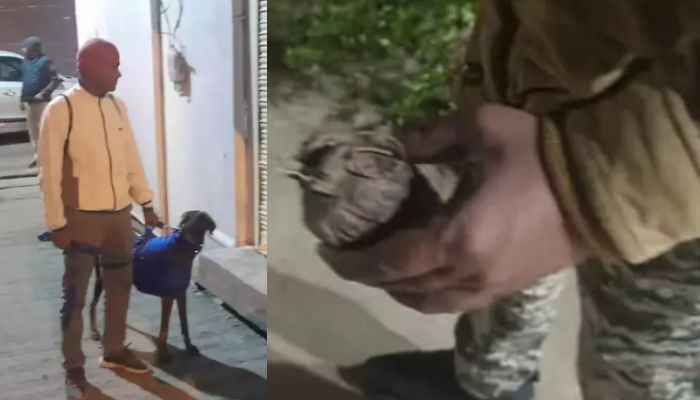
A hand grenade was recently found in the office compound of Rashtriya Swayamsevak Sangh located in Bhind, Madhya Pradesh. The discovery was made in the vacant ground of the complex after some children were playing with a ball-shaped object which was later found to be a hand grenade, creating a panic in the area. Following the discovery, Bhind police called the bomb disposal squad from Morena, which revealed that the hand grenade was more than three decades old and was ‘inactive‘, that is, it couldn’t detonate. 

According to the information, on Friday (23rd February), some children were playing in the RSS office compound which is located in the residential area of Hanuman Bajaria. The Sangh officials had gone to another city for a meeting and the office was lying vacant. Meanwhile, the children found a ball-shaped object, which turned out to be a hand grenade which led to a sensation in the area. The hand grenade had a pin attached.

Receiving information from Swayamsevak Ram Mohan, SP Asit Yadav arrived at the scene with his team and initiated an inspection. The Police called the bomb disposal squad from Morena which found in its investigation that the hand grenade was around 30-35 years old and was ‘inactive’ that is, it could not explode. 

Meanwhile, after getting the information, local BJP MLA Narendra Singh Kushwaha also visited the RSS office.

Regarding the incident, the Bhind Police said on Sunday (25th February), that an inactive hand grenade believed to be 30-35 years old, had been found at an empty ground of the Rashtriya Swayamsevak Sangh (RSS) office campus in Madhya Pradesh’s Bhind city. 

Superintendent of Police Asit Yadav said that the grenade possibly made its way to the Sangh office campus from a nearby area where a police firing range was located earlier in Didi village. He added that a bomb disposal squad along with sniffer dogs was sent to the spot and found the hand grenade was inactive.

According to the official, the ball-shaped object was found on Friday by some children who were playing at the RSS office ground in the Bajaria locality of the city. 

The SP stated that the police got the information about it at around 10.30 pm on Saturday following which the bomb disposal squad was sent there.

According to the SP, the ground at the Sangh office complex must have been filled with soil earlier and the grenade reached with it. A police release said the grenade looks around 30-35 years old and it made its way with the soil brought from a nearby area and spread on the Sangh office campus ground earlier.

It is pertinent to note that RSS and its Swayamsevaks frequently face threats and two years back, the RSS headquarters in Nagpur received a bomb threat following which its security was heightened.

Indus Water Treaty: India fully stops the flow of Ravi River water to Pakistan, water to be used for irrigation and hydropower generation

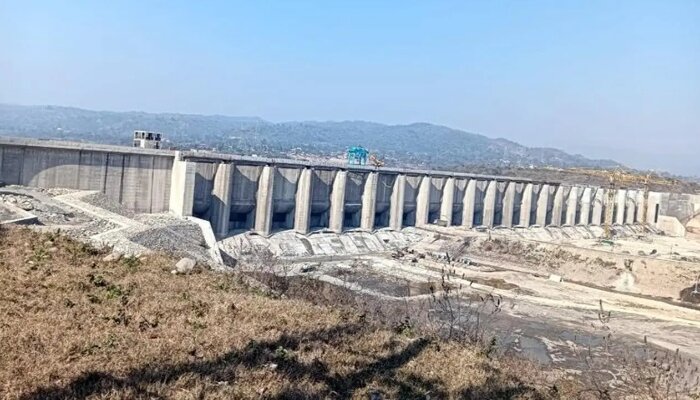
On 24th February, India reportedly completely curtailed the flow of water from the Ravi River into Pakistan following the completion of the Shahpur Kandi barrage, which is situated on the boundary between Punjab and Jammu and Kashmir. According to this development, 1150 cusecs of Ravi water is going to be utilized to irrigate more than 32,000 hectares of land in the Jammu and Kashmir districts of Kathua and Samba, rather than spilling into Pakistan.

The irrigation and hybrid power generation project has encountered many difficulties during the last thirty years, based on official sources. The process of pondage at Shahpur commenced barely two days ago, after the conclusion of the barrage work. Nonetheless, Shahpur’s water retention process has already started with the completion of the barrage.

India will now use all of the water from the Ravi River, as stipulated under the Indus Water Treaty. Water that once flowed towards Pakistan from the ancient Lakhanpur dam will now serve purposes in Punjab and Jammu & Kashmir. After the Shahpur Kandi barrage was successfully completed, the old Lakhanpur dam’s water resources were redirected towards the two northern states, allowing India to make the most of the Ravi River’s water resources.

India has exclusive rights over the waters of the Ravi, Sutlej and Beas rivers, while Pakistan has authority over the Indus, Jhelum and Chenab rivers, as per the 1960 Indus Water Treaty between the two countries. India’s capacity for water management is further enhanced by the treaty’s clauses, which allow it to build storage facilities on the western rivers.

Former Prime Minister late PV Narsimha Rao had laid the foundation stone of the significant Shahpur Kandi Barrage Project in 1995. However, internal disagreements between the governments of J&K and Punjab presented numerous challenges for the project from the outset. The project was put on hold for multiple years before being revived in 2018 after a four and a half-year pause owing to the intervention of Prime Minister Narendra Modi and Union Minister of State in the Prime Minister’s Office, Dr. Jitendra Singh.

The sources revealed, “This multipurpose project worth Rs 3300 crores (Revised cost) would not only provide 1150 cusecs of irrigation water to the J&K and over 5000 cusecs of water to Punjab state, but also generate about 206 MW of electricity besides attracting tourists to the site. Punjab state would be the major beneficiary of the power generated from this project.”

Dr. Jitendra Singh also made a statement in which he asserted that political reasons alone prevented the project from moving forward in Jammu and Kashmir, even though it would have benefited the districts of Samba and Kathua. He recounted, “In 2014, Prime Minister Narendra Modi was briefed about Shahpur Kandi project and its benefits. He set up high level committee under the chairmanship of PM’s then Principal Secretary Nripendra Mishra. Even former Chief Minister Mehbooba Mufti tried to sabotage the project by raising the demand of Rs 600 crore compensation from Punjab Government.”

He mentioned that the project was awarded national project status, allowing for its prompt completion, and that it was resurrected after 40 years due to the imposition of Governor’s Rule in Jammu and Kashmir as a result of PM Modi’s efforts and initiative.

Ajit Kumar, the Executive Engineer at RTIC Kathua, confirmed in a phone conversation that the pondage process has commenced and that water from Ranjeet Sagar Dam is being discharged in a methodical way for the Shahpur Kandi barrage. He noted that the Shahpur Kandi dam will reach its necessary height in ninety days.

In response to a query, he stated that the project’s budget was altered multiple times. The project was originally estimated to have cost Rs 2793 crores, but its current updated cost is Rs 3300 crores. The development of a 206 MW hydropower project is also included in the project cost. The Power House is being built approximately three kilometers from Shahpur Kandi and according to the agreement, Punjab State will be the primary recipient of the electricity produced there, with J&K receiving no share of it.

When asked how much water J&K and Punjab will receive from the Ravi River, the Executive Engineer replied that J&K would receive a maximum of 1150 cusecs, while Punjab state would receive 5000 cusecs. According to him, the Ravi-Tawi canal has a design capacity of 1350 cusecs, and Punjab’s authorities would release water in line with our expected demand.

He added, “We can, however, request a maximum of 1150 cusecs of water. In addition to other regions of Kathua, Rajbagh, Sanji Morh, Mareen, Hiranagar, Rajpura, Samba, Vijaypur, and Ramgarh, and others, roughly 32,000 hectres of land in the Kandi belt of Kathua and Samba, nearly 82 kilometers in length up to Ramgarh sub division would be irrigated. It will be a huge relief for the farmers in this belt.”

He further revealed that work on a 1378-meter stretch of the canal that runs from the Shahpur Kandi barrage to the J&K intake point is still outstanding, approximately a month and a half in duration. He stated that construction is underway on a nearly 20-meter bridge close to the Lakhanpur village of Kulyarh, while head regulators are being expected as part of mechanical work on the J&K side of the canal. He pointed out that the remaining work will be finished in little more than 45 days well in advance of the barrage’s required water level.

In reply to a different question, he replied that it is anticipated that Shahpur Kandi Power House will begin producing energy by the end of the following year based on inputs. He claimed that following Prime Minister Narendra Modi’s participation and designation of the project as a Project of National Importance, real work on the project began in 2018. He highlighted, “Ranjit Sagar Dam which is about 11 kilometres upstream of this project, is already generating over 600 MW of power and 206 MW will be additional benefit from river Ravi with Shahpur Kandi project.”

India has built storage facilities including the Bhakra Dam on the Sutlej, the Pong and Pandoh Dam on the Beas, and the Thein (Ranjitsagar) on the Ravi as part of a number of water management projects. India is now able to use almost all (95%) of the water from the eastern rivers because to these efforts and other projects like the Indira Gandhi Nahar Project and the Beas-Sutlej link. However, below Madhopur, almost 2 million acre-feet of the Ravi River’s water flowed to Pakistan without being harnessed. India is well-positioned to capitalize on these water resources, promoting agricultural and economic growth in Jammu & Kashmir and Punjab, with the completion of the Shahpur Kandi barrage.

During a rally in 2026, Prime Minister Narendra Modi promised to make sure that Indian farmers could effectively use the waters of the Sutlej, Beas and Ravi rivers. He underlined that India has a legitimate claim to these waterways and that Pakistan must stop wasting them. To ensure that every drop of water from these rivers reaches Punjab and Jammu and Kashmir, a task force was subsequently formed.

Punjab: Three associates of Canada-based gangster Lakhbir Landa arrested, 17 guns recovered during arrest

0

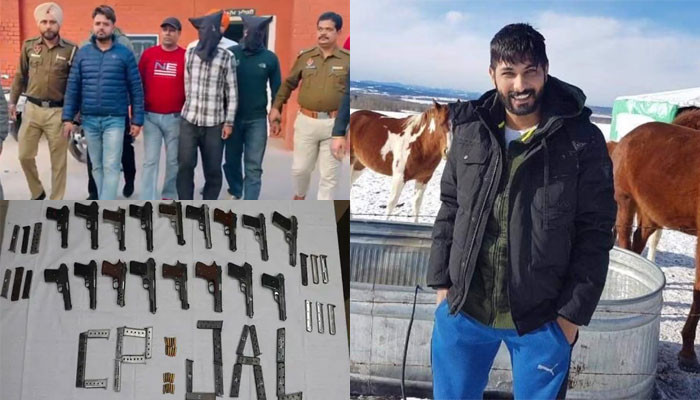
On 24th February, Jalandhar Commissionerate police arrested three associates of dreaded Canada-based gangster Lakhbir Singh Landa. In the intelligence-led operation, the police seized 17 guns and 33 magazines that were procured using hawala money. The inter-state weapon smuggling network was busted in a seven-day-long operation based on a tip-off. The three accused arrested have been identified as Gurlal, Khushal and Parvez.

Commissioner of Police Swapan Sharma said police laid a trap to bust the racket. Khushal is a resident of Ferozepur and has seven cases pending against him, including an attempt to murder, drug smuggling and more. Gurlal and Parvez are cousins. Reportedly, all three met in jail and were operating the Hawala network on behalf of Landa.

During the investigation, it was revealed that the weapons were being procured from an Indore-based supplier. CP Sharma said that Gurlal’s brother Sharanjit is closely associated with gangsters Lakhbir Singh Landa and Gurdev Gill. Both gangsters are involved in terror activities and extortion. Notably, Landa was declared a terrorist in December 2023 by the Ministry of Home Affairs, Government of India.

Furthermore, CP Sharma said that Landa and Gill are handlers of the weapon smuggling racket. Kushal was being paid to procure weapons via the Hawala channel. A total of twelve .32 bore pistols, five .34 bore pistols, 33 magazines and 20 live ammunition were recovered from the accused.

CP Sharma added that the weapons were seized during raids in districts Tarn Taran and Ferozepur. The accused were supposed to hand over the guns to Landa’s associates in districts Moga, Ferozepur and Tarn Taran.

Canada-based Lakhbir Landa was declared a terrorist

On 29th December, MHA declared Lakhbir Singh Landa as an “individual terrorist” under the Unlawful Activities (Prevention) Act (UAPA). According to the MHA, 33-year-old Lakhbir Singh Landa belongs to the Khalistani terrorist group Babbar Khalsa International (BKI) and planned a rocket strike on the Punjab Police Intelligence Headquarters in Mohali in 2021, among other terrorist activities. National Investigation Agency announced a cash reward of Rs 10 lakh in September 2023 after several raids conducted on premises linked to Landa and his associates. 

TN film producer Jaffer Sadiq, wanted in Rs 2,000 cr drug racket, was seen donating money during Michaung cyclone, photo with Udayanidhi Stalin emerges

0

The Tamil Nadu-based film producer who is wanted in a Rs 2,000 drug racket has been identified as Jaffer Sadiq. According to the Narcotics Control Bureau, he operated the racket for three years. Based on the inputs provided by the authorities from Australia and New Zealand, the Indian agencies busted the racket and recovered large quantities of pseudoephedrine, which is a crucial component in methamphetamine generally known by its street names meth, ice, poor man’s cocaine, speed, glass, crystal trash, and more.

Meth is a highly addictive drug that increases heart rate and blood pressure. It can cause anxiety, paranoia and other side effects. High doses of the drug may lead to convulsions, stroke, cardiovascular collapse and death. The drug sells at around Rs 1.5 crores per kg in countries like New Zealand and Australia.

Who is Jaffer Sadiq?

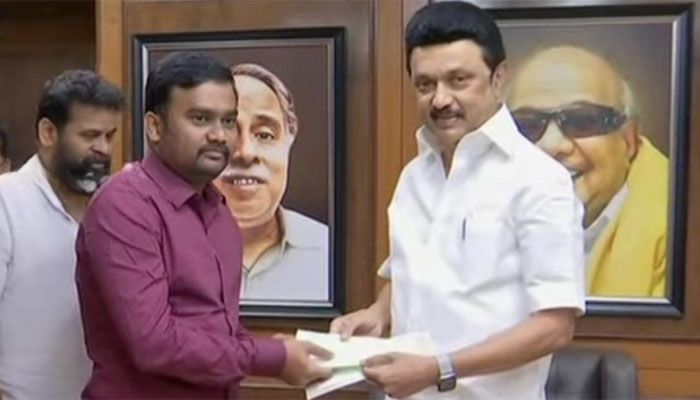
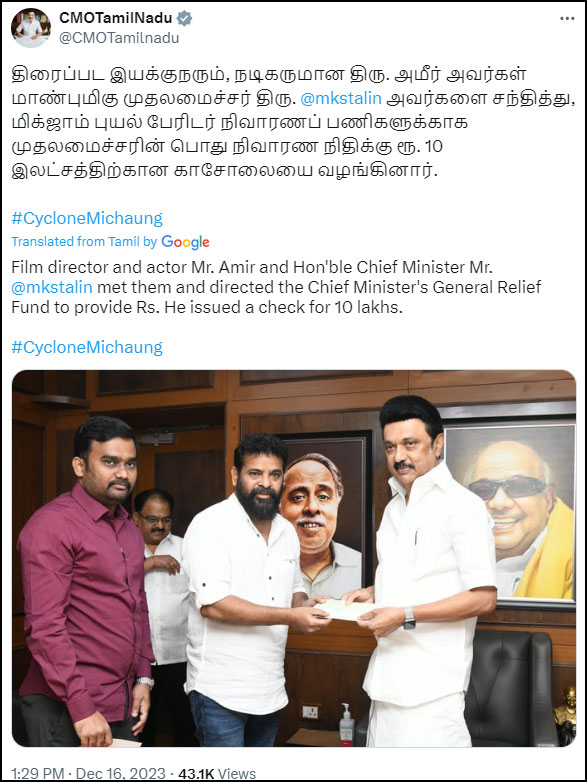
Jaffer Sadiq is a Tamil Nadu-based film producer who has produced a film called Mangai under the banner of JSM Pictures. The film’s song was released by the wife of the Minister for Youth Welfare and Sports Development, Special Act Implementation Department of Tamil Nadu, Udhayanidhi Stalin, Kiruthiga Udhayanidhi. Notably, on 17th December 2023, Sadiq and actor/director Ameer met Tamil Nadu chief minister MK Stalin. They donated Rs 10 lakh towards the Chief Minister’s relief fund on the sidelines of the Michaung cyclone. Sadiq donated another two lakhs to Udhayanidhi Stalin for the CM Relief Fund.

Source: X

In a post on social media, Udhayanidhi acknowledged the donation, which has now been deleted. In the post, Udhayanidhi wrote, “In all areas affected by heavy rains, rescue work and relief assistance are being provided systematically. To join hands with the government in this work, the district deputy organizer of the Chennai West district neighbourhood team, brother A.R. Zafar Sadiq, handed over a check of Rs.2 lakh to us today for the “Chief Minister’s General Relief Fund”. My love and gratitude to him. @nchitrarasu”.

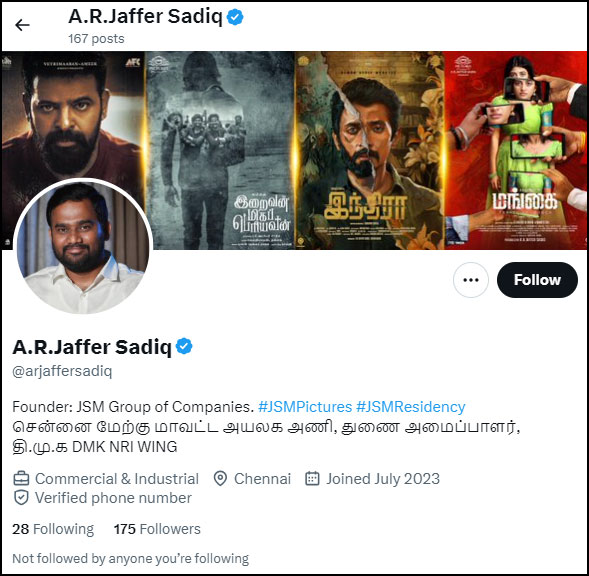
In his bio on X, Sadiq claimed to be part of the DMK NRI Wing. Furthermore, he was seen with several politicians linked to DMK.

Source: X

His photographs were shared by Bharatiya Janata Party (BJP)’s Tamil Nadu chief, K Annamalai, on social media. He wrote, “In Delhi, a gang trying to smuggle drugs worth around Rs 2,000 crore has been arrested by the Anti-Narcotics Unit. In the investigation, it has been revealed that these people are from Tamil Nadu, and the leader of this gang is Zafar Sadiq, deputy organizer of DMK’s Chennai West district team, and his brother, Central Chennai Regional Deputy Secretary of the Liberation Tigers of India, Mohammad Salim and Mydeen are his assistants. It has come to light that they may have sent around 3,500 kg of narcotics abroad 45 times in the last three years and have earned thousands of crores of rupees from them.

Zafar Sadiq, Deputy Organizer of DMK’s Chennai West District Team, whom Narcotics Control Unit officials want, has used this money to produce Tamil films and the photos of Tamil Nadu Government’s relief fund to Chief Minister Stalin and Minister Udhayanidhi of lakhs of money received from drug trafficking. Pictures of him with Shekharbabu and photos of another wanted person, Central Chennai Regional Deputy Secretary of the Liberation Tigers of India, Mohammad Salim, who has given party funds to Vishika leader Thirumavalavan, have surfaced on social media. Photos of her in close contact with many directors and actors in the Tamil film industry have surfaced. Ever since the DMK came to power, the DMK government has repeatedly urged the government to take strict action on behalf of  BJP4Tamilnadu that there is a lot of drug traffic in Tamil Nadu, the influence of drugs has spread even to school students, and the media reports that drugs are widely available in Tamil Nadu. Nothing seems to have been taken. At present, the fact that one person who is in a critical position in the DMK has been involved in drug smuggling from Chennai for all these years has raised serious doubts. To avoid further strengthening of these suspicions and bearing in mind that drug trafficking is a war waged on our country, I request on behalf of BJP4Tamilnadu that the Tamil Nadu government immediately identify all those involved in drug trafficking and take strict action.”

Drug racket busted in Delhi

The Narcotics Control Bureau (NCB) in Delhi busted a sprawling drug trafficking network on 15th February. The NCB officials shared this information on Saturday (24th February). The operation, led by NCB officials in conjunction with the Delhi Police Special Cell, culminated in the arrest of three individuals hailing from Tamil Nadu and the seizure of 50 kilograms of pseudoephedrine, a key chemical used in the production of methamphetamine. A Tamil film producer is reportedly the mastermind of the racket and is currently absconding.

During interrogation, the three arrested individuals disclosed that they had orchestrated a total of 45 consignments over the past three years, collectively amounting to approximately 3,500 kilograms of pseudoephedrine. These shipments, valued at over Rs 2,000 crore in the international market, underscored the scale of the operation and the substantial profits involved in the illicit trade. They also had planned to conceal pseudoephedrine within seemingly innocuous food products. Furthermore, the interrogation unveiled the transnational reach of the drug trafficking network, spanning across India, New Zealand, Australia, and Malaysia.