Home Blog Page 1335

‘Don’t give protesters services of equipment’: Haryana DGP warns JCB, poclain operators & owners as farmers take heavy machines to ‘move barricades’ at border

Amid the farmers’ protest, the Punjab DGP has issued orders stopping the movement of JCBs, Poclaines, Tippers, Hydras and other heavy earthmoving equipment towards the Punjab-Haryana Border at Khanauri and Shambu.

The instructions to this effect have been issued to all Senior Superintendents of Police (SSP) and Commissioners of Police (CP). The orders will be implemented especially in the areas where protesters plan to storm the barricades of Haryana Police and enter the state.

The order was issued after a written request for the same by DGP Haryana.

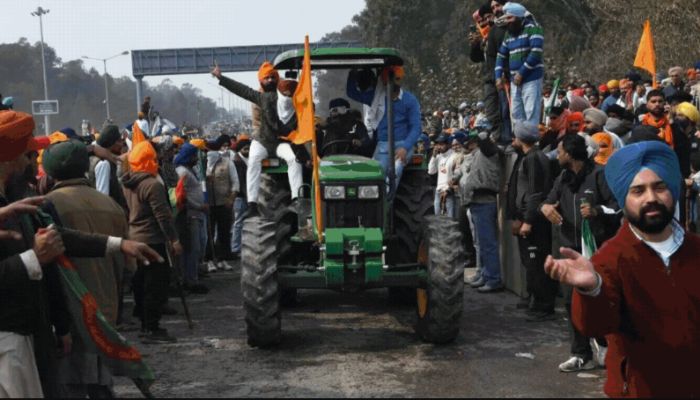
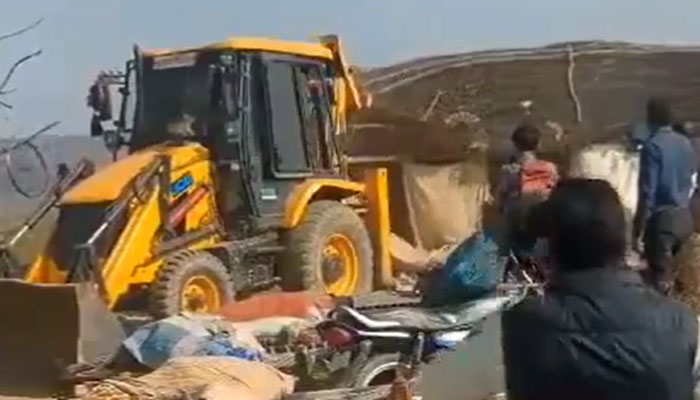
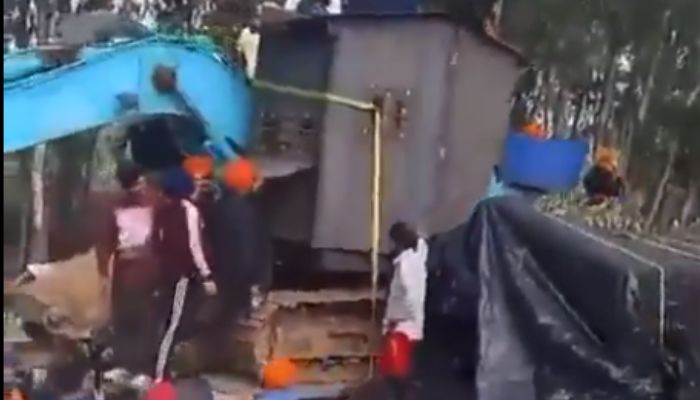
Videos shared on social media show heavy machinery being taken by protesters to the Haryana border. The person filming the video can be heard saying that the poclain machine is being carried to move the barricades put up at the Shambhu border.

The driver seat of the poclain can be seen covered from all four sides with an iron layer. He further says that the poclain is protected with an iron layer so that “Modi and Khattar’s gang cannot harm the farmers”. He says that the farmers have brought the poclain and now barricades will be broken.

Poclain machines are excavators designed for digging and excavation tasks. The tracks of the machinery allow it to move across different terrains.

As per TV media reports, protesters have gathered at the border area with JCB machines, poclain whereas the state has deployed forces with 7-layer of barricading.

Meanwhile, the Haryana Police has posted in social media platform X directing the owners and operators of poclains and JCBs to not provide the services of their equipment to the protesters.

“Owners and operators of Poclains,JCBs:Pls do not provide the services of ur equipment to the protestors. Pl withdraw these machines from the protest site.These machines may be used to cause harm to security forces,it’s a non bailable offence and you may be held criminally liable,” the police wrote.

Moreover, the Ambala Police has booked some unknown drivers of Poclain machine. Taking to X, the Ambala Police wrote, “During the farmers’ movement, a case has been registered against the unknown suspected drivers of the Poklane machine shown in the picture with the intention of causing damage to government property by driving the Poklane machine. Ambala Police.”
Rahul Gandhi almost gets a journalist lynched during his Bharat Jodo Nyay Yatra in UP, tries to incite crowd on caste lines

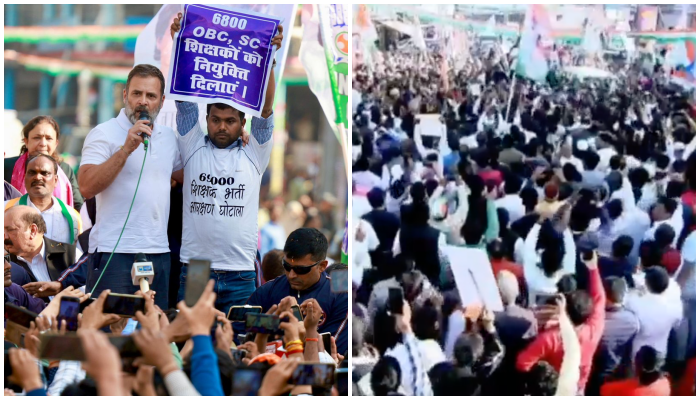
Rahul Gandhi’s Bharat Jodo Nyay Yatra is currently passing through Uttar Pradesh. On Tuesday, February 21, speaking to the public and Congress workers around him, Rahul Gandhi peddled his usual claims of the central being hostile to OBCs, and Dalits.

“The Ram Mandir is only visited by the likes of PM Modi, Ambani, and Adani. You will see all our billionaires there but not a single person from a backward class or the Dalit community,” Rahul said.

“Your place is only limited to roads for begging while they (Centre’s alleged corporate cronies) keep minting money,” he added.

During the speech, Rahul Gandhi addressed a journalist in public and asked for his name.

“Are you from the media? What is your name? What is the name of the owner of your organisation?” Rahul Gandhi asked the journalist.

When the journalist attempted to say something, Rahul Gandhi’s tone suddenly became aggressive. “Tell his name, what is your owner’s name? Say it”, he was heard saying as the crowd of Congress supporters around him got agitated and hostile against the journalist.

“Is he an OBC? Is your owner a Dalit? No, he is not.” Rahul Gandhi continued as the crowd around the journalist got hostile. He then stopped the Congress workers saying, “No. Don’t beat him up”.

Gandhi even repeated the old Congressi lie of President Murmu ‘not being invited to Ram Mandir inauguration’ during his public address yesterday.

Rahul claimed that President Draupadi Murmu was deliberately not allowed to visit Ram Mandir during its inauguration last month as she belongs to an Adivasi background.

Addressing a public meeting on the thirty-eighth day of the Bharat Jodo Nyay Yatra here on Tuesday, Rahul said, “In India, the power, resources and wealth are in the hands of 2-3% people while about 90% are deprived of everything. Dalits, backwards, Adivasis and the poor among the general castes, who constitute a huge majority of India’s population, did not have any representation anywhere–be it swanky corporate offices, judiciary, media, private hospitals or educational institutions.”

Taking a further dig at the Centre over the opening of the Ram Temple in Ayodhya last month, he claimed only the rich and the famous like Adani, Ambani, Amitabh Bhachan and others were seen there, apart from PM Modi.

The truth is that President Murmu was formally invited by a delegation representing the Ram Temple Trust to attend the consecration ceremony in Ayodhya. The invitation was extended on 12th January by a delegation comprising Vishva Hindu Parishad (VHP) working president Alok Kumar, Rashtriya Swayamsevak Sangh leader Ram Lal, and Ram Mandir construction committee chairperson Nripendra Mishra.

However, President Murmu had said that she would soon decide the time to visit Ayodhya. In fact, on 21st January, the President hailed the Ram Mandir inauguration ceremony and sent heartfelt wishes to the Prime Minister for making the temple appear into reality.

Meanwhile, the BJP is furious over one of the comments of Rahul Gandhi where he said he saw young men in Varanasi being drunk and lying on roads. He tried to make a point that the youth he saw were drunk and lying on the roads because the government is focused on inviting only powerful people to the Ram Mandir.

Tearing at Rahul over his remark on Varanasi, Union Minister Smriti Irani said, “Rahul has no right to insult the people of Kashi and the youth of Uttar Pradesh. The whole world looks to UP these days for its skillful and talented youth. We don’t expect any apology from Rahul Gandhi as he is a shameless person.” 

(With inputs from ANI)

Virat Kohli-Anushka Sharma welcome their second child, name the baby boy Akaay

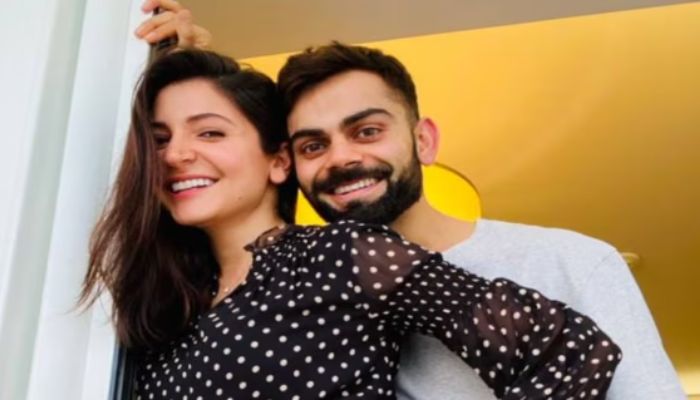
Indian ace batter Virat Kohli and Bollywood actress Anushka Sharma have announced the birth of their second child. As per the announcement made by Virat Kohli, the baby boy has been named Akaay. 

Taking to his Instagram handle, Virat Kohli shared the announcement. As per the post, the cricketer-actress couple welcomed their second child on 15th February. Further in the post, he requested everyone to respect their privacy at this time. 

His Instagram post read, “With abundant happiness and our hearts full of love, we are pleased to inform everyone that on 15th February, we welcomed our baby boy Akaay/अकाय & Vamika’s little brother into this world!”

It added, “We seek your blessings and good wishes in this beautiful time in our lives. We request you to kindly respect our privacy at this time. Love & Gratitude. Virat & Anushka.” 

The couple has been receiving a flurry of posts from well-wishers, colleagues and fans. Reacting to the post, Former Indian opener Virender Sehwag commented, “Many congratulations Virat.”

West Bengal: Hindus perform puja inside disputed ‘Adina mosque’ in Malda, FIR lodged against priest Hirnamoy Goswami

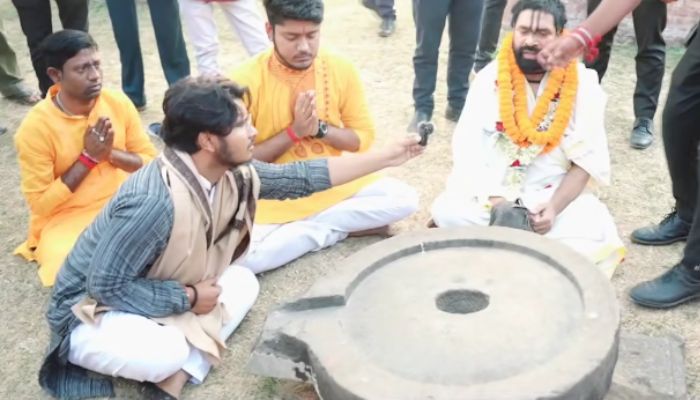
On Saturday (17th), a group of Hindus led by a young priest named Hiranmoy Goswami performed puja inside the premises of the disputed ‘Adina mosque’ in the Malda district of West Bengal.

Goswami, who had visited the Archaeological Survey of India (ASI)-listed monument, spotted idols of Hindu deities and a Shivling. Soon after, he along with his followers began performing puja and reciting mantras next to the Shivling.

In the meantime, local Muslims in the area notified the police. Soon after, the Hindu priest was stopped from conducting rituals by assistant sub-inspector Navin Chandra Poddar, who told Goswami that he could not offer his prayers at the disputed mosque.

This led to a heated argument between Hiranmoy Goswami and the police official. On being asked about his crime, Poddar told the Hindu priest, “Your crime is that you are offering ‘pranam’ wherever you want. This cannot be done here.”

Goswami, who is the President of Vishwavidya Trust in Vrindavan, asked why he could not offer prayers when idols of Hindu deities are visible on the walls of the disputed structure.

“Show me the order which says I cannot offer pranam here? I am going to offer my pranam here. What will you do? Do you have the right to tell me to get out of this place,” he asked the cop.

The Hindu protest further directed the police official to get a written order that he is not allowed to be present inside the premises of the ‘Adina Mandir.’

The Archaeological Survey of India (ASI) later filed a complaint with the Malda police against Hiranmoy Goswami, following which a First Information Report (FIR) was registered against him.

“Acting on the complaint received from the end of the ASI, police lodged a complaint formally,” an official told The Telegraph anonymously. Reportedly, a large contingent of police was deployed in the area in the aftermath of the incident.

It must be mentioned the Adnina mosque was built on the ruins of Hindu and Buddhist religious structures by Islamic invader Sultan Sikander Shah in 1369.

Earlier in May 2022, BJP leader Rathindra Bose pointed out that an ‘Adinath Mandir’ exists underneath the disputed structure. In a tweet, he said, “The Adinath temple is sleeping beneath the Adina mosque. Jitu Sardar gave his life to save this temple. That history is unknown to many.”

“He was martyred while trying to protect the temple from the British and Muslim rulers. This issue came to my mind repeatedly when I visited the disputed place with local MLA Chinmoy Deb Barman yesterday. Kashi’s Lord Vishwanath got back his place. Is it now the turn of Adinath?”, Bose further added.

Gross impropriety: Supreme Court quashes verdict of former Madras High Court judge who delivered judgement 5 months after his retirement

0

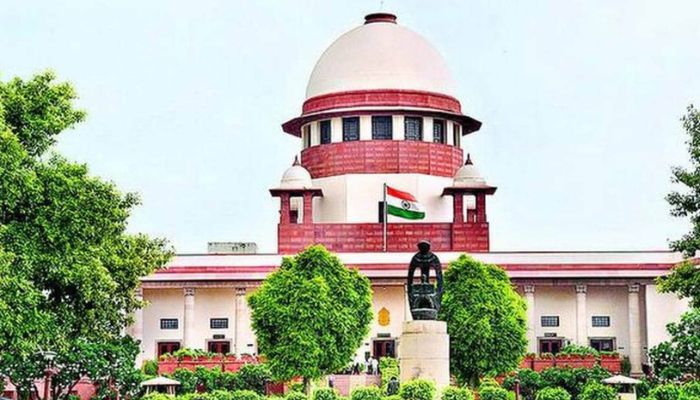
The Supreme Court recently quashed the verdict of a Madras High Court judge noting that the latter had delivered a detailed judgement 5 months after his retirement. The apex court also criticised the retired Judge T Mathivanan, stressing that a judge can’t retain case files after leaving office. 

The apex court noted that in the present case, the judge who delivered the verdict had retained the case files for five months after his retirement. Notably, the Former Madras High Court judge had pronounced a one-line order in a criminal case and released the detailed judgement on the High Court website five months after he retired from service.

Supreme Court asserted that retaining the case file after demitting office is a “gross impropriety”. Consequently, the bench comprising Justices Abhay S Oka and Ujjal Bhuyan remitted the appeal to the High Court for its fresh consideration.

Details of the case

In this criminal case, the then Madras High Court Justice T Mathivanan pronounced a one-line order that had the operative part in a criminal appeal on 17th April 2017. He demitted the office on 26th May 2017, but the detailed judgement with reasons was released by the judge only on 23rd October 2017, nearly five months after his retirement.

Later, the Central Bureau of Investigation (CBI) approached the Supreme Court in the matter challenging the High Court’s verdict. The Central agency also highlighted that the judgement was pronounced after the judge’s retirement and used it as a ground to challenge the verdict. 

The Supreme Court bench noted that there were five weeks available for the judge to release the reasoned judgement. It added, “However, the detailed judgement running into more than 250 pages has come out after a lapse of 5 months from the date on which the learned Judge demitted the office. Thus, it is obvious that even after the learned Judge demitted the office, he assigned reasons and made the judgement ready.”

The apex court criticised how the judge handled the case and the bench remarked, “It is obvious that even after the learned Judge demitted the office, he assigned reasons and made the judgement ready. According to us, retaining file of a case for a period of 5 months after demitting the office is an act of gross impropriety on the part of the learned Judge. We cannot countenance what has been done in this case.”

The bench cited the quote of Lord Hewart where he noted, “Justice must not only be done but must also be seen to be done.” 

Setting aside the judgement of the Madras High Court judge, the Supreme Court added, “What has been done in this case is contrary to what Lord Hewart said. We cannot support such acts of impropriety and, therefore, in our view, the only option for this court is to set aside the impugned judgement and remit the cases to the high court for a fresh decision.” 

Subsequently, the apex court bench refused to hear the case on merits and remitted the matter to the High Court for a fresh call. It added, “Needless to add that we have made no adjudication on the merits of the controversy, and all issues are left open to be decided by the high court.” 

Can’t use tractor trolleys on highways: Punjab and Haryana High Court slams agitating farmers, says right to protest is subjected to reasonable restrictions

On 20th February (Tuesday), the Punjab and Haryana High Court rapped the agitating farmers stating that they cannot use tractors and trolleys on highways, as per the Motor Vehicles Act. Stating that everyone knows their fundamental rights, the High Court also reminded the protesting farmers to follow “constitutional duties”.

Notably, a divisional bench of Acting Chief Justice (ACJ) GS Sandhawalia and Justice Lapita Banerji has been hearing the plea that has challenged the alleged obstructive actions of the government and another plea seeking immediate action against the protest.

ACJ GS Sandhawalia asked the Punjab Government to ensure that the protesting farmers don’t gather in large numbers. The judge reiterated that the protesting farmers have the Right to protest but it is subjected to reasonable restrictions. 

During the hearing, ACJ Sandhawalia also objected to farmers travelling in tractors and trolleys for protest and said, “According to the Motor Vehicles Act, you cannot use tractors and trolleys on the highway. You are travelling from Amritsar to Delhi on trolleys. Everyone knows their fundamental rights, but there are also some constitutional duties that need to be followed.”

The ACJ further added that if it is required then the tractor and trolleys can be carried on trucks.

Additionally, during the court hearing, the Union government updated the High Court on meetings held with the protesting farmers regarding their demands. Subsequently, the High Court directed the Union government to submit a fresh affidavit detailing discussions from these meetings. Consequently, the High Court adjourned the hearing to next week.

Meanwhile, the Farmer Unions have announced that they would resume their ‘Dilli Chalo’ march and launch a protest demanding MSP law from the Union government on 21st February. The development came after the farmers’ unions rejected the Union government’s five-year plan to procure pulses, maize, and cotton crops at MSP to boost crop diversification. 

As reported earlier, a large number of farmers marched towards the national capital on 13th February. The police have deployed concrete slabs, iron nails, barricades, barbed wires, and police and paramilitary personnel at Kurukshetra in Haryana because of the ‘Delhi Chalo’ march by the farmers. The protestors are seeking legal guarantees for MSP among other demands.

In addition to drafting a law on MSP, the protesting farmers have been demanding that India should quit the World Trade Organisation (WTO), halt trade agreements with other nations, and a monthly pension of Rs 10,000 to farmers who attain the age of 60 years among others. The protest has been called by Sanyukt Kisan Morcha and Punjab Kisan Mazdoor Sangharsh Committee, led by farmer union leaders Jagjeet Singh Dallewal and Sarwan Singh Pandher.

So far there have been four rounds of talks between the representatives of the agitating farmers’ Unions and three Union Ministers on 8th,12th,15th, and 18th February.

According to an Industry body’s estimate, the ongoing farmers’ protest in Delhi-NCR will cost more than Rs 500 crore every day and will negatively impact the quarter-four Gross State Domestic Product (GSDP) numbers of Northern states. 

With some Muslims feeling unsafe in India, Pakistan should introduce its own version of CAA

Bharat Varsh was divided into two nations – partitioned in 1947. Though the storm of a division was brewing for a few years before this ‘jhatka’, no one- at least the people was not sure what would happen to them. Pakistan was created based on religion, though Indian leadership was clearly more accommodating towards all faiths. At that time, it was a free-for-all two-way flow and people had a choice. Either go to Pakistan or choose India. Most – yes most- Hindus chose to come to the Indian side and so did Sikhs and some other minorities too. Non-Muslim people who stayed back in Pakistan thought of staying back because at that time they thought of their Muslim friends as their own- ‘ikko log’ was the spirit that was to evaporate very soon.

Two nations would be sworn enemies soon. Some decided to stay back because they were reluctant to uproot and leave everything behind. Pakistan was going to be an Islamic state known from day one- but none of the Non-Muslims could ever imagine what was in store for them. The state and state of mind were more than chaotic, to say the least. I am sure it must have been a terrible dilemma to choose between the two options. In a way it was your destiny- pick of the lot!

Be that as it may, people took a call. No one knew how the two nations would progress in the future and what exactly was in store for them.

As Pakistan started moving forward- or backward is anyone’s guess- they started taking a very hard stand against the Non-Muslims. Be it Hindus, Sikhs, Christians, Jains, or Buddhists- they were systematically being targeted- converted or killed.

At the time of Independence Hindu population in Pakistan was 20.05% and by 1988 it had reduced to just 1.6% and today it is lower than that.’Kahhaan gaye saab log?’ is the moot question. Minorities were discriminated against blatantly by people as well as by the government. Many of them decided to cross over to India- illegally- and it was just to survive this step was taken- they must have cursed their parents or grandparents who took a call to choose Pakistan as their land. 

It had been a big mistake and for no fault of theirs, they were getting hammered in Pakistan. It was also happening in all neighboring Muslim nations like Bangladesh and Afghanistan- more visible in Pakistan for sure. 

The government of India came up with a law called – the CAA-Citizenship Amendment Act to facilitate these ‘crossovers’, all minorities, to get citizenship of India and absorb them as Indians honorably. Yes, certain guidelines and cut-off dates had to be put in place, which has been done. What a sigh of relief for those who were being hounded in their ‘chosen land’ to come to a nation that respects them and allows them to take up citizenship!

The reverse too must also happen

Some Muslims who chose to stay back in India at the time of partition are making a strong case for themselves today that they do not feel safe in India. However, this is far from true as we had Muslim presidents, Governors, Chief Ministers, Cabinet Ministers, Police chiefs, Army commanders, secretaries to the government of India, Vice Chancellors et al.

Bollywood is full of Khans, Akhtars and Naseers, Azmis, Siddiqui, Warsi, Farhans and Hashmis, Jaffrey or Katrina, Mumtaaz, Zeenat, Tabu, Waheeda. A person as successful as Aamir Khan says he is not safe. I do not want to single him out. But there are many on TV debates too. Politically MOTIVATED OR LEFTIST MINDSET ONE IS NOT SURE OF – OR MAY BE BOTH. In any case, they are getting more than anyone else! The best part is they know it.

Change of guard in Pakistan

Elections have just finished in Pakistan- Whichever government comes, or grabs power, should take up a task in the very first meeting of the cabinet to start a ‘CAA-PAKISTAN’, or CAAPAK (they normally copy us) to accept all those Muslims in India who feel persecuted or discriminated or even feeling unsafe to be given ‘open-armed citizenship’ of Pakistan. A fast-track immigration or migration office must be created for them and guaranteed Pakistani citizenship within two weeks of applying. The pre-condition will be ‘loyalty to Pakistan’ and surrendering citizenship of India and the passport. I am sure India will not go to war with Pakistan on this ‘sensitive matter’.

Rajasthan’s illegal beef market: Administration clears 500 acres of encroached land in Alwar district during action on beef market

0

On Monday, 19th February, the Alwar administration took swift action against the illegal slaughter market that was operating in the remote wilderness of Kundhagadhbara in Kishangarhbas. The administration initiated an anti-encroachment drive in the area and cleared around 500 acres of land.

On this land, the illegal beef market was being run, where 20 cows were being slaughtered on a daily basis. The beef was then supplied to 50 villages, covering around 300 shops. As per reports, about 70 acres of encroached land had wheat and mustard plantations that have also been cleared. The administration demolished dozens of structures associated with cattle farming for slaughtering. The region falls under Alwar and Khairthal-Tijara districts. The latter was formed in 2023. The administration is still under the Alwar district.

As per Deputy Superintendent of Police Anil Beniwal, around a dozen cows were recovered from the area where they were kept for cattle farming. They have been sent to a shelter by the administration. Notably, on 18th February, 35 individuals were taken into custody by the police for interrogation following unrest in villages surrounding the area. 300 police personnel have been deployed to arrest the accused and maintain law and order in the area.

As per reports, Forest Minister of Rajasthan Sanjay Sharma visited the Kishangarh-Baas police station area of Alwar following the complaints of an illegal beef market running in the forest area. During his visit, he ordered an investigation against those involved in illicit cattle farming and asked the officials to clear the encroached land. Furthermore, it was found that the people involved in illegal cattle slaughtering were also stealing electricity.

25 individuals involved in running the illegal beef market have been named by the police in the matter. All of them have reportedly absconded since the case was registered. Notably, some of the accused already have cases registered against them related to illegal cattle farming and theft. The entire Kishangarh-Baas police station area has been put on high alert. Four police officials were suspended with immediate effect after the discovery of the illegal beef market.

On 18th February, it was revealed that an illegal beef market was operating in the Kishangarh-Baas police station area of Alwar. Videos of the market showing the brutal slaughtering of cows in the forest area near Rundh Gidwada in Birasangpur went viral on social media. The orders for the beef were taken by the accused using WhatsApp, and deliveries were made directly to customers. The market reportedly served hundreds of buyers.

It was reported that the police were aware of the illegal market, but no action was taken against those running it. Following the expose, IG Umesh Chandra Datt of Jaipur Range initiated an investigation and raided the illegal market.

‘Western countries long preferred to supply arms to Pakistan, not India’: EAM Jaishankar reaffirms India’s stable and friendly ties with Russia 

0

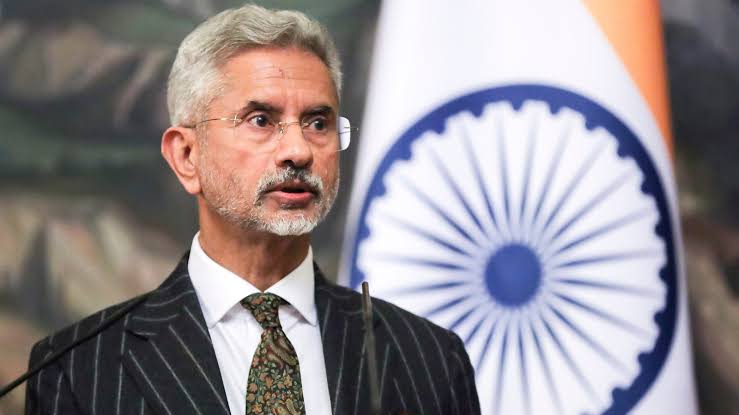
In an interview with the German economic daily, Handelsblatt during his visit to the Munich Security Conference in Germany on February 20, External Affairs Minister S Jaishankar reaffirmed defence and trade cooperation with Russia. Jaishankar said Russia never violated India’s interests and the bilateral ties remain “stable and friendly”.

“The current relationship with Moscow is based on a stable and always very friendly relationship with Russia,” said Jaishankar.

He further stated that the Indian inventory of Russian-origin weaponry has grown since many Western countries used to supply arms to Pakistan and not India for decades. He added that the trend has, however, changed in the past decade.

“In terms of inventory, yes, because many Western countries have long preferred to supply Pakistan and not India. But that has changed in the past ten or fifteen years with the U.S.A., for example, and our new purchases have diversified with the U.S.A., Russia, France and Israel as the main suppliers,” he said.

Further talking about India’s strengthening relations with Russia, External Affairs Minister S Jaishankar said that India doesn’t expect Europe to have a New Delhi-centric view of China and Europe should also understand that India won’t move with the European view of Russia.

“My point is: just as I do not expect Europe to have a view of China that is identical to mine, Europe should understand that I cannot have a view of Russia that is identical to the European one. Let us accept that there are natural differences in relationships,” he said.

EAM Jaishankar further highlighted the challenges faced by India to manage its energy supplies after the Russia-Ukraine war.

“Both sides (Russia and Europe) have communicated their positions clearly and have not emphasized their differences. But yes, there are differences. You mentioned the energy issue. When the fighting started in Ukraine, Europe shifted a large part of its energy procurement to the Middle East – until then the main supplier for India and other countries. What should we have done?” EAM Jaishankar said on being asked if Europe’s differences with Russia put a strain on India-Europe relations.

“In many cases, our Middle East suppliers gave priority to Europe because Europe paid higher prices. Either we would have had no energy because everything would have gone to them. Or we would have ended up paying a lot more because you were paying more. And in a certain way, we stabilized the energy market that way,” he added.

The minister also insisted on mediating talks with Russia and Ukraine to end war in the region and said that India would be happy to help but won’t initiate anything in this direction on its own.

“We (India) have already helped with very specific issues. When Turkey negotiated the corridor through the Black Sea, for example. And we were very supportive of the inspections by the International Atomic Energy Agency, IAEA, of the Zaporizhzhya nuclear power plant. Wherever we can help, we are happy to do so. We are open when we are approached. However, we do not believe that we should initiate anything in this direction on our own,” he said.

India and Russia have maintained a robust strategic partnership, rooted in historical ties and shared interests, over decades. Central to this relationship is extensive defence cooperation, with Russia serving as a major supplier of military equipment to India and both nations engaging in joint military exercises, co-development of advanced military platforms, and technology transfers, according to the Russian news agency.

More recently, energy collaboration has become another strong pillar of bilateral ties. The Kudankulam nuclear power plant (KNPP), India’s largest, is being built in Tamil Nadu with technical assistance provided by Moscow.

Russia’s expertise in nuclear technology has been instrumental in advancing India’s capabilities, fostering a mutually beneficial partnership, according to RT. The two countries have pledged to deepen their nuclear cooperation, recognizing its strategic importance for energy security and technological advancement.

Over the past 18 months, India has emerged as one of the largest importers of Russian oil–a stand New Delhi has had to defend on many occasions from accusations by Western media, and even some political leaders, of funding ‘Russia’s war’ with Ukraine.

(This news report is published with inputs from ANI)

Bangladesh: Luftar and Mahmud forcibly occupy ancestral land of Hindu family, build boundary wall flouting court and local arbitration

Two Islamists, identified as Lutfar Khan and Mahmud Khan, have been trying to forcibly occupy the ancestral land of a Hindu family in the Barishal district of Bangladesh.

The victim was identified as Titu Saha, a resident of Ward No.5 of Bakerganj Upazila municipality. Saha has been fighting a legal case over his land against Lutfar Khan in the High Court.

The Islamist along with his accomplice bypassed the court proceedings and began constructing a boundary wall on the Hindi family’s land on Sunday (16th February).

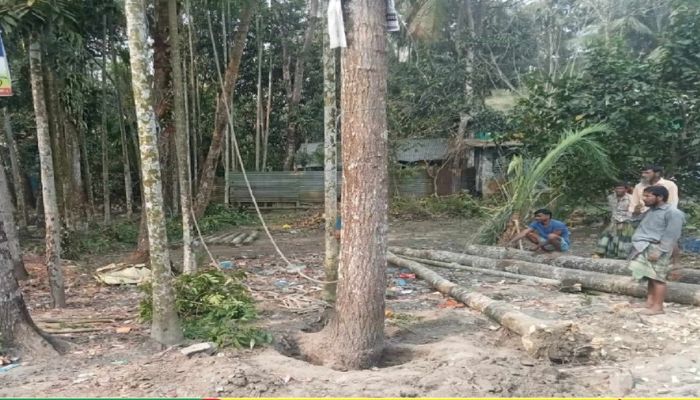
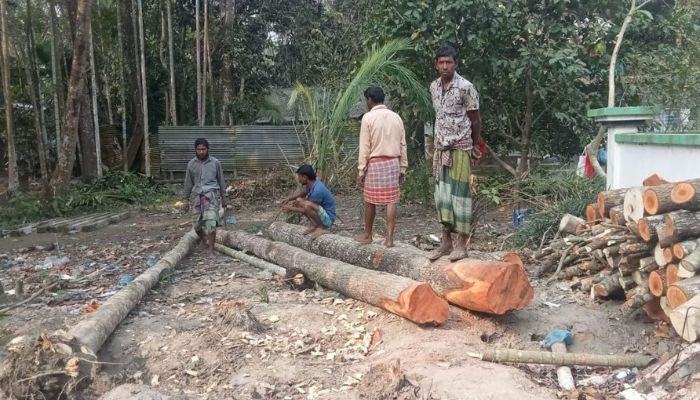
Trees located on ancestral property of Titu Saha were cut down by Lutfar Khan’s men, image via Barishal Times

Lutfar Khan reportedly directed some men to cut down trees on Saha’s ancestral property and build a permanent brick wall. He and Mahmud also threatened the Hindu family and attempted to attack their house.

Forced by circumstances, Titu Saha’s wife Nupur Das filed a written complaint with the officer-in-charge of the Bakerganj police station Md. Afzal Hossain. It was only then that the police intervened and stopped the construction. A probe has been initiated into the matter.

Lutfar Khan flouts local arbitration, claims to be the ‘property owner’

While speaking to Barishal Times, Titu Saha said, “The matter was decided to be sorted out through local arbitration on Sunday (18th February). But they flouted all that and began constructing a boundary wall.”

His mother Geeta Rani Saha broke down in tears and informed, “They are illegally occupying the house of my husband. We, Hindus, belong to this country? Can’t we live here (peacefully)? I demand strong action from the local administration against the culprits.”

In the meantime, accused Lutfar Khan told Barishal Times that he has purchased the land and is the owner of the property. This is not the first time that Islamists have tried to forcibly encroach upon the land of minority Hindu families in Bangladesh.

Hindu families forced to sell their houses in Shailkupa

Earlier, OpIndia reported that several Hindu families have been forced to vacate their houses in Shailkupa upazila in the Khulna division of Bangladesh and sell them at giveaway prices to avoid religious persecution.

As per a report by Kalbela News published in November 2023, the minority community is facing threats from Islamists and hence many Hindu families are migrating to other parts of the country. For instance, the residence of a deceased Hindu man named Satyendranath Saha was encroached and a 4-storeyed building was constructed in its place.

‘Jubo League’ Chairman (Shailkupa upazila) Shamim Hossain Mollah and his father Sabdar Hossain Mollah were accused of infringing upon the property of the Hindu family. It must be mentioned that the ‘Jubo League’ is the youth wing of the ruling Sheikh Hasina-led-Bangladesh Awami League party.

While speaking about the matter, the daughter-in-law of Satyendranath Saha informed that the ‘Jubo League’ leader had taken their house and a Kali Mandir by force. Despite complaints to the local MP Mohammed Abdul Hyee, no action has been taken against the accused.

Interestingly, Hyee is also a leader of the Bangladesh Awami League party from the Jhenaidah constituency. According to Kalbela News, the case of Satyendranath Saha is one of the countless stories of minority Hindu families who have lost their property to encroachment by local influential Muslim leaders.

Everyone involved in this organised form of ‘land jihad’ are politicians and political workers. In order to intimidate the Hindu residents of Shailkupa into selling their homes, the Islamists have resorted to threats, assault and even vandalism of Hindu temples.

89990 acres of land of religious minorities remain encroached: Reports

Previously the Bangladesh National Hindu Grand Alliance (also called the Bangladesh Jatiyo Hindu Mahajot) informed that a whopping 89,990 acres of land belonging to religious minorities in the country remain occupied.

Between January and December 2022, about 572 families were also evicted from their homes while 445 families of religious minorities were forced to leave Bangladesh altogether.