Home Blog Page 1354

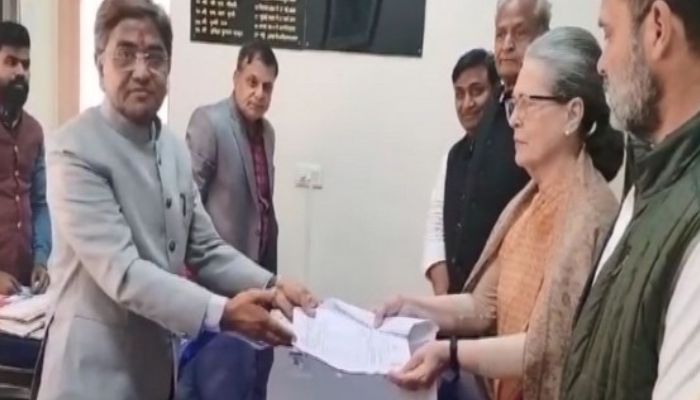
Sonia Gandhi files RS nomination from Rajasthan after Rahul fled from Amethi in 2019: Has Congress already accepted another defeat?

With no hopes of retaining the Rae Bareli Lok Sabha seat in the upcoming 2024 general elections, Congress supremo Sonia Gandhi fled to Rajasthan to file a nomination for the Rajya Sabha seat from the state her party recently lost. This step came in sharp similarity with her son Rahul Gandhi’s escape from the Amethi battlefield in 2019. Rahul Gandhi – sensing an inevitable defeat in Amethi – had contested the last Lok Sabha elections with Muslim-majority Wayanad in Kerala as his second constituency.

This time, the Lok Sabha elections have a backdrop of the NDA government’s impeccable performance and a vibe of pro-Modi enthusiasm in the country after the Ram Mandir consecration. As a result, Sonia Gandhi is fetching grounds to retain her membership in the parliament through the Rajya Sabha instead of facing an election.

Rae Bareli – the fortress of Gandhi family – is not a safe seat for Congress anymore.

Before discussing the speculations and probable reasons for the Congress queen leaving her family fortress, let’s delve into her Lok Sabha performance in the past elections. In the 2014 general elections, she won from Rae Bareli against Ajay Agarwal of the Bharatiya Janata Party. Sonia Gandhi bagged 526434 votes which was 52.43% of the total votes cast. Ajay Agarwal got 173721 votes which was 42.45% votes.

In 2019, Sonia Gandhi received 534918 votes (57.20%) when she defeated Dinesh Pratap Singh of the Bharatiya Janata Party who got 367740 votes (39.34%). What is worrying Sonia Gandhi is not the vote percentage. It is a sheer rise in the actual number of votes cast in favour of the Bharatiya Janata Party. The winning margin of Sonia Gandhi reduced from 352713 in 2014 to 167178 in 2019.

Rahul Gandhi had to run away to Kerala from Uttar Pradesh

A similar situation was seen in Amethi with Rahul Gandhi. In 2009, Rahul Gandhi secured 464195 votes which was 71.8% of the total votes cast. He defeated Ashish Shukla of the Bahujan Samaj Party who got 93997 votes which is 14.5%. BJP candidate Pradeep Kumar Singh received 37570 votes which was 5.8% of the total votes. Rahul Gandhi’s winning margin was 370198.

In the 2014 elections, stats showed a sharp decline in the vote share of Rahul Gandhi. In 2014, BJP leader Smriti Irani fought against him from Amethi. She received 300748 votes (34.38%) while Rahul Gandhi received 408651 votes (46.71%). His winning margin came down to 107903 votes. This was an alarming signal for the Congress party to rethink the ways to send the scion to Lok Sabha again in 2019.

Why Wayanad?

In 2019, the grand old party resorted to its appeasement policies and chose the Muslim-dominated Wayanad constituency in Kerala as the second seat to fight for Rahul Gandhi. This was done to ensure his membership in Lok Sabha in case he lost Amethi – one of the traditional seat of the Gandhi family.

In 2019, Smriti Irani defeated Rahul Gandhi from Amethi. She received 467598 (49.78%) votes and Rahul Gandhi got 412668 (44.55%). These numbers are self-explanatory to reveal how Rahul Gandhi was afraid of losing this election and chose to go to Wayanad instead of defending his family’s traditional seat.

Is Congress planning to (re)launch Priyanka Vadra from Rae Bareli?

It is being speculated that Sonia Gandhi is vacating the Rae Bareli seat because her daughter Priyanka Vadra can be the potential Congress candidate from the ‘family bastion’. A section of Congress of workers still believes that the Gandhi princess, having a nose similar to that of her grandmother Indira Gandhi and a husband entangled in multiple frauds and land grabbing cases will win from Rae Bareli to further the family tradition from Rae Bareli which has historically been ‘in the family’. But this is far from reality.

Priyanka Vadra has been the General Secretary of the party for a long time. She was given the charge of campaigning in the Rae Bareli and Amethi constituencies in the 2014 general elections. Interestingly, the Congress party could win on the very two seats out of 80 seats in Uttar Pradesh at that time. BJP-led NDA won 73 seats and the Samajwadi Party won 5 seats – all shared among the Yadav family. Opposition in Uttar Pradesh was reduced to 7 seats only revealing the true face of the dynastic parties.

A brief report card of Priyanka Vadra

Priyanka Vadra has, over the years, taken various responsibilities in the party organisation in various elections. Congress fought the 2022 assembly elections of Uttar Pradesh under what they call the ‘charismatic’ leadership of Priyanka Vadra. She gave the slogan – ‘Ladki Hoon, Lad Sakti Hoon’. This slogan means ‘I am a girl, I can fight’. In the results of those elections, it was revealed that she could not give any significant fight to the good governance model proposed and executed by Yogi Adityanath.

In 2019, Priyanka Vadra was heading the Congress campaign in Uttar Pradesh for the 2019 Lok Sabha elections as a general secretary for the Congress party. The 17th Lok Sabha elections saw a decisive victory for the Narendra Modi-led NDA alliance, winning 354 seats, with BJP alone victorious on 303 seats. The extent of Modi’s dominance was evident while analysing the figures pouring in from the Election Commission for the country’s most populous state, Uttar Pradesh. In the state, Congress fielded 67 candidates and lost security deposit in 63 of them.

Priyanka Vadra helped Congress lose deposits in Uttar Pradesh

According to the Election Commission set rules and norms, if a candidate fails to get 1/6th of votes (16.67%) of votes polled in a constituency, such a candidate stands to lose the security deposit. Based on this rule, only four Congress candidates in UP got their security deposits back, the deposit for the remaining 63 was lost. The 4 seats where Congress managed to save deposits were Amethi, Rae Bareli, Saharanpur and Kanpur. Sonia Gandhi won from Rae Bareli, the only seat that Congress won in Uttar Pradesh, where the SP-BSP alliance did not field a candidate. Smriti Irani pulled off a splendid victory against Congress president Rahul Gandhi in Amethi.

So the report card of Priyanka Vadra says that let alone retaining Rae Bareli by winning it in the 2024 general elections, she is unfit to contest the seat in the first place. This is because the historic loss of Congress in Amethi and the significant rise in the number of votes in favour of the BJP in Rae Bareli constituency has manifested only under the ‘charismatic’ leadership of Priyanka Vadra.

Is Sonia Gandhi afraid of losing Rae Bareli just like her son lost Amethi?

Seemingly the reason behind Sonia Gandhi’s escape to Rajasthan is that Congress is afraid of another historic loss in the upcoming elections – this time in Rae Bareli. Notably, Smriti Irani’s victory in Amethi did not come just like that. She spent much time working in Amethi after losing the seat in 2014. After winning in 2019, she promised that the BJP would sweep the adjacent Rae Bareli as well.

With the penetration of various schemes of the central and the state government to the remote interiors of these two constituencies, the electoral turnout and the mindset of the voters have experienced a paradigm shift in the last few years. This shift is potent enough to shake the Congress supremo to the core. It is the fear of an insulting loss ahead in May 2024 that she opted to get a Rajya Sabha seat and ran away to Rajasthan – a state Congress recently lost to the BJP after multiple cases of rape atrocities on women.

The BJP has already started calling it an act of surrender.

Uttar Pradesh is already leading the prevalent Ram vibe in the country after the consecration of the Ram Mandir in Ayodhya which is not far away from the Gandhi family strongholds. Diminishing winning leads in Rae Bareli implies that even if Priyanka Vadra contests this seat, she is likely to lose it. Even if she wins, the margin can be as meagre as it can be. In case of her loss, the party may resort to citing electoral beginnings for her in ‘tough’ times. But if Sonia Gandhi loses the Lok Sabha election, it will be a yet greater embarrassment.

With top leader Sonia Gandhi opting not to face the supreme test of mass appeal the Congress party may further see a lower tally in Lok Sabha than what it has now. It sends a message that the party president lacks the courage to face the Hindutva wave in the country. Sonia Gandhi’s Rajya Sabha entry from Rajasthan therefore brings nothing to the table for Congress except saving a Luteyns’ bungalow at 10, Janpath Road in New Delhi.

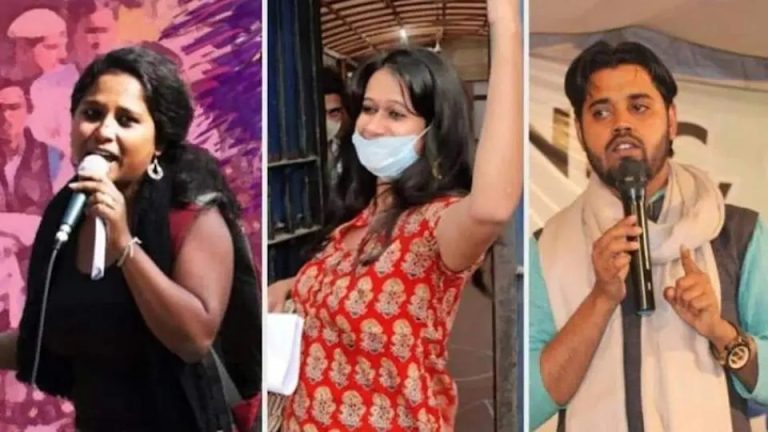
How Supreme Court contradicted its own judgement by not canceling bail granted to Devangana Kalita, Natasha Narwal accused in Delhi anti-Hindu riots

In February 2020, the National Capital of India was rocked by widespread violence directed specifically against Hindus. Amidst chants of Allahu Akbar, Hindus were mercilessly slaughtered by a Muslim mob – the first murder being that of constable Ratan Lal. Thereafter, there were several Hindus who were slaughtered merely for being Hindus during the Delhi anti-Hindu Riots. Ankit Sharma was murdered, with his body dumped in the drain, by AAP councilor Tahir Hussain and his men. Tahir Hussain later mentioned in his disclosure statement that the aim was to “teach Kafirs a lesson”.

In September 2020, the Delhi police filed a chargesheet – 59/2020, which detailed the conspiracy that was hatched to burn Delhi and target Hindus. The charge sheet was an elaborate document spanning thousands of pages, with pictures, CDR records, witness statements, disclosure statements, and undeniable evidence. Regardless, the narrative that the Islamists and Leftists propagated was that the Delhi Riots were one directed against the Muslims – an “anti-Muslim pogrom”.

While the judiciary heard the cases about the Delhi anti-Hindu riots, some troubling judgements started coming to the fore. For example, the first conviction in the Delhi Riots was of a Hindu called Dinesh Yadav. Dinesh Yadav was convicted and handed a sentence of 5 years. In his case, there was no evidence of violence against Yadav. Applying Section 149, the court essentially said that since Yadav was in the vicinity of a mob, and because he is Hindu and the mob was Hindu too, he must have had the same intention and participated in the violence. Essentially, he was convicted simply because he was Hindu. In the raids during the investigation, there was no weapon, and no evidence found against Yadav. As unjust as Yadav’s conviction was, the lack of justice was evidenced by the fact that Muslim accused were given bail and even acquitted using a different interpretation of Section 149.

Just as Dinesh Yadav was convicted, almost simultaneously, those who were accused of murdering Dilbar Negi were awarded bail. The Delhi High Court granted bail to six persons named Mohd Tahir, Shahrukh, Mohd Faizal, Mohd Shoaib, Rashid, and Parvez in the Gokulpuri murder case related to the Delhi Riots of February 2020. The bail was granted by Justice Subramonium Prasad. The six were accused of vandalism and setting Anil Sweet Corner on fire “resulting in the death of 22-year-old Dilbar Negi”. In giving bail to these Muslim rioters, the court, in its wisdom, took exception to Section 149 being applied to every individual who was a part of the illegal assembly. 

The court said, “…clear finding needs to be given by the Court regarding the nature of unlawful common object. Furthermore, if any such finding is absent or if there is no overt act on behalf of the accused, the mere fact that the accused was present or armed would not be sufficient to prove a common object”. The court had further said, “We feel it highly unsafe to apply Section 149 IPC and make every one of them constructively liable. But so far as the above nine accused are concerned the prosecution version is consistent namely that they were armed with lethal weapons like swords and axes and attacked the deceased and others. This strong circumstance against them establishes their presence as well as their membership of the unlawful assembly. The learned counsel appearing for the State vehemently contended that the fact that the Muslims as a body came to the scene of occurrence would show that they were members of an unlawful assembly with the common object of committing various offenses including that of murder. Therefore all of them should be made constructively liable. But when there is a general allegation against a large number of persons the Court naturally hesitates to convict all of them on such vague evidence. Therefore we have to find some reasonable circumstance which lends assurance…” 

Essentially, the same Section 149 was interpreted in two different ways – one to convict Dinesh Yadav and one to give bail to the Muslim accused.

This is not the only instance of judicial double standards. There have been several instances when the court seems to have contradicted its judgements and the precedents set in the past. One such case is the bail granted to Devangana Kalita by the High Court and then upheld by the Supreme Court.

Delhi High Court granting bail to Devangana Kalita and Natasha Narwal – an example of judicial overreach

In June 2021, the Delhi High Court granted bail to Devangana Kalita of Pinjda Tod, Natasha Narwal of Pinjda Tod, and Asif Iqbal Tanha of SIO (Student Islamic Organisation). The three are accused in the larger conspiracy case of Delhi anti-Hindu riots. The Delhi Police had arrested the three far-left ‘activists’ in the case, and a case was registered under the Unlawful Activities (Prevention) Act for their role in the anti-Hindu riots that were unleashed on the streets of Delhi in February 2020.

While granting bail in 2021, the Delhi High Court exceeded its brief and made observations regarding the application of UAPA against the accused and the definition of terrorism itself.

“While the presence of the appellant for purposes of trial must be secured, there is no material or basis to suspect; nor is there any reasonable apprehension that the appellant will tamper with evidence or intimidate witnesses. As very pithily put by the Hon’ble Supreme Court in P. Chidambaram (supra) the gravity of the offense alleged would beget the length of sentence, as may be awarded upon conclusion of trial; but an assertion as to the gravity of the offense cannot thwart the grant of bail,” the court said while granting bail to Tanha. The bail orders for Narwal and Kalita too made similar observations.

The bail orders also questioned the veracity of the charges, an exercise which the court is not supposed to conduct at the stage of hearing bail.

“We are not persuaded to think that prima-facie the accusations made against Natasha Narwal make out any offense under sections 15, 17, and 18 of the UAPA; and therefore the stringent conditionalities contained in section 43D(5) of the UAPA would not apply,” the bail order in Narwal’s case says. “A closer reading of the allegations made against Natasha Narwal shows that no specific, particularised or definite act is attributed to her, apart from the admitted fact that she engaged herself in organizing anti-CAA and anti-NRC protests.”

While granting bail to the accused, the High Court had also observed, “We are constrained to express, that it seems, that in its anxiety to suppress dissent, in the mind of the State, the line between the constitutionally guaranteed right to protest and terrorist activity seems to be getting somewhat blurred. If this mindset gains traction, it would be a sad day for democracy“.

It is at this stage itself that it becomes important to point out the wide difference between the bail order passed in 2021 and the observations of the sessions court only a few months before this order.

In January 2021, Additional Sessions Judge Amitabh Rawat said the allegations against Devangana Kalita prima facie seem to be true. The rejection of Devangana’s bail had come just a day after the Delhi court had rejected the bail plea of another accomplice Natasha Narwal. While rejecting the bail, the court had noted that intentionally blocking roads leading to disruption of essential services, attack on police personnel, and eventually culminating in riots falls within the scope of the terrorist act under the Unlawful Activities Prevention Act (UAPA). 

Firstly, with the same set of facts, one is pressed to understand how two courts in their infinite wisdom came up with two completely different interpretations of the law.

Special Leave Petition challenging HC bail order filed by the Delhi Police

After the High Court’s order granting bail and the observations the bench made in so far as the application of UAPA is concerned, the Delhi Police filed a Special Leave Petition in 24 hours. A Special Leave Petition is one filed against any judgement or decree or order of any High Court /tribunal in the territory of India. The procedure for filing a Special Leave Petition is set out in order XVI of the Supreme Court Rules 1966. According to the rules set forth, an SLP has to be filed within 90 days of the date of the order/decree passed by the High Court.

In this case, the Delhi Police filed the SLP against the High Court order granting bail to the Pinjra Tod accused and the observations it made thereof, within 24 hours of the order.

In the SLP, Delhi police say that the court has conducted a “mini-trial” in the case while granting bail to the accused and has “recorded perverse finding which is contrary to the record and the arguments made during the hearing of the case to arrive at a finding that case under Sections 15,17 and 18 of UAPA was prima facie not made out against the respondent”. 

The SLP further says that the High Court has assumed that this case is one of a simple protest, however, that is not in tune with the evidence on record. Saying that the court has applied “irrelevant considerations” while granting bail to the accused, the SLP says, “Hon’ble High Court completely lost sight of the evidence and statements which were produced before it and had arrived at the impugned judgement discarding the evidence which made out a sinister plot of mass-scale riots being hatched by the respondent along with other co-conspirators”.

In its SLP, the Delhi police said that this observation was beyond the purview of the bail petition and was ‘perverse and misdirected’ in nature. The Delhi Police says, “There was a cause and evidence of terrorist activity against the respondent; there was corroborative evidence, however, while applying the legislative mandate the Hon’ble High Court misdirected itself and gave ex-facie perverse findings to arrive a conclusion that no case of UAPA was made out”. 

In its scathing submission, the Delhi police say that the judicial scrutiny while granting bail to the accused was not to evaluate the evidence on the record but to “somehow establish” that the government was trying to suppress “dissent”. Delhi police say, “This in the respectful submission of the petitioner is without any foundation and appears to be based more on the social media narrative than the evidence gathered and elaborated in the chargesheet“. 

The Delhi police also countered vehemently the observation made by the High Court regarding the application of UAPA. The court had said “In our opinion, the intent and purport of the Parliament in enacting the UAPA, and more specifically in amending it in 2004 and 2008 to bring terrorist activity within its scope, was, and could only have had been, to deal with matters of profound impact on the ‘Defence of India’, nothing more and nothing less…It was neither the intent nor purport of enacting UAPA that other offenses of the usual and ordinary kind, however grave, egregious, or heinous in their nature and extent, should also be covered by UAPA since such conventional matters would have fallen within Entry 1 of List-II (State List) and/or Entry 1 of List-III (Concurrent List) of the Seventh Schedule to our Constitution. To lean in favour of the constitutionality of the provisions of sections 15, 17, and 18 of the UAPA, as we must, it must be taken that the Parliament acted within the realm of its legislative competence and that UAPA came to be enacted and amended in 2004 and 2008 to address issues relating to the ‘Defence of India‘”. 

Delhi police said that the above consideration is ‘irrelevant’ to grant bail to the accused in Delhi Riots and the above reasoning would also hamper investigations being carried out by other organizations including NIA.

The Supreme Court hearing and final dismissal of SLP by Delhi Police in Delhi anti-Hindu Riots case

On the 18th of June 2021, the Supreme Court issued a notice in the SLP and issued interim orders that the High Court observations while granting bail to the accused cannot be considered a precedence and should not be considered in the course of the trial. The court essentially said that the observations cannot be cited by other accused to demand bail as well. Appearing for the Delhi police, Solicitor General(SG) Tushar Mehta submitted that the entire UAPA had been turned on its head along with the Constitution by the high court, which, according to Mehta, had virtually acquitted the accused persons. Supreme Court observed the court found it troubling that the high court had, in a bail application, commented on the law that too when the validity of the UAPA was not under challenge.

Finally, on the 2nd of May, the Supreme Court dismissed the Special Leave Petition filed by the Delhi Police and upheld the bail granted to the three accused, reiterating that the observations by the High Court would not be considered precedence.

The Supreme Court in its order said, “The impugned order is an extremely elaborate order of bail interpreting various provisions of the UAPA Act. In our view, the only issue that is required to be examined in such matters is whether, in the factual scenario, an accused is entitled to bail or not. It is this argument that persuaded us while issuing notice on 18.06.2021 to observe that the impugned judgement cannot be treated as a precedent and may not be relied upon by any of the parties in any other proceedings. The idea was to protect the State against the use of the judgement on the enunciation of law qua interpretation of the provisions of the UAPA Act in a bail matter. The respondents have been on bail now for almost two years. We see no purpose in keeping these matters alive“.

The operative part of the Supreme Court order in the Delhi Riots case that we need to focus on for this article is the following:

“The respondents have been on bail now for almost two years. We see no purpose in keeping these matters alive“.

The Kumer Singh judgement and what the Supreme Court had said about cancellation of bail after 2 years

In the Kumer Singh case in 2021, the Supreme Court addressed this very question of upholding bail merely because the accused had been out on bail for 2 years.

The Supreme Court had said, “Now so far as the submission on behalf of the accused that the accused are released on bail in the year 2019 and by now more than approximately 2 years have passed after they were released on bail and there are no allegations of misuse of liberty and/or having committed any breach of the conditions of the grant of bail and therefore this court may not set aside the order passed by the High Court is concerned, the aforesaid cannot be accepted”.

The following are the reasons cited by the court:

  1. No delay in filing of appeal against the bail granted by the High Court. The petition against the High Court bail order was filed within 2 months. The time limit for filing of SLP is 90 days.
  2. The SC in this case cites two previous SC orders – The case of Mahipal (Supra) and the case of Ramesh Bhavan (Supra). Citing these cases, SC says that the application for cancellation of bail stands on a different footing than challenging the order passed by the High Court/Appellate Court releasing the accused on bail.
  3. Citing precedence, the court says that in the Mahipal case, which cited the Neeru Yadav case, the court held that there are two kinds of bail cancellation cases. One is of the nature when the accused has contravened the conditions of the bail. But the other kind is where the order granting bail itself was unjustified, illegal, and perverse, the higher court can cancel the bail even if the accused has not violated the conditions of the bail.
  4. Citing the Mahipal Singh case, the court said, “Where a court considering an application for bail fails to consider relevant factors, an appellate court may justifiably set aside the order granting bail. An appellate court is thus required to consider whether the order granting bail suffers from a non-application of mind or is not borne out from a prima facie view of the evidence on record.”
  5. The Supreme Court in the Kumer Singh case further said that “The aforesaid principle of law has also been reiterated by this court in the recent decision in Parvez Noordin Lokhandwalla vs. the State of Maharashtra10”.
  6. In this case, the order of the SC said, “Impugned orders passed by the High Court granting bail to the respondents – accused do not pass the test laid down by this Court on grant of bail and exercising of powers of the appellate court laid down in various decisions through Mahipal (Supra), Neeru Yadav (Supra); Gulabrao Baburao Deokar (Supra) referred to hereinabove. Therefore, the impugned orders passed by the High Court deserve to be quashed and set aside”.
  7. In the Kumer Singh case, the Supreme Court thus ordered all the accused to surrender forthwith.

How the Supreme Court contradicted itself while upholding the bail of Devangana Kalita, Natasha Narwal, and Asif Iqbal Tanha, accused in Delhi anti-Hindu Riots

In the Kumer Singh case, the first observation of the Supreme Court was that there was no delay in filing the Special Leave Petition against the High Court order granting bail and that it was filed within 2 months (when the time limit is 90 days). In the case of Devangana, Natasha, and Asif, the Delhi Police filed the SLP within a day.

The second observation, and the most important perhaps, was that even if the accused has not violated conditions of bail, simply because it has been two years since the grant of a bail which was perverse and bad-in-law, to begin with, was granted, does not preclude the higher court (Supreme Court) from canceling the bail granted. In the Kumer Singh case, the Supreme Court ordered the accused to surrender forthwith even though they had been out on bail for 2 years and had not violated the conditions of the bail granted. The Supreme Court did so because it deemed the grant of bail perverse and bad in law.

In the case of Devangana Kalita, Natasha Narwal, and Asif Iqbal Tanha, the Supreme Court specifically said, “The respondents have been on bail now for almost two years. We see no purpose in keeping these matters alive“. This, was after the Supreme Court had explicitly stated that the High Court exceeded its brief in commenting on the merits of the case and the validity of the provisions of law. If the High Court had indeed exceeded its brief, then it would be par for the course for the Supreme Court to either cancel the bail and grant the SLP filed by the Delhi Police or throw the case back to the High Court asking them to hear the cause on the merits of the bail granted. However, the Supreme Court seems to have an exception in dismissing the SLP filed by the Delhi Police merely because the accused have been out on bail for the past 2 years and have supposedly not violated the terms of the bail granted.

It is pertinent to mention here that proving that the High Court order granting bail to the three accused was bad in law, is the fact that the High Court upheld the applicability of UAPA in the case of Umar Khalid. This is further proven by the fact that Umar Khalid’s counsel Kapil Sibal on 14th February withdrew the bail application from the Supreme Court, after seeking numerous adjournments.

The Court is allowed to be discretionary, however, when the judicial process becomes whimsical and the Supreme Court is found contradicting its own judgements, especially in a sensitive case like the Delhi Riots, one is pressed to ask which judgement, in the judiciary’s infinite wisdom, should be considered precedence going forward.


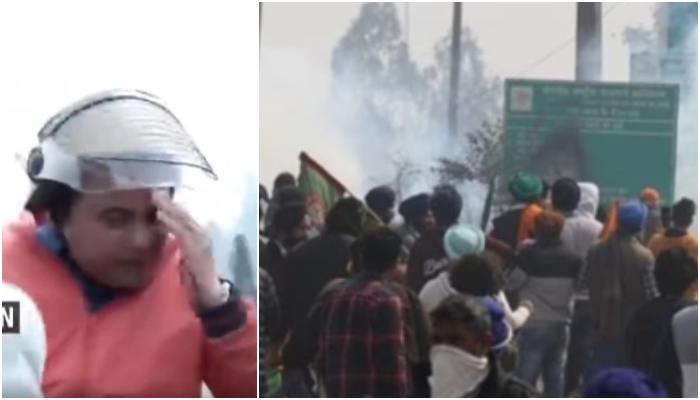
India Today journalist, who said ‘don’t show’ to cameraman recording stone pelting by ‘farmers’, admits protesters pelted stones after getting injured

0

On Wednesday (14th February), a video report from the Indian Today news channel was making rounds on social media in which one of its journalists could be seen trying to shield the protesting farmers who pelted stones at the state police at the Shambhu border in Haryana.

Journalist Satendra Chauhan could be seen directing the cameraman to avoid showing one of the protesters pelting stones at the Haryana Police. “Don’t show that,” he could be heard saying as the cameraperson widened the angle to show some of the agitated protesters pelting stones.

The video of the said incident was posted by several social media influencers and media commentators who alleged that India Today was trying to safeguard the protesters as they pelted stones. “The camera showed protesters pelting stones at police. The reporter asks the cameraman not to show that. Why shouldn’t that be shown?” questioned one of the netizens.

“Why your reporter is forcing the cameraman not to show the Stone pelters? Is he there for propaganda or reporting?” asked another X user.

Meanwhile, Political Kida, one of the X users, alleged that India Today only aimed to portray the government as wrong while defending the stone pelters.

“Cameraman captures protesters throwing stones at the police. India Today’s journalist Satyendra Chauhan tells him not to show that. But if police respond with tear gas, the media will label the govt as Anti-Farmer and Fascist!” commented another X user.

The video has been widely shared on social media platforms criticizing India Today for allegedly spreading partial information in favour of the protesting farmers. However, later India Today officially shared another video coverage by Satendra Chauhan in which the latter could be seen reporting and confessing that the protesting agitated farmers pelted stones at the Police.

“The farmers did not intend to stop. They were continuously pelting stones at the police resulting in police action. The Haryana Police then fired tear gas shells and attempted to disperse the crowd,” Chauhan could be heard saying.

Interestingly, Chauhan is said to have reported about the stone pelting after he got injured during the attack. Chauhan, who also is associated with Aaj Tak was injured during the farmer’s protest at the Shambhu border in Ambala, Haryana. He was immediately taken to Ambala city’s civil hospital where he is undergoing treatment.

However, the reporter reported from the hospital that the farmers pelted stones at the police which triggered the police to take severe action against the protesters. “The situation at the Shambhu border was quite tense. The tensions escalated further after the farmers began pelting stones at the police. Later the police also resorted to firing tear gas shells at the farmers,” Chauhan reported from the hospital bed.

The protests at the Shambhu border and nearby areas are underway. On Wednesday (14th February), protesting farmers from various organizations began marching towards the national capital. The Delhi Police posted at the borders are currently protecting the borders and maintaining law and order in response to the farmers’ ‘Delhi chalo’ demands. A vast deployment of police and paramilitary forces, as well as multi-layered barricades, are in place to secure the national capital borders at Singhu, Tikri, and Ghazipur.

Central Delhi has been heavily secured, with anti-riot soldiers placed strategically and metal and concrete blocks limiting access to numerous critical roadways.

On Tuesday, the Delhi Metro restricted passenger admission and exit at nine stations by closing some gates for many hours in anticipation of the farmers’ march to the national capital.

Following failed negotiations with the government, police used tear gas to prevent hundreds of farmers demanding minimum crop prices from marching on the capital, Delhi. Thick clouds of tear gas were used to disperse protesters at the Shambhu border near Ambala, around 200 kilometres north of the capital. Additionally, authorities used drones to drop tear gas canisters from the air.

While the police are not actively hindering farmers’ passage from the state to Delhi, Punjab has declared a state of high alert, with roughly 70% of the state police force told to remain on duty in the field.

The farmers are organizing a large-scale protest to force the Centre to acknowledge their list of demands. The farm organizations are pushing for legislation to establish a minimum support price (MSP), a criterion they agreed to in 2021 when they agreed to terminate their protest against the now-repealed agricultural laws.

Farmers are also advocating for the implementation of the Swaminathan Commission’s recommendations, pensions for farmers and agricultural workers, and farm debt relief. According to the farmers, the Centre should secure “justice” for the victims of the Lakhimpur Kheri violence.

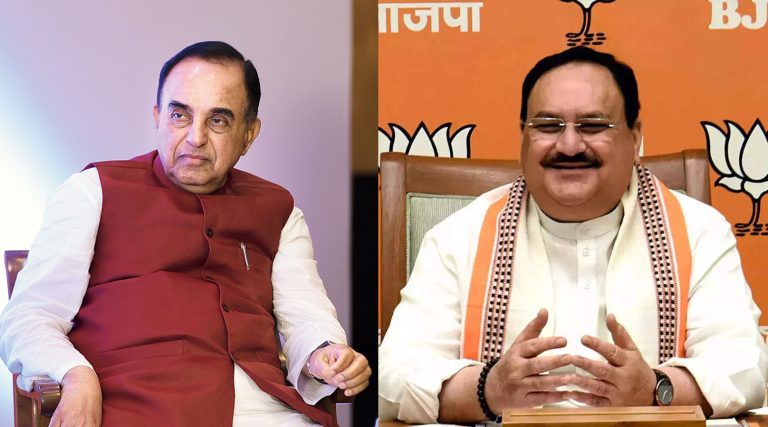
Subramanian Swamy threatens legal action against BJP for not holding party elections, claims extension of president Nadda’s term violates his fundamental rights

Disgruntled BJP leader Subramanian Swamy, who is more known for spreading fake news against his own party these days, has threatened to take legal action against the party over the extension of the party president’s term. The former Rajya Sabha MP on 14th February shared a letter written to BJP President Jagat Prakash Nadda, opposing the party’s decision to extend Nadda’s term and not hold elections.

Swamy informed Nadda that he wrote to the Election Commission of India alleging that not holding party elections in BJP violates statutory and constitutional provisions. It is notable that JP Nadda was elected the president of BJP in January 2020, and his term ended in January 2023, as the BJP constitution states that the term of the president is 3 years.

During the BJP’s national executive meeting days before the expiry of his term in January last year, the party decided to delay the internal elections and extend the party president’s term to June 2024. BJP didn’t want to make any change in the party ahead of the general elections and therefore decided to fight the polls under the leadership of JP Nadda.

However, now rebel BJP leader Subramanian Swamy has objected to this decision. He has written a letter to JP Nadda, opposing the extension of Nadda’s term as BJP president. According to Swamy, the extension of the party president’s term violates the provisions of the Constitution, The Representation of the People Act, 1951, the party’s constitution and his fundamental rights.

Saying that he has already filed a complaint with the EC, he wrote, “I am enclosing herewith my letter apprising the Election Commission (dated November 13, 2023) about the lack of internal party elections in BJP as violative of statutory and constitutional provisions, as provided in the Constitution and The Representation of the People Act, 1951.”

Arguing that the decision also violates the BJP constitution, he wrote, “Even the term-extension of the BJP President is currently in contravention to the Article XXI of the Party Constitution, which stipulates for the term’s length to be only 3 years, extendable through fresh party elections.”

Subramanian Swamy claimed that this violates his fundamental rights, and therefore he may take the matter to Delhi High Court, adding that the matter is already with the Election Commission. Swamy said that the letter is a notice informing that he is taking legal action after a month from the date of the letter.

“Since the matter is before the Election Commission and may be filed in the Delhi High Court as violative of my fundamental rights, I hereby give you notice that I intend taking legal action for necessary reliefs, after a month from today’s date,” Swamy wrote. This means he indents to approach the Delhi High Court on or after 6 March 2024.

At the end Subramanian Swamy added that he is available to apprise “the ramification of the failure to hold legitimate party elections to elect office bearers and committees.” He also sent a copy of the letter to the Chief Election Commissioner.

Rahul Gandhi cuts short Bharat Jodo Nyay Yatra in Jharkhand to join farmers’ protest outside NCR

The second phase of Rahul Gandhi’s ‘Bharat Jodo Nyay Yatra’ in Jharkhand, set to commence on Wednesday (14th February), has been abruptly cancelled. This decision came as the senior Congress leader, Rahul Gandhi, rushed to Delhi to participate in a farmers’ agitation in the national capital, according to party officials.

The decision to join the farmers’ protest in Delhi comes amidst ongoing agitation from Punjab farmers, planning to march to the national capital to press for various demands, including a law on minimum support prices for crops and loan waivers.

Scheduled interactions with MGNREGA workers in Ranka, Garhwa district, will now be conducted by senior Congress leader Jairam Ramesh and other party members, as per reports. Rahul Gandhi, who was slated to re-enter Jharkhand from Chhattisgarh for the yatra’s second phase, redirected his plans to join the farmers’ protest.

Congress spokesperson Sonal Shanti confirmed the cancellation of all yatra programs in Jharkhand, stating that it is unlikely to resume from the state. Instead, AICC general secretary Jairam Ramesh, along with other senior Congress leaders, will participate in the scheduled interactions with MGNREGA workers in Ranka.

Rajesh Thakur, Jharkhand Congress president, earlier stated that Gandhi had to depart for Delhi for a “special purpose,” referring to his participation in the farmers’ agitation. The first leg of Gandhi’s yatra in Jharkhand occurred in the first week of February, entering the state from West Bengal on 2nd February and exiting to Odisha on 6th February.

Gandhi was initially scheduled to stay in Jharkhand for two days. The ‘Bharat Jodo Nyay Yatra,’ launched in Manipur on 14th January, aims to cover 6713 kilometres in 67 days, traversing 110 districts across 15 states, and culminating in Mumbai on 20th March.

On 13th February, farmers from Punjab, Haryana and other states marched towards Delhi, aiming to get their demands fulfilled by the Government of India. Around 200 farmer unions are participating in the protests.

While police and rapid action forces attempted to stop them from entering the national capital, there were visuals confirming the farmer protests of 2024 had already been infiltrated by pro-Khalistani elements.

Apart from drafting a law on MSP, the protesting farmers have been demanding that India should quit the World Trade Organisation (WTO), halt trade agreements with other nations, and a monthly pension of Rs 10000 to farmers who attain the age of 60 years among others. Now, Rahul Gandhi is joining these protestors.

Swaminathan Commission didn’t ask for MSP to be made into law: Congress has been lying and misleading farmers and taxpayers

On the 13th of February, Congress leader Rahul Gandhi promised to enact a Minimum Support Price (MSP) guarantee law if his party comes to power in the coming Lok Sabha Elections.

While addressing a gathering in Chhattisgarh’s Ambikapur, Rahul Gandhi said, “BJP government gave Bharat Ratna to M.S. Swaminathan. But the cause to which Swaminathan devoted his life, his recommendations on MSP, they are not ready to do. Swaminathan report clearly said that farmers should get MSP as a legal right. But the BJP is not doing this. If the INDIA alliance forms the government we will give MSP’s legal guarantee.”

Taking to X, Rahul Gandhi wrote, “Farmer brothers, today is a historic day! Congress has decided to give a legal guarantee of MSP to every farmer on crops as per the Swaminathan Commission. This step will change the lives of 15 crore farmer families by ensuring their prosperity. This is the first guarantee of Congress on the path of justice.”

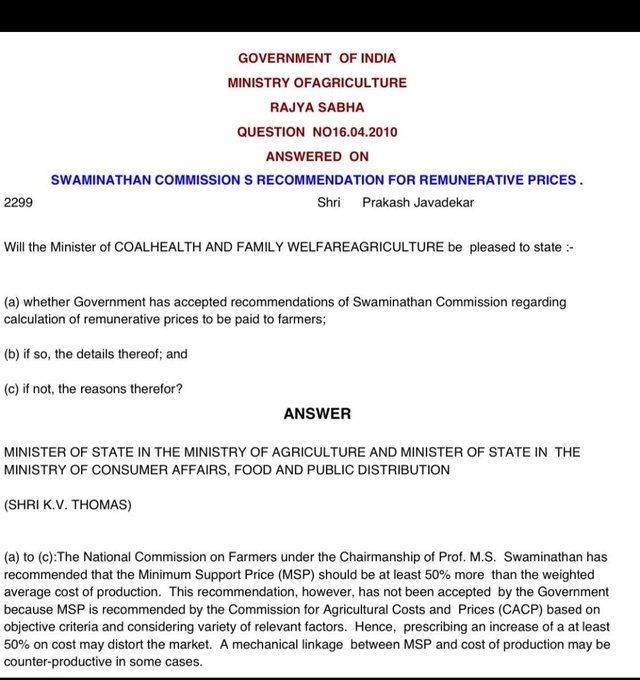
While the Congress party is now promising to legalise MSP if voted to power, back in 2010 his own party’s government led by the then Prime Minister Dr Manmohan Singh had rejected the Swaminathan Commission’s C2+50 per cent formula recommendation citing “counter-productivity”.

Back in 2010, KV Thomas, the Minister of State for Agriculture, informed the Rajya Sabha that the then-Manmohan Singh-led government did not accept the MSP recommendation, which was made by the Commission for Agricultural Costs and Prices (CACP) based on objective criteria and taking into account a variety of relevant factors.

“Hence, prescribing an increase of at least 50% on cost may distort the market. A mechanical linkage between MSP and cost of production may be counter-productive in some cases,” Minister Thomas had replied.

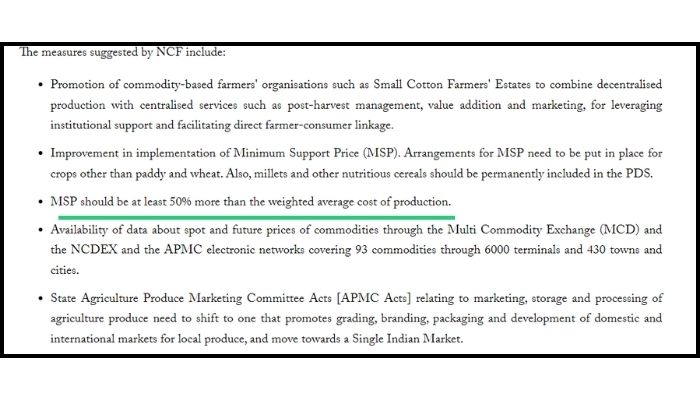
Notably, the Swaminathan Committee’s National Commission on Farmers had recommended that the MSP be at least 50% higher than the weighted average cost of production. This was referred to as the C2+50% formula, which included the capital input cost and land rent to provide farmers with 50% of the returns.

Excerpt from Swaminathan Committee report (Source: prsindia.org)

It is pertinent to note that although the Swaminathan Committee recommended that the MSP be at least 50% higher than the weighted average cost of production, it did not essentially make a case for the legalisation of MSP. The commission never asked for MSP to be made a legal right, contrary to what the Congress is trying to portray.

Notably, the National Commission on Farmers (NCF) was established on 18th November 2004, under the leadership of Professor M.S. Swaminathan. The terms of reference reflected the priorities outlined in the Common Minimum Programme. The NCF presented four reports in December 2004, August 2005, December 2005, and April 2006, respectively. The fifth and final report was submitted on 4th October 2006. The studies include proposals for achieving the “faster and more inclusive growth” goal outlined in the Approach to the 11th Five-Year Plan.

Before attacking the Modi government, Rahul Gandhi should question his own party as to why the UPA government did not implement the Swaminathan Committee’s recommendation with regard to MSP if the party actually cared for the farmers. The Congress party’s bold promise to make MSP a legal right comes when the farmers are protesting to press their demand for drafting a law on MSP.

The timing of the party’s sudden flip raises the question if Congress genuinely intends to support farmers or is just eyeing an opportunity to garner votes since the INDI Alliance is in a deplorable state and is miserably failing to put forth any strong fight before the Modi-led government.

Rahul Gandhi’s opportunism might prove destructive for not just the agriculture sector but also pose a threat to the country’s economic stability and growth.  

A history of Congress’ duplicities and betrayals

Interestingly, this is not the first time that Congress has exposed its own duplicity. Back in 2019, the Congress party had in its Lok Sabha election manifesto promised to repeal the Agricultural Produce Market Committee. “Congress will repeal the Agricultural Produce Market Committees Act and make trade in agricultural produce — including exports and inter-state trade — free from all restrictions,” the party’s 2019 election manifesto stated.

However, when the Modi government introduced similar reforms in the year 2020, the Congress party vehemently opposed the government, clearly just for the sake of opposing. The Congress party back then called the three farm laws as ‘black laws’.

Interestingly, former Prime Minister Dr Manmohan Singh had also urged states to amend the APMC Act, giving farmers greater freedom in 2009 and 2012. But when the Modi government gave farmers the option to trade freely outside of APMCs, the same Congress took a hypocritical stand.

In 2020, a noticeable lack of uniformity was observed in then-Congress-ruled states such as Punjab, Chhattisgarh, and Rajasthan regarding legally guaranteed MSP for floor pricing. While these states passed farm bills to sidestep the now-repealed central farm regulations, there was no consistency in guaranteeing MSP. While the Punjab government’s bill guaranteed MSP only for wheat and paddy, Rajasthan’s bill mentioned MSP guarantees only for contract farming, and the Chhattisgarh bill was hazy on MSP assurances and dealt with concerns subjectively. In its entirety, none of these bills adequately addressed the protesting farmers’ demands for a legally enforced MSP, despite the Congress leadership’s claims of full support for farmers.

Congress playing South India-North India divide and ‘support for Punjab farmers’ at the same time

Irony starved to death when Congress leader and Karnataka deputy Chief Minister DK Shivakumar came forward to support the ‘Annadaatas’ over bringing MSP law. Taking to X on 12th February, Shivakumar wrote, “Union Govt promised to implement MSP law in 2021, and now we are in 2024 and still the govt has not fulfilled its promise to our farmers. More than 700 farmers lost their lives during the last protest, but our govt continues to play with their sentiments & their future with unfulfilled promises. Now, by constructing barricades it wants to stop the farmers from protesting for their rights. Look at the injustice of it all! Our farmers have every right & reason to protest against these injustices and we stand with them in this fight!”

While the Congress party is now suddenly worried about Punjab farmers, its leaders like DK Suresh were crying hoarse over “why South India tax money would fund North India development. The Karnataka Congress leader went as far as expressing his disdain for North India as he ended by saying that in the future, “South Indian states may demand a separate country for themselves and become a separate nation.”

How MSP is calculated?

The Central Government determines the minimum support price (MSP) using a formula that considers production costs and sets the price at one-and-a-half times these expenses. This approach takes into account both explicit costs (A2), which include expenses for goods such as seeds, fertiliser, pesticides, fuel, irrigation, hired labour, and leased-in land and the estimated value of unpaid labour done by family members (FL). Notably, the government determines MSP for 22 mandated crops based on recommendations from the Commission for Agricultural Costs and Prices (CACP), as well as the views of state governments and concerned Central Ministries/Departments.

Farmers protest and their demands

On Tuesday (13th February), a large number of farmers marched towards the national capital. In addition to drafting a law on MSP, the protesting farmers undertaking the ‘Delhi Chalo’ march have been demanding that India should quit the World Trade Organisation (WTO), halt trade agreements with other nations, and a monthly pension of Rs 10,000 to farmers who attain the age of 60 years among others. The protest has been called by Sanyukt Kisan Morcha and Punjab Kisan Mazdoor Sangharsh Committee, led by farmer union leaders Jagjeet Singh Dallewal and Sarwan Singh Pandher.

Notably, the MSP has increased substantially since the Modi government took power in 2014. In response to OpIndia’s RTI, the Government of India stated that the MSP for wheat per quintal has increased from Rs 1,350 in 2013-14 to Rs 2,015 in 2022-23. As reported earlier, the minimum support price for wheat increased from Rs 1,350 per quintal in 2013-14 to Rs 2,105 in 2022-23. The Modi government’s measures have ensured an increased income for the farmers over the years. 

On 6th February, Arjun Munda, the Union Minister of Agriculture and Farmers’ Welfare informed the Lok Sabha that procurement of foodgrains has increased from 761.40 lakh metric tonnes in 2014-15 to 1062.69 lakh metric tonnes in 2022-23, benefitting more than 1.6 crore farmers. The expenditure incurred (at MSP values) on procurement of foodgrains increased from 1.06 lakh crores to 2.28 lakh crores, during the same period.

Bringing a law legalising MSP would involve a tremendous fiscal burden on the government exchequer, there would be a risk of undervaluation of crops with low yields, an increase in food inflation, market distortionary and economically unsustainable practices, and India would face opposition in the WTO as well as trade disputes with importing countries.

Delhi anti-Hindu riots: Umar Khalid withdraws bail plea from SC citing ‘change in circumstances’, to ‘try luck’ in trial court

Former Jawaharlal Nehru University (JNU) student Umar Khalid withdrew his bail plea before the Supreme Court in the Delhi anti-Hindu riots in February 2020 on Wednesday.

A bench of Justices Bela M Trivedi and Pankaj Mithal allowed him to withdraw the bail plea.

Senior advocate Kapil Sibal, appearing for Khalid, told the bench that the petition is being withdrawn in view of a “change in circumstances” and to seek bail afresh before the trial court.

Sibal said, “Bail matter, we wish to withdraw. There has been a change in circumstances; we will try our luck in the trial court.”

Khalid has been in custody in a UAPA case in the anti-Hindu Delhi riots in February 2020.

Khalid had approached the top court challenging an October 2022 Delhi High Court verdict that had denied bail to him.

Khalid, arrested by Delhi Police in September 2020, had sought bail in the High Court on the grounds that he neither had any “criminal role” in the violence in the city’s north-east area nor any “conspiratorial connection” with any other accused in the case. The Delhi police had opposed Khalid’s bail plea.

He had approached the High Court, challenging the dismissal of his bail application by the trial court in March 2022.

He was charged with criminal conspiracy, rioting, and unlawful assembly, as well as several sections of the Unlawful Activities (Prevention) Act (UAPA).

Besides Khalid, Sharjeel Imam, activist Khalid Saifi, JNU students Natasha Narwal and Devangana Kalita, Jamia Coordination Committee members Safoora Zargar, former AAP councillor Tahir Hussain and several others were booked under the stringent law in the case.

The violence that erupted during the protests against CAA and NRC left 53 people dead and over 700 injured. (ANI)

(With agency inputs)

Providing time and money to mother by husband does not constitute domestic violence: Mumbai court quashes woman’s petition

0

A sessions court in Mumbai has ruled that a man caring for his mother can’t be considered as domestic violence against his wife. The court made this observation while dismissing a complaint filed by a woman against her husband and in-laws. The court pronounced that a man providing time and money to his mother cannot be classified as domestic violence. The charges against the respondents are insufficient and opaque and there is no evidence that the accused subjected the applicant woman to domestic abuse, per a ruling delivered on 13th February by Additional Sessions Judge Ashish Ayachit of the Dindoshi court.

The woman, an assistant in the state secretariat known as “Mantralaya” had filed a case under the Protection of Women from Domestic Violence Act with a magistrate court, seeking an order for compensation, financial relief and protection. She claimed that her spouse had tricked her into marrying him by hiding his mother’s mental instability. The complainant further alleged that she had arguments with her husband and mother-in-law who objected to her work as well as harrassed her.

According to the woman, her husband spent September 1993 through December 2004 working overseas. He used to visit his mother in India whenever he visited India on leave and would send her Rs 10,000 annually. The woman added that he also paid for his mother’s eye surgery. She also claimed being harassed by the other members of her in-laws’ family.

On the other hand, the man refuted every accusation. He asserted that his wife resorted to making up accusations against him and never acknowledged him as her spouse. He mentioned he had petitioned a family court for a divorce as a result of her torment. Furthermore, he maintained that his wife had secretly taken out Rs 21.68 lakh from his NRE (non-resident external) account and used it to buy an apartment. The woman was granted Rs 3,000 per month in interim maintenance by the trial court (magistrate) while the appeal was pending.

After hearing all the arguments, the magistrate court rejected the lady’s petition and withdrew the temporary orders and reliefs that had been accorded to her while the case was pending after recording her testimony and that of other witnesses. The woman then went before the sessions court to file a criminal appeal. The sessions court concluded after reviewing the information that the accusations made against her in-laws are “vague and ambiguous” and that there is insufficient evidence to support the claims that they assaulted the woman.

The court highlighted, “It is a matter of record that the applicant is an ‘assistant’ working in Mantralaya and getting a salary. It is revealed from the entire evidence that her grievance is that, the respondent, her husband, is giving time and money to his mother, which cannot be considered as domestic violence. Careful reading of the entire evidence of the applicant and respondent number 1(husband), I am of the opinion that the applicant has miserably failed to prove that she was subjected to domestic violence.”

The woman’s spouse served her with a notice of intent to file for divorce, the court explained, and only then were the proceedings initiated. It remarked that she was not eligible for any kind of redress based on the Protection of Women from Domestic Violence Act. The court pointed out that it could not accept the contention that because the woman’s daughter is single, the former should be granted support.

The judge stated, “I do not think that the applicant is entitled to recover maintenance for major daughter,” emphasizing that the daughter is an adult and she has an independent remedy available under the law. The judge added that the court does not need to get involved in the contested trial court’s decision.

‘Humanity facing a new challenge as terrorism changes forms everyday,’ says PM Modi in his address at World Governments Summit in Dubai

0

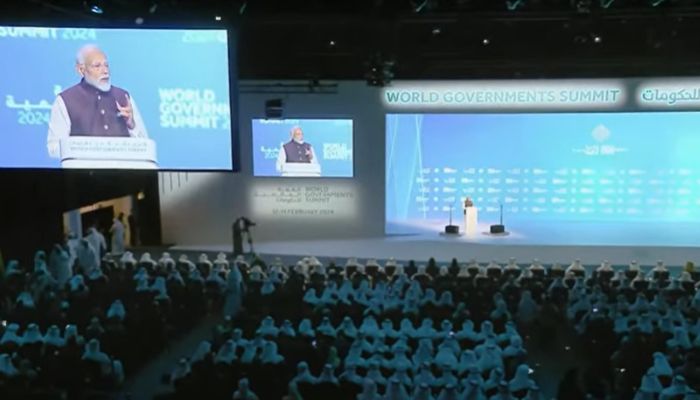
Prime Minister Narendra Modi on Wednesday (14th February) addressed the World Governments Summit in Dubai on day 2 of his visit to the United Arab Emirates (UAE).

While listing the challenges faced by nations in the new world order, Prime Minister Modi said that technology has proven to be a “key disruptor” both negatively and positively.

In this context, he said that terrorism has been changing forms and posing a new challenge to humanity.

“With every new day, terrorism is changing its form and posing a new challenge to humanity,” PM Modi said. He said that there are domestic concerns on one hand and on the other hand, international systems appear scattered.

“Between all this, every government is facing a very big challenge of defending its relevance,” he said.

The Prime Minister underlined that even as governments around the world have witnessed a decline in their perception amongst the people, India has seen an upward trend in this regard.

“Trust on governments worldwide declined after Covid. But we (BJP government) experienced the complete opposite in India,” he said adding that the confidence of Indians in their government has only strengthened.

Prime Minister Modi presented his ‘Minimum Government, Maximum Governance’ model and said that there should be no scarcity nor excess of government in the life of people.

“People have complete trust on our intent and committment. How did this happen? Because we prioritised the social sentiment, we are sensitive towards the needs and dreams of the people,” he said.

PM Modi highlighted his governance model based on the ‘top down and bottom up’ and ‘whole of society’ approach.

PM emphasized on his government’s people-driven approach to ensure people’s participation. He said, “People of the country should take charge of running the nation,” as he explained his governance model in detail.

Vibhakar Shastri, the grandson of former PM Lal Bahadur Shastri joins BJP after resigning from Congress

0

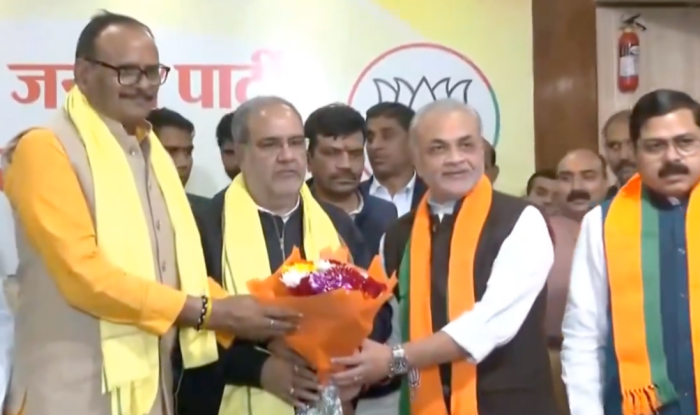
 Vibhakar Shastri, the grandson of former Prime Minister Lal Bahadur Shastri joined the Bharatiya Janata Party (BJP) on Wednesday in the presence of Uttar Pradesh Deputy CM Brajesh Pathak.

Shastri resigned from the Congress party’s primary membership ahead of Lok Sabha polls earlier in the day.

After joining the saffron party, Vibhakar thanked Prime Minister Narendra Modi, UP CM Yogi Adityanath and other leaders of the party for providing him a chance to connect with Lal Bahadur Shastri’s vision of ‘Jai Jawan, Jai Kisan’.

“I think under the leadership of PM Narendra Modi, I will be able to serve the country by further strengthening Lal Bahadur Shastri’s vision of ‘Jai Jawan, Jai Kisan’,” he said.

“We also want that under the leadership of PM Modi, we become a developed nation, and the largest economy of the world,” he added.

Earlier, Shastri informed about leaving the grand old party through a post on the social media platform, X.

“Hon’ble Congress President Shri @kharge ji! Respected Sir, I hereby tender my resignation from the primary membership of the Indian National Congress (@INCIndia). Regards Vibhakar Shastri,” he posted.

Vibhakar Shastri had fought and lost from the Fatehpur constituency in Uttar Pradesh during the 2009 Lok Sabha elections on a Congress ticket.

Earlier, former Congress leader Ashok Chavan resigned from the grand old party on Monday and joined the Bharatiya Janata Party on Tuesday, asserting to work for the “constructive development of Maharashtra”.

Calling it a “new beginning” in his political career, Ashok Chavan said, “Today it’s a new beginning of my political career. I am formally joining the BJP in their office today. I am hopeful that we will work for the constructive development of Maharashtra.”

Chavan was the third big name to desert the Congress ship in Maharashtra. First to go was former South Mumbai MP Milind Deora, followed by former MLA Baba Siddique.