Home Blog Page 1417

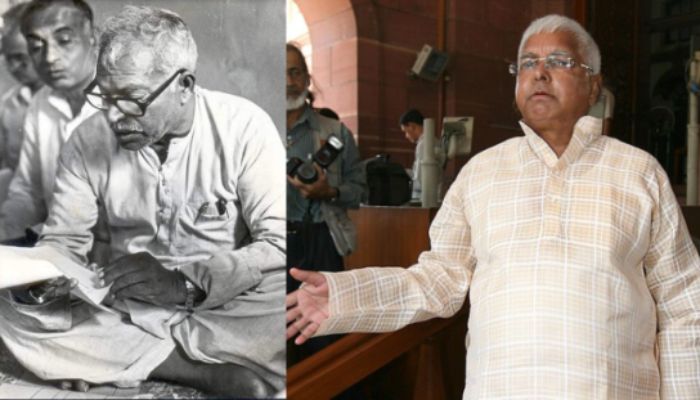
History of Bihar- Lalu Prasad Yadav used to call Jan Nayak ‘Kapti Thakur’, projects Kaproori Thakur as ‘Guru’ after Bharat Ratna

On 23rd January, the President of India, on the recommendations of the Modi government, conferred Bharat Ratna on the late former Chief Minister of Bihar, Karpoori Thakur. Over the years, he had earned the moniker ‘Jananayak’ for his fight for social justice. Thakur was the head of the first non-Congress government in Bihar. 

On the 100th birth anniversary of the late socialist leader, PM Modi penned his thoughts to pay tribute to ‘Jan Nayak’ Karpoori Thakur. In the commemorative article, PM Modi wrote, “I never had the opportunity to meet Karpoori Ji but, I heard a lot about him from Kailashpati Mishra Ji, who worked closely with him.” 

Notably, Mishra had served as the Finance Minister of Bihar and later also became the Governor of Gujarat and Rajasthan. 

Discussing Karpoori Thakur’s simple lifestyle and humble nature, PM Narendra Modi shared a few anecdotes that highlight the simplicity of the socialist leader.

PM Modi recalled how Karpoori Thakur preferred to spend his own money on any personal matter including his daughter’s wedding rather than drawing even a single penny from the government’s coffers. 

Describing another incident to highlight Thakur’s simplicity, PM Modi wrote, “During his tenure as Chief Minister of Bihar, a decision was taken to build a colony for political leaders but he himself did not take any land or money for the same. When he passed away in 1988, several leaders went to his village to pay tributes. When they saw the condition of his house, they were moved to tears- how can someone so towering have a house so simple!” 

PM Modi added that Karpoori Thakur was a proponent of education in local languages so that people from villages and small towns could also get a good quality education.

Meanwhile, when the decision to confer Bharat Ratna posthumously on Karpoori Thakur was announced, a race began with opportunistic leaders of Bihar trying to steal the credit for it. RJD chief Lalu Prasad Yadav, who is part of the coalition government of Bihar, was at the forefront of this. Lalu Yadav, who had vehemently opposed Karpoori Thakur throughout his life, projected himself as the one fighting for Thakur. We will unmask the face of Lalu Yadav who pushed Bihar into ‘Jungle Raj’, but before that let us know who Karpoori Thakur was.

Karpoori Thakur – the recipient of ‘Bharat Ratna’

The date of birth of Karpoori Thakur is a matter of some uncertainty, but it is generally believed that he was born on 24th January 1924 in Pitaunjia, Samastipur district. He was the son of Gokul Thakur and Ramdulari Devi. His native village is now known as ‘Karpoori Gram’. He hailed from a ‘Nai’ family which falls under backward community. 

Thakur pursued his higher education at CM College in Darbhanga, but could not complete it as in 1942, he actively participated in Mahatma Gandhi’s ‘Quit India’ movement and played a role in India’s struggle for independence.

About Karpoori Thakur’s family, his grandfather’s name was Pyare Thakur. Karpoori Thakur had 2 brothers and 6 sisters. The name of one of his brothers was – Ramswarath Thakur. His sisters were Galho, Siya, Rajo, Sita, Parvati and Shail. In the name of property, there was a thatched house and 3 acres of agricultural field. In 1938, he established ‘Navyuvak Sangh’ in his native village. He passed matriculation in 1940. Before independence, he was a member of JP-Lohia’s ‘Congress Socialist Party’.

Mahatma Gandhi and Subhash Chandra Bose had a major influence on him. Thakur started his political life as a disciple of the prominent socialist leader Ram Manohar Lohia. From 1952 until his death, Thakur was consistently elected to either the Legislative Assembly or the Lok Sabha. As the Education Minister of Bihar, he removed the mandatory status of English in the matriculation exam. This provided an opportunity for many poor students who were lagging behind due to their lack of proficiency in English.

Karpoori Thakur was a supporter of the Panchayati Raj system. When he became the Chief Minister in 1971 and again in 1978, he conducted Panchayat elections in Bihar. After that, for two decades, there were no Panchayat elections in the state. 

Thakur implemented reservations within reservations, providing 8% reservation for the backward classes and 12% for the extremely backward classes. He also included a provision for 3% reservation for economically weaker sections of upper castes and women as well.

In 1952, Karpoori Thakur won his first legislative assembly election from Tajpur. In 1957, he defeated the Congress candidate as a Praja Socialist Party nominee from the same constituency. In the 1950s, he toured several countries in Western Asia and Europe. He won again from the same constituency in 1962. In 1967, he won on the ticket of the ‘Samyukta Socialist Party.’ In 1967, when the government was formed under the leadership of Mahamaya Prasad, Karpoori Thakur became the Deputy Chief Minister. He was assigned important departments like Education and Finance.

In 1969, midterm elections were held in Bihar, and Karpoori Thakur once again won from Tajpur. Before becoming the Chief Minister of Bihar on 22nd December 1970, he went on a 28-day hunger strike in Jamshedpur for the laborers. The demands of the Tata Factory workers were accepted, after which the workers considered Karpoori Thakur as their leader. He also went on a hunger strike for the workers of the Gomia Explosive Factory. In 1972, he again registered a victory from Tajpur. However, by then, the student movement under the leadership of Jayaprakash Narayan had intensified, and following the resignations of opposition leaders, he also resigned as a legislator in May 1974.

Then the Emergency was imposed. During the authoritarian rule of Indira Gandhi, Thakur initiated many anti-Emergency activities, mainly coordinating them from Nepal. In the 1977 Lok Sabha elections, Karpoori Thakur secured a significant victory from Samastipur on the ticket of the Janata Party. In June 1977, he once again became the Chief Minister of Bihar. He defeated Congress’s Ramjayapal Singh Yadav from Phulparas in Madhubani, securing a legislative seat because it is mandatory for the CM to become an MLA within 6 months. When the Tajpur area was divided in 1980, he contested from Samastipur and won.

He became the opposition leader when the Congress government was formed in Bihar. After differences with Chaudhary Charan Singh, Karpoori Thakur formed the Lok Dal (K). In the 1985 parliamentary elections, Karpoori Thakur faced defeat amid the sympathy wave following Indira Gandhi’s demise. However, despite this being his first electoral loss, he achieved a significant victory just two months later in the assembly elections from Sonbarsa in Sitamarhi. While the merger of Lok Dal and Janata Party did not happen, in that election, Karpoori Thakur won 47 seats, making his Lok Dal the largest opposition party.

Lalu Yadav had called Karpoori Thakur a ‘Kapti’

Now, let’s talk about Lalu Yadav. During the Emergency, the student movement led by Jayaprakash Narayan also made Lalu Yadav a significant leader. Born in Fulwariya, Gopalganj, Lalu Yadav was adept at drama from his childhood and used to perform in small programs in the village. Even though he is now 75 years old, the playful drama of sitting on a buffalo from childhood is still a game he enjoys, albeit in a different form. Now, he is taking credit for the ‘Bharat Ratna’ award bestowed on Karpoori Thakur.

After the announcement of Bharat Ratna, Lalu Yadav tweeted, “My political and ideological guru Karpoori Thakur ji should have received Bharat Ratna long ago. We raised this voice from the House to the streets, but  the central government woke up when the current Bihar government, in the present context of social concerns, conducted a caste-based census and increased the scope of reservation for the benefit of the Bahujans. The fear is real, politics will have to focus on the concerns of Dalit Bahujan.” Lalu Yadav not only labeled the Modi government ‘scared’, but also declared Karpoori Thakur as his ‘Guru’.

Can a person call his Guru a ‘Kapti’? In Hindi, Kapti is used as an insult for someone who does ‘Kapat’ (deceit) or one who is cunning. 

Lalu Yadav, who is now presenting Karpoori Thakur as his guru and is accusing the Modi government of giving respect to him ‘out of fear’, had once referred to Karpoori Thakur as ‘Kapati’. Sankarshan Thakur explicitly mentions this in his book ‘The Brothers Bihari,’ and it also finds mention in Arun Sinha’s book ‘Nitish Kumar and Ubharta Bihar.’ Yadav took advantage of Karpoori Thakur’s demise in February 1988 to elevate himself as one of the biggest opposition leaders in Bihar.

Even though Lalu Yadav was a student leader and had also gone to jail during the Emergency, the credit for bringing him into mainstream politics goes to Karpoori Thakur. In 1977, it was Karpoori Thakur because of whom 29-year-old Lalu Yadav got a Lok Sabha candidacy from Chapra on ‘Bharatiya Lok Dal’. Lalu Yadav got 85% votes in this election and the victory margin was 77%. After this, Karpoori Thakur also got him the assembly election ticket from the party.

In spite of the significant victory of the Congress in 1980, Karpoori Thakur kept socialist politics alive in Bihar. He encouraged many youths during that era. Even though Lalu Yadav declared himself as Karpoori Thakur’s successor after his demise, Karpoori Thakur himself never wanted this. Journalist Sankarshan Thakur writes in his book that Karpoori Thakur often referred to Lalu as ‘Lampat’ (vagabond). The same book also mentions how Lalu Yadav used to privately call Karpoori Thakur ‘Kapti’.

Lohiawadi Lakshmi Sahu, who was the lifelong private secretary of Karpoori Thakur, narrated an incident. At that time, Karpoori Thakur was an opposition leader and was quite unwell. He was resting at home. However, a crucial discussion on a matter in the assembly came up, and he had to attend. He asked Shivanandan Paswan to arrange for a vehicle. During that time, Lalu Yadav used a second-hand Willys Jeep, which he used to drive himself.

The story goes that when Shivanandan Paswan asked Lalu Yadav to bring Karpoori Thakur from his home to the assembly, Lalu Yadav said, “There is no oil in my car. Why don’t you ask Karpoori Ji to buy a car? He is such a big leader!” Lakshmi Sahu mentions that after becoming the Chief Minister, Lalu Yadav had stopped mentioning Karpoori Thakur’s name because he felt that if he did, he would always remain in Karpoori Thakur’s shadow. He also did not fulfill his promise to build a memorial in memory of Karpoori Thakur.

Lalu Yadav only built a wall outside the house on Deshratna Marg where Karpoori Thakur died, nothing else. He always kept postponing the demand for the construction of the Karpoori Thakur Memorial. During those days, Lalu Yadav used to be close to VP Singh and Devi Lal, and perhaps, that’s why he saw no benefit in staying close to the ailing Karpoori Thakur in Patna or helping him. Ultimately, with the blessings of these two leaders, Lalu Yadav assumed the post of Karpoori Thakur in March 1989, the year following Karpoori Thakur’s demise. He became the leader of the opposition in the Bihar Legislative Assembly.

Arun Sinha writes in his book that Lalu Yadav disliked the fact that Karpoori Thakur wanted to give a share to all castes of the backward society and that he did not openly disclose his plans with others. Lalu then started calling Karpoori Thakur ‘Kapti Thakur’. 

At the same time, another young leader, Nitish Kumar, convinced non-Yadav legislators to support Lalu Yadav, and Lalu Yadav became the leader of the opposition. Today, the opportunistic Lalu Yadav is declaring himself a disciple of Karpoori Thakur.

What did opportunist Lalu Yadav do for ‘Samajwad‘

While Lalu Yadav’s supporters may present him as a proponent of ‘social justice’ and socialism, counting him in the lineage of Ram Manohar Lohia and Karpoori Thakur, what has Lalu Yadav done beyond chanting slogans like ‘Bhurabal Saaf Karo‘ (for the cleansing of certain castes) and discussing caste-based census to divide Hindus? 

Notably, Bhurabal (Bhu-Ra-Ba-La) was an acronym for Bhumihar-Rajput-Brahmin-Lala (Kayastha) used by the RJD to incite other castes to rally behind its banner.  

In the pursuit of taking credit, the way Lalu is acting, it embodies the proverb ‘Jiyati Na Dihin Kaura, Mare Dolavay Chauran‘ (one who lives without dignity is as good as dead).

Opportunist Lalu Yadav used to say that Nitish Kumar has teeth in his stomach (pet me dant) and today, his party is a part of Nitish Kumar’s government. Reason? The reason is that Lalu Yadav’s son Tejashwi is the Deputy Chief Minister in this government, and his other son Tej Pratap is also a minister. 

Meanwhile, amid the credit race in Bihar, CM Nitish Kumar also got involved to appropriate credit for the Bharat Ratna awarded to Karpoori Thakur terming it as his long-standing demand. Some are claiming that the decision was made for electoral gains, while others are boasting about bringing down the Modi government.

Now, it remains to be seen how Karpoori Thakur’s name becomes relevant again in Bihar in the Lok Sabha elections of 2024 and the Assembly elections of 2025, 36-37 years after his demise. Lalu-Nitish will showcase this as a mark of respect to their ‘Guru’ and talk about bringing down the Modi government, while the BJP will talk about honouring a proponent of socialism. However, Bihar’s politics is different from traditional politics and politics in other parts of the country; one cannot predict what might happen here. 
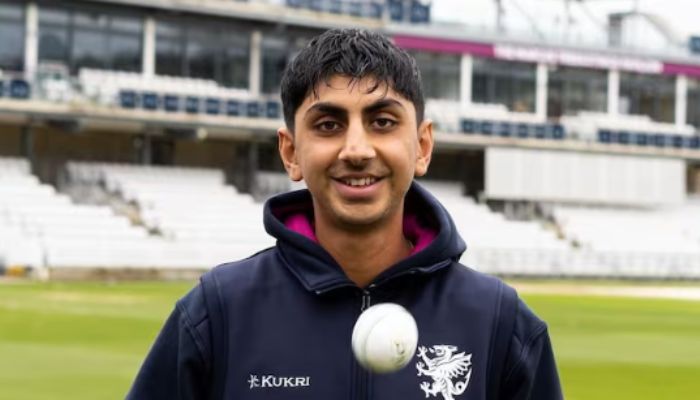
England cricketer Shoaib Bashir finally granted Indian Visa, read why he needed to submit additional documents and how British press wrongly criticised India

On 24th January (Wednesday), the English Cricket Board confirmed that England’s rookie spinner Shoaib Bashir was finally granted an Indian Visa, putting to rest the controversy over Visa issuance to the English cricketer of Pakistani descent. Taking to X, the Cricket board added that Bashir will be traveling to India this weekend. 

As per reports, Bashir travelled back to London from UAE on Wednesday to get his visa issue cleared. However, on account of the delay, the 20-year-old cricketer will miss out on the first test against India which starts on 25th January in Hyderabad. 

Bashmir who is yet to make his International debut, plays for Somerset in the English county. He was born in Surrey and brought up in England but his parents are of Pakistani heritage which became a reason for the delay in his Visa issuance. 

It is important to note that another England player with Pakistani roots, Leg-spinner Rehan Ahmed is also in the squad. However, he was allowed in as he possessed the required documentation after serving as one of the standbys for the World Cup held in India in October-November.

English media accused India of ‘racial’ discrimination, questioned India’s credential to host major events like Olympics

The controversy erupted when Bashir had to fly back to England from UAE because of a prolonged delay in the issuance of an Indian visa. Apart from him, the entire English squad was granted a Visa on time. Notably, England had a training camp in UAE before the Indian tour during which the visiting side will face off against Men in Blue in a 5 test match series.    

On account of the delay, English media and its cricketers went into a frenzy with some of them even questioning India’s credentials for hosting major events like the Olympics if it couldn’t issue a Visa to a cricketer on time. Some of the British media and social media users advised their side to not resume cricket unless India granted Visa to Bashir. 

Martin Samuel in The Times wrote, “India’s name is relentlessly advanced as welcoming hosts — of future Olympics, maybe even a football World Cup. How so, when there is the appearance of discrimination at work in the offices of government?”

The Telegraph even went ahead to call the delay a “shameless stunt”. It tweeted, “England should refuse to play in first Test after India’s shameless Shoaib Bashir stunt.”

Cricket writer and Commentator for BBC Sports, Kit Harris went on a tirade against India. In a series of tweets, he accused India of following a “racially” discriminatory policy. He even gave a political angle to the delay blaming the ruling party BJP for a show of “power”. 

When the issue got resolved, in a mocking tone he tweeted, “Glad it’s been conclusively established that Somerset’s 20-year-old off-spinner poses no risk to the population of India.” 

Speaking about the delay, England team’s captain Ben Stokes called the turn of events “frustrating“. 

Stokes expressed disappointment. He, however, clarified on his earlier stance where he was of the opinion that the England team should not enter India till Bashir was also granted an Indian Visa. 

In the pre-match press conference ahead of the first Test, Stokes said, “When I first found the news out in Abu Dhabi, I did say we shouldn’t fly until Bash gets his visa. But that was a little bit tongue-in-cheek. I know it’s a way bigger thing than doing that. That was probably just emotions around the whole thing. I’m pretty devastated that Bash has had to go through this.”

Reacting to the development, Rohit Sharma, in the pre-match press conference, while empathising with the young spinner said, “I feel for Shoaib Bashir – Unfortunately, I don’t sit in the Visa office to give you more details, but I hope he gets it quickly & enjoys our country.” 

Meanwhile, Former Indian Cricketing legend Venkatesh Prasad slammed the English Cricket Board for the delay and called out the “old English way” of crying foul. He asserted that ECB was at fault for the delay as it should have followed the basic procedure which is well established, as explained later in the article. 

Ventakesh Prasad tweeted, “His (Bashir) visa needed to be stamped in the UK. The ECB sent Shoaib Bashir to the UAE, thinking it would be stamped in a third country.

Not following basic procedures, assuming things and then crying foul is an old English way. If anyone, it is the ECB at fault.” 

When the controversy escalated, UK PM Rishi Sunak’s office got involved. One of his spokespersons said that the government expects British citizens to be treated fairly by India’s visa processes. The spokesperson also added that they had raised issues of this kind with the Indian High Commission as in the past as well British citizens of Pakistani heritage had faced similar delays. 

“I can’t speak to the specifics of this case. But more broadly we have previously raised issues of this kind with the High Commission. We have been clear that we expect India to treat British citizens fairly at all times in its visa processes. We have previously raised the issues British citizens with Pakistani heritage have experienced. We’ve raised the issues about their experience of applying for visas with the Indian High Commissioner in London,” the spokesperson said, as quoted by the BBC.

As per reports, along with his other English teammates, Bashir’s Visa application was made in December when the touring squad was announced. However, only Bashir’s visa was delayed and he had to head back to England to get his Visa stamped while his teammates headed to India. 

The well-established rules for Visa issuance explained

Shoaib Bashir faced a delay in his visa issuance because of his Pakistani origin, as the regulations differ for individuals with such backgrounds. While foreign nationals can freely apply for Indian visas across different categories, the criteria vary for Pakistani citizens or those of Pakistani origin. Similar distinctions exist in visa rules for Bangladeshi citizens differentiating them from the general regulations applicable to the rest of the world. The regulations for Visa issuance are set by the Foreigners Division of the Ministry of Home Affairs (MHA).

People of Pakistani origin who apply for Indian visa fall into two categories: those with dual citizenship (possessing both a Pakistani passport and another country’s passport) and those without a Pakistani passport but with ancestral ties to Pakistan. The Indian government defines individuals of Pakistani origin as those from foreign nations who are married to Pakistani nationals or have parents or grandparents who previously held Pakistani passports. The Ministry of Home Affairs (MHA) also mandates that individuals who held Pakistani citizenship in the past must declare it when applying for a visa to India.

In this scenario, the applicants must furnish documentary proof, including certified copies of their renunciation of Pakistani citizenship. If the applicant possesses dual citizenship, it is obligatory for them to seek an Indian visa using their Pakistani passport. Furthermore, if an applicant was born outside Pakistan but has ancestral ties (parents or grandparents being Pakistani citizens), they must provide a certificate of “naturalization as foreign citizens.”

An official explained, “In the case of Bashir, although he was born in the UK, his parents hail from Pakistan. So, according to the rules since he was born outside of Pakistan, he was required to submit a birth certificate from the local authority of the UK as a document for visa processing.” 

The heightened scrutiny of individuals with Pakistani origins has led to an extended duration for the clearance and issuance of Indian visas.

Citing reasons for the delay, several Indian X users also criticised English supporters and media for crying foul over the episode when it was their fault of not following the well-established procedure.

Previous instances involving Pakistani players or players of Pakistani origin

It is important to note that Bashir’s case is not the first time that Pakistani players or those of Pakistani heritage representing other teams faced delays in getting Indian visas.

The Pakistan team secured their visas for the World Cup journey to India at the last minute, despite submitting their applications well in advance. Consequently, they had to call off their pre-tournament camp in the UAE. Journalists from the neighbouring country encountered similar issues, and the presence of Pakistani fans was nearly non-existent.

English players Moeen Ali and Saqib Mahmood also experienced delays in visa processing on previous occasions. Moeen encountered this situation when he was slated to participate in the 2022 Indian Premier League for the Chennai Super Kings, while Mahmood faced a similar issue during his selection for an England Lions Tour in 2019.

Australian cricketer Usman Khawaja, who also has Pakistani roots, encountered a delay in obtaining his visa before the Test series in India a year ago.

Delhi HC dismisses plea against Rahul Gandhi for revealing identity of minor rape victim, but it’s not a clean chit even after deleting tweet as FIR was registered

On 24th January (Wednesday), the Delhi High Court dismissed a petition that sought registration of an FIR against Congress leader Rahul Gandhi for revealing the identity of an alleged rape victim in 2021. The court rejected the plea after taking note of the submissions made by the Congress leader, the city police and social media platform X. 

The bench of Acting Chief Justice Manmohan and Justice Manmeet PS Arora were hearing a 2021 petition by social activist Makarand Suresh Mhadlekar. He had sought an FIR against Gandhi in his case. 

Taking into account the arguments presented by the parties, the high court observed that the requests in the petition had been already addressed and resolved, thereby disposing of the plea. There were three requests made in the plea, action by NCPCR, deletion of the tweet, and and FIR by the police. Now it has been confirmed that all three have already been done. NCPCR had lodged a complaint against Rahul Gandhi, after which the Delhi Police registered an FIR in September 2021, which was confirmed by the police in the court.

Meanwhile defending Congress leader Rahul Gandhi, his counsel informed the bench that Gandhi has taken down the tweet which revealed the identity of a minor Dalit girl who was allegedly raped and murdered. Following his counsel’s assertion, the advocate representing social media platform X (formerly known as Twitter) confirmed before the court that Gandhi deleted the tweet himself. Earlier the tweet was withheld in India by the platform.

Thus, all the pleas made in the petition have been fulfilled, making the petition infructuous. Therefore, the court dismissed the petition. However, the deletion of the post doesn’t secure relief for the Congress leader as the case for revealing the identity of the alleged rape victim still stands and the call for his arrest has been gaining steam. 

The dismissal of the plea has not brought any relief for the Congress leader as the actions sought in the plea had already been taken, that is, an FIR had already been lodged in 2021 against the Congress leader. The police investigation following the FIR is still on, and it does not stop just because Rahul Gandhi deleted the tweet.

Although the tweet has been deleted, the fact remains that Rahul Gandhi had revealed the identity of a minor rape victim, which is an offence. Notably, disclosing the identity of a rape victim is an offence under Section 228A of the Indian Penal Code. It is punishable with imprisonment up to two years and a fine. Moreover, the fact that the Congress MP agreed to delete the tweet can be considered a confession of guilt.

Regarding the development, NCPCR chief Priyank Kanungo elaborated on the details of the case and noted that they had asked Delhi police to file an FIR in the case way back in 2021. He also expressed hope that Delhi Police will soon arrest the accused in the case, Rahul Gandhi, for revealing the identity of parents of an alleged rape victim.

Speaking with ANI, Kanungo said, “There was an incident of rape and murder of a minor in 2021. At that time, to sensationalise it, Rahul Gandhi had shot a video with the girl’s parents and had posted it on social media account. By doing so he violated the provisions of the POCSO Act and Juvenile Justice Act. We had asked Delhi Police to register an FIR against him. Today, during the hearing of a petition in this case, Delhi Police told the court that they filed an FIR against Rahul Gandhi in September 2021. We hope that Delhi Police will arrest the accused soon …”

Furthermore, the Delhi High Court had earlier asked Delhi Police to submit its status report within 10 days about this case. 

The case pertains to a social media post uploaded in August 2021. Back then, Congress leader Rahul Gandhi met the family of the minor girl who was allegedly raped, murdered, and cremated without her parents’ consent in Delhi’s Old Nangal crematorium. After meeting with the family, he assured his support to the family. Rahul Gandhi also tweeted about his meeting and shared a picture of him with the victim’s parents on Twitter. As the identification of the parents could lead to the identification of the alleged rape victim it is barred to share such details to avoid stigmatisation of the victim. 

Click here, to read why the Delhi Police’s bizarre argument earlier in the trial proceeding drew criticism. 

Any attempt to compromise the electoral process using deepfake or AI will be met with swift, strong and robust measures: Chief Election Commissioner

0

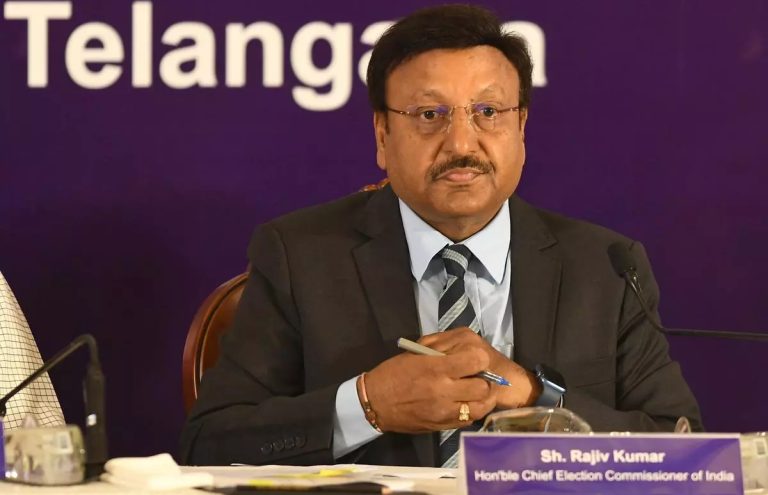
Emphasizing that technology has been leveraged to bring in transparency and efficiency in all aspects of elections, Chief Election Commissioner of India Rajiv Kumar on the occasion of the 14th National Voters Day, said that misinformation, deep fakes and the use of Artificial Intelligence are being used increasingly to undercut the “faith and trust” of the people in the electoral process.

He further said that any attempts to compromise this fundamental tenet through false narratives will be met with swift and robust measures to uphold the integrity of our elections.

The Chief Election Commissioner extended warm greetings to all voters on the momentous occasion of the 14th National Voters’ Day and said that any attempts to compromise this fundamental tenet through false narratives will be met with swift and robust measures to uphold the integrity of our elections

“While technology has made possible many enabling features to enrich the electoral process, it has also posed various challenges to the democratic exercise. We, however, stand firm in our resolve to maintain a level playing field and foster an informed electorate. Any attempts to compromise this fundamental tenet through false narratives will be met with swift and robust measures to uphold the integrity of our elections,” he said.

He further urged first-time voters to exercise their franchise with full enthusiasm adding that the youth will make a resounding and emphatic statement by voting and motivating their peers to do the same.

“Over 60 democratic countries will have elections this year to elect their respective governments. India shall be the focus of all, as the world’s largest and most vibrant democracy conducts 18th Lok Sabha elections and elections to around eight state legislative assemblies during 2024. This day is an occasion to celebrate voters, youngsters in particular, as central to this great democracy of ours,” Rajiv Kumar said on Wednesday.

Kumar said that India will be having the World’s largest peacetime logistical exercise of movement of man and materials, to enable over 96 crore voters to exercise their franchise over 12 lakh polling stations through our 1.5 crore plus election officials.

The Chief Election Commissioner thanked and appreciated their polling teams who traverse the harshest of terrains to deliver democracy to the last mile.

“Our focus has been to make the electoral experience pleasant, all-inclusive and inducement-free. Our electoral roll serves as a vibrant and diverse mosaic, reflecting the rich diversity of our democracy,” Rajiv Kumar said.

Recalling a few lines from Tiruvalluvar’s, Kural, “It is compassion, the most gracious of virtues, which moves the world”. Reflecting this sentiment, it is the Commission’s resolve to make our elections inclusive and accessible. We have over 81 lakh persons with disability voters, over 1.8 crore 80 plus voters, 2.5 lakh 100 plus voters and over 48,000 third-gender voters registered with us. Optional Home voting facility is also available for 80 plus and PwD voters to vote from the comfort of their homes, he added.

Rajiv Kumar further said that in 2023 the Commission has successfully conducted elections in 9 states, where more than 16 crore voters gave voice to their cherished democratic right and voted in an atmosphere of fairness, confidence and joy.

“Elections were held peacefully, with no major incidents of violence and near zero repolls. In 126 villages of Bastar, polling stations were set-up for the first time in independent India, where voters came to polling stations without any fear and anxiety. Women voters participated enthusiastically, even surpassing male voters in many constituencies across these 9 states. The Commission’s efforts have meant 100 per cent registration of Particularly Vulnerable Tribal Groups in the festival of democracy,” he added.

The Chief Election Commissioner further said that political parties are the pivot of our vibrant democracy and urged them for their continued support and assured them of our fullest cooperation.

“The Commission bases its engagement with political parties on three pillars – full disclosure, complete involvement and assured responsiveness. Going into General Elections 2024, we appeal to them for their continued support and assure them of our fullest cooperation. Fostering an ethical and respectful political discourse plays a critical role in shaping the democratic process and in influencing our young voters. It is imperative that political parties engage in discussions that inspire rather than divide, and promote ideas instead of personal attacks. Political Parties, our biggest stakeholders must become our best partners in ensuring an ethical journey,” he added.

Kumar further expressed confidence in giving India’s approximately 96 crore electors and all stakeholders the best possible electoral experience, truly befitting the largest democracy in the world.

Concluding his address he appealed to each and every one of you, to take part in the ensuing festival of democracy with full vigour and enthusiasm.

The Election Commission of India was established on January 25, 1950, a day before India became a Republic, and that is why we celebrate National Voters Day on January 25.


(This news report is published from a syndicated feed. Except for the headline, the content has not been written or edited by OpIndia staff)

Mandir and Economics: Illuminating the economic impact of Hindu Temples

0

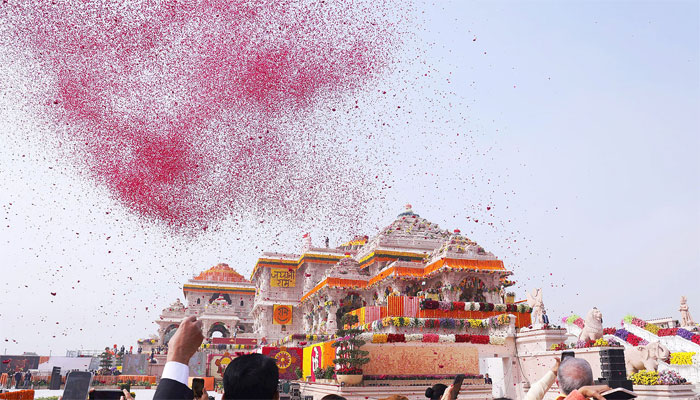
India has a rich mosaic of cultural heritage where Hindu temples stand as architectural marvels, spiritual sanctuaries and symbols of the resilience of the Hindu community. The recent Ram Mandir Pran Pratishtha has shown how Hindu Mandirs are beyond their religious significance as they play a pivotal role in boosting the nation’s economic landscape.

Hindu temples contribute significantly to local economies and foster community development. Interestingly, living and working in a holy Hindu city is beneficiary for everyone from an economic point of view, as Mandirs generate income for everyone irrespective of caste, religion, race and gender.

If we look at Bhavya Ram Mandir as an example, it gets easier to understand the effect of Hindu temples on the economy. Before the historic decision of the Supreme Court of India in 2019, where the apex court handed over the disputed land to Hindus to build the Bhavya Ram Mandir, Ayodhya was not a developed city. There was no airport, the railway station was in shambles, and the price of land was similar to a small city. In short, Ayodhya was more of a tier-2 or tier-3 city. Yes, there was a large influx of devotees, but it was not as great as Ayodhya became in less than five years.

When the judgment came in favour of Hindus, the land price skyrocketed overnight. The state and central government announced several projects to bring Ayodhya back to its glory. In less than five years, the Airport is ready and functional at Ayodhya and will soon become an international airport. The Railway Station got a massive facelift. Roads became broader and cleaner. New residential and commercial projects mushroomed in the city and around it. In short, Ayodhya became one of the most happening places in India because of one Hindu temple.

Bhavya Ram Mandir is being constructed with Rs 3,500 crore in donations from devotees. As the money is in a bank, it has given the bank cash flow to give out loans. Furthermore, the construction of Ram Mandir is a massive project that has given jobs to thousands of construction workers, contractors and skilled workers.

As the Ram Mandir is now open to the public, people from across India and abroad will come to Ayodhya, boosting the local economy. Hotels, restaurants, taxi services, gift shops, guides and other service providers will generate more income, adding to the local economy.

As the income of people living in Ayodhya increases, it will result in more taxes for the state, making it possible for the state to spend more on welfare schemes. The influx of religious tourists creates a vibrant economic ecosystem. It provides employment opportunities for the local population and stimulates the growth of ancillary industries.

Historically, Hindu temples have been centres of education, art and commerce. They provide a platform for traditional arts and crafts. Again, if we take the example of Ram Mandir, artisans and craftsmen from across the country are working on different projects. The intricate carvings, vibrant paintings, and architecture showcase religious devotion and the remarkable skills of India’s artisans.

Many temples engage in philanthropy as well. Several temples nationwide run state-of-the-art educational institutions, hospitals and social initiatives. They not only address the spiritual needs of the people but also the societal needs by contributing to the region’s overall development. Not to forget, almost all temples have massive kitchens offering free food for all devotees.

It is high time that the people of India realise the untapped economic potential of Hindu temples. Initiatives like digitising donation processes, online darshan, and developing temple-related merchandise can help boost the economy further. These steps can enhance the convenience for devotees and increase the outreach of religious institutions, attracting a wider audience.

Regarding sustainable and responsible tourism, Hindu temples can be crucial in promoting eco-friendly practices. With the immense devotion in the hearts of the devotees, it is much easier for the temple authorities to advocate environmental conservation and sustainable development. Temples can become a beacon of hope for Mother Earth’s future by guiding devotees to indulge in saving the planet. It can create a niche market of responsible tourists.

While the economic benefits of Hindu temples are limitless, it is essential to balance commercialisation and preserve the sanctity of these sacred places. It is necessary to plan and govern religious places with full transparency. Furthermore, it is necessary to ensure that the economic benefits help the Hindu community and small regional temples. While the economic benefits are for everyone in the area, it is essential to have moral consciousness to develop religious places for Hindus with complete adherence to the rituals.

To conclude, Hindu temples provide spiritual sanctuary and function as powerful engines of economic growth. Temples leverage their cultural, historical, and religious significance and continue to play a pivotal role in fostering regional development by creating employment opportunities and contributing to the country’s overall economic prosperity. It is high time that society and policymakers alike recognised and harnessed the potential while ensuring a blend of spirituality and economic progress.

Not official US policy: US clarifies after outrage in UK over American scientist’s suggestion to add salt to tea, says proper way of making tea is microwaving it

The Brits were furious after an American professor recently suggested that the perfect cup of tea can be brewed by adding a pinch of salt. Michelle Francl, a professor of chemistry at Bryn Mawr College in Pennsylvania, suggested several measures for the perfect in a recently released book. While some suggestions are normal, others were not so, which created massive outrage in the UK. Now to calm the matters, the US embassy in UK has decided to get involve in the matter, distancing the US from the suggestions by the scientist.

In the book “Steeped: The Chemistry of Tea,” Michelle Francl made several suggestions, some of which are not controversial like using a short and stout mug which will keep tea hot for longer due to its low surface area. She also suggested pre-heating the mug or teapot, using loose leaves instead of teabags, using leaves only once.

However, she also suggested adding warm milk after pouring the tea, adding to an age-old debate in tea brewing. It is notable that tea drinkers are divided in the middle in this topic, some prefers adding milk before pouring the tea, which the others prefer the other way. Francl also said that warm milk should be used to reduce the chance of curdling.

She then went on to suggest adding a small squeeze of lemon juice can remove the ‘scum’ that sometimes appears on the surface of the drink. However, the most controversial suggestion has been to add a pinch of salt, to reduce bitterness of tea. She said that the sodium ion in salt blocks the chemical mechanism that makes tea taste bitter.

The Brits were horrified with the suggestions, that too coming from a country with questionable taste of tea, where most people prefer coffee. “Americans should leave things like this alone, they should stick to fast food and not bother with anything more refined!” said one comment in to the Daily Mail report on the book’s suggestions.

“We are a nation of tea drinkers, and we don’t need any ‘experts’ telling us how to make a brew!” was the sentiment behind the most of the comments. “Like we need help from the Americans on making tea. Who do you think you’re talking to, the French?” said another.

After the Britons objected to the suggestions made in the book, the US Embassy in the UK released a statement on 24 January, saying that the media reports of an American Professor’s recipe for the “perfect” cup of tea has landed America’s special bond with the United Kingdom in hot water.

The embassy said that it can’t ignore that such an outrageous proposal threatens the foundation of the UK-US relationship. They wrote, “Tea is the elixir of camaraderie, a sacred bond that unites our nations. We cannot stand idly by as such an outrageous proposal threatens the very foundation of our Special Relationship.”

The US Embassy in London made it clear that the outrageous proposal to add salt to tea is not the official policy of the US. The statement said, “Therefore we want to ensure the good people of the UK that the unthinkable notion of adding salt to Britain’s national drink is not official United States policy. And never will be.”

It then added, “Let us unite in our steeped solidarity and show the world that when it comes to tea, we stand as one.”

While the all was well till now, the last line in the statement completely seem to overturn it. The US Embassy in London stated the proper way to make tea is to make it in a microwave, and it will continue to do. The embassy statement said, “The U.S. Embassy will continue to make tea in the proper way – by microwaving it.”

It is notable that for tea purists, microwaving tea is the most horrible idea, perhaps even more disgusting than adding lemon and salt to tea with milk.

To further note, lemon tea with salt without milk is quite popular in India, particularly on trains. But this is not the tea the Americans and the Britons are talking about. Michelle Francl suggested adding salt and lemon to milk tea.

‘Kill as many Hindus as you can, don’t leave them alive’: How Muslim mob attacked Ram yatra in Vadodara’s Bhoj – What FIR reveals

0

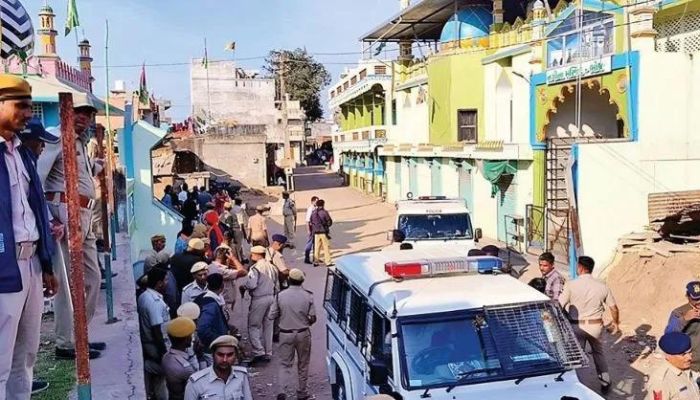
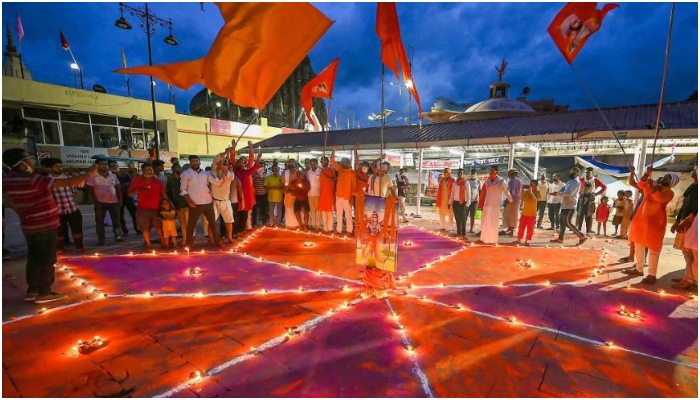
On Monday (22nd January), the idol of Lord Ram was consecrated in the Ram Mandir in Ayodhya. Not only in the country but Hindus all over the world celebrated this day like a grand festival. Shri Ram Shobha Yatras were organised everywhere. But violence by Islamists took place on this day too. Stones were pelted on the procession in two cities of Gujarat, while there was also fierce violence in Thane, Maharashtra. In Gujarat, stones were pelted in Kheralu on Sunday and on Monday, Hindus carrying a procession of Shri Ram were attacked by a Muslim mob in Bhoj in Vadodara.

Following the incident, an FIR has been lodged against 16 persons and the rest of the mob at Vadu police station in Padra taluka. A copy of the FIR is available with OpIndia. The FIR narrates how a Muslim mob in Bhoj collectively attacked the procession to kill Hindus.

In this FIR lodged at Vadu police station on January 22, a policeman himself has become the complainant. The head constable said in the complaint, “A procession of Lord Ram was organised in Bhoj village on the occasion of Shri Ram Mandir Pran Pratishtha in Ayodhya and during this a total of 22 personnel of PSI, Police Constable, Home Guard, GRD were present on duty to maintain the law and order situation.

The incident took place when the procession reached near the mosque

According to the predeclared route, the Shobha Yatra started from the Ramji temple in Bhoj village at 2 p.m. and was attended by around 500 to 700 people from the Hindu community. Three DJ vehicles were also part of the yatra. The yatra started and reached in front of Nagina masjid in the village at around 3:35 p.m. At this time the organisers of the procession had turned the DJ off and were taking the yatra ahead.

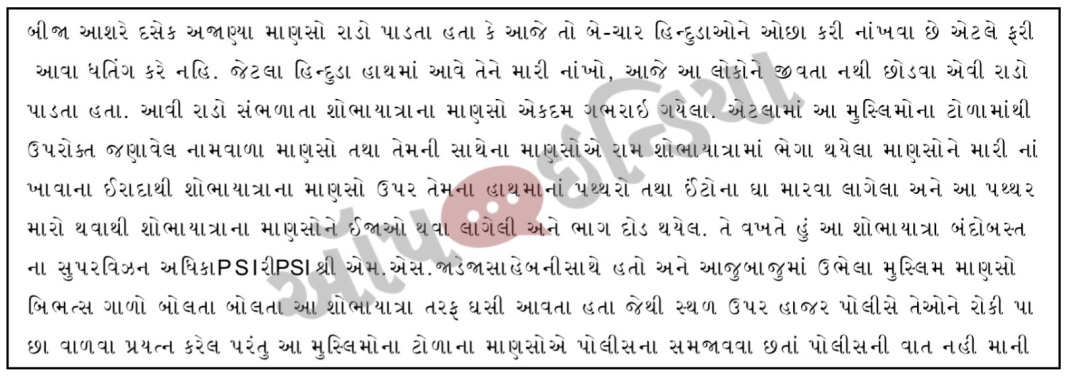
According to the FIR, at the same time, a group of Muslims came together from the street in front of the Nagina Mosque in Bhoj with stones in their hands and they said ‘Today we have to reduce the number of Hindus by two or four, so they will not do such a thing again’. ‘Kill as many Hindus as you can’; ‘Don’t leave these people alive today’, they shouted as they marched towards the Shobha Yatra to carry out the attack.

A copy of the FIR is with OpIndia. Image Source: OpIndia Gujarati

As the mob did not listen, the police had to lathi charge and chase them away

As soon as the people involved in the procession heard such slogans, they were frightened and there was a ruckus. On the other hand, the Muslim mob threw stones and bricks at the people involved in the procession to kill them, due to which some were also injured.

The police said in the complaint, “The men in the Muslim mob rushed towards the procession, speaking foul language, and the policemen present at the spot stopped them but the attackers did not listen to them. Finally, as it was necessary to protect those involved in the procession, the police started a lathi charge and dispersed the attacking mob. The attackers fled the spot after police used force.”

The FIR further said, “A total of 8 people were injured in the attack, out of which 6 are women. The constable of Vadu police station was also injured. All of them were later shifted to the hospital for treatment.”

The saffron flags put up by Hindus were also removed two days ago

Apart from this, another thing is mentioned in the FIR, which states that before the procession, Hindus had put up saffron flags on its route, but they were removed and thrown away at night on 18th January. The organisers of the yatra later filed a complaint with the Vadu police station in this regard.

A case has been registered against the accused under sections 120B, 143, 144, 147, 148, 149, 152, 153A, 295A, 323, 332, 324, 307, 427, 294(b), 505(2), 505(3) of the IPC and section 135 of Gujarat Police Act. According to media reports, 13 accused have been arrested, while the search for the rest is currently underway.

Maharashtra: Aslam, Gaffar Khan booked for threatening Hindus with death for celebrating Pran Pratishtha in Nanded

The Ram Mandir Pran Pratishtha event at Ayodhya on January 22nd brought tears of pleasure and pride to every Hindu’s eyes as the community welcomed Lord Ram back home after about 500 years. However, the huge ceremony in Ayodhya enraged Islamists, who raced to attack Hindus who were celebrating their God’s return after 5 centuries.

Reports of Islamists attacking Hindu devotees came in from Gujarat’s Mehsana, Vadodara, Maharashtra’s Solapur district, and Mumbai’s Mira Road sector. A similar incident was reported from Nanded district of Maharashtra. Hindus in the Chikhli village of Nanded were abused and threatened by Islamists for celebrating the event of Ram Mandir Pran Pratishtha at the local temple.

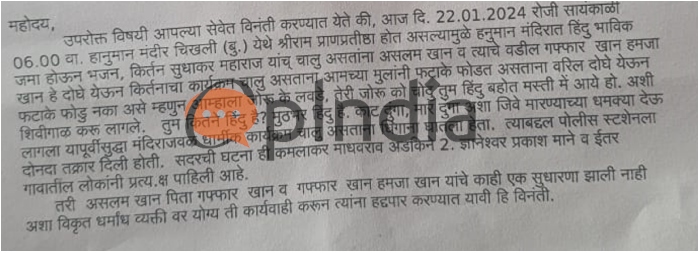
The Police took cognizance of the incident and booked two individuals identified as Aslam Khan and Gaffar Khan under sections 294 (humiliation), 504 (punishment for insulting someone intentionally to provoke them), 506 (Punishment for criminal intimidation), and 34 of the Indian Penal Code, 1860.

OpIndia exclusively obtained the FIR copy of the incident to learn that the police action had taken place based on the complaint filed by a resident named Bhasker Bhagat. In the complaint, Bhagat mentioned that the accused persons threatened the Hindus to death for celebrating the Ram Navami Pran Pratishtha ceremony and also abused the Hindu faith.

FIR copy obtained by OpIndia

“You Hindus are very less in number here. What will you do? You all are doing too much. We will kill you, cut you in half. We’ll also not spare your women, they’ll be abducted. You’ll regret it later. Do not mess with us,” the accused persons said while threatening the Hindus in Chikhli village as per the FIR.

The incident is said to have happened on the 22nd of January evening when the Hindus gathered in the local Hanuman temple to celebrate the arrival of Ram Lalla in Ayodhya. The Hindus were singing praises of Lord Rama and were also bursting crackers during the celebration.

The accused persons barged into the local temple where the Hindus had gathered and stopped them from continuing with the celebrations. The Hindus were abused and threatened with death by the accused persons.

Sources confirmed to OpIndia that the village in Nanded where the incident is said to have happened houses mostly Muslim population. OpIndia contacted the police for updates on the case but the calls remained unestablished. The report will be updated once the updates are obtained. Further investigation into the case is underway.

Congress leader ‘Ria Revealed’ asks Foreign Ministry of Qatar to take action against X user for tweeting ‘Jai Shree Ram’, calls it ‘Islamophobic’

Congress leader Andria D’Souza also known as ‘Ria Revealed’, whose intellectual supremacy is only second to Priyanka Chaturvedi, was so miffed over a reply to one of her X posts on Tuesday (23rd January)  regarding the Ayodhya Ram Mandir consecration ceremony that she tagged Foreign Ministry of Qatar to action a person supposedly staying in Qatar.

The Maharashtra Congress state secretary of Human rights and AICWA secretary (as per her X bio) thinks that the “Pran Pratishtha” or consecration of Ram Lalla means his ‘birth’ while calling the historic event a “blatant display of power”. She further claimed that there was nothing religious about Ram Mandir Pran Pratishtha even though the consecration was performed as per Vedic rituals.

Moreover, she asserted that the Pran Pratishtha ceremony was an idea having elements of humiliating a ‘weak person’ in its foundation. Perhaps she was referring to the Muslim community. However, she did not explain how a temple rightfully reclaimed after winning a legal battle is “humiliating” any religious community. D’Souza concluded her rant with the Sine Qua Non of the left-liberal meltdown over the Ram Mandir— “Death of democracy”.

“For whom would not the birth of Rama be a matter of joy? But sadly, I have no hesitation in saying that this is a blatant display of power under the guise of Ram Mandir. There is nothing religious about the #RamMandirPran Pratishtha. There is nothing religious in an idea that has the element of humiliating a weak person in its foundation. Even if this crowd includes my religion, country, village, family, and the whole public. It is the test of my conscience to distinguish between reverence and the intent of an insulting show of power. My teaching tells me to stand with humanity and righteousness Regardless of this.. It’s the Death of democracy Death of the idea of the secular country, India,” D’Souza wrote.

In response, an X user who goes by the name “Murali” wrote, “Jai Shree Ram” several times. “Jai Shree Ram ,#Jai Shree #Jai Shree Ram, #Jai Shree Ram, #Jai Shree Ram, #Jai Shree Ram, #Jai Shree Ram, #Jai Shree Ram, #Jai Shree Ram, #Jai Shree Ram, #Jai Shree Ram, #Jai Shree Ram, #Jai Shree Ram, #Jai Shree Ram,#Jai Shree Ram, #Jai Shree Ram,” Murali wrote.

Merely writing the divine name of Shree Ram agitated ‘Ria Revealed’ to such an extent that she tagged the Qatari Foreign Ministry to “have a look” at the “Islamophobe” residing in Qatar. The ultra-high IQ ‘Ria Revealed’, however, did not explain how a Hindu writing slogan in the glory of his God is anyway ‘Islamophobic’.

“Dear @MofaQatar_EN have a look there seems to be a man living in Qatar who seems to be Islamophobic,” D’Souza wrote.

In a reply to the X user who wrote Jai Shree Ram, Andria D’Souza called him a ‘fake Hindu’ and claimed that she does not use God’s name to torture or kill people. “Jai Siya Ram. Jai Maa Durga Jai Shri Krishna Har Har Mahadev… I am a Hindu and I love my gods. My religion is my space none of anyone’s business… I don’t insult my god to suppress the weak. I don’t use my God’s name In torturing ppl or killing ppl .. Only fake Hindus do so… And ur surely a fake Hindu,” she wrote obviously without delving into who exactly was tortured or killed during the Pran Pratishtha ceremony. Even during the Ram Janmabhoomi liberation movement, it was unarmed karsevaks who were killed in a then Mulayam Singh Yadav-led state-government orchestrated massacre.

Meanwhile, several netizens also alleged that Andrea D’souza has committed “sedition” by tagging the Qatari authorities to initiate action against the Indian national in Qatar.

An X user named Akshat Deora wrote, “Journo @RiaRevealed commits sedition by tagging Qatar ministry to take action against an Indian worker in Qatar. @MumbaiPolice please take appropriate action before something happens to their safety.

One Pankaj Rathore tagged Mumbai Police and wrote, “@MumbaiPolice They are playing with the safety of an Indian citizen. Please take appropriate action before anything happens to the citizen. Thank you.”

Meanwhile, one Dilpreet Kaur wrote, “Why displaying your low IQ here Since when has chanting Ram naam become Islamophobic.”

Another one wrote, “For chanting only “jai shree ram” why? where has your so-called secularism gone? And will you call crores of Hindus as “Islamophobic” because they chant “jai shree ram” I think you will like and love that person who will say “Allah ho Akbar” even if he or she is Hindu”

An X user Rohit Chouhan wrote, “Why are putting his life and job in danger for only writing Jai Shri Ram?”

Notably, the left-liberal ‘journalists’, ‘activists’, and propagandists are having a meltdown since the consecration ceremony of Bhagwan Ram Lalla was performed by Prime Minister Narendra Modi on the 22nd of January. Andria D’Souza joined the long list of those including Arfa Khannum Sherwani whining about the Pran Pratishtha of Ram Mandir.

It is pertinent to mention that the construction of Ram Mandir in Ayodhya and the recent Pran Pratishtha ceremony came after the Supreme Court in 2019 ended the five-century-long-running dispute with a unanimous decision, allowing the entire 2.77-acre disputed site for the construction of a temple devoted to the deity Ram Lalla, one of the three claimants in the case. This came after the Hindu side presented numerous historical, scriptural and archaeological evidence to prove the existence of a temple at the disputed site before the construction of the Babri structure in 1528.

ULFA disbands itself as per peace agreement after decades of strife, signifying a historic milestone: The rise, the fall and the split of the organisation

On 23rd January (Tuesday), the pro-talk faction of the United Liberation Front of Asom (ULFA) officially disbanded itself. The decision to disband the ULFA was taken at the outfit’s final general meeting held at Sipajhar which is located around 55 km from Guwahati. It comes twenty-five days after the pro-talk faction of ULFA signed a tripartite memorandum of settlement in New Delhi with the Centre and the Assam government on 29th December.

As per the tripartite agreement, ULFA was to abjure the path of violence, give up all arms and ammunition, and disband the organisation within one month.

In the meeting held in Darrang district, the leadership of ULFA decided to disband the group, as announced after the peace agreement. Senior leaders of the pro-talk faction including Arabinda Rajkhowa, Anup Chetia, Raju Barua, Pranati Phukan, Sasa Choudhury and others were present at the meeting. A seven-member monitoring committee will be formed to ensure the implementation of the various clauses of the tripartite agreement.

They also decided to form a non-political socio-cultural organisation named Jatiya Bikash Parishad, to maintain communication among ULFA members, and to work towards protecting the cultural and linguistic identity of the society. ULFA leaders will soon meet CM Himana Biswa Sarma to hand over a formal letter informing about the disbanding of the group.

ULFA leaders and cadres were known by different names they had taken after joining the group, but from now they will now be known by their original names, and they will stop using their organisational names. This means that chairman Arabinda Rajkhowan will now be known as Rajeeb Rajkonwar and general secretary Anup Chetia will revert to his original name Golap Barua.

The cadres will also have to vacate the designated camps where they are living along with their families, and return to normal lives. There are nine such designated camps in the state. The cadres will hand over their arms and ammunition to the govt at a formal ceremony soon.

However, while ULFA has been disbanded following the agreement with the govt, a faction of it called ULFA (Independent) led by commander-in-chief Paresh Barua remains, with its armed struggle for an independent Assam.

As the organisation disbands itself, it becomes necessary to revisit its formation, the history of the terror activities by the outfit and subsequent disbanding after continued talks with the BJP government.

Formation of ULFA

Established in 1979, the United Liberation Front of Asom (ULFA) has traversed a tumultuous journey over four decades, leaving an indelible mark on the landscape of Assam. Its story unfolds as a pursuit of autonomy, marked by the wounds of violence, and ultimately, a journey towards reconciliation.

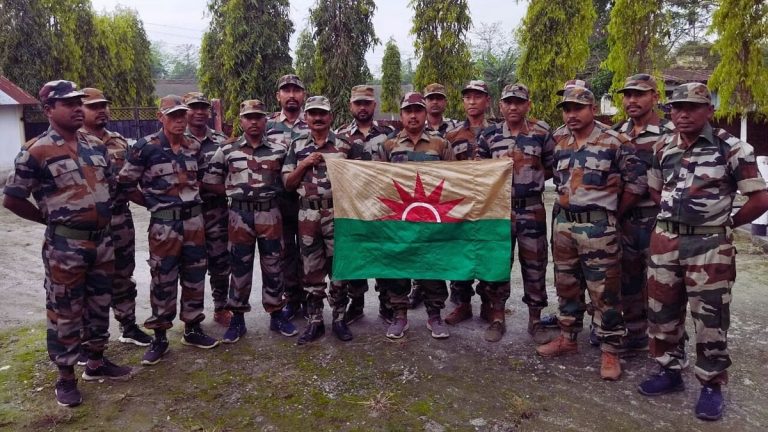
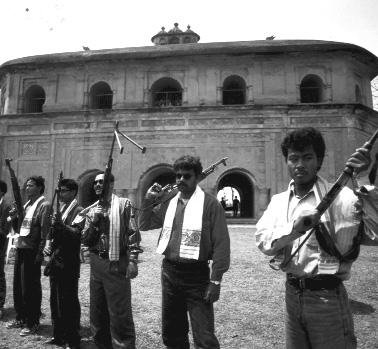
ULFA was founded in 1979. Image Source: docplayer.net

Formed on 7th April 1979 within the historic Rang Ghar in Sivasagar during the anti-illegal immigrants movement, the United Liberation Front of Asom (ULFA) arose as an extremist organisation with an explicitly anti-Indian state agenda. Led by Paresh Baruah and Arabinda Rajkhowa, ULFA articulated a vision of a so-called “sovereign socialist Assam”, seeking independence from what they perceived as exploitation and neglect within the Indian framework. After garnering support among specific segments of the Assamese population in its initial phases, ULFA strategically embraced armed tactics, actively recruiting members and resorting to violence as integral elements of its anti-Indian state ideology.

ULFA was greatly influenced by NSCN in neighbouring Nagaland, which was leading a similar armed struggle in the state. Although formed in 1979, ULFA became active only after 1983, when it recruited youths and got them trained by other groups such as the Kachin Independence Army (KIA) and the Nationalist Socialist Council of Nagaland (NSCN). It then launched a fundraising operation, and became very strong in upper Assam districts of Tinsukia and Dibrugarh. However, soon it was declared a terrorist organization by the government under the Unlawful Activities (Prevention) Act.

Decades of extremism and split in ULFA

The peak of ULFA’s influence unfolded during the decades of the 1980s and 1990s, characterised by a relentless wave of guerrilla attacks on security forces, abductions for ransom, and targeted bombings that cast a shadow over Assam. As the people of Assam started to become unhappy with the AGP govt formed after signing the Assam agreement, ULFA enjoyed the support of a large number of people initially in the Brahmaputra valley. In the beginning, the group only attacked security forces and therefore was not seen as a terror group by people.

In less than a decade of formation, ULFA emerged as one of the most powerful and violent insurgent outfits in Southeast Asia, aided by locals who would shelter and feed them, and protect them from security forces.

However, as time passed, the group’s kidnappings for ransom, attacks on civilians and public properties, smuggling of weapons and support of other insurgent groups started to make news. Several leaders of the group were operating from Bangladesh, apart from Myanmar and Bhutan, a fact not liked by most people. As a result, people quickly got disillusioned with ULFA, and its popular support fell rapidly.

The abduction and killing of social worker Sanjoy Ghosh by ULFA in 1997 was one of the most important incidents that led to the group’s fall. It is believed that Sanjoy’s work in the development of Majuli Riverine island had affected ULFA’s recruitment drive. Moreover, his work in protection from erosion had displeased the local contractor lobby, who patronised ULFA.

The fall in popular support led to the creation of factions within the organisation that supported dialogue with the govt, but a significant faction remained steadfast on extremism as a way of the so-called struggle. Such internal divisions in ULFA reached a critical juncture in 2011 with the formal split between the pro-talk faction led by Arabinda Rajkhowa, and the ULFA (Independent) under the leadership of Paresh Baruah. The schism highlighted the complexities within the organisation, marking a turning point in its trajectory of terror and internal dynamics.

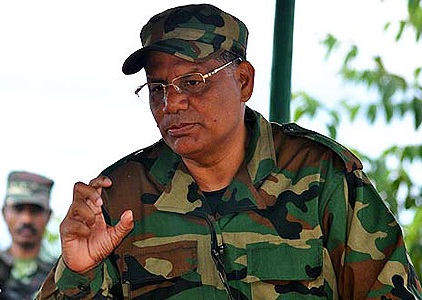
Paresh Baruah. Image Source: News Live

During the 1990s, a large number of ULFA cadres surrendered and were known as SULFA or Surrendered ULFA cadres. They had surrendered their weapons and were offered resettlement packages by the govt. However, it led to a dark chapter in Assam’s history, the secret killings. From 1998 to 2001, during the second Prafulla Kumar Mahanta-led AGP govt, relatives, friends, and sympathisers of ULFA insurgents were systematically killed by unknown assailants.

It has been alleged that the killings were orchestrated by the state govt, with the help of security forces, and the actual executions were done by surrendered ULFA militants. In retaliation, several SULFA leaders were also targeted and killed by ULFA during this time. The secret killings, in which over 400 people lost their lives, stopped after the fall of the AGP govt in 2001.

In 2011, a ray of optimism dawned as ULFA pro-talked faction, guided by Rajkhowa’s leadership, embarked on peace negotiations with the Indian government, helmed by the Congress party at the time. The subsequent years of dialogue, marked by fluctuations and challenges, witnessed substantial concessions from both parties involved.

The dialogue picked up pace with the double-engine government of the BJP

The advent of the BJP government in 2014 ushered in a fresh dynamic, actively supporting the peace process. In addition to Prime Minister Narendra Modi’s direct involvement and emphasis on Northeast development, the BJP came to power in the state in 2016, securing a clear majority government. Since then, it has consistently maintained its majority, further intensifying the impetus behind the peace talks.

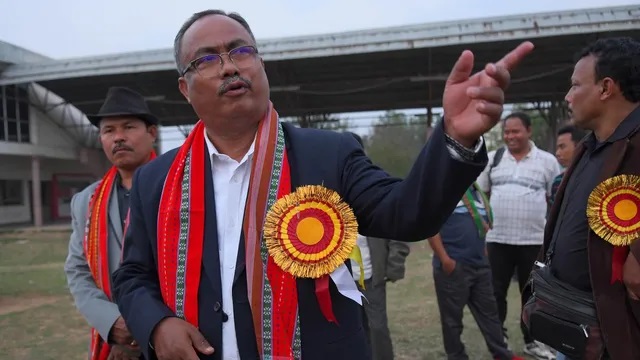
Arabinda Rajkhowa preferred talks over terror. Image Source: NewsDrum

Prime Minister Modi’s intervention and focus on Northeast development were widely recognised as pivotal factors, with the notable achievement of being the sole Prime Minister to have visited the northeast on more than 50 occasions. The implementation of diverse development projects in the region played a crucial role in integrating the people of the northeast into the broader national development framework. In response, leaders of ULFA-I came to a realization and committed to working peacefully within the framework of the Indian constitution for the betterment of Assam.

Disbanding of ULFA

Regarding the dissolution of the outfit, ULFA chairman Arabinda Rajkhowa said, “The decision to disband and dissolve the outfit was taken at the meeting today as stipulated by the settlement signed in Delhi. With this, the cases of sedition on the outfit will be lifted.” The pro-talk faction of ULFA has around 700 total members. The anti-talks faction of the outfit, ULFA-Independent (ULFA-I) has camps in Myanmar and parts of the northeast. They have around 200 members and are opposed to any settlement till Assam’s sovereignty is discussed.

The ULFA’s general secretary Anup Chetia had earlier stated that after the meeting, they would hand over the letter of the outfit’s disbandment to the Chief Minister of Assam. According to Chetia, after the disbandment, the ULFA leaders and cadres will have different identities. He added that he will personally be involved in social work.

The tripartite agreement

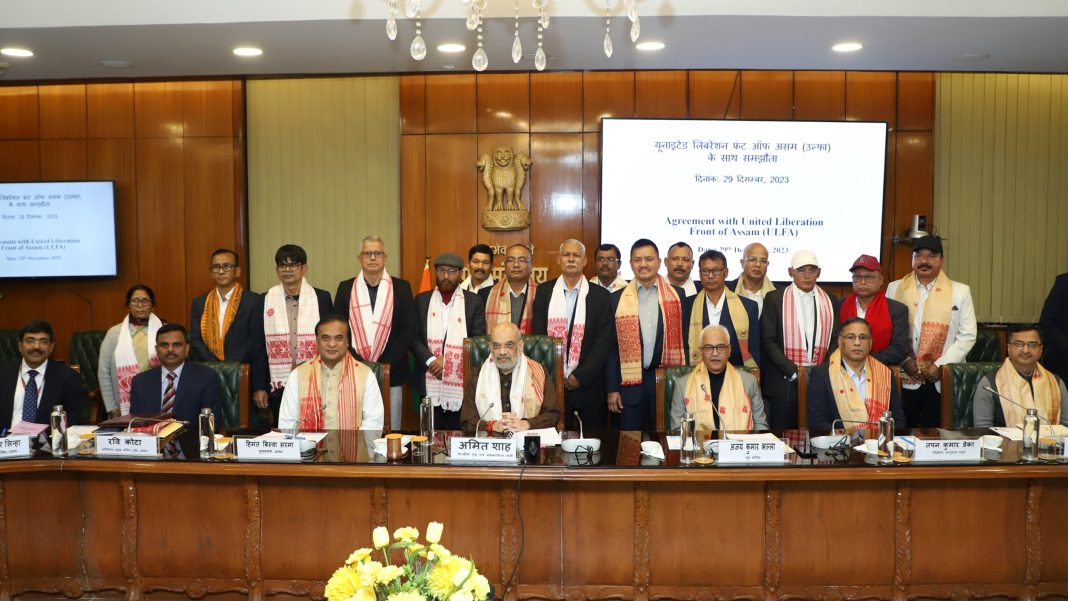
Last month on 29th December, the pro-talk faction of the outfit signed an agreement in the presence of Union Home Minister Amit Shah and Assam Chief Minister Himanta Biswa Sarma. This was a significant pact as the banned ULFA-Independent has been the only major insurgent outfit in the state after the ULFA pro-talks faction signed the agreement with the Centre and Assam government. ULFA (Independent), the other faction of the group led by Commander in Chief Paresh Baruah remains outside the peace agreement. Except for Baruah, all other founding members of ULFA have left armed struggle.

ULFA agreement with the government of India. Image Source: OpIndia File Photos

The tripartite agreement signed last month covered a wide range of subjects, including politics, land rights, NRC and immigration, employment, economy and skill development, flood control, industries, agriculture, education, culture, sports infrastructure, tourism, demands of ST status, Act East Policy, and settlement of the outfit’s cadres who have returned to the mainstream. Last month’s settlement stipulated, “ULFA shall abjure the path of violence, give up all arms/ammunition, and disband the armed organisation within one month”.