Home Blog Page 1416

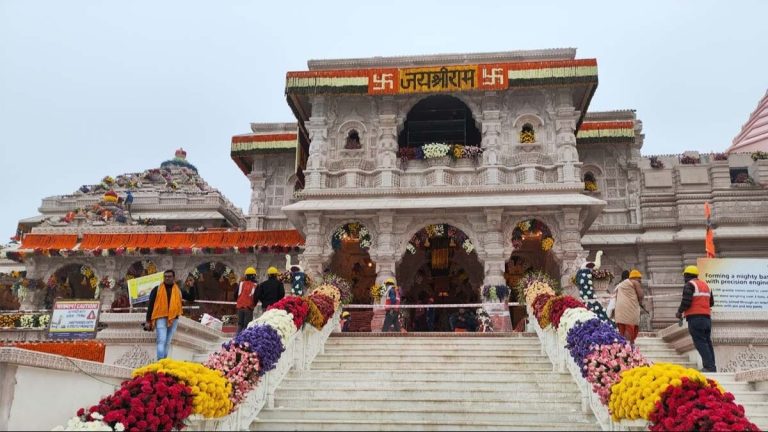
Ayodhya on the day of Ram Lalla Pran Pratishtha: A glimpse into what true Ram Rajya looks like

22nd of January was no ordinary day – it was one where an ancient, wounded civilisation, neutered by tales of defeat and conquest and deracinated by the forced taille of secularism, finally rose to reclaim its dignity. The very people who were told, repeatedly, that they needed to die and let their faith be desecrated with a smile on their face simply because barbarians needed to be placated – rose. The very people who were told, repeatedly, that the burden of harmony and morality rested solely on their shoulders – rose. The very people who were told, repeatedly, that the truth about the genocide of their people, the rape of their women and the attempted annihilation of their faith was either a myth or a conspiratorial campaign against their aggressors – rose. The very people who were forced to accept their demise – rose. The very people who were humiliated, insulted, mocked, tortured and sacrificed at the altar of mythical harmonious co-existence – rose. Rose to say – thus far and no further. Rose in celebration and rapture. Rose in devotion. Rose to tell the world that they exist – and that they will continue to exist – just as they had for thousands of years.

On the 21st of January, as I boarded the flight from Delhi to Ayodhya, the sense of devotional triumph was palpable – it was almost tangible. With chants of Jai Shree Ram, a disparate lot, many of whom did not know each other, embarked on a journey to witness the rise of our civilisation – to finally witness the return of our God King after 500 years of bloodshed and struggle. To finally witness the Pran Pratishtha of Ram Lalla after countless devotees had given their lives up to ensure that the sacred Janmashthaan was freed from the legacy of invading barbarians and the symbol of their tyranny.

A few years ago, it was perhaps unthinkable that a nation of Hindus would rise to celebrate the building of the Ram Temple in Ayodhya and accept the merit of the demolition of the illegal structure in 1992 by Karsevaks. Internalised guilt and the burden of tyrannical acceptance was one that generations of Hindus had lugged around not just on their shoulders, but tied around their ankles like legcuffs. But this day was different.

As I landed at the Maharishi Valmiki International Airport, Ayodhya Dham, I saw a beautiful painting on the wall, welcoming Ram Bhakts.
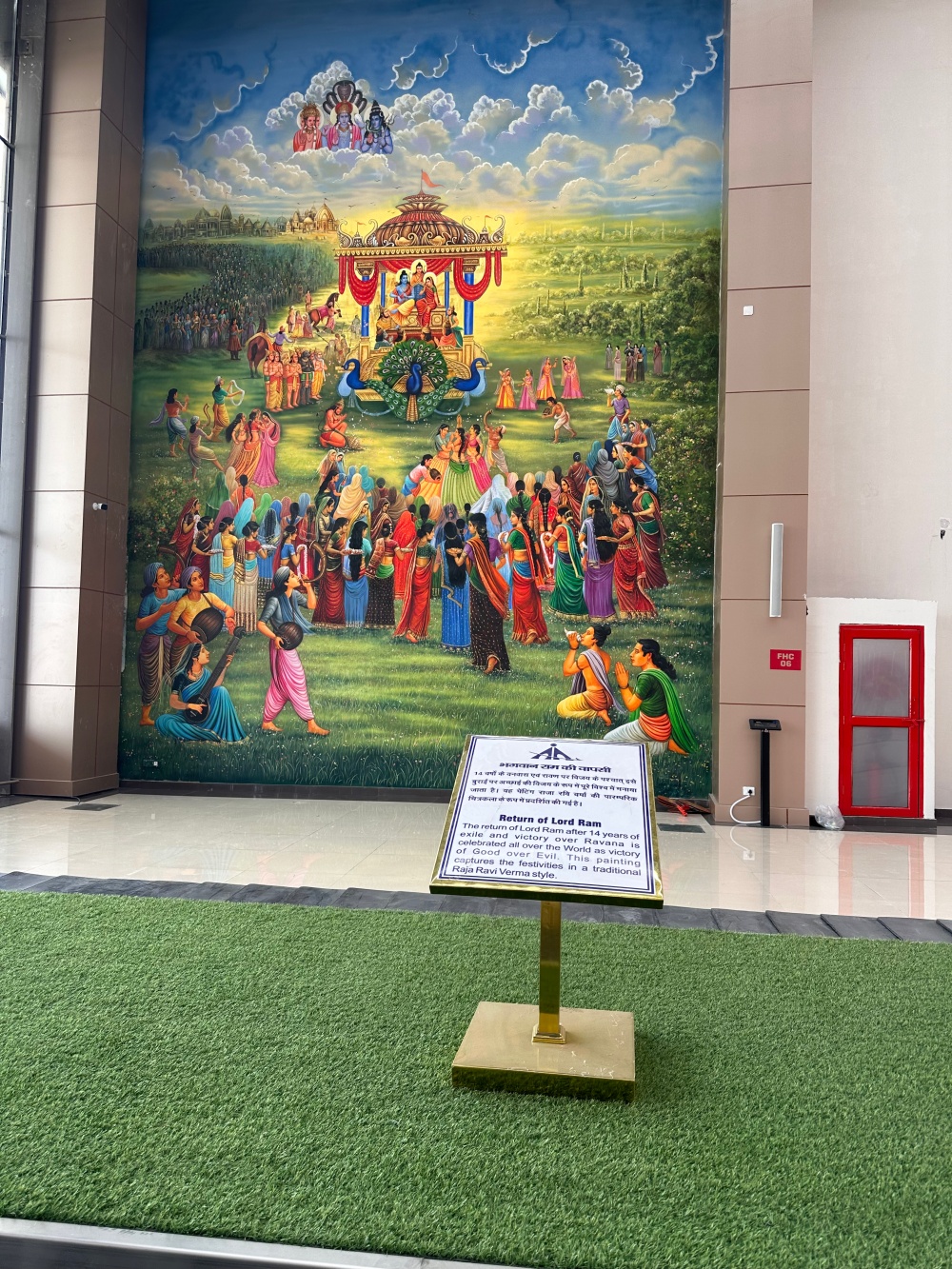
Return of Lord Ram – the painting depicted.

Everything in Shree Ayodhya Dham immersed you in divinity, from that moment forward. The road from the Airport to the hotel was pasted with the images of Lord Ram and the air filled with Ram bhajans booming through speakers – some in the distance, some close by. Bikes and cars had saffron flags and as one drove, one would see groups of devotees marching through the streets chanting Jai Shree Ram – in perfect harmony.

Much has been said and written about the Pran Pratishtha ceremony itself – about the divinity of the occasion and the untamable tears that flowed as the Ram Lalla Murthi was infused with life. The images of Sadhvi Ritambara, the Sadhus and Sanyasis present, the several thousand invitees and the effusive words of Prime Minister Narendra Modi described the occasion far better than my words ever could.
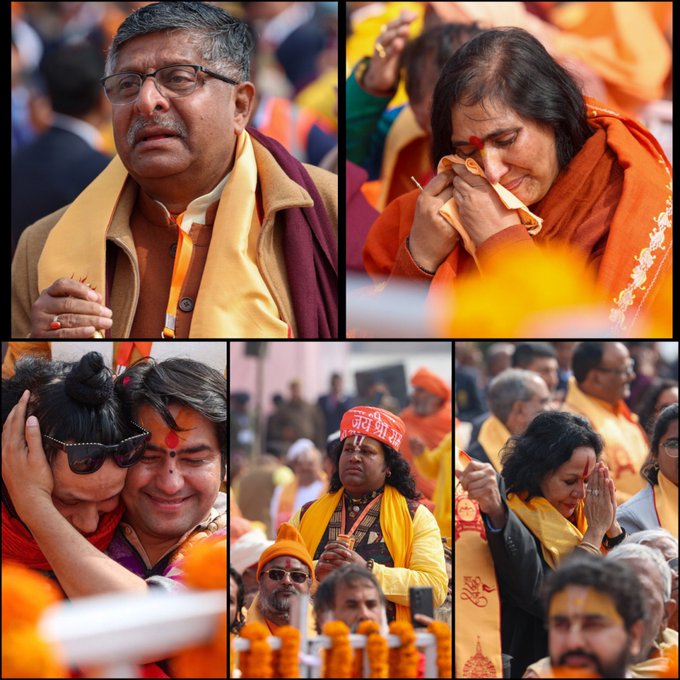
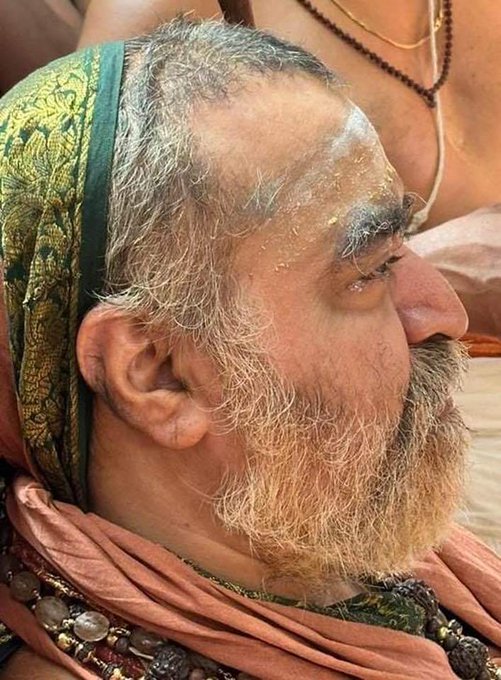
As I walked through Ayodhya those two days amidst the lakhs that had taken to the streets to welcome Raja Ram and talking to hundreds of those present, the recurring thought was – ‘Is this what Ram Rajya might look like’.

Ram Rajya essentially signifies the ideal reign of Bhagwan Ram as described in the Ramayan – A Kingdom ruled by one who was the epitome of Maryada (the English language is hardly equipped to translate Maryana – but loosely, it would mean virtue, honour and the moral fortitude to do what is right) and a people who lived their life within virtuous bounds of Dharma, duty and honour.

I remembered a couple of verses that my grandfather often recited to me growing up:

सर्वं मुदितमेवासीत्सर्वो धर्मपरोअभवत् ।
राममेवानुपश्यन्तो नाभ्यहिन्सन्परस्परम् ॥ ६-१२८-१०१

And another:

रामो रामो राम इति प्रजानामभवन् कथाः ।
रामभूतं जगाभूद्रामे राज्यं प्रशासति ॥ ६-१२८-१०३

In the Yuddha Kanda of Valmiki Ramayan, an almost Utopian picture is painted of what Shree Ram Rajya would look like. A world where people did not feel jealous, did not steal or murder, respected women, there was no danger of wild animals or disease, everyone lived a virtuous life with happiness in their hearts, turning their consciousness towards Lord Ram and Dharma alone, performing their duties in the society with excellence and diligence.

Again, the English language hardly does justice to what Shree Ram Rajya is described as but suffices to say, that Ram Rajya was meant to accomplish what our modern legal system and ruling class struggle to achieve.

On the 21st of January, as I walked around Ayodhya, the fervour amongst Ram Bhakts was perhaps at its peak. Only hours before the Pran Pratishtha, lakhs (no exaggeration) had taken to the streets. The roads of Ayodhya are not too wide. In that cramped space, there were thousands singing, dancing, chanting Jai Shree Ram, eating, celebrating, talking and taking pictures. Amidst all of that, some Sadhus were talking to groups of youngsters and some were rolling on the ground on the path to the Ram Mandir – fulfilling their tapasya. This was not all – there were YouTubers and journalists littered on the same streets conducting their interviews and shooting their monologues.

Ordinarily, this would not be an ideal place for a woman to walk around alone at night. There are plenty of ways things could go wrong really quickly. Eve teasing, catcalling, theft, stampede, horrible comments and far worse. One of my earliest memories was walking to school as a child and being groped by a man walking beside me. In several reporting assignments, I have felt the glances. I have, numerous times, felt unsafe. This is not to say that I have never before experienced the generosity that people are capable of, however, anywhere in the world, as a woman, one cannot ever be too careful when walking around alone at night.

That night in Ayodhya, however, I felt safe. I felt like I was amongst my people who would not harm me. This was not just a figment of my religious imagination but several experiences that contributed to how I felt.

On the 21st, while walking on the Bhakti Marg, there was a stage erected where several Bhakts were dancing feverishly celebrating the return of Bhagwan Ram.

There was no smell of alcohol and while young men danced and celebrated in their fervour, they were extremely conscious of the presence of women and ensured that they were not touched even by mistake. While I did not go up on stage, Shefali Vaidya did. She later told me how the older boys dancing on the stage ensured that they pulled the younger men away from her, who might not have noticed her presence, to ensure that she felt safe there.

As I stood there, I could not peel my eyes of the safai karamchari who held on to his broom and started dancing while the music played.

As I walked ahead and stopped to have tea, I had random conversations with fellow Ram Bhakts – those who were not invitees but just people who had travelled to Ayodhya from different parts of the country in the hopes of getting one glimpse of Ram Lalla. One said, “I don’t know when I will go back. But I am here till I get the chance to do Darshan – whenever that is”. When asked the same question, I told them that I was an invitee to the Pran Pratishtha ceremony. Their immediate response was to remind me that this invite was a result of my Prarabdha karma – a collection and result of all my past karma in all my previous lives.

The tea vendor, on the other hand, spoke about how he did not doubt that a Bhavya Ram Mandir would be built in Ayodhya – how it was a matter of faith and pride for Hindus. He further spoke about how the Temple would benefit the city and its people by ensuring their economic success. Behind his stall, were three red bricks from his original building that was pushed back due to the government widening roads. He displayed them nostalgically but was happy that his city was changing – evolving – thanks to Bhagwan Ram’s homecoming.

The roads of Ayodhya were not just brimming with devotees, but Uttar Pradesh police officials who had a mammoth task at hand – ensuring order. With lakhs of people on the streets, the situation could devolve very quickly. One push, one shove, one harsh word and the order delicately maintained could come crashing down like a house of cards. One can only imagine the stress the Uttar Pradesh police was under – lakhs of devotees and thousands of dignitaries from across the country had descended on this little town that had simply never featured in the priority list of the previous governments as far as infrastructure development was concerned. Despite the obvious pressures of crowd management, VIP security and the threats by Jihadis that loomed large, in my time, I never saw one police official lose their temper.

I didn’t see even one officer speak rudely to a devotee. I didn’t see them raise their voice, push and shove the devotees or treat them disrespectfully, given they had dignitaries and VIPs to take care of. The police officials folded their hands and asked devotees to stand back. They called women Mata ji or behen – the men – bhai, beta. They helped anyone who needed it. Had beautiful, wide smiles on their face and were more than willing to listen. All of them responded with Jai Shree Ram.

On the day of the Pran Pratishtha ceremony, lakhs of devotees lined both sides of the street – starting from the Ram Mandir to about a 5-kilometer stretch. When I left the Ram Mandir premises after Pran Pratishtha and Darshan, I had several devotees come up to me to touch my feet – not because they knew me, my work or had unbound respect for me – but because I was present during the Pran Pratishtha ceremony, was one of the first people to witness the glory of Ram Lalla after Pran Pratishtha and had been in the presence of the divinity of their Aradhya. The police personnel who had to ensure safety and order as the VIPs would start leaving the premises soon had to ensure that the crowd stayed behind the barricades. It would be very easy for the police to rudely push people back. But the common bhakt was not once treated as an inferior entity lurking on the roads while dignitaries got priority. The police folded their hands and asked people to stand back – and to my surprise – people obliged with a smile on their faces.

While I walked the long road towards my vehicle, there was one Sadhu who did get a little angry perhaps legitimately so. “You are letting big people inside the Temple, not us”, he said angrily. In torn clothes, walking barefoot, the Sadhu was distressed. The police officer he was shouting at immediately bowed his head and apologised. “I am sorry, baba”, he said with folded hands. Almost immediately, the anger of the Baba disappeared and he blessed the police officer, placing both his hands on his head. “Kal aunga”, he said and left.

I decided to walk on the footpath to make the police’s life a little easier – at least for that moment. I approached a section where the footpath was cut off by a rope. I had to bend and cross the rope, a terrible task for someone who decided to wear heels. 4 Ram Bhakts immediately held the rope down so I could cross. Sensing that I was scared of tripping, a man clothed in saffron and holding a flag folded his hands and offered his arm to me – just in case I needed a little support. He folded his hand to send an important message – don’t be scared – I am just trying to help.

When I entered my hotel, finally, after walking for several kilometres and a short cab ride, the receptionist asked me if I had the fortune of being in the presence of Ram Lalla. When I said I had a fleeting Darshan, his face beamed – ‘Bahut Bhagyashaali hai aap’, he said.

Later at night, I decided to go out and walk around Ayodhya again. As I stood in front of the very tea stall I had visited a day before, a Shobha Yatra passed with a Rath carrying Bhagwan Ram and Maa Sita. The divider was full of devotees catching a glimpse of the Rath Yatra. I hesitated to cross over and join them – but when I did – several men made way for me and ensured that I got a good look.
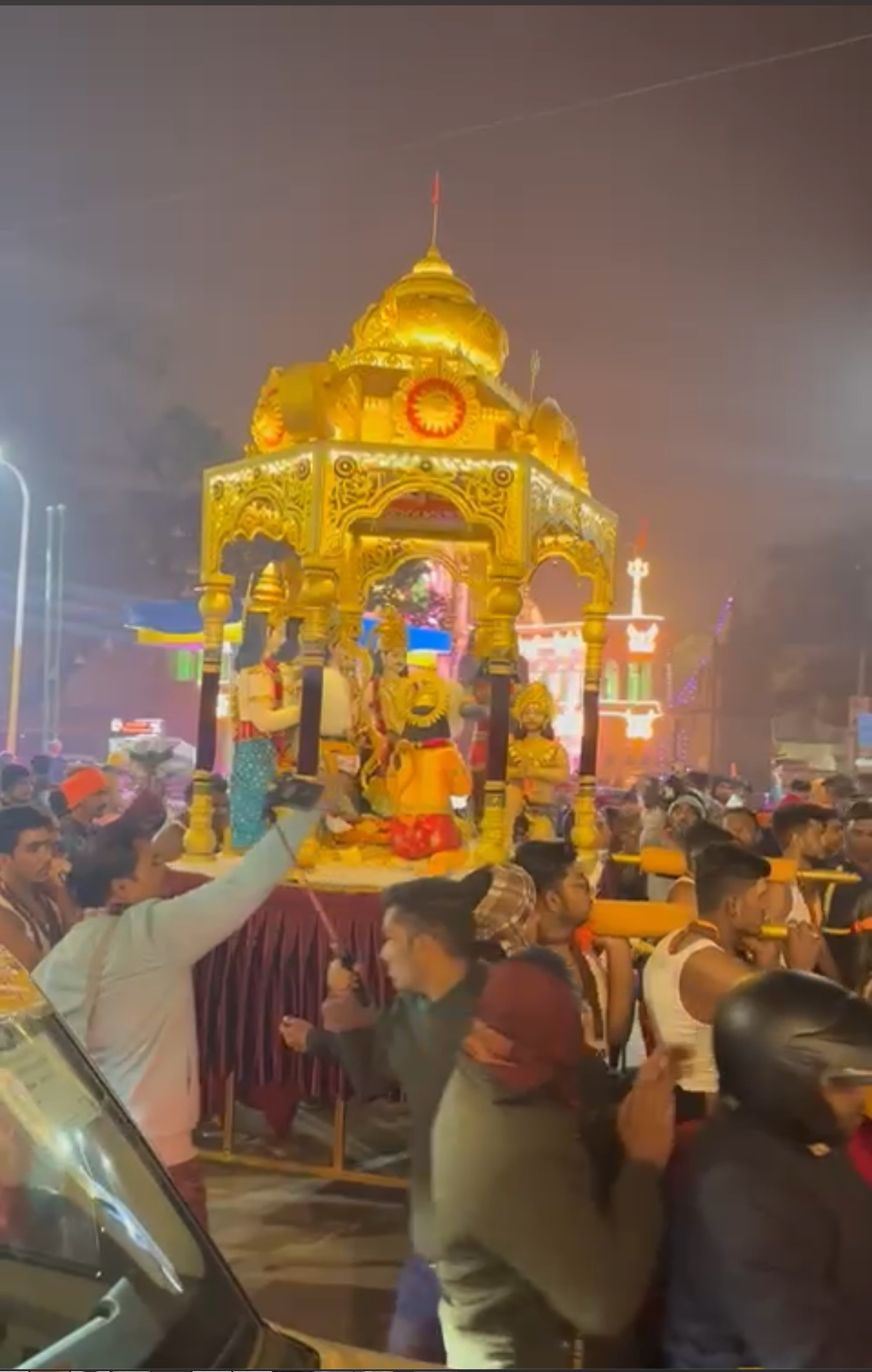
The divider was full of devotees catching a glimpse of the Rath Yatra. I hesitated to cross over and join them – but when I did – several men made way for me and ensured that I got a good look.

I walked right up to Hanumangarhi Temple and then, decided to make my way to Ram ki Paidi – to take a walk along the Saryu. At 11 PM, I was walking along a largely deserted Saryu ghat with only a few people lighting Diyas.
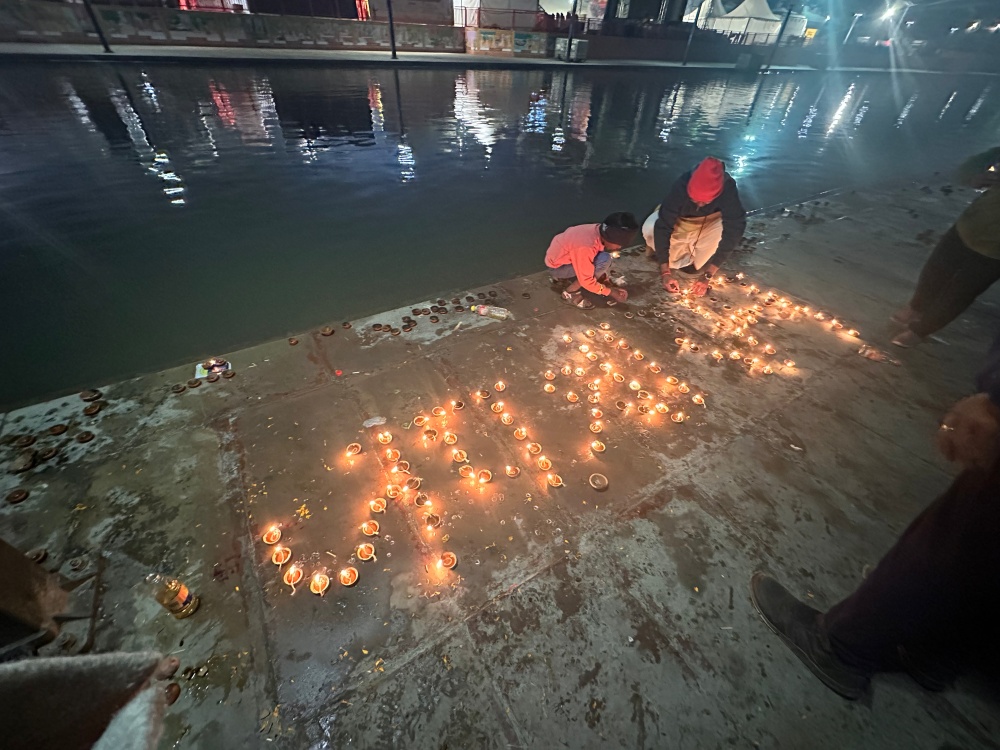
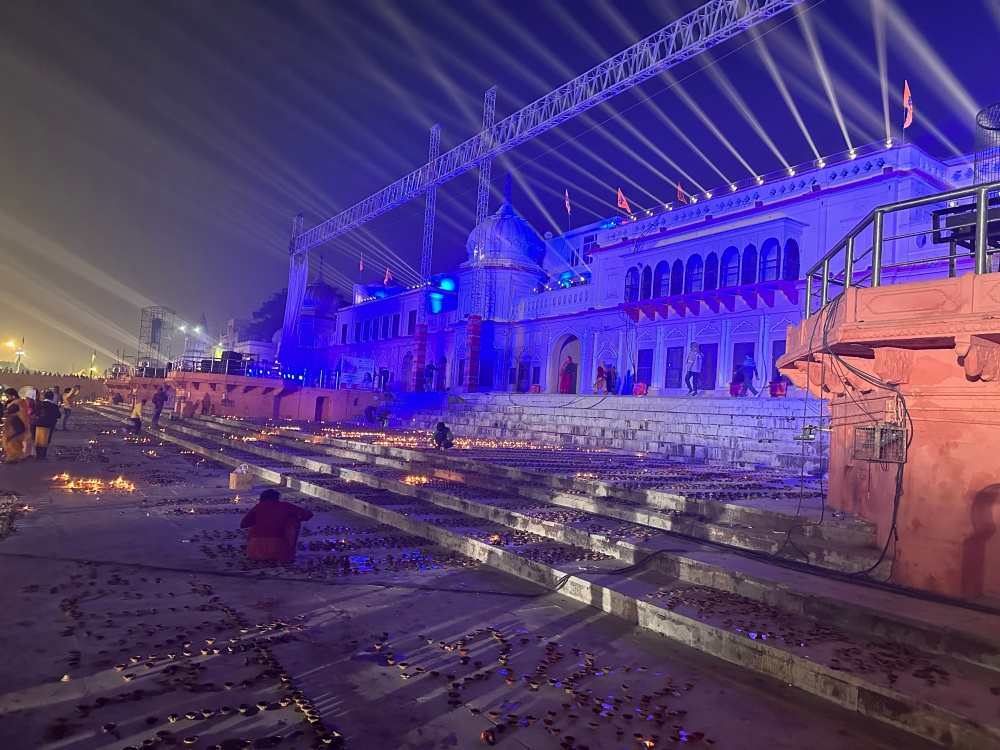
The few people left at Ram ki Paidi at that unearthly hour, were eager to talk. We spoke about where we had come from, the jubilation of the Ram Mandir being built, PM Modi’s speech and how Ayodhya was brimming with a sense of community.

Did we change overnight? Did we become kinder to each other suddenly? Was there a fundamental shift in our consciousness? A part of me likes to believe there was. Civilisationally, it was perhaps only after the Karseva that Hindus came together in collective devotion. It was perhaps only after the Karseva, for the first time, that Hindus from across the globe felt like one undivided monolith – a community. Or perhaps it was the majesty of faith. Of victory. Of Dharma. Maybe, it was what true Ram Rajya looks like – a virtuous state with a dignified population. One where there is no theft or murder. One where women are respected. One where our consciousness is so overcome with devotion towards Bhagwan Ram, that there is no space for Dwesha. One where Dharma reigns supreme.

While I repeat often that it is my job to be a pessimist because the ugly, stark, dirty and blood-soaked truth cannot be spoken in a state of hope and bliss, and that every day, I feel like I am documenting the end of my people, Ayodhya gave me the strength to hope. Hope that as a people, as a civilisation – we are not lost. That despite historical and ongoing atrocities, faith can bring us together – faith can drive civilisational reclamation and revival. On 22nd January, our ancestors rose in Ayodhya – to show us the way forward – sparking hope even in a professional doomsayer like myself.
Indian origin student from Britain jokes about being a part of the Taliban, faces trial in Spain now

0

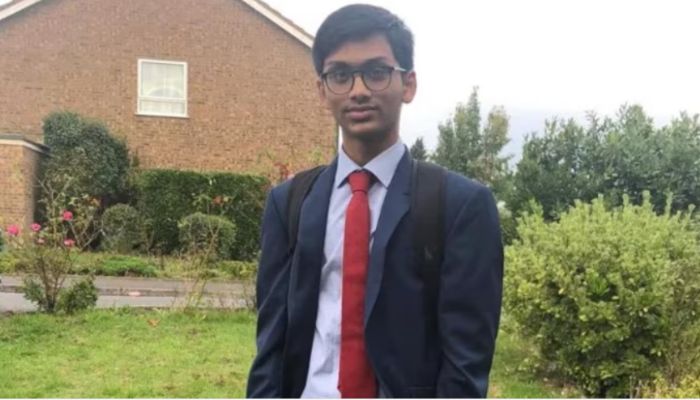
A student of British-Indian descent is currently undergoing trial in Spain on charges of public disorder. The accusations stem from a Snapchat message in which the student made a joking reference about him being from the Taliban and blowing up a plane while travelling with friends. Accused Indian student Aditya Verma, an economics student at Bath University, is currently on bail in this case.

In July 2022, Aditya Verma, accompanied by his friends, was en route to the island of Menorca in Spain aboard an easyJet flight. Before departure, he sent a message to his friends on Snapchat. This message read, “On my way to blow up the plane (I’m a member of the Taliban).” UK security agencies detected Aditya Verma’s message on Gatwick’s Wi-Fi network and promptly alerted Spanish authorities while the easyJet plane was in flight.

In a Madrid court trial, Aditya Verma asserted that he had no intention of causing harm or distress to the public. The court learned that upon reading the threatening message, Spanish authorities scrambled two F-18 fighter jets, with one tailing the plane until its landing in Menorca, where an extensive search was conducted.

Aditya Verma was arrested and held in police custody for two days before being subsequently released on bail. He was 18 years old at the time of the incident. Following his arrest, the student was later interrogated by the British intelligence agencies MI5 and MI6 in the United Kingdom. Subsequently, he was sent back to his residence in Orpington, Kent.

During the course of the trial on Monday, Verma stated that the message was “a joke within a private group setting.” He clarified, “It was just sent to my friends I was travelling with on the day.” When asked about the reason for sending the message, he said, “Since school, it’s been a joke because of my features. It was just to make people laugh.”

When asked about the moment he observed the Spanish fighter jets accompanying his plane, Aditya Verma said he thought it was a military exercise linked to the Russia-Ukraine war.

Authorities informed the court that they conducted a search of Verma’s phone, revealing research on confrontations between India and Pakistan and the potential for an attack by the Islamic State terror group in that region. Nevertheless, officials found no discernible connection between Verma and jihadist radicalism.

The teenager is not confronting charges related to terrorism or imprisonment, but a potential fine of 22,500 euros (Rs 20.35 lakh) awaits if he is found guilty. Additionally, the Spanish Defence Ministry is seeking 95,000 euros (Rs 85.94 lakh) to cover expenses.

Bulldozer action continues in Mumbai: After Mira road, BMC demolishes 40 illegal encroachments on Mohammed Ali Road

0

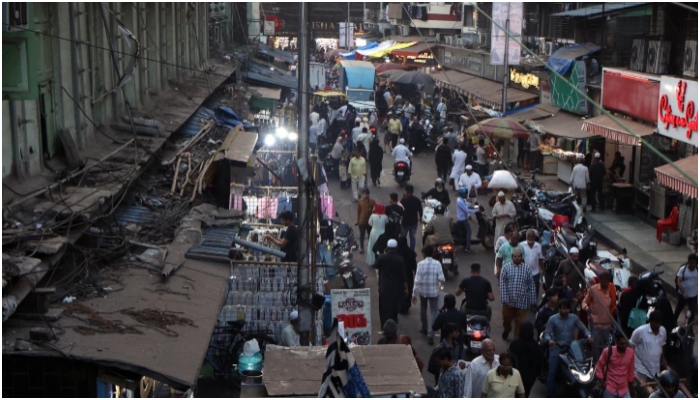
A day after the Mira Bhayander Municipal Corporation (MBMC) demolished illegal construction from around 15 structures at Haidary Chowk on Mira Road in Thane district, the Brihanmumbai Municipal Corporation (BMC) demolished 40 more illegal encroachments on Mohammed Ali Road in Mumbai.

The MBMC carried out the demolition on Tuesday (23rd January) at the same place where the Islamists attacked the Hindus on Sunday (21st January) night.

As reported by the Indian Express, BMC authorities stated that all of the constructions demolished on Mohammed Ali Road were illegal encroachments and that they were removed to open up space on the sidewalks.

The demolished structures included existing commercial establishments, shops located on Ibrahim Mohamed Merchant Road, and stalls of hawkers.

While the BMC conducted the drive on Mohammed Ali Road, there were no reports of a similar effort by the civic body in any other ward. At least ten ward offices contacted by The Indian Express reported that no anti-encroachment activity was conducted in their wards. Mumbai has 24 municipal ward offices. A couple of ward offices claimed that they had been working on Chief Minister Eknath Shinde’s ‘deep cleaning’ effort, which mostly involves the removal of illegal vendors.

“At present, local drives are being taken up in all municipal wards as part of CM’s ‘deep cleaning’ drive. For this, we are removing small roadside eateries and vendors to ensure the pavements stay clean. This drive has been operational since the first week of December,” BMC official was quoted as saying.

The Congress and the Samajwadi Party, meanwhile, have questioned the bulldozer action against illegal structures. “Use of bulldozers is not the constitutional way to act against unauthorised constructions. A proper legal procedure of hearing and notices being served should be followed. One also wonders why such actions are always targeted at particular communities. It should be stopped,” Congress spokesperson Atul Londhe said.

Samajwadi Party MLA from Bhiwandi, Rais Shaikh said, “The government is doing all this because elections are coming. They single out one particular community and they think that by doing so they would be able to please the other one. But they are mistaken. This would go against them. Maharashtra has been a land of saints.”

Meanwhile, the BMC official stated that no notices were issued to the vendors as they have no permanent addresses. “These stalls are temporary structures and not legal. Therefore, they don’t have a proper recipient address, as a result, we didn’t issue them any notice and took direct action on Wednesday,” the official added.

“Last week we carried out an anti-encroachment drive to identify illegal structures that were blocking pedestrian space. Following this, we took action on Wednesday morning and demolished nearly 40 structures on Ibrahim Merchant Road that were obstructing footpaths,” the official added.

Odisha Congress distributes ‘wedding cards’ for BJD-BJP marriage, claims the 2 rivals are having ‘love affair’

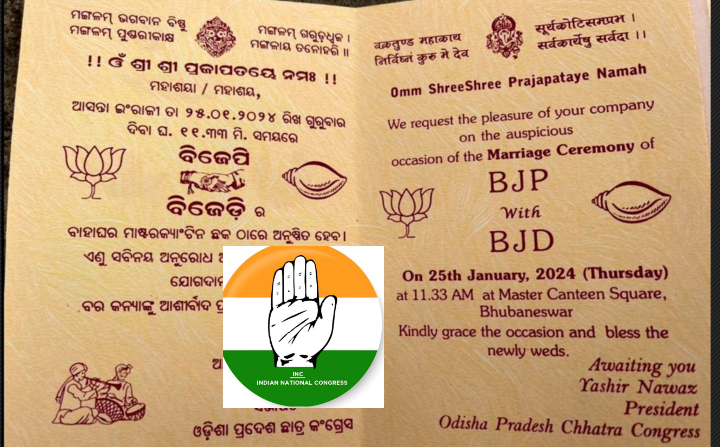
As general elections and state assembly elections approach in Odisha, the political scene is slowly heating up. The Congress, which has been largely left irrelevant in state politics, has found a new campaign method by claiming that the BJP and BJD are not in a political rivalry but are in a ‘secret coalition’ in the state.

In a protest organised by Odisha Pradesh Chhatra Congress, president Yashir Nawaz has invited everyone for the ‘wedding ceremony’ of BJD and BJP.

The Chhatra Congress has distributed traditional wedding cards announcing the ‘wedding ceremony’ of BJD and BJP, and has invited everyone to attend it and bless the bride and groom.

The ‘wedding ceremony’ has been organised at the Master Canteen square, Bhubaneswar.

Recently Odisha Congress in charge Dr Ajay Kumar welcomed former state minister Balabhadra Majhi and his supporters into the Congress Party. Majhi, a former BJD leader, joined the Congress in presence of PCC chief Sharat Patnaik, former minister Bhakta Das and other party leaders in Bhawanipatna.

It is notable here that since CM Naveen Patnaik maintains a non-confrontational stance with the central government and BJD usually supports the BJP in key central decisions in the parliament, the Congress has long been claiming that the 2 parties are not rivals and have been maintaining a ‘secret coalition’. The BJP is the largest opposition party in Odisha where the BJD has been enjoying a brute majority since the last 4 assembly elections.

Canada achieves new heights of India hate, initiates investigation into alleged meddling in general elections

On 24th January (local time), Canada’s federal commission of inquiry into foreign interference announced that it plans to examine India’s meddling in the country’s last two general elections. Initially, the commission was inquiring about the role of China and Russia in meddling with the federal elections. However, it has expanded its scope to include India in the inquiry.

In a statement released by the commission, it expressed interest in assessing possible interference by India in the past two elections held in Canada in 2019 and 2021. The commission has asked the federal government to provide documentation on the allegations against India. Notably, Canada has a history of meddling in India’s affairs for decades. Furthermore, due to political desires, Canadian leaders have unnecessarily targeted India in matters such as the murder of Khalistani terrorist Hardeep Singh Nijjar. Canada may be attempting to initiate an investigation against India to balance the scales.

The commission’s initial hearings will start on 29th January to delve into the challenges and limitations of disclosing classified national security and intelligence information to the public. In May 2024, an interim report from the commission will be published to offer an early glimpse into the findings. The final report is expected to be published by the end of 2024.

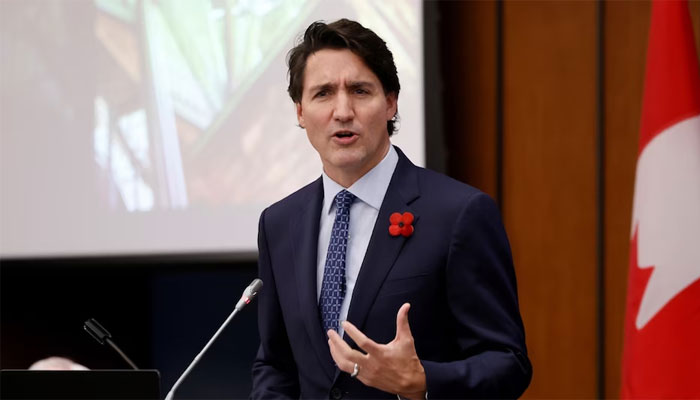
Notably, current PM Justin Trudeau has been the winner in the last 2 elections held in Canada.

Canada’s meddling in India’s affairs

Canada has a long history of meddling with India’s affairs. When farmer protests were ongoing in India against the now-repealed three agricultural laws, Canada sided with anti-India elements that were using the protests to defame India on an international platform. Pro-Khalistani leaders of Canada, such as Jagmeet Singh, openly poked nose into India’s internal matters.

Canada-based businessman Mo Dhaliwal openly ran toolkits against India under the banner of the Poetic Justice Foundation. Controversial climate change activist Greta Thunberg shared one of its toolkits, leaking the anti-India plans. Several “activists” from India were involved in the campaigns run by Mo Dhaliwal. Canadian government failed to take any action against such anti-India elements.

Furthermore, Canada is a well-known haven for criminals, terrorists and anti-social elements. Several gangsters and terrorists who fled India and are now living in Canada and are indulging in anti-India activities. India has requested extradition of such criminals, but Canada has failed to oblige.

In June 2023, Khalistani terrorist Hardeep Singh Nijjar was killed in a possible gang war in Canada. In September, Canadian Prime Minister Justin Trudeau accused India of being involved in the murder. To this date, Canada has failed to provide any concrete evidence that points towards India’s involvement in the murder.

Canada’s history of Indian hate has achieved a new milestone by initiating an investigation against India, accusing the biggest democracy in the world of meddling in its general elections, not once but twice.

French President Emmanuel Macron, chief guest for 75th Republic Day, coming to Jaipur to kick-start his state visit to India: Details

0

French President Emmanuel Macron has arrived in India as the distinguished Chief Guest for the 75th Republic Day celebrations. Macron’s visit marks the completion of the 25th-anniversary celebrations of the strategic partnership between India and France, fostering cooperation in defence, security, clean energy, trade, and technology.

Jaipur Sojourn: A Cultural Extravaganza

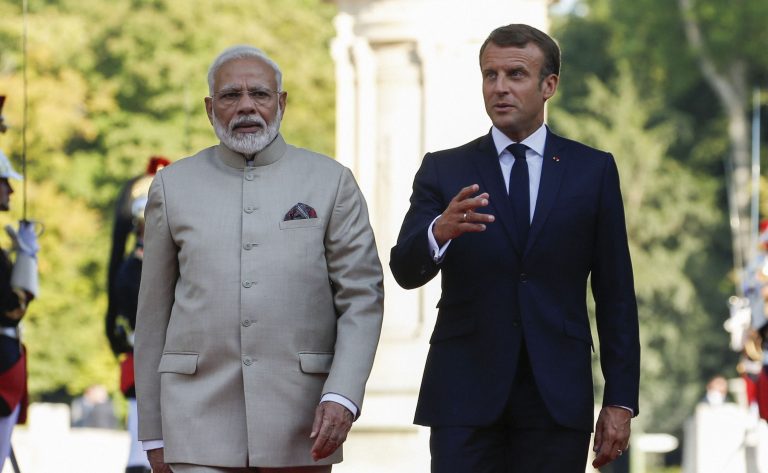
President Emmanuel Macron’s state visit to India is set to commence with a fascinating exploration of Jaipur’s cultural heritage starting with a cultural event at Amber Fort. The French leader will then be accompanied by Prime Minister Narendra Modi, to explore the World Heritage Site Jantar Mantar, acknowledging its historical significance for the French. This observatory, built by Sawai Jai Singh, had French astronomers engaged in collaborative efforts with Indian counterparts in the 18th century.

In 1734, two French Jesuit astronomers from Chandernagore, under French control, were invited to the court of Sawai Jai Singh, the visionary ruler of Jaipur. Macron’s visit to this celestial tapestry serves as a symbolic nod to the historical collaboration between the two nations.

Royal Roadshow and Delightful Detours

A joint roadshow with PM Modi will take Macron from Jantar Mantar to Sanganeri Gate, with stops at iconic landmarks such as Hawa Mahal and Albert Hall Museum. The day will conclude with a private dinner hosted by PM Modi at Rambagh Palace, setting the stage for Macron’s participation in the Republic Day parade in Delhi. Following their tour, the two leaders will hold in-depth bilateral talks.

Emanuel Macron is the chief guest for the Republic Day celebrations

Macron’s presence as the Chief Guest at the Republic Day parade at Kartavya Path in Delhi underlines the close ties between the two nations. The French President is set to visit the French Embassy, partake in the ‘At Home’ function at Rashtrapati Bhavan, and attend an official banquet dinner. Notably, Macron has previously been in India on a state visit in March 2018 and an official visit in September 2023 for the Delhi G20 Summit. Moreover, he has welcomed PM Modi to France on four occasions.

On 26th January, President Macron will attend the Republic Day parade as the chief guest. A French armed forces contingent will participate in the Republic Day parade and flypast alongside Indian troops and aviators. An official statement said, “He will attend the At Home reception at Rashtrapati Bhavan and, later, the State Banquet, at the invitation of the Hon’ble President of India, H.E. Smt Droupadi Murmu.”

Macron follows in the footsteps of his predecessors who remained present as chief guests of India’s Republic Day celebrations. François Hollande in 2016, Nicolas Sarkozy in 2008, Jacques Chirac in 1998, Valery Giscard d’Estaing in 1980, and Prime Minister Jacques Chirac in 1976, have all strengthened the bonds between India and France on this significant occasion.

Accompanying President Macron is a high-profile delegation including ministers such as Stephane Sejourne (Europe and Foreign Affairs), Sebastien Lecornu (Armed Forces), and Rachida Dati (Culture) as well as CEOs, cultural personalities, and ESA astronaut Thomas Pesquet. The visit underscores the commitment to deepen cooperation in various sectors.

25 Years of Indo-French Strategic Partnership

France and India are poised to reinforce their strategic partnership, ushering in a new era of collaboration encapsulated in the “Horizon 2047 Roadmap.” Commencing 25 years after the launch of this strategic alliance, the leaders of both nations, during discussions in Paris on 14th July, charted a course for the next quarter-century. This renewal aims to bolster trust-based cooperation, particularly evident in the defence sector, where joint efforts include advancements in platforms and technologies.

Why this visit by Emanuel Macron is important

President Emmanuel Macron’s visit to India is a pivotal moment to actualise the shared aspirations outlined in the Horizon 2047 Roadmap. The three pillars of this strategic framework — strengthening strategic autonomy, fostering international peace and security, and cultivating partnerships for the planet — will be the focal points of discussions between President Macron and Prime Minister Modi. This diplomatic exchange not only underscores their joint commitment to the Indo-Pacific region but also solidifies a remarkable 60-year cooperation in space exploration, climate monitoring, and maritime surveillance.

A particular emphasis on initiatives promoting student mobility aligns with President Macron’s goal of welcoming 30,000 Indian students to France by 2030. Furthermore, the visit will fuel business ties and cross-investments, supported by France’s “Make It Iconic” nation-branding campaign, signifying India as a strategic priority. The significance of this visit extends beyond diplomatic conversations, embodying a commitment to fostering enduring connections between the peoples of France and India.

‘It will hurt Maldives in the long term’: Opposition parties issue joint statement slamming Muizzu govt’s ‘anti-India’ policy

0

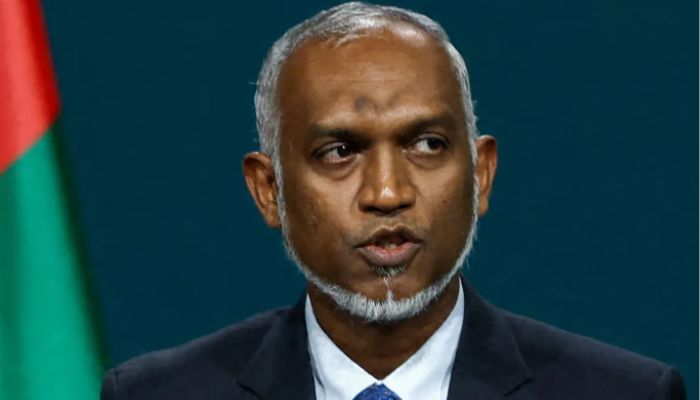
Amid strain in India ties over President Mohammad Muizzu asking New Delhi to withdraw its troops from the Maldivian waters and the disparaging remarks by junior ministers and government officials of Maldives against Prime Minister Narendra Modi, two opposition parties in the Maldives have come out against the current regime over its ‘stark’ anti-India pivot.

The Maldivian Democratic Party (MDP) and The Democrats jointly issued a joint press statement, labelling the shift in foreign policy as ‘extremely detrimental’ to the country’s long-term development. The statement served to reassert and affirm the Opposition’s belief that “alienating any development partner, and especially the country’s most long-standing ally will be extremely detrimental to the long-term development of the country”.

The Opposition further underscored that “stability and security in the Indian Ocean is vital to the stability and security of the Maldives.”

Both the MDP and The Democrats emphasised the critical need for consecutive governments to maintain the ability “to work with all development partners for the benefit of the people of the Maldives, as the Maldives has traditionally done”.

They expressed the view that a departure from the historical collaboration with India could potentially jeopardise the country’s stability and progress.

A recent Reuters report stated that a Chinese research vessel was heading to the Maldives. Opposition parties in Maldives call out Muizzu govt’s ‘anti-India’ pivot, calls it potential ‘detriment’ to long-term development significant, coming close on the heels of Maldivian President Muizzu’s recent state visit to China, during which the two leaders aimed at strengthening ties.

Responding to the report, the Maldives Ministry of Foreign Affairs stated that the island country has always been a welcoming destination for vessels of ‘friendly nations’ and continues to host both civilian and military vessels making port calls for peaceful purposes.

The development, however, has raised concerns in New Delhi, as India has previously viewed the presence of such vessels near its shores, including in Sri Lanka in 2022, as problematic, Reuters added in its report.

India and the Maldives on January 14 “agreed to fast-track the withdrawal of Indian military personnel from the island nation, according to the Maldives’ Ministry of Foreign Affairs. The removal of Indian troops in the Maldives was the main campaign plank of Muizzu’s party during the Presidential elections. Currently, there are around 70 Indian troops, along with Dornier 228 maritime patrol aircraft and two HAL Dhruv helicopters, stationed in the archipelago. On the second day of assuming office, Muizzu officially requested the Indian government to withdraw its military personnel from the Maldives.

Apart from the call for the withdrawal of Indian military personnel, a massive row erupted after a Maldivian deputy minister, along with other cabinet members and government officials, made disparaging and unsavoury references to Primer Minister Narendra Modi’s recent Lakshadweep visit and call for the development of the Indian archipelago as a global retreat for beach tourism. The Maldives government, however, distanced itself from the remarks.

Pro-Chinese Maldivian President worsening relations with India

It is pertinent to note that Progressive Party of Maldives (PPM) leader Mohamed Muizzu won the presidential election in October last year after running a vicious “India Out” campaign. The Maldivian President is also known for his pro-China stance. Just days after the diplomatic row erupted between India and Maldives, Muizzu, while on a state visit to China, urged the country to send more tourists to the island nation.

Amid diplomatic tension with India, a 14-year-old Maldivian boy died on 20th January after President Mohammed Muizzu’s government reportedly refused to allow a Dornier aircraft provided by India to airlift him.

On 14th January, reiterating his demand that India withdraw its troops from Maldives, the Maldives’ President Mohamed Muizzu asked India to withdraw its military deployment from the archipelago nation by 15th March. 

Additionally, Maldives President Mohamed Muizzu on 9th January urged China to send more tourists to the archipelago. His remark came amid reports that a large number of Indians had cancelled their trips to Maldives in the wake of their Ministers’ unwarranted and deplorable comments on India, Indians, and PM Modi.  

Notably, it all started on 4th January after PM Narendra Modi shared some pictures of his visit to Lakshadweep. He exhorted people to explore the scenic islands in what could be seen as a push to his ‘vocal for local’ slogan, and an effort to give a boost to tourism on the archipelago.

Following his visit to Lakshadweep, a large demand erupted among Indians to explore the Indian Islands and boost our tourism sector before visiting beaches or tourism sites in other countries. However, jittery Maldivian politicians interjected and reacted by making racial commentary on Indians. 

It is important to note that neither the Indian PM mentioned any country nor it was targeted toward any nation, yet some Maldivians feared a potential hit to their tourism economy. 

Mariyam Shiuna, Deputy Minister of Youth Empowerment, Information, and Arts, made insulting remarks against PM Modi, referring to him as a ‘clown’ and a ‘puppet of Israel’ after he posted pictures from his visit to Lakshadweep Islands. She later deleted the tweet and was among one of the three Ministers who were suspended by the Maldivian government for making disparaging remarks on India. 

On 5th January, Zahid Rameez, a Council member of the ruling Progressive Party of Maldives (PPM) also took to the microblogging site X to mock Indians.

On 8th January, The Democrats leader in the Maldivian Parliament, Ali Azim called for the sacking of the archipelago’s President Mohamed Muizzu. Azim called for steps to remove the Maldivian President from office including initiation of a vote of no confidence against him. 

Following the controversy, Maldives opposition had publicly condemned the commentary made by the members of the ruling party and its Ministers noting that India was “rightfully angry” over the uncalled racial remarks. 

Senior Maldivian politicians including former President Ibrahim Solih and ex-Foreign Minister Abdullah Shahid had condemned the use of “hateful language” and “reprehensible” remarks against India

 In response to Maldivian users’ and politicians’ uncalled-for racial commentary, trends like #BoycottMaldives, and cancellation of trips to Maldives are picking steam in India. Moreover, the Indian online travel company, Ease My Trip, also suspended all flight bookings to Maldives amidst the controversy. Consequently, the Maldives Association of Travel Agents and Tour Operators (MATATO) wrote to Ease My Trip CEO Nishant Pitti seeking his assistance in fostering positive relations between the two countries.

(With inputs from ANI)

In Congress-ruled Telangana, cop pulls female ABVP student by the hair on the road, BJP demands strict action

0

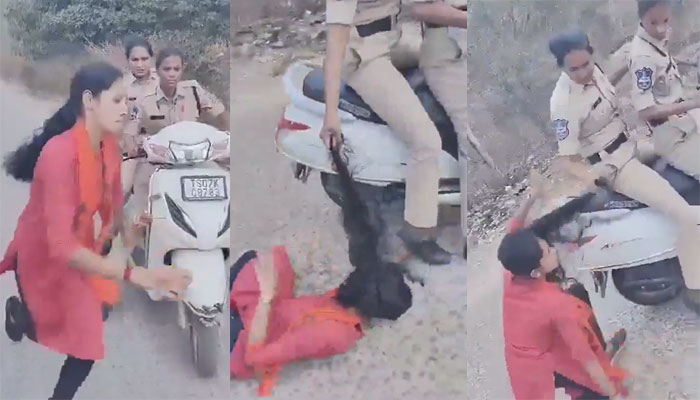
On 24th January, a video of two female cops dragging a female student associated with Akhil Bharatiya Vidyarthi Parishad (ABVP) by pulling her hair went viral on social media. The incident took place during a protest in Rajendra Nagar Mandal of district RangaReddy in Telangana.

Students of Professor Jayashankar Telangana State Agricultural University (PJTSAU) have been protesting against the state government’s decision to allocate 100 acres of university land for the construction of the new High Court Complex. ABVP had called for a protest in support of the students on Wednesday, January 24. Local police took 20 protesters under preventive custody to curb the protests.

Reports suggest that during the protest, two female cops, riding a scooter, chased down a female activist of ABVP. During the chase, the pillion-riding cop got hold of the student activist’s hair, after which the student fell on the road.

Opposition leaders have demanded strict action against the female cop. Bharatiya Janata Party’s (BJP) state president, G Krishan Reddy, wrote on X, “Strongly condemn the inhumane actions perpetrated by negligent police officials. This incident in Hyderabad reflects the Congress’ autocratic rule and is highly condemnable. Urgent and decisive measures must be taken against those responsible for this objectionable behaviour towards the protesting student leaders.”

Bharat Rashtra Samithi (BRS) leader Kavitha Kalvakuntla said, “The recent incident involving Telangana police is deeply concerning and unacceptable. Dragging a peaceful student protester and unleashing abrasive behaviour on the protestor raises serious questions about the need for such aggressive tactics by the police. This arrogant behaviour demands an unconditional apology from the Telangana Police. Urging the Human Rights Commission to take swift, strict action against those involved. This behaviour cannot become a norm and must be condemned by all alike.”

BJP State Vice President Vishnu Vardhan Reddy said, “A female ABVP worker who was protesting against Telangana’s Congress government is dragged by the hair by police. Is this your Mohabbat ki dukan, Mr Rahul Gandhi? I demand strict action against the culprits & request the Ministry of WCD to interfere.”

Rajendra Nagar Police Inspector said in a statement that the female cop “accidentally” held a protester by her hair when she was trying to run towards the road where the protest was happening. He said, “Today, a protest was held at PJTSAU where ABVP members also participated. We had taken around 20 protesters under preventive custody. Some protesters were running towards the road during which an incident happened where a woman constable by mistake held a protester by her hair, following which she fell (on the ground)”.

He further added that both a female cop and student activist associated with ABVP reached the police station, where the cop admitted her mistake. “They both reached the police station, where the female cop stated that it was by mistake, and the girl accepted that it was not personal. The girl filed no complaint,” he said.

Karnataka issues notification to cover 13,000 state govt employees under Old Pension Scheme

 The Karnataka government has issued a notification to cover about 13,000 state government employees, recruited after 2006, under the Old Pension Scheme.

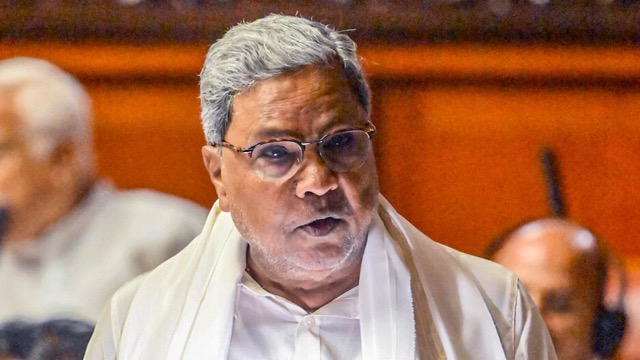
Taking to X, Chief Minister Siddaramaiah said that he had promised to fulfil this demand to the government employees when they were on a strike against the new pension scheme.

“An order has been issued to cover the old pension scheme to about 13,000 government employees of the state government recruited after 2006. Even before the election, I visited the place when the National Pension System (NPS) employees were on strike and promised to fulfil the demand after we came to power,” he posted on X on Wednesday.

“I hope this decision has given comfort to all the families of 13,000 NPS employees,” he added.

Under the old pension scheme, a government employee is entitled to a monthly pension after retirement. The monthly pension is typically half of the last drawn salary of the person.

Under the new pension scheme, employees contribute a portion of their salaries to the pension fund. Based on that, they are entitled to a one-time lump sum amount on superannuation.

The old pension scheme was discontinued in December 2003, and the new pension scheme came into effect on April 1, 2004. 

(This news report is published from a syndicated feed. Except for the headline, the content has not been written or edited by OpIndia staff)

‘It is over, I have reached age limit’: Six-time world champion and Olympic medalist Mary Kom announces her retirement

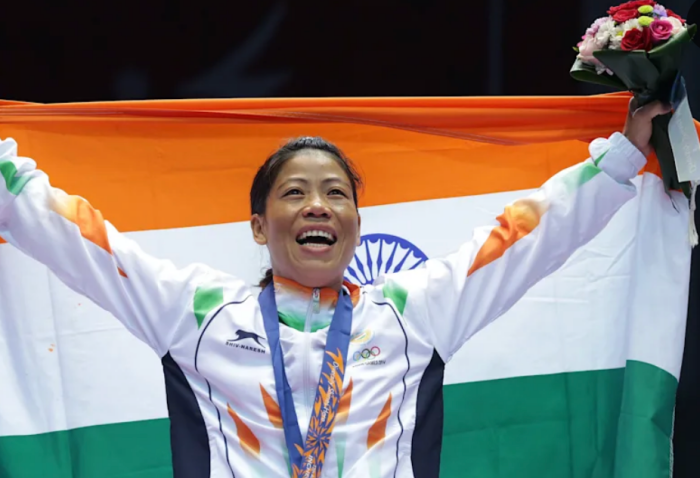
Six-time World Champion and 2012 Olympic medallist Mangte Chungneijang Mary Kom on Wednesday announced her retirement from boxing.

Mary Kom hung her boxing gloves as the International Boxing Association’s (IBA) rules allow male and female boxers to fight in elite-level competition only till the age of 40.

During an event, Mary, 41, admitted that she still has the hunger to compete at the elite level, but she has to bring curtains down on her career because of the age limit.

“I have the hunger still but unfortunately because of the age limit it is over I cannot compete in any competition. I want to play more but I am being forced to quit (due to the age limit). I have to retire. I have achieved everything in my life,” Mary said during an event.

Mary is the first female boxer in boxing history to have captured six world titles. The five-time Asian champion was the first female boxer from India to take home a gold medal at the 2014 Asian Games.

The experienced pugilist won a bronze medal in the London 2012 Olympic Games leaving any record or title untouched from her reach. She introduced herself to the world at the age of 18 in the inaugural world meet in Scranton, Pennsylvania.

With her near-flawless boxing style, she impressed everyone and made it to the final of the 48kg category. She fell short in the final but left a mark of the success that she was going to achieve in the future.

In the coming years, she went on to become the first Indian to win a gold medal at the AIBA Women’s World Boxing Championships. She went on to clinch the World Championships titles in 2005, 2006, 2008 and the 2010 editions. After winning the 2008 title, Mary went on a break after giving birth to her twins.

After winning the 2012 Olympic medal, Mary once again went on a break after giving birth to her third child. She marked her return but sealed her place at the summit in the 2018 World Championships which was held in Delhi.

She dominated with a 5-0 win over Ukraine’s Hanna Okhota for her sixth world title. A year later, she went on to clinch her eighth world medal, the most by any male or female boxer. 

(This news report is published from a syndicated feed. Except for the headline, the content has not been written or edited by OpIndia staff)