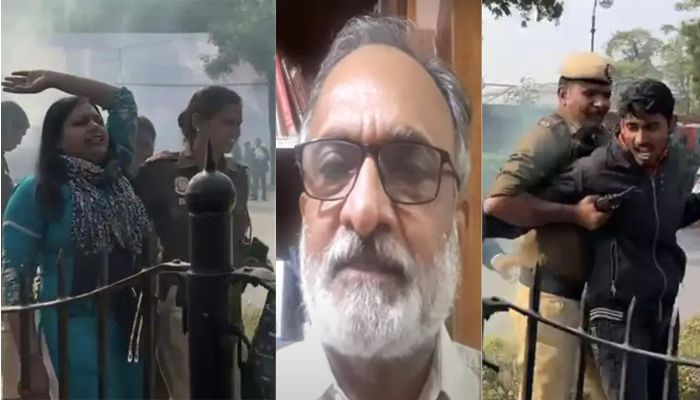
On 14th December, the maternal uncle of one of the Parliament intruders, Sagar Sharma, alleged that his nephew was dragged into the act as part of a “conspiracy” by a powerful individual. He asserted that the Sagar has no history of taking part in such acts.
The relative claimed, “An extensive investigation should be conducted. I know he is being trapped by someone. Any prior link should have existed if he was that way. He doesn’t have the money to travel. He had to have connected with them on social media. He must have befriended them on Facebook. He is a poor man and does not have the means to visit places. If it weren’t for Facebook, how would he have met someone who lives so far away? People are tricked into falling into traps in this manner. Perhaps he received some sort of incentive. Otherwise, a police station should have a record of him carrying out similar offences in the past. He has been pulled into it as part of a conspiracy by someone who holds a big position.”
#WATCH | "He has been pulled into it as per a conspiracy by someone who holds a big position," says Pradeep, maternal uncle of the Parliament breach incident accused Sagar, in UP's Lucknow pic.twitter.com/g8O2WnA0gr
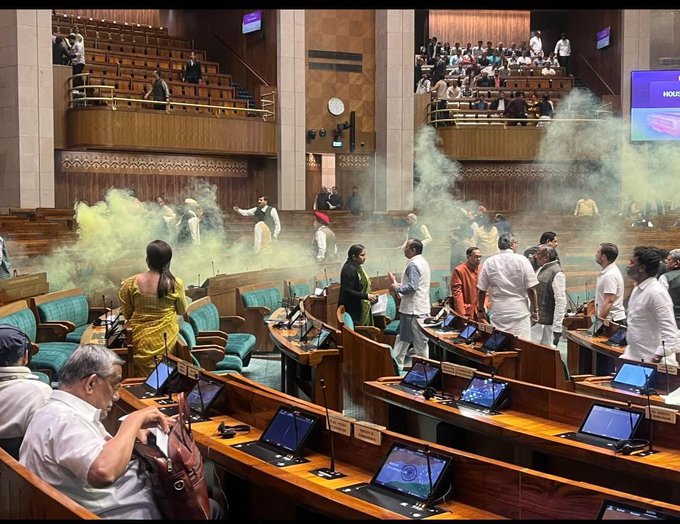
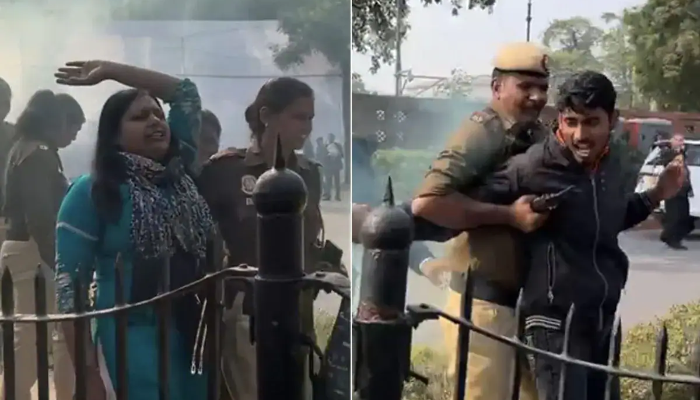
On 13th December, on the anniversary of the 2001 Parliament terror attack, Sagar Sharma and Manoranjan D broke through security and jumping into the Lok Sabha chamber from the public gallery during Zero Hour. They shouted slogans and released yellow gas from canisters before being subdued by a few members of parliament. Meanwhile, Amol Shinde and Neelam Singh raised slogans outside the Parliament buildings as they released coloured gas from canisters. It was the worst case of Parliament security breach in two decades.
All four are now in police custody. Their accomplice, Vishal Sharma alias Vicky and his wife Vrinda Sharma in whose house the accused stayed before reaching Parliament, have also been apprehended from Gurugram. A search is on to capture their other accomplice Lalit Jha. Police sources mentioned that all accused were associated with a social media page ‘Bhagat Singh Fan Club.’
The Delhi Police has launched a case against the accused under the Unlawful Activities (Prevention) Act (UAPA). A police team reached the house in Gurugram earlier in the day, where all four accused reportedly stayed briefly before the incident. The officials said the case has been registered under Indian Penal Code sections 120B (criminal conspiracy), 452 (trespass), 153 (wantonly giving provocation, with intent to cause riot), 186 (obstructing public servant in discharge of public functions) and 353 (assault or criminal force to deter public servant from discharge of his duty) and Unlawful Activities (Prevention) Act (UAPA) sections 16 and 18 at the Parliament Street police station.
In a major security breach since the 2001 Parliament attack, two persons jumped into the Lok Sabha well on December 13 from the visitors’ gallery while the proceedings were going on and released yellow-coloured smoke from canisters. The question here arises that despite multiple security checks and frisking, how did the intruders manage to smuggle the smoke canisters inside the Parliament. Apparently, the intruders carried the smoke canisters in the shoes they were wearing.
Notably, the Parliament Security Service operates under the administrative control of the Joint Secretary (Security) of the Lok Sabha Secretariat and oversees the security operations of both Secretariats. After the deadly attacks on the Parliament in 2001, several measures were taken to streamline the access points, advanced security gadgets were deployed, and a high-tech access control system was implemented to ensure the safety and security of the MPs and VVIPs. In addition, Radio Frequency Tags were introduced to enhance the identification processes.
The intruders Sagar Sharma and Manoranjan managed to breach the three-tier security of the parliament. The initial check is undertaken at the Parliament premises’ entry gate. Subsequently, another check is conducted involving metal detectors and hand-held metal detector frisking. This is followed by another round of checking at the Parliament building’s entrance gate, with additional security deployed in the corridor leading to the visitors’ galleries. While the visitors were not allowed to carry cell phones inside the gallery, the intruders were skillfully carrying smoke canisters made of plastic in their shoes.
An obvious question that comes to the mind here is why was the smoke cannister not detected during any of the three tiers of security checks including metal detector frisking. To understand this, one must recall the “Shoe Bomber” Richard Reid’s failed attempt to detonate a bomb on American Airlines Flight 63 from Paris to Miami 22 years back on December 22, 2001. Richard Reid had converted to Islam and joined the Islamic terrorist group Al-Qaeda. Interestingly, Reid was carrying the bomb with around 10 ounces of explosives in his shoes when he boarded the flight. Despite the prior security checks, the bomb Reid was carrying could not be detected.
Fortunately, the terrorist failed in his attempt to blow up the plane mid-air as a co-passenger smelled the sulphur and Reid was then pinned down, sedated and eventually handed over to the security officials. This incident, however, demonstrated that, unless shoes are removed and checked separately, they can pass through security with plastic explosives stuffed within. For this, in the US and Europe, passengers at the airport are required to take off their shoes, belts, all metallic objects, cellphones and other electronic items in a separate tray before passing through the metal detectors.
During the security checks at the parliament, the officials usually do not check the shoes of the visitors. As reported earlier, two of the accused had conducted recce outside the parliament beforehand, during the Budget session as well as the monsoon session. Had the frisking staff regularly checked the insides or the soles of the shoes of the visitors including those of the two intruders on Wednesday, the duo could have been caught beforehand. The incident has aptly triggered a serious review of the security arrangements as there could been noxious contents in the canisters smuggled in by the now-arrested intruders.
Citing a Parliament Security Services official, Indian Expressreported that hundreds of visitors are arriving at the parliament daily, especially after the inauguration of the new parliament, however, the staff is limited. The report adds citing sources that “301 security officers are usually deployed inside Parliament, but on Wednesday, 176 were present.”
Notably, the security breach took place at 1 PM on December during the zero hour in the Lok Sabha, just before the lunch break. When Khagen Murmu, BJP MP from West Bengal, was raising some points regarding his constituency, a commotion was suddenly heard in the background. When the Sansad TV switched to the view of the entire hall, a man could be seen who had already jumped from the gallery and was on the benches. He then started to proceed towards the front of the hall, jumping from bench to bench.
#WATCH | An unidentified man jumps from the visitor's gallery of Lok Sabha after which there was a slight commotion and the House was adjourned. pic.twitter.com/Fas1LQyaO4
A video from the Lok Sabha shows the members of Parliament assaulting one of the two perpetrators who burst into the chamber during proceedings and tossed canisters emitting yellow smoke. The MPs can be seen plucking the hairs of the intruder, hurling shoes at him, and landing punches at him before encircling him.
Meanwhile, the Lok Sabha secretariat has reportedly suspended eight security officials in connection with the security breach. As the Winter Session of Parliament resumed this morning, security measures were significantly increased.
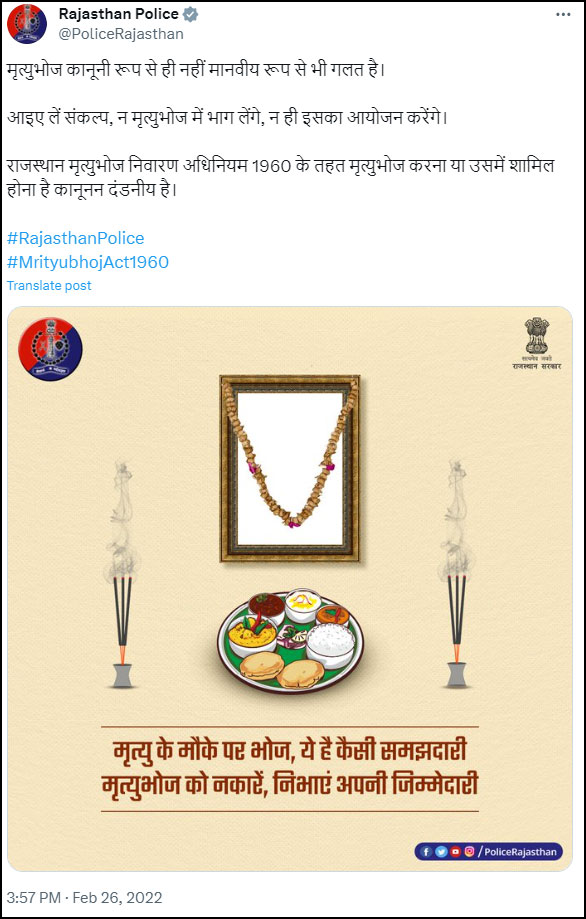
On 13th December, Rajasthan Police published a post on X (formerly Twitter) urging people not to participate in ‘Mrityu Bhoj’ and pointed out that it is a punishable offence. In the post, Rajasthan Police used the hashtag “MrityuBhojAct1960”.
मृत्यु भोज करना व उसमें शामिल होना कानूनन दंडनीय है।
The post read, “Eating at death feast and participating in it is punishable by law. This event is inappropriate, even from a human point of view. Let us together remove this evil from the society and oppose it.”
The post was criticised by many netizens who found this rule a needless interference with the religious practices of Hindus. Author and columnist Anshul Pandey wrote, “Since when did the Mrityu Bhoj became Evil–Rituals? If these are Evil–Rituals, then laws should be made on such Rituals of other religions too, are you ready for that?”
मृत्यु भोज कुरीति कबसे हो गई? अगर ये कुरीति हैं तो फिर दुसरे धर्मों की कुरीतियों पर भी कानून बनाना चाहिए, क्या आप तैयार हैं इसकेलिए?
Since when did the Mrityu bhoj became Evil–Rituals? If these are Evil–Rituals, then laws should be made on such Rituals of other religions too,…
Founder of Garuda Prakashan, Sankrant Sanu said, “When did the job of the police become to fix “kuritis.” It’s not your business colonial babus. Catch some thieves.”
When did the job of the police become to fix “kuritis.” It’s not your business colonial babus. Catch some thieves.
X user JIX5A said, “This is a barbaric law! How can anyone be so intolerant and hateful towards Hindus? Mrityu bhaji is no different from the western practice of keeping vigils for the dead. How can a country that has 80% Hindus violate their religious rights so much?”
This is a barbaric law! How can anyone be so intolerant and hateful towards Hindus? Mrityu bhaji is no different from the western practice of keeping vigils for the dead. How can a country that has 80% Hindus violate their religious rights so much?
Dr Amit Thadhani wrote, “It is our right to offer food to others for the moksha of our pitrs, and no one can stop us from doing it. The best time to change this disgraceful law is right now.”
It is our right to offer food to others for the moksha of our pitrs , and no one can stop us from doing it. The best time to change this disgraceful law is right now. @RajCMOhttps://t.co/9H98i82EuS
X user Shubhendu questioned why the post was made within two days after the new government was formed in the state and wrote, “The law has been in place in Rajasthan since 1960. Rajasthan Police rarely posts about it. But what made it post today when a new BJP CM has been declared, and the cabinet is going to take oath in a couple of days. Who (which agency) is running various handles of Rajasthan Police?”
The law has been in place in Rajasthan since 1960. Rajasthan Police rarely posts about it. But what made it post today when a new BJP CM has been declared and the cabinet is going to take oath in a couple of days. Who (which agency) is running various handles of Rajasthan Police? https://t.co/1e16SLrTIa
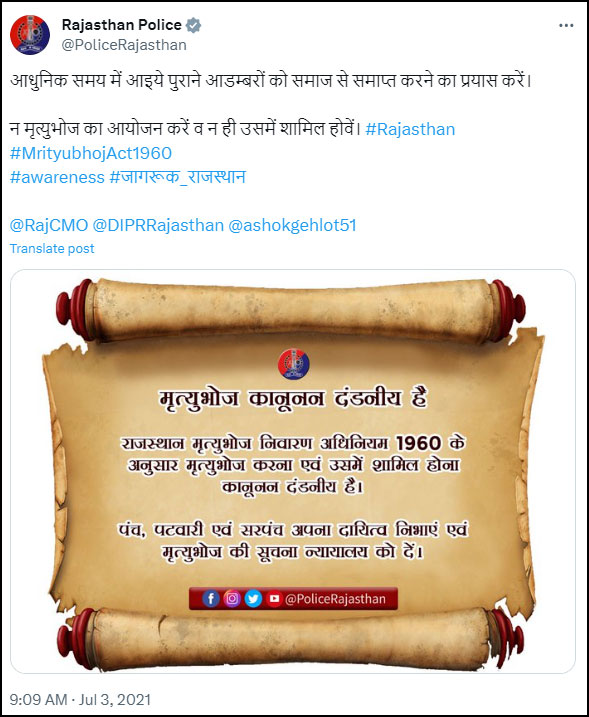
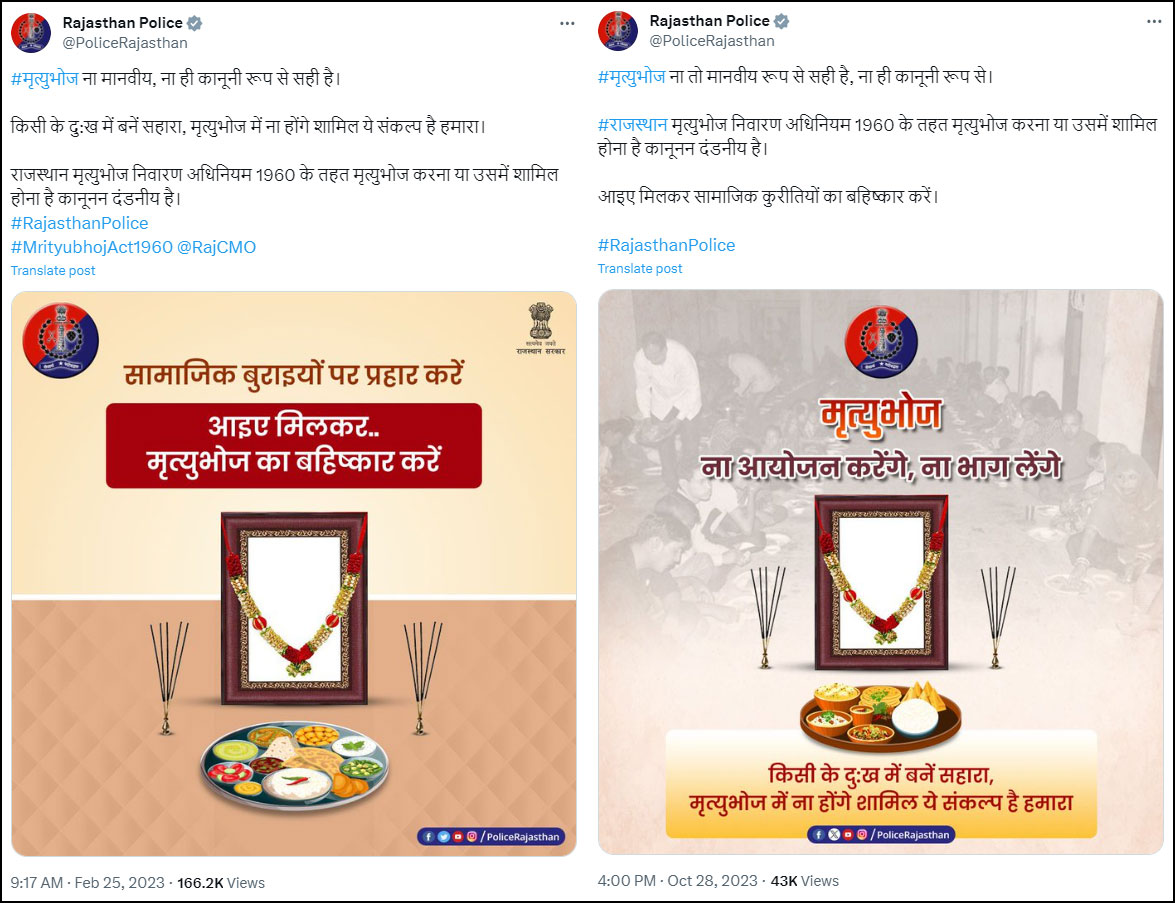
This is not the first time Rajasthan Police made a post on social media reminding people to refrain from attending Mrityu Bhoj. However, detailed information about it was never posted on social media. Similar posts were made in 2020, 2021, 2023 and earlier in 2023.
Source: Rajasthan Police/X
Source: Rajasthan Police/X
Source: Rajasthan Police/X
Source: Rajasthan Police/X
District Police handles in Rajasthan made similar posts over the years.
#मृत्युभोज ना तो मानवीय रूप से सही है, ना ही कानूनी रूप से।#राजस्थान मृत्युभोज निवारण अधिनियम 1960 के तहत मृत्युभोज करना या उसमें शामिल होना है कानूनन दंडनीय है।
— Jaipur Rural Police (@JprRuralPolice) July 8, 2020
The Rajasthan Government issued an order to strictly implement the Mrityu Bhoj Act amid COVID-19 pandemic
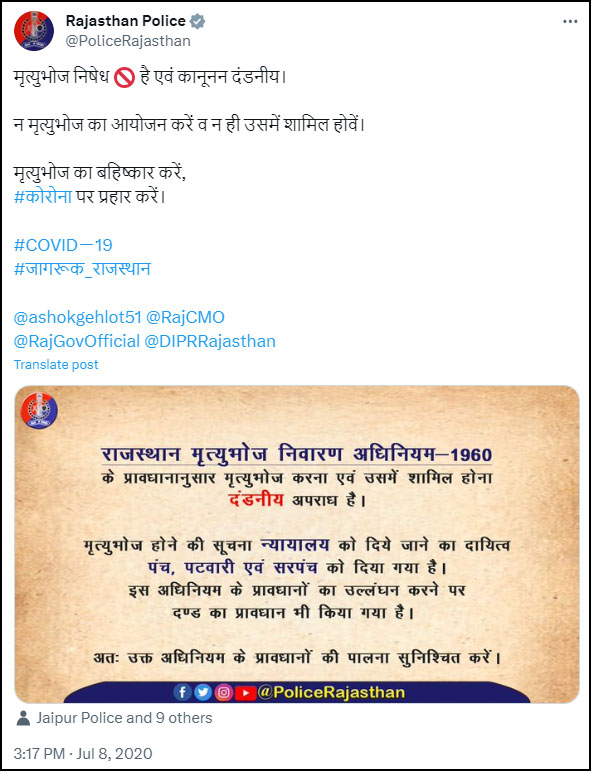
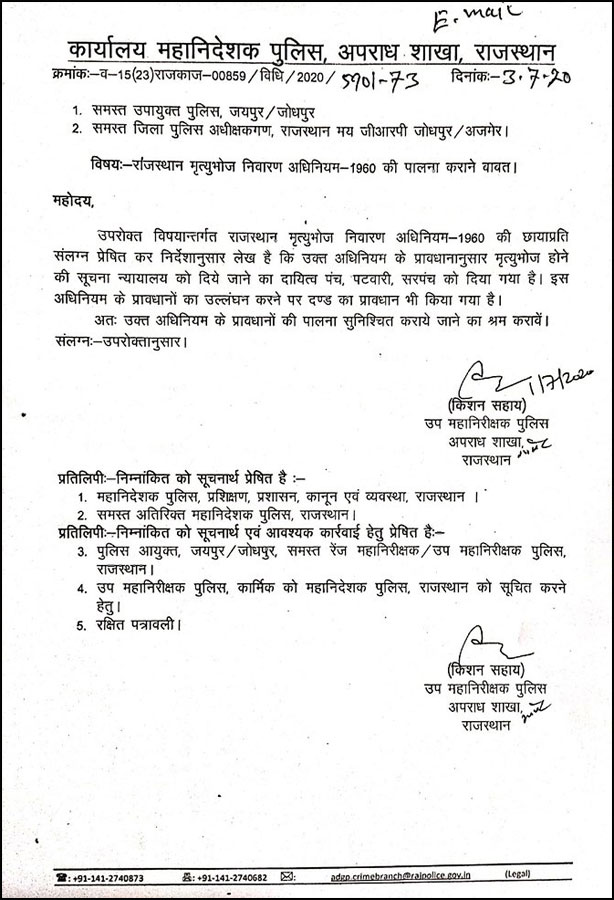
There was no such post prior to July 2020, and there is a reason for that. On 3rd July 2020, the Rajasthan Government, led by Congress leader and then-Chief Minister of the state Ashok Gehlot, issued an order to strictly implement the Rajasthan Prevention of Mrityu Bhoj Act, 1960. In a social media post on X in July 2020, Jaipur Police had shared the orders and details of the Mrityu Bhoj Act. As per the document, in accordance with the Prohibition of Mrityu Bhoj Act, 1960, it was directed that the duty of informing the court about the occurrence of Mrityu Bhoj was assigned to the Panch, Patwari, and Sarpanch. The violation of the provisions of this law is also subject to punishment. The law enforcement agencies were asked to make efforts to ensure compliance with the provisions of the aforementioned law. DIG Kishan Sahay issued the order.
Source: Jaipur Police/X
Though the law has been in place since 1960, there has been no strict implementation of it in recent times. However, things changed in 2020 when the pandemic hit. Reports suggest that complaints were filed during the pandemic that people were organising Mrityu Bhoj following the demise of their loved ones. As there were guidelines for social distancing amidst the pandemic, the government used the opportunity to implement a decades-old law against Mrityu Bhoj. Following the instructions, FIRs were filed in the matter against those who organised Mrityu Bhoj. During research, we found two such reports. In July 2020, two brothers were booked only a week after the instructions were given to implement the law. In April 2021, 100 people gathered for Mrityu Bhoj after which a fine of Rs 25,000 was imposed on the family.
What is Mrityu Bhoj?
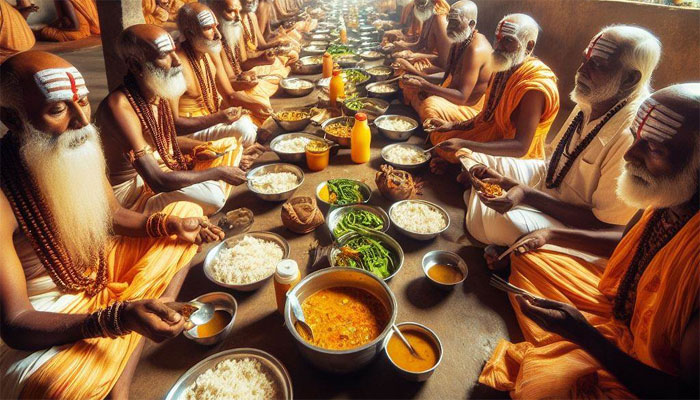
Mrityu Bhoj is an age-old Hindu tradition where priests, family, villagers, relatives and the poor are invited for a feast after the demise of a person. It is practised across the country by different names.
What is the Rajasthan Prevention of Mrityu Bhoj Act, 1960?
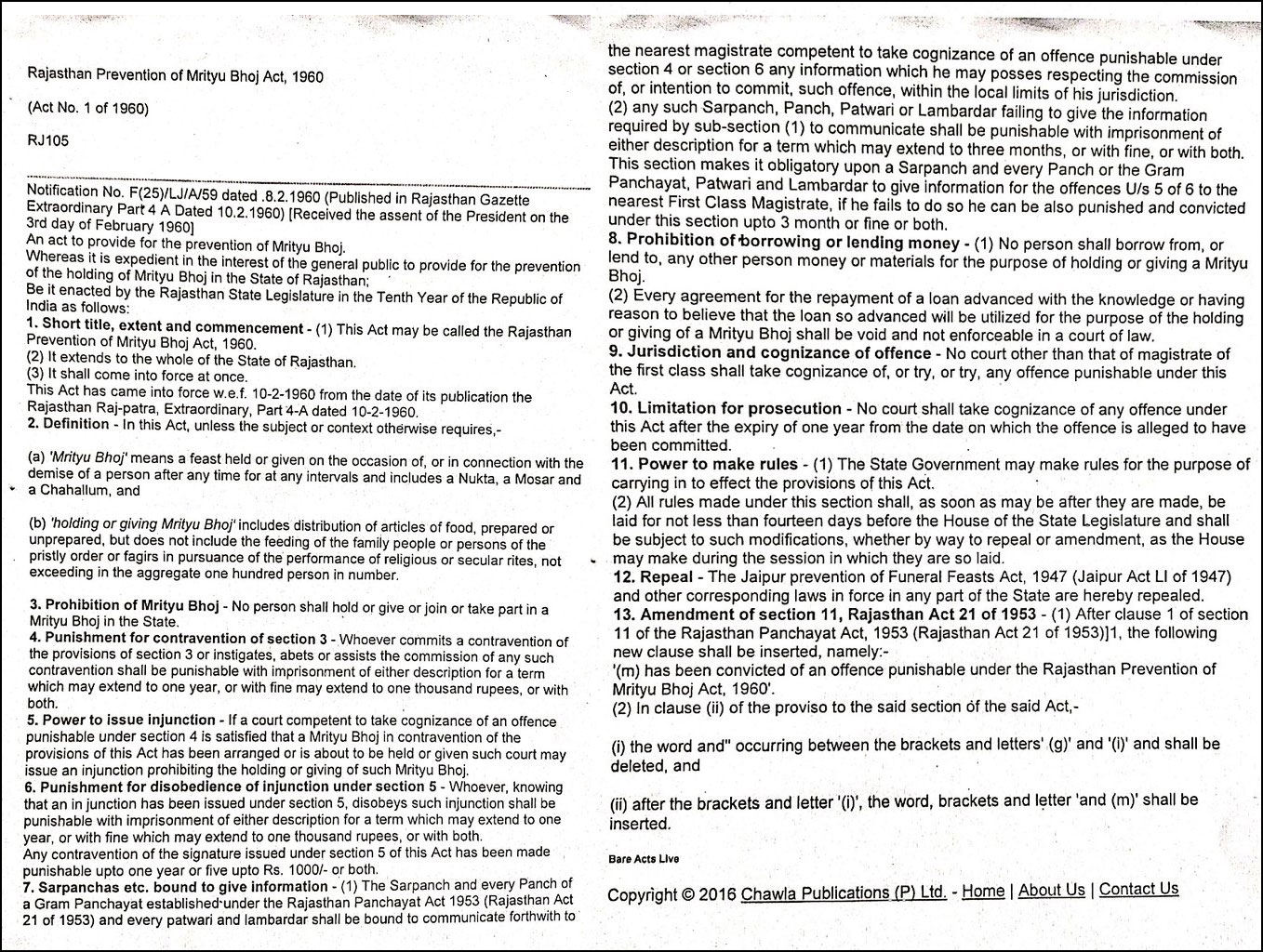
The Rajasthan Prevention of Mrityu Bhoj Act, 1960, was enacted to address the concerns related to the holding of Mrityu Bhoj in the state. On 3rd February 1960, the President of India gave assent the bill. It came into force on 10th February, 1960. As per sub-section (a) of Section 2, events like Nukta, Mosar and Chahallum were included in the prohibition act. Furthermore, as per sub-section (b), though there was a ban on Mrityu Bhoj, there was no restriction on feeding the family or specific groups for religious or secular rites.
Source: Jaipur Police/X
As per Section 3, no one is allowed to hold, give, join or take part in a Mrityu Bhoj. Section 4 states that anyone breaking the law may face imprisonment for up to one year or a fine of Rs 1,000. Section 5 of the Act gave the court authority to issue injunctions to prevent such feasts. As per Section 6, Sarpanchs, panchs, patwaris and lambardars must inform law enforcement agencies about such dinners and may face punishment if they fail. Section 8 of the Act prohibited anyone from providing financial assistance or loans for holding feasts. Other Acts, such as the Jaipur Prevention of Funeral Feasts Act 1947, were repealed after introducing this Act.
The act found a place in the Rajasthan Government’s action plan for 2023-24. It read, “The other prominent practice associated with death is the Mrityu Bhoj, wherein food is offered to the priests, family, relatives and villagers, on mass-scale, after the death of a person. This social practice proves to be more of a burden on the offspring of the deceased and exerts a heavy financial burden on them, especially those belonging to poor families, as there is an expectation and social pressure to feed scores of families. To curb the evil practice of “Mrityu Bhoj”, and spread awareness about the Prevention of Mrityu Bhoj Act, 1960 was passed, but the same needs better enforcement and implementation.”
It is important to note that the Mrityu Bhoj Act, 1960 specifically mentions the Islamic practice of Chahallum too. A Chahallum is a custom where Muslims honour the dead person of a family after 40 days.
Notably, the law from 1960 does not talk about the limit of people allowed. However, the action plan 2023-24 and a judgment in a matter related to the law mention it. The action plan read, “To effectively deal with the evil of Mrityu Bhoj, the Rajasthan Prevention of Mrityu Bhoj Act, 1960 was enacted, which bars anyone from hosting a feast for more than 100 people and mandates punishment of up to one-year jail term or a fine of Rs 1,000 (or both) for anyone who violates the law or anyone who “abets or assists the commission of any such contravention.”
Rajasthan High Court in Fateh Lal vs State of Rajasthan passed a judgment on 27th January 1988 where Fateh Lal and others were accused of holding Mrityu Bhoj. While contending the matter, Fateh Lal’s advocate informed the court that there was no proof that the feast was organised for more than 100 people. The judgment read, “It has been contended by the learned Counsel for the accused-petitioner that “Mrityu Bhoj” to the extent of 100 persons was permitted under the Rajasthan Guest Control Order, 1972 and also under the Raj. Prevention of “Mrityu Bhoj Act, 1960 and there is no evidence on record that “Mrityu Bhoj” was arranged for more than 100 persons and on this ground alone, the revision petition deserves to be allowed.” It further read, “Admittedly, ‘Mrityu Bhoj’ for less than 100 persons was and is permissible under the Rajasthan Guest Control Order and Rajasthan Prevention of Mrityu Bhoj Act. To sustain a conviction for the breach of Clause 3 of the Order, it is necessary to prove that the “Mrityu Bhoj” was arranged from more than 100 persons. Admittedly, no person was found eating when the police raided Mabeshwarion-ka-Nohara.”
The limit of the number of guests is not under the Mrityu Bhoj Act but under the Rajasthan Guest Control Order, 1978. As per the order, the food cannot be served to more than 100 people, including the host or hosts. That means if there are five members in the family, they are allowed to invite only 95 people. During Covid, there was a restriction on any gathering hence, even if the number of guests were less than 100, fines were imposed.
The Mrityu Bhoj Act was introduced, claiming it put pressure on the poor section of society as they often don’t have the money to hold grand feasts. It was further contended that the poor section of the society was forced to sell land or take hefty loans to arrange Mrityu Bhoj, which would put financial pressure on the family, making the future insecure.
It is pertinent to note that the Mrityu Bhoj Act does not prevent people from observing death rituals for their deceased family members. It just restricts the number of people invited to attend the ‘Bhoj’. The intention behind the law was to reduce the economic and social burden on poor families who had to undergo hardships for organizing grand events that involved a lot of people. It was enforced by the Gehlot government during the Covid time to prevent large gatherings.
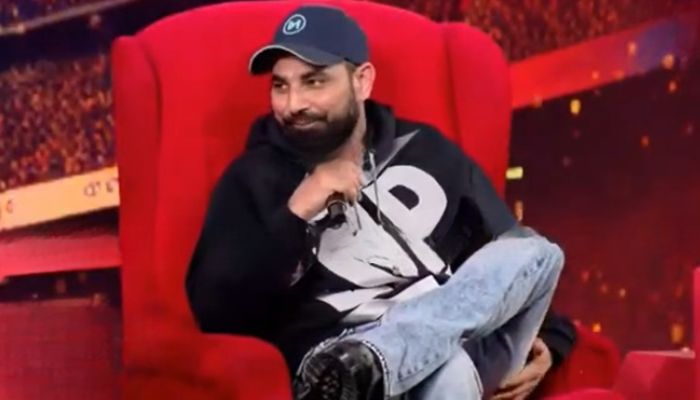
On Wednesday (13th December), Indian cricketer Mohammed Shami attended ‘Agenda Aaj Tak’. During his interview, he slammed the Pakistani social media handles who claimed that Shami stopped short of offering Sajda (prayer) on the ground in a match after taking the fifth wicket during the ICC Cricket World Cup 2023.
The anchor asked Mohammed Shami, “In a match, you took the fifth wicket and sat down on the ground. Then some social media handles from Pakistan claimed that ‘See, Mohammed Shami – an Indian Muslim – wanted to offer Sajda (prayer) but suddenly he was afraid and could not do it’.”
Mohammed Shami said, “If anyone wants to do Sajda, who will stop him? I won’t stop anyone from your religion from praying. You will not stop anyone from my religion from praying. If at all I want to do Sajda, I will do it anyway. What is the problem with it? I am a Muslim and I proudly say so. I am an Indian and I proudly say so.”
Mohammed Shami added, “If at all I had any problem with that, I should not have lived in India in the first place. Had I needed anyone’s permission to offer my prayers in this country, I would not have lived here. People have said a lot of things and even I have seen those things on Instagram. People are saying that I wanted to do a Sajda but I could not. Brother, have I done anything of that sort on the ground ever in my life before? I had taken five wickets before as well. I did not do Sajda at that time.”
Shami further said, “You tell me where I have to pray, and I will go and pray there. I will do it on every Indian platform I get. This is not done. We should change our thinking. These people think only about how to disturb us. They are not with me. Neither they are with you. They are not with anyone except gossiping. They do not love anyone and anything but gossip. All they need is content. They will take any content.”
About the five-wicket haul in that match, Mohammed Shami said, “Do you know how I took those five wickets? It was probably my sixth over. I was bowling with an effort that exhausted my energy limits. I already had three wickets. I was thinking that if I bowl even better in these 3 to 4 remaining overs, I will get five wickets. Because I already had three wickets. All I was thinking about was giving my 100 per cent. And in fact, I was giving my 200 per cent at that time. I was bowling better than my abilities.”
He further said, “I was tired. That batter was not getting out. I could beat him multiple times but he was not getting out. I was tired of this. When I got the fifth wicket I came on my knees. At that time, I lowered my neck. That’s it. People created different meanings out of that. These people are so free in their lives. I think they do not have anything else to do.”
Notably, Mohammed Shami had kneeled down for a few moments after taking five wickets against Sri Lanka, after which many Pakistani social media users started saying that the Indian bowler wanted to offer a Sajda but did not do it due to fear. Shami completed a five-wicket haul by dismissing Kasun Rajitha in the 13th over of the Sri Lankan innings. Shami took 24 wickets in seven matches – the most by any bowler in the tournament.
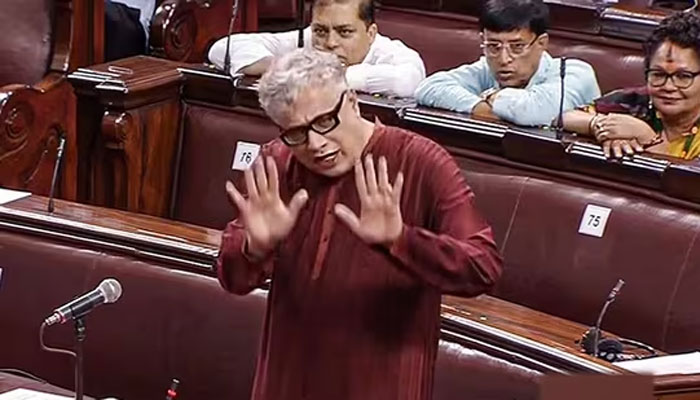
On 13th December, Trinamool Congress’s Rajya Sabha MP Derek O’Brien was suspended from Rajya Sabha for the remaining part of Winter Session. Leader of the House in Rajya Sabha, and Bharatiya Janata Party MP, Piyush Goyal moved the motion to suspend the TMC leader for misconduct in the house.
In his motion, Union Minister Goyal said, “This house has taken serious note of the misconduct of Mr Derek O’Brien, member, who has entered the well of the house and has been continuously shouting slogans to the Chair. Therefore, disrupting the house’s proceedings in utter disregard to the authority of the Chair and having been named by the Chair, resolved that the above-mentioned member that is Derek O’Brien, be suspended from the service of the Council for the remainder of this Session under Rule 256.”
Following the motion, the Chairman of the house, Jagdeep Dhankhar, called for voting and accepted the motion based on a voice vote to suspend Derek O’Brien for the remaining Winter Session.
What is Rule 256 under Rules of Procedure and Conduct of Business in the Council of the States (Rajya Sabha)?
As per Rule 256 under Rules of Procedure and Conduct of Business in the Council of the States (Rajya Sabha) titled Suspension of the member, the Chairman has the power to name a member who disregards the authority of the Chair or abuses the rules of the Council by persistently and willfully obstructing the business thereof.
The rule states that the member, if named by the Chairman, shall forthwith put the question on a motion being made, no amendment, adjournment or debate being allowed, that the member be suspended from the service of the Council for a period not exceeding the remainder of the Session.
Notably, the rule also states that the Council may, at any time, on a motion being made, resolve that such Suspension be terminated. Furthermore, a member suspended under this rule shall forthwith quit the precincts of the Council.
Lok Sabha secretariat suspended eight security personnel on Thursday over security lapses that led to a major security breach in Parliament on Wednesday.
The security breach happened on the anniversary of the 2001 Parliament terror attack. Two people–Sagar Sharma and Manoranjan D–jumped into the Lok Sabha chamber from the public gallery during Zero Hour, released yellow gas from canisters and shouted slogans before being overpowered by the MPs.
The Lok Sabha was adjourned till 2pm amid sloganeering by Opposition MPs over Wednesday’s security breach incident. The opposition MPs also demanded the resignation of Union Home Minister Amit Shah over the incident.
Lok Sabha Speaker Om Birla said “all of us are concerned” about what happened in the House yesterday. The security of the House is the responsibility of Lok Sabha Secretariat.
Congress MP Manickam Tagore said, “It is an intelligence failure and we hope for a fair investigation of the matter… Home Minister Amit Shah must answer, as the Delhi Police and all security agencies report to him. He cannot run away from this responsibility… BJP MP Mr. Simha provided passes to these culprits, there is a very deep conspiracy behind this and he must not be left unpunished.”
Meanwhile, a drastic security change was witnessed in the Parliament on Thursday with security personnel deputed on the entrance of the outer gates insisting to remove even shoes despite doing minute frisking of those entering the premises of the campus.
The new security set-up looks similar to that of the airport where shoes, especially long boots or a few made of leather, are asked to open during security check. Only MPs are being allowed to enter the Parliament building from Makar Dwar, and all persons entering the building are being checked thoroughly.
The move was adopted a day after Manoranjan and Sagar Sharma were arrested for breaking into the Lok Sabha and jumping from the visitors’ gallery and opening smoke cans that were hide by them in their shoes.
The security personnel have applied restriction for media to stand nearly 50-60 metre away from ‘Makar Dwar’ of the New Parliament building– one of the six entry gates from where majority of legislators enter.
Four people were arrested on Wednesday over the security breach in the Parliament under charges of the anti-terror Unlawful Activities Prevention Act (UAPA).
As per the Ministry of Home Affairs, the enquiry committee will investigate into the reasons for breach in security of Parliament, identify lapses and recommend further action. “The Committee will submit its report with recommendations, including suggestions on improving security in Parliament, at the earliest,” the MHA had said. (ANI)
(This news report is published from a syndicated feed. Except for the headline, the content has not been written or edited by OpIndia staff)
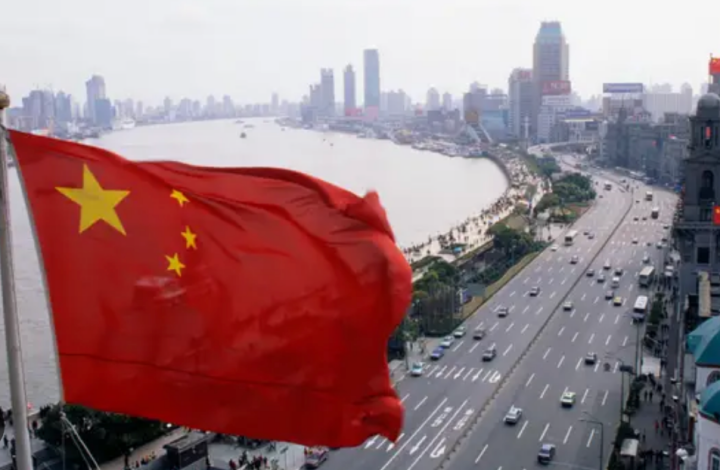
Amid China’s economy struggles to recover and unemployment remains high, the country’s indebted population is growing at a rapid rate, Voice Of America reported.
VOA quoting a report from the Financial Times said that defaults by Chinese borrowers have surged to a record high since the pandemic, with authorities blacklisting 8.54 million people from economic activities ranging from using toll roads to purchasing airline tickets and using payment applications.
According to the report, the number is up from 5.7 million defaulters in early 2020 and amounts to about 1% of working-age Chinese adults.
After online payment platforms like Alipay and WeChat replaced cash as the most used payment method in China, many stores refused cash payments, and some defaulters said it had become difficult for them to even buy food.
Those blacklisted by authorities for debt have difficulty obtaining other loans and, in some cases, are even banned from working as civil servants.
A Changsha businessman, Zhang Congzhi started borrowing money two or three years ago when online loans were easy to get. Now, the he has no money to repay those loans.
“I’m in debt for more than 100,000 yuan [approximately $13,700],” Zhang told VOA Mandarin. “Nobody can help me. The only solution I can think of is to delay repayment.”
Zhang is one of the millions of Chinese people who are in debt from loans they took out to get by during the economic disruption caused by the COVID pandemic and China’s strict lockdowns.
VOA reported quoting a banker, Lu Xiaojuan that China’s general public does not borrow money directly from the banks because they do not have collateral like a house or car.
The general public does not borrow money directly from banks because they do not have collateral like a house or car, said Lu Xiaojuan, a banker in Jinan, Shandong province, in a phone interview with VOA Mandarin.
“It’s the rich people who come to borrow money. Ordinary people don’t dare to come borrow money for fear of not being able to pay it back,” she said.
But Lu said it’s easy for them to get credit cards as long as they have an ID and do not have a bad credit record.
The Bank of China reported on September 1 that overdue unpaid credit in the first half of 2023 totaled RMB 89.646 billion yuan (approximately $12.3 billion), an increase of 3.54% compared to last year, VOA reported.
Li Zhaobo, an honorary research fellow at the Asia-Pacific Institute of Business at the Chinese University of Hong Kong, believes another reason for high debt is that many mainland Chinese people, whose consumption has grown faster than their salaries, do not understand the risks and costs of borrowing.
“While Hong Kong people know that they can choose low-interest loans, mainlanders are not familiar with the idea,” he told VOA Mandarin by phone interview. “So once they have cash flow difficulties, they can’t pay off their debts with interest.”
A Beijing-based economist, who asked not to be named because he has been warned by authorities not to talk to media, told VOA Mandarin in a phone interview that the ongoing problems in China’s real estate sector have also cut off cash flows, VOA reported.
“China has relied on the real estate industry to drive its economy for the past 30 years,” he said. “Now the industry has collapsed, and even Evergrande and Country Garden [two of China’s biggest property developers] have gone bankrupt and had their licenses suspended. With the property cash flow cut off, many people’s wealth has shrunk,” said the economist, “and they can’t afford their high mortgage payments.”
He added that private enterprises in China used to be able to borrow from each other, so they didn’t have to rely on banks alone, but that too has dried up, VOA reported.
“Things were OK in the past, but the three years of the COVID pandemic and the U.S.-China trade war have led to a significant reduction in businesses,” he said. “Many enterprises are cut off from cash flows, leading to a rising debt crisis.”
(This news report is published from a syndicated feed. Except for the headline, the content has not been written or edited by OpIndia staff)
According to Delhi Police investigators, the four men and a woman behind the security breach in Parliament on 13th December, first connected with each other via a Facebook group for a long time. The Facebook group, named after Freedom fighter Bhagat Singh, was where the accused communicated with one another.
According to a police officer, so far, they have identified over 40 people from that Facebook group, who were allegedly in regular touch with the accused.
Manoranjan D, one of the accused, reportedly even conducted a reconnaissance of the Lok Sabha premises during the Budget session.
The police sources revealed that the five individuals, who stayed in Gurugram before the attack arrived in Delhi three days ago from their different places. The accused are identified as 26-year-old Sagar Sharma, 34-year-old Manoranjan D, 25-year-old Amol Shinde and 42-year-old Neelam Singh. While a fifth accused, 44-year-old Vishal Sharma, also known as Vicky, was later apprehended from his Gurgaon home, another accused named Lalit Jha remains at large.
Authorities stated that Lalit Jha had brought Manoranjan D, Sagar Sharma, Neelam Singh, and Amol Shinde to the house of his friend Vicky in Gurgaon. They arrived in two groups in the capital over the last few days, per police sources. Lalit Jha took to Instagram to livestream the entire incident.
The perpetrators reportedly began preparing for the security breach in January, and even investigated the premises while on a visit to the Parliament complex during the Monsoon Session. An official said, “Three people, including Manoranjan and Shinde, had visited Parliament as a part of the recce for this protest. They were aware of the height of the visitors’ gallery from the parliamentarians’ seats and knew that they could jump below without hurting themselves.”
The name of the legislator who had signed their passes earlier was not yet known, even though they were signed in by Pratap Simha, the Bharatiya Janata Party MP from Mysuru on 13th December. Police mentioned that Manoranjan D’s family knew the MP. Amol Shinde reportedly confirmed that he was in the city on 10th August, the penultimate day of the Monsoon session by sharing a picture of himself on Kartavya Path on social media.
Following the surveillance, they began formulating their strategy after realising they could get past the three security checks that any visitor to Parliament is required to go through.
Sources said, “A few days ago, Manoranjan coordinated with the personal staff of Member of Parliament Pratap Simha, who is his local MP, and sought a visitor’s pass for December 14. The official staff called him on Tuesday, asking him to pick up his pass which was made for December 13 instead. This morning, the accused left Vicky’s house in a radio taxi and reached Parliament.”
Lalit Jha, Neelam Singh and Amol Shinde remained outside Parliament, while Manoranjan D and Sagar Sharma entered the premises. The suspects were brought to the Parliament Street police station and interrogated by Delhi Police and intelligence agency personnel. They added that before filing a formal complaint against them, legal counsel was consulted.
Sagar Sharma is from Lucknow, Manoranjan D is from Mysuru, Neelam Singh is from Jind, and Amol Shinde is from Latur. They arrived in Delhi three days ago via various trains from their homes. The officer said, “They met at a place near Connaught Place, from where they went to Gurugram and stayed with one Vicky Sharma there.”
Vicky Sharma resided with his wife and their 15-year-old daughter, according to a second Delhi Police official who added that the the daughter informed the police that Sagar Sharma and Manoranjan D had previously visited them. A third police officer stated that Lalit Jha had the four culprits’ cell phones in his possession. “He had all the mobile phones with him because phones are not allowed inside Parliament; we are yet to verify why Singh and Shinde (who were outside the House) did not keep their phones with them.”
The Delhi Police has lodged a case against the accused under the Unlawful Activities (Prevention) Act (UAPA). A police team reached the house in Gurugram earlier in the day, where all four accused reportedly stayed briefly before the incident. The officials said the case has been registered under Indian Penal Code sections 120B (criminal conspiracy), 452 (trespass), 153 (wantonly giving provocation, with intent to cause riot), 186 (obstructing public servant in discharge of public functions) and 353 (assault or criminal force to deter public servant from discharge of his duty) and Unlawful Activities (Prevention) Act (UAPA) sections 16 and 18 at the Parliament Street police station.
On Wednesday (13th December), the leftist-liberal YouTube channel Satya Hindi discussed the BJP’s landslide victory in three states and the change of generation in the leadership of the BJP in the states. During this discussion, leftist journalist Anil Sinha supported the accused in the recent episode of a security breach in the parliament wherein two youths jumped into the house from the visitor’s gallery and released a yellow gas from the canisters.
Anil Sinha said, “We don’t have any IT cell to give reactions on this. Had the names of people from minority communities come up in the recent incident (of parliament security breach), they would have sat with a panel to discuss it by now. They (BJP and its supporters) would have taken a march from Vijay Chowk saying that it is an attack on constitution and democracy. But now they are sitting quietly and presenting it differently. Had Congress defeated them, why would we sit here to discuss and debate? On the Doklam issue, Vishnu Som of NDTV has reported along with satellite pictures. He showed how China has settled colonies there. He expressed doubt that China may manipulate Bhutan against us. But they are saying that Bhutan is with us only. Even the situation in Laddakh and Arunachal Pradesh is the same. There is no debate on China’s infiltration. But you see one on the parliament security breach.”
Anil Sinha said, “Parliament me toh apne hi log gaye hain (Those who intruded into the parliament are our men only.) It is just that they entered the parliament in a wrong way. That is their only mistake. But they had gone there to register the protest. They did not harm anybody. Did they? And they raised the same issues (as us). And outside the parliament, they just released the gas. But, how did they reach there in the first place? Even I have covered parliament. How did they enter there crossing layers of security? This just exposes the security system of the new parliament.”
That part can be heard after 52 minutes in the above video.
Communist Journalists:
"Parliament mei toh apne hi log gaye hain" "Kisi ko nuksaan toh pahunchaya nhi" "Protest karne gaye the na bhai" pic.twitter.com/p4cqSji6ud
By calling the parliament intruders ‘Apne Hi Log’, Anil Sinha essentially meant that they belonged to the same ideology as him. He also lauded them for raising the same issues in the parliament which he claimed he was discussing in the debates.
Security breach in parliament
On the 22nd anniversary of the 2001 Parliament terror attack, a major security breach occurred when two intruders entered the Lok Sabha chamber from the visitor gallery during Zero Hour. The Ministry of Home Affairs (MHA) ordered an inquiry into a Parliament security breach incident. Six accused have been arrested in this case so far.
On Thursday, police sources said that the main conspirator in Wednesday’s Parliament security breach is someone else, as per the initial investigation. The accused had conducted a recce outside the parliament beforehand. Police sources mentioned that all accused were associated with a social media page ‘Bhagat Singh Fan Club.’
Even as investigation is underway in the Parliament attack case, the discourse around the issue since Wednesday (13th December) has been controversial to say the least.
Joining the discourse was Boxer Vijender Singh who in a controversial post wrote that seeing the scenes in Parliament, he remembered freedom fighter Bhagat Singh.
आज संसद में जो हुआ उसको देख कर भगत सिंह की याद आ गई ??
On 13th December, two accused breached inside the Parliament and jumped into the Lok Sabha hall from the visitor’s gallery releasing a yellow smoke canister.
The accused, identified as Manoranjan and Sagar Sharma, were nabbed by the members of Parliament. Two more accused outside the Parliament released smoke canisters and chanted slogans in protest.
Vijender Singh through his post has likened the attack to freedom fighter Bhagat Singh’s attack in the British-ruled Central Assembly in Delhi in 1929.
The Hindustan Socialist Republican Association (HSRA) headed by Chandrasekhar Azad decided to rock the British Raj by hurling two bombs in the Central Assembly and throwing in pamphlets explaining their motive.
However, what Bhagat Singh and his associates did was revolutionary in that it was in protest of an external tyrannical force ruling the India that was the British Empire.
Whereas what happened on Wednesday, 13th December, was an attack on the Indian Parliament against the representatives of the people and the Indian democracy at large. The name of the freedom fighter has also been used by the accused for their criminal activity. Police sources mentioned that all accused were associated with a social media page ‘Bhagat Singh Fan Club.’
The Olympic-medallist is drawing ire all over social media platform X for drawing parallels between a revered nationalist and a set of criminals.
A netizen corrected the boxer saying, “did you write Bhagat Singh in place of Afzal Guru?” Afzal Guru was the mastermind behind the 2001 Parliament attack resulting in the death of 9 people.
Vijender Singh had joined the Congress party and contested Lok Sabha elections in 2019 from South Delhi constituency, which he lost to BJP MP’s Ramesh Bhiduri.
Vijender had also participated extensively in the farmers’ protest in 2020 and joined demonstrations at Singhu border against farm laws. He had threatened to return his Rajiv Gandhi Khel Ratna Award, the country’s highest sporting honour.
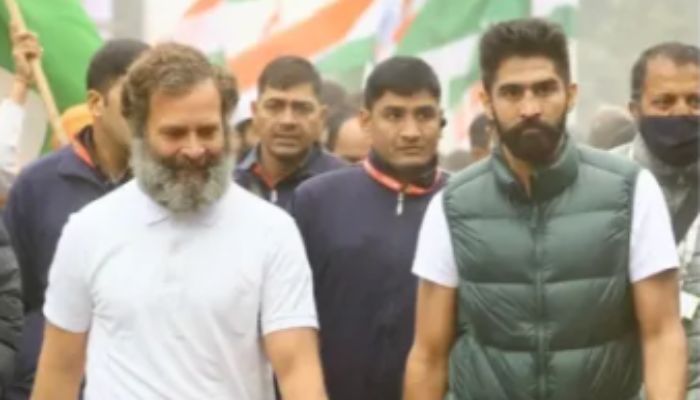
In June 2022, the boxer defended secessionist lyrics of Sidhu Moosewala’s song “SYL” which was released after the latter’s demise. In January this tear, he also joined Rahul Gandhi on his ‘Bharat Jodo’ yatra march.