Home Blog Page 29

Dead body of Muslim man buried near a Hindu crematorium in Bhavnagar; Gujarat HC orders its relocation

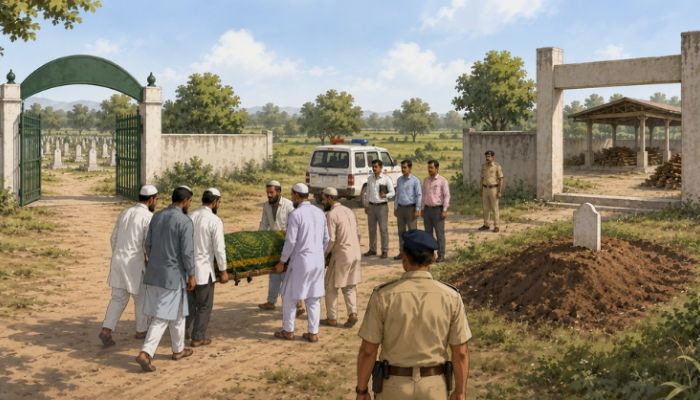
In Gujarat’s Bhavnagar district, the administration has shifted the corpse of a Muslim man buried on a disputed piece of land near a Hindu crematorium to the village’s official Muslim cemetery after the Gujarat High Court ordered its relocation. The body was exhumed and reburied on Monday, 27th July 2026, under heavy police security after the deceased’s family failed to comply with the court’s directions within the stipulated time.

The origin of the dispute

This controversy started on 11th June, when a Muslim resident of Rupavati village in Gariyadhar taluka passed away. Instead of burying the deceased in the village’s designated Muslim cemetery, family members chose to conduct the burial on a 27-guntha disputed plot located next to a Hindu cremation ground.

Despite the village having a separate Muslim cemetery with sufficient space, the burial ceremony was being held on 27 gunthas of land adjacent to the crematorium, raising objections from local Hindu villagers, alleging that an attempt was being made to disturb the peaceful atmosphere of the village by deliberately choosing such a location.

As the dispute escalated, the villagers approached the Gariyadhar Taluka Mamlatdar and requested him to move the body. Meanwhile, based on the complaint of the Sarpanch, a case was also registered at the Gariyadhar police station against Maqbool, Mubarak, Razak, Altaf, etc. under several sections of the BNS.

Panchayat issues notice, legal battle reaches High Court

Following the controversy, the Gram Panchayat issued a notice to the deceased’s family, asking them to explain why the disputed land had been used despite the availability of an official Muslim cemetery in the village.

The notice also stated that if the Muslim family failed to provide a satisfactory explanation, the body would be relocated to the designated cemetery while ensuring that all religious customs were respected.

During this period, the Muslim family approached the Deputy Collector at Palitana, requesting that the disputed land be officially recognised as a Muslim burial ground. However, the application was rejected. The family then moved the Gujarat High Court, challenging both the Panchayat’s notice and the Deputy Collector’s decision.

Muslim family claimed that the cemetery was full

The petitioners claimed before the High Court that, as per the Gaekwadi revenue records of the old Vadodara state, some part of these 27 gunthas of land was earlier marked for burial; however, that note was later removed. The petitioners also argued that the existing cemetery was full and hence they had to perform the burial on the disputed land.

Following these arguments, the High Court ordered the Revenue and Panchayat departments to conduct a site investigation. The report submitted to the High Court after the investigation stated that the official Muslim cemetery of the village is spread over an area of ​​around 700 square meters, is surrounded by a compound wall and about half of it is still vacant. 

This report proved the claim made by the Muslim petitioners wrong. It also made it clear that although there was still enough space available in the cemetery, the body was buried near the Hindu crematorium on the disputed land. Therefore, the court did not accept the arguments.

Similar incident happened in 2022

After the protest, a meeting was held between the people of both the communities in the presence of the Mamlatdar and the police, after which the body was taken out and shifted to the original cemetery. A written guarantee was also given that in future, no burial would ever be done at the place near the crematorium. However, recently, a similar incident happened again.

The court ordered the removal of the body

Finally, the Gujarat High Court dismissed the Muslim family’s petition, saying that when an official cemetery is available for the Muslim community and there is sufficient space there, no person can arbitrarily perform a burial on public or disputed land. Moreover, such an action cannot be considered legal. Referring to earlier incidents, the court said that the Muslim family had not challenged the decision to move the body and now, after four years, they cannot decide to perform the burial on the disputed land again on their own.

In the order, the court said that even if the cemetery was a little far away or the family could not reach there, the court would have considered it, but here it is clear from the administration’s report that there was no such situation, so such a burial cannot be permitted.

The Gujarat High Court on 13th July, 2026, ordered the petitioners to voluntarily move the body to the original cemetery within 10 days. The court also said that if the family does not take action within the stipulated time frame, the state government and the Panchayat system can enforce the court’s order. The court also instructed that if the body has to be removed, it should be done with full religious rituals and maintaining the dignity of the deceased. 

Administration carries out court order

As a result, on 27th July, officials, including the Gariyadhar Mamlatdar, the Taluka Development Officer (TDO), senior revenue officials and a large police contingent, reached the disputed site to execute the court’s order.

The body was exhumed from the disputed land and reburied in the village’s official Muslim cemetery after completing all religious rituals. The entire operation was videographed in accordance with the High Court’s directions.

Mamlatdar B. G. Zala said, “The entire process was carried out peacefully under tight security. The body was shifted from the disputed land and reburied in the village cemetery after following all religious rituals. Law and order was maintained throughout the operation.”

Officials added that the relocation was completed without any untoward incident and that adequate security arrangements ensured peace was maintained in the village throughout the exercise.

(This article is a translation of the original article published on OpIndia Gujarati.)
Surrendering to mob violence or sensitivity towards Gen Z demands? Decoding CJP standoff  

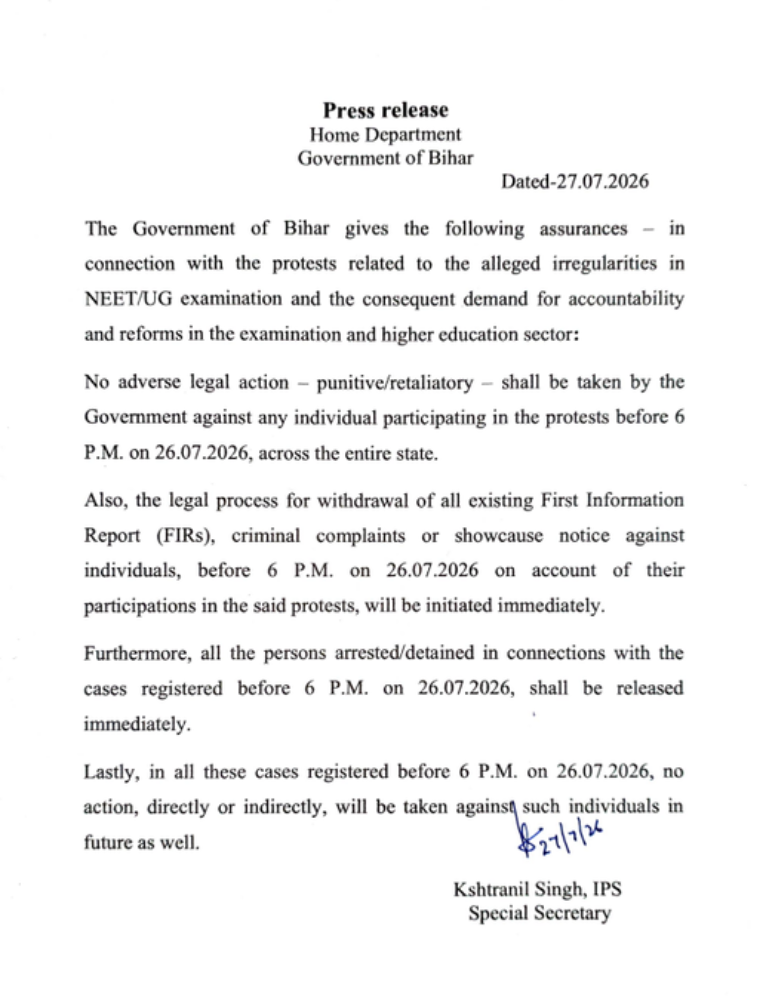
The BJP governments in Bihar and Assam issued notifications on 27th July 2026, stating that all FIRs against Cockroach Janta Party (CJP) protestors seeking the resignation of former Education Minister Dharmendra Pradhan shall be withdrawn.

BJP governments in Bihar and Assam assure withdrawal of all FIRs against CJP protestors 

The notifications stated that those detained or arrested shall be released, and no further adverse action will be taken against individuals who participated in protests before 6 pm on 26th July. 

“No adverse legal action punitive/retaliatory shall be taken by the Government against any individual participating in the protests before 6 P.M. on 26.07.2026, across the entire state. Also, the legal process for withdrawal of all existing First Information Report (FIRs), criminal complaints or showcause notice against individuals, before 6 P.M. on 26.07.2026 on account of their participations in the said protests, will be initiated immediately,” the notification issued by Bihar government’s Home Department stated. 

“Furthermore, all the persons arrested/detained in connection with the cases registered before 6 P.M. on 26.07.2026, shall be released immediately. Lastly, in all these cases registered before 6 P.M. on 26.07.2026, no action, directly or indirectly, will be taken against such individuals in future as well,” the notification signed by Special Secretary Kshatranil Singh added. 

The Bihar government said its move to withdraw FIRs against CJP protestors was in response to recent agitations demanding accountability and reforms in the examination and higher education sectors. 

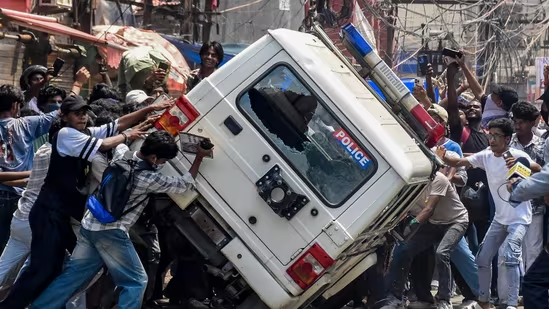
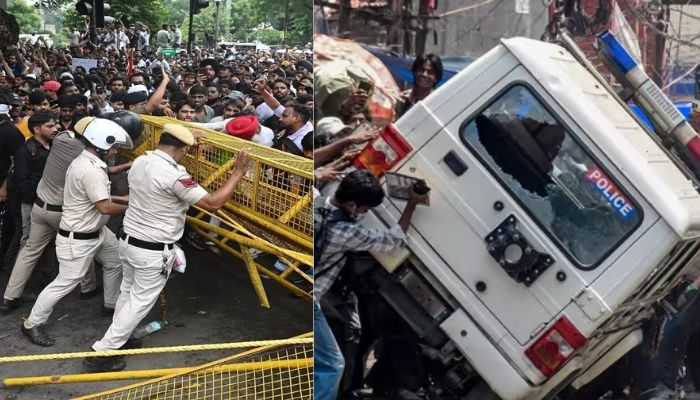
Notably, the Bihar Police had detained around 694 individuals in connection with protest-related violence, including stone pelting and arson. As per the police, 91 police personnel and 13 civilians were injured, while 15 government vehicles were damaged by CJP protestors. One of the senior police officers lost an eye in the protest violence. 

Police vehicle toppled by violent protestors in Patna during July 25 Bihar Bandh. (Image source: PTI)

The protests in Bihar were organised by the All-India Students’ Association (AISA) and Revolutionary Youth Association (RYA) in solidarity with the CJP protest in New Delhi. 

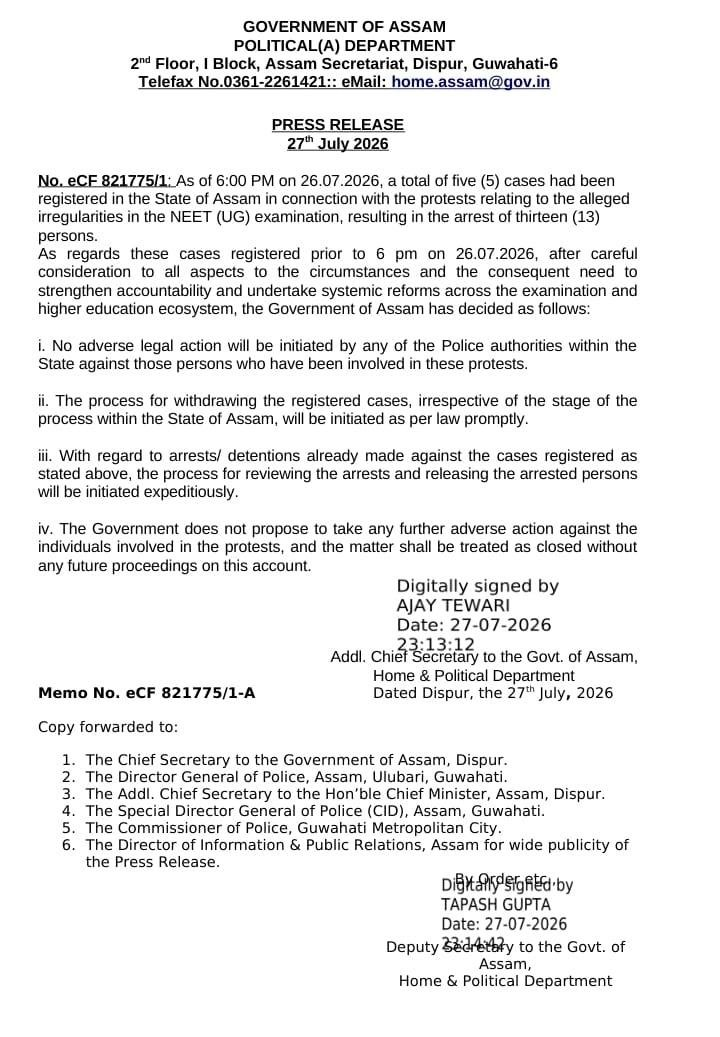
In a separate press release issued on 28th July, Assam’s Home and Political Department announced that it will withdraw all the cases and other legal proceedings against CJP protestors. The department noted that a total of five cases were registered, and 13 protestors were arrested. 

“No adverse legal action will be initiated by any of the Police authorities within the State against those persons who have been involved in these protests. The process for withdrawing the registered cases, irrespective of the stage of the process within the State of Assam, will be initiated as per law promptly,” t 
signed by the Additional Chief Secretary to the Govt. of Assam, Home and Political Department, stated. 

“With regard to arrests/ detentions already made against the cases registered as stated above, the process for reviewing the arrests and releasing the arrested persons will be initiated expeditiously. The Government does not propose to take any further adverse action against the individuals involved in the protests, and the matter shall be treated as closed without any future proceedings on this account,” the press release added.  

Meanwhile, CJP chief spokesperson Saurav Das published a video message online, sharing the Assam order and stating that government representatives met CJP leaders and shared copies of Bihar and Assam notifications guaranteeing FIR withdrawals. Das also claimed to have assurances for other BJP-ruled states, including Rajasthan and West Bengal. 

The FIR withdrawal assurances from the BJP governments are coming in accordance with the BJP-led Central government’s commitment to the CJP during negotiations for ending the 36-day Jantar Mantar agitation. 

The issuance of notifications from the Bihar and Assam governments came right after CJP national spokesperson Ashutosh Ranka claimed that the agreement on no police action was being “breached”. He demanded immediate withdrawal of FIRs against protestors, failing which, he threatened, “We will be forced to sit on protest again”. 

Government moves reflect recognition of the sensitivity of the issue, but is the Centre overcompensating for the initial indifference?  

It is an undeniable truth that the NEET UG paper leak and broader examination-integrity grievances were genuine. Numerous students and their families faced real distress when the NEET UG paper leak happened in May this year. The most tragic consequence of the lapse was the alleged suicide of over 20 students. 

OpIndia has repeatedly emphasised that the Cockroach Janta Party is not an organic or spontaneous movement but an unofficial B-Team of the Aam Aadmi Party, with CJP’s founder Abhijeet Dipke himself being a former AAP functionary. During the protests, it was seen how Samajwadi Party leaders and workers joined the agitation. We have also discussed how the CJP followed the “Laughtivism” playbook wherein non-serious methods and outlook are employed to achieve goals as serious as pushing the government into a lose-lose situation and even pulling off regime change.  

However, when the CJP picked up the NEET paper leak issue, it essentially picked up an issue strong enough to rally the support of a significant number of students across the country. While the CJP expanded its tentacles from social media to the ground, the Central government remained indifferent towards the protest, though not towards the paper leak issue itself. 

The accused persons involved in the NEET UG paper leak were arrested, fresh exams were announced and conducted without any major lapses, and results were declared within the announced timeline. However, the CJP’s protest and climate activist Sonam Wangchuk’s hunger strike overshadowed the government’s efforts. 

It is a popular opinion that if former Education Minister Dharmendra Pradhan had resigned in May itself, things would not have magnified to this extent. Dharmendra Pradhan’s resignation or not, the Central government’s deliberate refusal to even acknowledge Wangchuk’s weeks-long hunger strike and the CJP protest until 19th July backfired monumentally. Now, the government appears to be overcompensating for the initial indifference by accepting any and every demand the CJP is pushing, just to secure a permanent end to the agitation. 

There is no doubt the Modi government has recognised the scale of outrage and hurt through the Education Minister’s resignation, commitment to provide compensation, and most importantly, the anti-paper leak bill

Perhaps, a genuine sympathy for the protestors may also have driven the government. However, withdrawing FIRs against and committing no punitive action in future against violent protestors sets out a very bad precedent. 

Setting violent CJP protestors free for the sake of ending the protest: BJP governments are setting a bad precedent  

The near-blanket withdrawal of FIRs against violent CJP protestors, and written assurances, may indicate to critics and the Opposition that the Modi government is on the backfoot. However, it is worth remembering that law and order and the burden of maintaining peace also lie on the government in office.

Whether the ‘backfoot’ will really translate to emboldening anarchist elements under a government that has a stellar internal security record, or will actually be some much-needed breathing room during the Monsoon Session so more attention is focused on governance, rather than outrage and street violence, remains to be seen.

By giving written FIR rollback assurances in the face of the CJP’s ‘ultimatum’, the government, however, is inadvertently setting a precedent that sustained disruptions and street violence under the garb of fighting for a genuine issue are enough to arm-twist a government into accepting their demands while also allowing their violence and their perpetrators to roam free. 

It must not be forgotten that peaceful protest is a democratic right and an important pressure valve. However, when that very peaceful protest turns violent, it automatically enters the rioting territory.  

Today, the Central government and BJP governments in Bihar and Assam are taking back FIRs against violent protestors as a quick fix to the ‘cockroach’ menace and to restore order. However, these concessions will risk emboldening the anarchic elements, especially politically and ideologically driven entities, who remain perpetually unsatiated until the ouster of the perceived adversarial government.  

From the 2021 Farmers’ Protest to the 2026 CJP protests, the Centre has tackled many violent street protests that aim to normalise the idea that street veto can override law enforcement and prosecutorial discretion.  

It is the responsibility of the government and the police department to segregate peaceful protestors from those who indulged in violence and vandalism. The imperative to restore peace and normalcy cannot be fulfilled at the cost of sidelining due process.  

Pertinently, the Delhi Police have revealed that it verified the backgrounds of 2,873 individuals involved in the CJP’s ‘Chalo Sansad’ protests and found that all of them had criminal antecedents. Of these, 989 had previously been involved in serious criminal cases, including murder, attempted murder, robbery, rape, kidnapping, crimes against women, illegal arms offences, and narcotics-related offences.   

There is a possibility that similar findings may emerge in the case of detained protestors in Bihar, Assam, and other BJP-ruled states. However, the governments in these states chose to treat the violent protestors as part of the undifferentiated bloc of ‘student protestors’ that must receive collective amnesty, regardless of their violent and anarchic shenanigans.  

It is no exaggeration to say that regardless of the intentions, the BJP-led governments in the Centre and across various states appear to be handing a license to unruly elements to mobilise, weaponise prolonged occupation of public spaces, resort to violence and vandalism, and trivialise the authority of elected governments, police and courts, to hold the Republic hostage. 

Now, due to the government’s suicidal extension of amnesty to violent anarchists, those who assaulted police officials, damaged government vehicles and damaged public property under the garb of ‘peaceful protests’ will most likely walk free.  

Sensitivity towards Gen-Z demands is understandable; however, there is a serious need for the Central government to prevent the establishment of this problematic precedent. The Republic cannot afford to allow lawlessness to masquerade as freedom. If the rioters of the 2020 anti-Hindu Delhi Riots faced the law, the same should happen with the anarchists of CJP protests.

Ironically, the CJP wants accountability from the Central government for the NEET paper leak and broader exam irregularities and has even secured the resignation of Dharmendra Pradhan. However, the CJP does not want its ‘cockroaches’ to appear for the test of accountability for indulging in violence, vandalism and hooliganism in the name of ‘student protest’. 

BJP to launch ‘Samrasta Sankalp Abhiyan’, month-long yatra from Jalandhar to Varanasi: How Ravidassia outreach factors into UP, Punjab polls

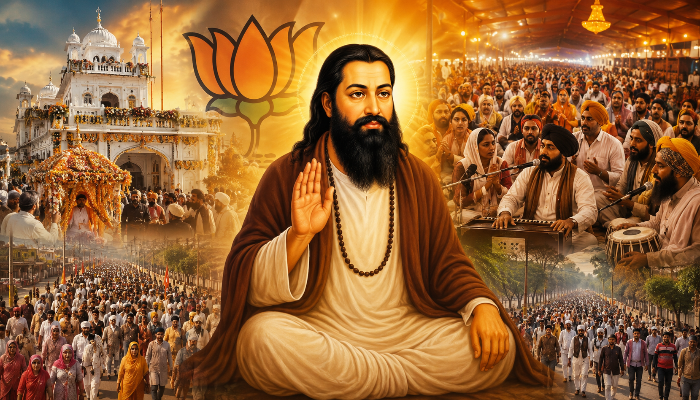
On 27th July (Monday), Bharatiya Janata Party (BJP) announced that it is going to commence a nationwide event to commemorate the 650th birth anniversary (Prakash Parv) of the 15th-16th century mystic poet-saint Guru Ravidas.”Samrasta Sankalp Abhiyan” (campaign for social harmony and resolve) will run for nearly seven months from 29th July to 20th February.

His birthplace at Seer Govardhanpur in Varanasi would host the official inauguration on Guru Purnima. Asim Arun, Uttar Pradesh’s social welfare minister, shared that it would be kicked off amid special functions on 28th and 29th July. Sacred soil would be collected and worshipped (maati pujan) at Seer Govardhanpur on 28th July.

131 kalash (urns) would be transported in a grand procession to his Janmabhoomi Temple for ceremonial worship from the memorial complex of Guru Ravidas. Teams with kalash from multiple states and districts in Uttar Pradesh would gather at Varanasi for this purpose. Every hamlet would be handed over 104 kalash loaded with this soil, and another 27 would be delivered to other states.

BJP delegates from 98 organisational district units and six regional divisions in Uttar Pradesh and 27 other states would receive the kalash and then take them to different temples and sant sammelans (congregations). Several programs would be organised on the occasions of Magh Purnima and Guru Ravidas Jayanti in different parts of India.

BJP national president Nitin Nabin, Uttar Pradesh chief minister Yogi Adityanath,h along with Dera Sachkhand Ballan chief and head of Guru Ravidas Janam Asthan temple, Sant Niranjan Das would all be present for the ceremonial launch.

From Deepotsav to month-long yatra and more: BJP plans multiple events

BJP national general secretaries Tarun Chugh and Dushyant Kumar Gautam also informed that 131 kalash would be sent around India from Varanasi. 21,000 locations would conduct social harmony initiatives, and 51,000 temples would witness the festival of lights. A “Guru Ravidas Maharaj Samrasta Deep Abhiyan” would be performed as 11,000 lamps would be lit at Ravidas Ghat and his memorial site. All BJP mandals and temples dedicated to the saint would observe the Deepotsav on 29th July.

The party officials highlighted that the Modi government has developed his place of origin, pilgrimage routes, airports, special trains and restored a number of sites associated with Guru Ravidas in order to preserve his legacy. According to Chugh, the goal of the recent effort is to spread his teachings on equality, social peace and public enlightenment.

They pointed out that Sikandar Khan Lodi, the Tughlaqs and Timur or Tamerlane were “engaged in carrying out religious conversions and demolishing temples across the country” in that age. Gautam stated, “At that time, their only slogan was ‘the sword or the Quran.’ During that mediaeval period, people had no means of expressing their views, and there was an atmosphere of widespread distress everywhere.”

He added that “many great saints of the Bhakti movement, including Goswami Tulsidas, Kabir Das, Sant Tukaram, Guru Nanak and Chaitanya Mahaprabhu,” emerged who “carried the knowledge and values preserved in Sanskrit to the masses through their respective regional languages, thereby creating public awareness and providing new direction to society throughout the country.”

The BJP spokesperson conveyed that Guru Ravidas made a very important contribution at that time and hence was awarded the title of “Sant Shiromani Guru Ravidas Ji” by Kabir. According to Gautam, his 650-year-old concept of an egalitarian society was well ahead of its time. In 1837, Abraham Lincoln started a campaign against slavery, and Dr BR Ambedkar enshrined the values of equality, liberty and fraternity while crafting the Constitution.

“However, long before them, Guru Ravidas had already conveyed the message of ‘chhote-bade sab base’ (small and big live together). He envisioned a casteless society and ‘Beghampura ‘, a place where there is neither sorrow nor suffering,” he expressed.

Lal Singh Arya, national president of the BJP Scheduled Caste Morcha, emphasised that the objectives are to foster social harmony between all groups and guarantee that every community is involved in building a developed India. He stated that the saint’s way serves as the cornerstone of “Sabka Saath, Sabka Vikas, Sabka Vishwas, Sabka Prayas,” and this mission would evolve into a widespread movement for social harmony and national unity.

“Guru Ravidas worked for human welfare, equality, and social harmony. He was against religious conversion. His message and ideas will be taken to people through 650 jayanti programmes,” Arya stressed. He revealed that state-level workshops were scheduled from 20th to 23rd July, district-level workshops from 25th to 27th July and a national workshop was arranged in Delhi on 19th July for this aim. These preparations transpired in 18 states.

There are scheduled to be five primary phases to the campaign. The national, state, district, and mandal levels would take out the “Shri Guru Ravidas Maharaj Kalash Vandan Abhiyan” from 29th July to 10th September.

BJP delegates from 98 organisational district units and six regional divisions in Uttar Pradesh and 27 other states would receive these kalash and then take them to different temples and sant sammelans (congregations). A Sant Sampark Abhiyan would also unfold from 29th July to 31st August as saints, mahatmas, gurus and mahants would be requested to bestow their blessings.

From 5th October to 5th November, the “Shri Guru Ravidas Maharaj Samrasta Yatra” would depart from Jalandhar to Varanasi, traversing Jammu and Kashmir, Himachal Pradesh, Uttarakhand, Chandigarh, Haryana, Delhi and Madhya Pradesh. The “Shri Guru Ravidas Maharaj Chhatravas Sampark Abhiyan” is slated from 26th November to 15th January.

Furthermore, students, hostels and religious outfits would participate in the outreach drive and processions. BJP is also set to arrange gurbani recitation and bhajan sandhya. Its top leaders would address a Samrasta Sankalp Sabha, and the party has been instructed to ensure an audience of at least 25,000 people.

A critical decision at a pivotal moment

Assembly elections are scheduled to take place in five states, including Uttar Pradesh and Punjab, in early 2027. However, BJP leaders have strongly refuted any association of the yatra with these polls. The party has celebrated Guru Ravidas Jayanti on a large-scale in the past as well.

However, this is the first time such a long drive has been designed to connect with the Dalit population, who follow him and are known as Ravidassias, and are heavily concentrated in Punjab and Uttar Pradesh, The Indian Express reported while quoting insiders.

Dalits make up 21% of the population in Uttar Pradesh, and 84 of the state’s 403 assembly seats are reserved for them. Together, the BJP and its allies Apna Dal (Soneylal) won 63 Scheduled Caste (SC) seats in the 2022 assembly elections while the then Samajwadi Party-led opposition alliance gained 20.

The 117-member assembly in Punjab, where Dalits make up 32% of the population, has 34 seats set aside for the community. None of these seats was secured by the saffron party in the assembly elections of 2022. Over 12 lakh Ravidassias reside in the Doaba region of Punjab, which includes the districts of Kapurthala, Hoshiarpur, Nawanshar and Jalandhar. The Dalits constitute approximately 45% of this area, which is far higher than the state average.

Interestingly, the 2022 assembly elections were rescheduled from 14th February to 20th February after parties objected that the dates would conflict with Guru Ravidas Jayanti, which brings a lot of Ravidassias to Varanasi. The prominence of Dalits in Uttar Pradesh and Punjab politics has attracted the BJP’s special attention on the community ahead of the upcoming contests.

Notably, the yatra between Jalandhar and Varanasi would stop in cities and villages, especially those with a large Dalit population between Punjab and Uttar Pradesh.

How the Modi government historically honoured Guru Ravidas

On 1st February, Prime Minister Narendra Modi landed in Punjab to commemorate the 649th birthday of Guru Ravidas. He went to the highly influential Dera Sachkhand Ballan, a major spiritual centre of the global Ravidassia community in Jalandhar, to pay respects and engage in the public festivities.

Founded in the early 20th century, it progressively became a focal point for Dalit assertion, specifically among Chamars, who have historically been subjugated to untouchability and usually have a link with the leather industry. Its supremo, Sant Niranjan Dass, has been conferred the Padma Shri this year.

Likewise, the Sant Ravidas Express, the first direct AC train between Amritsar and Varanasi, has been introduced by the government this month, satisfying a long-standing wish of the Ravidassia community a few months after PM Modi met Sant Niranjan Das. Countless devotees travel to Seer Govardhanpur each year, mainly from the Doab region,n to mark the birth anniversary of Guru Ravidas.

For years, the devotees had been waiting for a direct train on this route, specifically with air conditioning in the carriages. The Sant Ravidas Express would improve travel comfort and lessen the heavy traffic during the yearly festivities. A special tent city is also being planned for his 650th birthday, which is projected to be an even larger assembly.

PM Modi joined the celebration of the 647th birthday of the revered saint and spoke at the occasion in Varanasi on 23rd February 2024. He also laid the foundation stone for the Sant Ravidas Museum and unveiled the latter’s statue in a park next to his temple at Seer Govardhanpur.

On Ravidas Jayanti in 2022, PM Modi similarly visited the Shri Guru Ravidas Vishram Dham Mandir in Delhi’s Karol Bagh. He indulged in the “Shabad Kirtan” and enthusiastically played “Jhika” in tune with the songs dedicated to the saint.

Odisha govt to name medical college after Swami Lakshmanananda Saraswati: Read how the Hindu leader working against Christian conversions in tribal areas was murdered by Naxals

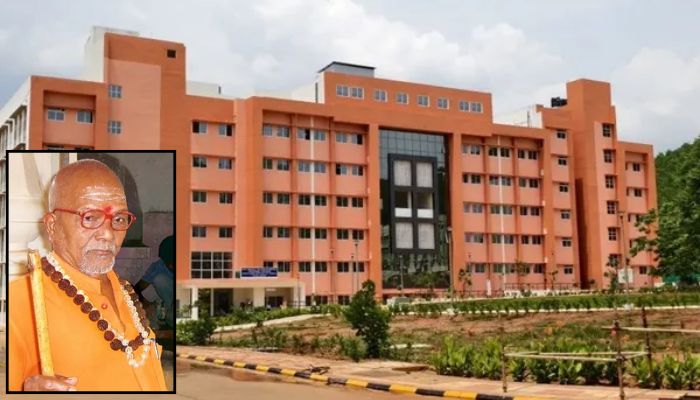
The Odisha government has decided to rename the Government Medical College and Hospital in Phulbani, located in the Kandhamal district, after the revered Hindu leader and spiritual figure, Swami Lakshmanananda Saraswati. Announcing the move on Monday, 27th July, Chief Minister Mohan Charan Majhi stated that the decision aims to honour Swamiji’s lifelong dedication, service, and sacrifice for the tribal communities of the region, ensuring his memory remains preserved for future generations.

Along with the renaming of the medical institution, the Chief Minister has approved a ₹13 crore grant from the Chief Minister’s Special Assistance (CMSA) fund. This financial allocation is directed toward the comprehensive development and preservation of Swamiji’s ashram, the ashram school, and the Kanyashram at Jalespata.

According to an official note from the Chief Minister’s Office, “The funds have been allocated to preserve the heritage of Swamiji’s ashram and to keep his legacy alive.” The financial package aims to strengthen both the educational and residential infrastructure on the campus to better serve local students.

Details of the ₹13 crore development package outline several key infrastructure projects aimed at improving living and learning conditions at the Jalespata campus. Out of the sanctioned amount, ₹5 crore is designated specifically for constructing a new 300-seat girls’ hostel, while ₹3 crore has been earmarked for the conservation and historical preservation of Swamiji’s heritage site. 

To address long-standing basic needs, ₹60 lakh has been allocated to a mega river lift project designed to secure a reliable water supply for the Jalespata Ashram, its school, and the residential facilities. The remaining funds will cover essential works including classroom construction, building boundary walls, expanding toilet facilities, and renovating existing hostel buildings.

The life and mission of Swami Lakshmanananda Saraswati

Swami Lakshmanananda Saraswati was a prominent social reformer who devoted over four decades of his life to the welfare, education, and spiritual preservation of the tribal population in Odisha. Believing strongly in empowering forest dwellers, he established an ashram in Chakapad in 1966, shortly after returning from years of penance in the Himalayas. 

Recognising that education was crucial for social upliftment, he founded the Gurukul Sanskriti Vidyalaya to provide structured education up to the graduation level for local youth. Beyond education, Swamiji was deeply committed to cultural preservation, actively running campaigns against cow slaughter and leading movements to reconnect indigenous communities with their heritage through initiatives like traditional Jagannath yatras.

Swamiji was targeted by Christian missionaries 

Swami Laxmanananda Saraswati had close ties with the RSS and was associated with the Vishva Hindu Parishad (VHP). He had been spreading awareness about Hinduism among the tribal society for 35 years by setting up an ashram in Chakapad. He was vocal aginst Christian conversions of tribals and actively worked against conversion attempts in remote areas, creating awareness and leading efforts to connect with the tribal communities.

His active opposition to aggressive religious conversions in the tribal belts of Kandhamal made him a target of local criminal elements. As he worked to establish schools, Kanya Ashrams, and community programs, his growing influence among the tribal populations was seen as a major barrier by Christian conversion networks operating in the region and Naxals, who were always opposed to tribals becoming a part of mainstream society. 

How the Hindu leader and social activist was brutally murdered in his own Ashram, on Janmashtami

2008 was the year when Maoist violence was at its peak in Odisha. The tensions surrounding Swamiji’s work culminated in tragedy on 23rd August, 2008, the night of Janmashtami. While Swamiji was at the Kanya Ashram in Tumudibandh, surrounded by young students and devotees, an armed group of Naxals carrying AK-47s, indigenous firearms, and sharp weapons stormed the premises. 

The 80-year-old saint, along with four of his disciples, including a young boy, was brutally murdered. The gruesome attack, where Swamiji’s body was hacked with axes, sent shockwaves across the region and occurred in full view of around 130 young schoolgirls staying at the residential facility.

While Maoists later claimed responsibility for the attack, the incident highlighted deep concerns regarding the convergence of Naxalite groups and missionary activities in rural Odisha. Critics and local community leaders pointed out that a significant portion of the local Maoist committee members involved in the region were converts, raising questions about whether the Maoist banner was used to provide cover for those targeting Hindu leaders. 

In 2007, Kandhamal saw communal riots between Hindu tribals and converted Christians who were demanding ST status. On 24 December, the Christians had attacked and vandalised a Durga Puja venue and had attacked Swami Lakshmanananda Saraswati too when he had tried to intervene. This had led to violent clashes where several houses were torched.

In 2015, the Justice Basudev Panigrahi Commission, which was probing the 2007 riots, had submitted its report. The report had cited ‘rampant Christian conversions’ as the reason behind the violence in the area. The former judge had told that despite strong anti-conversion laws in Odisha, rampant missionary activities are underway. Kandhamal, a small district with dense forests, has over 1200 churches and over 300 Christian organisations.

In October 2013, a total of eight people, 7 converted Christians and a Maoist leader named Pulari Rama Rao, were sentenced to life imprisonment for the murder of Swami Laxmanananda Saraswati. Two more Maoist leaders, Dunna Keshav Rao and Sabyasachi Panda, were also accused in the case. Both are lodged in jail and currently under trial in several other cases, including the murder in Kandhamal.

Media ignored the murder of an old Hindu leader and his 4 disciples

The fallout from the 2008 massacre ignited widespread grief and anger across Kandhamal, leading to severe communal violence and civil unrest. So, the initial massacre of Swami Lakshmanananda Saraswati and his 4 followers was not given priority in the news, but when Hindus protested, the nature of the protests became an issue. The massacre itself was forgotten by describing the Hindu protests as violent. ‘Journalists’ compared the protests to the riots in Gujarat after the Godhra massacre.

The recent state initiatives, including the renaming of the Phulbani Medical College and Hospital and the dedicated funds for the Jalespata facilities, represent an official effort to recognise Swamiji’s legacy. By linking major healthcare and educational development to his name, the state administration seeks to formally honour his contributions to tribal education, welfare, and social service in Kandhamal.

The selective feminism exposed: What a woman’s sexual assault at CJP’s Jantar Mantar protest reveals about the Left’s moral contradictions

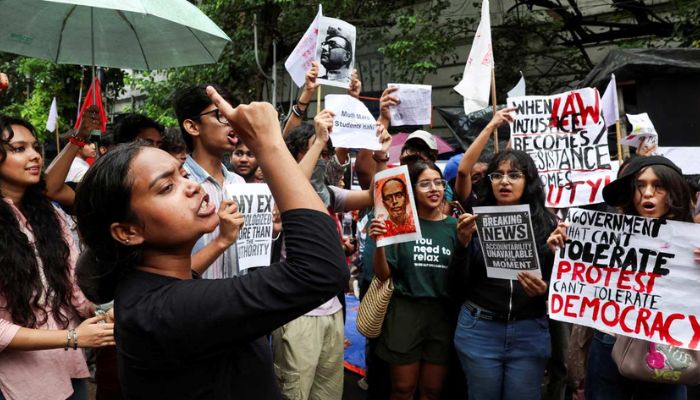
Amid the Cockroach Janta Party’s celebration videos circulating on social media, an X user, Yashaswinee Raje Singh, with X handle @ywineethpooh, on Sunday, 26th July, shared a post detailing the harassment and misogyny she faced while attending the claimed student protests. The protests were organised by another leftist group, the CJP, at Jantar Mantar.

Curiously, Singh posted her ordeal a day after CJP claimed victory as the Centre agreed to its demands. But even then, Singh appeared to shield the CJP from accountability, saying her intention was not to tear down the movement but to expose what she described as the glaring hypocrisy of those leading it. Singh, a daughter of a former BJP MLA from Uttar Pradesh and who recently dominated trends on social media platforms for her ‘friendship’ with a Pakistani, highlighted how, beneath the tall claims of fighting for justice, hope, and solidarity, these spaces are frequently infected by brazen misogyny, sexual assault, and a rampant rape culture.

In her post, Yashaswinee recounted the horrifying sequence of events from around 12:15 am on 24th July. As she and her sister tried to make their way toward the main stage, hundreds of protestors were packed tightly in front of metal detectors in complete chaos. Suddenly, a barricade collapsed just three feet away from them, triggering a dangerous surge that felt like the start of a stampede. Deciding it was unsafe to continue, they turned around to leave. It was at this moment that a man behind her attempted to grope her and force his hand between her legs. Reacting instinctively to the assault, she turned around and slapped the perpetrator thrice.

What happened immediately afterwards was even more infuriating. A young male volunteer who witnessed the incident rushed over, saw her visibly shaken, and instead of offering help or asking what happened, began aggressively shouting at her, “Aap yahaan kyun aa rahe ho?” When she countered, “Women are being sexually assaulted at the protest, and your response is to yell at them?!”, the volunteer continued yelling, “Main kya karun? Aap sun hi rahe ho!” As a crowd gathered, another young male volunteer casually dismissed the sexual assault, sighing, “Ab yeh sab galti toh hoti rehti hai. Aap udhar chale jao.”

Yashaswinee highlighted how the political humour and slogans at the protest leaned heavily on disgusting misogyny, ranging from boys holding sanitary pads reading “Modi, wear this” to posters depicting male politicians in bikinis, bras, or schoolgirl skirts with vulgar phrases.

A persistent pattern across left-led movements 

Yashaswinee’s experience is not an isolated incident, nor is it the first time women have faced systemic harassment, intimidation, and assault in protests organised or backed by the Left ecosystem. Time and again, under the guise of revolution and civil rights movements, female attendees, journalists, and activists have found themselves exposed to predators who operate with near-total impunity while the organisers turn a blind eye.

A glaring example of this unfolded during the farmer protests at the Delhi borders. Allegations of sexual assault against prominent activists associated with the movement opened a Pandora’s Box. Social media documenter Mohammad Zuber, associated with the Kisan Ekta Morcha and Trolley Times, was accused of raping a woman, after which he deactivated his Instagram account. When the survivor spoke out, Varun Chouhan, a key figure in Trolley Times, mocked her publicly. 

Later, multiple women came forward through “The Kaur Movement” detailing how Varun Chouhan had manipulated, groomed, and sexually assaulted them. One victim shared how he forced himself upon her during an election campaign meeting, leaving her with physical injuries and deep emotional trauma, while another recounted how he groped her in his room and dismissed her tears by saying, “I know you want it.”

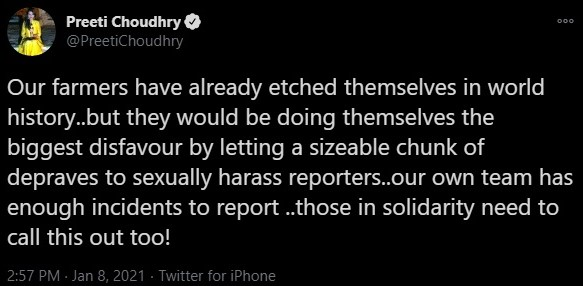
It was not just female activists who were targeted; journalists attempting to cover the demonstrations faced constant abuse. Preeti Choudhry, Editor at India Today, publicly called out the “sizeable chunk of depraves” among the protesting groups who were sexually harassing female reporters on the ground. When she spoke out against the pervasive groping and misconduct, figures linked to the movement tried to justify the behaviour, claiming news-hungry reporters were asking for it. Choudhry had to publicly remind them that if someone did not want to give an interview, they could simply decline rather than pinch a reporter’s buttocks.

Similarly, during the anti-CAA protests, women faced political violence and harassment from leaders associated with the movement. In one high-profile incident in Northeast Delhi, Aam Aadmi Party MLA Abdul Rehman, who had earlier been booked by the Delhi Police for inciting mobs during the anti-CAA demonstrations in Seelampur, was booked under an FIR at the Jaffrabad police station after a woman accused him and his associates of eve-teasing, physical assault, and thrashing her when she dared to object to their harassment during municipal bypolls.

Yogendra Yadav dismissed concerns raised by women during Farmers protests

When allegations of sexual abuse emerge within these movements, the leadership’s primary instinct is rarely to seek justice for the victim; instead, it is to protect the image of the protest. A tragic testimony to this culture of complicity was the case of a 25-year-old female activist from West Bengal who travelled to the Tikri border to join the farmer protests. She was sexually harassed on the train journey to Delhi and subsequently gang-raped at the protest site by two men affiliated with the Aam Aadmi Party, Anil and Anup Singh, before contracting COVID-19 and tragically passing away in a hospital.

Professional protester Yogendra Yadav later admitted in a press conference that he was aware of the woman’s predicament well before her death. Yadav revealed he had been in contact with her and her father since 24th April, 2021, speaking to her when she was being taken away by the accused, who lied about their location. 

Yet, despite knowing about the harassment and suspecting foul play, Yadav and the protest committee did not inform the police. Even after the victim’s father explicitly detailed the horrific rape to Yadav on 1st May, 202,1 after her funeral, the leadership restricted its response to internal measures like “social boycotts” and removing tents, waiting for days while the accused publicly claimed it was a political conspiracy to defame the movement. 

The victim’s father later noted that Yadav turned a blind eye to the brutalities and failed to alert law enforcement, prioritising the protection of the protest over the life and dignity of a young woman.

The expectation of the left ecosystem 

This recurring apathy points to a broader, toxic ethos within the Left ecosystem: the expectation that women must keep quiet about their personal trauma for the “greater good” of the political cause. 

Victims are made to feel that speaking out against abusers within their ranks will weaponise the narrative for their political opponents, damage the movement, or dilute the fight against fascism. In this twisted hierarchy of priorities, political optics are treated as far more sacred than human rights, and women are coerced into enduring abuse so that the movement’s facade remains untarnished.

Over time, this ideological conditioning becomes so deeply internalised that many women affiliated with the Left end up rationalising their own silence. Instead of demanding immediate accountability, they convince themselves that reporting a predator who belongs to a protected identity group or a shared political ideology will fan hatred or empower their political adversaries.

Brainwashed into overlooking abuse

This troubling mindset is clearly illustrated by public figures within the liberal-left space who have openly admitted to concealing sexual misconduct to protect their political narratives.

A recent case involved The Wire journalist Omar Rashid, who was accused by a Hindu woman of sexual coercion, physical abuse, and psychological manipulation, where he reminded her of her identity in a “Hindu Rashtra” to enforce her silence for the “greater good.”

Commenting on the incident, YouTuber who likes to refer to herself as a historian, Ruchika Sharma, publicly revealed that she too had chosen not to name or report her own sexual abuser in the past. She also claimed that they chose silence over justice, not out of fear of their abusers, but out of fear of “fanning Islamophobia.” She argued that if she spoke out, “dingbat Sanghis will just use it to further their own horrible communal agenda.” In Sharma’s worldview, the fear that right-wing opponents might gain political mileage from her story outweighed the necessity of holding a sexual predator accountable. 

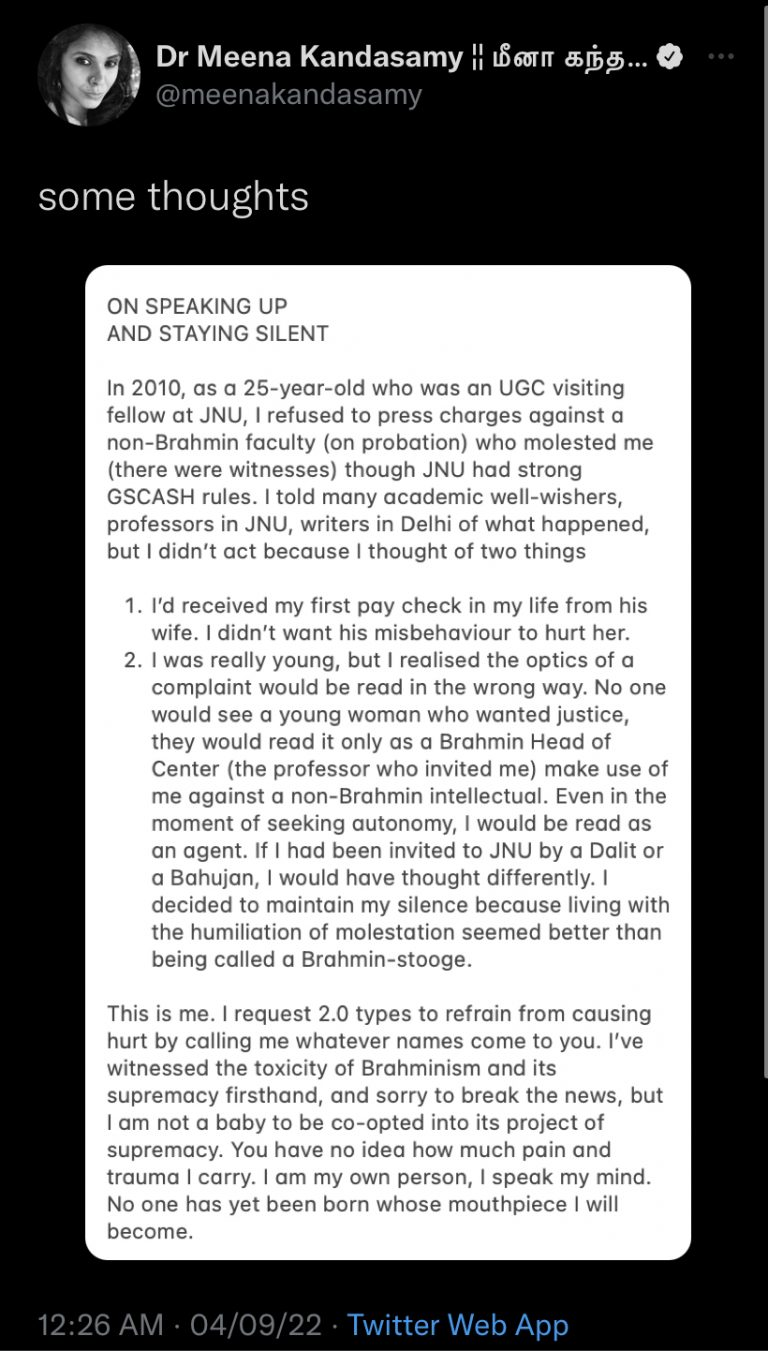
An even more explicit admission came from anti-Brahmin activist and writer Dr Meena Kandasamy. Reflecting on an incident from 2010 when she was a 25-year-old visiting fellow at JNU, Kandasamy admitted that she actively refused to press charges against a non-Brahmin faculty member who had molested her, despite having eyewitnesses and strict institutional rules like GSCASH available to her.

She explained her refusal to seek justice by admitting that her primary fear was being labelled a “Brahmin-stooge” by her peers. She wrote that “living with the humiliation of molestation seemed better than being called a Brahmin-stooge,” showing how ideological hatred completely subverted her self-respect and pursuit of justice.

When women are groomed to believe that exposing a rapist or a molester is an act of political treason, predators are given the ultimate haven. True gender justice cannot exist in spaces where progressive ideals are used as a cover to justify silence, cover up abuse, and protect perpetrators.

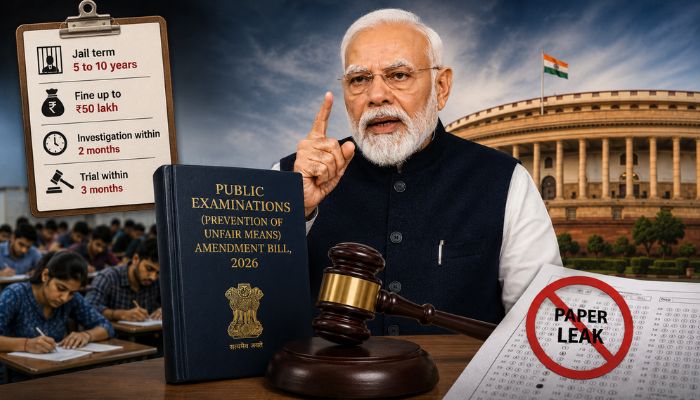
Anti-paper leak law: Here’s what the Public Examinations (Prevention of Unfair Means) Amendment Bill 2026 says 

The Centre has proposed sweeping changes to the country’s anti-cheating law, aiming to make investigations faster, ensure time-bound trials and impose much tougher punishment on those involved in paper leaks and examination malpractice. The Union Cabinet has approved the Public Examinations (Prevention of Unfair Means) Amendment Bill, 2026, and Prime Minister Narendra Modi has directed that it be treated as a priority. The Bill is expected to be introduced in the Lok Sabha on Monday, 27th July, after copies of the proposed legislation were circulated among Members of Parliament on Saturday, 25th July.

The proposed legislation seeks to strengthen the provisions of the existing Public Examinations (Prevention of Unfair Means) Act, 2024, which was enacted to curb unfair means in public examinations and protect the integrity of recruitment and entrance tests. 

The amendment increases punishments for examination-related offences, introduces strict timelines for investigations and trials, creates a framework for Special Fast Track Courts and Special Task Forces, and strengthens accountability for organisations and individuals involved in organised examination fraud.

Centre moves to tighten anti-cheating law

The proposed amendments come at a time when several public examinations in recent years have been hit by allegations of question paper leaks, organised cheating rackets and other malpractices. According to the Statement of Objects and Reasons accompanying the Bill, the government believes that stronger legal provisions are necessary to restore confidence in the examination system.

The government has said that while the 2024 Act created a legal framework to deal with organised examination fraud, recent incidents have shown the need for faster investigations, quicker trials and stricter punishment to deter offenders. The proposed law is intended to strengthen the integrity, transparency and credibility of public examinations while ensuring that cases are resolved within fixed timelines.

Jail terms and fines proposed to increase sharply

One of the biggest changes proposed in the Bill is a substantial increase in punishment for offences related to examination fraud.

Under the existing law, those convicted face imprisonment ranging from three to five years, along with a fine of up to ₹10 lakh. The amendment proposes raising the minimum imprisonment to five years, while the maximum jail term will increase to ten years. The maximum fine will also rise fivefold, from ₹10 lakh to ₹50 lakh.

The government believes that increasing the punishment will act as a stronger deterrent against organised paper leak syndicates and others attempting to manipulate public examinations.

Tougher action against service providers involved in malpractice

The proposed law also targets service providers entrusted with conducting examinations.

If a service provider is found involved in examination-related offences, it may now face a penalty of up to ₹5 crore, replacing the existing maximum fine of ₹1 crore.

The Bill also proposes extending the period during which such organisations can be barred from conducting public examinations. Instead of the current four-year ban, offending service providers may now be prohibited from conducting examinations for eight years.

The amendments further make directors, senior management officials and other responsible persons personally accountable. They will face a minimum imprisonment of five years, along with fines of up to ₹5 crore, if found guilty of examination fraud.

Organised examination fraud to invite even harsher punishment

The government has proposed even stricter penalties for organised examination fraud involving criminal networks or large-scale conspiracies.

Under the amended law, such offences will carry a minimum prison sentence of seven years, compared to the existing minimum of five years. The minimum fine for organised examination fraud has also been increased substantially, from ₹1 crore to ₹10 crore.

The proposal reflects the government’s view that organised paper leak rackets require stronger legal consequences than individual acts of malpractice.

Special Task Force to speed up investigations

To ensure quicker investigation of examination-related offences, the Bill empowers the Central Government to constitute a Special Task Force (STF) whenever required.

At present, cases can be referred to a central investigating agency. Under the amendment, the Centre will also have the power to notify a Special Task Force specifically for investigating offences under the Act.

The Bill further provides that once an STF is constituted for a particular case, the investigation will be carried out only by that Special Task Force.

Perhaps the most significant procedural reform is the introduction of strict timelines. Every investigation under the Act must now be completed within two months. This deadline will apply whether the investigation is conducted by a police officer, a Central Investigating Agency or a Special Task Force.

Special Fast Track Courts for speedy trials

The proposed legislation also seeks to prevent examination fraud cases from remaining pending for years.

Every State Government and Union Territory Administration will be required, in consultation with the concerned High Court, to designate a Court of Session as a Special Fast Track Court exclusively for cases under the Act.

These courts will hear proceedings on a day-to-day basis, with adjournments permitted only in exceptional circumstances that must be recorded in writing.

The Bill mandates that every trial should be completed within three months from the date the chargesheet is filed.

The Special Fast Track Courts will also be empowered to try other offences connected with examination fraud, including offences under the Bharatiya Nyaya Sanhita, 2023, during the same trial.

The legislation further provides that all pending cases under the Act will automatically stand transferred to these designated courts, and the proceedings will continue from the stage at which they were transferred. Such transferred cases must also be completed within three months.

Special prosecutors and new appeal mechanism

To strengthen prosecution, every State and Union Territory will appoint one or more Special Public Prosecutors for each Special Fast Track Court. These prosecutors will exclusively handle cases under the Act and will function as Public Prosecutors under the provisions of the Bharatiya Nagarik Suraksha Sanhita, 2023.

The Bill also introduces a separate appeal mechanism.

Any appeal against the judgment, sentence or order of a Special Fast Track Court will lie before a Division Bench of the concerned High Court consisting of two judges. The High Court has been asked to make every effort to dispose of such appeals within three months of their admission.

Appeals must ordinarily be filed within 30 days, although the High Court may condone delays for sufficient cause. However, the Bill makes it clear that no appeal can be entertained after 90 days.

The proposed law also allows appeals against orders granting or refusing bail passed by the Special Fast Track Courts.

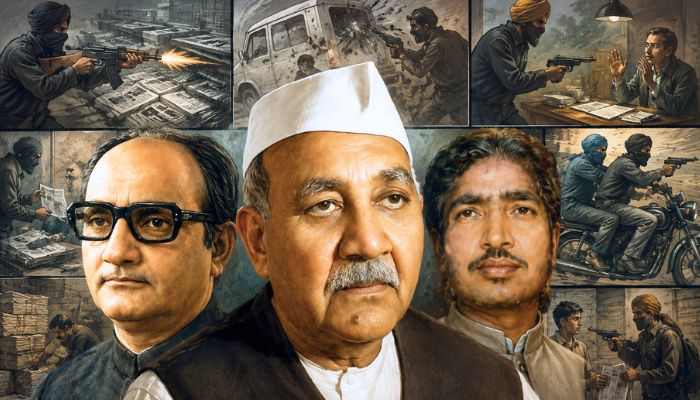
From Lala Jagat Narain to ML Manchanda: The journalists marked for death by Khalistanis

During the Punjab insurgency, Khalistani terrorists did not target only politicians, policemen or civilians. Journalists, editors, broadcasters, newspaper hawkers and delivery workers were also marked for death. The campaign began early in the insurgency and eventually developed into an effort to control not only what could be published or broadcast, but even the words journalists were permitted to use.

One of the earliest and most consequential attacks came on 9th September 1981, when Lala Jagat Narain, founder and chief editor of the Hind Samachar Group, was assassinated while travelling from Patiala towards Jalandhar. Jagat Narain had repeatedly criticised Jarnail Singh Bhindranwale, opposed communal separation and warned against growing violence. His newspapers reached readers in Hindi, Punjabi and Urdu, making his voice particularly influential. His killing was meant to demonstrate that publicly opposing Khalistani terrorism could carry fatal consequences.

The assassination failed to silence the Hind Samachar Group. Jagat Narain’s son Romesh Chandra continued the same editorial line, writing against terrorism and promoting Hindu-Sikh unity. On 12th May 1984, he too was shot dead in Jalandhar. The threat also crossed religious lines. Sumeet Singh, the Sikh editor of the Punjabi literary magazine Preet Lari, was murdered in February 1984 after advocating communal harmony. Communist activist and editor Baldev Singh Mann, another Sikh critic of Khalistan, was shot dead in 1986. Their killings showed that the decisive question for terrorists was not whether a journalist was Hindu or Sikh, but whether his words supported or obstructed the separatist cause.

District journalists were particularly vulnerable. Giani Jagjit Singh died after an armed attack in 1986, Punjab Kesari and Jag Bani correspondent Narendra Pal Singh was killed in 1987, Jag Bani chief sub-editor Bant Singh was assassinated in 1988, and PTI and Indian Express correspondent Parduman Singh was shot the same year. Hind Samachar news editor Inderjit Sood was also killed in 1988 after the death of Khalistan Commando Force chief Labh Singh, reportedly over the terminology used by Jag Bani while reporting his death. By the early 1990s, reporters including Nanak Chand Nagpal, Bhag Singh Khela, Balbir Singh Saggu and Amar Nath Verma had also been murdered.

The campaign soon extended beyond journalists themselves. After the Hind Samachar Group refused orders to stop publishing, terrorists attacked employees, newspaper vendors and the distribution network. Hawkers were killed while handling newspaper bundles, delivery workers were attacked and a newspaper van travelling towards Ferozepur was ambushed in July 1990, killing all five people inside. Around 40 vendors, agents and hawkers associated with the group were killed. Police eventually accompanied newspaper vendors on their routes as terrorists attempted to make the physical distribution of the publications impossible.

Khalistani organisations also tried to dictate editorial language. In November 1990, the Sohan Singh-led Panthic Committee issued a code instructing journalists to describe those campaigning for Khalistan as “militants” or “freedom fighters”, rather than terrorists. It went further by claiming that leaders of five associated terrorist organisations could pronounce death sentences on journalists and editors. The same battle over terminology reached All India Radio. Chandigarh station director Rajinder Kumar Talib was shot dead in December 1990 after Khalistani groups objected to the broadcaster’s language and terminology.

The most brutal example came in May 1992. Babbar Khalsa abducted ML Manchanda, station director of All India Radio in Patiala, and demanded that the electronic media adopt its prescribed code of conduct, including restrictions on Hindi and other non-Punjabi programming. When the government refused to comply, Manchanda was killed and beheaded. His torso was recovered in Punjab while his severed head was found in Ambala. Babbar Khalsa openly linked the murder to its effort to impose its media code.

From Lala Jagat Narain’s assassination in 1981 to ML Manchanda’s murder in 1992, the methods changed but the objective remained largely the same: force the media to submit. Editors were assassinated, correspondents were killed near their homes, broadcasters were targeted over terminology, hawkers were murdered for distributing newspapers and newsrooms received instructions backed by death threats. Yet newspapers continued publishing, vendors returned to their routes under police protection and journalists continued reporting from some of Punjab’s most dangerous districts.

Read the full article on Chapter One Magazine.

Anti-Paper Leak Bill: Opposition demands accountability, reforms, but paralyses Parliament 

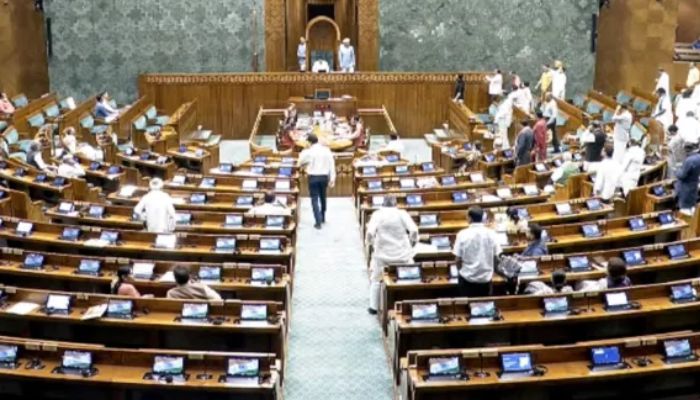
The political opposition in India has stopped believing in agitating for accountability but causing disruptions merely for the sake of targeting the ruling dispensation. On 27th July 2026, both Houses of Parliament, Lok Sabha and Rajya Sabha, were adjourned till noon shortly after proceedings commenced. The adjournments followed noisy protests and ruckus by Congress and other opposition MPs over the Delhi Police’s response to the Cockroach Janta Party-led ‘student protests’. 

The opposition MPs demanded a statement from Union Home Minister Amit Shah on the alleged Delhi Police excesses, including the use of pellet guns, shock batons, lathi charges, and tear gas, against the protests during the CJP-led “Sansad Chalo” march on 20th July. 

While Lok Sabha Speaker Om Birla repeatedly stressed that the government is set to introduce the Public Examinations (Prevention of Unfair Means) Amendment Bill, popularly referred to as the Anti-paper leak bill, and debate is to be on in Parliament, the opposition MPs continued sloganeering, screeching and causing unwarranted disruption. 

Similar scenes of performative protest were seen in Rajya Sabha as well. 

Consequently, both proceedings in both the Houses had to be adjourned.  

In the Lok Sabha, the proceedings began at 11: AM. After some time, when the Speaker tried taking up the Question Hour, the opposition MPs began creating a ruckus. The constant sloganeering and shouting by Opposition MPs forced Speaker Om Birla to adjourn the House first till 12:00 pm, then till 2:00 pm, and extend the adjournment as opposition members disrupted the proceedings again. 

Rajya Sabha was adjourned till 2:00 PM over the same issue. When the House reassembled after the first adjournment at 12 noon, the opposition again started protesting over the alleged police action on students. Consequently, Chairman C P Radhakrishnan adjourned the House till 3:00 PM. 

Lok Sabha Speaker Om Birla stated that the Central government and Opposition should come to an agreement till 5 pm, so that discussion on the Anti-leak bill can be started. Birla has said that a dedicated six-hour window for a comprehensive discussion on the Public Examinations Bill would be provided.

Opposition seeks accountability, without letting its ultimate forum function 

The MPs from the INDI Alliance parties are audaciously framing their in-House disruptions as a ‘fight’ for accountability and reforms in the Indian education system. The Opposition claims to seek justice for injured ‘students’, a probe into Delhi Police’s conduct during the CJP protests, and a statement from Home Minister Amit Shah. 

However, despite the Central government taking a step towards bringing the very reforms that the genuine student protestors demanded- stronger laws against paper leaks, accountability mechanisms, and enhanced exam system credibility- the Opposition is causing obstructions. 

By continuing to disrupt the House and prevent a debate on the Anti-Paper Leak Bill, despite Dharmendra Pradhan’s resignation and the CJP protest withdrawal, the Opposition parties are essentially blocking the legislation that would operationalise the much-needed systemic reforms. 

This impasse, however, is being manufactured by the Opposition MPs not out of an outpouring of sympathy for injured ‘students’ but for their own political agenda.  

Although the Modi government is projecting strength, Prime Minister Narendra Modi is leading the narrative game from the front now; Dharmendra Pradhan’s resignation as Education Minister has set a narrative that the Centre capitulated before young ‘cockroaches’.  

The Opposition does not want momentum to die without yielding maximum political output for them. Even though the Cockroach Janta Party is an unofficial B-Team of the Aam Aadmi Party, the narrative emerged that the apolitical ‘cockroaches’, the youth of India, were doing the job of the Opposition by aggressively demanding Pradhan’s resignation through street protests. 

In fact, it was only when the Parliament session neared that prominent anti-BJP MPs like Samajwadi Party’s Dimple Yadav, AAP’s Arvind Kejriwal, Azad Samaj Party’s Chandrashekhar Azad, among others, began flocking to Jantar Mantar.  

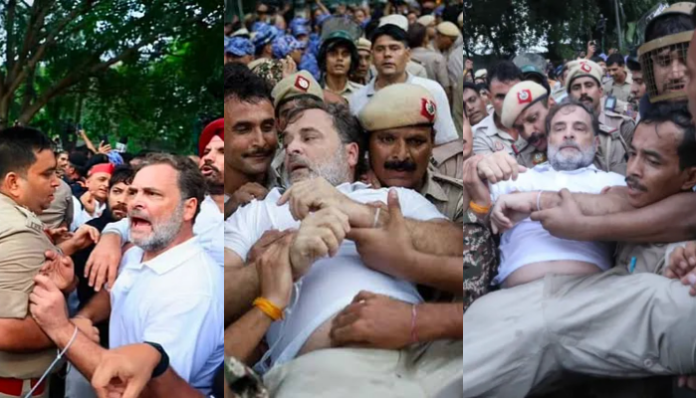
Realising that it has been almost absent and irrelevant in the entire anti-Dharmendra Pradhan agitation, the Congress party launched its parallel protest on 20th July, with Rahul Gandhi leading a march to PM Modi’s residence. The move was Congress’s attempt to hijack the issue and make Rahul Gandhi the hero of the fight he didn’t even participate in until the CJP protests reached their peak. 

Not to forget, Rahul Gandhi had promised to end his agitation if “NEET and related education issues including the ongoing protests” were debated in Parliament. The Centre assured that extensive discussions will be held on the matter in Parliament. However, upon seeing that the wider sentiment is in favour of seeking Dharmendra Pradhan’s resignation, Gandhi also changed tunes accordingly.

The opposition parties, particularly Congress, are now overcompensating for their calculated on-ground absence and restricting themselves to mere social media support by playing the usual performative protest on its political turf, the Parliament. 

The opposition wants to keep the ‘Modi government is defeated’ narrative alive for longer to exploit student grievances into a political theatre where they get to pull the strings. 

For this, Congress and other anti-BJP parties are engaging in classic parliamentary brinkmanship. The Opposition is claiming the moral high ground of ‘accountability’ while denying the very forum where accountability measures can be debated, amended and implemented.  

It is notable that the issue of alleged Delhi Police excesses during the 20th of July protest has reached the Supreme Court, which will hear the matter on 28th July. When the matter is listed for hearing before the Supreme Court, it is illogical to expect the Home Minister Amit Shah to issue a statement in this regard, as a precondition for letting the Parliament function. 

In fact, ever since the Monsoon Session of Parliament began on 20th July 2026, the Opposition has not let both Lok Sabha and Rajya Sabha function peacefully even for a single day. The Opposition has wasted 6 of the 19 planned sittings through disruptions which lead to adjournments. Amidst the Opposition’s intransigence and disruptions, the Parliament has witnessed little to no legislative business in this Monsoon Session.  

The Opposition knows that the passage of the Public Examinations (Prevention of Unfair Means) Amendment Bill, 2026, which PM Modi has directed to be treated as a priority, might help the Central government turn things around.  

The amendment increases punishments for examination-related offences, introduces strict timelines for investigations and trials, creates a framework for Special Fast Track Courts and Special Task Forces, and strengthens accountability for organisations and individuals involved in organised examination fraud. 

The Opposition knows that if the Modi government’s bill offering accountability, stricter laws against paper leaks and broader systemic reforms is passed, which it will be given the NDA has the required majority in both the Houses, it will push a “reforms sought, reforms delivered” narrative. The Opposition will lose the little ground it gained. Thus, the Opposition has weaponised disruptions and anarchy to meet its political objectives.  

On one hand, the Cockroach Janta Party ‘leaders’ are now issuing warnings to the Central government and BJP-ruled states against any detentions or arrest of violent protestors, even after they themselves publicly called them “not students, but anti-social elements”. On the other hand, the Opposition continues to paralyse the Parliament, refusing to let the House function despite claiming to want accountability. 

Clearly, everyone is eager to hold others to account. However, the moment accountability is sought from them, it becomes excess, harassment, and even political vendetta. 

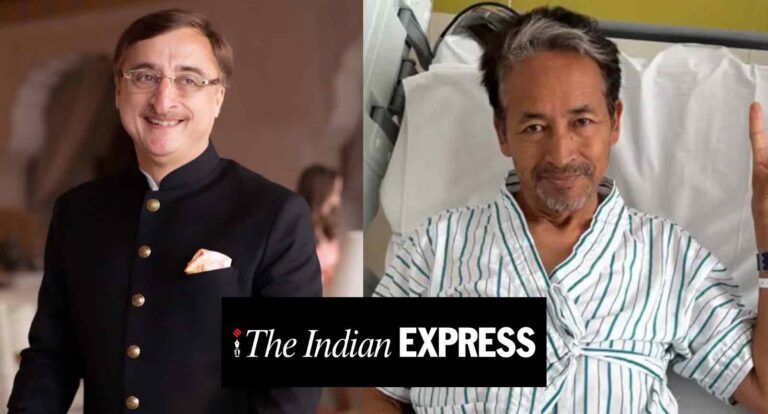
Congress MP Vivek Tankha denies Indian Express report claiming that he mediated between Sonam Wangchuk and government, issues notice calling it blatant lie and cheap journalism

Congress Rajya Sabha MP and senior Supreme Court advocate Vivek Tankha has issued a legal notice to The Indian Express Private Limited and its Hindi editor Saurabh Dwivedi, alleging that the publication and its platforms have disseminated false, misleading and defamatory content regarding his role in the recent conclusion of climate activist Sonam Wangchuk’s hunger strike. The publication has been asked to withdraw the article claiming that Tankha had facilitated discussions between Sonam Wangchuk and the Government of India that led to Wangchuk ending his hunger strike.

On Sunday, advocate Ujjawal Anand Sharma of the law firm Lawmen & White, acting on instructions from Tankha, served the notice calling upon Dwivedi and the newspaper to immediately cease and desist from publishing or circulating the impugned material across print, digital and social media platforms. The notice further demands that the content be permanently removed, that misleading headlines and promotional material be corrected or deleted, and that an unconditional public apology and clarification be published within 48 hours.

Failure to comply, the notice states, will leave Tankha with no option but to initiate appropriate civil and criminal proceedings.

The Indian Express article by Deeptiman Tiwary claimed that Congress MP Vivek Tankha “played a significant role in opening communication channels between the government and Wangchuk and finding a middle ground that both could agree on.” The report also claimed that Wangchuk issued an open letter to minister Nadda on Tankha’s persuasion.

Tankha has denied these claims in the notice, stating that he urged the activist to end the fast due to concerns of his health, and he was not acting on behalf of the central govt, as the article implies.

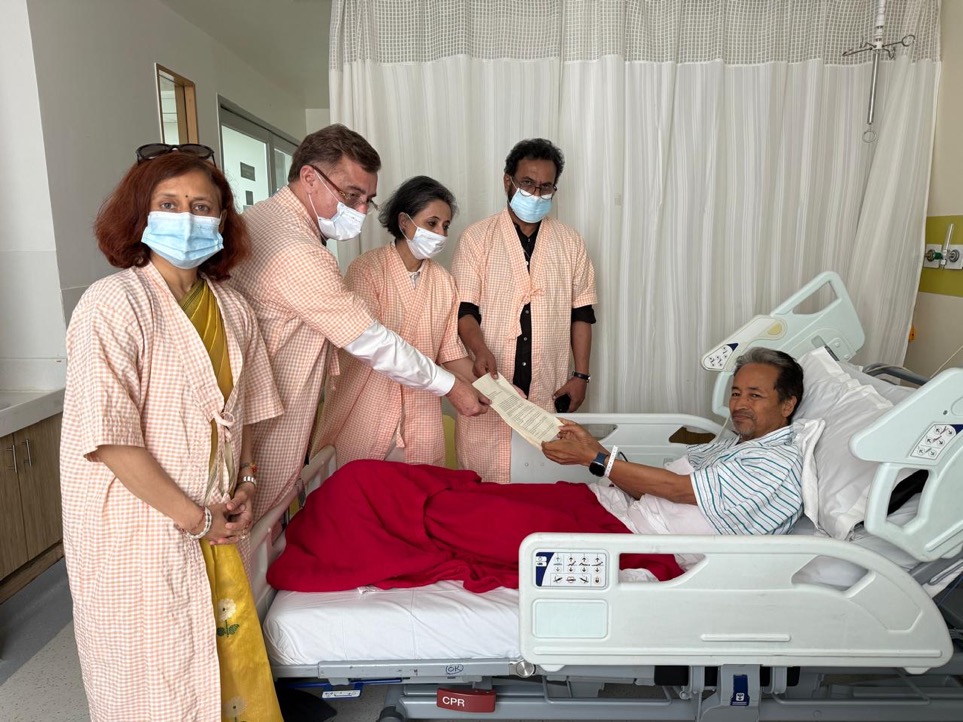
The notice sets out at length the factual background of Tankha’s long-standing professional association with Wangchuk. It records that Tankha, who had earlier represented the activist in the Supreme Court in the habeas corpus petition challenging his detention under the National Security Act, visited Wangchuk at the Jantar Mantar protest site on 17 July and later at Medanta Hospital in Gurugram on 22 July along with other Members of Parliament. On both occasions, according to the notice, Tankha expressed genuine concern over the activist’s deteriorating health after he had lost more than 11 kilograms and urged him, purely on humanitarian grounds, to consider ending the fast in the interest of his own well-being and the safety of the protesting students.

The notice emphasises that Tankha never acted on behalf of the Union Government, the Ministry of Home Affairs or any official, that he received no request or instruction from the government to negotiate, and that Wangchuk ultimately ended the fast only after receiving a written assurance from the Centre.

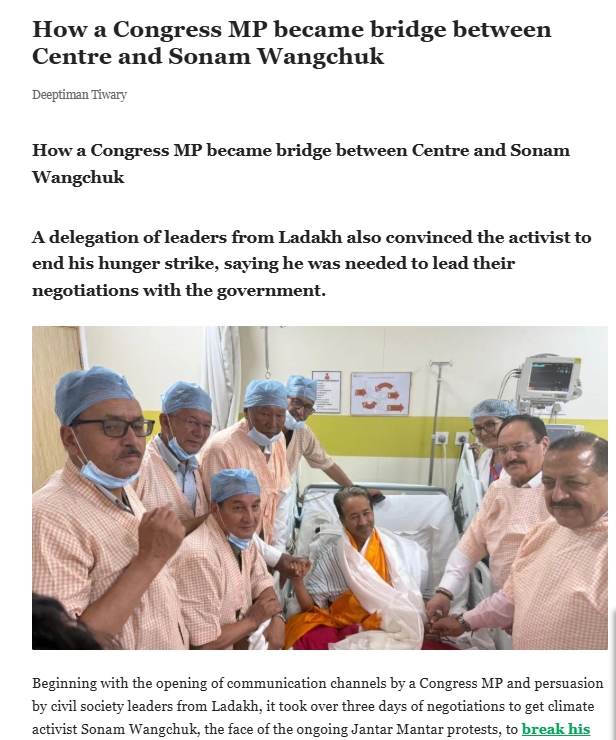
The publications, the notice alleges, have twisted these facts into a narrative that portrays Tankha as the central figure whose intervention persuaded Wangchuk to dilute the movement’s demands and end the fast. Particular objection is taken to the article authored by Deeptiman Tiwary that first appeared on the Indian Express website on 24 July under the title “How a Congress MP became bridge between Centre and Sonam Wangchuk,” which suggested that the Congress MP had convinced Wangchuk to end the hunger strike.

Screenshot of the original report

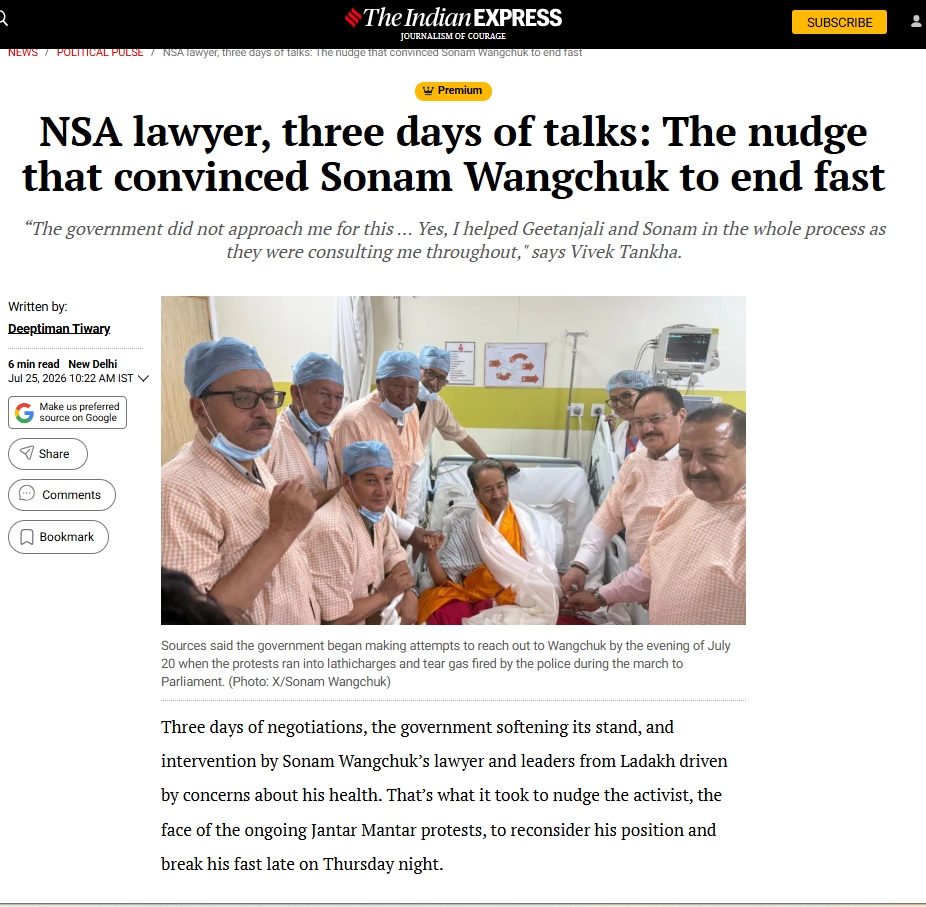
The title was subsequently altered to “NSA lawyer, three days of talks: The nudge that convinced Sonam Wangchuk to end fast.” The article states that Tankha “played a significant role in persuading him to end the fast” and quotes unnamed sources attributing the decision to discussions with him. Although the piece also carries Tankha’s own clarification that “the government did not approach me for this” and that his involvement stemmed from concern for Wangchuk’s life, the notice contends that the sensational headline, sub-headings and overall framing create a false impression of political intermediary work on behalf of the government.

Screenshot of the modified report

Compounding the alleged false claims, the notice points to promotional material circulated by Indian Express Hindi on X and Instagram. One video posted on 25 July carried the caption “वांगचुक का अनशन तुड़वाने में किस कांग्रेसी सांसद का हाथ है?” (Which Congress MP played a role in getting Wangchuk to end his fast?) while an Instagram reel used the caption “इस कांग्रेसी सांसद ने की अमित शाह की मदद” (This Congress MP helped Amit Shah), both of which, according to the notice, maliciously name Tankha and seek to fasten responsibility on him for “breaking” the fast while linking him to the Home Minister.

These assertions, the notice maintains, are wholly unverified, lack any documentary basis and amount to a calculated attempt to damage Tankha’s reputation as a Congress parliamentarian by suggesting that he abandoned his party’s position and acted in connivance with the ruling dispensation.

Notably, a delegation of opposition MPs had visited Sonam Wangchuk at Gurugram’s Medanta Hospital on 22nd July to persuade him to end his fast. Apart from Congress MP Vivek Tankha, others included TMC MP Sagarika Ghose and CPI(M) MP John Brittas. The delegation handed over a letter to Wangchuk, requesting him to withdraw the fast.

Wangchuk had been on an indefinite hunger strike for 26 days in solidarity with the Cockroach Janta Party-led student protest at Jantar Mantar demanding accountability for examination paper leaks, including the NEET controversy, and broader reforms in the education system. He ended the fast late on the night of 23 July at Medanta Hospital in the presence of Union Ministers JP Nadda and Jitendra Singh after receiving written assurances that no cases would be registered against peaceful protesters, that the issue of paper leaks and educational reforms would be discussed in Parliament, and that compensation for families of students who had died by suicide would be positively considered. Wangchuk himself later stated that the decision followed a hard bargain and was also influenced by the risk of the agitation turning violent.

In a post on X shortly after the notice was issued, Tankha expressed gratitude to Sharma and the firm, describing the reporting as “blatant journalistic lies being mixed to nix a true humanitarian story” and “cheap journalism.” He asserted that there is no freedom of expression to peddle lies and urged that the matter be taken to its logical conclusion.

The notice grants the addressees a strict timeline for compliance, including the publication of a correction that expressly states Tankha was never approached or authorised by the government and that his intervention was motivated solely by concern for Wangchuk’s health. They have been granted 48 hours to comply, failing which the MP will initiate appropriate civil and criminal proceedings and pursue all remedies available in law. The notice reserves Tankha’s right to claim damages for the reputational harm caused. As of Sunday evening, there has been no public response from The Indian Express or Saurabh Dwivedi.

How left-liberals and Islamists are using Dharmendra Pradhan’s resignation as foundation to incite anarchy in India

0

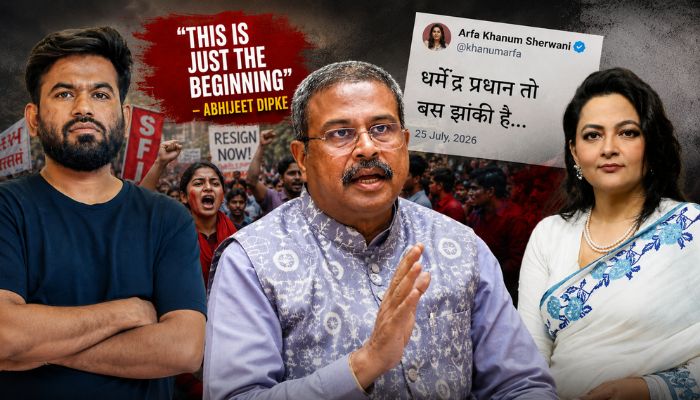
“This is just the beginning,” Cockroach Janata Party (CJP) founder Abhijeet Dipke issues an open threat in his first video message after former Union Education Minister Dharmendra Pradhan resigned on Saturday, 25th July. In the video shared on social media, Dipke issued a direct warning to the government, asserting that the stepping down of a Union Minister proves what united public pressure can achieve. Reiterating his core stance, he insisted that the minister’s exit is not the end of their fight, but merely the start.

Union Education Minister resigns amid growing unrest 

The political storm culminated when Union Education Minister Dharmendra Pradhan announced his resignation on Saturday, 25th July, 2026. The decision comes amid the ongoing protests over the NEET-UG paper leak and Sonam Wangchuk’s hunger strike at Delhi’s Jantar Mantar.

In a detailed two-page public letter addressed to the country’s youth, Pradhan stated that he had submitted his resignation to Prime Minister Narendra Modi in the interest of students and to ensure the issue was not exploited for political gains. Recalling his four-decade-long association with education as a student, teacher, and reform advocate, Pradhan reflected on his core belief that a strong, inclusive, and transparent education system forms the bedrock of a strong nation. 

Addressing the 3rd May, 2026 NEET-UG examination, Pradhan acknowledged that irregularities had taken place. He pointed out that the Centre acted immediately by handing over the probe to the CBI, cancelling the examination, and scheduling a fresh test. Furthermore, he noted that the government had decided to shift NEET to a computer-based test (CBT) format starting next year to bring complete transparency. 

The former minister emphasised that the government’s primary focus was to ensure that more than 20 lakh students could re-appear without hassle, highlighting how central and state governments, district administrations, students, and parents worked in tandem to successfully conduct the fresh exam on 21st June.

Commenting on the Jantar Mantar protests and Sonam Wangchuk’s hunger strike, he appealed to the youth not to get pulled into confusion or drawn into prolonged legal and political battles. He cautioned that anti-national forces should not be allowed to exploit the situation, urging students to direct their focus back to their studies and careers. 

Leftists and Islamists issue open threats and calls for anarchy

Following the minister’s resignation, a flood of mixed reactions erupted online. However, a noticeable wave of threats from leftists, liberals, and radical Islamists began emerging, where veiled threats of wider street agitation and anarchy were openly shared despite the minister already stepping down.

Social media saw a slew of provocative posts and aggressive videos targeting the ruling government. Arfa Khanum Sherwani of the leftist propaganda website The Wire, posted a cryptic tweet on X on Saturday, July 25, writing: “Dharmendra Pradhan is just the trailer…”, suggesting that the resignation was only the beginning and hinting at demands for further chaos in the country.

Similarly, members of the pro-communist Students organisation, SFI (Students’ Federation of India), flooded social media with red colour symbols to celebrate Pradhan’s exit. In a video circulating online, an SFI’s so-called activist was heard raising slogans against the Prime Minister and the Home Minister. Referring to Prime Minister Narendra Modi, she said, “Chai wale chacha, now it’s your time too go, go, resign.” The slogan was raised amid celebrations following Pradhan’s resignation.

Other online users quickly jumped on the bandwagon to push for a broader collapse of the ruling government. User Tarun Gautam called for expanding the protests, writing on X: “Do not settle with Dharmendra Pradhan’s resignation. It’s Modi who must go now.”

Another viral post echoed a similar sentiment, attempting to mobilise followers against the entire cabinet: “Now Dharmendra, Next Modi, Next Amit Shah, Next Gadkari, Next Next how long will we fight for each one, stand once for whole BJP Team none of them have accountability.”

Even CJP founder Abhijeet Dipke, emboldened by the resignation. In a viral video on social media, he openly challenged the country’s security agencies and police personnel. He wrote, “It’s just 1 resignation; withdraw cases against students on July 20 & later. Don’t mess with a cockroach. If we can make Minister resign, then you cops are nothing for us.” The statement was widely circulated online following Pradhan’s resignation.

Political reactions to the resignation 

Political opposition leaders were quick to claim victory following the announcement. AAP National Convenor Arvind Kejriwal released a statement congratulating the public and the student community: “Congratulations to all of you. Congratulations to the youth of our country. It is a matter of great joy that your struggle has borne fruit. Dharmendra Pradhan ultimately had to resign. This is a great victory for our democracy. People in our country had begun to lose faith in democracy. They felt that governments do not listen. People would raise their voices before the government and plead with folded hands, but the government never listened.”

Punjab Finance Minister Harpal Singh Cheema also took a sharp dig at the ruling party, saying: “Ever since the BJP came to power in the country, exam papers started being sold. They were leaked, and lakhs of children across the country took to the streets to protest against it… The downfall of the BJP has begun. From today, these same children who were protesting will give a befitting reply to the BJP whenever any state or national election comes.”

The selective outrage and silence on Non-BJP states

While Punjab ministers and opposition figures appeared visibly overjoyed by the resignation of the Union Minister, it clearly strikes a double standard in their political rhetoric. None of these political leaders or activist groups has acknowledged or condemned similar examination scandals in non-BJP-ruled states, such as the recent Punjab Pharmacy paper leak.

Furthermore, neither the CJP nor opposition commentators have demanded the resignation of education ministers in non-BJP-governed states, such as Madhu Bangarappa in Karnataka or Punjab’s own Education Minister, Harjot Singh Bains. 

This selective silence has raised valid questions about whether the outrage is genuinely about protecting students or simply about leveraging political momentum against a single political party.