On Thursday (1st May), legendary singer Sonu Nigam was rudely asked by a fan to sing in Kannada while performing at East Point College in Bengaluru. The singer said he felt “threatened” by the rude demand and stopped his performance to address the language issue, as well as speak about the deadly Pahalgam attack.
A video of the incident went viral on social media. In the video from the concert, Sonu Nigam can be heard saying, “In my career, I have sung in multiple languages but the best songs that I have ever sung is in the Kannada language. Whenever I come to your city, I come with lots of love. We do a lot of shows in a lot of places, but whenever we have shows in Karnataka we come with a lot of respect for you. You have treated me like your family, but I didn’t like when the boy there, who is not even as old as my career, is rudely threatening me to sing in Kannada.”
Sonu Nigam visibly enraged after a young boy from the crowd forced him to sing in Kannada during his live concert in #Bengaluru
Annoyed by the heckle, he hit back calling out rising regional intolerance and warning such behaviour fuels the very divide terror outfits like those… pic.twitter.com/D4RNbj0BFK
Nigam compared the student’s mindless rudeness towards the singer with the Pahalgam terror attack and said, “This is the reason behind the incident in Pahalgam. Please see who is standing before you. I love you guys.”
Expressing his love for Kannada language and his respect towards his audience, Sonu Nigam said, “I do so many shows across the world where thousands of people gather, and every time I hear even a single person shouting ‘Kannada’, I make sure to sing at least one line in Kannada for them. That’s how much I love and respect all of you. So please be kind.”
Notably, Sonu Nigam is a multi-lingual playback singer. In his career spanning three decades, Nigam has recorded many iconic songs in over 32 languages, including Hindi, Kannada, Bengali, Marathi, Telugu, Tamil, Odia, English, Assamese, Malayalam, Gujarati, Bhojpuri, Nepali, Tulu, Maithili, and Manipuri.
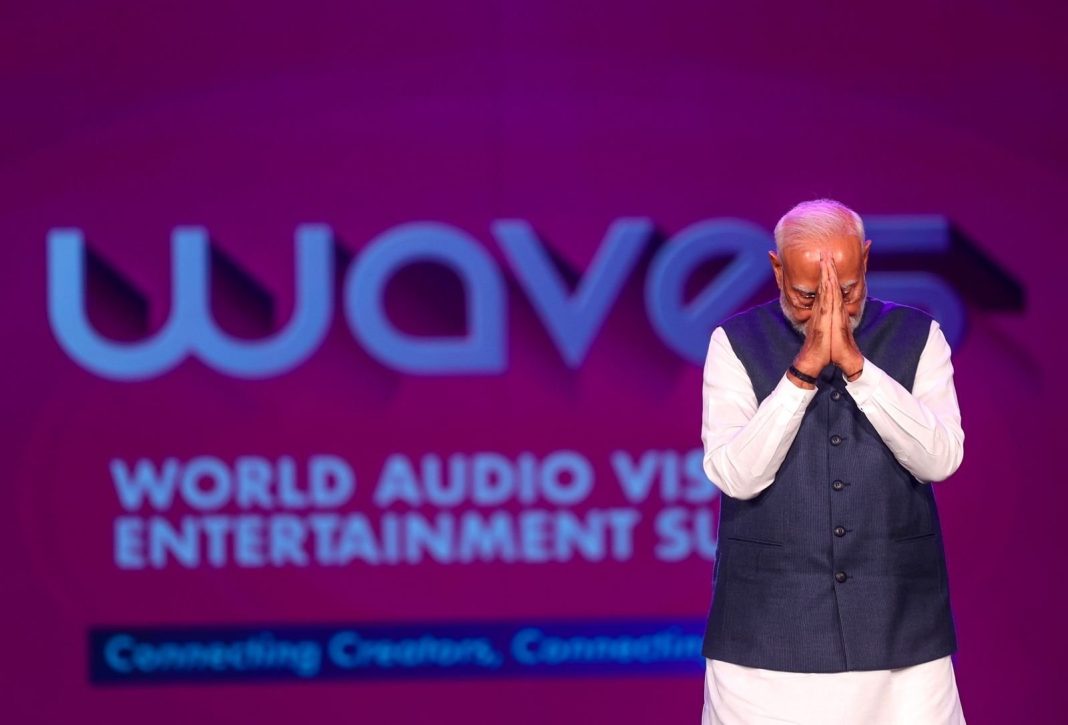
The inaugural World Audio Visual & Entertainment Summit (WAVES 2025) commenced on May 1 at the Jio World Convention Centre in Mumbai. Organized by the Ministry of Information and Broadcasting, the event was inaugurated by Prime Minister Narendra Modi. The four-day event (May 1–4) brings together global leaders in media, entertainment, and technology to position India as a hub for content creation and cultural innovation.
The summit is hosting over 10,000 delegates, 1,000 creators, 300 companies, and 350 startups from over 100 countries.
India’s Creative Economy Takes Center Stage
Inaugurating the summit PM Modi emphasised the rise of India’s “Orange Economy”—centered on content, creativity, and culture. He highlighted India’s growing influence in music, film, gaming, and animation, stating, “India is becoming the global hub of music, film, and gaming.” PM Modi encouraged young creators to “dream big” and share their stories with the world, underscoring government initiatives like Skill India and Startup India that support the creative sector.
He said India is not just a market for stories but also a powerhouse of storytelling. “Artists, innovators, investors and policy makers from more than 100 countries have come together under one roof today. In a way, we have laid down the foundation of global talent, global creativity and global ecosystem,” he said.
The PM said that WAVES is not just an acronym but a real wave. “Films, music, gaming, animation and storytelling are riding on this wave. Right from the first moment, the summit began to roar. It has attracted the world’s attention in its very first summit. More such beautiful waves are about to come,” he added.
Mukesh Ambani: Creative Industries Are ‘Real Power’
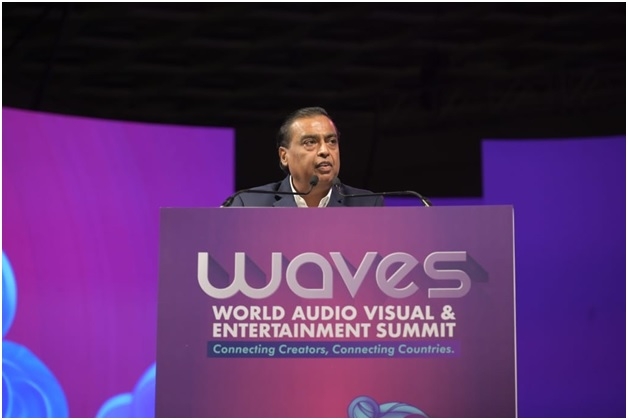
Reliance Industries Chairman Mukesh Ambani addressed the summit, asserting that India’s entertainment and cultural industries constitute “real power,” not just soft power. “People say Media & Entertainment is India’s soft power—I call it India’s real power,” said Ambani. He projected that the current $28 billion media and entertainment sector could exceed $100 billion within a decade, given appropriate investment and policy support.
“India is not just a nation—it is a civilization of stories, where story-telling is a way of life”, Mukesh Ambani said in his keynote address titled “Building the Next Global Entertainment Revolution from India”. He referred to India as “the cradle of the human race, the birthplace of human speech, mother of history, grandmother of legend, great-grandmother of traditions.” Emphasizing that storytelling is deeply woven into the fabric of Indian life, he stated, “From our timeless epics to mythological tales, storytelling is our heritage. Content is king—and good stories always sell. This timeless principle is the foundation of global entertainment.”
He also identified two tectonic shifts reshaping the creative landscape: geo-economics and technology. As the economic might of the Global South surges—home to 85% of the world’s population—so does its role in content creation and consumption. At the same time, cutting-edge technologies like Artificial Intelligence are revolutionizing every stage of the entertainment value chain, from content creation to distribution.
Highlighting India’s unique strengths, Ambani said that the country is poised to lead the entertainment revolution, powered by three pillars; Compelling Content, Dynamic Demography and Technological Leadership. “India’s digital revolution is not just a story of scale—it is a story of aspiration, ambition, and transformation,” he declared.
Day 1 Highlights: Celebrating Legends and Emerging Voices
The first day featured a tribute to late actor Manoj Kumar, with Hema Malini and director Madhur Bhandarkar discussing his contributions to Indian cinema. Musical performances by artists like MM Keeravani, Shreya Ghoshal, Sonu Nigam, Shankar Mahadevan, KS Chithra, and Mangli added to the day’s events
Key panel discussions included:
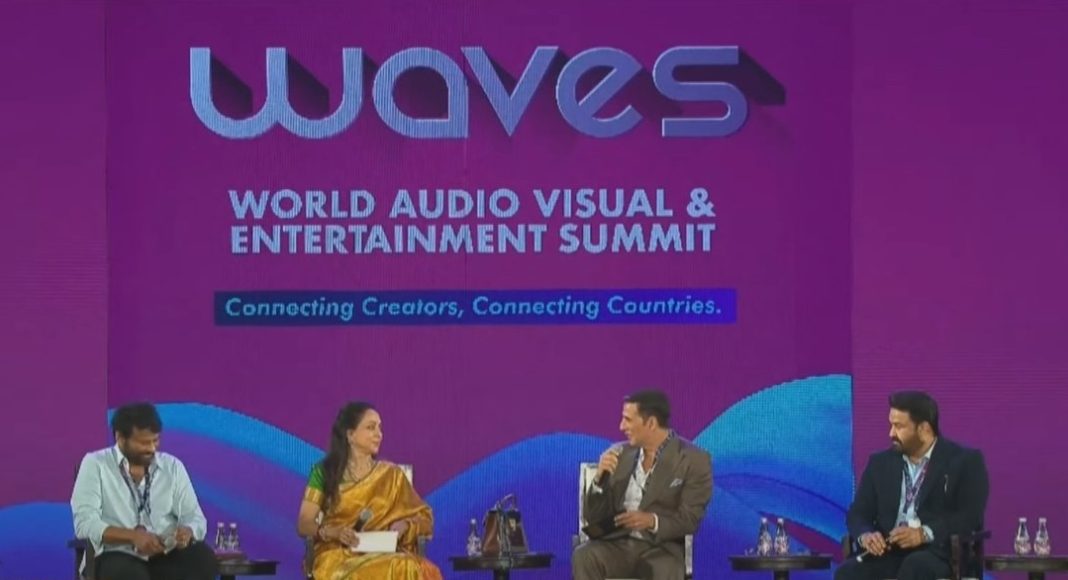
Legends & Legacies: The Stories that Shaped India’s Soul: Featuring Hema Malini, Mithun Chakraborty, Rajinikanth, Mohanlal, and Chiranjeevi, moderated by Akshay Kumar, the panel reflected on their cinematic journeys and impact on Indian cinema.
The New Mainstream: Breaking Borders, Building Legends: Director Karan Johar led a discussion with SS Rajamouli, AR Rahman, Alia Bhatt, Anil Kapoor, and Vicky Kaushal on how Indian cinema is transcending borders.
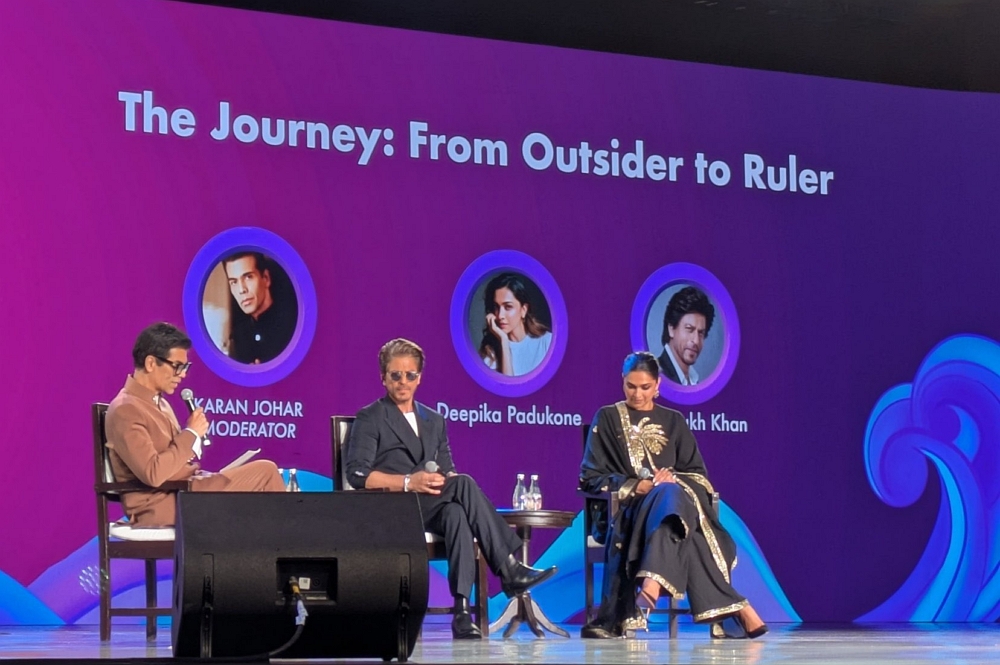
The Journey: From Outsider to Ruler: Shah Rukh Khan and Deepika Padukone shared their experiences of overcoming industry challenges, in a session moderated by Karan Johar.
Talent Beyond Borders: Allu Arjun spoke about the global recognition of regional talents.
Braving the Odds: Scripting a New Narrative: Legendary Footballer Ariane Hingst, Super Model Binaca Balti, Israeli actor Rona Lee Shimon, and TV9 MD Barun Das participated in this panel discussion.
“The Business of Influence: Creators Shaping Global Culture”: Moderated by Gautam Anand, Vice President, YouTube APAC, the session brought together four extraordinary creators whose journeys, rooted in passion and purpose, have quietly transformed corners of the digital world. Japanese creator Mayo Murasaki, Chef Ranveer Brar, Akash Jadhav of ‘Indian Farmer’, and Jeetendra Advani of ‘Chess Talk’ were the panelists.
Other than Mukesh Ambani, others to deliver keynote addresses on day 1 were Lisa Nandy, Secretary of State for DCMS, UK on “Creative Bridges: Unlocking The Power of Cultural & Creative Partnerships Between the UK & India”, WPP CEO Mark Read on “The Future of Advertising”, Adobe CEO Shantanu Narayan on “Design, Media and Creativity in the Age of AI”, Ogilvy Chief Strategy Officer Prem Narayan on “Culture as a Fuel to Build Brands”, and YouTube CEO Neal Mohan on “Powering the Creator Economy in India”.
WAVES 2025 has attracted over 100 countries, featuring international figures like Louis Boswell (AVIA), Kang Sungkyu (Busan Film Commission), and Prince Faisal Bin Bandar Bin Sultan Al Saud (Saudi Esports Federation).
The summit also introduced initiatives such as the WAVES Bazaar, a global e-marketplace for creative talent, and the WAVES Awards, recognising excellence in film, gaming, and advertising. With its blend of cultural celebration and strategic vision, WAVES 2025 aims to solidify India’s position as a global leader in the creative economy.
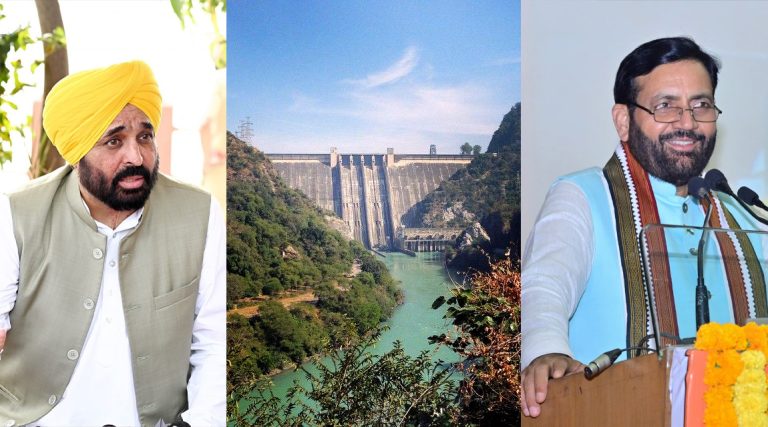
As the Indian government has suspended the Indus Water Treaty with Pakistan and stopped the flow of water of several rivers to Pakistan, a new water war has emerged between the Indian states of Punjab and Haryana. The issue emerged after the Bhakra Beas Management Board decided to release 8,500 cusecs of water to Haryana from the Bhakra Dam. This triggered protests by AAP and a war of words between the two state governments.
AAP argues that Haryana has already received its share of water from the dam, and Punjab should get all the water. Notably, Punjab, Haryana, Rajasthan, Himachal Pradesh and Delhi are partnering states that meet their water requirements from Bhakra and Pong dams managed by the BBMB. The board decides the annual quota of water supply to the three states for a cycle from May 21 to May 21 every year.
In a meeting attended by all three partner states on Wednesday, the BBMB accepted Haryana’s request for additional water, which was supported by Rajasthan and Delhi but strongly opposed by Punjab. Congress-ruled Himachal Pradesh chose not to vote for any side.
Notably, the Bhakra–Nangal Dam system is comprised of two dams, Bhakra Dam in Himachal and Nangal in Punjab.
Haryana is currently receiving 4,000 cusecs daily but has now requested 8,500 cusecs. The AAP govt in Punjab has alleged that Haryana has already utilized its allocated share, and it can’t be given more water, saying it is unjustified and will harm Punjab’s agriculture. Punjab officials blamed Haryana of mismanagement of water in the heated debate during the meeting.
After the meeting, Haryana CM Nayab Singh Saini called Bhagwant Singh Mann, saying Haryana needs additional water. But Mann refused, saying Punjab is already facing a water crisis, and it did not have a drop to spare.
Soon after, the Punjab govt decided to escalate the matter, and refused to release water to Haryana from the dam. The govt also ordered increased security at the Nangal dam.
CM Bhagwant Mann said, “Haryana has used its share of water. It runs from May 21 to May 21, they have used their water till March itself. Now, they are asking for additional water, which we don’t have. Our paddy season has arrived, we have fixed our canal system, now Punjab is using its share of water.”
The Punjab CM posted on X today, “The entire Punjab strongly opposes the decision to give water that is the right of Punjab and Punjabis to Haryana through BBMB. The BJP government of the Center and Haryana have united against Punjab. We will not tolerate another robbery of our rights by BJP at any cost. BJP should be ready to face opposition.”
Punjab Finance Minister Harpal Singh Cheema said the AAP government will not allow the release of any more water to Haryana. He said, “There is a strong government in Punjab and it will not allow the release of even a single drop of water to Haryana. We are not stopping anybody’s right and we are not betraying anyone. We have already given the allotted water.”
On the other hand, BJP has accused AAP of playing politics over the issue. Haryana BJP president Badoli accused Arvind Kejriwal of instigating Punjab CM Mann to take such actions to take revenge against people of Delhi for losing the elections. He said, “When the AAP government was in Punjab and Delhi, they used to misguide people the same way during the three months of summer. They used to lie, claiming a shortage of water. Politicising a matter like drinking water is Arvind Kejriwal’s old habit.”
Delhi minister Parvesh Sahib Singh has said that Punjab government has resorted to dirty politics by stopping the water supply to Haryana and Delhi.
पंजाब सरकार हरियाणा और दिल्ली का पानी रोककर गंदी राजनीति पर उतर आई है । दिल्ली में हारने के बाद अब दिल्ली में जल संकट पैदा करना चाहते हैं । हम दिल्ली में साफ़ और हर घर में पानी देने के लिए दिन रात मेहनत कर रहे हैं और अब पंजाब सरकार दिल्ली की जनता से ऐसे बदला लेना चाहती है । बंद…
He tweeted, “After losing in Delhi, now they want to create water crisis in Delhi. We are working day and night to provide clean water to every household in Delhi and now the Punjab government wants to take revenge on the people of Delhi in this way. Stop this dirty politics or else you will be expelled from Punjab as well.”
Haryana govt has also alleged that Punjab has capped the Bhakra water supply at 4,000 cusecs. Haryana Chief Minister Nayab Singh Saini has denied AAP’s claim that the state has received its full share, saying they have only received 60% of water.
The CM said, “He is trying to politicise this issue. I would like to clarify that the SYL (Sutlej-Yamuna Link) canal matter is under the supervision of the Supreme Court. But this issue is not about SYL’s water. It is about the issue of drinking water… Haryana has not yet received its full share. In the last week, Haryana received only 4,000 cusecs of drinking water, which is approximately 60 per cent of the state’s total demand. If BBMB provides the remaining water per Haryana’s demand, it will be only 0.0001 per cent of Bhakra Dam’s water reservoir.”
In a significant comment, CM Saini said that if Punjab govt keep capping water released from the dam at 4,000 cusec, excess water will overflow during monsoon and reach Pakistan. He said that the Bhakra dam reservoir has to be emptied before monsoon so that excess water accumulated during monsoon can be stored in the reservoir.
He said, “It is necessary to empty the Bhakra Dam water reservoir before June so that rainwater can be stored during the monsoon. If there is no space left in the water reservoir, excess water will go to Pakistan via Hari-ke-Pattan, which is neither in the interest of Punjab nor the nation.”
Notably, if Saini’s warning becomes true, it will nullify the impact of Govt of India stopping flow of water to Pakistan. Because the flow can be stopped only by dams. But if the water overflows over the dams because of filled-up reservoirs, then the water can’t be stopped from flowing downstream and reaching Pakistan.
CM Minister Nayab Singh Saini added that stopping water for Haryana will also impact Delhi. “As long as there was an Aam Aadmi Party government in Delhi, the Mann government in Punjab had no objection to the water going to Delhi. Now that there is no Aam Aadmi Party government in Delhi, why is Mann making such statements to punish the people of Delhi?” he said.
On the evening of Wednesday, 30th April, protests broke out in the Mallital neighborhood of Nainital, Uttarakhand, following the rape of a 12-year-old girl by an old man named Usman. He has been indicted under the Protection of Children from Sexual Offences (POCSO) Act and relevant provisions of the Bharatiya Nyaya Sanhita (BNS). Usman was brought before the court and has been placed in judicial custody. The victim was taken to BD Pandey Hospital for a medical evaluation.
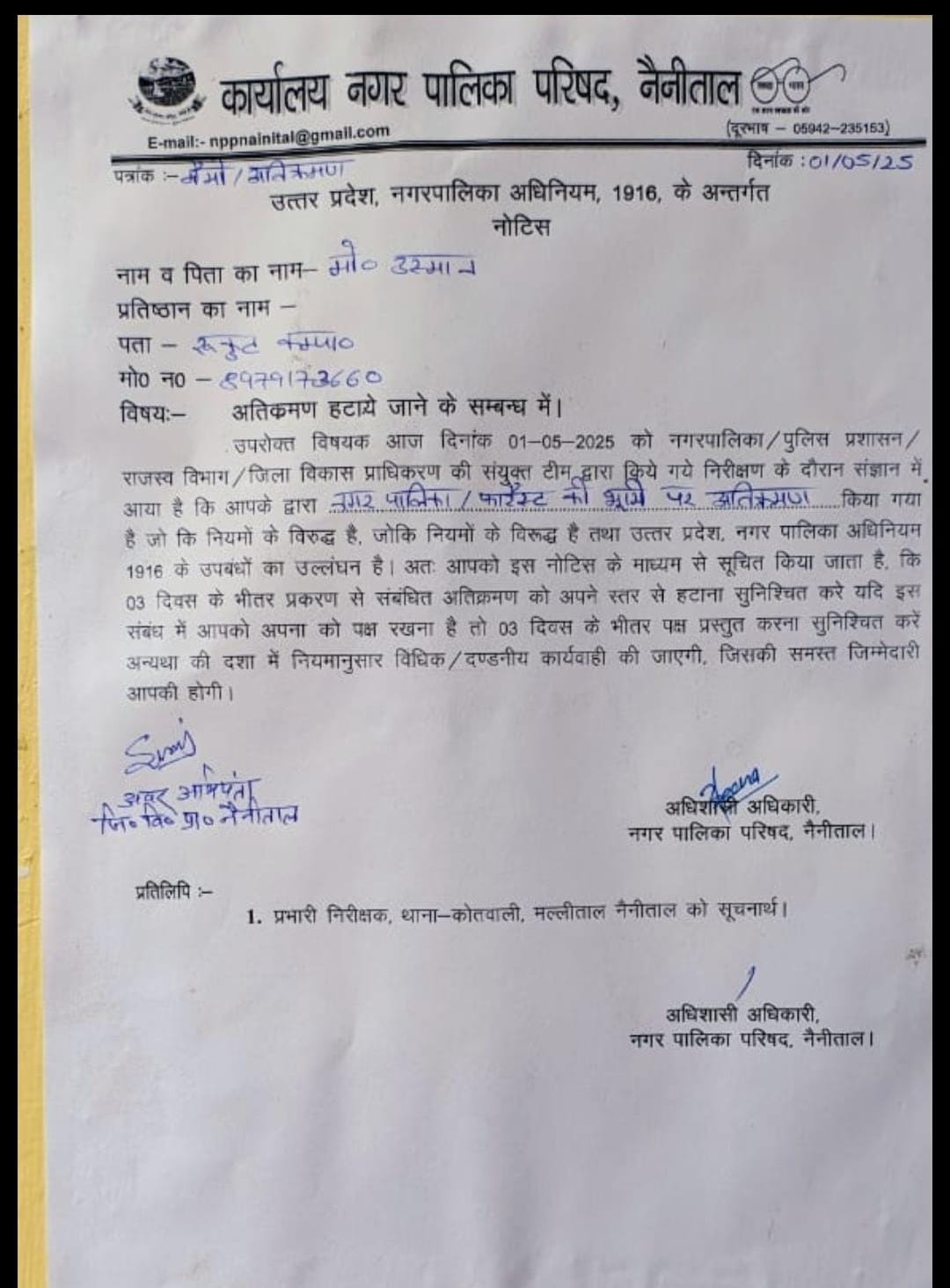
Meanwhile, the administration is not only pursuing legal action against Usman who has been arrested, but is also preparing to take measures against his illegal constructions. A notice has been placed at the accused’s residence by the municipal administration for the impending demolition.
“It has come to notice during the joint inspection conducted today, dated 01-05-2025, by the team comprising the Municipal Council / Police Administration / Revenue Department / District Development Authority, that you have encroached upon land belonging to the Municipality / Forest Department, which is against the rules and constitutes a violation of the provisions of the Uttar Pradesh Municipalities Act, 1916. Therefore, through this notice, you are hereby informed to ensure the removal of the said encroachment at your own level within 03 days. If you wish to present your side in this matter, make sure to do so within the same 03-day period. Failure to comply will result in legal/punitive action as per the rules, for which you alone shall be held fully responsible,” the official letter stated.
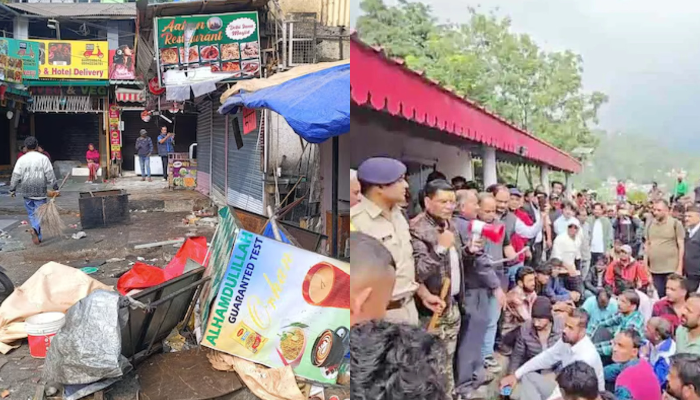
On the other hand, massive demonstrations erupted throughout the hill town of Nainital. On 1st April, there was complete shutdown in Nanital. Colleges, shops, street sellers and rickshaw services stayed closed in protest from Tallital to Mallital. As a safety measure, multiple schools were closed. A demonstration organized by Hindu organizations in Mallital drew thousands of participants. Multiple Hindu organizations also gathered around the local police station on the night of 30th April.
Bharatiya Janata Party city president Nitin Karki, along with members of Shri Ram Seva Dal and other Hindu outfits, marched to the Kotwali police station and protested there. They complained that certain elements of a specific community in the city were harboring antisocial individuals and accused the police of showing leniency in taking action against them. The enraged crowd stated that a close relative of the accused is a doctor at BD Pandey Hospital, raising concerns about possible tampering or bias.
Video of ruckus outside the mosque, as someone from Nainital it pains me to see this hate. Law must take its own course, criminal must be punished, but targeting an entire community is not justice.Nainital has always stood for peace & harmony-let's not lose that@nainitalpolice_pic.twitter.com/MGx4jXFFwV
However, the police intervened to placate the situation. When certain individuals hurled stones at a religious site, the police deployed their vehicle to obstruct the assault.
Protesters have called for the accused to face severe penalties, including the seizure of their property. They also demanded the identification and expulsion of any foreign nationals living illegally, as well as verification efforts for all outsiders, particularly tenants and temporary employees from a particular community. The agitators yelling anti-Pakistan slogans allegedly broke window panes in nearby homes and damaged cars by throwing stones at them.
Anger among Hindu Community in Nanital.
They don't want the 7th century primitive cult destroying their civilization. pic.twitter.com/boF41Qbk7a
Senior officials including Superintendent of Police (City) Jagdish Chandra, pacified the situation and assured the demonstrators that the offender would face harsh punishment. A few stores owned by members of a specific community were vandalized and stones were hurled. Cops did lathi-charge to control the situation. The administration dispatched more police personnel from other districts when a fight broke out between two sides during the demonstration.
“We have kept the accused under tight security in view of the mob’s unrest after taking him into custody. The medical examination of the accused is being conducted,” senior official stated. Officials are diligently observing social media platforms to curb the dissemination of false information.
#Nainital : मुस्लिम ठेकेदार द्वारा नाबालिग बच्ची से रेप के विरोध में लोगों का आक्रोश जारी
लोगों ने निकाली आक्रोश रैली, नैनीताल के मुख्य बाजार कराए बंद
“On Wednesday, we received a complaint from the minor girl’s family that she was raped by Usman, who is a building contractor and lives in their neighbourhood, in his car by luring her with some money. According to the family, the incident took place on 12th April. The minor girl lives with relatives and her mother lives in Sambhal of Uttar Pradesh. She told her mother about the incident on Wednesday. We immediately registered the FIR on the complaint and arrested the accused,” Jagdish Chandra informed.
He added, “As locals came to know about the crime, they first gathered at the Mallital police station. They then pelted stones at shops belonging to the Muslim community in Gaadi Padav area and beat up some men. The stones were also pelted at the gate and walls of the Jama Masjid. We brought the situation under control at around 12:30 am and dispersed the crowd. We are gathering visuals of the individuals who were part of the crowd, involved in stone pelting. We will also take action against them after their identification.”
The horrific incident has also severely hurt the city’s tourism industry. Numerous travelers have shortened their vacations due to the increasing instability and widespread hotel cancellations have been recorded. There was a significant police presence across the city to maintain the peace. Officials acknowledged that the situation remains tense but under control and they have stationed security officers at important locations throughout the town.
A Muslim girl student was reportedly expelled from school in Saharanpur, Uttar Pradesh, for trying to remove a Pakistan flag pasted on the road. The school administration took action against her after a video went viral showing the student attempting to remove the flag. The flag was reportedly pasted by some Hindu organisations on Tuesday (29th April) in protest against the Pahalgam terror attack in which 26 Hindu tourists were brutally killed by Islamic terrorists.
The video went viral
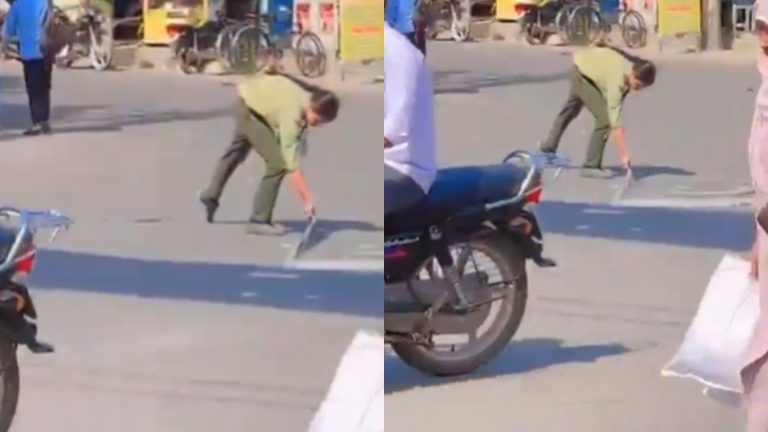
The 11th standard student was reportedly passing through the Saharanpur bus stand crossroad in Gangoh Nagar on her scooter when she noticed the flag. She parked her scooter on the side and walked to the middle of the road where the flag was pasted. The video shows that she tried to lift the flag from one corner, but was unable to remove it completely as the flag was pasted to the road with glue. There, when it did not come off, she gave up, went back to her scooter and left. However, an onlooker had recorded the incident, and the video went viral on social media, leading to outrage.
गंगोह जिला सहारनपुर
पहलगाम कांड के विरोध में सड़क पर पाकिस्तानी झंडा चिपका था
11वीं क्लास में पढ़ने वाली एक मुस्लिम छात्रा अपनी स्कूटी रोक कर सड़क पर चिपके पाकिस्तानी झंडे को हटाने के लिए कोशिश की हालांकि झंडा चिपकाया गया था इसलिए वह उसे उखाड़ नहीं सकी
The flag was reportedly pasted by members of Kranti Sena on Tuesday, a day before the girl tried to remove it. Vehicles and pedestrians were passing over the flag.
Hindu organisations protested
After the video of the girl trying to remove the flag went viral, it triggered outrage. As the girl was in her school uniform, her school was quickly identified, and people from Hindu organisations, including Kranti Sena, reached the school and started creating a ruckus on Wednesday.
District head of Kranti Sena Neeraj Rohila met the principal of the school with a delegation and expressed his protest, and submitted a memorandum. He called the act of the student treason and demanded immediate expulsion of the student from the college. Seeing the anger of the activists and the seriousness of the matter, the principal immediately expelled the student from the college.
From her uniform, it appears that the girl studies at the Silver Oak Public School in Gangoh, Saharanpur.
The girl’s family defends her act
The family of the student came out in her defence, claiming that she was not trying to remove the flag. They said that the girl walked to the middle of the road looking for her pen that had fallen there. Coincidentally, Pakistan’s flag was pasted at the exact spot where she went looking for her pen. This made her appear like she was removing the flag.
Delhi Police on Thursday filed a supplementary chargesheet against former MLA Naresh Balyan and three other accused — namely Sahil alias Poli, Vijay alias Kalu, and Jyoti Prakash alias Baba – arrested in connection with an MCOCA case involving an alleged organised crime syndicate run by gangster Kapil Sangwan alias Nandu.
This is the second supplementary chargesheet in the case and the first one naming Naresh Balyan. Earlier, a main chargesheet was filed against Ritik alias Peter. The first supplementary charge sheet was filed against Rohit, also known as Anna, and Sachin Chikara. Special Judge Dig Vinay Singh will hear the Delhi Police’s submissions on Friday.
This current chargesheet has been filed under various sections of under various sections of the Maharashtra Control of Organised Crime Act (MCOCA).
Balyan was arrested in connection with the case on December 4, 2025. Following his arrest, the court had granted an extension of 60 days to complete the investigation against him.
On April 23, the court further extended the time for 11 days to complete the investigation against two accused, namely Sahil alias Poli and Vijay Gahlaut alias Kalu, in a case under MCOCA.
Investigation officer ACP Naresh and Special Public Prosecutor (SPP) appeared before the court and sought an extension of 30 days. The court had extended judicial custody of EX MLA Naresh Balyan and other accused till May 5.
Notably, the Court had already granted an earlier 60-day extension on March 1 to allow the Delhi Police to complete the investigation against Naresh Balyan.
This extension period was set to expire on May 4.
The Court has already taken cognisance of the charge sheet filed against the accused Ritik alias Peter. A supplementary charge sheet has also been filed against Rohit alias Anna and Sachin Chikara. The court has also taken cognisance of the same.
Earlier, Special Judge Jitendra Singh had extended the period of investigation until May 5 after hearing the prosecution’s submissions.
(This news report is published from a syndicated feed. Except for the headline, the content has not been written or edited by OpIndia staff)
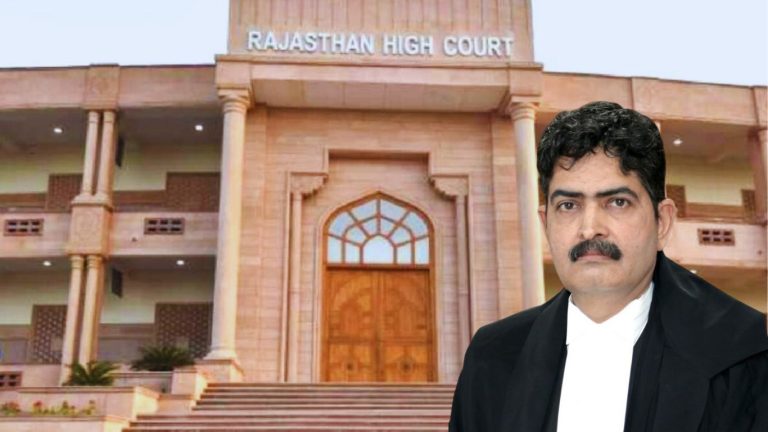
A single judge bench of the Rajasthan High Court on Tuesday (29th April) reprimanded the state government for including rich beneficiaries in a scholarship scheme, calling it a misuse of public money. The High Court highlighted the disparities in the implementation of the Swami Vivekananda Scholarship for Higher Studies (earlier known as the Rajiv Gandhi Scholarship), in its order passed on the petition of a candidate seeking benefit under the scholarship scheme. The court called out the state government for providing financial assistance under the scheme to candidates from rich and well-off families.
“Millions of rupees have been given in the name of such Scholarships to those candidates of the rich & wealthy parents who are, in fact, not in need to receive the same. By getting the benefits of such Scholarships by those candidates, they are actually depriving those needy, poor and scholar candidates who are outstanding in their studies, whose academic record is excellent and who want to pursue their higher studies in a renowned University/College in the nation and across the world. But, they have been deprived of getting the benefits of the same because these scholarships are given to the wards of the wealthy, rich and Influential parents,” the High Court noted.
The court cannot close its eyes to such discretionary functioning of the government: HC
Rejecting the petition, Justice Anoop Kumar Dhand restrained the state government from granting the benefits of the scholarship to candidates falling under the E3 category. The scholarship scheme divides eligible candidates into three categories- E1, E2 and E3, based on their annual family income. E1 category candidates are those with an annual family income under ₹8 lakh. E2 category candidates are those having an annual family income between ₹8 lakh to ₹25 lakh. And, E3 candidates are the ones who have an annual family income of more than ₹25 lakh.
“This Court cannot shut and close its eyes to such discretionary functioning of the Government and its officials who are misusing the public money and the government exchequer in the name of granting Scholarships to those who are not in fact entitled to receive the same,” the court asserted.
The court restrained the government from granting the scholarship to E3 category candidates. “Until further orders, the respondents are restrained to grant the benefits of this Scholarship Scheme to any candidates falling under the E3 category,” the court said.
Government not inclined to bring the truth: HC
In an order dated 17.04.2025, the High Court had directed the state government to furnish a list of beneficiaries of the scholarship scheme since its inception. However, the state government failed to provide the list. “…no such list of the beneficiaries and complete details of parents of such candidates has been submitted on record by the respondents for the reasons best known to them. Non-furnishing of the list of beneficiaries and the details of their parents reveals that the Government is not inclined to bring the truth on the record with a view to hiding the identity of the beneficiaries and their parents,” the High Court said, expressing disappointment over the state government’s inaction.
The High Court directed the state government to comply with its previous order and furnish the list of the beneficiaries.”The respondents are once again directed to comply with the order dated 17.04.2025 passed by this Court and submit the complete list of all the candidates along with the details of their parents, to whom the benefits of the Scholarship Scheme under the Categories of E1, E2, and E3 have been granted, since the date of inception of the Scheme to till date,” the court ordered.
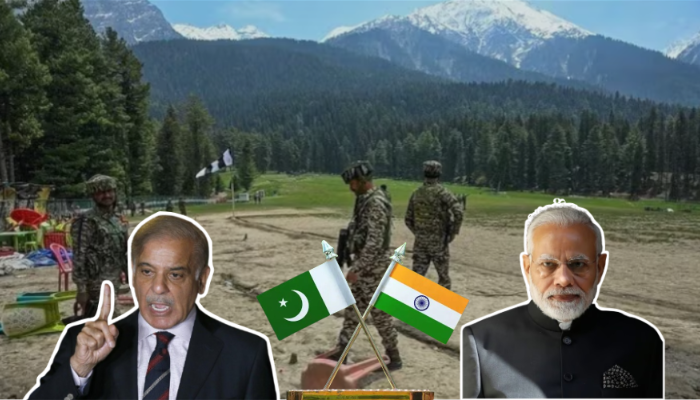
The global community has expressed its concerns following the attack by terrorists supported by Pakistan, which resulted in the deaths of 26 Hindu tourists and wounded many others in the Baisaran valley of Pahalgam. The Indian government has held talks with various officials from other countries and vice versa following the strike. Despite Pakistan’s provocative statements with religious undertones, India remains resolute in its commitment to hold the perpetrators and their enablers accountable for the horrific instance.
Meanwhile, world has implored India to show restraint and mitigate tensions, wary of the possibility of serious altercation between two nuclear-armed countries. The United States urged India and Pakistan to work together to de-escalate tensions and avoid an impending conflict. Secretary of State Marco Rubio talked with top officials from both countries on 30th April, urging them to “maintain peace and security in South Asia.”
According to a State Department statement, he told Pakistan’s Prime Minister Shehbaz Sharif that the terror assault must be condemned and direct communications restored. He asked Pakistani officials to cooperate “in investigating this unconscionable attack.” He also spoke with External Affairs Minister, Subrahmanyam Jaishankar. The United States expressed condolences to the victims and assured assistance for “India’s fight against terrorism.”
State Department spokesperson Tammy Bruce state that Marco Rubio “is encouraging other national leaders and Foreign Ministers to reach out to the countries on this issue.” She added, “Obviously, we’re also monitoring the developments across the board in that region, and we are in touch with the governments of India and Pakistan at multiple levels. We are encouraging all parties to work together for a responsible solution. The world is watching this.”
“Every day action is being taken, in this case the Secretary speaking directly to his counterparts in India and Pakistan, and well we expect certainly the impact he’s usually had with the individuals he’s spoken with and certainly with President Donald Trump’s leadership, India and Pakistan having those conversations,” she further claimed. The phone conversations were the first time the US administration has sought out to the leadership of India and Pakistan since tensions erupted over the assault, which New Delhi maintained had “cross-border linkages.”
Russia encourages to exercise restraint, maintain dialogue
On 28th April, Russia advised India and Pakistan to exercise patience and participate in constructive discussion to address their differences peacefully. A discussion took place between Deputy Foreign Minister Andrey Rudenko and Muhammad Khalid Jamali, the Ambassador of Pakistan to Moscow. Afterward the country’s foreign ministry conveyed, “The Russian side has voiced an appeal to both sides for restraint and constructive dialogue aimed at the peaceful resolution of differences,” in a statement.
The two officials discussed several issues of Russia-Pakistan relations, including “the escalation of tensions between Islamabad and New Delhi over the 22nd April terrorist attack in Kashmir.” The ministry stated that the meeting was carried out at the request of the Pakistani diplomat.
China supports Pakistan, wants independent probe
After Pakistan asked Western countries, Russia and China to initiate an independent investigation regarding India’s alleged role in the terrorist attack, Chinese Foreign Minister Wang Yi declared China’s support for the demand. On 27th April, during a telephone conversation with Muhammad Ishaq Dar, Pakistan’s Deputy Prime Minister and Foreign Minister, he advocated for the swift commencement of an unbiased inquiry into the terrorist incident. He further hoped that the two countires would demonstrate restraint and work towards reconciliation.
Wang Yi took this phone call at the request of Ishaq Dar, who briefed him on the latest events after the assault. According to The Global Times, Wang Yi noted that China was “closely following” the developments and continually “supports Pakistan’s firm counter-terror actions”. He alleged that combatting terrorism is a shared responsibility of all nations. Moreover, he stressed that China was Pakistan’s steadfast friend and cooperative partner regardless of situation.
China recognized Pakistan’s security concerns as valid and he expressed his support for maintaining Pakistan’s sovereignty and security interests. He emphasized that an India-Pakistan dispute is not conducive to regional peace and stability and it will not serve the fundamental interests of the two nations. He then hoped that both parties would “exercise restraint, move toward each other, and work to deescalate tensions.”
“As the neighbour of the two countries, China calls on the two sides to exercise restraint, solve differences through dialogue and jointly keep the region peaceful and stable,” Chinese Ministry of Foreign Affairs spokesperson Guo Jiakun stated.
UK wants calm and dialogue between India and Pakistan
The United Kigndom government has appealed for calm and discourse between India and Pakistan in the midst of rising tensions. Foreign Office Minister Hamish Falconer responded to a “Urgent Question” posed in the House of Commons on 29th April by Labour MP Gurinder Singh Josan over Britain’s involvement in assisting India in bringing the culprits to justice.
He highlighted concerns that regional strife could translate into unrest on UK streets, as seen in protests characterized by provocative speech and actions, such as a throat-slitting gesture made by a Pakistani official and the destruction of windows at the Pakistan High Commission in London.
Hamish Falconer replied, “The horrific terrorist attack in Pahalgam in Jammu and Kashmir on 22nd April was devastating. We call on all sides, all community leaders and all involved to call for calm at a time of tension in the region. We are aware of reports of the video that my honourable friend refers to; the Metropolitan police are investigating, so I will not provide any further commentary on that particular incident, but it is obviously concerning.” A Pakistani official was captured on camera making a threatening gesture toward Indian protesters.
“We take seriously our responsibility for the security of all embassies and high commissions under the Vienna Convention, so both the Pakistani and Indian High Commissions will receive all the support of the UK state to ensure that they stay safe,” he added. Priti Patel, the Shadow Foreign Secretary, was among the MPs who inquired of the minister about the “cross-border associations with Pakistan concerning the perpetrators of this terrorist act” and the initiatives underway to prevent escalating tensions among UK communities.
“We want to see the perpetrators held to justice properly, and we will be supporting India to do so. We are playing our role to try to ensure that tensions do not escalate. Many of us in this House are familiar with the tense and storied history between the two countries. We are friends to them both, and we do not want to see an uncontrolled escalation in tensions,” Hamish Falconer asserted.
The minister restated the UK’s long-standing position that India and Pakistan must find a long-term solution to the Kashmir crisis while taking into account the wishes of the Kashmiri people. “It is not for us to prescribe a solution,” he stated while advocating for “direct dialogue” between both countries.
He alleged, “This escalation is unsettling for communities within the UK. British Pakistanis and British Indians are valued parts of our community, but we look to all community and faith leaders to spread the message that now is the time for coming together across religious and ethnic differences, not to play out the tensions between two states on the streets of the UK, and we will continue to send that message.”
Gulf nations call to de-escalate tensions
On 30th April, Dubai, Qatar, Saudi Arabia and Kuwait voiced profound concern about the escalation between India and Pakistan following the Pahalgam terror attack, imploring both sides to exhibit caution and address the problem through diplomatic avenues. The Ministry of Foreign Affairs of Qatar has reaffirmed the country’s complete support for all initiatives focused on reducing tensions between India and Pakistan, advocating for the resolution of their unresolved matters through dialogue and peaceful approaches.
“Dialogue remains the optimal approach for addressing regional and international crises and disputes,” the statement conveyed, citing Qatar’s “deep concern” about India-Pakistan tensions. It invited the two nations to “exercise maximum restraint, prevail the voice of wisdom, respect the principles of good neighbourliness and resolve the crisis through diplomatic channels.”
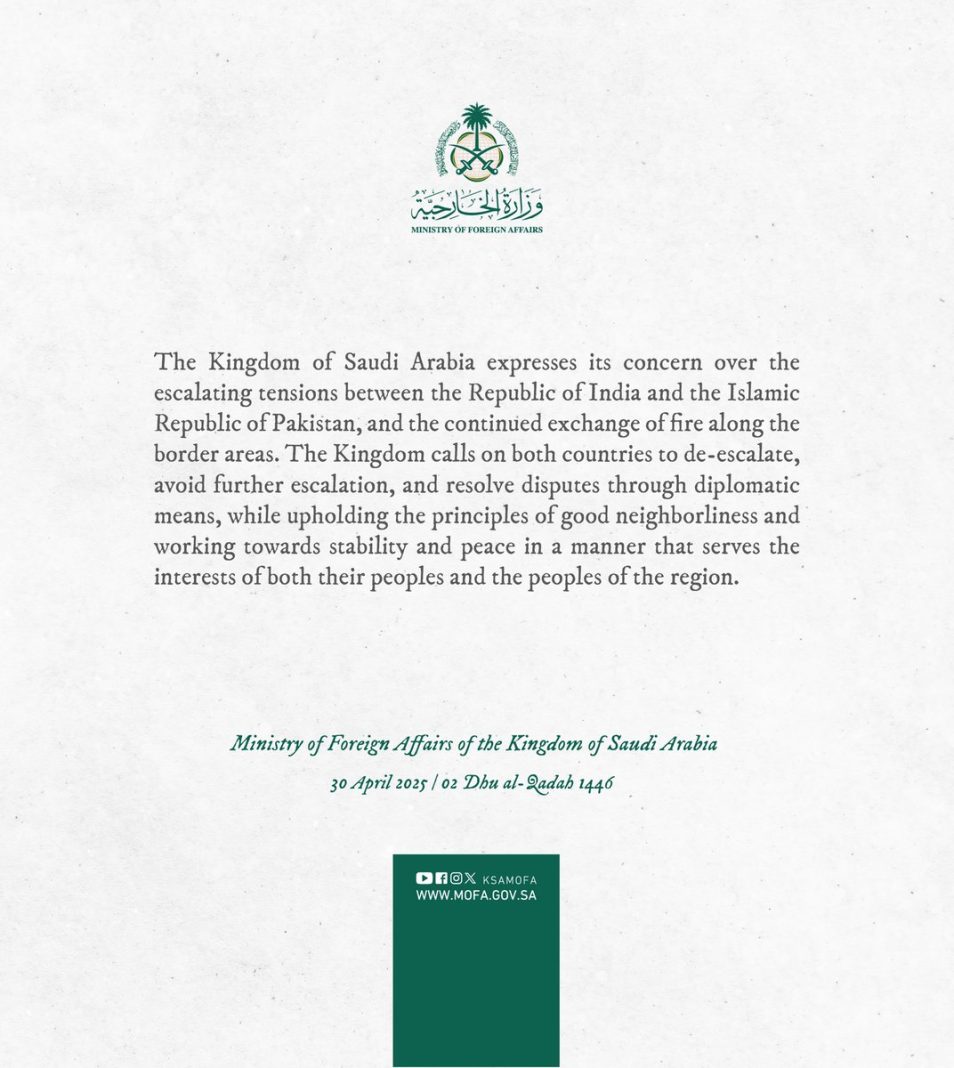
Saudi Arabia’s foreign affairs ministry communicated concern about the escalating tensions between India and Pakistan, as well as the continued exchange of fire along the border areas, in a statement, saying, “The Kingdom calls on both countries to de-escalate, avoid further escalation, and resolve disputes through diplomatic means.” It urged India and Pakistan to follow the ideals of good neighbourliness and work for stability and peace for the benefit of their people and region.
Kuwait’s Ministry of Foreign Affairs announced in a statement that it is following the tension between “the friendly” India and Pakistan with “great concern and interest.” It stated, “The ministry affirms Kuwait’s firm and unwavering position in supporting the diplomatic process and emphasising reason and dialogue in resolving all regional and international issues. The ministry also calls on all parties to exercise self-restraint, avoid escalation, and adhere to the provisions and rules of international law and the principles of good neighbourliness, with the aim of achieving constructive dialogue that achieves regional and international security and stability.”
UN officials voice “deep concern”
United Nations spokesperson Stephane Dujarric mentioned, “This morning, he (Antonio Guterres) spoke separately by telephone with Muhammad Shebaz Sharif, the Prime Minister of the Islamic Republic of Pakistan, and he also spoke earlier in the day with Subrahmanyam Jaishankar, the Minister for External Affairs of the Republic of India,” while briefing journalists at UN Headquarters in New York.
During the calls, the UN secretary-general restated his strong condemnation of the 22nd April terrorist strike, highlighting “the importance of pursuing justice and accountability for these attacks through lawful means.” He raised serious worries on “rising tensions between India and Pakistan and he also underscored the need to avoid a confrontation that could result in tragic consequences.” The Secretary-General also offered to assist with mediation and de-escalation efforts.
The President of the 79th session of the United Nations General Assembly, Philemon Yang claimed to be “deeply concerned” by the escalation of violence between India and Pakistan, according to Sharon Birch, Spokesperson for the Office of the President of the General Assembly. He shared his heartfelt sympathies to the families of the victims of the assaults, noting that “targeting civilians is unacceptable and cannot be justified under any circumstances.” He called on both countries to exercise maximum caution and resolve the matter diplomatically.
European Union advocates for military restraint
The European Union (EU) has asked India and Pakistan to exercise caution and engage in discussion as tensions increase in the Indian subcontinent following the terrorist attack in Pahalgam. EU spokesperson Anouar El Anouni stated, “The EU has consistently underlined the need for a peaceful solution to the situation rooted in dialogue and engagement. This is especially important in the aftermath of this terrorist attack,” while talking to DW at the daily press conference in Brussels.
He added, “It is crucial to show restraint and refrain from military, political, economic, legal or other measures that could undermine regional stability.” He added that the EU hoped that avenues of communication between the South Asian adversaries would stay open.
Concerns among the international community surged as Pakistan’s information minister, Attaullah Tarar, alleged that Islamabad had “credible intelligence” suggesting that India was orchestrating an imminent military strike, pledging a “decisive response,” on 30th April. He claimed, “Pakistan has credible intelligence that India intends to launch a military strike within the next 24 to 36 hours using the Pahalgam incident as a false pretext. Any act of aggression will be met with a decisive response. India will be fully responsible for any serious consequences in the region.”
On the other hand, India is expanding its negotiations with its close partners, and Union Defence Minister Rajnath Singh will travel to Russia to participate in the country’s 9th May Victory Day celebrations, in addition to holding discussions on subjects of mutual concern. Amid ongoing diplomatic talks, India is poised to host the President of Angola, Joao Manuel Goncalves Lourenco, from 1st to 4th May, indicating that the existing tensions with Pakistan will not disrupt the intended diplomatic events in New Delhi.
What happened in Pahalgam
On 22nd April Pakistan based terrroists opened fire on tourists in Pahalgam after confirmg their Hindu identity. They were questioned about their identity cards, instructed to recite verses from the Quran and even had their trousers lowered to verify their non-Muslim status. The police released sketches of the three terrorists involved for the attack and announced a reward of Rs 20 lakh for any information leading to their detention.
The two Pakistani terrorists are Hashim Musa (also known as Suleiman) and Ali Bhai (alias Talha). Adil Hussain Thoker, a local Lashkar-e-Taiba terrorist is believed to be the third attacker. He returned to Jammu and Kashmir sometime last year after visiting Pakistan in 2018 and undergoing training at terror camp.
The government also issued a notice for Pakistani nationals in India to leave the country. The deadline for those holding SAARC (South Asian Association for Regional Cooperation) visas to exit India was set for 26th April while those with medical visas were required to leave by 29th April.
The Modi administration enacted a series of significant actions, such as banning the country’s social media accounts and opting to suspend the Indus Water Treaty in reaction to the atrocious assault. Pakistan has also asked Indian nationals to leave the country. The diplomatic relations between the two nations have reached an unprecedented low. All trade between the two nations has come to a halt.
Recently, an incident of a ‘Muslim gang’ preying on Hindu girls came to light from Bhopal, Madhya Pradesh. Now a new revelation has been made in this case of ‘love jihad’. Investigation has revealed that the main accused Farhan was planning to sell the videos of the girl students to porn sites. Evidence of this has been recovered from his phone. Farhan had hatched this conspiracy to apparently ‘teach a lesson’ to a girl student, who had started ignoring him.
Farhan got the idea of selling the video to porn websites from his friends and fellow accused Abrar and Nabeel. Actually, the girl living in Indore had started ignoring Farhan continuously while he was forcibly pressuring her to meet him. He had also created a ruckus in the girl student’s house in Indore. But the girl student did not agree to meet him. To teach the girl a lesson, Farhan along with his friends made a plan to sell her video to a porn site.
According to the police, Farhan was in contact with a porn site and was going to sell the obscene videos of the victim girl students on those sites. A link to sell the video on a porn site and evidence of searching for porn has been found on his mobile phone, in which the fellow accused Abrar and Nabeel were helping him. Both of them taught Farhan how to sell videos on porn sites.
Abrar and Nabeel were close to Farhan
Accused Abrar and Nabeel also played an important role in the whole case. Both the accused used to call the girls to their room sometimes in the name of studies and sometimes in the name of party. Mobile cameras were already set up at secret places in the room. In the name of party, cigarettes filled with marijuana were given to the girls along with loud music. Main accused Farhan also often used to bring girls to the room of these two. Abrar and Nabeel were Farhan’s juniors in college.
Abrar and Nabeel are absconding since Farhan’s arrest. Two police teams have been searching for them in West Bengal and Bihar for the last five days. More than 10 hideouts of the accused have been raided. More than a dozen relatives and friends have been questioned. Abrar and Nabeel are constantly changing their locations. Abrar’s last location was traced to Murshidabad. However, he is originally from Bihar.
On Wednesday (30th April 2025), the police produced Farhan in the court through video conferencing. Earlier on April 13, 2025, he was sent to judicial custody. Now, the Ashoka Garden police will take the accused on 5-day remand.
Club-90 restaurant operator also part of the exploitation of Hindu girls
Farhan used to bring Hindu girls to a restaurant named Club 90 in Bhopal. He used to visit there almost every day. He used to call the girls to this location and misbehave with them. Then, from there, he used to take them to night clubs, parties and big hotels. The pictures that the police have found on Farhan’s phone are of this restaurant which is just 100 meters away from the girls’ college.
The police reached Club-90 with Farhan on Wednesday (30th April, 2025). Here, 7 rooms were found at the back, in which beds were kept. The restaurant operator used to give cabins to sit for hours in the name of privacy. He also used to provide marijuana. The police have sealed the restaurant. Now the police is also likely to make the operator an accused in the case.
Sahil’s Dance Academy main hub
SIT investigation has revealed that accused Sahil’s dance academy was the main hub of this exploitation racket. Records of 30 girls learning dance have been found from there. All the girls are Hindus. Sahil also used to do event management. In the name of this, he also used to send girls to many big events.
Recently, the case of love jihad with the Hindu girl students of a private college in Bhopal came to light. The case was revealed on April 18, 2025 when the first victim lodged a complaint at Bagh Sewania police station. The victim said that the accused Farhan was forcing her to introduce her friends to his friends. Later, those girls were also sexually exploited. Police suspect that the number of victims and accused may increase. That is why the scope of investigation of the case has been increased.
CM Mohan Yadav issues warning
In the case of the Love Jihad gang being exposed in Bhopal, the state CM Mohan Yadav has issued a warning. He said that Madhya Pradesh is known for good governance and whoever is found involved in the crime will be given strict punishment. “Whether the criminal is within the state or has fled the state. The police will catch him and bring him and punish him according to the law”, the MP CM said.
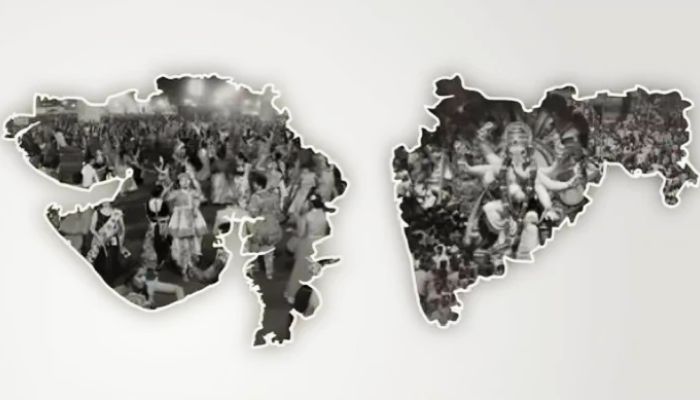
The world celebrates International Workers’ Day on the 1st of May, this day is also special for the people of Gujarat and Maharashtra. This is because on this day, 64 years ago, the two states were formed. Today, the Gujarati people celebrate Gujarat Foundation Day. The greatness of the state, ancient culture, and the heritage of Gujarat are celebrated on this day. Moreover, the brave activists of the Mahagujarat Movement are also remembered on this day. On this day, special celebrations are held at all government offices in the state.
Maharashtra also celebrates Maharashtra Foundation Day on the same day. The great Maratha Empire of Chhatrapati Shivaji Maharaj, also known as the Hindu Empire, is fondly remembered as well on this day. May 1st brings special enthusiasm in both neighbouring states as both states were born together and at the same time. On the 1st of May 1960, two regions were separated from the state of Greater Mumbai, Gujarat and Maharashtra. Since 1960, May 1st has been celebrated as Gujarat and Maharashtra Foundation Day every year.
Ancient Gujarat – Anarta Desha and Gurjar Dhara
Speaking of the ancient history of Gujarat, it goes back to the Vedic era. In the Vedic period, Gujarat was known as Anarta Desha. Anarta Desha has been mentioned repeatedly in ancient texts. Special mention is made of historical places like Somnath Temple, Garvo Gadh Girnar, etc. At that time, Saurashtra of Gujarat was known as Surashtra.
Historians even say that at one time, the Saraswati River may have flowed all the way to Gujarat. Besides, Gujarat is also mentioned in the Mahabharata. The notable mention of Dwarka and Gujarat comes during the exile of Pandavs and the Mahabharata war in Bhishma Parva. Lord Krishna had established the city of Dwarka in Saurashtra of Gujarat and founded the kingdom of the Yadu dynasty. It can be assumed that the Viratnagari, where the Pandavas lived during their exile, may have also been in Kutch, Gujarat.
The history of Gujarat is rooted in Dwarka and the Indus Valley Civilisation
Historically, Gujarat’s heritage is also considered to be advanced and magnificent. Since ancient times, Gujarat has been considered the economic hub. Gujarat traded with many foreign civilisations from its vast coastline. Along with this, remains of the Indus Valley Civilisation have also been found at 50 places in Gujarat like Lothal and Dholavira. In fact, the Indus Valley Civilisation was a part of the Dwarka Civilisation. The remains found from Lothal and Dholavira prove that the history of ancient Gujarat was magnificent and rich.
The cities of Gujarat were known for being ports and trading centres of the Maurya and Gupta empires. Gujarat has seen the rule of many kings and Nawabs, however, its folk culture has not been forgotten. Particularly, in Kutch and Saurashtra, Gujarat and its ancient folk culture continues to prosper. Gujarat’s glory remained intact until the Rajput era (Solanki, Vaghela etc., kings). After that, Islamic rule was imposed in Gujarat. Due to this, religious fanaticism spread in Gujarat. After that, the Maratha Empire ruled Gujarat in the 18th century, followed by the British Raj.
Independence and establishment of the Greater Bombay State
India gained independence on the 15th of August 1947. After that, it was time to bring the separated parts of the country together. This heroic task fell to the Iron Man Sardar Vallabhbhai Patel. A debate erupted over the basis on which the states should be formed. After that, the government under the leadership of Jawaharlal Nehru was making a plan for the formation of states. In 1947, the then government had established three states by merging the princely states in the western part. These states were Saurashtra, Kutch and Mumbai.
In 1953, there was a demand for separate linguistic states across the country. In December 1953, Prime Minister Nehru formed the ‘State Reorganisation Commission’ (SRC) to form linguistic states. This committee was headed by Justice Fazal Ali. Hence, it was also called the Fazal Ali Commission. In 1956, this committee submitted a report for the reorganisation of the states of India. Along with this, based on the report, the Mumbai state was expanded by adding Kutch, Saurashtr, Hyderabad and some parts of Madhya Pradesh, and it was named Greater Mumbai State
Mahagujarat Movement and United Maharashtra Movement
The newly created Greater Mumbai state had Gujarati-speaking people in the northern part and Marathi-speaking people in the southern part. Apart from this, there were also people speaking Kutchhi and Konkani in the state. The Kutchhi-speaking people called themselves Gujarati and the Konkani-speaking people backed the Marathi movement. In short, the main movement for separate states was of Gujarati and Marathi-speaking people. At that time, discrimination on the basis of language had started between the people of both languages.
Both Gujarati and Marathi people had demanded separate linguistic states, and demonstrations were held in many places for that. The situation had become very serious as Gujarati people demanded a separate state, and Marathi people a separate state. But more trouble arose when both the people demanded that the financial capital, Mumbai, be included in their state.
At that time, PM Nehru suggested the establishment of three states to resolve this situation. Maharashtra, Gujarat and the centrally administered city-state of Mumbai. Protests broke out in Mumbai and other Marathi speaking districts demanding a separate Marathi state. This later came to be known as the ‘United Maharashtra Movement’.
The decisive turning point in this movement came on August 8, 1956, when some college students in Ahmedabad went to the local Congress office at Lal Darwaza with a demand for a separate state. At that time, Morarji Desai did not listen to them, and 5 to 8 students died in police action. Its repercussion was felt by all Gujarati people. Indulal Yagnik came out of retirement and established the Mahagujarat Janata Parishad to give direction to the movement. Many agitators like Indulal Yagnik and Dinkar Mehta were also arrested at the time.
Birth of Gujarat and Maharashtra
People from both sides started movements with the demand for separate Gujarat and Maharashtra. The agitations even escalated to violence in some cases. Important agitators in the Mahagujarat movement included Indulal Yagnik (leader of the movement), Sanan Mehta, Dinkar Mehta, Vidyagauri Neelkanth, Shardaben Mehta, Ashok Bhatt, Buddhiben Dhruv, Ravi Shankar Maharaj, Brahmakumar Bhatt, Prabodh Rawal, Harihar Khambholja, Dinkar Amin, Ramniklal Maniyar, Ranjitray Shastri and Markand Shastri. Most of the leaders of the movement were writers, poets and film producers.
The plan for the proposed state were repeatedly hampered due to linguistic differences. There were agitations from both sides. Seeing the pace of protests in various parts of the state, the then government decided to prepare the Bombay Reorganisation Act. After the bill was introduced in the Parliament, it became a law. On May 1, 1960, the law came into force, and Gujarat and Maharashtra were separated from the state of Greater Mumbai. At that time, the economic capital Mumbai was given to Maharashtra and Dang to Gujarat.
On the 1st of May 1960, the state of Gujarat was established by the leader of the Mahagujarat movement, Ravi Shankar Maharaj. Along with that, the Mahagujarat Janata Parishad was also dissolved. A new government was formed, and Jivraj Mehta became the first Chief Minister of Gujarat. On the other hand, the state of Maharashtra was also established on the same day. Since then, May 1 is celebrated as Gujarat and Maharashtra Foundation Day.
Notably, the Gujarat government has declared May 1st as ‘Gujarat Gaurav Diwas’, and it is celebrated every year in all the districts. Usually, various development and public utility works are started or inaugurated on that day. Many programs are also organised in schools on this day on topics like the history of Gujarat.