In her opening speech today (January 31) during her confirmation as the National Director of Intelligence in the Trump administration, Tulsi Gabbard launched a scathing attack on the previous democratic government for the US ‘invasion of Iraq’. The former US Senator from Hawaii said that the ‘complete failure of intelligence’ on the part of the Bush administration was responsible for the US-led invasion of the Middle Eastern country.
“For too long, faulty, inadequate or weaponised intelligence has led to many costly failures and the undermining of our national security and God-given freedoms enshrined in the constitution. The most obvious example of one of these failures is our invasion of Iraq based upon a total fabrication or complete failure of intelligence,” Tulsi said.
Gabbard, the first Hindu American to be elected to the House of Representatives, criticised the US attack on Iraq as a ‘disastrous decision’ that resulted in the death of thousands of American soldiers and the emergence of Jihadist groups. “This disastrous decision led to the deaths of tens of thousands of American soldiers, millions of people in the Middle East, mass migration, destabilisation, undermining of the security and stability of our European allies, the rise of ISIS, strengthening of Al-Qaeda and other Islamist-Jihadist groups and strengthening Iran”, she added.
Iraq invasion was a 'disastrous decision' — Tulsi Gabbard who lists off the consequences:
Gabbard, a former Democrat, was nominated by Donald Trump as the Director of National Intelligence, overseeing US intelligence agencies including the CIA and the FBI.
The US narrative of ‘weapons of mass destruction’ and the Iraq war
Following the 9/11 terrorist attacks in the US, the Bush administration announced an all-out attack at the global level against terrorism. The Iraq war was part of the broader campaign against terrorism called the Global War on Terrorism. On March 19, 2003, a US-led coalition of countries including Australia, Denmark, Netherlands, Poland and Britain on Iraq on the pretext of the use of ‘weapons of mass destruction’ by the Saddam Hussein regime against his neighbours and the people of Iraq. The war went on from 2003 to 2011.
The Iraq invasion was not an overnight decision but the culmination of a series of occurrences. The Saddam Hussein regime was accused of violating the Gulf War Settlement between Iraq and the US which included the imposition of a cease-fire, sanctions, reparations and weapons inspections on Iraq. Baghdad had allegedly refused to allow access granted to the US under the Settlement. The CIA sought UN intervention in the violation of the Gulf War Settlement by Iraq by acquisition of ‘weapons of mass destruction’. Failing to receive a mandate from the UN to invade Iraq to ‘disarm’ it, the US-led coalition launched an attack on Baghdad.
Colin Powell and the glass vial
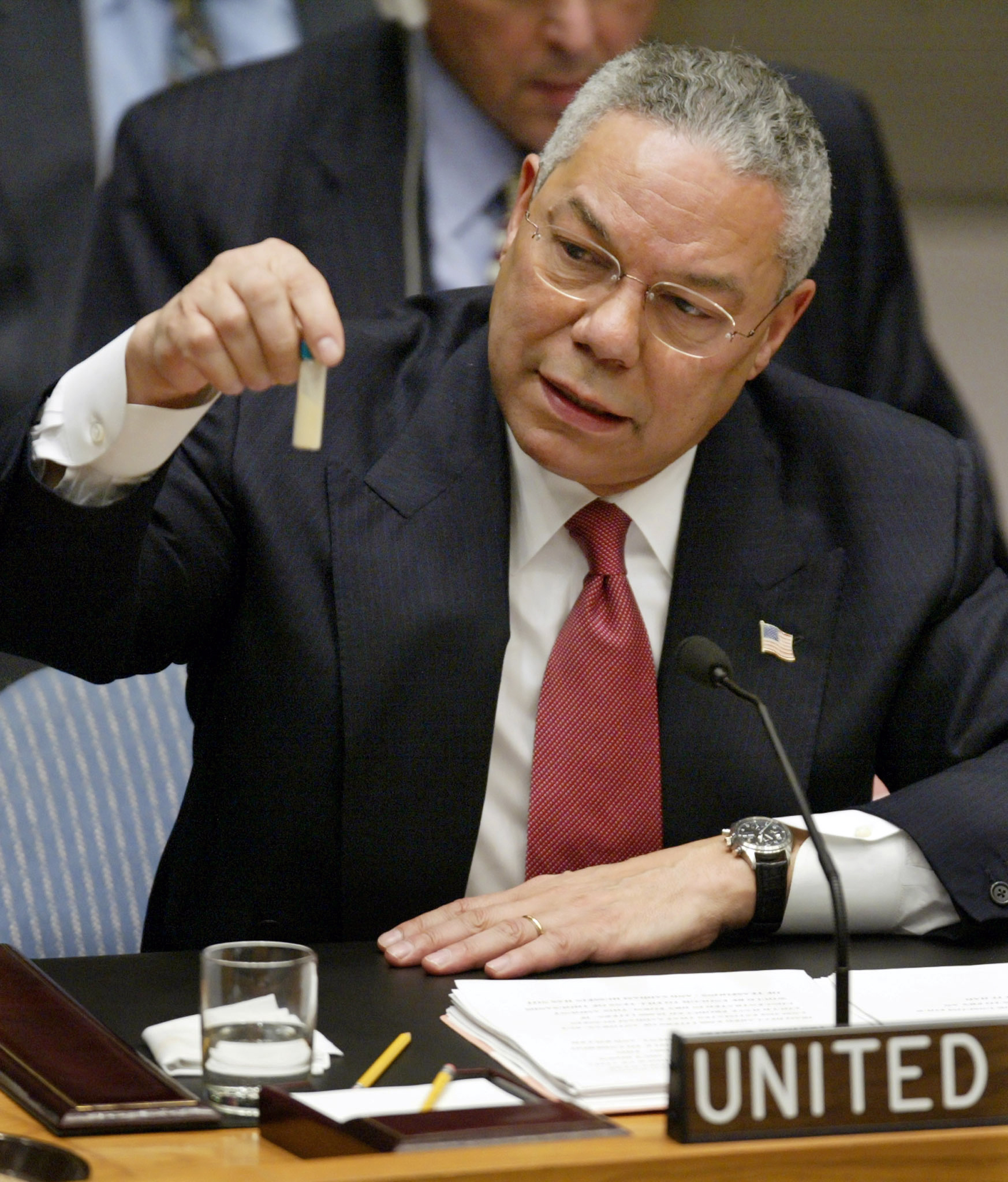
In the events leading up to the ultimate action, one pivotal moment that stood out was when the US Secretary of State Colin Powell made a case for the invasion of Iraq in his speech before the United Nations Security Council (UNSC).
The picture of Powell, who famously opposed the US intervention against Saddam Hussein’s regime in Iraq, holding a vial in his hand in the UNSC became a historic visual. On 5th February 2003, as the US was preparing to invade Iraq, Powell sat before the UNSC explaining how the content of the vial could be anthrax that Iraq for the invasion of Iraq. Powell claimed that the Saddam Hussein regime in Iraq was using chemical weapons against its neighbours. “Sadam Hussein has chemical weapons. Saddam Hussein has used such weapons. And Saddam Hussein has no compunction about using them again- against his neighbours, and against his own people, ” Powell claimed before the UNSC. He said that his every statement was backed by ‘solid sources’.
Former Secretary of State, US, Colin Powell holding a vial before the UNSC.
A month after Powell’s speech before the UNSC, the Bush administration ordered strikes over Baghdad. It marked the beginning of a military operation entitled ‘Operation Iraqi Freedom’ that lasted for about a decade in the name of ‘freeing the people of Iraq and saving the world from grave danger’ as claimed by then-US President George W Bush.
Notably, no weapons of mass destruction were found during the UN inspections of more than 70 sites preceding the US invasion. Moreover, the US military also could not find any weapons of mass destruction in Iraq.
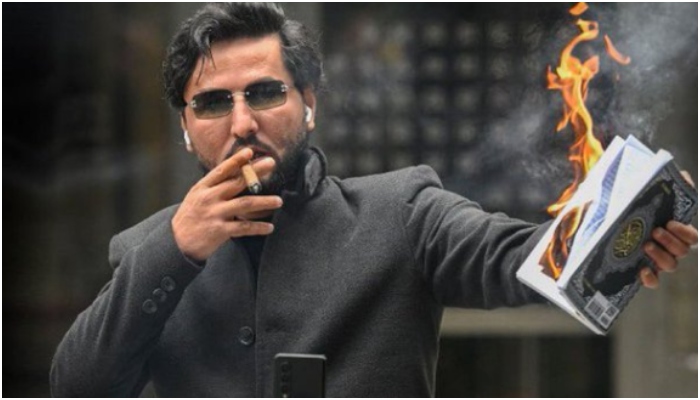
After the murder of the Iraqi Christian Salwan Momika, who organized a number of Quran burnings in 2023, Sweden’s PM stated that some foreign power might have something to do with the incident. A day after the activist was shot dead, the police arrested 5 individuals in the case. However, they did not reveal whether the shooter was among those detained.
“I can assure you that the security services are deeply involved because there is obviously a risk that there is a connection to a foreign power,” Ulf Kristersson, the Swedish prime minister said while commenting on the matter. The deputy prime minister, Ebba Busch also condemned the murder and said, “It is a threat to our free democracy. It must be met with the full force of our society.”
As per the reports, the deceased was streaming live on TikTok when he was shot. The security services said that while the police are investigating the matter, they are also constantly monitoring the events closely to see what impact it creates on the country’s security.
Notably, it has also come to the fore that the deceased Salwan Momika was living under constant threats in Sweden. In the trial, in which he was charged with inciting against a certain group, he was quoted as saying, “I live under death threats after al-Qaida published a statement threatening me. And the Iraqi state has issued an arrest warrant for me and put me on the red list. The Iraqi and the Taliban government are looking for me.”
Mårten Schultz, a legal commentator commented in the case that Sweden would become an unsafe place to stay if it appeared that alleged religious criticism led to Momika’s death. “If it turns out that it is so, it affects the image of Sweden, it would mean that Sweden can be seen as an unsafe country for people who exercise their freedom and rights. The threat picture against Momika was enormous. It is always tragic when a person is murdered, but it is particularly tragic when someone is because they have exercised their right to freedom of expression,” he said.
His lawyer Anna Roth meanwhile stated that the Swedish police provided protection to Momika only during the trials and when he participated in gatherings, but not otherwise. Former police commissioner Tage Åström backed the lawyer as he stated that the Police do not have the resources to provide personal protection to that extent.
He said that for the police to provide ‘severe’ protection, the threat must be severe. “To get protection to a greater extent, a very concrete threat is required. And if there were a very concrete threat, the person would be moved from their residence. In normal cases, you do not have protection in your home. The police do not have resources to that extent,” he said, who is now the operational manager of a security company.
In October 2023, during the war between the State of Israel and Hamas, activist Salwan Momika expressed his solidarity with the Jewish nation by stepping on the Quran and waving the Israeli flag. He was also seen kissing the Israeli flag and trampling a copy of the Quran with his foot.
On June 28, 2024, the Swedish Police gave the Iraqi refugee permission to burn the Quran at a demonstration outside the largest mosque in Stockholm. The development came ahead of Eid-al-Adha after a Swedish court struck down the police’s ban on Quran-burning demonstrations.
Salwan Momika was charged with inciting ‘ethnic hatred’ through his actions, and on Thursday, a Stockholm Court was set to pass a ruling on the same. The ruling against Momika has now been dismissed as the Court said that he has died. The Quran burnings in Sweden had strained the country’s ties with several Islamic countries, with massive protests in Muslim-majority countries.
Salwan Momika and another man Salwan Najem were charged with “offences of agitation against an ethnic or national group”.
Days after former Bollywood actor was inducted into Kinnar Akhara and anointed as a Mahamandaleshwar at the Maha Kumbh Mela in Prayagraj, she has been expelled from the Akhara. Mahamandaleshwar Laxminarayan Tripathi, who inducted Kulkarni into the Akhara, has also been removed by Rishi Ajay Das, founder of Kinnar Akhara, for allegedly taking the action without authorization.
A statement issued by Rishi Ajay Das on 30 January 2025 said that he is reliving Acharya Mahamandaleshwar Laxmi Narayan Tripathi from the post because he has strayed from the duties. Das added that earlier in 2019, Tripathi had entered into a written contract with the Juna Akhara without his consent. “Contract between Juna Akhara and Kinnar Akhara without the consent and signature of the founder is not legal,” he said.
Rishi Ajay Das, founder of Kinnar Akhara, expels Mamta Kulkarni from the Akhara. He has also expelled Mahamandaleshwar Laxminarayan Tripathi from the Kinnar Akhara for inducting Mamta Kulkarni, who is accused of treason, to the Akhara and designating her as Mahamandaleshwar… pic.twitter.com/Hhzezst49r
Talking about Mamata Kulkarni, the Kinnar Akhara founder said that she is accused of treason and associated with film glamour, and she was inducted into the Akhara without following any religious or Akhara traditions. Das said that instead of directing her towards renunciation, she was given the title of Mahamandaleshwar, which is against the interests of Sanatan dharm.
As a result, he was forced to relieve her from the post in the interest of the country, Sanatan and society, Rishi Ajay Das wrote.
He further added that by entering into an illegal contract with Juna Akhara, all the symbols of Kinnar Akhara have also been damaged. “These people are neither following the principles of Juna Akhara, nor the principles of Kinnar Akhara,” he said. Giving an example, he said that at the time of the formation of Kinnar Akhara, it was tradition to wear Vaijanti Mala around the neck, but they t they abandoned it and started wearing the Rudraksha Mala.
“Which is a symbol of renunciation and renunciation is not valid without Mundan Sanskar. In this way, they are cheating the Sanatan Dharma lovers and the society. Hence, it was necessary for me to give all this information in public interest and in the interest of religion through the press conference today,” the Kinnar Akhara founder added in the statement.
Notably, Mamta Kulkarni was anointed as a Mahamandaleshwar in the Kinnar Akhada at the Maha Kumbh Mela in Prayagraj on 24 January. The announcement was made by Acharya Mahamandaleshwar Laxmi Narayan Tripathi, of Kinnar Akhada. It was also announced that the former film star will be known as Shri Yamai Mamta Nandgiri.
As per reports, Mamta performed her “Pind Daan” ritual at Sangam Ghat in Prayagraj to mark her renunciation of worldly ties.
Acharya Mahamandaleshwar Laxmi Narayan Tripathi said that Kulkarni has been in touch with Kinnar Akhara and him for the last one and a half years. He that she was also in contact with Juna Akhara before contacting the Kinnar Akhara.
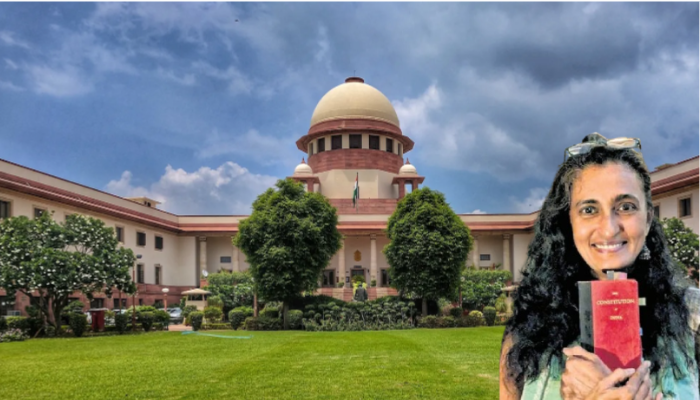
There has been an intriguing development in the Indian judicial landscape that could culminate in fundamental modifications in relation to the personal laws in the country. Safiya PM, a Muslim woman from Kerala, petitioned the Supreme Court and requested that as she is not a believer, the Indian Succession Act should apply to her concerning the matters of inheritance, not the Muslim Personal Law (Sharia Law).
Afterwards, the apex court on 28th January expressed that non-believers and apostates born in other religions should have the same rights if Muslim women who have renounced their faith are permitted to be governed by the Indian Succession Act rather than Muslim Personal Law. The court then ordered the central government to provide an explanation of its stance on the issue within four weeks.
It pointed out the wide-ranging implications of such an amendment in the law, which might determine how religious law applies to people who have rejected the faith they were raised in. The bench was led by Chief Justice Khanna, comprising Justices Sanjay Kumar and KV Viswanathan. The court even stated that “under the Hindu Succession Act, if you convert, your inheritance is taken away, if you convert, you lose your right of inheritance.”
However, Solicitor General Tushar Mehta who was representing the Union of India countered that the Hindu Succession Act’s limitations did not affect the ability to inherit through a will, but the Chief Justice responded that there were also instances of joint Hindu family property and intestate successions. The court highlighted, “There are legal provisions that disqualify persons after conversion or renouncing faith in other religions as well. You will have to put your reply on record,” and granted time to the Centre to file its counter affidavit.
It further stated that any change in the law would necessitate revisions to several legal documents and processes, which would have an impact on different religious communities. The Chief Justice also observed that alterations to official forms would need to be taken into consideration if the petition was successful. “Where (in a form) you have to mention your religion, the option not to mention one’s religion must be there or it ought to be waivable,” he added. According to Justice Viswanathan, such a choice can be categorized as a “private right.”
Tushar Mehta admitted to the court’s evaluation of the issue’s broad ramifications and assured that a “well-considered” response would be submitted. He acknowledged that the petition raised an intriguing query and that the central government should be given the opportunity to submit a comprehensive counter-affidavit.
What is inside the petition
Speaking on behalf of Safiya, attorney Prashant Padmanabhan stated that under Muslim Law, his client would only receive a third of her father’s property and she had to care for her brother, who had autism. She had challenged Section 58 of the Indian Succession Act, 1925, which expressly excludes Muslims from its scope, he further revealed. The Chief Justice asked if her father, who was subject to Muslim law, would be barred from leaving her his entire property. Padmanabhan maintained that a person who abandoned her religion shouldn’t be disqualified or disabled in regard to inheritance or other significant civil rights.
He cited the core secularist tenet that “allows each individual the fullest liberty to believe or not to believe and treats all religions on an even platform.” The plea read, “Persons who do not want to be governed by the Muslim Personal Law must be allowed to be governed by the secular law of the country, viz, the Indian Succession Act, 1925 both in the case of intestate and testamentary succession.”
It further pleaded, “The practices under Sharia Law (Muslim Personal Law) are discriminatory towards Muslim women and violate the fundamental rights guaranteed under the Constitution. The reason why the petitioner is not following the tenets of Islam is discriminatory practices of Sharia Law. It will be a failure of justice if the petitioner is to be governed by Sharia law, even if she officially leaves the religion.”
The petition underscored that even if she received a formal certificate from an authority stating that she was not religious or caste-related, she would still have no way to inherit the property due to the legal void. It mentioned, “The petitioner wishes to get a declaration that she shall not be governed by Muslim Personal Law for any of the matters listed in Sections 2 or 3 of the Muslim Personal Law (Shariat) Application Act, 1937. There is a clear vacuum in the statute which can be plugged by judicial interpretation.” Padmanabhan contended that this situation constituted a clear infringement on the basic freedom guaranteed by Article 25 of the Constitution to believe (or not believe) in a religion.
Who is ex-Muslim Safiya PM
51-year-old Safiya PM, a native of the Alappuzha district in Kerala, described herself as an “ex-Muslim” and is an activist. She also serves as the Kerala Ex-Muslims’ general secretary. The organization was started by ten individuals and was registered in 2020. However, she was catapulted into the spotlight as she is at the centre of the judicial dispute for the property rights of Muslim women who are now non-believers.
According to her writ petition, she would want to be governed by the Indian Succession Act, 1925 rather than Sharia or Muslim Personal Law as she no longer identifies with the religion. Her request, according to activists, is an important step in the struggle for the fundamental rights of those who want the government to accept their identity choice of “No Religion, No Caste.” According to Safiya, those who abandon their religion are put in a dangerous position because neither secular nor religious laws would protect them if there were no provisions for their inheritance rights. A person who leaves Islam forfeits all inheritance rights in accordance with Sharia Law.
She has been divorced since 2004 and reportedly raised her 25-year-old daughter alone. “I am a single mother who got divorced 20 years ago and my daughter is 25. I relinquished the religion and joined the Ex-Muslims of Kerala movement four years ago. Being born to Muslim parents, my religion was mentioned as Islam in the SSLC book. But that was not my choice. I have given up the religion and my father is not a practicing Muslim,” she conveyed.
“My fight is not just for myself, but for Muslim women who cannot leave all of their property to their daughters. The Muslim Personal Law does not allow me to leave all my property to my daughter. Only 50% of the property can be left to a girl child (under Sharia), while the rest is divided among male relatives,” she voiced and further questioned, “Why should religion have a bearing on a person who renounced faith. It is an issue affecting the lives of all women in the country, but unfortunately no one has expressed willingness to implead in the case.”
Safiya against discriminatory Sharia Law, supports UCC
Safiya disclosed that her 71-year-old father, U A Muhammad, a communist and atheist himself, will not be able to split his property evenly between his children, she and her brother with autism, under Sharia Law. If there are other heirs, a Muslim woman is only allowed to inherit a third of the family’s wealth, according to the Muslim Personal Law. A Muslim woman can only receive 50% of the family inheritance if she is the sole heir and the remaining portion will go to male family members.
“Under the personal law, my father cannot write a will that leaves the property to my brother and me,” she stated and declared, “It is a matter of equality assured under the Constitution. I have only one daughter and as per Sharia law, she is entitled to only 50% of my property. But I want to give my entire property to her. My daughter must inherit my property as per the Indian Succession Act, 1925.”
Safiya also explained her reason behind approaching the highest court and expressed, “The Muslim Personal Law is discriminatory against women and it violates the fundamental rights guaranteed under the Constitution. A person who has relinquished the religion should be governed by the Indian Succession Act in case of inheritance. But, though I have renounced the religion, I am still governed by the Muslim Personal Law, under which a woman will get only half of the share entitled to her male counterpart. My only daughter can inherit just half of my wealth and the rest will go to my brother. This forced me to approach the apex court.”
Safiya voiced that she was not aware of the personal law’s shortcomings until she experienced discrimination because of the same and highlighted, “I am all for a secular UCC (Uniform Civil Code) if it can help solve the issue.” The All India Muslim Personal Law Board is one of the prominent Muslim organizations that has regularly opposed UCC, claiming it is “discriminatory.” These Muslim bodies, outfits and leaders allege that it forbids Muslims from adhering to the principles of Islam, notably its personal law.
According to Safiya, her organization has supported her in the battle. “We are called ‘ex-Muslims’ because we face discrimination from the community if we leave the religion. On the other hand, we also have to deal with the phobia towards Muslims since we were born Muslims.” Her group has acquired support from regular people who have turned away from Islam. She stated that they educate people about patriarchal behavior in Islam and other religions.
“If a religion keeps telling you that you are only half a human being with half the rights, why would you want to follow it,” she asked. More Muslims are registering their marriages under Section 15 of the Special Marriage Act in order to circumvent the discriminatory restrictions of the Muslim inheritance legislation, according to a recent RTI application. She however countered, “Registering marriage under the Special Marriage Act will not help avoid the provisions of the Muslim Personal Law.”
She added, “As per Section 29 of the Indian Succession Act, 1925, the provisions for intestate succession, are not applicable to Muslims. Section 58 of the Act also says the provisions with regard to testamentary succession are not applicable to Muslims. We have submitted a petition before the apex court seeking to declare both these exclusions in Act, as unconstitutional, as it is violative of Articles 14, 15, 19, 21 and 25 of the Constitution.”
Supreme Court issues notices to state and centre
The Supreme Court had consented to look at the broader question of whether Muslims could be covered by a secular law controlling wills and inheritance in April of last year. The bench noted that the Indian Succession Act’s exclusion of Muslims created a number of complications, including serious difficulties for people like Safiya who no longer adhere to the religious law they were reared with.
On 29th April 2024, the Supreme Court sent notice to the union and Kerala governments, agreeing to consider a case seeking a declaration that those who do not choose to be ruled by the Muslim Personal Law shall be permitted to be governed by the nation’s secular law. A bench consisting of former Chief Justice DY Chandrachud and Justices JB Pardiwala and Manoj Misra passed a notification and asked Attorney General R Venkataramani to nominate a legal officer who could help the court decide the matter. The bench referred to the case as an “important issue.”
Padmanabhan asserted that the “fundamental postulate of secularism which treats all religions on an even platform and allows to each individual the fullest liberty to believe or not to believe” had already been emphasized by the Supreme Court. A person who abandons her faith should not be disabled or disqualified in terms of inheritance or other significant civil rights, he contended, to truly comprehend what the Supreme Court intended.
There has been discussion of the matter in court before. As the current law expressly excludes Muslims, additional solicitor general (ASG) Aishwarya Bhati, appearing on behalf of the center, contended in October of last year that extending the Indian Succession Act to the community would necessitate legislative action by Parliament.
What does Islamic law say
This development has brought Islamic inheritance law at the center stage. The rules of inheritance for both direct and indirect heirs are spelled forth in detail in Surah Nisa of the Quran. “For men there is a share in what their parents and close relatives leave, and for women there is a share in what their parents and close relatives leave – whether it is little or much. These are obligatory shares,” verse 7 stipulates.
Islam’s universally accepted property distribution laws provide that a daughter receives half of son’s portion. Therefore, if a parent leaves a son a 100-meter plot, the daughter receives only 50-meter or half of the 100-meter land’s worth. Islam states that after marriage, the man is expected to provide for the family’s needs, including housing, food, clothing, and medication, in addition to supporting his wife, his children’s education, and his parents.
If the marriage has children, the wife will receive an eighth of the husband’s property if he passes away before her. If not, she receives a quarter. As long as they are blood relations, paternal uncles, aunts and other relatives also receive a portion. If grandparents are still living, the same applies. If the son dies before them and leaves children behind, each parent receives one-sixth. A challenge arises when a couple has only one or two daughters, as was the case with the Kerala couple.
The Islamic holy book indicates that “if you leave only two or more females, their share is two-thirds of the estate,” meaning that the daughters can only inherit two-thirds of their father’s property. Furthermore, the mother and paternal blood relatives obtain their portion.
The petition has drawn attention to the restrictive character of Muslim Personal Law, which establishes gender inequities in inheritance rights and restricts a Muslim’s ability to will property to one-third of their wealth. It emphasized that Muslims who reject their faith are unable to fully benefit from the provisions of secular testamentary legislation due to the legal void created by Section 58 which governs testamentary succession for all citizens regardless of their religion, except Muslims.
On Thursday (30th January), a man identified as Mubin killed a college girl in Raichur city of Karnataka for rejecting his marriage proposal.
The accused slit the throat of the girl studying MSc at a private college in Sindhanoor town after pressuring her to marry him. The deceased girl who was 24 years old has been identified as Shifa, a resident of Lingasaguru.
As per the reports, the victim had known the accused for more than 6 years during which he had developed feelings for her. Amid this, Shifa’s parents had been planning to get her married to another man.
The accused, learning this, pressured the victim to marry him. On refusal, he attacked the girl while she was commuting from Lingasaguru to Sindhanoor. The accused stabbed the girl in the neck near the Sindhanoor Government Graduation College and slit her throat before leaving the spot.
The accused then visited the footwear shop of the person with whom Shifa’s parents had fixed her marriage. He created a ruckus there and then reached the Lingasaguru police station, surrendering for the crime he had committed.
Superintendent of Police Puttamadaiah took cognizance of the event and reached the spot to begin an investigation into the case. He ordered enhanced security at the college to ensure the safety of the students.
He also said that an FIR in the case has been registered and that the accused is being interrogated.
Muslim man murders Nega for refusing to convert to Islam
In a similar incident reported last year, a Hindu girl in Hubballi, Karnataka was murdered by a Muslim man who forced her to marry and convert her religion to Islam.
The accused identified as Fayaz killed Neha because she had refused to convert to Islam. The accused was reportedly in ‘love’ with her and had been furthering romantic advances.
But the girl had told him flat that she was not interested in his advances. Fayaz however proposed to her and on refusal murdered her. A detailed report on this account can be read here.
Intelligence agencies arrested a Pakistani-origin man identified as Mohammed Zakriya at Chennai International Airport on January 25 when he was trying to travel to Sri Lanka. The National Investigation Agency (NIA) took him into custody for interrogation. Zakriya is linked to a Pakistani terrorist organisation named Khalifa.
Zakriya has reportedly been living in India for the last 25 years and runs a food business named Royal Bawarchi Biryani in Telangana. The agencies found on him literature associated with Jamaat-e-Islami Pakistan.
Zakriya was coordinating sleeper cells in Telangana and West Bengal
As per reports, Zakriya first lived in Guntur, Andhra Pradesh for five years and then moved to Hanamkonda in the Warangal district of Telangana where he has been living for the past 20 years. Zakriya is said to have been handling the operations of Khalifa in India. He was under the watch of the intelligence agencies for coordinating sleeper cells in Telangana and Andhra Pradesh. According to the agencies, Zakriya was trying to travel to Pakistan via Sri Lanka to take part in the election of the leader of his terrorist organisation as their leader passed away recently.
Involved in Islamic religious conversions in Warangal
Zakriya is reportedly also involved in Islamic religious conversions in Warangal and converted several individuals. He runs several businesses including some biryani centres in Warangal and Hanamkonda. The agencies suspect that his food business is a cover for his terror operations. He owned 16 auto-trolley vehicles used for selling sweets and ice-creams. He was in direct contact with his Pakistani handlers through encrypted communication channels. He was involved in coordinating logistical support, financial transfers via hawala and recruitment of the local youth in his terrorist organisation.
Zakriya has two wives and ten children in India
The Intelligence agencies suspect that Zakriya was heading the terrorist organisation’s activities in India. He lived in Hanamkonda with his two brothers. He has two wives and ten children. The agencies have been interrogating Zakriya and probing his connections with the Pakistani terrorist organisation. During a raid at his residence, the security forces reportedly recovered explosives, firearms and several fake IDs.
The previous article in this series explained how the Portuguese arrived in India as traders but soon displayed their unending greed and began fighting the indigenous rulers to control the spice trade. Their onslaught, however, continued unabated because the aforementioned incidents were followed by even more brutal attacks and a greater Portuguese ambition to seize control of the entire Indian trading network along the West Coast.
The present article throws light on how they successfully repelled assaults from Indian kings and introduced brutal tactics in their warfare to enhance their dominance on the Indian subcontinent.
1503: First siege of Cochin
Calicut was regularly bombarded by the Portuguese armadas which preyed on its ships and diverted trade traffic from the city. The Zamorin soon discovered that there was little use in opposing the Portuguese fleets at sea because of the vast technological gap between the Indian or Arabic ships and the Portuguese ships fitted with bigger cannons. He also realised that the difference was not nearly as pronounced on land. Spices were the reason the Portuguese had arrived. The Zamorin reasoned that the Portuguese would either retreat or be compelled to engage in serious negotiations and reach truce if he could exercise his customary power over the Malabar nations and cut off access to spices.
The Zamorin of Calicut took a strong force of over 50,000 armed warriors overland against Cochin in March 1503, as soon as de Gama’s fleet left. Cochin was Calicut’s vassal. Cochin was a junior familial branch of the mainland kingdom of Edapalli (Repelim) and the Trimumphara Raja of Cochin was a prince who was somewhere down the line (perhaps the second heir) to the Edapalli throne rather than a monarch in his own right.
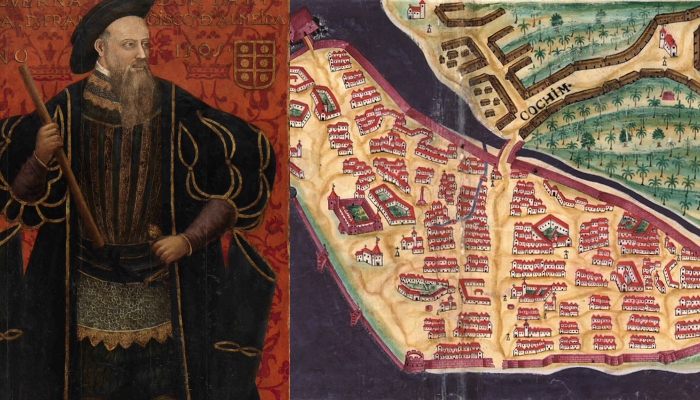
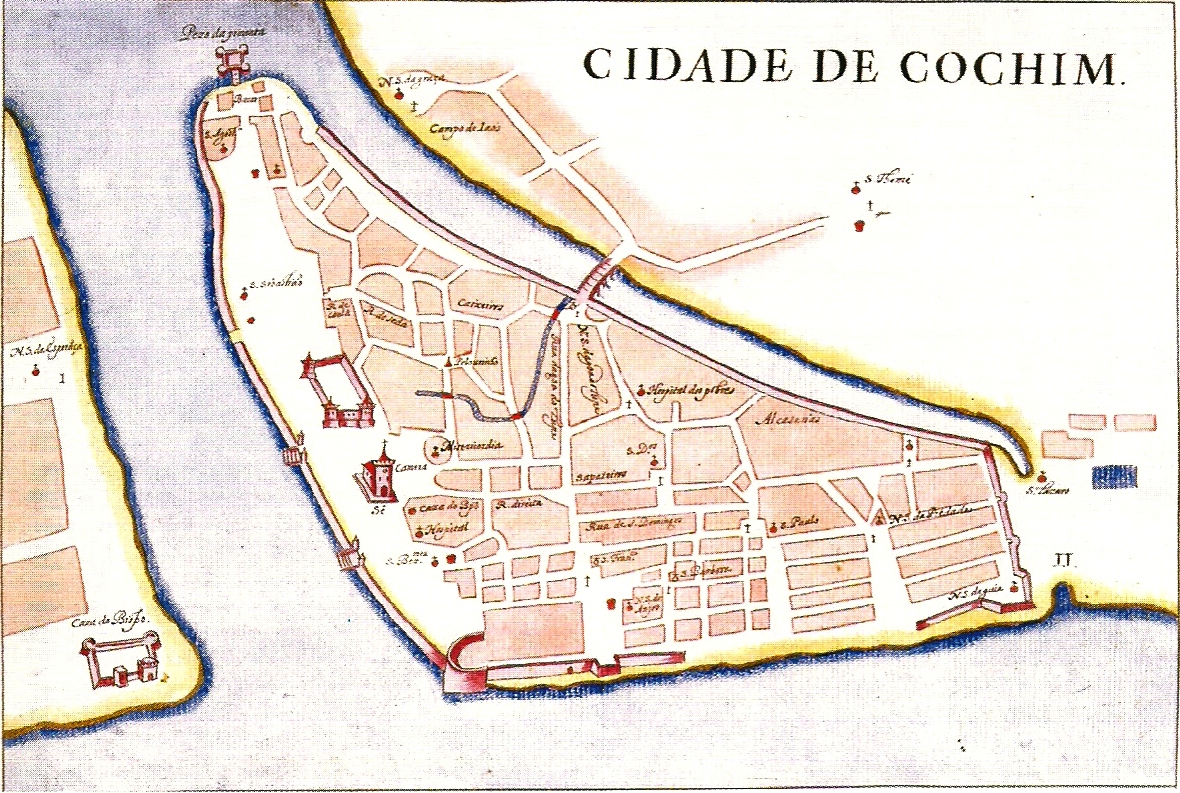
Portuguese map of district of Santa Cruz (Fort Kochi), showing location of Fort Manuel of Cochin. (Source: Portuguese World Heritage)
The Zamorin sent a message to the Trimumpara Raja of Cochin from Edapalli, directing him to turn over the Portuguese traders in the city, as he appeared to have no trouble marching his enormous force over that region. The Zamorin authorized an attack on the city after this request was denied. With Calicut’s far larger army (perhaps reinforced by Edapalli-supplied auxiliary forces), the small Cochinese troops had little chance. However, it is reported that Narayan, Trimumpara’s son, rallied the Cochinese. Under him, Cochin defended its stronghold on the Vembanad coasts, fending off two overwhelming attacks until succumbing to sheer numbers.
They had enough time to leave Cochin city and escape to Vypin Island with the core of the Nair (Nayar) guard. With its natural fortifications, Vypin’s location at the mouth of the Vembanad lagoon proved to be a formidable obstacle. However, weather also had an impact and the conditions were made exceedingly challenging by the intensifying Spring monsoon winds and heavy rains. Under these circumstances, it was nearly impossible to deploy assault boats against Vypin. The Zamorin then gave the order for his army to end the siege, but not before destroying Cochin city with fire and promising to return in August when the weather improved.
In August 1503, Francisco de Albuquerque and Nicolau Coelho, the vanguard of the 5th Armada, eventually located the crippled patrol at Angediva (or Cannanore). After completing the repairs, Albuquerque commanded the patrol caravels and sailed south toward Cannanore. During their journey, the ship of Duarte Pacheco Pereira caught up to them. The Zamorin of Calicut had regrouped his force by this point, as promised, and was once again intiated the siege of Cochin (or rather, Vypin Island, as Cochin itself was a blazing waste).
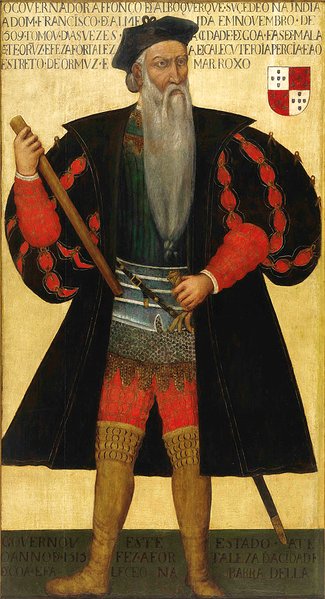
“Portrait of Afonso de Albuquerque, Viceroy of Portuguese India” (after 1545) at the National Museum of Ancient Art, Lisbon. (Source: Palacio do Correio Velho)
After learning of the dire situation at Cannanore, Albuquerque wasted no time in sending his fleet of eight ships down to save their stronghold. The Portuguese factor Diogo Fernandes Correia and the Trimumpara Raja were once again trapped up in Vypin Island, under siege by the Calicut army, when Francisco de Albuquerque’s improvised squadron arrived in Cochin. As the fleet approached, the attacking force started to disperse.
The Calicut army lacked local backing after the auxiliary forces (of Edapalli and others) likely left the siege first in apprehension of Portuguese retaliation. The Zamorin came to the conclusion that he had no option except to end the siege and return his soldiers to Calicut.
1504: Battle of Cochin
The Portuguese garrison at Cochin, which was allied with the Trimumpara Raja, and the armies of the Zamorin of Calicut and vassal Malabari states fought each other on land and at sea during the Battle of Cochin, also known as the Second Siege of Cochin, which took place between March and July of 1504. An army around hundred times larger was repelled by a small Portuguese garrison under the command of Duarte Pacheco Pereira.
The Zamorin of Calicut suffered a terrible loss. His incapacity to suppress the small opposition damaged the faith of his associates and vassals in him in addition to his failure to conquer Cochin. The result was a significant loss of the Zamorin’s customary power over India’s Malabar states while the Portuguese were able to maintain their presence in India by preserving Cochin.
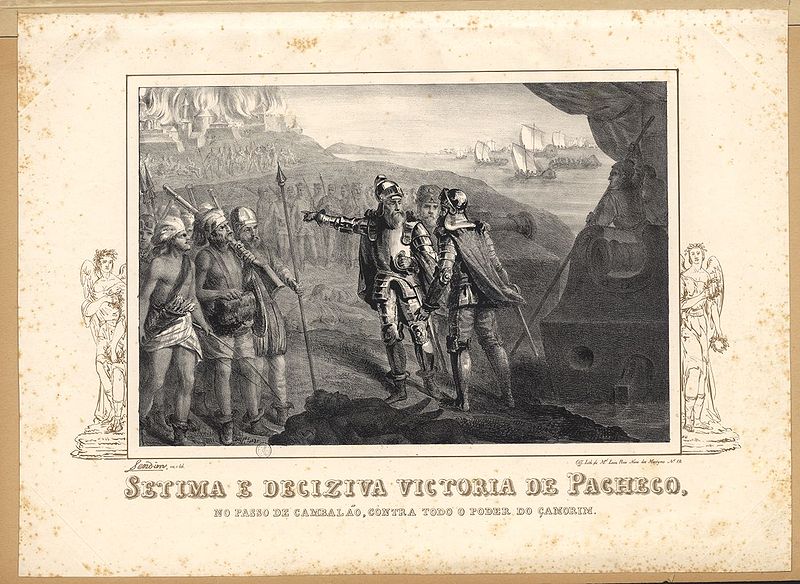
Portuguese 1840 lithograph depicting the final victory of Portuguese commander Duarte Pacheco Pereira over the Zamorin of Calicut at the Battle of Cochin (1504). (Source: Biblioteca Nacional de Portugal)
As soon as the 5th Armada departed in late January of 1504, the Portuguese started preparing right away without the fleet. They convinced Trimumpara Raja to let them build a fort on the edge of the Cochinese peninsula, which is now called “Fort Kochi,” a short distance west of the old city of Cochin proper (now known as Mattancherry). It was called Fort Manuel de Cochim and was the first Portuguese fort in Asia. The fort was finished in a few months using local coconut palm wood that the Trimumpara himself provided.
Calicut’s naval power Vs the Portuguese armada
However, Albuquerque unexpectedly consented to a peace pact with the Zamorin of Calicut. This was later broken again in a conflict over the delivery of a supply of spices in Cranganore. At Fort Manuel of Cochin, Portuguese left behind a small garrison of about 150 armed soldiers, led by the knight Duarte Pacheco Pereira. He obtained information about the Zamorin’s military forces and, more crucially, their movements from intelligence networks. The Zamorin himself was in charge of an army of 57,000 people in Calicut. Five European huge guns, cast by the two Venetian engineers, and around 300 smaller Indian weapons were also being brought by the Zamorin’s troops.
There were 160 ships in the Calicut navy, with roughly 76 of them were Malabari warships powered by sail and oars. Each one had 25 archers, five muskets, and two bombards. The other boats were smaller, and each one had 16 troops and a gun. Mass panic quickly ensued as some Cochinese boats began to turn away, followed by others. Soon, Cochinese boats were escaping back to Cochin with their 500 Nairs. There were just three anchored ships left to contend with the Zamorin’s troops and fleet, together with about 90 Portuguese and two Cochinese officials.
The five Venetian guns on the coast were Pereira’s first concern. Due to their “range and strength of an arm-thrown stone” the majority of Indian guns were considered to be of little danger to the cotton-reinforced ships. At a distance, however, the Venetian guns might sink them. Pereira quickly focused all of his fire on those guns, scattering the battery workers and continued to fire intermittently on them to keep them from regrouping. Additionally, Calicut hatchet crews who had ventured into the ford to try to tear down the stockade that blocked the ford were also targeted.
The navy from Calicut started to move toward the Portuguese position. But several waves blocked their progress. However, Portuguese crossbowmen, musketeers, and gunners were able to eliminate the Malabari gunners and musketeers, who had little to no protection as the tower shields and cotton sacks on the Portuguese ships, which effectively cushioned the projectiles. Four boats were partially sunk after a few volleys, and the remaining boats were either too damaged or covered in enough dead and injured to continue, so they started to retire.
The Portuguese found it easier as the sinking, damaged, and retreating paraus of previous waves created river barriers (and a disheartening sight) for the subsequent waves. The commanders of the Calicut fleet realized this was not working by midday and gave the order to withdraw. The Calicut army and fleet lost about 1,300 men in this initial battle, while the Portuguese were unharmed.
A week later, the Zamorin had been occupied with assembling additional troops and fixing his ships. He had chosen a diversionary strategy for the second time. A fleet of about 70 Calicut paraus would go into Cochin city and engage the nau Concepcao, while the main Calicut fleet (about 150 boats) would go towards Kumbalam. The idea was to make Pereira’s little group leave Kumbalam in order to save Cochin city, which would allow his army to cross the Kumbalam ford.
Upon learning of this (via standard intelligence channels), the Trimumpara Raja promptly sent a message to Pereira, pleading with him to come back who arrived at Kumbalam ford in time to join the others and get ready to face the majority of the Calicut fleet, which was now advancing on the ford. The scene from the previous week was repeated, with Calicut paraus being forced to progress in narrow and little waves. The Calicut admiral canceled the attack after about 290 people were killed and about 19 ships were severely damaged. The diversionary strategy had not worked.
A 16th century Indo-Portuguese depiction of a Malabarese warrior of the Nayar or Nair caste (Naire in Portuguese), present in the anonymous Portuguese codex now stored in the Casanata library in Italy. (Source: Wikipedia)
Pereira’s surprise attack on a few small villages on neighboring islands the next day was believed to have secretly provided paraus to the Calicut fleet in order to psychologically trouble the Zamorin army by highlighting that, in spite of the horrific events of the day before, the Portuguese were still unharmed and in renewed fighting form. The Zamorin chose a different strategy the following day. No more rash fleet assaults would occur. The fleet was told to wait until shore cannons sank or seriously damaged Portuguese ships. However, this plan also resulted in zero casualities for the Portuguese as the Zamorin army lost 22 paraus and some 600 died.
The Portuguese ships launched a bombardment from land. However, the comparatively unskilled battery crews lacked the accuracy, at least not from that distance, while the Venetian guns had the range to strike the ships. Pereira promptly informed the ships of the situation and prohibited them from retaliating. He wanted to instill confidence in the Calicut battery operators and encourage them to advance their guns for better aim (and expose themselves).
The Calicut commanders quickly deduced that the Portuguese must have run out of ammunition when the guns on the Portuguese ships stopped firing and they simply sat there in silence, letting themselves be fired upon from land without retaliating. The Zamorin’s cautious approach collapsed at this point. The Calicut fleet, which had been sitting at the mouth of the strait, observing the Portuguese with caution, decided this was a great chance and the cannon batteries also started to leave their protected positions. They hurled themselves downriver in the direction of the Portuguese without warning.
After holding fire until the first wave of paraus approached sufficiently, Pereira opened fire at close range, sinking eight paraus in a single, enormous salvo of musket and cannon fire, resulting in an exceptionally high death toll. The rest of the paraus had advanced too far to retreat at this point, but the first wave was shattered. The exact thing that the Zamorin had wished to stay away from was happening.
However, one of the Portuguese boat was on fire before noon, so the crew had to split their focus. The next wave of Calicut paraus focused all of their energy on it in the hopes of permanently decommissioning at least one of the four Portuguese stations. However, the crew was able to repel the attack and extinguish the fire.
1504 Battle of Cochin: Further assaults between the two sides
The Zamorin dismantled his tent at Kumbalam in late April and started to leave, presumably returning to Calicut. However, Pereira quickly learned that Zamorin’s army was actually on its way to the Palignar-Palurte passes and that 500 Nairs, or more, of the Zamorin’s advanced forces were already on Arraul island, clearing thickets to make way for the army. The Trimumpara Raja sent an army of about 200 Cochinese Nairs from Cochin city to assist as he hurried up to Arraul with a few boats. After taking charge of them, he split them up into two columns, one led by Pero Rafael and the other by himself. He then forced the thicket-cutters to retreat.
A day or two after the battle at Arraul, the Zamorin army’s vanguard, consisting of some 15,000 infantrymen under the command of Prince Naubeadarim, reached Palignar ford. The Calicut fleet, which consisted of about 250 ships and was commanded by Lord Ercanol of Edapalli, arrived at the Palurte area around the same time. Ercanol was left to dislodge the two caravels at Palurte while Naubeadrim set out to take control of the ford with his army. The onslaught started on 1st May at morning.
As soon as they arrived at Palurte, Pereira saw that the foliage on the opposing banks had been cleared, and that several Calicut cannons were being brought into position with the intention of sinking the anchored Portuguese ships called Caravels. Calicut artillery crews were dispersed as he ordered concentrated fire from the ships at their position. He then landed a Portuguese-Cochinese assault force on the shore. It spiked or dragged away the abandoned Calicut cannons and rushed to finish off the remaining Calicut men.
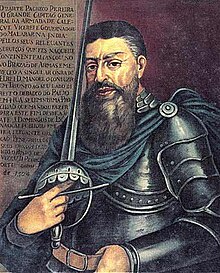
Duarte Pacheco Pereira (Source: O Portal da Historia)
The troops went back to the caravels to confront the approaching Calicut fleet after the cannon threat was eliminated. The admiral Elcanol of Edapalli was able to send in a significant first wave, a broad front of 40 paraus, tied across, against the caravels since the strait was not as narrow as it had been at Kumbalam. However, the oncoming fleet was wiped out by the Portuguese gunners’ quickness. It was followed by another wave of almost the same magnitude, but it was also repelled.
The Calicut admiral Ercanol ordered the fleet to leave because the tide had started to drop and the Calicut paraus were having problems navigating the treacherous shallow waters of Palurte. It was soon reported that the infantry of Naubeadarim from Calicut was preparing to wade the passage at Palignar. Pereira returned with his soldiers on their longboats. Naubeadarim’s infantry column began their assault to take the ford when the tide was sufficiently low. However, the fast and intense shooting from the bateis and the constant missile fire from the Cochinese Nairs on the bank prevented them from moving much or reaching the opposing back.
The tide started to rise again after two fierce but unsuccessful attacks, and Naubeadarim gave the order for the column to withdraw. The battle at Palignar and Palurte that day was arguably the most intense the Portuguese had yet encountered. They had little time to construct effective defenses and were lucky to get away with it. The Portuguese were worn out and suffered numerous injuries, but no fatalities.
Over 10,000 troops were lost in the Zamorin army as a result of the cholera epidemic. Some of the old Cochinese vassals who had previously deserted the Trimumpara Raja had returned as a result of the triumph.The Zamorin launched his largest attack to date on or around 6th May, centering all of his soldiers on capturing the ford at Palignar. About 4,000 men with 30 brass cannons led the charge. Prince Naubeadarim spearheaded the 12,000-man vanguard column that followed. The Zamorin led a column of about 15,000, including 400 specialist hatchet workers to cut down the stockade and clear the passages, while Ercanol of Edapalli headed a column of the same size.
Portuguese floating artillery Vs Calicut’s land-based cannons
The land-based Calicut artillery and the bateis engaged in a cannonade battle to start the attack on Palignar. The Calicut cannons were scattered when the Portuguese artillery overcame it. However, the tide had dropped by this point, and the bateis, which were now scraping the riverbed, were difficult to maneuver into the best firing positions. Calicut infantry surged into the Palignar ford after the Zamorin ordered an advance in an attempt to retake the other bank.
The spiked planks had the desired effect: the Calicut army gathered into a dense throng as the rear lines pushed them from behind and the front forces slowed to observe their step. This dense human mass was the target of Portuguese artillery fire, which resulted in a horrifying number of Calicut ranks casualties. Nevertheless, the Calicut infantry continued to advance under the encouragement of their superiors.
Pero Rafael used a cannonball to kill the Zamorin and the two of the nobles who were standing close to him were sliced to pieces as it landed close enough to him. His security rushed the blood-covered Zamorin from the field, leaving Naubeadarim and Ercanol to carry out the remainder of the attack. Naubeadarim rallied the Calicut warriors and moved forward with a vengeance, infuriated at the assassination attempt. The vanguard eventually made it to the palisade on the Cochinese bank after agonizingly navigating the impaling spikes. According to reports, the few Portuguese soldiers positioned there were abandoned for lost, and the Cochinese soldiers guarding the walls retreated or abandoned their posts.
The tide had started to rise again by this point, though, and the bateis were no longer stuck in the muck and could be moved freely. As the bateis charged directly into the ford, they broke up the intense attack on the palisade with focused fire. The Calicut troops were pushed to return to the banks and retreat to the tree line after the ford was crossed back and forth with near-point blank cannon. The assault ended when the high tide returned after nine hours of fierce combat as the army of the Zamorin had once again failed.
The troops of the Zamorin started to march in the direction of Palignar at the crack of dawn on the day of the launch of sixth attack. Pereira also took a boat all the way to the point of Arraul island, where he landed with a small group of soldiers to fight the Calicut army’s advance squads. A sizable portion of Zamorin’s army was turned after him by the agitated leader. Pereira simply got back into his boat and headed out.
The combat started at Palurte, where the caravels were anchored, since the tide was high. The first to be launched were the Calicut fire ships, but they were intercepted by the anchored raft and burned innocuously. The caravels then were launched against the row of floating castles. This was more challenging because it appeared that their fortified sides could withstand all of the Portuguese cannon fire. It appeared hopeless, and Pereira is credited with frantically saying, “Lord, don’t make me pay for my sins just yet,” before directing heavy, concentrated fire on the closest fortress and ultimately shattering its sides. Soon after, the entire apparatus started to pull and break apart, causing the paraus to sink.
The tide had turned and the army of the Zamorin marched on Palignar ford while the caravels at Palurt were thus engaged. As the Calicut army entered the ford, line after line was mowed down by the ceaseless firing of the two bateis, as well as the constant missile fire of the Cochinese on the palisade ramparts and in the launches. The attack was repulsed and the Calicut soldiers were forced to abandon the attempted crossing when the high tide returned. This day reportedly saw the greatest number of casualties in the Calicut army, but the Portuguese still had no fatalities, only injuries. Great celebrations were held in Cochin to celebrate the triumph over the Zamorin’s most formidable attack to date.
The Zamorin reportedly ordered a few more attacks on the Portuguese positions, one of which reportedly used the same floating castles that have now been restored, but to no avail. Due to disease and defection, the Zamorin had fewer troops for these raids, and their attacks were generally ineffective due to a lack of enthusiasm and energy. The monsoon season had already started to change by this point, and the Zamorin army was suffering from the stronger winds and rains, which made it harder to move around and spread disease.
Additionally, the passages had higher water levels, which made sailing the paraus more challenging and the Calicut vassals were slipping out of the Zamorin’s camp one by one. Generally speaking, a fresh Portuguese armada was expected to arrive in August. Having given up on taking Cochin by that point, many of the Zamorin’s vassals decided it would be preferable to work out their own conditions of peace with the Trimumphara Raja before the Portuguese came, should their territories be targeted by retaliatory, punishing raids. The lord Elcanol of Edapalli was the final vassal to reach a separate peace with Cochin.
After deciding he had had enough, the Zamorin of Calicut abdicated his crown on 24th June 1504, transferring it to his nephew and heir, Naubeadaraim, the general who had commanded the Calicut soldiers. He then retreated to a temple and committed himself to a life of religion. However, the reprimand of his own mother enticed the weary Zamorin to leave the temple and plan a final attack. However, when it didn’t work out, the Zamorin went back to his religious seclusion for good. The Calicut army left the Vembanad lagoon shoreline on or around 3rd July. Duarte Pacheco Pereira set sail for Quilon with his caravels as soon as the Zamorin withdrew his men from the area of Cochin (some claim early August, 1504).
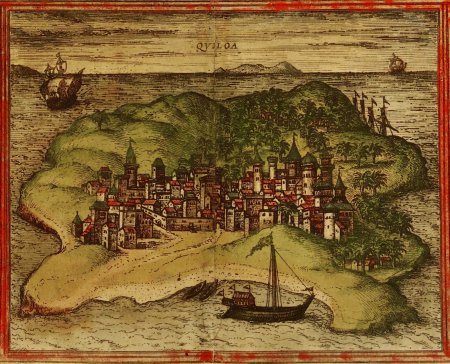
The bird’s-eye view of the city of Kilwa from Georg Braun and Franz Hogenberg’s atlas Civitates orbis terrarum, vol. I, 1572. (Source: Civitates orbis terrarum)
1505: Francisco de Almeida appointed the first Portuguese Viceroy of India
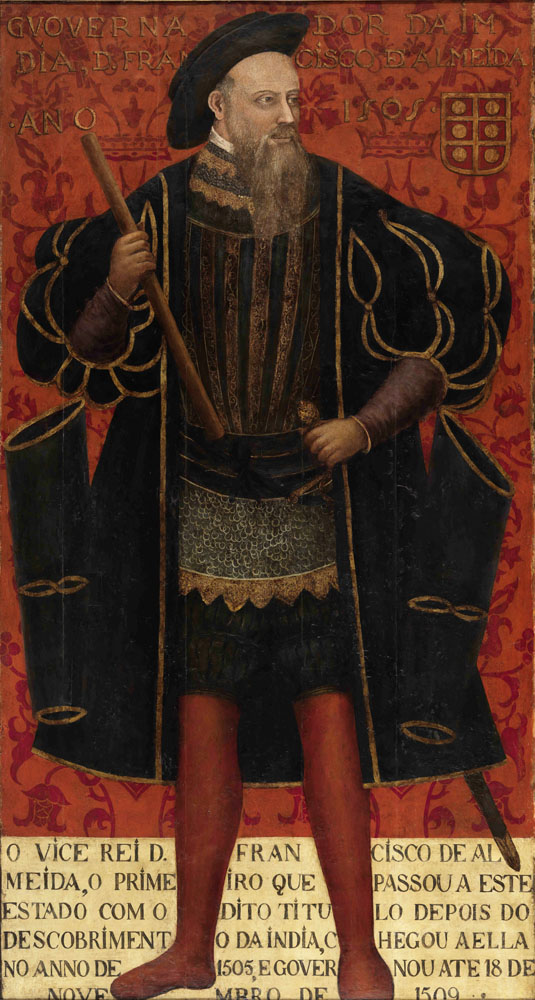
Francisco de Almeida was a Portuguese explorer, soldier and aristocrat. He gained fame as a counselor to King John II of Portugal, and then as a participant in the Moorish battles and the 1492 conquest of Granada. In 1505, he was appointed viceroy, the commander of the seventh armada and first ruler of the Portuguese State of India. On 25th March 1505, Portugal’s King Ferdinand I appointed a three-year governor to India and gave him enough troops to protect Portuguese interests. Almeida, the recently appointed governor, was given the mission of disrupting Muslim trade and strengthening Portuguese dominance in the country by capturing Aden, Ormuz, and Malacca.
On 31st October 1505, Almeida reached Cochin with just eight remaining ships. He set off with a mighty fleet of twenty-one ships, passed the Cape of Good Hope, and proceeded along the east coast of Africa, seizing Kilwa (in present-day Tanzania), where he built a fort. He then devastated Mombasa, arrived in India, and settled in Cochin. He constructed many fortified installations with the goal of monopolizing the spice trade and elevating Portugal to the position of supreme power in the East. A business agreement was reached with Malacca (present-day Melaka, Malaysia) under his leadership, and additional explorations were performed, particularly by his son Lourenco.
“Portrait of Dom Francisco de Almeida, Viceroy of Portuguese India” (after 1545) at the National Museum of Ancient Art, Lisbon. (Source: Palacio do Correio Velho)
While there, he discovered that the Portuguese traders at Quilon had been massacred. The six ships he sent with his son Lourenco indiscriminately sank Calicut boats in the harbor of Quilon. Almeida made Cochin his home. He strengthened the Portuguese defenses at Fort Manuel there. He is recognized for having established Portuguese dominance in the Indian Ocean with his triumph in the naval Battle of Diu in 1509 and became the first Portuguese to reach Bombay by the sea in the same year.
He pursued the Mamluk Mirocem, who resided over a fleet of 23 ships close to the port of Diu, and Meliqueaz, to whom he had sent a terrifying letter, in the naval Battle of Diu on 3rd February 1509. With expert naval assistance from the Republic of Venice and the Republic of Ragusa (Dubrovnik), which were concerned for their eastern trade links, he overcame a combined fleet of the Sultan of Gujarat, the Ottoman Empire, the Mamluk Burji Sultanate of Egypt, and the Zamorin of Calicut.
Almeida and his Portuguese fleet were now a threat to Sultan of Egypt too
Additionally, he was told to build defences at Cochin and Anjadiva. However, in addition to the Zamorin’s opposition, Almeida were also in danger from Egypt’s Mamluk Sultan. The trade disruptions had sent shockwaves through the Indian Ocean Region, and Arab powers, including the merchants of Venice who traded with the Arab powers..
The merchants of Venice, whose lucrative commerce was now in danger due to Portuguese interference, encouraged the Egyptians to establish a warship in the Red Sea to resist the Portuguese advance. The battles and rapidly shifting power games that were to follow in the next few years, were at a scale never seen before in these regions. The combined mercantile power of Calicut, Arab traders, the Sultan of Gujarat and the Mamluk Sultan of Egypt was to witness a naval force that was stronger than anything they had imagined. Little did anyone know at that time that the Portuguese ‘Viceroy’ will wage wars that will spell the end of Muslim dominance in the Arabian Sea spice trade and open the floodgates of European monopoly.
1507: Siege of Cannanore (Kannur)
The Portuguese fleet led by Lourenco de Almeida, son of Viceroy Almeida, and the Indian fleet of the Zamorin of Calicut participated in a battle in 1506 off the Indian harbor of Cannanore, now known as Kannur. Hindu, Arab, and Turkish crews manned the roughly 200 ships that formed the Calicut navy, which had cannons made with the assistance of two Milanese Italians. However, the Portuguese prevailed and this victory was followed by the siege of Cannanore in 1507.
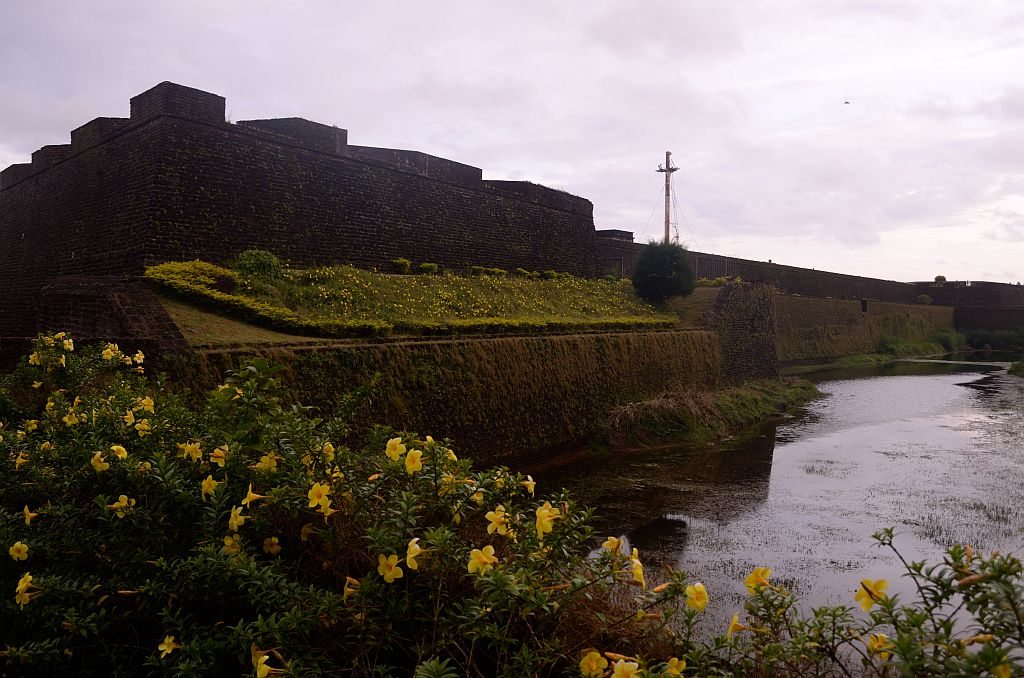
The Portuguese admiral Pedro Alvares Cabral and the Zamorin of Calicut started a conflict in early 1501, but the King of Cannanore urged the Portuguese to trade in his spice markets instead. In 1502, treaties were made and a crown factory was built, protected by a modest palisade. The first Portuguese viceroy of the India, Almeida, obtained authorization to erect the stone fortress of St. Santo Angelo in Cannanore towards the end of 1505. D. Lourenco de Brito was assigned to lead the 150-man garrison in the castle.
St. Angelo Fort Kannur (Source: Lakshmi Sharath)
Sometime in 1506, the elderly Kolathiri Raja who had actively sought the Portuguese alliance passed away. The Zamorin of Calicut, the official suzerain of the Kerala coast, appointed an arbitrator to sift through the candidates because the succession was subjected to debate. As a result, the new Kolathiri Raja of Cannanore had less affinity for the Portuguese and a greater debt to the Zamorin.
The Portuguese sank an Indian ship and killed its crew by sewing them into sails and tossing them into the sea because they were not carrying one of the Cartaz, which they imposed on all ships in the area. This was a major contributing factor to the hostilities. These passes have to be signed by Cannanore or the Cochin commander. The incident immensely infuriated the people of the neighboring state of Kolattunad, who then asked that their king, the Kolathiri, launch an attack on the Portuguese.
Commencing on 27th April 1507, the siege was expected to last for four months. The position was attacked by 40,000 Nayars ordered by the monarch. The monarch of Cannanore received 20,000 auxiliary troops and 21 pieces of artillery from the Zamorin. Under Lourenco de Brito, the garrison’s weaponry enabled it to repel large-scale attacks with thousands of soldiers. With walls of cotton bales shielding the Malabari trenches from Portuguese cannon fire and their gradual starvation to death, the attempt quickly came to a standstill. On 15th August, a tidal surge of lobsters swept ashore, surprising and saving them.
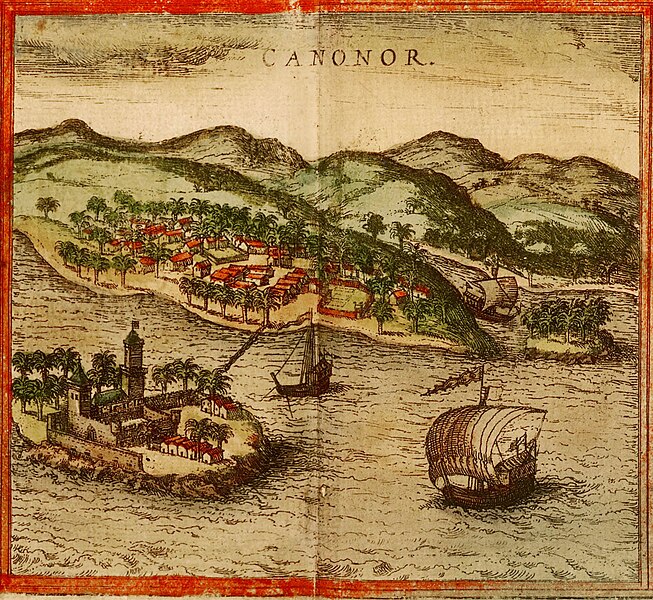
The bird’s-eye view of the city of Cannanore (Kannur, India) from Georg Braun and Frans Hogenberg’s atlas Civitates orbis terrarum, vol. I, 1572 (Source: Civitates orbis terrarum)
Before the Onam festival, an attack came dangerously close to defeating the defenders but was ultimately repelled while several Portuguese men were injured. As the Portuguese garrison was about to be overrun, a fleet of eleven ships led by Tristao da Cunha, the 8th armada, arrived from Socotra on 27th August just in time to turn the tides in the battle. The siege was forced to be lifted and the castle was relieved when the ship landed 300 Portuguese men. Negotiations for peace between the Portuguese and the Kolathiri Raja confirmed that the Portuguese would remain in Cannanore and would once again have access to its spice markets.
The Portuguese’s inability to possess any items that the Indians wanted was the main obstacle to their commercial aspirations in the East. They were already exceedingly wealthy from centuries of lucrative relationships with Muslim traders in the Persian Gulf and on the Swahili coast of East Africa, and they were reluctant to alter a regional trading network that was operating perfectly and, peacefully. The Portuguese were the disruptors of that peace. They did not merely want to trade, they wanted a trade monopoly and the spread of Christendom.
More importantly, trade ships in the Indian Ocean Region were constructed for freight and speed, to endure the Monsoon winds. The cannons from the hardened Portuguese Carracks were not what they expected to face. Though some Arab traders and Indian monarchs did own cannons, they were not as good as those of the Europeans. OpIndia will address how this technological superiority helped the Portuguese to advance their ruthless rule over the Indian subcontinent through the “Battle of Diu” in the next article.
Amid reports suggesting that a certificate from religious leaders is mandatory for registering live-in relationships under the Uniform Civil Code (UCC) in Uttarakhand, Manu Gaur, a member of the UCC Rules Committee, has clarified that this requirement applies only to cases where marriage is legally prohibited. Such relationships are explicitly listed in Schedule 01 of the Code, said a press statement.
Gaur stated that for live-in registration under UCC, only four key documents need to be submitted–proof of residence, date of birth, Aadhaar, and tenancy documents (if applicable).
Additionally, divorced individuals must provide legal proof of divorce, and those whose previous partner has passed away or whose live-in relationship has ended earlier must submit relevant documents.
Addressing concerns over religious certification, Gaur emphasized that such a certificate is only necessary if the couple has a prior relationship that falls within the legally prohibited category. He noted that such cases are rare in Uttarakhand, constituting less than one per cent of UCC registrations.
Societies that permit such relationships can also provide certification from religious leaders if required. The intent, he asserted, is to facilitate registration rather than impose restrictions.
Furthermore, Gaur clarified that under UCC, any person residing in Uttarakhand for a year is eligible for registration, irrespective of their original or permanent residence status. He explained that many people from other states reside in Uttarakhand and benefit from government schemes.
With UCC registration, these individuals must now formally register to continue availing services, ensuring better resource management for the state’s permanent residents.
The UCC Act defines residency specifically for matters related to UCC, categorising five different types of residents. The registration process is designed to be comprehensive, akin to a voter ID system, without linking it to permanent residence.
Gaur acknowledged that the UCC registration form extends to 16 pages to ensure thoroughness, but reassured that it takes only five to ten minutes to complete online. The system auto-fills details using Aadhaar, making digital registration a convenient option, though an offline process is also available.
(This news report is published from a syndicated feed. Except for the headline, the content has not been written or edited by OpIndia staff)
The wait for the Budget 2025 is over as the Narendra Modi-led NDA government is set to table the Economic Survey in the Parliament on Friday afternoon.
As is the convention, Finance Minister Nirmala Sitharaman will table the pre-budget detailed state of the economy document in the Parliament, a day ahead of the Budget presentation for the next financial year – 2025-26.
Economic Survey will be tabled in Lok Sabha at 12 noon and at 2 PM in Rajya Sabha.
What is an Economic Survey
The Economic Survey document, prepared by the Economic Division of the Department of Economic Affairs in the Ministry of Finance and formulated under the supervision of the chief economic adviser, gives insights into the state of the economy and various indicators of 2024-25 (April-March) and some outlook for the next fiscal.
The Economy Survey document may also give some idea about the tone and texture of the actual Budget for 2025-26, to be presented on Saturday.
The first economic survey reportedly came into existence in 1950-51, when it used to be a part of the budget documents. In the 1960s, it was separated from the Budget documents and presented the day before the Union Budget.
The most important feature that many will look out for is its central theme
In 2022, the central theme was ‘Agile Approach’, which emphasized India’s economic response to the COVID-19 pandemic shock. In 2023, it was ‘recovery complete’, when the economy staged a broad-based recovery from pandemic-induced contraction, Russian-Ukraine conflict, and inflation, and ascended to the pre-pandemic growth path. In 2024, it focussed on economic resilience.
Typically, along with the sectoral chapters, the Survey document also adds new need-based chapters that call for special focus.
All eyes will be on the key announcements and the government’s forward-looking economic guidance for the remainder of the Modi 3.0 tenure. This upcoming budget comes in the backdrop of weak GDP numbers and weak consumption in the economy.
With this upcoming Budget Presentation, Sitharaman will have presented seventh budget. She has already surpassed the record set by former Prime Minister Morarji Desai, who presented five annual budgets and one interim budget between 1959 and 1964 as finance minister.
Like the previous few full Union Budgets, the Budget 2025 will also be delivered in paperless form.
State of the economy
The Indian economy grew by 5.4 per cent in real terms in the July-September quarter of the current financial year 2024-25. The quarterly growth was quite lower than RBI’s forecast of 7 per cent. In the April-June quarter too, India’s GDP grew at a slower pace than was estimated by its central bank.
The Reserve Bank in its latest monetary policy had cut India’s growth forecast for 2024-25 to 6.6 per cent from 7.2 per cent. The government expects 6.4 per cent growth.
India’s GDP grew by an impressive 8.2 per cent during the financial year 2023-24, and continued to be the fastest-growing major economy. The economy grew by 7.2 per cent in 2022-23 and 8.7 per cent in 2021-22.
The Economic Survey tabled in July 2024 “conservatively” projected India’s real GDP growth at 6.5-7 per cent for 2024-25, acknowledging that market expectations were higher. Real GDP growth is the reported economic growth adjusted for inflation.
Customary halwa ceremony
A key event before the budget presentation is the ‘halwa ceremony’. A few days before the budget is presented, the government has a tradition of conducting a ‘halwa ceremony’, marking the start of budget document printing. This year it happed on January 24.
As is the convention, the ceremony was led by Finance Minister Nirmala Sitharaman, with Minister of State Pankaj Chaudhary, and secretaries, in attendance. Officers and staff involved in the budget preparation and compilation process were also be present on the occasion.
The halwa ceremony is a significant event as it also marks the beginning of lockdown at the finance ministry. This means no official is allowed to leave the ministry compound. Everyone part of the Budget team is allowed to leave only after the financial document is presented in Parliament. The printing of the Union Budget inside the basement located at the North Block has become a permanent feature since 1980.
Budget session 2025
The budget session of parliament will begin on January 31 and, according to schedule, will end on April 4.
The budget will be presented on February 1. On budget day, the Finance Minister will present the Union Budget in the Lok Sabha at 11 am. The budget speech will outline the government’s fiscal policies, revenue and expenditure proposals, taxation reforms, and other significant announcements.
A day prior, President Droupadi Murmu will address the joint sitting of two houses of Parliament on January 31. Parliament will have an inter-session break from February 14 and the two Houses of Parliament will resume their sittings on March 10.
The budget, once tabled on February 1, is then subjected to detailed debate and discussion in both houses of Parliament, allowing members to scrutinise its provisions, raise concerns, and propose amendments. Following its presentation and approval by Parliament, the Union Budget sets in motion a series of post-budget activities aimed at implementing its provisions and achieving the outlined objectives.
On the morning of budget day, the finance minister will go to the North Block, where the Ministry of Finance is housed. She will meet the secretaries of her ministry, and later, along with them, she will reach the President’s residence to get permission before presenting the Budget. Half an hour before the budget is presented, a Cabinet meeting headed by the Prime Minister is usually held, where ministers are briefed about the budget and Cabinet approval is taken.
(This news report is published from a syndicated feed. Except for the headline, the content has not been written or edited by OpIndia staff)
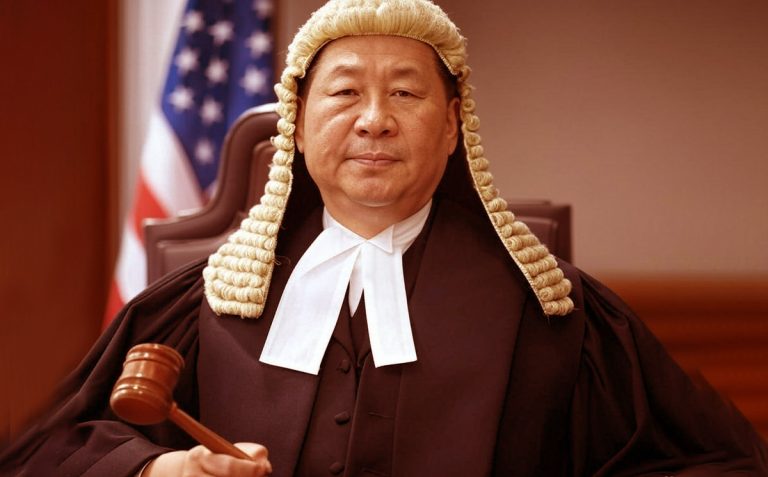
China is reportedly imposing its legal system on American soil through a network of nonprofit organizations in the United States linked to a Chinese Communist Party (CCP) intelligence agency, according to the Daily Caller News Foundation (DCNF).
The network, comprising over a dozen organizations across California, the greater Washington, DC area, Hawaii, and New York, shares information with Chinese law enforcement officials. Some of these organizations have even set up unofficial courtrooms in the United States, according to a months-long investigation by DCNF.
US lawmakers and intelligence analysts warn that these underground courts could be used to target dissidents and expand Beijing’s influence abroad. This contradicts the Chinese government’s claim that it sends law enforcement officers overseas solely to handle routine matters, such as international divorces and Chinese driver’s license renewals, DCNF reported.
According to the investigation, some nonprofit leaders within this network have openly discussed forced repatriation operations with China’s Ministry of Public Security (MPS). Furthermore, all of these organizations are run by individuals affiliated with the United Front Work Department (UFWD), a CCP intelligence agency.
Additionally, several individuals designated to run these overseas Chinese courts in the US are linked to the same nonprofit organization that operated an illegal Chinese police station in New York. The US Department of Justice (DOJ) previously discovered that the police station had attempted to coerce individuals into returning to China, DCNF reported.
“The Chinese government’s attempt to impose its repressive legal system on US soil through the CCP’s United Front network is an unacceptable assault on US sovereignty and the rule of law,” Michigan Republican Rep. John Moolenaar said as quoted by DNCF.
“These actions jeopardize the safety and freedoms of Chinese Americans and undermine the principles of justice that define our nation, Congress and law enforcement must remain vigilant, hold those involved accountable, and impose costs on the CCP’s illicit United Front activities within the United States,” said Moolenaar, chairman of the House Select Committee on the CCP as quoted by DNCF.
(This news report is published from a syndicated feed. Except for the headline, the content has not been written or edited by OpIndia staff)