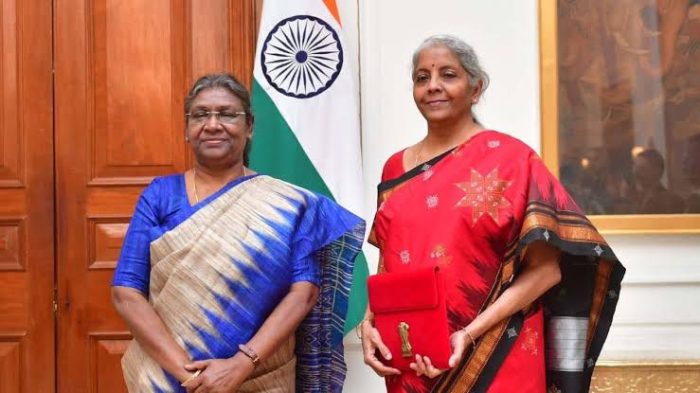
Union Finance Minister Nirmala Sitharaman and Minister of State for Finance Pankaj Chaudhary met President Droupadi Murmu at the Rashtrapati Bhavan on Saturday ahead of Union Budget.
The Finance Minister was seen discussing the contours of the Budget proposals with the President. She will now leave for the Cabinet meeting where the Budget will be ratified prior to its presentation in Parliament.
Nirmala Sitharaman is set to present her record 8th consecutive budget today at 11 am in the Lok Sabha. The budget speech will outline the government’s fiscal policies, revenue and expenditure proposals, taxation reforms, and other significant announcements.
Meanwhile, the Economic Survey tabled in Parliament on Friday projected India’s economy to grow between 6.3 per cent and 6.8 per cent in the next financial year 2025-26.
The survey, tabled a day before the union budget, highlights that the country’s economic fundamentals remain strong, supported by a stable external account, fiscal consolidation, and private consumption.
It noted that the government plans to strengthen long-term industrial growth by focusing on research and development (R&D), micro, small, and medium enterprises (MSMEs), and capital goods.
These measures aim to enhance productivity, innovation, and global competitiveness.
“The fundamentals of the domestic economy remain robust, with a strong external account, calibrated fiscal consolidation and stable private consumption. On balance of these considerations, we expect that the growth in FY26 would be between 6.3 and 6.8 per cent,” it said.
The survey noted that food inflation is expected to ease in Q4 FY25 due to the seasonal decline in vegetable prices and the arrival of the Kharif harvest. A good Rabi production is also expected to help keep food prices in check in the first half of FY26. However, adverse weather conditions and rising international agricultural prices pose risks to inflation.
The survey also added that India’s foreign exchange reserves remain strong, covering 90 per cent of external debt and providing an import cover of over ten months. The reserves increased from USD 616.7 billion in January 2024 to USD 704.9 billion in September 2024 before moderating to USD 634.6 billion as of January 3, 2025. The stability in capital flows has played a key role in supporting India’s external strength.
The survey also highlighted significant growth in the formal employment sector. Net Employees’ Provident Fund Organisation (EPFO) subscriptions have more than doubled from 61 lakh in FY19 to 131 lakh in FY24.
(This news report is published from a syndicated feed. Except for the headline, the content has not been written or edited by OpIndia staff)
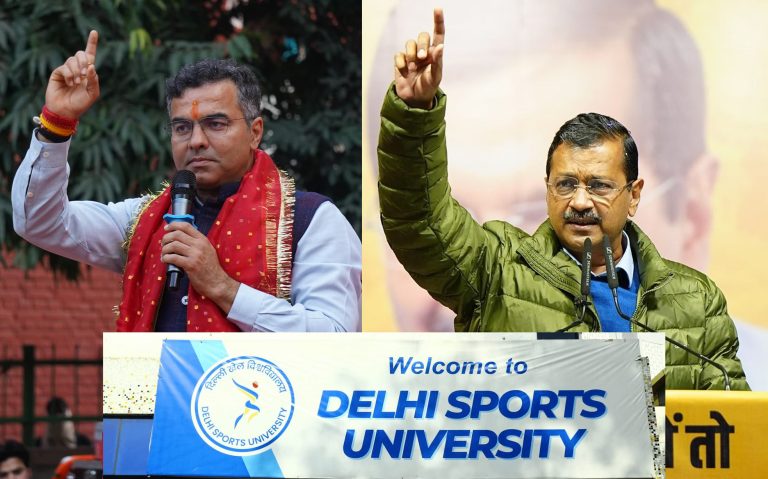
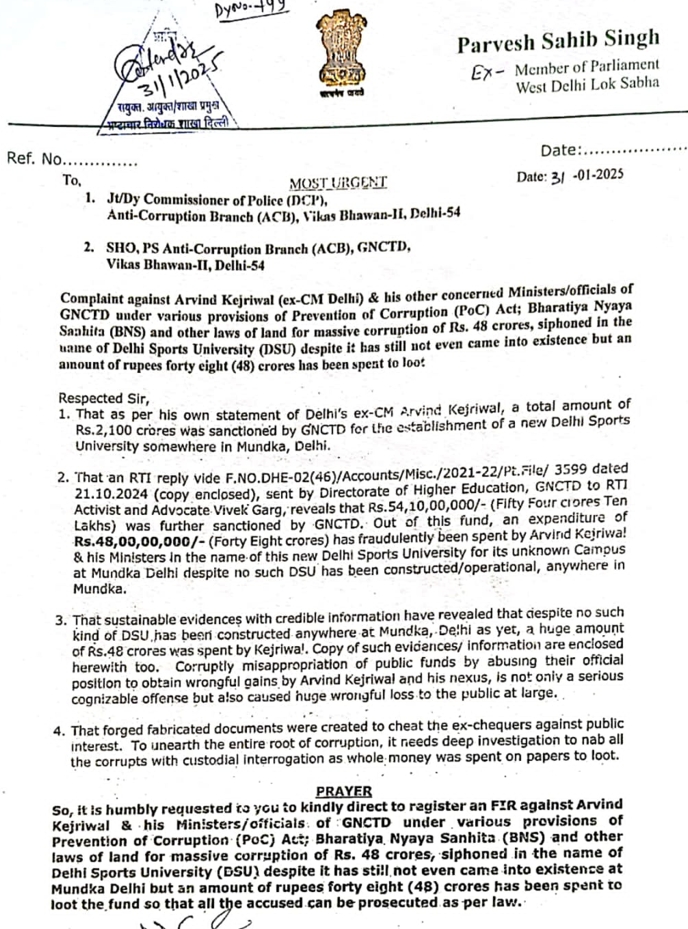
Bharatiya Janata Party (BJP) candidate Parvesh Verma on Friday filed a complaint with ACB against Aam Aadmi Party leader and former Delhi Chief Minister Arvind Kejriwal, alleging corruption concerning Delhi Sports University (DSU).
Verma, who is contesting Delhi polls from the New Delhi seat against Kejriwal, in his complaint alleged “corrupt misappropriation of public funds” through “the abuse of official positions to gain wrongful benefits”.
The complaint has been filed with the Anti-Corruption Branch (ACB) of the Delhi government.
Verma’s advocate, Vivek Garg, told ANI that this was “a huge fraud” with the students of Delhi and a complaint has been filed with the ACB on behalf of the BJP candidate.
“This is a huge fraud where Arvind Kejriwal and his ministers have embezzled Rs 48 crore on paper for which our team of lawyers have filed a complaint with the Anti-Corruption Branch on behalf of Parvesh Verma… the location he (Kejriwal) has mentioned does not even have a brick. This is a huge fraud with the students of Delhi…,” Garg said.
“Such expenditure requires the approval of the Cabinet, which includes the Finance Minister and the Education Minister and so they are all involved in this case… DCP Madam has assured us that there will be a fair investigation, and a high-level investigation of the case will start immediately… We have filed a complaint with RTI evidence…,” he added.
Verma had earlier filed a formal complaint with the Anti-Corruption Branch (ACB) against Kejriwal, a former Delhi Chief Minister, and other officials for alleged corruption in the installation of CCTV cameras in the New Delhi Assembly Constituency.
(This news report is published from a syndicated feed. Except for the headline, the content has not been written or edited by OpIndia staff)
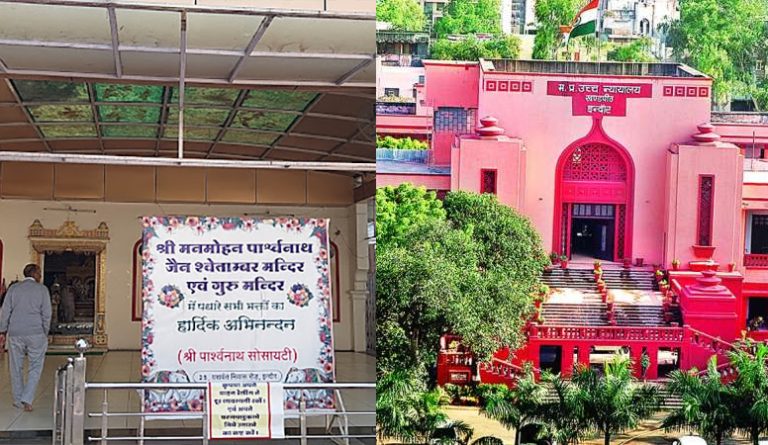
On 23rd January, the Madhya Pradesh High Court dismissed a petition demanding the removal of a temple at Yashwant Niwas Road, Indore. The bench stated that the petitioner did not have any specific reason for seeking the removal of the temple. Imposing the cost of Rs 25000 on the petitioner who claimed to be a journalist, the court stated that the applicant had a vested interest in the premises following which he made such a plea.
The court also said that if the litigant was so very concerned about the construction of illegal religious structures on government land, he should have taken measures to challenge all such illegal structures.
“The petitioner is not a resident of nearby places of Yashwant Niwas. He has not disclosed as to why he is only targeting one temple at Yashwant Niwas Road in public interest. Being a Journalist, he ought to have conducted a survey in Indore or Madhya Pradesh about all the illegal constructions before filing this PIL. Therefore, such a petition cannot be treated as Public Interest Litigation when the petitioner is interested only in one temple. It appears that he has some vested interest in it. We do not find any mistake apparent on the face of the record in the order passed by the Division Bench to exercise the power of review,” the division bench of Justice Vivek Rusia and Justice Gajendra Singh observed.
Earlier a PIL was filed by the petitioner which was also dismissed by the High Court saying that the petitioner was not a social worker to invoke the public interest writ petition.
While reviewing the circumstances of the case, the court noted that the petitioner claimed to be a journalist and sought the removal of a specific temple. In the process, he listed 25 respondents, 20 of whom are the president and trustees of the Manmohan Parshavanath Jain Shwetamber Mandir Evam Guru Mandir Trust.
“If petitioner is aggrieved by illegal construction of religious places, then he ought to have challenged all the religious structures constructed either on government land or without permission,” the court said.
“In the present case the petitioner has not been able to point out any error apparent on the face of the record, on the contrary this Court has decided the case on merits,” it added imposing a fine of Rs 25000 on the review petitioner.
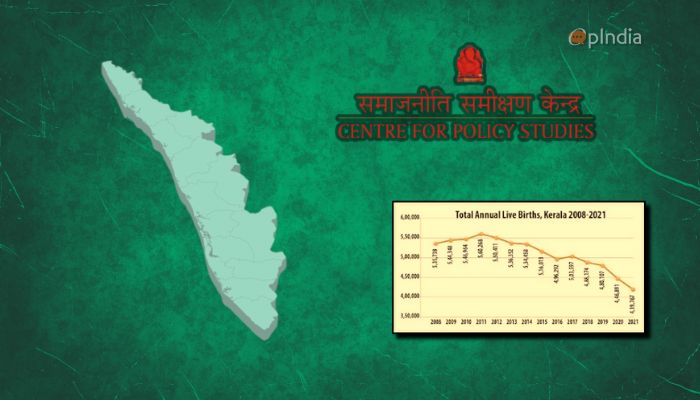
In the serene backwaters and mesmerising landscapes of Kerala, stealth but profound demographic change is ongoing. Beyond the flex of high literacy rates and “progressive” social indices, this south Indian state is witnessing an alarming shift in religious composition which is inevitable to have an impact on Kerala’s religious, cultural, political and social fabric. A recent report published by think-tank Centre for Policy Studies (CPS) delves into the interplay of fertility rates and religious demographics. The report raises concerns over possible religious-demographic imbalances in the states.
On 30th January 2025, CPS India released its report titledReligious Demography of India: Rising Religious Imbalancein the Declining Fertility Regime of Kerala. The report analyses data from the Annual Vital Statistics Report from 2008 to 2021 on birth rates and deaths by religious communities in Kerala.
The share of Muslims in live births went up, but the share of Hindus and Christians in live births declined
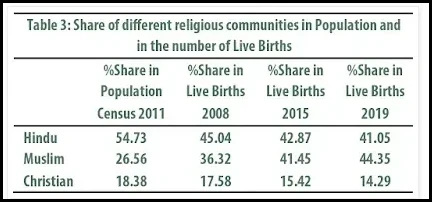
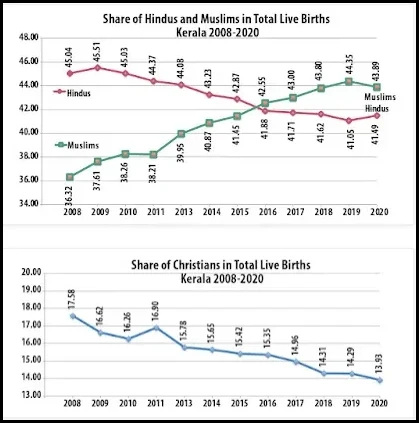
The CPS India analysis found that Muslims in Kerala overtook the Hindus who form 54% of the state’s population in total live births after 2015. In the year 2019, out of the total live births, Muslims had a share of 44% while Hindus had a share of 41%. It must be noted that Muslims, as per the 2011 census are around 27% in Kerala.
Between 2008 and 2021, the share of Muslims in total live births witnessed a significant increase and in specific years even overtaken Hindus while the Hindu community’s share in total live births dropped significantly with similar trends recorded on Christian total live births.
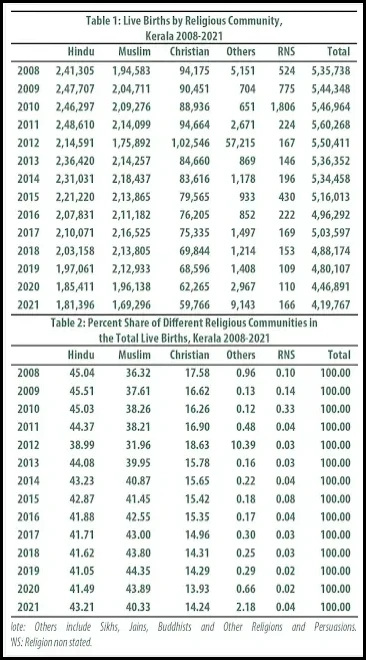
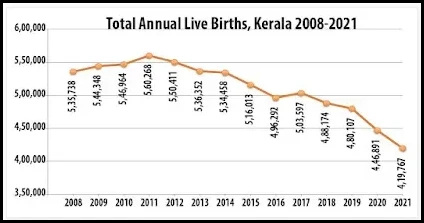
In the year 2008, the live births of Hindus were 2,41,305 (45.04%), Muslims 1,94,583 (36.32%), and Christians 94,175 (17.58%). In 2009, the numbers went up for Hindus (45.51%) and Muslims (37.61%), but Christian live births saw a slight decline (16.61%). In 2010, Hindu live births were recorded at 2,46,297 (45.03%), Muslim live birth count stood at 2,09276 (38.26%) while Christian live births further declined to 88,936 (16.26%). In 2011, Hindu, Muslim and Christian live births recorded a noticeable increase although this was the last time Kerala’s total live births went up to 5,60,268 only to witness a perpetual decline in the following years.
In 2012, live births of both Hindu and Muslim communities in Kerala saw a sharp drop while the numbers crossed 1 lakh mark for the first and the last time between the years 2008 to 2021. Surprisingly, in 2013, the numbers for Hindus and Muslims as per official data went up while the Christian live births were reduced dramatically from 1,025,46 to 84,660.
The year 2014 saw an increase in Muslim live births but a decline in the numbers for Hindus and Christians. From 2015 onwards, while live births among Muslims went up and down, Hindu annual live births have continuously slumped and the same goes for Christians. In 2015, Hindu live births were 2,221,220 (42.87%), Muslim live births were 2,13,865 (41.45%) and Christian live births were 79,565 (15.42%) while the total live births in the state that included other minority groups like Buddhists, Jains, Sikhs alongside RNS or those who did not state their religion stood at 5,16,013.
In 2016, Muslims with 2,11,182 live births (42.88%) overtook Hindus who had 2,07,831 live births (41.55%) while Christian annual live births that year further slumped to 76,205 (15.35%).
The year 2017 was the last time between 2008 and 2021 time period that the annual live births in Kerala crossed the 5-lakh mark recording 5,03,597 total live births. In 2018, Kerala recorded a sharp fall in total live births. While Hindu live births fell from 2,10,071 in 2017 to 2,03, 158 in 2018, Muslim live birth also saw a slight reduction from 2,16,525 in 2017 to 2,13, 805.
In the year 2019, Hindu live births came down to 1,97,061 while Muslim live births stood at 2,12,933 and Christian live births were recorded at 68,596. In 2020 and 2021, Hindu live births further went down to 1,85, 411 and 1,81,396 respectively. Muslim live births in 2020 were recorded 1,96, 138, however, in the following year, the number came down to 1,69, 296. The Christian live births went from 62,265 in 2020 to 59,766 in 2021.
Highlighting the fall in Kerala’s total live births from 2008 to 2021, the CPS India report says, “The number of births in Kerala rose from 5.36 lakh in 2008 to the peak of 5.60 lakh in 2011. From there, it declined rapidly to reach 5.16 lakh in 2015. It has further declined to 4.46 lakhs in 2020 and 4.20 lakhs in 2021. The live births in 2021 are a quarter below the number in 2011. This, of course, is an indicator of the declining fertility of Kerala. The TFR in Kerala had fallen below the replacement level of 2.1 already by the early nineties as estimated in the first round of the National Family Health Survey of 1992-93. It has fallen to 1.46 in 2021 according to the annual vital statistics report for that year.”
The research raises concerns that with Total Fertility Rates perpetually remaining below replacement levels for over three decades, not only a decline in total live births is nearly inevitable but there is also the risk of population shrinking.
The data compiled by the Centre for Policy Studies indicates that the share of Kerala’s Hindu majority in total live births has perpetually decreased while that of Muslims who are the second largest religious community in the state has dramatically surged. The share of Christians in total live births peaked for once in 2011 and since then has continuously declined.
“The share of Muslims in total live births has been rising consistently since 2008. The rise was somewhat slower up to 2011 and has been more rapid since then. This rising trend has led to the share of Muslims in live births overtaking that of Hindus after 2015. This is remarkable, because the share of Muslims in the total population of Kerala was less than half that of Hindus in the Census of 2011,” the CPS report reads.
“The data shows a peaking of the share of Muslims at 44.35 percent of all live births in 2019. After that, there is a slight decline in 2020 and, as we have mentioned earlier, a further sharp decline to 40.33 percent in 2021. However, as we see later, this decline in the share of Muslims and a corresponding rise in that of Hindus and Christians is accompanied by the number of deaths among Hindus becoming almost equal to the live births. In case of Christians, recorded deaths in 2021 exceed the number of live births, thus leading to a shrinking of their population,” it adds.
Share of Muslims in live births way higher than their share in total population: A deliberate attempt to bring demographic change?
Between the time period of 2008 to 2019, the share of Muslims in live births has increased from 36.3% to 44.4% while the share of Hindus has correspondingly declined from 45.0 %to 41.0% and that of Christians from 17.6 to 14.3%. In simple terms, Muslim share in live births in this time period increased by 8%, while that of Hindus went down by 4% and that of Christians by 3.3%. This means that the Muslim share in live births is much higher than their total share in Kerala’s population. As 2011 census data, the Muslim population in the state is 8,873,472, which is 26.56% of the total population.
“According to Census 2011, Muslims in Kerala form only 26.6 percent of the population. But their share in the live births in 2019 is as high as 44.4 percent. On the other hand, Hindus have a share of 54.7 percent in the population, but their share in live births is only 41.0 percent. For Christians also, their share of 14.3 percent in total live births is far below their share of 18.4 percent in the population. Stated in other terms, the share of Muslims in live births is two-thirds more than their share in the population, while that of Hindus and Christians is a quarter less than of their share in the population,” the CPS report states.
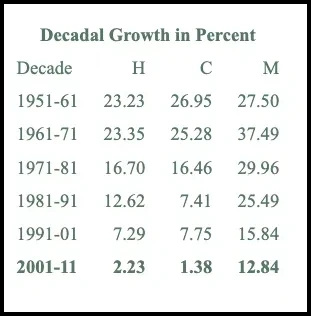
Notably, this disproportionate increase of Muslim live births while their share in Kerala’s total population is way lesser is not something that began after 2008. In fact, CPS India’s 2016 report found that between 2001 and 2011, Muslims had a decadal growth of a massive 12.84% while the Hindus despite being the majority group had a decadal growth of a miniscule 2.23% and the decadal growth of Christians was 1.38%.
“As a consequence of this differential growth, the share of Muslims in the state has increased by 1.84 percentage points at the cost of both Hindus and Christians who have lost 1.44 and 0.64 percentage points, respectively, from their share in 2001,” the CPS’s 2016 report reads adding that Muslims have always been growing faster than the Hindus and Christians since 1951, however, the gap between the growth rates of Muslims and Hindus and Christians has constantly widened over the decades.
It must be recalled that back in 2017, P K D Nambiar, President of the National Foundation for Justice and Development had raised alarm over Muslim birth rates being far higher than their share in Kerala’s total population. “While the birth rate of Hindus and Christians has marked a decline, the Muslim birth rate in the state has been rising steadily, according to a vital statistics report 2015, prepared by the economics and statistics department. Hindus in the state will become a minority by 2025,” Nambiar said adding that the societal changes seen in Kerala is due to this “strategic planning” and that the ‘secular’ government in the state may have facilitated this demographic change conspiracy as a part of their Muslim votebank appeasement politics.
Coming back to the latest report published by the Centre for Policy Studies, the report outlined that a higher share of Muslims in annual live births reflects in their higher TFR. The report relies on the findings of the last four rounds of the National Family Health Survey (NFHS) to assert that the TFR of Muslims has been around 50 percent higher than that of Hindus in every round, except NFHS-4.
While noting that NFHS is based on a very limited sample set, the CPS report said, “It is remarkable that while the total fertility of the State was below the replacement level already in the first round and has been declining further, the TFR of Muslims has remained above the replacement level, if we ignore the anomalous numbers of the fourth round.”
The large change in the relative proportion of Muslims in Kerala, the CPS report points out, has occurred in a period when the total fertility rate of Kerala has been below the replacement level for nearly three decades and all other religious communities have apparently entered the phase of demographic decline.
Interestingly, a 2023 study titled Hindu-Muslim fertility differentials in India said that the TFR of Kerala Muslims was 2.25 while the TFR of Kerala Hindus was 1.53 in 2019.
Total death rates in Kerala consistent between 2008-2021 but the share of Muslims was dramatically lesser than their population
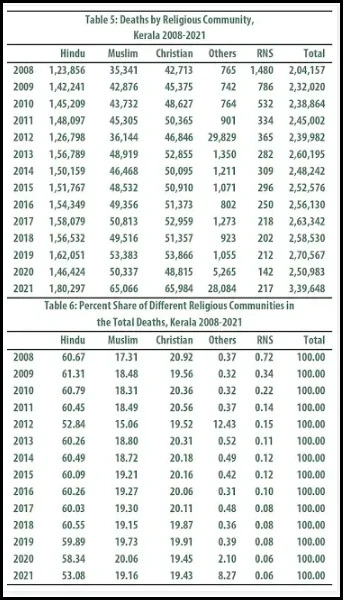
The data compiled by CPS shows that, unlike the total live birth numbers where one community recorded a perpetual increase with few points of reduction, the number of total deaths is relatively consistent. “If we leave out the number of deaths in 2008, which seems abnormally low, and for 2021, which is abnormally high, the number of total deaths for the remaining years has been fluctuating around 2,50,000 per annum during this period,” the report says.
Interestingly, while the share of Muslims in total live births in Kerala is far higher than their total population, their share in total deaths is far below their share in the total population.
The report says that the share of Muslims has generally been below 20% across the 2008-2021 time period, compared to their share of 26.6 percent in the population. Meanwhile, the share of Hindus in total deaths has hovered around 60%, excluding the anomalous numbers of 2012 and 2021. The share of Hindus in the population is far lower at 54.7% in 2011 which, the CPS report says is likely to have declined further by 2021. On the other hand, the share of Christians in total deaths has been around 19 to 20%, which is also slightly above their share of 18.4 %in the total population. In a nutshell, while Muslims had a way lower share in total death rates compared to their share population, Hindus have the largest share in total death compared to a far lower share in the total population.
Detailing on this pattern of Hindus having a considerably lower share in live births and a high share in deaths, Christians having lower live births but slightly higher deaths and Muslims having significantly higher live births and lower deaths, the report says, “The share of Hindus in the live births is 13.7 percentage points lower and their share in deaths is 6 percent higher than their share in the population of 2011. The share of Christians in the live births is 4 percentage points lower than and their share in total deaths is somewhat higher than their share in population. The share of Muslims is more than 14 percent higher in live births and at least 6 percent lower in total deaths as compared to their share in the population. The gap in the share of live births of different communities has only been growing during the period we are considering, while it has remained more or less steady in the share of deaths.”
Natural accretion highest for Muslims, declining for Hindus and Christians
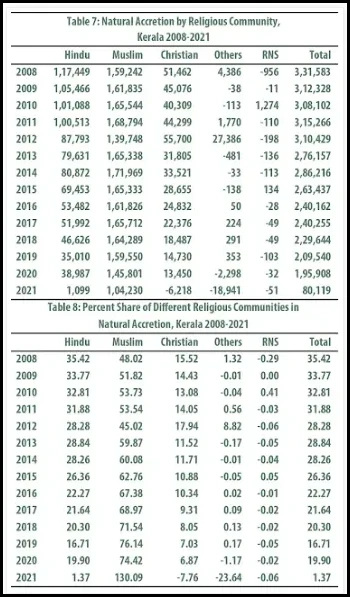
The report further noted that since Muslims had way higher live births and lower deaths, natural accretion to the Muslim population has been much higher than any other religious community in Kerala. Notably, natural accretion is calculated as the difference between the number of live births and total deaths.
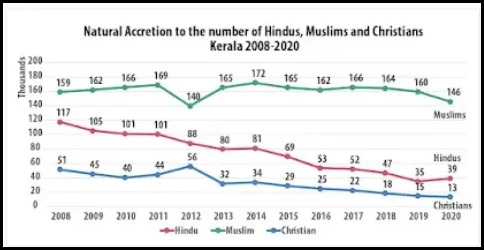
Till 2014, the number of persons added per year was rapidly increasing for Muslims, while it was sharply declining for the Hindu majority and the Christian community. While the natural accretion among Hindus and Christians has been consistently lower than Muslims since 2008, till 2011, natural accretion to the Hindu population was not in as deplorable a state as it turned in the following years.
The alarming situation can be better understood from the fact that in 2011, the natural accretion to the Hindu population stood at 1,00,513. However, in 2017 it dropped to 51,992, in 2020 it further came down to 38,987 and by 2021 there was a massive drop and the number stood at just 1099. By 2021, natural accretion to the Christian population has gone in negative while the numbers for the Muslim community have consistently increased with 2012 and 2021 being the only two years when there was a noticeable drop. From Hindus having 35.42% share, Muslims having 48.02% share and Christians having 15.52% share in natural accretion in 2008 to Hindus having mere 1,37% share, Christians having -7.76% share to Muslims having a whopping 130.09% share in natural accretion in 2021, the threat of demographic change and religious imbalance in Kerala becomes evident.
“If we exclude the anomalous numbers of 2012, the number of persons added per year was rising for Muslims up to 2014. After that, there seems to be a decrease in the number of accretions, but that decrease has been much sharper for Hindus and Christians. If the 2021 numbers can be relied upon, then the number of natural accretions has declined to almost nothing for Hindus and has turned negative for Christians. It seems that all other communities except the Muslims have entered the phase of declining population,” the CPS report points out.
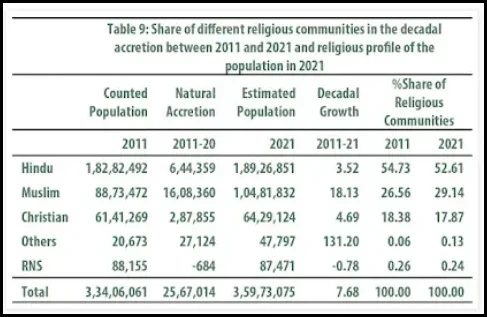
Continuing the trend recorded in the decadal growth for 2001-2011 wherein Muslims had a growth of 12.84%, in the decade 2011 to 2021, the Muslim community’s share in decadal accretion stood at 18.13% with 16,08,360 natural accretion and an estimated population of 10,04,81,832. While the Hindus despite being the majority group who had a decadal growth of a minuscule 2.23% between 2001-2011, recorded 3.52% decadal accretion between 2011-2021 with 6,44,359 natural accretion and an estimated population of 1,89,26,851. Meanwhile, the decadal growth of Christians between 2011-2021 has improved from 1.38% in 2001-2011 to 4.69% which is higher than Hindus.
Notably, the official data indicates that the share of Hindus in Kerala’s total population has dropped from 54.73% in 2011 to 52.61% in 2021. The share of Christians has gone down from 18.38% to 17.87%. Meanwhile, the share of Muslims in the state’s population has skyrocketed from 26.56% to 29.14%.
“Such a growth in the share of Muslims would be considerably more than the long-term trend since 1951. Between 1951 and 2011, their share has grown from 17.53 to 26.56 percent, recording a growth of 9 percentage points in 6 decades, with an average rise in their share of about 1.5 percentage points per decade. There has indeed been a rising trend in the increase in share from decade to decade, but so far, the increase has touched 2 percentage points only once. This was during the decade of 1981-91 when the share of Muslims in the population of the State rose from 21.25 to 23.33 percent. The data on live births and deaths suggests that during the decade of 2011-21, Muslim share is set to rise by about 2.5 percentage points, from 26.56 to 29.14 percent,” the CPS report states.
“The analysis indicates that in a scenario of declining fertility, the imbalance in the growth of different religious communities is likely to become even more pronounced,” the report emphasises.
The CPS report noted that the numbers for 2021 are extremely striking. In 2021, the total population of Kerala grew by only around 80,000. However, Muslims have added over 1 lakh to their population, Hindus have grown have added only 1000 persons, and the number of all others, including Christians, has declined by 25,000.
Last year, a report published by the Economic Advisory Council to the Prime Minister of India, Narendra Modi (EAC-PM) said that between 1950 and 2015, the population share of Hindus in India declined sharply by 7.8% while Muslim share grew by 43.15%, Christians by 5.38%, and Sikhs by 6.58%. The share of Hindus in India’s population saw a decrease from 84% in 1950 to 78% in 2015, while that of Muslims witnessed an increase from 9.84% to 14.09% in the same period.
At a time, when India’s TFR has fallen below 2 and in several states the situation is even worse, the imbalance in the growth of religious communities will be detrimental to the country. With Muslims having way higher live births and way fewer deaths compared to other communities considering their respective share in total population as data shows in the case of Kerala, it is paramount to compile such data in all other states and take necessary measures to curb religious imbalance and demographic change. This becomes even more crucial when religious conversions and designs of those working on their sinister agenda of carrying out population jihad to outnumber the Hindu majority are taken into consideration. The nationwide demographic change will not come without social, cultural and political consequences.
Besides TFR, legal and illegal immigration, illegal religious conversions of Hindus to Islam and Christianity also impact the population of Hindus not just in Kerala but in other states of India. In Kerala, time again the religious leaders of the Hindu and Christian communities as well as politicians have raised concerns about the menace of love jihad (grooming jihad) which they deem a sinister conspiracy to alter demography in the state. The left-liberal ecosystem wants Hindus to remain oblivious to the existential threat they face. However, the report by the Centre for Policy Studies highlighting the threat of religious imbalance and demographic change serves as a stark reminder of what is being taken too lightly by the governments and the Hindu community particularly—Demography is destiny.
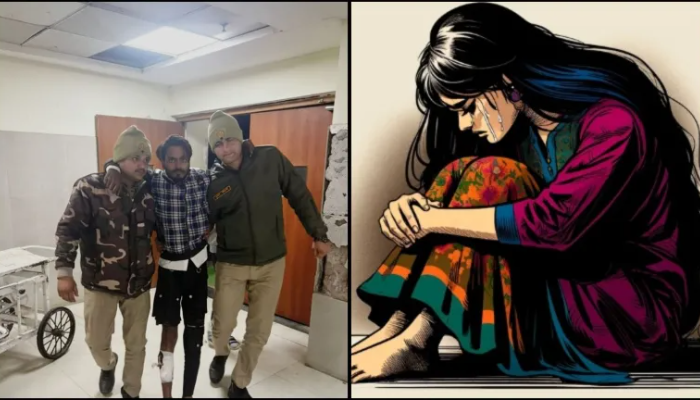
A Muslim youth lured a minor Hindu girl from Lakhimpur Kheri in Uttar Pradesh and took her with him. Afterwards, she was raped and pressured to convert to Islam. However, she refused and he killed her with the aid of his associates. Her body was then dumped in a forest about 500 kilometres away from Lakhimpur. The authorities arrested one accused while another was involved in an encounter with the cops.
On 25th January, a 17-year-old girl from Goriya village, which is located near the Padhua police station in Lakhimpur Kheri, disappeared, according to media reports. Her family members looked everywhere but were unable to locate her. They went to the Padhua police station and filed a report. They revealed that she was deceived by a Muslim young man. They also named his companions and submitted a case against eleven culprits.
Hindu organizations also got involved in the matter. Following an investigation by the police, it was discovered that she was with a young guy named Asif. Additionally, the cops discovered CCTV footage of the same incident.
His whereabouts were then tracked down by the police. It turned out that he had travelled to Dehradun from Lakhimpur. They also reached there and took his accomplices into custody. He was questioned, and it came out that the underage girl had been raped and murdered. According to him, the body was dumped in the forests of Ramnagar afterwards. The police retrieved the body and sent it for post-mortem. Asif, the primary suspect was captured following an encounter in Lakhimpur.
The deceased’s father unveiled that she was being forced to embrace Islam by Asif and his friends who ended her life after she refused to comply. Six others including Salman, Raja and Zubair have been nabbed by the police. Hindu outfits also organised protests against the instance. Further investigation is now underway.
The Union Finance Ministry on 30 January released the Economic Survey for the financial year 2024-25, ahead of presenting the budget for the next financial year. The Economic Survey 2024-25 provides a detailed assessment of India’s economic performance over the past year and outlines future growth prospects.
Despite global uncertainties triggered geopolitical tensions and supply chain disruptions, the Indian economy has remained on a steady trajectory, with an estimated GDP growth rate of 6.4% for FY2025. The survey highlights the resilience of domestic demand, the stability of financial markets, and the role of regulatory reforms in driving economic progress. The report places a significant focus on deregulation and structural reforms as key drivers of sustainable growth.
Macroeconomic Overview and Growth Trends
India’s economic trajectory in FY2024-25 has been characterized by resilience and steady expansion, despite challenges in the global environment. The survey underscores the importance of private consumption and investment as primary drivers of growth. With inflation largely under control and fiscal consolidation measures in place, the economy has maintained a stable macroeconomic outlook, says the survey report.
The industrial sector grew by 6 per cent in the first half of FY25, while the services sector grew by 7.1 per cent in that period. The labour market has also improved, with the unemployment rate declining to 3.2%, reflecting a positive trend in job creation. Moreover, India’s external trade has witnessed a moderate upswing, with exports reaching USD 602.6 billion and imports rising to USD 682.2 billion.
The report states that private final consumption expenditure at constant prices is estimated to grow by 7.3 per cent, driven by a rebound in rural demand. The industrial sector is estimated to grow by 6.2 per cent in FY25, while agriculture sector is expected to rebound to a growth of 3.8 per cent. Growth in the services sector is expected to remain robust at 7.2 per cent.
The survey also points to global economic headwinds, including geopolitical tensions, supply chain disruptions, and the tightening of monetary policies by advanced economies. However, India’s strong domestic fundamentals, including robust consumption demand and increasing infrastructure investments, have cushioned the economy from these external pressures. The survey predicts a continued growth momentum, projecting a stable outlook for FY26 and beyond.
Monetary and Financial Sector Developments
The financial sector remains a pillar of economic stability, supported by strong banking performance and regulatory reforms. India’s banking sector has witnessed a notable improvement, with non-performing assets (NPAs) declining, and credit flows increasing across industries. Insolvency and Bankruptcy Code, 2016 played a crucial role in addressing the NPAs, and has redefined the debtor-creditor relationship.
The survey says that the deterrent effect of the Code has led to a significant shift in debtor behaviour, and thousands of debtors are resolving distress in the early stages of distress.
The Reserve Bank of India’s monetary policy stance has focused on controlling inflation while ensuring liquidity in the financial system.
Foreign direct investment (FDI) inflows showed signs of revival in FY2024-25, although net inflows remained subdued due to capital repatriation and tighter global liquidity conditions. Meanwhile, foreign portfolio investments (FPI) remained volatile, reflecting global market trends.
The survey also notes the growth in insurance industry and expansion of India’s pension system, which has become more inclusive, though there is scope for further improvement in retirement savings and financial security.
External Sector Performance: Trade and Investment
India’s external sector has shown resilience despite global challenges. The balance of payments remains stable, with foreign exchange reserves standing at USD 640.3 billion as of December 2024. India’s forex reserves are sufficient to cover 90 per cent of external debt and provide an import cover of more than ten months.
The survey highlights the government’s efforts to enhance ease of doing business for exporters, including streamlined trade facilitation measures and expanded market access.
India’s export growth was driven by services and high-value manufacturing, though challenges remain in the textile and agriculture sectors, which have been impacted by fluctuating global demand.
The survey also discusses the increasing role of bilateral and multilateral trade agreements, which are expected to diversify export markets and reduce dependency on traditional trade partners. Additionally, geopolitical risks and trade restrictions in developed markets pose potential challenges that policymakers must address in the coming years.
The report states that India must continue reducing trade costs and improving facilitation to boost export competitiveness.
Inflation and Price Stability
Inflation remained largely under control, although fluctuations in food and fuel prices necessitated policy interventions. The Consumer Price Index (CPI) inflation hovered around 5%, with food inflation being a primary driver. The CPI dropped by 0.9 percentage points between FY24 and FY25 (April-December), largely driven by decline in core services inflation.
India’s food inflation rate has remained firm, primarily driven by a few food items such as vegetables and pulses. The average food inflation rate in FY25 (April-December) was 6.5 per cent, excluding three most price-sensitive vegetables – Tomato, Onion and Potato.
The government implemented targeted subsidies and price controls to maintain affordability, particularly for essential commodities. The survey acknowledges the impact of extreme weather conditions on food supply chains, which contributed to price volatility. Efforts to modernize agricultural supply chains and enhance storage infrastructure are highlighted as key policy priorities to mitigate future inflationary risks.
Medium-Term Outlook: Deregulation and Structural Reforms
The survey notes that to realise its economic aspirations of becoming Viksit Bharat by the time of the centenary of independence, India needs to achieve a growth rate of around 8 per cent at constant prices, on average, for about a decade or two. It acknowledges that this will be impacted by global environment, both political and economic.
One of the central themes of the survey is the role of deregulation in driving economic growth. The government has taken major steps to simplify regulations, improve business conditions, and encourage private sector participation in economic activities. It adds that deregulation is more critical for MSME growth than large enterprises.
The survey projects that if India continues on this path, the economy could achieve an 8% annual GDP growth rate, helping the country become a USD 6.3 trillion economy by FY30.
The survey adds that India has made significant strides in promoting renewable energy and boosting domestic manufacturing of renewable energy equipment through initiatives such as the Production-Linked Incentive (PLI) Scheme.
Importantly, the report notes that promise of shared benefits from a globalised world with open trade, free flow of capital and technology, and sanctity for rules of the game are things of the past. It acknowledges the new reality, to look inwards, adding that the current tendencies in the rest of the world necessitate that India redoubles its efforts to boost exports and attract investment.
Investment and Infrastructure Development
Infrastructure investment remains a cornerstone of India’s economic strategy. The survey mentions that capital expenditure by the union government on major infrastructure sectors has increased at a trend rate of 38.8 per cent from FY20 to FY24. The National Infrastructure Pipeline now has over 9,766 projects and schemes across 37 sub-sectors. These projects are tracked and reviewed through the integrated India Investment Grid.
The power sector saw significant expansion, with total installed capacity reaching 456.7 GW, and renewable energy contributing 209.4 GW. The survey highlights key developments in transportation and logistics, particularly the expansion of Indian Railways, road networks, and metro systems. Investment in smart cities and urban infrastructure has also increased, with a focus on affordable housing, public transport, and digital connectivity.
The government has also prioritized rural infrastructure, with notable investments in irrigation, electrification, and road connectivity. These initiatives aim to bridge the urban-rural divide and promote balanced regional development.
The survey mentions key infrastructure projects of the government, like Dedicated Freight Corridors, Vande Bharat trains, Amrit Bharat Station Scheme, Bharatmala Pariyojana to develop 34,800 km of National Highways, National High-Speed Corridors, UDAN scheme for air travel, ports and river cruise tourism etc.
Industrial and Manufacturing Sector Reforms
India’s manufacturing sector has shown signs of recovery, although some segments continue to struggle. The industrial sector grew by 6.2 per cent in FY-25 as per first advance estimate of GDP, driven by robust growth in electricity and construction.
The government’s Production-Linked Incentive (PLI) scheme has boosted domestic manufacturing, particularly in electronics, pharmaceuticals, and automotive industries. The domestic production of electronic goods has increased substantially from ₹1.90 lakh crore in FY15 to ₹9.52 lakh crore in FY24,
The economic survey notes that the country has drastically reduced its dependence on smartphone imports, with 99 per cent now manufactured domestically. PLI scheme has now been introduced in 14 key sectors, not just electronics. The survey highlights the role of MSMEs (Micro, Small, and Medium Enterprises) in driving employment and economic diversification.
The report highlights reform done in patent and trademark procedures, stating that simplified processes have resulted in increased number of patent filings and trademark registrations.
The report also points out the challenges of supply chain dependencies on China and underscores the need for domestic capacity building in critical industries. Encouraging self-reliance in key sectors is emphasized as a strategic priority.
Services Sector: A Major Growth Engine
The services sector remains a dominant contributor to India’s GDP, driven by IT services, digital platforms, and financial services. Its contribution to the total gross value added (GVA) at current prices has increased from 50.6 per cent in FY14 to about 55 per cent in FY25.
The survey notes that India’s IT exports have continued to expand, despite global economic uncertainties. Business services, including start-ups and fintech, are also growing rapidly, supported by government initiatives and venture capital investments.
Another area of focus is logistics and transport-related services, which are benefiting from improved infrastructure and digitalization. The expansion of e-commerce and digital payment platforms has further strengthened the service economy.
The economic survey notes that the new risks have surfaced in the growth of IT and professional services in view of the recent changes in global policies following key electoral outcomes. It states that that growth in manufacturing has a significant bearing on service sector growth, and vice versa., due to ‘servicification’ of manufacturing, i.e., increasing utilization of services in manufacturing production and post-production value addition.
The survey says that one of the primary conditions for manufacturing and service sector progress is the focus on appropriate skilling of the labour force. It further adds that there is an urgent need to review and amend complicated procedures at the grassroot level, regulations and rules that hinder both manufacturing and services.
Agriculture and Food Management
The agricultural sector continues to play a vital role in India’s economy, with significant improvements in crop production, irrigation coverage, and farmer support initiatives. The Kisan Rin Portal, launched to facilitate agricultural credit, has improved financial access for small and marginal farmers. Additionally, food security programs such as the Public Distribution System (PDS) have been instrumental in reducing hunger and malnutrition.
The survey emphasizes the need for climate-resilient farming practices, as changing weather patterns continue to impact agricultural output. Expanding crop diversification, sustainable irrigation, and advanced technology adoption are highlighted as necessary steps for ensuring long-term food security.
Employment and Skill Development
Employment trends have shown a positive trajectory, with the formal job market expanding significantly. The Employees’ Provident Fund Organisation (EPFO) registered over 131 lakh new subscribers in FY24, almost double the figure from FY19. The survey highlights the government’s focus on skilling initiatives, including vocational training and digital literacy programs.
As automation and artificial intelligence reshape the job market, the survey stresses the importance of reskilling and upskilling programs to prepare India’s workforce for future job opportunities. The government’s initiatives in STEM education, startup incubation, and research funding are expected to enhance India’s competitive edge in the global market.
The survey says that farmers need to be nudged away from impairing their soil fertility with an unbalanced application of fertilisers and from producing already overproduced crops, which deplete India’s water resources and use up electricity excessively. It adds that farmers must be allowed to receive price signals from the market unimpeded, and they need to have market mechanisms to hedge their price risks.
Conclusion and Policy Recommendations
The Economic Survey 2024-25 provides a comprehensive roadmap for India’s economic future, emphasizing deregulation, infrastructure investment, financial stability, and innovation-driven growth. The government’s focus on simplifying regulations, expanding digital and physical infrastructure, and strengthening key industries is expected to create a more resilient and competitive economy.
With strong macroeconomic fundamentals, strategic policy interventions, and a youthful workforce, India is well-positioned to sustain its growth momentum and achieve its long-term vision of becoming a USD 6.3 trillion economy by FY30. However, addressing global trade uncertainties, inflationary pressures, and climate-related challenges will be crucial for sustaining long-term economic stability. The survey calls for continued policy reforms and a proactive approach to economic governance, ensuring that India remains a key player in the evolving global economic landscape.
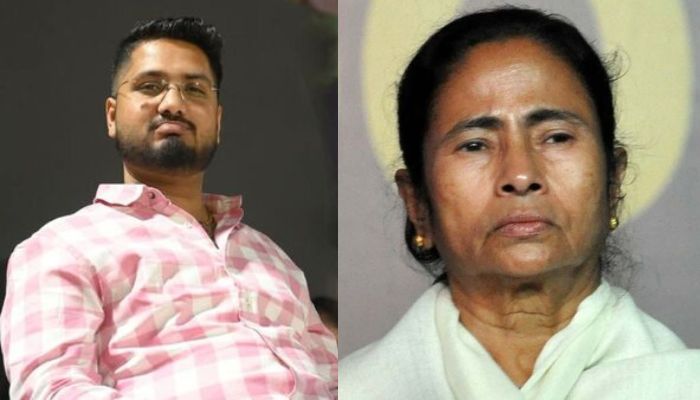
Students studying at the Jogesh Chandra Chaudhuri Law College in Kolkata have accused a Muslim Trinamool Congress ‘student leader’ of obstructing the Saraswati Puja celebrations at the campus.
According to them, Mohammad Shabbir Ali (the General Secretary of the West Bengal State Trinamool Chhatra Parishad) threatened them with rape and murder if the students of the government-law college dared to perform Saraswati Puja.
They have now filed a complaint with the Charumarket police station. The students have also submitted a complaint to the principal, Pankaj Roy. He has made several allegations against the TMC leader Mohammad Shabbir Ali.
Coincidentally, Jogesh Chandra Chaudhuri Law College is the alma mater of West Bengal Chief Minister and TMC supremo Mamata Banerjee.
One student informed, “These outsiders are extortionists. They want us not to organise Saraswati Puja. They have abused us with the choicest of expletives and threatened us with assault and rape.”
Another student lamented, “We have the right to organise Puja. Why are they stopping us? We are being told that if we perform Saraswati Puja, they will kill us when we pass through Anwar Shah Road. They are extorting money.”
TMC leader Mohammed Shabbir Ali is also accused of threatening to send men in girl’s hostel if students go ahead with the Puja.
The situation for Hindus in West Bengal has become so dire that Saraswati Puja has been blocked at the renowned Jogesh Chandra College!
Mamata Banerjee, who claims to be an alumnus of this college, has remained silent while TMC student leader Sabbir Ali and his group openly… pic.twitter.com/7MOkrQAGYf
Reportedly, outsiders are not permitted inside the college campus. However, Ali and other TMC goons continue to wreak havoc within the campus. The atmosphere of fear and intimidation is such that the principal himself is afraid to go to the government college.
Principal Pankaj Roy informed, “Last year, I was harassed while entering the college. I have never seen anything like this in my 40 years of teaching.” He hinted at an extortion racket being run by the TMC goons. “Given them money or else you will be in trouble,” Roy added.
The principal informed that the TMC goons initially peddled the rumour that he did not permit organising Saraswati Puja. Pankaj Roy said that he had written about the development to both the State government and the Centre.
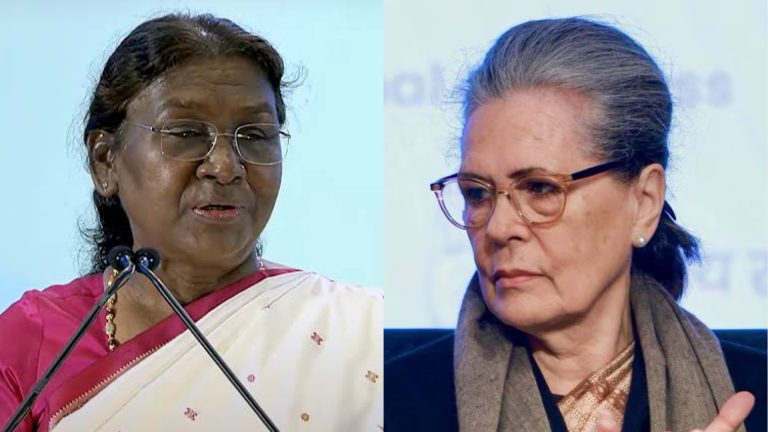
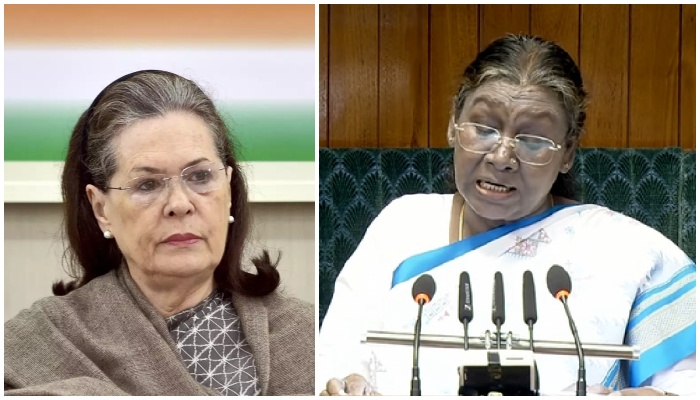
In response to senior Congress leader Sonia Gandhi’s remarks, the Rashtrapati Bhavan, without mentioning her name called it “unacceptable” and said it “clearly hurt the dignity of the high office.”
The Rashtrapati Bhavan also clarified that President Droupadi Murmu was “not tired at any point”, adding that the President believes speaking up for the marginalized communities, for women and farmers can “never be tiring”.
“While reacting to the media on the Hon’ble President’s Address to the Parliament, some prominent leaders of the Congress party have made comments that clearly hurt the dignity of the high office, and therefore are unacceptable. These leaders have said that the President was getting very tired by the end and she could hardly speak,” the Rashtrapati Bhavan said in a statement.
It further said that “it might be the case” that the leaders are not acquainted with idiom and discourse in Indian languages, adding that “in any case, such comments are in poor taste, unfortunate and entirely avoidable.”
“Rashtrapati Bhavan would like to clarify that nothing could be farther from the truth. The President was not tired at any point. Indeed, she has believed that speaking up for marginalized communities, for women and farmers, as she was doing during her address, can never be tiring. The President’s office believes it might be the case that these leaders have not acquainted themselves with the idiom and discourse in Indian languages such as Hindi, and thus formed a wrong impression. In any case, such comments are in poor taste, unfortunate and entirely avoidable,” it added.
This comes after in reaction to President Murmu’s address to the joint session of the Parliament, Sonia Gandhi said, “The President was getting very tired by the end…She could hardly speak, poor thing.”
Meanwhile, the Bharatiya Janata Party leaders have come heavily on the former Congress chief over her remarks.
Parliamentary Affairs Minister Kiren Rijiju demanded an apology from the Congress party.
“I condemn the comments made by Sonia Gandhi and other opposition leaders. Our President, a tribal woman, is not weak… Droupadi Murmu has worked extensively for the country and society and they cannot even imagine the kind of work she has done… They should apologise to her,” Rijiju said.
President Murmu during her address, said that the government is working for all-round development, adding that the country has only one aim which is to become a Vikshit Bharat (developed India). She also emphasised that the government is working with a “saturation approach” so nobody is left in the journey.
Murmu said, “My government is working with the Saturation Approach, so nobody is left in the journey of Vikshit Bharat…We have only one aim to become Viksit Bharat.”
As the Made in India defence product goes global, the President lauded the government for taking steps towards self-reliance in the defence sector.
“The country has taken several historic steps to protect the country’s borders and ensure internal security…The govt has also taken steps towards self-reliance in the defence sector. From Make in India, we have moved to make for the world,” she said.
After the completion of the Udhampur-Srinagar-Baramulla link railway project, President Murmu said that now India will be connected by railway line from Kashmir to Kanyakumari.
“The Udhampur-Srinagar-Baramulla rail link project has been completed and now the country will be connected by railway line from Kashmir to Kanyakumari. India’s metro rail network has now crossed the 1000-kilometre milestone. India has the world’s third-largest metro network,” the President stated.
(This news report is published from a syndicated feed. Except for the headline, the content has not been written or edited by OpIndia staff)
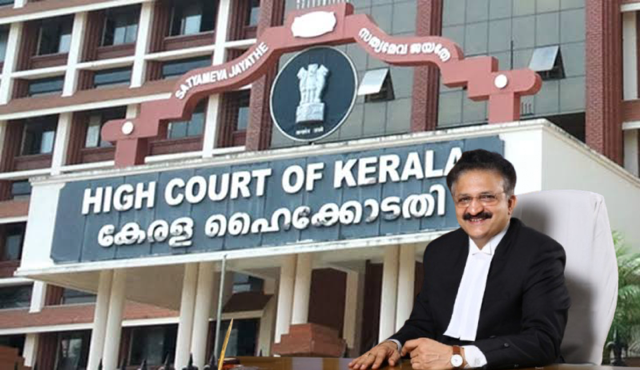
The Kerala High Court in a recent hearing noted that legislators who seek to change their political affiliation must resign and face people’s mandate again. The observation was made in connection with the assault of a councillor who had changed her political stance, prompting her party members to allegedly abduct her. The court emphasised that democracy allows for political shifts through ballot papers, not violence, and one must resort to violence against an elected representative who had shifted their party allegiance.
“If an elected representative changes their policy or affiliation, they must resign and face the people’s mandate again. This is the moral side of democracy. Otherwise, it’s a unilateral withdrawal from the people’s bond, an insult to their will. The people can show their will in the next election by supporting or defeating them. This is democracy’s beauty,” the Kerala HC noted.
Kala Raju, an LDF Councillor, was allegedly abducted by her party members on January 18 for voting in favour of the no-confidence motion moved by the UDF. To escape, the present assault case is registered against UDF members by LDF workers as a counter-attack.
The court stated that defeating someone in a democratic setup is through ballot papers, not weapons or vandalism. Both sides are trying to take the law into their own hands instead of approaching the people democratically, it said.
The allegation against the five petitioners is that they assaulted the complainant when she reached the Nagara Sabha Office to attend the no-confidence motion, causing her injuries. They also allegedly pulled her saree and outraged her modesty.
Koothattukulam Nagara Sabha is now governed by the LDF, with a one-seat majority. If Kala Raju votes in favour of the UDF’s motion, the LDF will lose power. This is why she was allegedly abducted by her party workers. The present crime is registered at their instance at Koothattukulam Police Station for offences under Sections 115(2), 126, 74, 76, 189, 191, and 190 of the BNS.
The court ruled that elected representatives must face the people’s verdict in the next election if they change their political affiliation. Physical attacks on such representatives are not allowed. The Court noted that these crimes occurred due to the embarrassment of LDF workers because their Councillor changed her political affiliation. Therefore, the bail application was allowed.
Bharatiya Janata Party has slammed Congress Parliamentary Party Chairperson Sonia Gandhi for her remarks calling President Droupadi Murmu “poor thing”. The ruling party at the Centre said that the remarks showed the “elitist, anti-poor and anti-tribal nature of the Congress.”
“I and every BJP Karyakarta strongly condemns the usage of the phrase “poor thing” by Smt. Sonia Gandhi for Honourable President of India, Droupadi Murmu Ji. The deliberate usage of such words shows the elitist, anti-poor and anti-tribal nature of the Congress Party,” JP Nadda, BJP President said in a post on X.
“I demand that the Congress Party unconditionally apologise to the Honourable President and the tribal communities of India,” he added.
While reacting to President Murmu’s address to the joint session of the Parliament, Sonia Gandhi told reporters, “The President was getting very tired by the end…She could hardly speak, poor thing,” Sonia Gandhi told reporters.”
BJP MP Sambit Patra said that President Murmu is neither tired nor bowed down and called Sonia Gandhi’s remarks inappropriate.
“Sonia Gandhi’s comments were totally inappropriate. She said that during her speech the president was very tired. She called her a poor thing. We want to tell it clearly that the honourable President is not a poor thing. India is a republic and the world’s largest Democracy. The first citizen of this Democracy is a woman who comes from a tribal community. That woman from the tribal community cannot be a poor thing. She is empowered and strong. She has been at the helm of many important positions,” he said.
Parliamentary Affairs Minister Kiren Rijiju also called for an aplogy from the Congress.
“I condemn the comments made by Sonia Gandhi and other opposition leaders. Our President, a tribal woman, is not weak… Droupadi Murmu has worked extensively for the country and society and they cannot even imagine the kind of work she has done… They should apologise to her,” Rijiju said.
Union Minister Dharmendra Pradhan said, “Such an insult of the President was unprecedented. The kind of words Congress MP Sonia Gandhi and his son and LoP Rahul Gandhi used against the President, I cannot even imagine. What else can be expected from them?…”
President Murmu’s address kickstarted the Budget Session. Emphasising that the government is working on all-round development, President Murmu said that the country has only one aim which is to become a Vikshit Bharat (developed India) and the government is working with a “saturation approach” so nobody is left in the journey.
Murmu said, “My government is working with the Saturation Approach, so nobody is left in the journey of Vikshit Bharat… We have only one aim to become Viksit Bharat.”
As the Made in India defence product goes global, the President lauded the government for taking steps towards self-reliance in the defence sector.
“The country has taken several historic steps to protect the country’s borders and ensure internal security…. The govt has also taken steps towards self-reliance in the defence sector. From Make in India, we have moved to make for the world…” she said.
After the completion of the Udhampur-Srinagar-Baramulla link railway project, President Murmu said that now India will be connected by railway line from Kashmir to Kanyakumari.
“The Udhampur-Srinagar-Baramulla rail link project has been completed and now the country will be connected by railway line from Kashmir to Kanyakumari. India’s metro rail network has now crossed the 1000-kilometre milestone. India has the world’s third-largest metro network,” the President stated.
(This news report is published from a syndicated feed. Except for the headline, the content has not been written or edited by OpIndia staff)