Home Blog Page 6389

BSP-SP breakup: After BSP supremo Mayawati, Akhilesh Yadav drops hint of SP going into the assembly by-polls alone

A day after BSP supremo Mayawati held Samajwadi Party chief Akhilesh Yadav responsible for the disastrous performance of the SP-BSP Mahagathbandhan alliance in the Lok Sabha 2019 polls and hinted at going into the assembly elections alone, Akhilesh Yadav too has admitted the possibility of going into the by-polls alone if the coalition is broken.


SP chief has said that if the coalition between SP-BSP is broken, he will deeply reflect on it and Samajwadi Party will prepare for the local by-polls on 11 seats alone if the BSP breaks away from the coalition.

Earlier today, defending her decision to go solo in the upcoming by-elections in the state, BSP supremo Mayawati asserted that this hiatus in alliance with Samajwadi Party is not permanent but based on the condition that if the SP chief Akhilesh Yadav manages to be successful in his political work, BSP might again join hands with the SP. However, she also added that if Akhilesh Yadav fails, they will continue separately.

In addition, Mayawati said that her relationship with Akhilesh Yadav and his wife Dimple Yadav will never end as they have given her immense respect.

Justifying her decision of breaking away from the coalition, Mayawati cited the political compulsions following the dismal performance by SP party in the Lok Sabha elections for them to go alone in the by-polls. Mayawati alleged that the UP base of Samajwadi Party, the ‘Yadav’ community didn’t support the party and even the formidable contenders of SP were defeated in the recently concluded general elections.


Yesterday, in a meeting with her party leaders to assess the reasons for SP-BSP alliance’s failures in the elections, Mayawati had held Akhilesh Yadav responsible for their poll rout. She also sacked election councillors of 6 states and asked for the resignation of presidents of two states for their party’s miserable show. It was in this review meeting that Mayawati declared of going into the upcoming assembly by-polls alone.

The debate around PLFS is back and here are the issues that the politicised controversy fails to consider

The Periodic Labour Force Survey (PLFS) is officially out, and with it, the controversy on job growth over the last 5 years has resurfaced. At the onset, I must state that the unit level data of the survey should have been released long ago. As far as the report is concerned, we’ve enough evidence to now know for sure that it suffers from serious inconsistencies.

For starters, let it be known that PLFS and the previous Employment-Unemployment Surveys have different sampling techniques. While the EUS uses income levels for stratification, PLFS used education attainment for stratification. Therefore, any comparison of unemployment rates for these two techniques is fundamentally flawed so any article that claims unemployment is at a 45-year high is junk and you’re better off ignoring it rather than wasting your time on it.

With the PLFS report finally out, commentators can now explore the inconsistencies within the report in far greater detail. It will also be possible now to use the unit level data and adjust for the change in the sampling framework to arrive at near comparable estimates of unemployment. One such inconsistency has been in the rate of urbanization as reported by PLFS which is lower than the one provided by the NSSO in 2011-12. This suggests that post-2011 there was a decline in urbanization, but rapid urbanization is visible across the country. Another issue with the PLFS is its underestimation of the population which clearly is yet another inconsistent finding. Therefore, there are multiple problems with the PLFS, and it simply does not pass the basic smell test!

The question that is often being asked is why the government released the report if it is incorrect- but then when the report was not being released everyone was criticising the government for withholding it. Fact remains that the report is definitely problematic irrespective of the fact that it has been now officially released. This release should be welcomed as now we have the entire report with us to identify what went wrong with the sampling framework and the survey design so that we can rectify it for the future. But would I base my understanding of India’s labour market solely on the PLFS? Absolutely not!

As far as the issue of job creation in the economy is concerned, the debate has been far too politicized in the recent past and it continues to be politicized even after the elections. Such politicization will not help address the issue at hand and it would only direct our attention to the inconsequential and never-ending debate on whether there is robust job creation in the economy or not. The answer to this question is likely to be highly subjective: if you were looking for a job and got one then you’d believe in robust job creation, if not then you’d believe that there are no jobs in the economy.

But a modern economy like India does require a time series statistic that can estimate unemployment (and hence job creation) on a regular basis. This was the initial motivation for the Periodic Labour Force Survey and perhaps, there were some errors that were made in the process but now would be the time to correct for them and reconstitute a similar survey with an improved sampling framework along with a questionnaire that aims at capturing the self-employed and flexible employment contract workers in the process of estimation.

Additional questions on whether an income was earned and if yes then from what source could be instrumental in capturing the source of livelihood for a respondent. It would be difficult to quantify job creation during the last 5 years in the absence of such data, but there is macroeconomic evidence to suggest that job creation has definitely improved between 2014-18 compared to 2009-13.

OpIndia Impact: Congress party updates its website after mistakes and omissions were pointed out

After OpIndia pointed out multiple errors about mistakes and omissions by the Congress party about their own organisation in their official website, they have now corrected those errors.

On 2nd June, we have reported how the Rahul Gandhi’s biography page on the Congress website mentioned that his father Rajiv Gandhi was Prime Minister of India when he was assassinated in 1991. But it was totally wrong as Rajiv Gandhi was the leader of the opposition at that time, and Chandra Shekhar was the PM.

Again on 3rd June, we had noticed that former Congress president Sitaram Kesri’s name was missing from the list of former presidents on the party website. Sitaram Kesri served as Congress party’s president from 1996 to 1998, after which he was unceremoniously removed to make way for Sonia Gandhi.

After the mistakes were pointed out, now the Congress party has corrected them in their website. Rahul Gandhi’s biography page no longer says that Rajiv Gandhi was PM when he was killed.

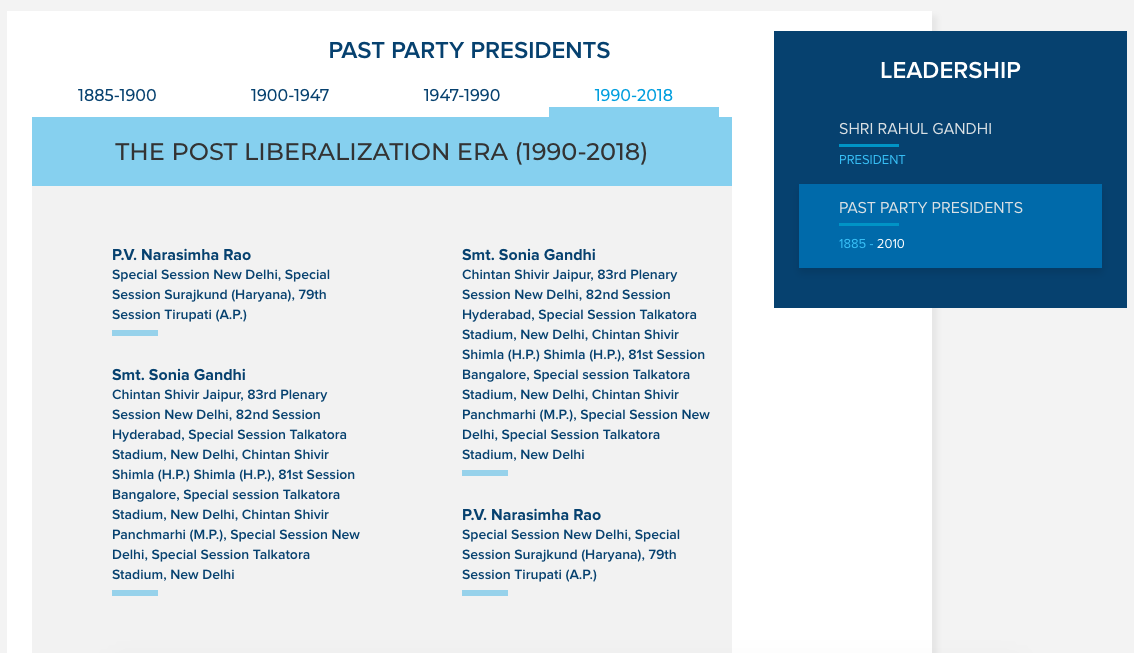
List of Congress Presidents before correction
List of party presidents after correction

Similarly, the page for past party presidents also has been updated, and now Sitaram Kesri finds a place in the list of the Congress presidents in the post-liberalisation era, along with P.V. Narasimha Rao and Sonia Gandhi. Although the question will always remain, why his name was omitted from the site in the first place.

People fear for their lives unless they show Army, India and Hindus in bad light: Vivek Agnihotri on ‘The Kashmir Files’

Filmmaker Vivek Agnihotri announced his latest film The Kashmir Files, based on the plight of Kashmiri Pandit refugees following the 1990 Kashmiri Pandit exodus from the valley. Speaking exclusively to OpIndia on his new film, Agnihotri said that this film will not be a sugarcoated version of the plight of Kashmiri Pandits.

“People fear for their lives when it comes to Kashmir issue unless you are making a film that shows the Indian Army, India and Hindus in a bad light. I don’t think the Kashmiri Pandit issue is just a Kashmiri issue. That’s where we go wrong. It is an Indian problem. It is an issue every Indian must worry about as India’s cultural boundaries of a diverse culture are shrinking with Kashmir going to Sharia mindset,” said Agnihotri who recently directed the critically acclaimed The Tashkent Files which is also a commercial success.

Like his previous film, The Tashkent Files, which was backed by solid research work around the mystery surrounding former Prime Minister Lal Bahadur Shastri’s mysterious death in Tashkent, The Kashmir Files will also be backed by research as well as real stories of people who lived through it. He says the focus will be more on people as while books are aplenty, most are written to promote a certain ideology. “It is not just a film, it is my life mission,” he says on a topic the Bollywood has usually shied away from exploring.

Speaking about his experience of making The Tashkent Files, Agnihotri said, “People smell conviction and honesty. This is what I have learnt. We ensured throughout making The Tashkent Files that we remain honest to the material we had and people appreciated it. It has also made me more responsible as my relationships with my audience is that of trust, faith and honesty. I can’t divert from these three.”

He adds that a filmmaker must not worry about what would work and what wouldn’t. “One should just stick to one’s conviction. In The Tashkent Files, everything we did was against the norms. The theme, the narrative, casting, marketing everything was seen as disastrous. But in the end, we survived giants like Kalank, Avengers, SOTY2 as well as films by Ajay Devgan and Arjun Kapoor. Even the IPL, Elections and the results. The good news is that we will still be running despite Salman Bhai’s ‘BHARAT’. That is the reward of breaking almost every rule. But still, nobody in the industry wants to recognise such unprecedented success.”

Vivek Agnihotri’s film The Tashkent Files, while was very well accepted by the audience, the ‘film critics’ were quite hostile towards him. “I don’t have much problem with people like Raja Sen as they are corrupt and immoral people. My problem is with someone like Shubhra Gupta of Indian Express, who is an award winner, giving it 0 stars. ZERO STARS? What kind of critic gives 0 stars? It tells more about her than me or the film. NDTV gave 0.5 stars. A lot of them wrote 5000-word articles on me but nothing on the film. Same people then go and become faces of the ‘liberal’ movement and ‘feminist’ movement and tell us about ‘intolerence’ and return awards. They condemn the star system in their columns but become sycophants of the same stars after just one drink at their house. These are scheming, corrupt people. They are the middlemen of Bollywood’s underbelly,” Agnihotri reveals the dark side of the glamour world.

Film critics had even boycotted his film and refused to review it. “I am upset with people like Anupama Chopra and Rajeev Masand. By boycotting my film they have also sent a message that they are prejudiced and don’t care about the audience. They run small power camps. I have exposed them time and again and that’s why they hate me. They don’t even want to acknowledge me as a filmmaker. What Anupama Chopra ignores that my film has had higher IMDB ratings than her husband’s (Vidhu Vinod Chopra) film 3 idiots which had the highest ratings thus far. Do you see different standards? But I don’t care about them much. Rajeev Masand said he was out of country. Now he is back and the film is still running. If he is a fair and honest man will he see it and review now? Will he invite us and especially Shweta Basu for his round tables?” he says

“If it was a Karan Johar film or a big star’s film or an Anurag Kashyap film doing 50 days at the BO, they would have called it a classic and written hundreds of articles. Who wrote about us? If Shweta was backed by the Moguls of Bollywood, she would have been on all covers and front pages. She is undoubtedly one of the best female talents this industry has discovered since Alia Bhatt. Did you see any big filmmaker talk about her?” Agnihotri said adding that the Bollywood doesn’t care about talent, they need slaves which we can never become. Whoever is not a slave of some camps, is sitting at home, he says.

Arnab Goswami talks about some unPRINTable facts: Who got free flats and land? Who are the people now promoting freebie culture?

After the AAP government declared that it intends to make bus and metro ride free for women in Delhi, media and social media has been awash with debates on opinions over the freebie culture and whether the plan is just another of AAP’s dozens of other promises which they never keep.

While a certain section of Delhi elites and AAP supporters were seen hailing the move, there was also a debate on whether the freebie culture is just another way to divert the public attention from the glaring issues of safety, overcrowding and lack of other basic necessities.

Arnab Goswami of Republic slammed the ‘Freebie’ culture and stated that there is a section of Lutyens Delhi elites who have lived on freebies all their lives and they are the people who hail and celebrate this freebie culture.


Arnab slammed the comment “It is an era of freebies” and stated that India has stated through votes that it is an era of aspirations, ambition, merit and not freebies. He stated that a group of people, who have no connection with ground realities say ‘It is an era of freebies’ when India has already rejected the idea of freebies.

Arnab stated that there is a media house which obtained acres and acres of free land in Uttar Pradesh before the last assembly elections in the state. He added that there are journalists who have got free lands, free flats in Noida, Greater Noida and Gurgaon are objecting when Republic TV raises questions over free metro rides.

Arnab also emphasized some ‘UnPrintable’ facts where a certain journalist had obtained lands in Chhatarpur to build large farmhouses in the name of NGOs. He added that there are journalists who had obtained cars from private companies during the 2g case. They have been living their lives on freebies, from flight tickets to holidays and now they have concluded that there is a freebie culture in the country.

Arnab asserted that the country and its people have now started to reject freebies. he said that a storm has come over the country and the public now wants their problems of sewage, drinking water, illegal settlements, overcrowded facilities solved, they do not want freebies.


Arnab has been bringing the issue of certain Lutyens journalists getting undue favours from previous governments. He had also used wordplay around ‘Print’ earlier. Earlier this year, Arnab had, at an event, talked about the many media bigwigs owning farmhouses in Chhatarpur that have been ‘gifted’ by previous governments and being used to run money-spinning NGOs.

BCCI announces home season schedule for India

On Monday, BCCI (Board of Cricket Control of India) announced the number of cricket matches and teams India will play at home in 2019-20 season.

As World T20 is set to happen in October 2020, India is playing more T20 games (12) than Test (5) and ODI (9).

India will play 5 Tests in the home season which will be the part of the inaugural World Test Championship that begins after the 2019 World Cup.

The World Test Championship has been scheduled in such a way that India and Pakistan won’t play each other unless they both make the final.

South Africa will be the first team to play in India’s home season. They will play 3 Tests and 3 T20Is.  South Africa’s tour of India will start from September 15 and will end on 23rd October. South Africa will come back in March 2020 to play 3 ODIs.

Up next is Bangladesh, they will play 2 Tests and 3 T20Is. This will be the first time Bangladesh playing a proper series in India.

The five cities which will host tests are – Vizag, Ranchi, Pune, Indore, and Kolkata. The cities which will host more than one match in home season are Mumbai, Pune, Vizag, Rajkot, Bengaluru, and Indore.

West Indies, Zimbabwe, and Australia will play only limited over cricket in India. The schedule for the home season is as follows

Freedom Trophy – 2019 against South Africa

1st T20I: 15 September, Dharamsala

2nd T20I: 18 September, Mohali

3rd T20I: 22 September, Bengaluru

1st Test: 2-6 October, Vizag

2nd Test: 10-14 October, Ranchi

3rd Test: 19-23 October, Pune

Bangladesh’s Tour of India – 2019

1st T20I: 3 November, Delhi

2nd T20I: 7 November, Rajkot

3rd T20I: 10 November, Nagpur

1st Test: 14-18 November, Indore

2nd Test: 22-26 November, Kolkata

West Indies’ Tour of India 2019

1st T20I: 6 December, Mumbai

2nd T20I: 8 December, Thiruvananthapuram

3rd T20I: 11 December, Hyderabad

1st ODI: 15 December, Chennai

2nd ODI: 18 December, Vizag

3rd ODI: 22 December, Cuttack

Zimbabwe’s Tour of India – 2020

1st T20I: 5 January, Guwahati

2nd T20I: 7 January, Indore

3rd T20I: 10 January, Pune

Australia’s Tour of India – 2020

1st ODI: 14 January, Mumbai

2nd ODI: 17 January, Rajkot

3rd ODI: 19 January, Bengaluru.

Delhi Police reminds AAP government in Delhi for sanction to chargesheet its ‘sex tape’ minister Sandeep Kumar

The Delhi Police sent a reminder to the AAP government in Delhi for sanction to chargesheet AAP’s former minister Sandeep Kumar infamous for his alleged ‘sex tape’. The sanction is pending with Delhi government for around 1 year now.


The Additional Deputy Commissioner of Police (Outer) Rajendra Singh Sagar had confirmed that the police had moved the application for prosecution grant against Sandeep Kumar to the Kejriwal government in April 2018 also. However, the police had, then too, not received any response from the AAP government.

Ousted Sandeep Kumar is most well known for his ‘sex tape’ that emerged in August 2016, which ensured that he got removed as a minister, ironically of the Women and Child Development ministry.

Reports also claimed that the woman who featured in the sex tape had lodged a complaint against Sandeep Kumar, accusing that he sexually exploited her on the pretext of getting her a ration card.

Following the complain the police had arrested the accused on September 3, 2016, and sent him to 3 days police custody booking him under section 376 (rape), 328 (causing hurt by means of poison with intent to commit an offence) of IPC, under section 67A of IT Act (punishment for publishing or transmitting of material containing sexually explicit act) and Section 7 of the Prevention of Corruption Act (public servant taking gratification other than legal remuneration for an official act).

In addition to the rape charges, there was another controversy about Sandeep Kumar which made him very unpopular especially in the virtual world. He was also accused of trying to use his official position to ensure American citizenship for his newly born son.

The MLA had then defended himself against the rape charges, saying he has been targeted since he was a Dalit. Kumar’s wife has also come out in support of her husband, claiming that he was “falsely implicated” in the scandal.

Anubhav Sinha’s ‘Article 15’ claims of highlighting ‘equality’, takes liberties with facts to suit anti-Brahmin propaganda

The trailer of Ayushman Khurana starrer ‘Article 15’ was released recently. The movie is made by Anubhav Sinha of ‘Mulk’ and Ra-One fame. The film claims to be based on true events and a look at the trailer makes it clear that it is based on the infamous Badaun hanging case where two young girls were murdered in a village in UP.

A report quotes Manoj Pahwa, one of the actors in the film saying, “This film is not completely based on the heinous crime that took place in Badaun where two girls were raped and hanged. We can say that this film is inspired by that incident and we have included some chunks of it.”

[youtube https://www.youtube.com/watch?v=HKOJY0cU63E]

The trailer begins with the reference to Article 15 of the Indian constitution which gives a right of equality to everyone. However, the movie seems hell-bent on driving home the fact that ‘equality’ means showing Brahmins as the villains in the story.

The trailer shows two young girls of a village brutally raped and murdered, their bodies hanging from a tree. It shows the girl, whose families are marginalised and forced to work as day labourers, were targeted because they demanded a hike of 3 rupees in their daily wages and shows how caste equations are prevalent in the area. The trailer also mentions that the crime was committed by ‘Mahant ji ke ladke’. Mahant ji is mentioned as a Brahmin of the highest order.

The scenes of the trailer also show how the people in the area think that the Dalits have no right to demand higher wages, and their status is what the ‘upper caste’ deems fit.

In its attempt to be ‘inspired’ from the Badaun case, the movie seems to have taken wide liberties with facts. The case got wide attention in national and international media, bringing shame for the then Akhilesh Yadav government in UP because it was highlighted as a case of upper caste atrocity against Dalits.

The accused were named Pappu Yadav, Avadhesh Yadav, Urvesh Yadav, Chhatrapal Yadav and Sarvesh Yadav. Chhatrapal and Sarvesh were policemen. The police department was accused of showing leniency to the accused in the case due to political pressure from the Samajwadi Party which was favouring the Yadavs. Even the police investigation was severely criticised and the people had demanded a CBI inquiry.

The CBI had later stated that their probe indicates that the two girls, aged 14 and 15, had committed suicide and they were neither raped or murdered. The five accused were all given a clean chit.

Anubhav Sinha, the person whose own shady money laundering attempts have been highlighted before and who was last seen requesting Pakistanis to watch his ‘Mulk’ movie illegally, has made great efforts in his movie to take a widely publicised crime and paint it in colours of casteism that suits his political narrative. The invisible ‘Mahant ji’ (a probable sly at Yogi Adityanath) who is a Brahmin, is painted as the all-powerful root of evil in the movie. Also, the over-emphasis of ‘upper castes’ and Brahmins being the sole cause of all atrocities seems to be the central theme in the movie.

The attempt to pick a highly publicised crime and paint it in anti-Brahmin, anti-upper caste colours is unfair, even in the name of artistic liberties. The Badaun case had no brahmin angle. Changing the ethnicities and identities of a highly publicised crime only reeks of narrow political agenda, an agenda which is dangerously partial and divisive.

In the recently concluded Lok Sabha elections, Uttar Pradesh has shown that it has discarded its age-old political tools of caste and community. The SP-BSP alliance whose entire politics is based on caste divisions and antagonisation was rejected and the BJP who fought the elections on the issues of development and nationalism was selected by the people with an overwhelming mandate. At a time when the people are ready to cement their faultlines and look forwards, movies like this are a shameless attempt to further enforce the old shackles of caste identities down their throats.

Preview – Match 7: Afghanistan vs Sri Lanka – Who will get their first points of the World Cup on the board

Two lowest ranked ODI teams in the World Cup will lock horns today as Number 9 Sri Lanka take on Number 10 Afghanistan. After a disappointing start, both will be looking to get their first points on the board in this encounter.

Sri Lankan ODI side is in the middle of a terrible run of a form right now, having won just 2 games since September last year, and they will be desperate for a win here to get some confidence back. Few years back, this fixture would have been taken as straight forward 2 points by Sri Lanka but the recent form of both teams shows that we may be in for a very evenly matched contest. Last time these 2 sides met; Afghanistan handed Sri Lanka a heavy 91 runs defeat to knock them out of the Asia Cup.

Sri Lanka started the World Cup in the worst possible way for them, a comprehensive 10 wickets defeat. Sri Lankan batting was thoroughly exposed by the Kiwi quicks as Henry and Ferguson ran through their batting line-up with only skipper Karunaratne digging in to produce a fighting half century. The batsmen will have to do a lot better against Afghanistan to give themselves any chance in the bowling friendly conditions expected during this game.

If the pitch is anywhere close to the green colour we saw during Sri Lanka-New Zealand game at the same venue, expect an additional seamer Nuwan Pradeep to come in to the XI at the expense of Jeevan Mendis or Isuru Udana.

Afghanistan showed a lot of impatience against Australia in their opening match with most of their batsmen playing as if they were playing a T20 match. It could be the nerves of playing in a big tournament or maybe they just wanted to get as many as they could before they get a ball with their number on it. In seaming and swinging conditions in Cardiff, they will have to show a little more restraint to be successful and put up a fighting total, though you won’t expect Shehzad to show any restraint at all.

Their bowling may see some changes with Mujeeb’s poor form from IPL continuing in the first game. A seamer may get drafted in his place for this venue. Their bowling will stay heavily reliant on Rashid Khan though who had a rare off game against Australia.

Key Players:

Kusal Perera– Only time period during which Sri Lanka was in the contest against New Zealand was when Kusal Perera was batting. The diminutive left hander scored a quickfire 29 with some attractive boundaries before skying a catch off Henry. He was the star when Sri lanka pulled off the greatest Test chase against South Africa earlier this year, and now Sri Lanka will be hoping he can bring some of that form to England.

Rashid Khan– For Afghanistan, the star man remains Rashid Khan. He had a decent outing with the bat against Australia where his quick cameo pushed the total above 200 but he had an off day with the ball. Bowling slightly shorter than what he usually does, Rashid leaked runs square off the wicket and was unable to build any pressure. Afghanistan will be hoping it was just an off day for their star bowler and he will be back to doing what he does best against Sri Lanka.

Sri Lanka vs Afghanistan in ODIs

Overall: Matches 3, Sri Lanka Won 2, Afghanistan Won 1

World Cup: Matches 1, Sri Lanka Won 1, Afghanistan Won 0

Recent Form (most recent first): Sri Lanka LWLLL | Afghanistan LWLWL

ICC Rankings: Sri Lanka (9), Afghanistan (10)

Karl Marx had impregnated his maid and didn’t own up the child

Considered the father of Communism, Karl Marx reportedly had a side of his which has been kept well-hidden. As per an archived opinion piece on NYTimes by Ralph Buultjens, Marx has a secret which is not that well known. Marx had reportedly impregnated his family maid and then didn’t own up the child.

The portion of NYTimes article which mentions his illegitimate child which Marx abandoned is reproduced here in its entirety:

In 1851, while living in London, Marx fathered an illegitimate son by Helen Demuth, the longtime family maid. Fearing that this indiscretion would destroy his marriage and damage his public image, he organized an effective cover-up, whose participants were Marx’s friend and collaborator Friedrich Engels and Helen Demuth.

Engels pretended he was the father and Miss Demuth confirmed the deception. The infant, Fredrick Demuth, was given away to be brought up by a working-class family in London. The secret was preserved for more than four decades. In 1895, on his deathbed, Engels confessed to Eleanor Marx -one of Marx’s two surviving daughters. She was shattered by the revelation. Three years later, she committed suicide. In 1911, Marx’s other daughter, Laura, killed herself. Freddy Demuth grew up a neglected, lonely child. Marx could not afford any support. Engels, on whom Marx depended financially, sent small, infrequent remittances. Both Marx and Engels distanced themselves from Freddy. Marx never saw the boy. Freddy Demuth was poorly educated. For most of his life, he worked as a laborer and toolmaker. After Marx’s death, he established closer contact with his mother, who had then become Engels’s housekeeper. Freddy visited her weekly but was allowed only into the kitchen and servants’ rooms through the back door. Engels, like Marx, shunned him. After his mother’s death in 1890, Freddy hardly ever saw Engels. Neither Marx nor Engels provided a legacy for him. However, Marx’s daughters did give Freddy some money from their share of both estates. In 1929, after a hard, obscure life, Freddy died at 78 in a poor section of London. Nobody, not even his mother, told him the truth about his paternity and he died believing he was Engels’s bastard child. Marx’s secret was well-concealed. In his lifetime, only Helen and Engels shared in this confidence. On his death, they screened his papers to eliminate references to Freddy. Later, about the time Engels died, a few associates and family members came to know of the Demuth affair, but it was not much discussed. While researching this part of Marx’s life, a part that contains many clues to the development of his ideas, I became convinced that many Marxists had built a wall of silence around this secret. No major Soviet biographical material about Marx mentions Freddy. Other Marxists brush it off as irrelevant gossip. It is clear that to the Marxist world, Fredrick Demuth did not exist, or that the subject is taboo. The heroic proletarian image of the father of the revolution must not be tarnished by evidence of his duplicity, hypocrisy, frailty.