Home Blog Page 6702

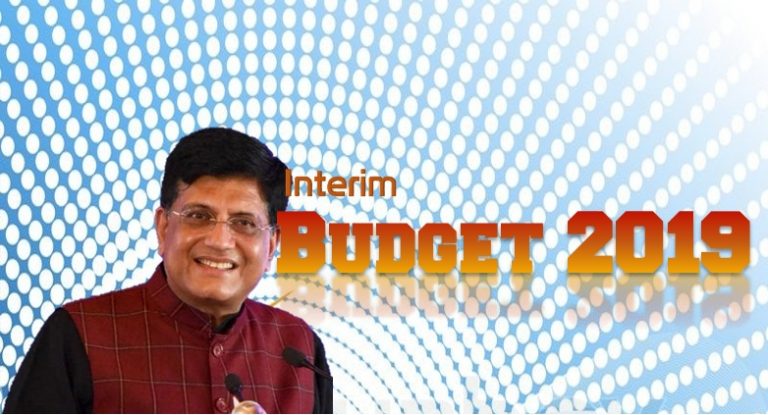
Interim Budget 2019: A bridge towards our vibrant future

A lot will be written about the Interim Budget 2019 over the next couple of days- some may applaud it, some may call it a “political budget” while others may continue to criticize it just as they’ve criticized everything that the government has done over the last couple of days. But the budget is nothing beyond a simple extension of the economic policies that the government has been following since the last four and a half years and it is a simple extension of the larger vision with which the Prime Minister of India led his 2014 campaign.

In many ways, the budget is historic in the true sense of the word as it recognizes for the first time that India’s approach to the farming sector has not worked. This recognition should have come decades earlier, however, for petty political considerations, successive governments have failed to recognize policy blunders and thus, they’ve not dared to correct them. There is no doubt that India’s Minimum Support Price policy has not helped in providing “income support” to India’s farmers, yet successive governments have relied upon this policy for a prolonged period of time.

There was an urgent need to move towards providing income support to farmers and the government has rightfully recognized it and provisioned for it by providing Rs. 6000 per annum to small and marginal farmers. This is significant as it recognizes the need to uplift the small and marginal farmers who own less than 2 hectares of land from abject poverty. A proposal for Targeted Basic Income by Dr Surjit Bhalla and me had advocated covering the entire poor population irrespective of whether they were rural poor or urban poor, however, it is reassuring to recognize that at least the government is partially accepting the concept of Targeted Basic Income. This may very well be a step towards the Targeted Basic Income program in the coming years.

Most commentators will look at the increase in income tax slabs as a move that is political in nature, but such a view is extremely myopic in nature. Successive governments have highlighted the low tax base in India, but they’ve been unable to correct the situation. The disruptive reforms of the government such as GST & Demonetization have led to a significant increase in India’s tax base. During demonetization, it was argued that eventually, a higher tax base will result in the tax burden being evenly spread across people. The interim budget witnessed this become a reality as the government gave major tax breaks to the middle class of India. This came with the government recognizing the contribution of the middle-class taxpayers towards some of its flagship redistribution schemes.

Another important aspect in this budget is that it demonstrates a vision till 2030 and provides a very clear dimension for evaluation of the progress on this front. In that manner, the budget rightfully looks ahead at our vibrant future. A lot of times it has been stated that the policies of the current government cannot be looked in isolation. This budget rightfully ensures that the continuity of policies is maintained. This is very important to ensure that there is a consistent policy framework that is in place throughout the country. We’ve moved a long way from the days of policy paralysis and this consistent policy framework is ensuring that investors and citizens can take decisions without any fear of uncertain changes.

The government continues to be committed to the program of fiscal consolidation and it has decided to stick to the 40% target for India’s debt to GDP ratio. This reiterates the commitment of the government towards strong macroeconomic fundamentals. It is evident with this budget that the government wants growth, but it also wants to focus on redistribution of the benefits of the growth to ensure that India’s growth is inclusive in nature. The fine print of the budget also suggests that the government has a clear sense of purpose in terms of its expenditure towards the development of future-ready infrastructure.

With GST in, the budget is no longer a document that tells us what will be cheaper or what will be expensive going forward, but it gives us a direction for our future. In that sense, today’s budget has very well placed the foundation for higher growth in the future while it redistributed some of the benefits of the past reforms.
Serial petitioner advocate M L Sharma moves Supreme Court against interim budget, challenges validity

0

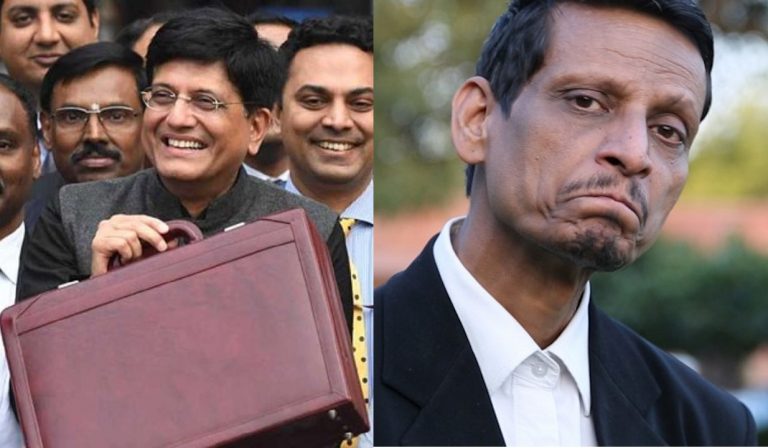
Serial petitioner advocate M L Sharma, who is known for his petitions rejected by courts, has yet another filed a PIL, and this time his target is the interim budget presented by finance minister Piyush Goyal today.

Challenging the validity of the interim budget in his petition, advocate ML Sharma had filed a petition against it at the Supreme Court saying that there is no provision for an interim budget in the constitution. He says that the budget is a fraud on the constitution. Sharma also alleges that government has obtained the signature of the President on the budget fraudulently, as he was not informed that there is no provision for interim budget in the constitution.

Advocate M L Sharma added that the interim budget was a fraud on parliament as it was presented by the government for political benefits.

Just yesterday, M L Sharma’s petition against appointment of former CBI special director Rakesh Asthana as director general of Bureau of Civil Aviation Security was junked by the Supreme Court. Chief Justice of India Ranjan Gogoi had said that the petition had no coherence, as it included multiple issues with no connection with each other.

Earlier too, several petitions by Sharma has been dismissed by courts, and he also has been fined and reprimanded for filing frivolous petitions. This petition against the interim budget filed by him is also destined to be rejected.

Interim budgets presented by previous governments

Successive governments in the past had presented interim budgets in their last year of rule. Moreover, the apex court is unlikely to interfere in a matter which is fully in the domain of legislature.

Rahul Gandhi finally comments on Budget 2019, but not without lying and obfuscating

0

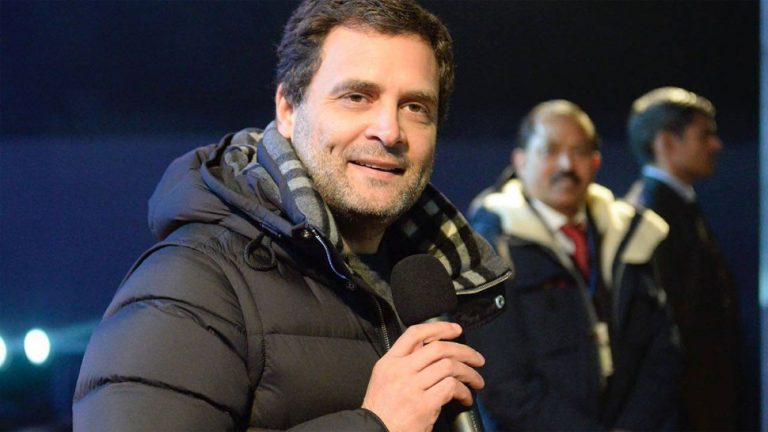
Congress President Rahul Gandhi lies. And he has no qualms about it. After the presentation of the interim budget earlier today, Congress President took to Twitter in an attempt to mock assured income support promised to the farmers.


Rahul Gandhi claimed that Rs 17 per day to farmers as assured income support is ‘an insult’ to farmers. With Rs 6,000 a year, for farmers with less than 2 hectares land, this amount will provide support for the procurement of inputs. This would be over and above the other subsidies, they may already be getting. So effectively, the actual benefit to the 12 crore small farmers may be much more than Rs 17.

Later, while addressing media, he said that PM Modi could ‘waive off’ Rs 3.5 lakh crore loan of 15 people but give only Rs 17 per day to farmers.


This is a lie on multiple accounts. First of all, no loans of ’15 people’ or any industrialists were ‘waived off’. The bad loans were written off. There is a difference between loan waiver and loan write off. Not just that. Rahul Gandhi cannot even stick to one figure of the loan ‘waived off’. It has gone from 1.1 lakh crore to 3.5 lakh crore in a span of less than 2 years. As usual, he provides no data to back his claims.

But seems like Rahul Gandhi is taking lessons in the economy from the farmer of the family, his brother in law Robert Vadra. In 2011, Congress-led UPA government had said that if you spend Rs 32 a day you can’t be poor. The Planning Commission had then told the Supreme Court that anyone spending Rs 26 a day in villages and Rs 32 a day in the city is not poor.

Read also: What will it take for Congress to be described as an elitist and casteist organization?

But mocking the poor is not the only thing Congress and its leaders are good at. In 2013, displaying the elitist nature that is inherent in Congress leaders, Congress leader Raj Babbar had said that poverty had come down even though prices had gone up. To justify his statement, he had said that in Mumbai he could get a ‘full meal’ for Rs 12. This combined with the various elitist comments where Congress leaders have mocked Prime Minister Modi’s humble beginnings as a tea-seller, talks a lot about Congress’ culture. No wonder Indira Gandhi’s ‘Garibi Hatao’ continues to be Congress’ slogan even after 40 years.

Read also: Dear Shashi Tharoor, today a ‘chaiwala’ is the Prime Minister, not because of, but despite Jawaharlal Nehru

Moreover, Congress President accusing anyone else of insulting farmers is a bit rich considering newly formed Congress governments in Madhya Pradesh and Rajasthan have not been having a good time keeping promises to farmers. From speculations of loan waiver scams in both, Madhya Pradesh as well as Rajasthan, where non-existent names were found in the list of beneficiaries to waiving off as little as Rs 13 against a loan of Rs 24,000, Congress has done nothing but mock farmers. Despite the tall promises of loan waiver, the farmers in Punjab, Madhya Pradesh and Karnataka continue to commit suicide because of debt burden.

Rahul Gandhi has developed a habit to mouth-off platitudes which in reality, mean paltry little. He lies, he obfuscates and confuses and hopes something, anything would stick and earn him brownie points. And as we get closer to 2019, the malaise would just get deeper.

Media loses it after Budget 2019: From ‘Hindi imposition’ to ‘where is the money’

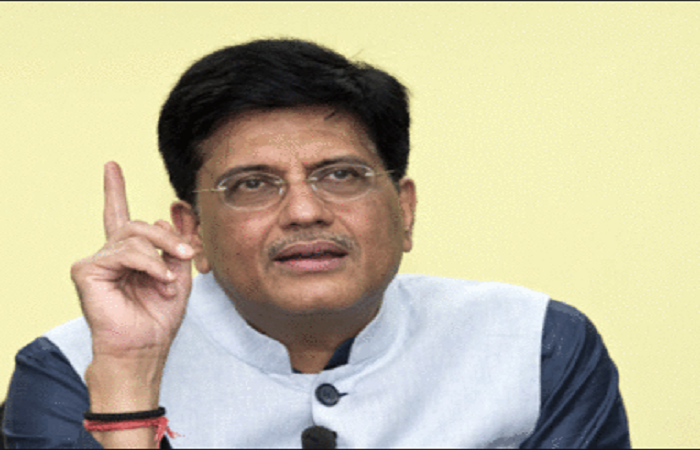
The acting Finance Minister Piyush Goyal today presented the interim budget 2019 which is also the last budget of the first tenure of this government. Some sweeping announcements were made in the budget like the full tax rebate for individuals with up to 5 lakh rupees annual income, structured income support for farmers, mega pension for workers in the unorganised sector and much more.

While the budget appears to provide relief to the individual taxpayers and the farmers, it has caused deep restlessness among certain usual suspects in media. Some had a problem with the budget being presented in Hindi and some couldn’t stop worrying as to where the money will come from. Here are some “serious” concerns expressed by certain journalists over the budget and the witty reactions of people:


As some journalists expressed their concern as to where the money would come from, people were quick to come up with suggestions.


People also questioned as to why these highly concerned individuals did not worry about money when Rahul Gandhi promised minimum universal basic income.


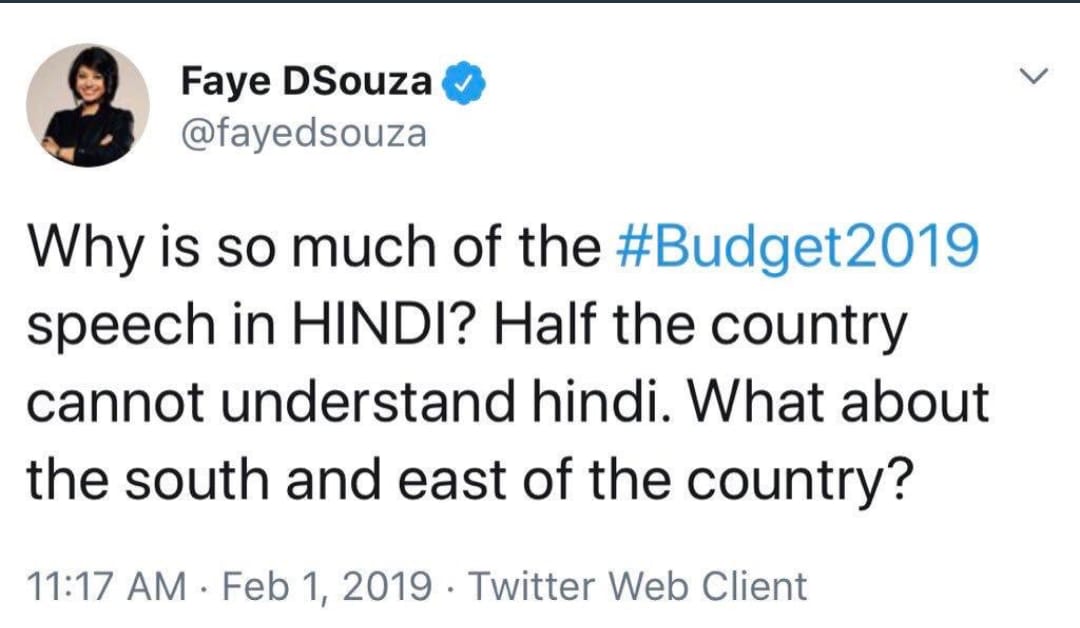
Next in the line were some colonised brains raising objections over the use of Hindi in the budget, claiming half the country cannot understand the language.

This made people question her logic.


Seems like certain sections of media can’t get over their compulsive disorder of finding faults in everything or anything the Modi government does. Time and again their bias stands exposed by the common people proving that they reflect anything but reality.

Congratulations, finally someone in Congress could do arithmetic right

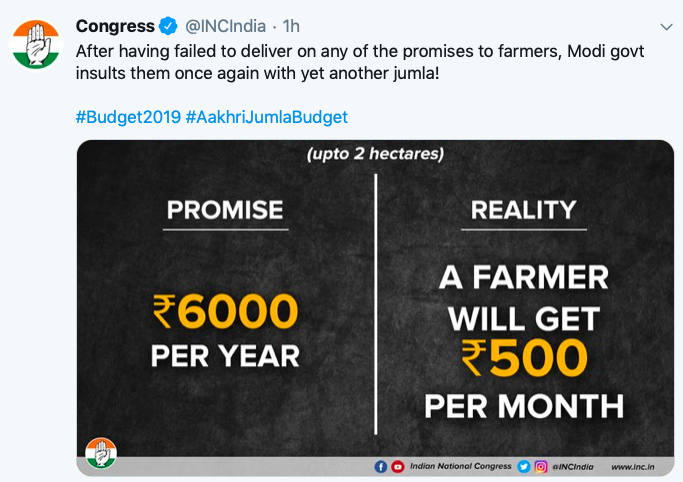
In a tweet that can only be construed as the Congress party acknowledging its President Rahul Gandhi’s newly acquired skills of the Unitary method in Mathematics, the official account of the party tweeted the revolutionary discovery that there’s a fundamental difference between Rs. 6000 per year and Rs. 500 per month.

In Budget 2019, one of the most significant announcements was the structured income support that will be provided to farmers through the Pradhan Mantri Krishan Samridhi Yojana. Rs. 6000 will be provided to farmers with less than 2 hectares of land annually in three instalments. It will cost the state Rs. 75,000 crores per year. In addition, a 2% interest subvention has been provided to farmers who practice animal husbandry and fisheries. An additional 1% interest subvention will be given if loans are repaid on time.

Congress took to Twitter to try and criticise this move. In its tweets, the Congress party asserted that while Rs. 6000 per year was a promise, Rs. 500 per month was the reality. And therefore, the promise of Rs. 6000 per year was a ‘Jumla’.

Via Twitter

If tweeting the embarrassment once wasn’t enough, the party posted it again. But this time, in Hindi.


But even then, the tweets were factually incorrect as the farmers will be paid the amount in three instalments and not Rs 500 every month.

While the Modi government gave people plenty to smile about through the announcements made by the Acting Finance Minister Piyush Goyal in his budget speech. the Congress party contributed to it through its tweets.


While the President of the Congress party could not ever be accused of possessing a high degree of intellect, it appears his creative ideas are rubbing off on other members of the party as well. However, Congress deserves to be congratulated for at least doing their arithmetic right.

Budget 2019: Piyush Goyal, PM Modi hail the contributions of the middle class in country’s economy, bring tax relief

Finance Minister Piyush Goyal today delivered the Union Budget 2019, which has brought a host of significant benefits for the middle class. Today FM announced a full rebate of income tax to people earning less than Rs 5 lakh per annum. The tax rebate is expected to benefit around 3 crore middle-class taxpayers.

Finance Minister Piyush Goyal before announcing the sops for the middle class, thanked them for their immense contribution to the nation building. He said it is because of the middle class, that the individual belonging to the poor and marginalised section, has access to a better way of life.

“Your tax helps provide dignity to our sisters and mothers with toilets and cooking gas connection” He further added. Be it the about the dignity of the retired soldier, or about health care to our around 50 crore citizens, FM Piyush Goyal said that it is the middle class which is helping those sections.

FM Goyal, praising the government efforts in the last four years said that the tax collection and tax base have shown a significant increase, which has helped the government inch towards moderate taxation and high compliance regime.

“It is, therefore, just and fair that some benefits from the tax reform must also be passed onto the middle-class taxpayers,” FM said. Due to restrictions of the interim budget, FM Goyal said that tax proposal can only be presented in the regular budget. Despite this, the finance minister announced reforms so as to give certainty to small taxpayers, especially the middle class, senior citizen and pensioners, at the beginning of the year. FM Goyal felt that such reforms should not wait for the full budget, and be announced now only.

In addition to the tax rebate, the standard deduction for salaried income has also been raised to ₹50,000 from current ₹40,000. The Finance minister Goyal also announced tax relief on interest income, as TDS threshold on interest on bank and post office deposits raised from ₹10,000 to ₹40,000.

Also, TDS threshold on rental income has also been raised from 1.8 lakhs to 2.4 lakhs. Capital gains from residential property sale will be eligible for exemption under section 54 for up to 2 properties bought.

The Middle-class has often complained about being sandwiched between the lower income group and rich section of society. The reforms like tax rebate up to Rs 5 lakh is bound to give the middle class a sigh of relief, as the burden on its shoulders stands curbed.

After the budget speech by Piyush Goyal, PM Modi also praised the contributions of the middle class.


The PM stated that it is the generosity and honesty of the middle class and upper middle class which provides taxes to the nation and helps to formulate schemes for welfare.

Indiaspend’s faulty ‘FactChecker’ spreads fake news about Budget 2019 while ‘fact-checking’ Piyush Goyal’s speech

Fact-checking in a nuanced job. One must research and be willing to go where the facts take them rather than where they want the facts to take them. Indiaspend, which is known as a biased “research organisation” and has been caught spreading communal disharmony several times, has a “fact-checking” arm, factchecker.in, which also lies profusely. Today, after Piyush Goyal’s Budget 2019 speech, factchecker.in decided to ‘fact-check’ the speech, and in the process, ended up spreading fake news themselves.

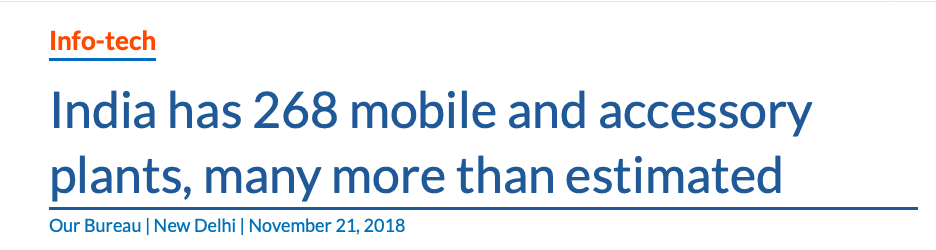
In one of their tweets, they claimed that acting Finance Miniter lied when he said ‘under Make in India, mobile and parts manufacturing have increased from 2 to more than 268 providing huge job opportunities’.


According to FactChecker.in, the truth is that there are 127 mobile manufacturing units in India according to a response in Lok Sabha.

However, FactChecker.in conveniently uses data from August 2018 to brand Piyush Goyal’s assertions as a lie.

However, if one digs a little further, one realises that according to November 2018 data, Piyush Goyal’s assertions are right on the mark.

HinduBusinessLine article

In November, The India Cellular & Electronics Association (ICEA) had said that there are 268 mobile and accessories factories in India and not 120, as is often quoted by many senior leaders in the government.

ICEA had undertaken physical verification of all such facilities over a period of 2-3 months.

“ICEA and the industry were always clear that the number of units exceeded 120, which was usually reported by the government. The physical survey vindicated this belief and the total number of new factories reported as per this report stands at 268 and not 120. The corresponding employment number is 6.70 lakh and not 4.50 lakh,” it said.

They said, “accessory like powerbank is becoming a big industry in India with a market of around ₹2,000 crore, which may go up to ₹15,000 crore in the future”.

In fact, the ICEA had made a very significant observation. It said that in 2014, there were only 3 manufacturing units functioning in India with mobile handset manufacturing reducing significantly to 58 million unites as compared to 130 million in 2013. However, “Government’s policies and specific interventions along with the hard work of global and indigenous entrepreneurs have helped India attain the number two mobile handset manufacturing destination tag,” Pankaj Mohindroo, Chairman, ICEA said.

It had also said that owing to this rise, 6,50,000 jobs were created.

As is evident, FactChecker.in chose to pick up data from August 2018 instead of the more recent November 2018 data just to assert that Piyush Goyal had lied Budget 2019 speech.

Budget 2019: Here is how people earning upto Rs. 75,000 per month can pay zero income tax

Today finance minister increased both the rebate and threshold for the rebate in the Interim Budget 2019. Earlier the rebate was ₹2,500 for net taxable income up to 3.5 lakhs, now the rebate will be up to ₹12,500 for net taxable income up to 5 lakhs.

But this does not mean only people with income up to ₹5,00,000 will not have to pay income tax. As the income tax act already provides various exemptions, the effect of the income tax due to this rebate will be much more.

It is important to note that the rebate is applicable for income after net of deductions. This means, even if your gross income is more than ₹5 lakhs, if it comes down to ₹5 lakhs or less after various deductions, you won’t have to pay any income tax, provided you are able to take the benefits of various subsections available under the section 80 of the Income Tax Act.

Let’s take the example of one individual with a monthly salaried income of ₹75,000.00.

The annual income will be  ₹9,00,000.00
From this, the following deductions are allowed
Standard Deduction  ₹50,000.00
Interest on House Loan  ₹2,00,000.00
Deductions under section 80C  ₹1,50,000.00
Deduction under National Pension Scheme  ₹50,000.00
Total Deduction  ₹4,50,000.00
Net Taxable Income  ₹4,50,000.00


As the net taxable income is less than ₹5 lakh, the section 87A rebate will be applicable, and there will be no tax payable on this income.

Fact-check: Congress lies profusely in an attempt to ‘fact-check’ Piyush Goyal’s Budget 2019 speech

Acting Finance Minister Piyush Goyal presented a significant Interim Budget 2019 today where he announced numerous benefits to farmers, the middle class and MSMEs. With the various announcements that were made, it was natural for the Congress party to feel jittery about its electoral prospects ahead of General Elections later this year.

In a thread, it has made some quite a few misleading arguments to downplay the significance of Piyush Goyal’s speech.


The Congress party appears to have picked two years randomly to assert that the GDP growth rate was better under its rule. This cherry-picking of data does not depict reality very accurately.

The GDP growth rate was 6.72% in 2008-09, 8.59% in 2009-10,  8.91% in 2010-11, 6.69% in 2011-12, 4.47% in 2012-13 and 6.6% in 2013-14. Compared to UPA-II, the Modi government’s GDP growth rate has been 7.2% in 2014-15, 7.9% in 2015-16, 8.2% in 2016-17 and 7.2% in 2017-18. It shows that while the GDP growth rate fell drastically during the later years of the UPA regime, the NDA government has consistently maintained a growth rate of above 7%.

Moreover, the BJP government has controlled the high rates of inflation remarkably and brought it under 4%. The Congress also appears to have forgotten that India is the fastest growing major economy in the world currently.

In another tweet, the Congress said that Goyal was wrong to assert that the Modi government put Mizoram and Tripura on the railway map for the first time.


While it is true that railways have been operating in Tripura even before the NDA government came to power in 2014, it is only during Prime Minister Modi’s tenure that Broad Gauge services have reached the state. And it is only during this government’s rule that the state has been connected to the rest of the country through Broad gauge.

As for Mizoram, the 84.25 km broad gauge railway line from Katakhal Junction to Bairabi railway stations was sanctioned in 2000 but it was only in 2016 that the project was completed. Therefore, it is a straightforward lie by the Congress party that Modi government didn’t put the state on the rail map of India for the first time.

The Congress also appears to have lied outright when it claims that 3.65 million houses have been constructed by the Modi government. It claims that till December 2018, 1.25 million houses were constructed under the Urban Housing Scheme and 2.4 million houses constructed under the Rural Housing Scheme.


However, as per an Economic Times report in August 2018, over 1 crore houses had been constructed under the Pradhan Mantri Awas Yojana-Gramin since 2014. As per another report by Business Standard in September, last year, about 9 lakh homes had been constructed under the Urban Housing scheme. Considering the time that has passed since then, the figure of 1.53 crores stated by Piyush Goyal appears to be an extremely reasonable figure.

The Congress party is still continuing with its narrative that Demonetization was a disaster.


As Goyal quite clearly stated today, Demonetization brought to light that the anti-Black Money drive has brought an undisclosed income of Rs. 1.30 lakh crore rupees to the fore and over 3 lakh shell companies have been deregistered as a consequence. We, at OpIndia.com, have continuously reported on the various ways in which demonetization has helped fix the economy.

West Bengal: CBI summons Derek O’Brien, grills Mamata Banerjee’s close aide over sale of her paintings to chit fund companies

The Central Bureau of Investigation (CBI) on Thursday, have questioned Manik Majumdar, a close aide of the West Bengal CM Mamata Banerjee, about the sale proceeds of the paintings and even sent a notice to her party’s MP Derek O’Brien.

The CBI has reportedly questioned Majumdar over how the proceeds of the CM’s paintings were utilised.

The Trinamool Congress has been hellbent, ever since, claiming that the sale proceeds of her paintings were used to set up and expand operations of Jago Bangla, the mouthpiece newspaper of the party.

CBI officials have reportedly stated that they are “Investigating the route of chit fund money in various directions so as to the find out the larger conspiracy angle as has been directed by the Supreme Court of India.”

Banerjee’s close aide, Manik Majumdar, who was questioned by the CBI, is an authorised signatory of the bank account of the newspaper, while the Trinamool legislator, Derek O’Brien is the printer and publisher and party general secretary, Subrata Baxi is the editor of the Trinamool’s mouthpiece newspaper, Jago Bangla.

Subrata Baxi was summoned by the CBI back in December 2018, regarding the same case. Derek O’Brien too was sent a notice, then but was unable to go to the CBI office as he was at that time in New Delhi attending parliament.

As the TMC MP did not join the probe, he was issued a fresh summons. According to CBI sources, the TMC Leader in Rajya Sabha, Derek O’Brien, has been asked to appear before the Agency by the third week of this month with relevant documents detailing transactions done in the respective accounts.

As per reports, O’Brien has stated that though he has heard of the summons, he has not received it and will decide on his response after receiving the summons.

The CBI had on January 31, alleged that the West Bengal CM, Mamta Banerjee and her government were impeding the investigations going on in the multi-crore Saradha ponzi scam. It has alleged that the “hostile” government is delaying the filing of the final charge sheet.

BJP President, Amit Shah, while addressing his rally in West Bengal, on Tuesday, went hammer and tongs against the TMC supremo, accusing the West Bengal Chief Minister, Mamata Banerjee of selling her paintings at inflated prices to chit fund companies in dubious deals.

CM Banerjee had become furious at the allegations and stated that her party will issue a notice to Amit Shah and will consider filing a defamation suit.

The state government has been at loggerheads with the CBI on a number of issues. Recently, CBI officials had claimed that the WB government is obstructing the investigations into the Saradha Chit Fund scam case.

The reports further mentioned that banking security fraud branch, special crime branch and the economic offender wings of the premier investigative agency has been rendered non-operational after West Bengal had withdrawn the general consent to CBI, last year.

“Only the Economic Offences IV (chit fund probe wing) is functioning in the state,” The official was quoted further.

In August, last year, the CBI had written to the Director General of Police in West Bengal, seeking to question members of the SIT team that investigated the Saradha Chit Fund Scam alleging that the documents provided to them were manipulated and few were even missing.

Earlier this month, CBI had nabbed Chief of Shree Venkatesh Films, Shrikant Mohta, in connection to the Rose Valley Chit Fund scam. It is alleged that Mohta’s production house was paid Rs 25 crore by Rose Valley for producing 17 films.