This year’s Kumbh Mela which is taking place at Prayagraj is special not only because of the unprecedented enormity of preparations but also because Prime Minister Narendra Modi himself has reviewed the preparations of the largest religious congregation. While this act of the Prime Minister has attracted both praises as well as criticism, there are some who are harping on an altogether different string.
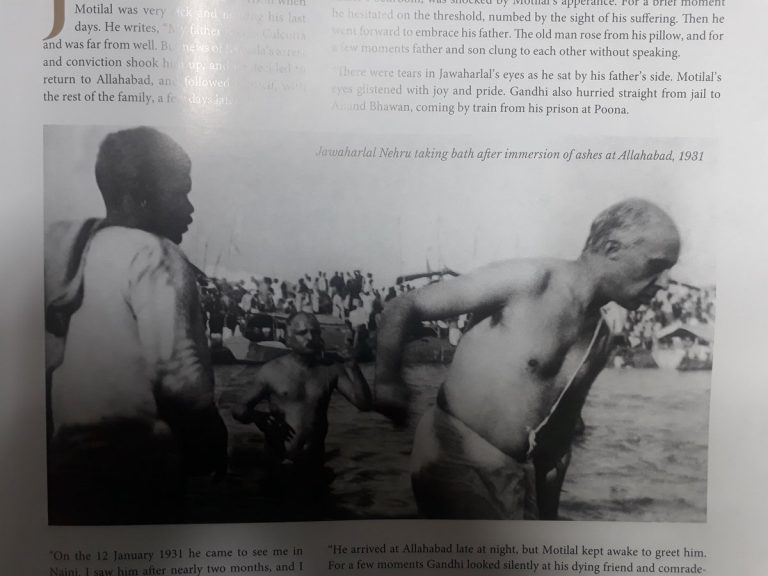
A photo of Jawaharlal Nehru was posted by Vinod Kapri on Twitter, the director of the movie Pihu and the former editor of Zee News and India TV, claiming that Nehru had taken a dip during the 1954 Kumbh Mela.
Responding to his tweet, a Twitter user posted the same photo from Congress leader A. Gopanna’s biography of Nehru – Jawaharlal Nehru: An Illustrated Biography – where the photo is captioned as ‘Jawaharlal Nehru taking a bath after immersion of ashes at Allahabad in 1931’.
Dont lie @vinodkapri This is Nehru immersing his father’s ashes in the Ganga at Allahabad. (A Gopanna’s biography of Nehru released today, p. 73). pic.twitter.com/1jAsxbZMo7
This led to a war of words on Twitter with Kapri claiming that the picture cannot be that of immersion of Nehru’s father’s ashes because at that time Nehru’s age was 42 while he looks much older in the picture and therefore the picture is of 1954 Kumbh when Nehru was 65.
आपको झूठ फैलाना है तो फैलाइए।पर तथ्य ये है कि पंडित नेहरू के पिता मोतीलाल का निधन फ़रवरी 1931 को हुआ था और उस वक्त जवाहरलाल की उम्र 42 साल थी।आपको किस चश्में से इस तस्वीर में नेहरु 42 साल के दिख रहे हैं ??? ये तस्वीर 1954 कुंभ की है,जब नेहरु की उम्र 65 साल थी। https://t.co/TMAPBTcXVv
A. Gopanna is a Congress leader, and currently the Chairman of Media Department of Tamil Nadu Congress, apart from being a spokesperson. His illustrated biography of the first Prime Minister if India was unveiled by former President of India Pranab Mukherjee in May last year. Therefore, there is very little reason to doubt that Goppana will mislabel the image of Nehru in his book.
Moreover, the photo tweeted by the Twitter user was originally posted by Journalist Vikash Pathak in May last year.
#nehru wearing a janeu immerses his father’s ashes in the Ganga at Allahabad. (A Gopanna’s biography of Nehru released today, p. 73). pic.twitter.com/jmbYR4Diwi
He had also written in the tweet that the photo shows Jawaharlal Nehru immersing his father’s ashes while wearing a janeu.
The photo is also used in an article of India Today wherein it is claimed that the picture is that of immersion of Nehru’s mother’s ashes (1938). Similarly, an article published in Open magazine also captions the photo as that of the immersion of ashes of Nehru’s mother in 1938. What is common in the captions given in the biography, the India Today article and the Open magazine article is that they all caption the photo as being that of Nehru taking a bath after immersion of ashes of either of his parents, restricting the scope of suspicion only to whether it was his father’s or mother’s ashes. None of the above mentioned sources have captioned the photo as being from the 1954 Kumbh.
If we look at another photo of Nehru from the Naini Central Prison taken somewhere between Oct 19, 1930 – Jan 26, 1931, during his fifth imprisonment, Nehru looks quite similar to how he looks in the photo.
Fifth Imprisonment, Jawaharlal Nehru in Naini Central Prison, courtesy: http://nehruportal.nic.in
Given that a Congress party leader has included that photo in his book saying it shows Jawaharlal Nehru immersing his father’s ashes, and few media houses have labelled it as a photo of Nehru immersing his mother’s ashes, the possibility of the photo being from Kumbh in 1954 becomes very slim.
The 1954 Kumbh is infamous for a tragic stampede that happened on the main bathing day. On 3 February 1954, which was the Mauni Amavasya, around 800 people had lost their lives. The reason for the incident was the failure of crowd management by authorities, compounded by the presence of several political leaders, for which several areas of the Kumbh were blocked for the general public.
This is not the first time that Vinod Kapri has been caught spreading lies. Earlier, Kapri was caught lying about the violence that had broken out it Bulandshehr, Uttar Pradesh. When caught in the lie, he had attacked the police.
“There are three kinds of lies: lies, damned lies, and statistics.” – goes the popular phrase. Nothing exemplifies this more than the conduct of many in the English Main Stream Media (MSM) when it comes to reporting the Rafale deal.
Latest in the series of such ‘analysis’ is a piece in The Hindu by none other than N. Ram, the former editor of The Hindu. I guess with articles and analysis by run-of-the-mill ‘journalists’ and newly minted ‘defense experts’ on online portals not making the required impact, the ecosystem has become desperate and has had to deploy the big guns! The thinking here seems to be that if the numbers by themselves don’t stick, the fact that they’re coming from Mr. N. Ram himself, should give the analysis some weight.
But here’s the problem, he doesn’t even get the basics right!
Same plane, Mr Ram?
Right of the bat, the article gets its facts wrong and makes a blunder which is akin to losing your opening batsmen in the first over. In a Test Match. In Adelaide.
The article says and I quote:
This article, based on information exclusively available to The Hindu, focusses on the interesting question of how and why the price per Rafale fighter jet of the F3-R standard, with practically the same configuration and capabilities, changed substantially over three points, in 2007, 2011, and 2016.
Tell me something, aren’t journalists supposed to cross-check the information they get from their sources? It obviously wasn’t done in this case. And here’s why.
The base plane which participated in the 2007 tender was F3 standard. F3R standard Rafale simply could NOT have participated in the 2007 tender.
You know why?
Because F3R standard was qualified in 2018!
Here is an official press release from Dassault and I quote[1]:
On 31 October 2018, the F3-R standard of the Rafale was qualified by the French defence procurement agency (DGA). The development of this new standard, launched at the end of 2013, was successfully completed by Dassault Aviation and its partners in full compliance with contractual performance, schedule and budget.
Unless we’re talking about time-machine here, an aircraft standard, whose development started in 2013 and was completed in end-2018, could not have been there in 2007 or 2011.
Rafale loaded with F3R standard weapon load
F3 Standard + Euro 1 billion = F3R!
French government paid Dassault Euro 1 billion to develop the F3R standard for the Rafale aircraft. Yes, while the baseline aircraft are same, F3R represents a quantum jump in capability over F3 standard.
And what does F3R standard involve? Again, in the words of Dassault[2]:
(1) The F3-R standard is an evolution of the Rafale F3 standard, with the exceptional versatility being further reinforced. It is part of the ongoing process to continuously improve the aircraft in line with the operational requirements and the feedback from experience of the pilots. It enables the Air Force and Navy Rafale aircraft to carry the following equipment and weapons:
(1.1) The European Meteor long-range air-to-air missile produced by MBDA. This high-performance missile achieves maximum effectiveness thanks to the “active array” radar which equips all production Rafale aircraft delivered since mid-2013
(1.2) The laser homing version of the Safran AASM Air-to-Ground Modular Weapon. This family of weapons, with GPS primary guidance and an additional booster, is unmatched. It enables the Rafale to destroy targets at ranges of several tens of kilometers with metric precision. The laser homing version is particularly adapted to moving targets.
(1.3) The Thales Talios new-generation laser designator pod. Primarily used for air-to-ground strikes, in daylight or darkness, this pod further enhances the high degree of precision that the Rafale has shown since its first engagements (in 2007 in the Afghan theatre)
(2) F3 R also includes upgrades to the Rafale sensors and to systems ensuring total interoperability.”
The Meteor Air-to-Air missile mentioned above is today reckoned as the best air-to-air missile in the world. The missile is considered so potent that UK has awarded a contract to MBDA (missile’s manufacturer) to integrate the missile on its F-35 stealth aircraft fleet[3]. Apart from F-35, most air forces operating 4.5 generation fighters from European manufacturers (Rafale, Eurofighter, JAS-39 Gripen) are looking forward to integrate Meteor with their fighters.
Rafale launching Meteor MissileRafale with Meteor AAM and Scalp air-to-ground missile
Long story short, we’re getting a more capable place at a marginally higher cost and not 41% more expensive, as we’ll see in subsequent sections.
Sensational headline OR boring numbers!
In a desperate bid to give an impression of some great scoop which no one was so far aware of, the article suspends common sense and chooses to build a headline along an absolutely illogical and irrelevant number.
Let’s see why.
First, the story accepts that the flyaway price of the Rafale aircraft had escalated from Euro 79.3 million in 2007 to Euro 100.85 million by 2015. And that the present government has contracted a flyaway cost in 2015 of Euro 91.75 million, which is 9% cheaper than the escalated flyaway cost in 2015 of 2007 tender.
Second, it also accepts that the upfront, non-recurring, India Specific Enhancement (ISE) cost in 2007 tender for 126 aircraft was Euro 1.4 billion while the same for 36 aircraft deal in 2015 was Euro 1.3 billion.
Then, it goes on to make the following claim and I quote:
“Dassault claimed a €1.4 billion cost for the ‘design and development’ of 13 India Specific Enhancements, that is, additional capabilities in the form of hardware as well as software that had been specified by the Indian Air Force all along, and this cost was negotiated down to €1.3 billion. What it meant was that the design and development cost, now distributed over 36 Rafale fighter jets, shot up from €11.11 million per aircraft in 2007 to €36.11 million when the deal was struck in 2016.”
Taken as it is, the above analysis is correct. Per aircraft ISE cost did go up in the second deal.
Before we proceed further, let’s quickly summarize the numbers and analysis presented in the Hindu article.
2007 Tender
Total Aircraft
126
Flyaway Cost in 2007
79.3
Euro Mn
2007 Flyaway Cost in 2015 after escalation
100.85
Euro Mn
ISE Cost
1.4
Euro Bn
Per Aircraft ISE Cost
11.11
Euro Mn
2015 Tender
Total Aircraft
36
2015 Flyaway Cost
91.7
Euro Mn
ISE Cost
1.3
Euro Bn
Per Aircraft ISE Cost
36.11
Euro Mn
However, where Mr N. Ram loses the plot and which shows the desperation behind this article, is in how he chooses to use these numbers. This is where the sleight of hand becomes obvious. Using the above numbers, the article comes up with this gem:
What the Law Minister’s statement failed to say was that when the ‘non-recurring’ design and development cost claimed for the India Specific Enhancements was factored in, the per unit price negotiated by the NDA government for the 36 Rafale fighter jets worked out to €127.86 million, which was 41.42% higher than the price quoted by Dassault in 2007.
When the escalation formula was applied, the price per aircraft agreed to by the NDA government turned out to be 14.20% higher than the proposed price per aircraft when the commercial bid was opened in November 2011 under the UPA government.
Seriously?
By what yardstick and logic is the 2007 per aircraft price (Euro 79.3 Mn + Euro 11.11 Mn = 90.41 Mn) is being compared with 2015 per aircraft price (Euro 91.7 Mn + Euro 36.11 Mn = 127.81 Mn)?
If at all the comparison has to be made, the second one is more relevant. Where you compare sum of escalated 2007 flyaway cost in 2015 and ISE per aircraft (Euro 100.85 Mn + Euro 11.11 Mn = Euro 111.96 Mn) with 2015 per aircraft price (Euro 91.7 Mn + Euro 36.11 Mn = 127.81 Mn).
Whatever happened to apple to apple comparison?
But then, the purpose of the article in The Hindu was never to undertake objective analysis. It was meant to create an impression of unhealthy deal. Or better, a scam. And what better way to grab reader eyeballs than by making extravagant, even if wrong, claim in your headline?
After all, if the headline had read:
“Modi’s decision to buy 36 Rafales shot the price of each jet up by 14%”
instead of
“Modi’s decision to buy 36 Rafales shot the price of each jet up by 41%”
no one would even bat an eyelid.
I mean, 10%-15% difference in a multi-billion dollar deal separated by couple of years is hardly news.
But then, The Hindu wasn’t trying to share news with the readers. It was hunting for a sensational headline and a number to attack the current government with. It very well knows that in the current political environment, none of the so called defense experts or journalists or eminent intellectual will call it out for this skulduggery.
But then again, is the present aircraft deal even 14.2% costlier?
Before we come to that, here’s an interesting thought someone shared with me on reading the article:
If The Hindu would’ve been genuinely trying to do an analysis, the first thing it would’ve commented upon was that Modi government managed to get a lower ISE cost (Euro 1.3 billion) than 2007 deal (Euro 1.4 billion). And this when the older number and new deal are separated by a gap of almost 8 years!
Price Analysis
The biggest flaw in the price comparison done by The Hindu is that it picks-up only two price components of the overall deal. The fact of the matter is that the overall cost per aircraft consists of other components as well.
I had done a comprehensive price analysis[4] and benchmarking a few days back which showed that considering all the cost components, the per aircraft price of 36 Rafale fighters is only 10.8% more expensive than per aircraft cost of 18 aircrafts to be made in France as per old deal.
And mind you, we’re getting a better aircraft with better weapons and much more enhanced support package.
Let’s look at the overall price comparison between the two deals. But be aware that since old deal had only 18 aircraft coming directly from France, the comparison is actually between prices of these aircraft as against the 36 coming directly from France in new deal. And not 126 versus 36.
But before we proceed, let me summarize the key data-points which are used in the price comparison analysis.
Flyaway Cost per aircraft in 2015 after escalation
100.85
Not Applicable
Euro Mn
Cost Escalation
The most important takeaway from various open sources like The Hindu article, Indian Express report, interview of Arun Jaitley and recent parliamentary debate is that there was an escalation clause in the winning bid submitted by Dassault in 2007. Because of this winning bid, the basic flyaway cost of an aircraft rose from Euro 79.3 million in 2007 to Euro 100.85 million in 2015. Working backwards, the escalation comes out to 3.05% per annum.
Rafale Flyaway Cost Escalation as per 2007 deal
Does the escalation apply to only flyaway cost?
Considering the figures at hand, the 2007 winning bid numbers can be divided into three broad categories – Flyaway Cost /aircraft, India Specific Enhancement/Aircraft and Balance Cost/Aircraft.
We’ve already applied the price escalation to Flyaway Cost/aircraft. What about the price escalation for the ISE and balance cost part? Does it apply to the other components of tender?
While the ISE component consists of R&D cost, the balance component of the 2007 bid would’ve consisted of ammunition, spare parts, logistics, training and other paraphernalia. Common-sense tells you that the price of all these items will also see escalation. Just like cost of producing a new aircraft would increase over time, cost of producing ammunition and spare parts would also increase.
And there is enough precedence within India of price increase in defence contracts with time being the deciding factor. For example, when India first envisaged interest in the US made M-777 ultra-light weight howitzers, the same were offered in 2010 at $647 million. However, the deal could not go through because of myriad reasons. When the deal was revived in 2013, the price had increased to $885 million. However, the deal was not concluded by the UPA-2 government. After the NDA-2 government came in 2014, it revived the negotiations and concluded the deal in 2016 at $ 750 million.
Scenario Analysis
Let’s assume two scenarios. Scenario one assumes the 3.05% price escalation applies to the whole 2007 per aircraft cost of the aircraft while second scenario assumes that India Specific Enhancement Cost (ISE) remains static while price appreciation applies to the flyaway cost and balance amount.
Scenario 1 – ISE Cost Constant
The following table gives the total price of the aircraft after considering escalation in per aircraft flyaway cost and per aircraft balance cost; per aircraft ISE cost is kept constant and sees no escalation.
Year
Escalation in flyaway Cost (Euro Mn)
Escalation in Balance Cost (Euro Mn)
ISE Cost-Constant (Euro Mn)
Total Cost/Aircraft (Euro Mn)
2007
79.30
64.35
11.11
154.76
2008
81.72
66.31
11.11
159.14
2009
84.21
68.34
11.11
163.66
2010
86.78
70.42
11.11
168.31
2011
89.43
72.57
11.11
173.11
2012
92.15
74.78
11.11
178.05
2013
94.96
77.06
11.11
183.14
2014
97.86
79.41
11.11
188.38
2015
100.85
81.83
11.11
193.79
Takeaway from above table:
Escalated total aircraft cost in 2015 – Euro 193.79 Mn
Flyaway Cost + ISE Cost = Euro 111.96 Mn
Scenario 2 – ISE Cost with escalation
The following table gives the total price of the aircraft after considering escalation in per aircraft flyaway cost, per aircraft balance cost and per aircraft ISE cost.
Year
Escalation in flyaway Cost (Euro Mn)
Escalation in Balance Cost (Euro Mn)
ISE Cost-With Escalation (Euro Mn)
Total Cost/Aircraft (Euro Mn)
2007
79.30
64.35
11.11
154.76
2008
81.72
66.31
11.45
159.48
2009
84.21
68.34
11.80
164.35
2010
86.78
70.42
12.16
169.36
2011
89.43
72.57
12.53
174.52
2012
92.15
74.78
12.91
179.85
2013
94.96
77.06
13.31
185.33
2014
97.86
79.41
13.71
190.99
2015
100.85
81.83
14.13
196.81
Takeaway from above table:
Escalated total aircraft cost in 2015 – Euro 196.81 Mn
Flyaway Cost + ISE Cost = Euro 114.98 Mn
Price Comparison
Now that we’ve factored in the price escalation bit, let’s compare the price in the old deal and the new.
Comparison 1
In this comparison, we compare the overall per aircraft cost as per 2015 deal with escalated overall per aircraft cost as per 2007 deal but keeping the ISE cost constant.
Year
Flyaway Cost per aircraft
(Euro Mn)
Balance Cost per aircraft
(Euro Mn)
ISE Cost
(W/O Escalation) per aircraft
(Euro Mn)
Total Cost
(Euro Mn)
Escalated price of 2007 deal in 2015
100.8
81.8
11.1
193.8
2015
91.7
90.2
36.1
218.1
The 2015 deal for a much more advanced plane with more modern avionics and weapon suite, and enhanced support package is only 12.5% more expensive that 2007 deal for 18 direct purchase aircraft.
Comparison 2
In this comparison, we compare the overall per aircraft cost as per 2015 deal with overall escalated per aircraft cost as per 2007 deal; ISE cost also sees escalation.
Year
Flyaway Cost per aircraft
(Euro Mn)
Balance Cost per aircraft
(Euro Mn)
ISE Cost
(with escalation) per aircraft
(Euro Mn)
Total Cost
(Euro Mn)
Escalated price of 2007 deal in 2015
100.8
81.8
14.1
196.8
2015
91.7
90.2
36.1
218.1
If we consider an escalation in India Specific Enhancement (ISE) cost as well, price difference between the 2015 deal and escalated cost of 2007 deal narrows further to only 10.8%.
Let’s suspend Logic!
For fun sake, let’s suspend logic and undertake price comparison like the Hindu article. In this case, we’ll compare the sum of flyaway cost and ISE cost in the two deals. Here we’re considering an escalation in ISE cost as well. The Hindu article has already said that escalated flyaway cost with constant per aircraft ISE cost (Euro 111.96 Mn) is only 14.2% more expensive than the new deal at Euro 127.81 Mn.
Year
Flyaway Cost (Euro Mn)
ISE Cost (With Escalation)
(Euro Mn)
Total Cost
2015 escalated price of 2007 deal
100.8
14.1
115.0
2015 deal
91.7
36.1
127.8
Using the above logic of comparison, we find that aircraft under new deal is only 11.2% more expensive than the 2007 deal.
Summary
(1) Aircraft Type:
Indian Air Force is getting a more advanced version of Rafale aircraft. 2007 tender was for F3 standard Rafale while 2015 deal is for FR3 standard.
F3R standard is the latest standard for Rafale and has been qualified only in late 2018.
French Navy and Air Force Rafale have just now started their upgrade to F3R standard.
(2) Price Comparison:
When we consider the escalation in the whole of 2007 deal, in line with escalation in the flyaway cost from Euro 79.3 Million in 2007 to Euro 100.85 Million in 2015, and compare it with 2015 deal, we find that new deal is only 10.8% more expensive.
Year
Flyaway Cost (Euro Mn)
Balance Cost
(Euro Mn)
ISE Cost (with Escalation)
(Euro Mn)
Total Cost
Difference
2015 escalated price of 2007 deal
100.8
81.8
14.1
196.8
2015
91.7
90.2
36.1
218.1
10.8%
If don’t consider escalation in Indian Specific Enhancement (ISE) cost but the flyaway cost and balance 2007 cost, and compare it with 2015 deal, then new deal is only 12.5% more expensive.
Year
Flyaway Cost (Euro Mn)
Balance Cost
(Euro Mn)
ISE Cost (W/O Escalation)
(Euro Mn)
Total Cost
Difference
Escalated price of 2007 deal in 2015
100.8
81.8
11.1
193.8
2015
91.7
90.2
36.1
218.1
12.5%
And if we consider only the sum of escalated flyaway cost, escalated balance cost and escalated ISE cost of 2007 deal and similar numbers for 2015 deal, we find that new deal is only 11.2% more expensive.
Year
Flyaway Cost (Euro Mn)
ISE Cost (W/O Escalation)
(Euro Mn)
Total Cost
Difference
2015 escalated price of 2007 deal
100.8
14.1
115.0
2015
91.7
36.1
127.8
11.2%
Conclusion
In the end, we find that in whatever way you look at the new Rafale deal, it is extremely beneficial to the country and the Indian Air Force. Unless, of course, you’re someone who’s sole idea of analyzing the deal is to using dubious logic and come with faulty but eyeball grabbing headline. Like Mr N Ram did in The Hindu.
Prahlad Bandhwar, BJP leader and the chairman of the Mandsaur Municipal Corporation was shot dead last evening by unidentified criminals. As per reports, Bandhwar was shot at in full public view, near BPL square in the city.
Bandhwar’s killers reportedly came on a Royal Enfield motorcycle and shot him at point-blank range. Bandhwar was reportedly standing in front of the district co-operative bank. As Bandhwar fell immediately, panic spread in the area and shopkeepers nearby closed their shutters. Taking advantage of the chaos, the murderers reportedly escaped.
Bandhwar was immediately rushed to a nearby hospital in an auto rickshaw but he had already succumbed to his injuries.
The seven Kashmiri students who are accused of raising anti-India slogans on JNU campus on 9th February 2016 had in their confessional statement claimed that they did not know Kanhaiya Kumar, Umar Khalid and Anirban Bhattacharya. This was part of the charge sheet filed on Monday. However, as reported by DNA, the police investigation has revealed that not only they knew each other but the event was also being planned for a long time.
Recently, the Delhi Police filed a charge sheet in the JNU case to the Patiala House Court. The charge sheet filed by the Special Cell of the Delhi Police against Kanhaiya Kumar, Umar Khalid and others on the celebration of terrorist Afzal Guru’s death anniversary at Jawaharlal Nehru University in February 2016. Shehla Rashid and daughter of CPI leader D Raja also are mentioned in the charge sheet. The charge sheet states that the JNU event was part of a planned conspiracy.
Philip Kotler, the top marketing guru and consultant, has thanked Prime Minister Modi for accepting the first Philip Kotler Presidential Award presented to him by the World Marketing Summit.
Kotler has added further that the world is watching India and China. The two countries represent two very different visions of the future and he believes that democracy, though imperfect, is the best way to achieve the aspirations of a nation’s people. On this regard, the world looks at India as a model, because it seeks justice and economic progress for all its people.
He also added that Modi being the first winner has raised the bar for the future recipients of the award. Kotler had also praised PM Modi in an exclusive interview.
Reputed columnist Manu Joseph has made a startling claim on Twitter. In November last year, he had claimed that The Wire had refused to report Anjuli Pandit’s account of sexual harassment at the Taj because of fear of the Tatas. Pandit is a former Tata Group Executive. Then, Tata was believed to be a possible donor to The Wire. Siddharth Varadarajan, the Founding Editor of Wire, had vehemently denied the claim.
It was revealed that the Tatas have funded The Wire. Following the revelation, Joseph further asked Sidharth Bhatia, Founder Editor at Wire, if the funding from Tata had anything to do with their refusal to run Pandit’s account. Joseph further stated that the Wire ought to be questioned in this regard due to its ‘hypermoral’ positions regarding issues concerning women. No one from the Wire had issued a response at the time this report was written.
President Ram Nath Kovind became the first President since Dr Rajendra Prasad in 1953 to visit the Kumbh Mela when he offered prayers with his wife on Thursday. Chief Minister of Uttar Pradesh Yogi Adityanath and Governor Ram Naik were also present at the occasion.
The President inaugurated the Gandhian Resurgence Summit at Prayagraj and congratulated the Government of Uttar Pradesh and its people for organising the Kumbh. He also said that it is an important part of India’s cultural and spiritual heritage.
IAS officer Shah Faesal made national headlines when he resigned from the service earlier this month. Observer Research Foundation’s (ORF) associate fellow Khalid Shah has written an article, which is critical of Faesal, as the victim of the ‘sentiment’ is now positioning himself as a sympathiser of the champions of ‘resistance’ who promote gun, militancy and violence.
The article was sent to two prominent newspapers for publishing, but both of them refused to print it. The article was rejected by Indian Express and Hindustan Times. The rejection of the article by two prominent newspapers shows how mainstream media work to build a narrative. As the article didn’t suit the narrative they want to peddle, they refused to publish it.
The Times Group is a rather amusing media group in the sense that it caters to people from both sides of the political spectrum through different channels. It owns Times Now with its overt ‘nationalist’ slant and Mirror Now with explicitly leftist tendencies.
One issue, however, where both these channels were on the same side was the Sabarimala verdict. They unanimously supported the desecration of the abode of Bhagwan Ayyappa. However, Times Group appears to have an extremely contrasting opinion when it comes to Islam. The Kochi edition of its newspaper, Times of India, published an article with effusive praise for the religion with the headline “Convert to Islam“.
The Times Group’s stance on Islam appears to be markedly different from its opinions on the traditions of the Hindu Sabarimala Temple. The article, in fact, comes across as da’wah or the Islamic practice of inviting non-Muslims and Muslims to understand the teaching of Islam and inform them about prophet Muhammad and convert them to a ‘purer faith’.
The Hindu today published a story authored by N Ram, a foremost member of the family that owns the paper. In the article, which lifted content revealed by another journalist and passed them off as a The Hindu ‘exclusive’, N Ram made some fantastical claims deriding the Rafale deal. After the article was published, the Ministry of Defence spokesperson has issued a detailed response to the article. In the point by point response, MoD spokesperson has rubbished the claims made.
Despite facing flak over his recent remarks against BJP President Amit Shah, Congress leader and Rajya Sabha member BK Hariprasad has yet again issued a controversial statement claiming that he has received reports stating that BJP President Amit Shah does not have any flu, reported ANI.
According to ANI, BK Hariprasad claimed that he knew few people belonging to All India Institute of Medical Sciences (AIIMS) and went on to say that he has received reports regarding Amit Shah not suffering from any flu.
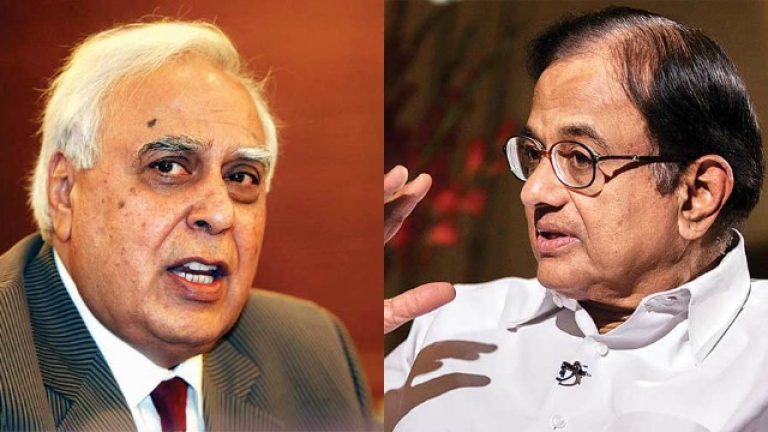
According to a report, a new Television News Channels is going to be launched in the month of January, which is backed by Congress leaders Kapil Sibbal and P Chidambaram. The channel will reportedly be titled Harvest TV or HTV and will have noted journalists and anchors from existing media houses.
It is reported that several well-known journalists like Barkha Dutt, Karan Thappar, Punya Prasun Bajpai, Ashutosh, Ravish Kumar and many other will join the English and Hindi channels of the group promoted by Kapil Sibal and P Chidambaram.
10. Opinions
In his latest article titled, “Cursed by vultures: Will Opposition end Ayushman Bharat if it gets power at the Centre“, Abhishek Banerjee speculates whether the Opposition parties will discontinue the Ayushman Bharat scheme that provides free healthcare to poor people out of sheer jealousy towards Prime Minister Narendra Modi. He writes, “The saddest part is that it appears the other side is willing to trample upon the lives of India’s poor to extract its “revenge” on Modi. In a democracy, sooner or later, the government is going to change. People look to the incoming government to bring its new ideas to the table. That is what keeps democracy fresh, that is what keeps the engine of progress running. It would be a shame if the Opposition is going into an election with an agenda of ending healthcare, shutting down toilets, gas connections and electricity connections. And all because of jealousy.”
According to a report, a new Television News Channels is going to be launched in the month of January, which is backed by Congress leaders Kapil Sibal and P Chidambaram. The channel will reportedly be titled Harvest TV or HTV and will have noted journalists and anchors from existing media houses. Sibal was also among the contributors of Tehelka Magazine co-founded by Tarun Tejpal who was accused of sexual assault by a woman colleague in 2013.
The report claims that P Chidambaram has offered to pay Rs. 200 crore to Veecon Media and Private Broadcasting Ltd over a period of two years in instalments. Veecon Media has licences for new channels in English, Hindi and other languages, and it will start the Hindi channel after the English channel is launched. Journalists like Punya Prasun Bajpai, former AAP leader Ashutosh and Ravish Kumar are expected to be hosting the Hindi channel. Several anti-BJP journalists have been asked by the Congress leaders to join the channel and Barkha Dutt is expected to be the host of a Prime Time show on the English channel, and Karan Thapar will also join the channel. Rajdeep Sardesai is also wanted by the Congress leaders.
It can be noted that speculations of Congress leaders launching a news channel was doing the rounds for several months. When few journalists had left ABP news including Punya Prasun Bajpai, several politicians and journalists had alleged that they were forced to leave due to pressure from the government. There was a huge outrage that the media houses are firing journalists at the behest of Modi government. But at the same time, some people had informed that journalists had left their jobs to join a new channel to be started by Kapil Sibal.
Now it seems that the rumours of several journalists joining a channel promoted by Congress leaders is correct, and the journalists were not forced to leave their jobs, they left on their own. It is important to note that journalist Shekhar Gupta’s portal The Print, with which Barkha has a mysterious relationship, has also reported about the launch of Harvest TV and other channels from the group.
Some one rightly said long time back that Sibal is launching a new News channel and all media assets will be there.
A senior Congress leader said that the channel will counter the “pro-BJP propaganda by Arnab Goswami’s Republic TV”, says the report. Lalit Kumar Srivastava and US-based Jaswant Kumar Srivastava are the promoter Directors of Veecon Media. Karnataka Congress leader D K Shivakumar and Naveen Jindal are also expected to support the channel. According to PGurus, while these two persons will be shown as Directors, the Congress leaders have acquired 90% stack in the media house. The report says that attempts were made to launch the channel earlier as well in 2009, during the UPA regime when the owner firm Veecon Media had obtained News channel licenses. It was earlier called VEE News and was later renamed as Shri S7 News.
According to the report, the Intelligence Agencies have reported to the concerned authorities about some objectionable issues in the Harvest TV project including certain violations in the shareholding pattern, the I&B Ministry guidelines, the money flow pattern and a series of violations in frequency allotment to the News channel.
Launching a searing attack on the Communist Party of India (CPI), Union Minister Smriti Irani assailed the Kerala government for being dismissive towards the condition of the nuns in Kerala. She had alleged that the Kerala government endorses women empowerment only when it is politically convenient for them.
Union Minister Smriti Irani in Delhi: People who speak about women empowerment but keep quiet when women empowerment is not convenient for them politically, should be questioned. Kerala govt should be asked about the steps they have taken up for their security of four nuns. pic.twitter.com/HgmWYGv3jh
Smriti Irani’s remarks came just a day after the four nuns who stood against rape accused Franco Bishop Mulakkal and supported the survivor nun were asked by the Missionaries of Jesus congregation to leave the Kuravilangad convent in Kerala and rejoin their communities in other parts of the country.
Referring to the ‘punishment’ meted out by the Missionaries of Jesus congregation, Smriti Irani chastised the Kerala government for turning a blind eye to the ordeal of the nuns and not providing adequate security to them.
In October 2018, the communist government in Kerala had maintained a stoic silence when Catholic Federation threatened that nuns will be thrown out if they continued with their protest against Bishop Franco. The Missionaries of Jesus has often taken a perverse stand on the issues concerning the abuse of nuns. From doggedly defending Franco Bishop to releasing rape victim’s photos, the Missionaries of Jesus has tried everything in its power to discredit the victim and those who have come forward in her defence.
On the other hand, the Kerala government is trying its best to ensure that women can enter the Sabarimala temple despite massive protest by devotees. The government has provided security to women wanting to enter the shrine, in line with the Supreme Court’s order. But when it comes to nuns harassed by the church, the government turns a blind eye. It is this cowardly attitude of Kerala government against the Church authorities is what Smriti Irani is calling into question.
In 2013, Chinese President Xi Xinping, mooted the idea to revive ancient Silk route and termed it as One Belt One Road (OBOR). He presented OBOR as a program which will propel infrastructure growth in participating nations and increase connectivity across Central Asia, Europe and Africa thus significantly increasing trade. The projects that China had financed before 2013 were amalgamated in OBOR. 6 years later much has changed, for one, OBOR has now been renamed as Belt and Road Initiative (BRI) and China has contributed significantly towards infrastructure development in many nations, building new ports, airports, railway lines, power plants, housing and in some cases even whole cities from scratch vital to the progress of any nation. Today, projects worth almost $340bn are underway in various countries and this amount is expected to increase to $1tn in 6-7 years.
However not everything about BRI is helpful for participating nations as it also brings a spate of problems, like- high amount of debt and scale of operations from infrastructure nowhere near to the forecasts shown in a feasibility study which restricts the revenue. While some countries such as Sri Lanka have already suffered a great deal because of this, many others such as Pakistan, Maldives, Malaysia and Djibouti are at high risk of defaulting on their debt repayments and getting stuck in a debt spiral. What were the factors that led these countries to such a situation and what is their present position?
Sri Lanka
After the end of the bloody civil war, China was the very first country to start investing in the country. Starting 2009, almost $8 billion were invested in multiple projects, Hambantota port, Mattala Rajapaksa International airport, an affordable housing project in Jaffna, a port city dubbed as Sri Lanka’s Dubai, roads and a number of hospitals among many others. Hambantota port was shrouded in controversy even before its construction began in 2008. The capacity of Colombo port, Sri Lanka’s largest, had just been increased by 30% in 2003. It was the expansion of one of the two terminals, another terminal could be expanded later and by 2008 port wasn’t even operating at full capacity which could be realised in later years thus rendering the need for whole new port questionable. The construction of the new port finished in 2010 and since then it hasn’t seen much business, handling just 1 ship a day on an average.
The revenue from port wasn’t enough for Sri Lanka to pay back the loan to China, so in 2017 an agreement was signed to lease the port to China for 99 years in lieu of repayment of the loan for that particular project. Mattala airport, located near Hambantota, was constructed in 2013 at a cost of $209mn out of which China lent $190mn. Initially, several airlines operated from there but ceased operations eventually due to low demand. Without any revenue, the airport became unsustainable as the operating cost was still being incurred while there was no revenue. India entered into a joint venture to run the airport in 2017 basically to keep an eye on Hambantota port. As of in 2018, no flights are scheduled from the airport due to the absence of demand. According to the 2012 annual report by the Ministry of Finance and Planning of Sri Lanka, China had invested $3.851bn in the country; $3.841 billion in loans and only $10 million as grants. Currently, China Communications Construction Company (CCCC) is engaged in building the Port City also known as Colombo International Finance City. It is being presented as Sri Lanka ’s own London and Singapore in terms of financial importance. The deal was signed during the tenure of Mahinda Rajapaksa and construction was to begin in 2011.
In 2014, Prime Minister Ranil Wickramsinghe suspended the project citing damage to the environment, however, the construction was resumed in 2016 after CCCC threatened to bring a legal case against the government for damages. Construction is expected to complete by 2041 and total estimated investment in the project by then would be $16bn. Today Sri Lanka is entangled into a web of debt where it is constantly borrowing more to pay off existing commitments; government borrowed $3.5bn in 2018 to pay off loans maturing at the end of this year. As per Finance Minister, Mangala Samaraweera, the situation will be worse in 2019 when loans worth $4.9bn will have to be repaid. The current government has blamed the previous administration of Mahinda Rajapaksa for not carrying out proper feasibility studies for personal gains. A recent New York Times report claimed: “large payments from Chinese port construction fund flowed directly to campaign aides and activities for Rajapaksa, who had agreed to Chinese terms at every turn and was seen as an important ally in China’s effort to tilt influence away from India in South Asia.” The report goes on to allege that Rajapaksa’s campaign and his aides received a total of $7.6mn from China for 2015 elections.
Pakistan
China-Pakistan Economic Corridor can easily be termed as the crown jewel of Belt and Road Initiative. CPEC is an umbrella program under which China would undertake multiple projects for transportation, energy and communication. Initially, in 2014, the total worth of planned projects were estimated to be at $46bn but now it has increased to $62bn. Financing for projects will be provided by Exim Bank of China, China Development Bank and Industrial and Commercial Bank of China in form of loans. As of now, projects worth almost $26bn are in various stages of construction.
Gwadar deep sea port is located in Balochistan region, being constructed by China Overseas Port Holding Company (COPHC), is one project under CPEC, once completed, it will have a capacity of handling 1 million tonnes cargo annually. Pakistan has already leased the land to COPHC for 40 years. Pakistan government claims that Gwadar port will generate a significant amount of revenue given its proximity to the Gulf of Oman from where majority of oil passes, however as per contract91% of revenue from the operation of the port and 85% of revenue from free zone will go to COPHC. China is also building a gated city near Chinese workers working at the port. Only Chinese nationals will be allowed in the city and China has also asked Pakistan to legalise Yuan in the port. As per estimates, 500,000 Chinese nationals will be living there by 2022. This is more than the local populace of that area which numbers around 250,000. It can alter the demography of Balochistan, an already troubled province, in a significant manner. It also shows that port may not generate as many jobs for locals as Pakistan is hoping since the majority of positions will be held by Chinese workers.
Besides CPEC, China and Pakistan are also engaged in another program named North Indus Cascade Project, under which China will build 5 dams on the Indus River. This project is valued at $50bn and it is independent of CPEC. This is presenting an even more significant challenge to Pakistan. The new government under Imran Khan has pulled $14bn Diamer Bhasa Dam out of the project citing strict conditions over Chinese financing which would give ownership of dam to China. World Bank and IMF have refused to provide funding for this project citing “it lies in the disputed territory of Gilgit-Baltistan.” Khan has also asked for a review of terms of all projects under CPEC to make them friendlier towards Pakistan but much to his chagrin, China has refused to review the projects that are already under construction.
Now Pakistan is finding it difficult to repay debt. In the financial year 2016-17, Pakistan borrowed $10bn to service foreign debt. It also issued bonds against national assets such as Karachi airport, dams and highways. Things will get difficult for Pakistan once payment for debt under CPEC start in 2021 and at the peak, it will have to make annual payments of $3.5bn. In addition, Pakistan will have to spend $22bn for capital goods till 2022.
Realising that repayment of debt may not be possible; Pakistan invited Kingdom of Saudi Arabia(KSA) to join CPEC in September 2018 and KSA agreed. However since then, Pakistan has declared that KSA will not be joining, whether this is due to objections from China or some other reason is not clear. With a balance of payment crisis, foreign reserves are at an all-time low, Pakistan approached IMF for a bailout of $11bn dollars. However no deal has been finalised as IMF is demanding to see the details of loans under CPEC, a standard practice to check the financial health of any sovereign looking for a bailout, but Pakistan has declined to share the details. Moreover, to add to the woes of Pakistan, USA has declared that it will not allow Pakistan to use any money received from IMF towards repayment of Chinese loan. Pakistan also approached Saudi Arabia and China for financial assistance and has also received $7bn from the former and latter has also agreed to provide assistance but the details of such assistance have not been made public.
With the present economic situation and an ever-increasing debt burden, it’s entirely possible that Pakistan may end up being not able to repay the debt accrued under CPEC and North Indus Cascade Project upon which Hambantota port like deals may be struck between Pakistan and China handing over vital national assets to China.
Maldives
Till 2012 China didn’t even have an embassy in archipelago nation and since then has invested over a billion dollars in many projects across the country. China undertook an expansion project of international airport, which was earlier awarded to Indian company, GMR, but was later cancelled even though GMR quoted a cost of $511mn whereas China will undertake the project at a cost of $800mn, a 1.3 mile long bridge connecting male to the airport worth $400mn and a hospital. All these contracts were signed during the previous government. These contracts have increased Maldives’ debt considerably. The current finance minister Ibrahim Ameer told reporters “We believe most of these projects are at inflated prices so we are looking at them. We cannot do much in terms of renegotiation but going forward our objective would be to reduce cost.” He revealed that the cost for the hospital has already run up to $140mn whereas the rival original offer was for $54mn. Former President Mohammed Nasheed claimed that the Chinese ambassador to the Maldives handed over a $3.2 billion invoice to the new government, however, China denies these allegations. If the Maldives was to pay back the entire loan back to China by itself, it will need to set aside an amount equal to 10% of its GDP annually. The new administration has asked India for assistance and has secured financial assistance of $1.4bn which will be utilised in repaying Chinese debt.
Malaysia
China has so far invested a total of $34bn in Malaysia. East coast rail link, Forest City and Singapore-Kuala Lumpur are the most valued of all. The total valuation of Forest city after completion is estimated to be $100bn. It can house 700,000 people. Over two-thirds of apartments have been sold to Chinese nationals whereas Malaysians have bought only about 10% of apartments as they are too costly for locals. China is also building a deep sea port close to Malacca Strait that is large enough for an aircraft carrier. This port has brought in questioning China’s strategic aims as Malacca Strait is one of the world’s most vital sea routes from where most of the world trade takes place, including oil. 80% of China’s trade passes through here and it would want naval presence nearby to protect its interest. PM Mahathir Mohammed, who defeated Najib Razak in recent elections under whom deals with China were signed, has been very vocal against Chinese projects in the country. He termed Forest City akin to having a Chinese town in the middle of the country which can create demographic problems and has declared that no foreign nationals will be allowed to live in the city but the constructions will go on. He has also cited concerns about the growing debt which the country might not be able to pay back and consequently has cancelled projects worth $22 billion fearing Malaysia will end up in a situation akin to Sri Lanka where it will have to hand over the control of territory to China.
Malaysia has also cancelled East coast rail project, that would connect East coast of peninsular Malaysia in South China all to the west with Thailand for transportation of goods, along with Singapore-Kuala Lumpur High-Speed Rail project and gas pipeline calling them unnecessary. This change in the stance of Malaysia has been detrimental to China’s BRI as many countries have now adopted a policy of wait and watch before entering into contracts with China under BRI. Malaysia used to be the most welcoming country towards Chinese investment and signed a lot of contracts but now it is a frontrunner in cancelling projects and most vocal against the policies of financial assistance provided for the projects. China surprisingly has shown an accommodative approach towards Malaysia and has agreed to discuss the terms of contracts. Soon after PM Mahathir’s comments on Forest City project, China appointed a Malaysian national as new Managing Director, earlier this post was occupied by a Chinese national.
There is a striking similarity among Chinese investments across countries in the Indian Ocean Region:-
Financial assistance to the government to avoid any meaningful resistance against projects;
Opaque decision-making process;
Lending more even when the country is struggling with high debt;
A strategically located port and;
Resistance to any external participation which might ease repayment burden on the host nation.
Currently, Former PM of Malaysia Najib Razak is being probed by law enforcement agencies in relation to payment for gas pipelines projects awarded to China for which 88% of total payment was made and the project completion is less than 15%. Even former President of Sri Lanka Mahinda Rajapaksa and Former Maldives President Abdulla Yameen are under investigation for receiving election campaign funding from Chinese companies. China was quick to utilise its influence in developing port near strategic sea routes and choke points. Gwadar port in Pakistan situated just north of Gulf of Oman provides access to Strait of Hormuz form where the majority of world’s oil passes. This port also provides China with an alternative land route for its trade, bypassing the need to cross the Indian Ocean and areas under the influence of the USA and its allies. Melaka port in Malaysia is located at the southern end of Malacca Strait, which connects South East Asia, East coast of China and East Asia with Central Asia and Africa is the busiest sea route. A military base in Djibouti along Bab-el-Mandeb strait which connects Asia to Europe and North America through Suez Canal.
China has also been quite rigid in laying down the conditions for financing which generally have not been in best interest of borrowing nation, consequently country ends up with a lot of debt not able to pay it back, neither able to bring in any other country as party to the project to ease loan burden due to China’s objections. Brahma Chellaney, a fellow with Delhi based think tank Centre for Policy Research, said it is in the interest of China if countries are not able to pay back the loans since it gives China control of vital assets. It is in the interest of participating nations to keep the process transparent and allow investment in limited quantum and in a phased manner so as not to end up borrowing more than they can pay back and risk unsustainable level of debt.
The Uttar Pradesh government has approved 10% reservation for the economically backward people among the upper castes in relation to jobs and educational institutions. The government spokesperson Shrikant Sharma told that the decision to implement the Constitution (124th Amendment) Bill, 2019 was taken at a meeting of the State Cabinet presided by the Chief Minister.
“The cabinet meeting presided over by Chief Minister Yogi Adityanath approved the notification granting 10 per cent reservation to the poor among the upper castes which have come into effect on January 14,” said Shrikant Sharma.
The act, which was passed by the Parliament in the winter session provides for 10% reservation for the economically weaker sections in the General category in jobs and educational institutions. “The UP government will implement the quota fully without touching the reservation for other sections of society”, Sharma said.
Gujarat and Jharkhand have already approved the act with now Uttar Pradesh joining the league as the third State to have approved the act. The proposal for the implementation of the 10% reservation for economically weaker sections of the upper caste in higher education institutions has been approved by Deputy CM Dinesh Sharma who holds the Higher Education portfolio.
After Madhya Pradesh government initiated farm loan waiver scheme for the state as per promises made during election campaigning, reports have emerged casting suspicion on the rollout of the scheme. Many farmers across the state, who had taken the loan from banks before 31 st March 2018 and that of more than Rs 1 lakh, have reportedly got loan waiver benefit of mere Rs 25-30.
According to a report by Amar Ujala, farmers in the state were waiting to see the list of nominees for the Jai Kisan Rid Mukhti Yojana, and to check if their names were included. The scheme was launched by Kamal Nath government, in accordance with its poll promise, to waive off loans of 55 lakh small and marginal farmers across the state.
When the list of beneficiaries was made available at nearest town halls, farmers in many villages were enraged on finding that the list did have their names, but the amount that was waived of ranged from Rs 25 to few hundred rupees, while their loan amounts stood at more than Rs 1 lakh. A farmer in Jaitpur, according to report, said that out of 2 and a half lakh loan, only Rs 25 have been waived off. Similarly, a farmer in Sikandarpur village in Kurwai Tehsil of Vidisha claimed that out of his Rs 30,000 loan amount, a minuscule amount of Rs 300 has been waived off.
On 17th January, reports had emerged that amongst various beneficiaries listed by the government eligible for farmer loan waiver did not even exist in reality. In one particular case, the farmer had already paid his loan amount, yet his name appeared in the list of beneficiaries for the government’s loan waiver. His loan of Rs 31000 was waived off by the government. However, the farmer insists that he has already paid up his loan amount and has a bank receipt to support his claim.
The Madhya Pradesh government is clearly, finding it hard to implement his party’s poll promises made by Congress President Rahul Gandhi during his election campaigning. The lofty promises of farm loan waiver had already taken 3 lives in Madhya Pradesh. It now remains to be seen, whether the Rs 25-30 loan waivers are a mistake and whether these will be rectified or not.
Farmers in Madhya Pradesh blocked the Damoh-Sagar highway protesting over the absence of bags for the purchase of urad dal, bringing traffic on the highway to a standstill. The farmers were also upset with the surveyor. Farmers in Madhya Pradesh are upset with the surveyors accusing them of trying to force their way.
As per reports, for the purchase of urad dal, surveyors were hired. For sale of urad dal, a token system was put in place, but in a lot of places, it led to chaos. Eventually, police were called to control the situation. Earlier this week, too, farmers had blocked roads protesting unavailability of bags for the purchase of urad.
On Monday, the purchase of urad dal was staled for over five hours and roads were blocked over half an hour. Farmers had alleged that while there are no bags available for the purchase of urad dal, traders were buying urad dal stealthily. The last date for the purchase of urad dal was 17th January, but the produce was still not weighed. This infuriated the farmers.
Farmers also allege that while the farmers have been waiting to sell their produce, some traders were purchasing urad dal through unfair means.
It has been a month since Kamal Nath-led Congress government was formed in Madhya Pradesh, making huge promises to the farmers. However, in last one month, the problems of farmers only seem to be increasing. As many as three farmers have committed suicide in the state due to the debt burden. In December, farmers were lathicharged as well as severe mismanagement of urea rocked the state.
There are also allegations of a scam brewing in the state as it was recently reported that Rs 120 crore non-existent farm loans were ‘waived off’ in Madhya Pradesh. The Congress after assuming power in Madhya Pradesh had cleverly altered the conditions to waive-off farms loans in contrast to their earlier stand.
Finance Minister, Arun Jaitley, while addressing at the Indian Business Leader Awards function, through video conferencing, organised by CNBC-TV18, on January 17, dropped strong indications that the Interim budget 2019 may go beyond the convention and be more significant than a vote on account.
This came at the backdrop of speculations on whether Jaitley, who is currently in New York, for his medical treatment, would be available to present the crucial February 1, interim budget.
However, dropping no hints that he would be unable to perform the crucial task, Jaitley was quoted as saying, “The convention has always been that the election year budget normally is an interim budget and ordinarily there should be no reason why we should move away from that convention. But then the larger interest of the economy always dictates what goes into the interim budget and that is something which cannot be discussed or disclosed at this stage.”
Traditionally there are no big announcements in the Interim Budget but, some sources have revealed that the union government is thinking of introducing direct cash benefit scheme for farmers and is planning to introduce certain tax benefits for the middle class as well.
Rubbishing doubts that he is under pressure to present a populist budget after the recent election defeat in three states and ahead of general elections in April-May, Jaitley said: “The NDA (National Democratic Alliance) government had been in this game for far too long to have nervousness about the budget. We are confident and proud of our performance over the last five years. The NDA government has succeeded in restoring the credibility of the economy and its decision-making process over the last few years.”
However, Arun Jaitley did confirm that in order to deal with a few economic challenges, which would be in the interest of the country, the Government might deviate from the election year convention.
He suggested that issues confronting the farm sector would constitute one such challenge, which can cause the government to take a detour of convention and pointed to the problem of high production and slower rise in prices of key agriculture products.
Though the reference to the farm sector is seen to be crucial as the government might be under pressure to announce measures for the farm sector which is linked to more than half of the population, however, Jaitley made it sufficiently clear that the government will stick to its path of fiscal prudence.
“I have always believed that fiscal discipline is always rewarded. In the past when governments have not stuck to it, we have seen the consequences,” the minister said. But he also added that in “unusual situations”, a deviation from the fiscal consolidation path might be required, which was understood by the markets and analysts.
Along with addressing the issues pertaining to the farm sector, Jaitley also showed concern about the growth rate. As per the report, Jaitley said the 7-7.5 per cent growth rate will not suffice and the eight per cent barrier would have to be crossed. However, Jaitley did say that the problems could not be addressed through “negative politics”. He added that the “nawabs of negativity” may come together but they wouldn’t hold together or have enough credibility.
Though Jaitley refrained from expressing any view on any rate cut, he did specify that India cannot have a real rate of interest that’s higher than anywhere else in the world.
Addressing to the recent grievances between the government and RBI, which saw Urjit Patel’s resignation nine months before the end of his term as governor, the minister said that the central bank and the Centre have often had different points of view but it has been resolved through consultations.