Home Blog Page 7442

Twitterati call out the bigotry of the ‘prominent’ personalities batting for Rohingyas

0

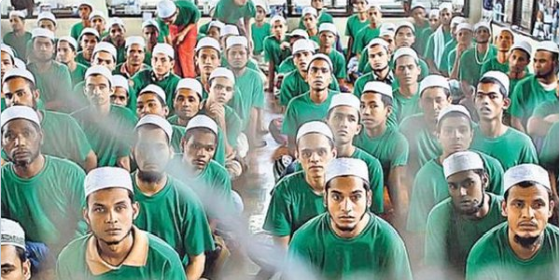
About 51 ‘prominent’ personalities have written to Prime Minister Narendra Modi urging the government not to deport the illegal Rohingya immigrants in India, even though there are intelligence reports about security risk and recently one heard how Rohingya terrorists had killed Hindus back in Myanmar and that many of those entering India could be radical Islamists.

These ‘prominent’ and ’eminent’ citizens range from politicians like Shashi Tharoor, who indulges in spreading fake news, to journalists like Sagarika Ghose who spreads communal discord on Twitter, to lawyer Prashant Bhushan, who has indulged in spreading unverified, fake images to score political point.

The list also features prominent bigot John Dayal and Teesta Setalvad, who has been under CBI scanner for alleged embezzlement of funds collected in name of 2002 riot victims and her husband, Javed Anand. The list also features JNU professor Nivedita Menon, who believes Kashmir is not the integral part of India.

The list also features random names like Ajai Shukla, a journalist, who spreads mischievously edited videos and stand-up comic Sanjay Rajoura, who cannot quite take criticism that well. In fact, Rajoura is someone who wants Brahmins kicked out of India, but Rohingya Muslims welcomed:


Once the list was out, many Twitter users pointed out how it was in reality a group of casteist, Hinduphobic and hateful individuals, who somehow are full of milk of human kindness when it comes to caring for Rohingya Muslims:


Only in India you can live with so much of hate in your heart, and yet be termed a “liberal” person caring for “human rights”.

How media spread propaganda to link Gauri Lankesh murder with ‘right wing’ outfit

The Special Investigation Team (SIT) probing the murder of Gauri Lankesh has finally released sketches of the suspects involved in the murder.

Untitled.png

Now this is in itself a little surprising, considering that eminent liberals appeared to have solved the murder case within minutes of the news breaking on Twitter.

But here is the most telling statement from B K Singh, the head of the SIT.

Untitled.png

This would mean NO link has been found so far to the murder of Narendra Dabholkar? No confirmation on whether weapons used to murder Gauri Lankesh were same as that in the Kalburgi murder?

Now let us read some screaming headlines in some allegedly “reputable” newspapers that have appeared over the last few days.

We’ll start with the Indian Express and its alleged journalism of ‘courage’.

Untitled.png

The “source” based news raises it’s ugly head yet again. How clever.

The source based report made it all over the left wing ecosystem. The good folks at The Wire, renowned for their active imagination, couldn’t let it pass, could they?

Untitled.png

Anyway, why blame a marginal propaganda site like The Wire when Times of India itself picked up the “story”?

Untitled.png

Only a few days ago, even more headlines appeared, loaded with unsubstantiated “news”. Here is Firstpost:

Untitled.png

In the Gauri Lankesh case, the torrent of unsubstantiated “news” invariably appears to find it’s way back to The Indian Express. Firstpost has quoted this Indian Express report, which indeed remarkably gives out the full names of the “Five key suspects” in the murder!

Untitled.png

It is almost unimaginable that here is an allegedly reputable newspaper naming five people as “key suspects” out of thin air.

Even hours before the SIT released sketches of the suspects, The Indian Express published another report, which said thus:

Untitled.png

This time The Indian Express did not even feel the need to put the onus on unnamed “sources”. They just reported it as an accepted fact that the investigation found the gun used to murder Gauri Lankesh to be the same as the one used to kill Kalburgi!

Obviously, things didn’t quite go the way The Indian Express wanted once the SIT actually spoke up. Here is the fourth paragraph of The Indian Express report on what happened at the SIT’s press conference.

Untitled.png

Obviously, this part didn’t make it to the Indian Express’ headline. In the online version, it appears below three full paragraphs and then an embedded video. It is almost like the editors at The Indian Express didn’t want people to read it and hence it was carefully tucked away in the later part of the article.

One would think, wouldn’t they?

5 times Rajdeep Sardesai was absolutely decimated while recording an interview

0

Controversial journalist Rajdeep Sardesai who currently is working with the India Today group, has interviewed many celebrities and VIPs in his career but in most of the instances, the guests objected to Rajdeep’s attitude, his mannerisms and choice of questions.

This side of Rajdeep again came into public limelight after former President Pranab Mukherjee chastised him during a recent interview.

In this interview which aired on 13th October, Rajdeep is seen asking a question, but rather than patiently seeking a reply he kept interrupting Mr Mukherjee. This angered the former president who then took Rajdeep to task, which included asking him to have the necessary courtesy while conducting the interview. All this left Rajdeep fumbling for an apology:


Such an disagreement between Sardesai and his interviewees have been a fairly common occurrence over the years. Here are a few more instances:

He also didn’t have a very good time while interviewing businessman Mukesh Ambani. While starting that interview, he portrayed Ambani someone more powerful than Modi which wasn’t taken too kindly by the latter. He in jest, ended up dismissing Rajdeep by stating that he didn’t take him seriously:

[youtube https://www.youtube.com/watch?v=KFOXpAldxUU?rel=0&showinfo=0]

Rajdeep’s gaffes have even extended to Bollywood. He in an interview asked Amitabh Bachchan about the whole “India getting intolerant” debate. This wasn’t taken kindly by Mr Bachchan who first expressed surprise and later sarcastically claimed that he wasn’t qualified to answer such questions:

[youtube https://www.youtube.com/watch?v=8rDFINd77qw?rel=0&showinfo=0]

MNS chief Raj Thackeray too famously had a loud mouthed confrontation with Rajdeep which included the politician reminding Rajdeep that it was an interview and not an interrogation:

[youtube https://www.youtube.com/watch?v=64iPYoCTWRo?rel=0&showinfo=0]

Finally, even PM Modi has had his share of skirmishes with Rajdeep during his Gujarat days. In one such instance from 2007, Rajdeep was seen asking Modi if he regretted what happened in 2002. In the response Modi took Rajdeep to the cleaners by talking about the agenda set by Rajdeep Sardesai and other journalists:

[youtube https://www.youtube.com/watch?v=18erXrUa2k8?rel=0&showinfo=0]

Gurmehar Kaur is by no means a ‘Free Speech Warrior’

0

TIME Magazine thinks of Gurmehar Kaur, the celebrity student, as a “free speech warrior” and such an idea could not be further from the truth.

It is indeed true that she faced a situation which I would wish on no one. But the fact of the matter is that abuse is a surety if you are a public personality in twitter. The fact that she had to go through that is definitely unfortunate and condemnable, but it is not out of the ordinary. 

More importantly, she is not in any way a crusader for free speech. She can claim that she is a free speech advocate, but she is not.

She has been threatening young boys for making harmless memes – which she deemed to be defamatory in nature. I do not dispute her right to legal recourse. However, claiming that she is in any way a paragon of free speech is more than disputable.  

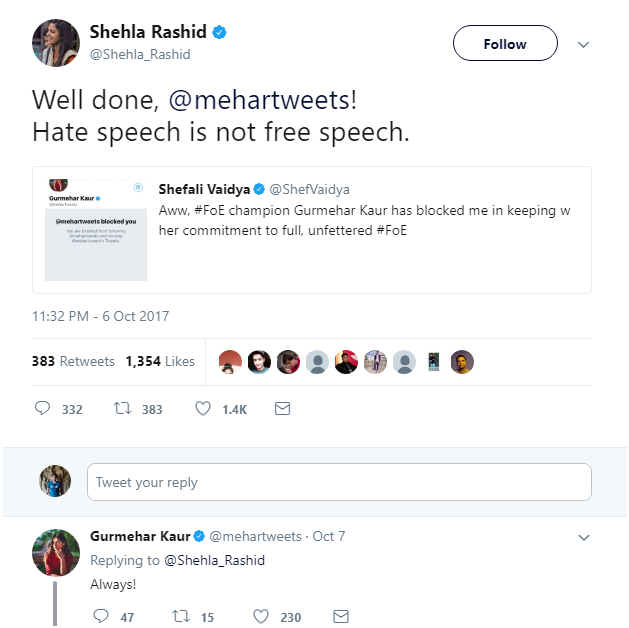
On 6th October, leftist student leader Shehla Rashid tweeted this, to which Ms. Kaur, the TIME magazine’s free speech crusader replied “Always”:

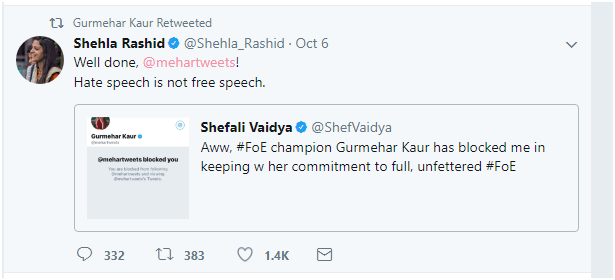
Not just that, she also retweeted that tweet: 

This incident imitates something that has been quite a phenomenon in the global left:

The artificial distinction that they have sought to create between “free speech” and “hate speech” in an effort to shut down any speech that they dislike.

Much like another favourite buzzword of the left – “Islamaphobia” – the distinctions that exist between “hate speech” and free speech are unclear. Moreover, while there are limitations to free speech, the United States Supreme Court (the bastion of free speech in the world), has consistently upheld the citizens right to free speech which includes hate speech.

This is because what constitutes “hate speech”, is a matter of subjective and thus arbitrary opinions. Can then, an advocate of free speech accept this classification? After all, what is accepted now could have been considered hateful some time ago, and vice versa.

Ms Kaur is, in my view, actually a status quoist to our current legal regime. If she supports the distinction between hate speech and free speech, she is endorsing Section 295 A of the IPC – the provision that criminalises blasphemy, since Blasphemy is obviously hateful speech against a religion or religious figure.

I am more than inclined to take this exercise further. If she thinks that hate speech is not free speech, then the slogans that were raised at JNU – were they not hateful to the patriotic citizens of India? Thus, is it or is it not free speech?

I digress.

Considering all this, is Ms. Kaur an advocate of free speech? In my mind, she is not. She may not have retreated into a cocoon when faced with opposition to her views, and I applaud her for that. But the fact that she is more than happy to silence others is worrying. To think that Ms. Kaur, with her hypocritical stand on free speech is a next generation leader is extremely concerning for me.

She maybe an advocate of free speech for some, but for me – as a person of the same generation, she is a representative of the rapid raise in progress and fame one can have, if one has the right family background and right ideological background (pun unintended). Her appearances in TV, her book deal and her selection as a next gen leader displays to me, at the least, the influence her ideological compatriots exercise in the national and international media and otherwise.

I have, for TIME magazine alternative suggestions to Ms. Kaur, who they can hail as “free speech warriors”:

Ms. Shreya Singhal, who filed the Public Interest Litigation that struck down Section 66A of the IT Act, 2000 which had severely limited our freedom of speech in the internet.  Or the 17 years old boy in West Bengal whose harmless Facebook post led to Islamist mobs rampaging in West Bengal and so many others.

Even this article can be considered as being hate speech against Ms. Kaur. After all, it has all the necessary ingredients. If we were to stand for civil liberties in any manner, we have to imbibe Evelyn Beatrice Hall’s words: “I disapprove of what you say, but I will defend to the death your right to say it”. (He was illustrating Voltaire’s ideas)

Editor’s note: The author has earlier written two articles on his blog: “On Free Speech” and “An Examination of two scenarios” and a third one for Swarajya Magazine: “The Rights and wrongs of free speech” . It is advised that the articles be read for a clearer picture on the Freedom of Expression. You can also follow him on Twitter at @Ananth_Krishna_.

Kerala High Court rules that student politics has no place in educational institutes

0

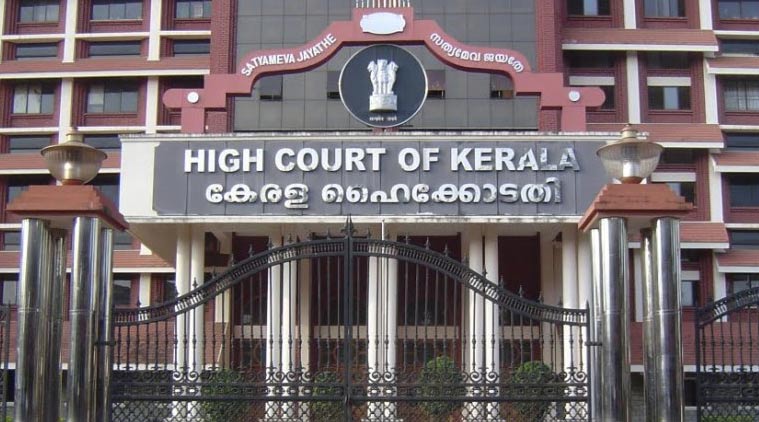
The Kerala High Court, while hearing a contempt of court case, has ruled that politics has no place in campuses of educational institutes and students can be expelled if they are found indulging in such activities.

The court made the observations while hearing a contempt of court case which was filed by the Principal of MES College, Malappuram against Debashish Kumar Behra, the secretary of the college’s Students Federation of India (SFI) wing, a radical leftist organisation found on some campuses.

As per the court, political activities like dharna, hunger strikes, satyagraha, etc. have no place in a constitutional democracy, let alone in educational institutions. It further observed that anyone indulging in such activities at educational institutions would make himself/herself liable for expulsion.

The court made more scathing observations:

Educational institutions are meant for imparting education and not politics. By their political ambition, the political parties cannot hold to ransom the educational institution or the right of the civilised students to receive education.

The court also looked at photographs of students holding a dharna inside the campus and opined that students council, academic council, and courts are available for students to put forth their grievances. It also made a scathing remark that, people resorting to dharna or hunger strike shows that they are aware about the illegitimacy of their demands. Thus they use coercive methods to achieve their objectives which otherwise could not have been achieved legally.

Such an observation by a nation’s High Court might be a landmark precedent when it comes to student politics in India.

Even though such on-campus politics has some on paper benefits like, imbibing team spirit and leadership qualities among students, in reality the whole students politics scenario has become synonymous with various negatives in recent years.

There have been various cases of violence in educational campuses around the nation. It was reported in February that a clash had broken out between leftist student organisation All India Students Association (AISA) and Akhil Bharatiya Vidyarthi Parishad (ABVP) outside Ramjas College in Delhi University. This fight had caused injuries to professors and media persons, though media tried to hid the violence by the leftists.

West Bengal too has become notorious in this regard. To name a few instances, in 2016, 16 students and 2 policemen were injured in north-Dinajpur after a fight broke out between student wings of CPI(M) and TMC. In 2015 there were reports that a member of Congress’ student wing was beaten to death, by alleged Trinamool Chhatra Parishad (TMCP) when a clash broke out between the two organisations in a West Midnapore college.

Uttar Pradesh has also seen a share of its student violence after there were reports  in 2014 about a big brawl erupting in Digambar Jain college at Bagpat during a student union election.

Kerala, whose High Court has now made the observations, too has seen violence in the form of SFI forcibly preventing the entry of other student federations in colleges across the state.

Apart from violence, some educational institutes have also become hotbed for anti-national activities under the garb of student politics. The most high profile instance was the 2016 JNU protests where leftist student organisations had reportedly chanted anti-India slogans while protesting the death penalty meted out to terrorist Afzal Guru.

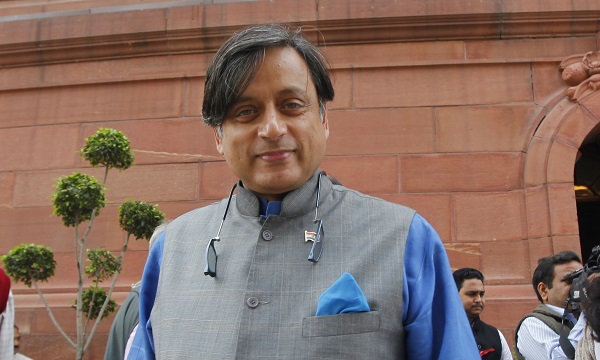
Former minister Shashi Tharoor gets schooled by a Twitter user on Global Hunger Index

0

Congress MP and former union minister Shashi Tharoor today took to Twitter to show his disappointment at India’s rank in Global Hunger Index:


The report, which cited Washington-based International Food Policy Research Institute (IFPRI) said that with a global hunger index (GHI) score of 31.4, India is at the high end of the “serious” category. Data from the report showed that India’s rank (100) was lower than all its neighbours—Nepal (72), Myanmar (77), Bangladesh (88), Sri Lanka (84) and China (29)—except Pakistan (106). Even North Korea (93) and Iraq (78) fared better in hunger parameters and GHI rankings.

However, a Twitter user, @WrongDoc provided a comparative analysis on the same to Tharoor, by juxtaposing India’s position with India itself before comparing ourselves with other countries:


According to the Twitter user, India has been doing consistently better in fighting hunger over the years:


He further states that as compared to 2009, India has been doing much better in fighting hunger and malnourishment amongst children under 5 years of age:


Amidst all this, some users also took this moment to point out the hypocrisy:


If only Tharoor took a lesson or two on #KnowYourLegacy, he’d know the decisions and scams and misrule which led to this situation.

UPDATE: Not only Tharoor was harping more on rhetoric than data, even the supposed data (huge fall in ranking) is entirely wrong and result of either propaganda or weak data interpretation and analytical abilities of journalists who wrote the news report. The corrected data was pointed out by yet another Twitter user @Nesenag is:


Now AAP leader announces reward for whoever can find Kejriwal’s stolen car

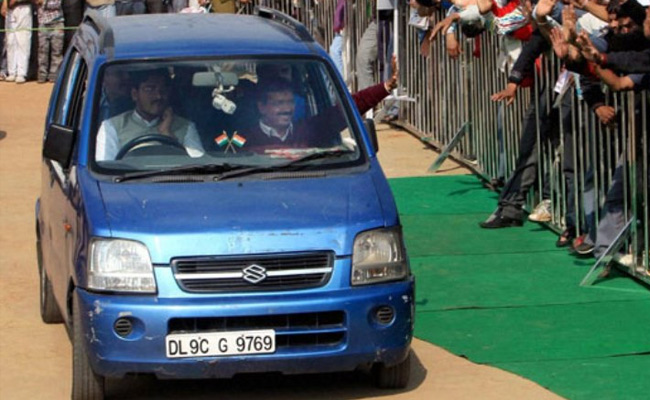
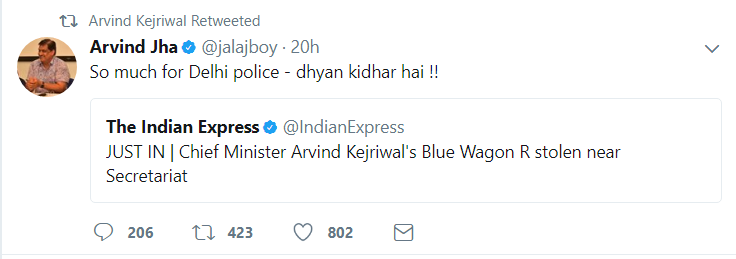
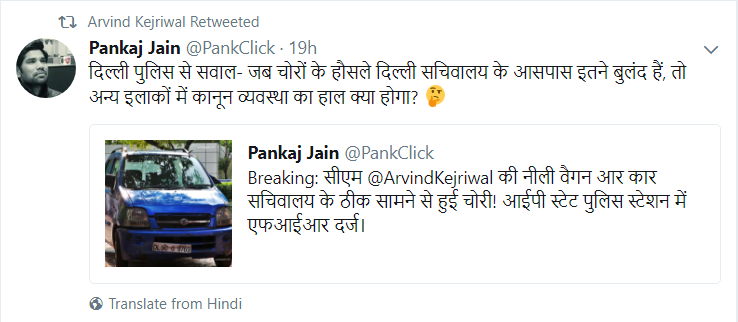
On Thursday tragedy struck Delhi as reports announced that Kejriwal’s famous blue Wagon-R was stolen from the Delhi Secretariat. The car was reportedly parked outside the secretariat and went missing at about 1 PM.

An FIR was later registered and it was also reported that the car was currently being used by a member of AAP’s media cell. After the news started spreading, Twitter users wasted no time and started cracking jokes:


Kejriwal as a response to the theft, retweeted a few tweets criticising Delhi Police, for its supposed negligence:

This theft also raised the question as to whether the thieves knew that the car was associated with Kejriwal or whether they simply jacked a random car.

The police has reportedly started to hunt for the car and has reached as far as Meerut during its searches. Turns out that a Sotigunj market in that city is infamous for getting stolen cars stripped down and later selling their parts. The police is believed to have carried out searches in godowns present there.

Now in order to possibly motivate the public to step up their search for this “iconic” car, an AAP leader from Haryana has come out to announce a reward for successful retrieval. AAP’s Haryana convener named Naveen Jaihind has promised an undisclosed reward which he claims would be much more than its resale value.

According to him, he has many memories attached to the car as he had used this “lucky car” for campaigning during the 2014 Lok Sabha polls in Rohtak, Haryana where he was the candidate. He had lost those polls by about 4.4 lakh votes.

Incidentally this whole theft saga isn’t the most dramatic thing which has happened to this car. This car was not brought by Kejriwal but was donated to him by an AAP supporter in January 2013. The supporter had later demanded in 2015 that his car be returned back after he was disappointed over the removal of Prashant Bhushan and Yogendra Yadav from the party. Kejriwal clearly didn’t pay heed to his demand.

Woman dies after man attempts rape, inserts iron rod in her private parts in Naubatpur, Patna

0

In a shocking incident, a man attempted rape on a woman, and when he could not rape her, inserted iron rod in her private parts, killing her. As per the reports, a 35 year old woman went to use the toilet, where a 22 year old man of the same village attempted to rape her. When she protested, he inserted iron rod in her private part. She was taken to hospital, but she died during treatment.

The woman, who is a mother of four, was allegedly having an affair with the accused, Dhiraj. When she broke off the relationship, Dhiraj was not able to forget her and move on and would harass her off and on. On Wednesday, when the woman left her home, Dhiraj, with his friend, attempted to rape her, but failed. After which, he inserted a rod in her private parts and abandoned her when she started bleeding heavily. The woman was taken to a hospital, but she died due to excessive bleeding while she was undergoing treatment.

As of now, police have arrested Dhiraj and are on a lookout for his friend who is also an accuse. A special investigative team will be formed to probe into the incident.


On the same day, in a separate incident, an 18 year old gang rape survivor, committed suicide in Bhagalpur, Bihar, as she could not bear the mental trauma coupled with threats from the perpetrators to make the rape video viral if she says anything to police.

As per National Crime Records Bureau, there are more than 34,000 rapes reported in the country in 2015, where as many as 95% of the rape victims in India are known to their offenders, of which about 27% rapes are committed by their neighbours.

Civil liberties group files petition in Supreme Court against Delhi cracker sale ban

0

On 9th October the Supreme Court in a verdict announced that the sale of crackers would be banned in the Delhi NCR region till 1st November.

This ban during the Diwali period resulted in an uproar within the Hindu community which saw the judgement as infringing into their religious practices. On the other hand various environmental groups and the so called liberals welcomed the verdict, which they claimed would control the air pollution around Delhi.

Even though the air quality does tend to deteriorates in this time-frame, but as detailed in this report, various other factors apart form crackers are responsible for the same. On top of it, we also reported that pollution was not the main reason why Supreme Court had banned the sale.

As a result of the ban, the Delhi police suspended about 400 temporary and permanent licenses given to traders and shopkeepers. Thus these sellers were hit the hardest, many of whom are now unsure as to what to do with the stock of crackers which has already been delivered to them.

Now there might be a glimmer of hope for Delhi and its Diwali after, “Indic Collective” a civil liberties group has now filed a petition in the Supreme Court against this ban.

We had recently reported about Indic collective and how they are a Chennai-based registered trust of activists, intellectuals and civil liberty advocates. Their main aim is to usher in an Indian renaissance with the help of legal actions and initiatives.

Soon after the cracker ban was imposed, they had assured that they were in process of filing a review petition:


Now they have come true on their statement and have filed an application before the Supreme Court for modification of the order:


The matter was mentioned before Justice Ranjan Gogoi and Justice Naveen Sinha by arguing counsel Sai Deepak J and advocate on record Suvidutt Sundaram. The hearing in the Supreme Court is scheduled on Friday. The fast approaching date Diwali and the infringement of fundamental rights under Article 25 were submitted as grounds for urgency.

Various netizens welcomed the initiative of Indic Collective and gave them their wishes:

The Dynasty’s tryst with adult magazines

0

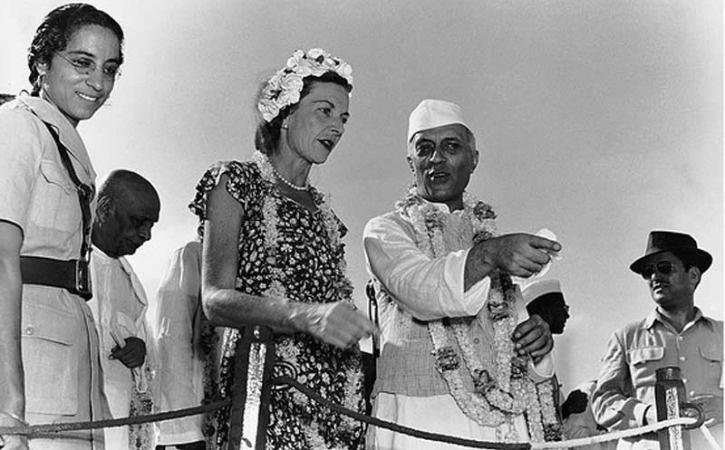
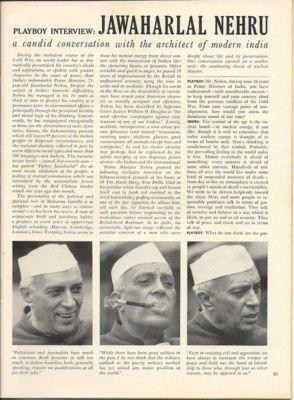
The adult magazine Playboy, which features scantily, almost naked women on the centrefold, had ran an exclusive interview of Independent India’s first Prime Minister Jawaharlal Nehru in October, 1963. On Thursday, Playboy Twitter handle tweeted an image which had Nehru’s interview, but within minutes, deleted the same.

Turns out the October, 1963 edition of Playboy indeed run an “exclusive” interview of Nehru, albeit with a disclaimer on the third page that the Indian Embassy in Washington had denied that any such interview of Nehru ever took place. The note read,

After the rest of the magazine had gone to press, we received word from the Indian Embassy in Washington that our interview with PM Nehru was not, in fact, the result of an exclusive, personal conversation with the head of the Indian state, but simply a gathering together of public pronouncements made by the Prime Minister in various speeches, statements, etc., over the past several years….

…the Nehru material was submitted to us by a well-regarded journalist-publisher who has previously conducted numerous similar interviews with famous personages all over the world; it was sold as an actual interview, recorded on tape, and the covering letters that so described the material also included photographs of the Prime Minister and journalist together. There was no reason to doubt its validity and we consequently published it in good faith as a personal interview.

So essentially, while we are not sure whether Nehru gave an exclusive interview to the journalist, Playboy did publish the piece as an interview with Nehru.

Playboy Interview of Jawaharlal Nehru

Apparently, Playboy was banned by Indian government back then. However, the issue featuring the alleged interview was being sold at premium in India.

Rajiv Gandhi on Penthouse Magazine

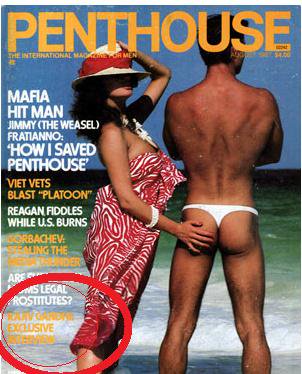
Surprisingly, Nehru wasn’t the only one to have an ‘exclusive interview’ in an adult, men’s lifestyle and softcore pornographic magazine. His grandson, Rajiv Gandhi, also allegedly gave an exclusive interview to Penthouse magazine, which was published in the August, 1987 issue when he was the Prime Minister of India. Even then, the Prime Minister’s office denied giving interview to Penthouse. Instead they thought the interview was for a book and tried to legally stop the publication of the interview. Penthouse, though, published the interview, albeit with a note of protest from the Indian Government.

Rajiv Gandhi interaction on Penthouse adult magazine

Indira Gandhi’s interview to porn magazine Oui

But that is not all. Former Prime Minister Indira Gandhi, too, gave an exclusive interview to men’s adult pornographic magazine Oui in May, 1973.

Indira Gandhi’s interaction with José-Luis de Vilallonga “Sacred cows aren’t easy to milk” apparently appeared on page 58. You could still buy a copy of this collectible here.