The Assam government said that 47,928 illegal immigrants were detected in the state during the period between 1971 and 2014 and out of them 43 per cent are Hindus.
The Foreigners’ Tribunals of the state declared these people as foreigners during this period.
Replying to a written question of AGP MLA Ponakan Baruah, Assam Chief Minister Dr Himanta Biswa Sarma who also holds the Home Department portfolio said that from 1971 to 2014 the Foreigners’ Tribunals declared 47928 persons as foreigners and out of them 20,613 are Hindus and 27,309 are Muslims and six belonged to other religions.
According to the state government data, out of a total of 20,613 Hindus declared as illegal immigrants by the Foreigners’ Tribunals, 8,139 are from Cachar district, 2884 from Guwahati city, 1574 from Lakhimpur district, 1038 from Dibrugarh district.
On the other hand, out of 27309 Muslims declared as illegal immigrants by the Foreigners’ Tribunals, 4182 are from Jorhat district, 3,897 from Guwahati city, 2,829 from Dibrugarh district, 2,100 from Hojai district, 2,096 from Sivasagar district, 2,083 from Nagaon district, 2,013 from Cachar district, 1,710 from Lakhimpur district, 1,172 from Morigaon district.
According to the Assam Accord, the midnight of 24 March 1971 is the cut-off date for the detection and deportation of illegal migrants.
Citing the 2011 census, Assam Chief Minister Himanta Biswa Sarma said, “The Assamese-speaking people accounted for 48.38 per cent of the state’s total population of 3.12 crore and the Bengali-speaking people accounted for 28.92 per cent of the total population.”
On Baruah’s question, if the state government was aware of the fact that the number of people speaking non-Assamese languages is rising and creating a threat to the indigenous communities, Sarma said the dispensation is monitoring the situation.
(This news report is published from a syndicated feed. Except for the headline, the content has not been written or edited by OpIndia staff)
The Assam government on Thursday tabled a bill in the state assembly that seeks to repeal the Assam Muslim Marriages and Divorces Registration Act, 1935.
Assam Revenue and Disaster Management Minister Jogen Mohan introduced the Assam Repealing Bill, 2024, in the state assembly.
The objective of the proposal of the Assam Repealing Bill, 2024, is to replace bill for the Assam Repealing Ordinance, 2024 for the repeal of the Assam Muslim Marriages and Divorces Registration Act, 1935 and Assam Muslim Marriages and Divorces Registration Rules, 1935.
As per the Bill, the Assam Muslim Marriages and Divorces Registration Act, 1935 is a pre-independence Act adopted by the British India Government for the then Province of Assam for Muslim religious and social arrangements. The registration of marriages and divorces is not mandatory and the machinery of registration is informal leaving a lot of scope for non-compliance of extant norms.
The Assam Minister Jogen Mohan said in the Statement of Object and Reasons of the Repealing Bill that there remains a scope of registering marriages of the intended person below 21 years (in case of male) and 18 years (in case of female) and hardly any monitoring made for implementation of this act throughout the state which attracts and invite huge amount of litigation in the criminal/civil court. There is a scope of misuse by both authorized licensees (Muslim marriage Registrars) as well as by citizens for underage/minor marriages and forcefully arranged marriages without the consent of the parties.
On August 21, the Assam cabinet approved the Assam Compulsory Registration of Muslim Marriages and Divorces Bill, 2024 to strengthen the institution of Muslim marriage, and authorize government machinery as the registering authority of marriages and divorce and prevent the menace of child marriage.
This new bill would likely be placed in the ongoing autumn session of the Assam assembly. It seeks to make it compulsory for all married couples to get their marriages and divorces registered. The marriages may be solemnized as per their ritual, usage and ceremony and declared as per provisions of the law.
Assam Chief Minister Himanta Biswa Sarma said that this bill is made in line of the Civil Code of Procedure for summon, notice etc. to ensure and find out the truth of the application of all related issues. This bill will benefit the common people and protect them from all odds and evils besides legal recognition of their marriage and divorce, the Chief Minister said.
(This news report is published from a syndicated feed. Except for the headline, the content has not been written or edited by OpIndia staff)
Punjab Police has secured the extradition of 2016 Nabha Jailbreak mastermind Ramanjit Singh alias Romy, from Hong Kong.
The latter was brought back to India by the team of the Anti-Gangster Task Force (AGTF) of the Punjab Police on Thursday, said the Information And Public Relations Department, Punjab.
“After tireless efforts by @PunjabPoliceInd, Romy, the key conspirator, is being brought back today to face justice. He was in touch with #ISI and other escaped prisoners, including Harminder Singh Mintu and Kashmir Singh Galwaddi of the Khalistan Liberation Force (#KLF),” informed Director General of Police (DGP) Punjab Gaurav Yadav in a post on X.
Mastermind of 2016 Nabha Jailbreak, Ramanjit Singh @ Romy, Extradited to #India from #HongKong!
After tireless efforts by @PunjabPoliceInd, Romy, the key conspirator, is being brought back today to face justice. He was in touch with #ISI and other escaped prisoners, including… pic.twitter.com/h6kNx57kHG
The DGP’s post further reads, “We thank the Hong Kong authorities, the CBI, Ministry of Home Affairs, the Ministry of External Affairs and all other central agencies as part of this international cooperation.”
Pertinently, the fugitive Ramanjit Singh alias Romi played a vital role in Nabha Jailbreak took place on November 27, 2016 at around 9am, in which, gangsters dressed as policemen, broke open the high security jail and freed six dreaded inmates and gangsters, namely Harminder Singh alias Mintu, Gurpreet Singh Sekhon, Amandeep Singh Dhotian, Kulpreet Singh alias Neeta Deol, Kashmir Singh alias Galwaddi and gangster Harjinder Singh alias Vicky Gonder, who were later neutralised by Punjab Police on January 26, 2018 in Rajasthan, while others were arrested.
Romi, who is a key member of the Shera Khuban/Vicky Gaunder gang, had provided logistical in the form of financial aid, weapons used in Nabha Jail break, fake IDs used to gain access in the jail and financial support to the gang members in the preparation to execute the jail break, besides, providing safe houses and hideouts to the prisoners, who had escaped from the jail.
DGP Gaurav Yadav said that through relentless investigation and meticulous operations, a total of 26 accused of Nabha Jailbreak were arrested and chargesheeted, however, Ramanjit Singh alias Romy, who was the foreign handler was declared a proclaimed offender.
Mastermind of 2016 Nabha Jailbreak in Punjab Ramanjit Singh @ Romy has been extradited to India from Hong Kong today.
Romy was in touch with Pakistan ISI & other escaped prisoners, including Harminder Singh Mintu & Kashmir Singh Galwaddi of the Khalistan Liberation Force (KLF). pic.twitter.com/ItZqSllm6J
The latter, who was also in touch with ISI and Harminder Singh Mintu and Kashmir Singh Galwaddi of the Khalistan Liberation Force (KLF), emerged as the mastermind behind the jailbreak, he said.
“Our relentless pursuit of justice led to issuance of a Look Out Circular (LOC) and Red Corner Notice (RCN) against Romi. The extradition process was set in motion in 2018 as per the mutual legal assistance treaty (MLAT) with the Government of Special Administrative Region (SAR) Hong Kong, where the case was robustly presented to the Department of Justice and the Courts of Hong Kong,” said the Punjab DGP, while adding that the Chief Executive Officer of Hong Kong issued the order for Romi’s surrender on August 6, 2024.
DGP Gaurav Yadav commended the strenuous efforts of the entire team of AGTF headed by ADGP Promod Ban for marking the culmination of an extraordinary international operation with the cooperation of Ministry of External Affairs (MEA) and the Government of India that demonstrated the resolve and competence of the Punjab Police.
(This news report is published from a syndicated feed. Except for the headline, the content has not been written or edited by OpIndia staff)
During PM Narendra Modi’s historic visit to Poland, the two countries decided to elevate the bilateral relationship to the level of a “strategic partnership”, and unveiled a 5-year program to implement the same. In the meeting between PM Modi and Polish PM Donald Tusk, both sides vowed to significantly expand the bilateral defence and security ties, and Tusk expressed Warsaw’s eagerness to be a key partner in New Delhi’s aim to boost domestic defence production and modernise its armed forces.
PM Modi arrived in Polish capital Warsaw on Wednesday, in the first visit by an Indian prime minister to Poland in nearly half a century. Apart from meeting PM Donald Tusk, he also held a meeting with Polish President Andrzej Duda on Thursday. During the meeting of the two PM, the two countries decided to elevate the India-Poland relationship to strategic partnership.
The two PMs held talks in private and also in delegation level formats. The two leaders agreed that there were significant opportunities available for economic and business collaboration in sectors such as food processing, urban infrastructure, water, solid waste management, electric vehicles, green hydrogen, renewable energy, AI, mining and in clean technologies.
The leaders underscored the importance of deepening people-to-people ties and cultural relations. In this regard, they highlighted the unique bond established between the two countries based on the generosity of Maharaja of Jamnagar and the royal family of Kolhapur. Modi and Tusk also discussed important regional and global issues of mutual interest including the conflicts in Ukraine and West Asia. They exchanged views on reform of United Nations and other international institutions, climate change action and threats posed by terrorism.
Following this decision, the two sides unveiled a five-year Action Plan for the period 2024-2028 in a range of areas including defence, trade, agri-tech, energy, green technologies, infrastructure, pharmaceuticals and mining for cooperation.
The five-year action plan is as follows:
Political Dialogue and Security Cooperation
The two sides will maintain regular contacts between foreign ministers, and they will use both bilateral and multilateral fora for these interactions.
Both sides will consider supporting each other’s aspirations on a case-by-case basis to contribute to multilateral cooperation in the spirit of the United Nations Charter.
The two sides will ensure holding of annual political dialogue at the level of deputy minister in charge of foreign relations.
The two sides will encourage relevant institutions to hold regular consultations on security and defence cooperation to promote contact between defence industries, modernise military equipment, and address outstanding issues.
The two sides decided that the next round of the Joint Working Group for defence cooperation will take place in 2024.
Trade and Investment
Recognizing opportunities in high-tech, agriculture, agritech, food tech, energy, climate, green technologies, infrastructure, smart cities, defense, healthcare, pharmaceuticals, and mining, the two sides will explore further cooperation in these sectors during next Joint Commission for Economic Cooperation (JCEC) meeting scheduled for the end of 2024.
The two sides will strive to organize meetings of JCEC at least twice every five years, with the possibility of more frequent meetings, if necessary.
Both sides will work towards achieving balanced bilateral trade and addressing all issues to facilitate smooth trade and investment.
Both sides will enhance cooperation in economic security by focusing on increasing supply chain resilience and mitigating risks associated with trade dependencies.
Climate, Energy, Mining, Science and Technology
The two sides will expand their cooperation in sustainable and environmentally friendly technological solutions for the circular economy and waste-water management.
Acknowledging their historical reliance on domestic supplies for energy security, both sides will work together on advancing cleaner energy approaches and exploring cooperation in Clean Coal Technologies to minimize environmental impact.
Recognizing the crucial role of innovation and the growing importance of critical minerals, the two sides will collaborate on advanced mining systems, high-tech machinery, pioneering safety standards, and increase exchanges and cooperation in mining-related industries.
Both sides agreed to work on concluding a cooperation agreement to promote the safe, sustainable, and secure use of space and commercial space ecosystems. They also agreed to promote human and robotic exploration.
Poland recognizes India’s ambition to join the International Energy Agency.
Transport and Connectivity
The two sides will explore developing cooperation in the field of transport infrastructure.
The two sides will work to enhance connectivity between their countries and respective regions by discussing and pursuing further expansion of flight connections.
Terrorism
The two sides reiterated their unequivocal condemnation of terrorism in all its forms and manifestations and emphasized that no country should provide a safe haven to those who finance, plan, support or commit terrorist acts. Both sides will make concerted efforts against all terrorists, including by designating individuals affiliated with groups that are listed by the UN Security Council 1267 sanctions committee.
Cyber Security
Recognizing the critical importance of cyber security for economic and social development, both sides will enhance close interaction and increased exchanges in ICT-related fields, with particular attention to international cooperation, legislative and regulatory solutions, judicial and police activities, deterrence, prevention and responses to cyber-attacks, awareness-building and educational programs, scientific and technological research and development, business and economic exchanges.
Health
Both sides underlines the vital role of strengthening collaboration in the field of health by exchanging and sharing information on areas of mutual interest, enhancing contacts among health experts, and supporting cooperation between health institutions in both countries.
People-to-People Ties and Cultural Cooperation
Both sides will work together to implement the Agreement on Social Security and they will make efforts to complete their respective internal legal procedures in this regard.
The two sides will strengthen cooperation between cultural institutions and organisations of the two countries. The two sides will strengthen exchanges between artists, language experts, scholars, and cultural institutions from both countries. They will also explore establishing cooperation and dialogue between their think tanks and experts.
The two sides will work together to strengthen cooperation in higher education and encourage universities from both sides to organise relevant activities. They will also encourage respective authorities to establish partnerships between academic institutions in both countries.
Both sides emphasized importance of education and linguistic and cultural exchange in building mutual understanding and fostering bilateral cultural ties. They also recognized the role of Hindi and Indian studies in Poland and Polish language and culture studies in India and agreed to work on an agreement between Polish National Agency for Academic Exchange and respective Indian agencies on teaching Polish language at various universities in India.
Both sides will continue to expand tourist flows in both directions by strengthening cooperation in tourism. This includes organizing tourism missions, arranging family trips for influencers and travel agencies, and participating in tourism fairs and roadshows in both countries.
To mark the 75th Anniversary of the establishment of Diplomatic Relations, both sides will hold cultural festivals in each-others countries organized by the diplomatic missions. Dates for such special events will be decided in mutual consultations.
Both sides will also promote a Student Exchange Programme and build mutual understanding with younger generation.
India-EU
Recognizing that the EU and India are key international partners with a significant role in promoting peace, stability, and prosperity, both sides will support the early conclusion of the ongoing India-EU trade and investment negotiations, the operationalization of the India-EU Trade and Technology Council (TTC), and the implementation of the India-EU Connectivity Partnership to advance the India-EU Strategic Partnership in trade, new technologies, and security.
Way Forward
Both sides will ensure regular monitoring of the implementation of the Action Plan, with the annual political consultation as the primary mechanism for reviewing and updating the activities. The extension of the Action Plan for another five-year period will be adopted by the respective ministers in charge of foreign affairs.
At the invitation of H.E. Mr. Donald Tusk, Prime Minister of the Republic of Poland, Shri Narendra Modi, Prime Minister of the Republic of India, paid an official visit to Poland from August 21-22, 2024. The historic visit, came as both nations celebrate the 70th anniversary of their diplomatic relations.
Recognizing their long-standing ties, reaffirming the deep-rooted bonds of friendship between their countries and peoples, and commitment to realizing the full potential of their ties, the two leaders decided to elevate India-Poland bilateral relations to the level of a “Strategic Partnership”.
Both the Prime Ministers emphasized that shared values of democracy, freedom, and a rules-based international order, along with historical ties, are at the center of the growing bilateral partnership. They reaffirmed their commitment to deepening bilateral, regional, and international cooperation for a more stable, prosperous, and sustainable world.
Both leaders stressed the need to maintain regular high-level contacts to strengthen bilateral political dialogue and develop mutually beneficial initiatives.
The leaders agreed to further intensify bilateral economic relations, stimulate trade and investment, and explore new mutually beneficial areas of cooperation. In this regard, they agreed to fully utilize the Joint Commission for Economic Cooperation. The leaders also agreed that efforts should be made to balance bilateral trade and expand the trade basket.
Both leaders acknowledged the growing importance of expanding economic cooperation in sectors such as technology, agriculture, connectivity, mining, energy, and environment.
Acknowledging the critical role of digitalization in economic and social development, both sides agreed to bolster bilateral cooperation in this field, including in cybersecurity, to enhance stability and trust between the two countries.
The Prime Ministers emphasized the importance of connectivity between two countries and respective regions. They welcomed the commencement of direct flight connections between the two countries and stress the need for a further increase of direct flights connections to new destinations in both countries. Both sides underlined the importance of strengthening maritime cooperation, and the patency of infrastructure corridors.
The two leaders underscored that as the world’s two largest democracies, the EU and India have a common interest in ensuring security, prosperity and sustainable development in a multi-polar World They reaffirmed their commitment to deepen India-EU Strategic Partnership, which would not only benefit both sides but also have a far-reaching positive impact globally.
The two Prime Ministers expressed their commitment to peace and rules-based international order with the UN Charter at its core and agreed that cooperation in the sphere of security in its multiple dimensions is vital during serious conflicts and tensions in various regions of the world. They decided to enhance collaboration at multilateral forums to promote respect for rules-based international order and maintain global peace, stability, and security.
Both sides recognized the need to strengthen and deepen cooperation in the defence sector. To this end, they agreed to fully utilize existing bilateral mechanisms, including the Joint Working Group for Defence Cooperation.
The two leaders expressed their deepest concern over the war raging in Ukraine including its terrible and tragic humanitarian consequences. They reiterated the need for a comprehensive, just, and lasting peace in line with international law, consistent with the purposes and principles of the UN Charter, including respect for sovereignty and territorial integrity. They also noted the negative impacts of the war in Ukraine with regard to global food and energy security, especially for the Global South. In the context of this war, they shared the view that the use, or threat of use, of nuclear weapons is unacceptable. They underscored the importance of upholding international law, and in line with the UN Charter, reiterated that all states must refrain from the threat of or use of force against the territorial integrity and sovereignty or political independence of any state.
The two leaders reiterated their unequivocal condemnation of terrorism in all its forms and manifestations and emphasised that no country should provide a safe haven to those who finance, plan, support or commit terrorist acts. Both sides stressed the need for firm implementation of relevant resolutions of the UN Security Council, the UN General Assembly, as well as the implementation of the UN Global Counter-Terrorism Strategy. They also reaffirmed on the early adoption of the Comprehensive Convention on International Terrorism (CCIT).
The two sides reinforced their commitment to a free, open and rules-based Indo-Pacific in accordance with the international law of the sea as reflected in UNCLOS and with full respect for the sovereignty, territorial integrity and freedom of navigation to the benefit of the maritime security and international peace and stability.
Recognizing the significant challenges posed by climate change, both leaders agreed on the importance of cooperation in climate action initiatives. Indian side encouraged Polish side to consider Poland’s memberships of the International Solar Alliance (ISA) and the Coalition for Disaster Resilient Infrastructure (CDRI).
Appreciating the role of parliamentary contacts, the leaders agreed that expanding exchanges and cooperation between their legislatures would significantly deepen bilateral ties and mutual understanding.
The Prime Ministers noted the longstanding special people to people ties and agreed to strengthen these further. They also agreed to expand cooperation in the areas of culture, education, science, research, and health. They welcomed efforts to promote and encourage additional steps to establish future-oriented partnerships between academic institutions.
The leaders acknowledged the role of tourism in driving economic and business opportunities and enhancing understanding between the people of both countries.
To implement the Strategic Partnership, both sides agreed to a five-year Joint Action Plan for 2024-2028.
Prime Minister Modi thanked Prime Minister Tusk and the people of Poland for the hospitality extended to him and his delegation and he invited Prime Minister Tusk to visit India.
– Statement issued by Prime Minister’s Office on PIB
The media, especially the Western media, has its own ways of shielding the religious identity of Muslims when found involved in criminal activities and emphasising the same they happen to do something positive. The world is in shock after A 40-year-old doctor in Michigan, Oumair Aejaz was arrested in the US after being charged with numerous sex crimes, including recording thousands of nude images of women and children over the past six years. A significant section of the media even in this horrifying crime managed to fan stereotypes against Indians and conceal the religious identity of the perpetrator.
In a flagrant display of hypocrisy, a large section of the media across the world emphasises a Muslim person’s religious identity when they do something great or decent, but downplays or obscures the same identity when they engage in criminal activity. While usually, the foreign media calls the accused persons involved in such cases either Asian or South Asian, this time, the emphasis is explicitly on his Indian origins.
Sadly, even the Indian media outlets toed the Western media’s line meant to tarnish India’s image globally and reported Oumair Aejaz as an “Indian doctor”. Interestingly, there can be Muslim doctors’ associations, and their religious identity be highlighted if they do something laudable but the same cannot be done with a Muslim doctor like Oumair Aejaz carries out horrendous crimes.
The headline of the report published by South China Morning Post (SCMP), a Hong Kong-based news outlet owned by the Alibaba Group, reads: “Indian doctor in US took thousands of images of naked adults and children as young as 2”.
The International Business Times, an American online newspaper also chose to call Oumair Aejaz an “Indian doctor”.
Meanwhile, a WION report’s headline reads: “‘13,000 videos in single drive,’ Indian doctor jailed in US for recording nude videos of children, women”.
Similarly, Mint’s headline states: “Indian doctor films naked children and adults in US, arrested; thousands of videos found at his Michigan home”.
IndiaTV reported: “’Disturbing on many levels’: Indian doctor arrested in US for taking pictures of naked adults and children”
Another leading Indian media outlet IndiaToday reported: “Indian doctor in US records thousands of nude videos of kids, women, arrested”.
On the face of it, nothing much might seem problematic here since perpetrator Oumair Aejaz is indeed of Indian origin, however, the emphasis on his Indian connection is the problem. Have a look at how the both Indian and foreign media report incidents wherein the “good Samaritan” happens to be a Muslim.
In 2017, Australian news outlet The Weekly Times reported: “Muslim doctor saves man’s life”.
In 2016, the Times of India reported how a Muslim girl saved her Hindu classmate from kidnappers even as there was no imperative to mention the girl’s Muslim identity but only talk about her act of bravery.
Just a few days back, a Pakistani news publication AajTV, boasted in its report how a “Heroic Muslim” saved people in the London knife attack. However, demonstrating its hypocrisy, the same publication chose to call Oumair Aejaz an “Indian doctor” in its report and not highlight his Muslim identity. Interestingly, the same Pakistani media called javelin throw star Neeraj Chopra’s Tokyo Olympics gold win a “victory of South Asia” but when a Muslim man Oumair Aejaz carries out a horrendous crime in Michigan, they dismiss him as a “Indian doctor”.
In January last year, Citizens for Justice and Peace (CJP), a ‘Human rights’ group, reported about an incident wherein a man named Tipu Sultan saved girl Monali Kaushal’s life as she was drowning in Madhya Pradesh. “Muslim man risks life to save a Hindu girl from drowning in Madhya Pradesh,” CJP reported even as there was no imperative to highlight the saviour’s religious identity.
CJP reports
Another CJP report asserted how a “Muslim woman” saved the lives of many people through post-humous organ donation. The CJP, however, failed to mention that donating organs is prohibited in Islam and only receiving is allowed.
In July last year, Turkish news outlet Anadolu reported how a French Muslim “risked his life” to save people from fire in Romans-sur-Isere in southeastern France.
It must also be recalled how the Indian mainstream media highlighted the Muslim identity of rat miners who rescued 41 workers stranded in the Uttarakhand tunnel last year even as several Hindu rat miners were also involved in the rescue mission. The leftist media selectively highlighted the religious identity of Muslim rescuers making them national heroes while no such emphasis was laid on the religious identity of Hindu rescuers.
Glorify Muslims when something good happens, conceal their religious identity when involved in crimes: The hypocrisy of the global legacy media
Ironically, the very same section of foreign and Indian media that leaves no opportunity to glorify the Muslim identity when something good happens even as that the religiosity has little or nothing to do with the good actions of the people, also indulges in whitewashing the crimes committed by Muslims. A classic case of this is being seen in their coverage of anti-Hindu pogroms in Bangladesh, wherein Hindus are being attacked, killed, raped and their houses and temples vandalised, Hindu officials being forced to resign by Islamists solely out of their hatred for Hindus, yet the media outlets like Al Jazeera, NYT, ABC, etc passed these incidents off as “politically motivated revenge attacks”. Moreover, these hypocrites of top order highlighted the Muslim identity of those forming the farcical “human chains” to ‘protect’ Hindu temples, but failed to ‘verify’ whether the attacks on Hindus were driven by Islamism.
Clearly, the Islamist sympathising media lives in and wants to further their delusion that there are only good Muslims and the rest just bad people even if they kill and rape non-Muslims in the name of their religion and Allah.
When Muslims achieve significant success or make great contributions to society, their Islamic identity is frequently highlighted even if their good actions are unrelated to their faith. This narrative framing aims to dispel negative perceptions and promote the notion of Muslims as integral and constructive members of Western society. However, when it comes to naming Islamic terrorists what they truly are, these same media outlets promote a “terrorism has no religion” lie. Apparently, the media and the left-liberals globally want the world to live in denial of the Islamist threat knocking at their doors.
Media called the UK grooming gangs “Asian” even as they explicitly targeted non-Muslim girls out of their pervert religious extremism
Even with the infamous UK grooming gangs, the mainstream media called them “Asian”, despite the fact that it was their Muslim identity that made them groom non-Muslim girls. For example, take this The Telegraph report’s headline, “Telford scandal: Over 1,000 girls abused and raped by Asian gangs while police looked the other way”. All the perpetrators in this grooming gang were Muslims, mostly of Pakistan descent who singled out non-Muslim, white girls groomed them, sexually abused them multiple times, and threatened to kill them over disclosing their deeds to anyone and yet the media failed to or deliberately covers up the religious and racial motivation behind the crime.
Be it Rotherham, Telford, or Rochdale grooming and sexual exploitation cases, the pattern remained the same, non-Muslim girls including Hindu, Sikh, and White Christian girls being systematically targeted in the United Kingdom by Pakistani Muslims out of their religiously and racially motivated hatred towards non-Muslims. While the pro-Islamist bias is an obvious reason behind downplaying these cases for years or concealing the religious motivation behind the crime, another important reason for the cover-up was the fear of offending the perennially offended Muslim community.
By calling the Muslim groomers “Asian grooming gangs” or by simply their nationality, avoiding the explicit mention of their Muslim identity, the media perpetuates a generalisation unfairly implicating other Asian communities who were the victims of these Muslim grooming gangs, while also avoiding uncomfortable discussions about the specific religious factors involved.
The idea behind laying selective emphasis on the religious identity of Muslims is apparently, intended to create a skewed perception, where the positive aspects or deeds are linked to the religion, but the negative aspects are detached from it. This contributes to the establishment of a one-sided narrative that only those who do good deeds are ‘real Muslims’ while the predators, terrorists etc are not real Muslims even if they quote they carry the Quran in one hand and weapon in another to eliminate non-Muslims as seen in the case of ISIS executing kafirs.
The Muslim grooming gangs in the UK were shielded by the media and pro-Islamist politicians by passing them off as “Asian” or “South Asian grooming gangs”, The Palestinian Islamic terrorist group Hamas’s religiously driven attacks on Jews and Israel are passed off as ‘resistance’, Islamist attackers are labelled as “Bhatke huye naujawan [mislead youths] and grooming Jihad targeting Hindu women in India is outrightly dismissed as ‘hoax’, ‘fiction’, ‘right-wing conspiracy theory’ and whatnot. Currently, the media is obscuring Oumair Aejaz’s Muslim identity and passing him off as an ‘Indian doctor’, had the person happened to be a Hindu, the leftist media outlets would have somehow linked the crime with his religious identity and even to his political leanings. But since a Muslim can’t be bad because of being a Muslim, according to the leftist-Islamist propagandists, Aejaz and other criminals like him are and will be labelled “Asian”, “South Asian”, or “Indian”.
Ironically, Muslims who overtly assert their religiosity in anything and everything do not want the criminals and terrorists carrying out religiously motivated attacks on non-Muslims to be associated with Islam. However, these very people prioritise Islam over the country as was recently said by an Islamist maulana on national television.
If religion comes before the country for Muslims, shouldn’t the media also report according to this approach and mention “Muslim doctor” instead of “Indian doctor” as in the case of Oumair Aejaz? However, the media decided not to mention the predator’s name in their headlines but only in the body so that the focus remains on how an Indian doctor turned out to be a criminal but not essentially a Muslim doctor.
The Central Bureau of Investigation on Thursday approached Kolkata High Court for permission to conduct a polygraph test on RG Kar Medical College and Hospital’s ex-principal, Dr Sandip Ghosh, and four doctors after finding discrepancies in their statements during the investigation.
A senior CBI official informed that they have approached the court for permission and after getting the permission, the polygraph test will be conducted.
“We will corroborate their statements with the result of the polygraph test to verify their statement given to the agency,” the official added.
The CBI official stated that the polygraph test would help verify their statements and corroborate evidence.
Ghosh was previously questioned about his response to the incident, notification to police and parents, and other aspects.
Meanwhile, after the Supreme Court’s appeal, health professionals at All India Institutes of Medical Sciences, Delhi called off their 11-day-long strike and are back on their duties as of Thursday.
In a statement, the Resident Doctors Association made the announcement and said, “In the interest of the nation and the spirit of public service, the RDA, AIIMS, New Delhi, has decided to call off the 11-day strike. This decision comes in response to the appeal and direction of the Supreme Court. We extend our sincere appreciation to the Supreme Court for taking cognizance of the RG Kar Medical College incident and addressing the broader issue of safety and security for healthcare workers across the country.”
Earlier, the Supreme Court, while commencing its hearing on the Kolkata doctor rape-murder case, said that health professionals must return to work and that once they resume their duties, the court will prevail upon authorities to not take adverse action against them.
The development comes days after the rape and murder of a junior doctor in Kolkata sparked nationwide protests, the apex court suo motu took up the case and directed the task force to submit an interim report within three weeks and a final report within two months.
The top court also asked the Central Bureau of Investigation (CBI) to file a status report on the status of the investigation in the rape case. Also, the court asked the West Bengal government to file a status report on the mob attack incident that took place at the RG Kar hospital on August 15.
On August 9, a postgraduate trainee doctor was allegedly raped and murdered while on duty at RG Kar Medical College in Kolkata, sparking nationwide strikes and protests by the medical community.
(This news report is published from a syndicated feed. Except for the headline, the content has not been written or edited by OpIndia staff)
On Thursday, 22nd August, the Aligarh Railway Police charged one Afsan for deliberately placing an alloy wheel on the railway track to derail a moving train. The incident happened on Tuesday, 20th August when the accused made a deliberate attempt to recreate the Kanpur rail accident that happened on August 17th. Rail Minister Ashwini Vaishanav during the Kanpur case had confirmed that the derailment of the engine took place because of an object placed on the track.
Notably, twenty coaches of the Sabarmati Express passenger train had derailed near Govindpuri station in Kanpur after the engine hit an object placed on the track. In the Aligarh case also, Afsan placed an alloy wheel on the track to derail a train. However, a major train accident was averted due to the vigilance of the railway police team.
As per the reports, the railway police were informed that the alloy wheel was placed on the rail route of the Delhi-Kanpur freight corridor. The police immediately reached the spot and took down the wheel. The incident took place on the Talaspur railway track of the Roravar police station area.
Regarding the incident, Area Officer First Abhay Pandey said that a case at Roravar police station is being investigated. “Information was given by RPF in this matter. On receiving the information, the police force reached the spot, after which the railway track and the surrounding area were inspected. At the same time, a case was registered on the complaint given by the RPF in this regard and three police teams had been deployed to search for the accused,” he said.
The police have finally traced the accused and identified him as Afsan, as confirmed by the Times Now Navbharat.
Earlier, on August 17th, the engine of the Sabarmati Express train had derailed near Kanpur at 2.35 am. The Railway Minister Ashwini Vaishnaw shared that the derailment of the engine had taken place because of an object placed on the track.
The engine of Sabarmati Express (Varanasi to Amdavad) hit an object placed on the track and derailed near Kanpur at 02:35 am today.
Sharp hit marks are observed. Evidence is protected. IB and UP police are also working on it.
No injuries to passengers or staff. Train arranged…
Notably, this won’t be the first incident of someone deliberately placing objects on Railway tracks. There are many YouTube channels operating where the “creator” puts random things on Railway tracks and then records the videos for likes and shares.
Earlier in August, a YouTuber named Gulzar Sheikh was arrested for putting different items on railway tracks including cycles, soaps, stones, and more in the name of content creation.
OpIndia investigated the matter and found that many YouTube channels have been uploading such videos for likes and shares. In most probability, these channels are earning hefty money by monetizing these videos where they attempt to derail trains by placing objects on the tracks.
Samajwadi Party (SP) leader and Ayodhya gang-rape accused Moeed Khan has been subjected to further severe measures by the Uttar Pradesh government of Yogi Adityanath, following the demolition of his illegal bakery. On 22nd August, the authorities destroyed a third of his shopping complex, which was constructed unlawfully on public property.
A team of district administration drove up with bulldozers to the shopping centre located in Bhadarsa town at around 11 AM. The complex including banks and other businesses housed in the mall was vacated before the action. Notably, the perpetrator is a close associate of Samajwadi Party leader and Ayodhya Lok Sabha MP Awadhesh Prasad.
#WATCH | Ayodhya gang-rape incident | Police and administration carry out demolition drive at shopping complex owned by accused SP leader, for illegal construction. pic.twitter.com/r9TXr7Lidw
The victim has undergone medical termination of her pregnancy at King George’s Medical University (KGMU) Lucknow and has since moved to a residence in Bhadarsa town with her family. Meanwhile, security has been strengthened to safeguard her. She and her family have been under constant threat, therefore the officials informed that over thirty well-armed and prepared police officers, including female constables, have been strategically stationed around the clock to assure their protection.
Moeed Khan and his employee Raju Khan are accused of gang-raping a 12-year-old Other Backward Class (OBC) girl in Ayodhya and recording the incident to use as blackmail against her for more than two months. The victim’s pregnancy-related health problems brought the crime to light. The filing of the First Information Report was delayed. Since 2012, the police station has been housed on Moeed Khan’s land. Arrests were made following public outcry and an investigation into the matter is currently underway.
Police Station In-Charge Ratanlal Sharma and Outpost In-Charge Akhilesh Gupta have been suspended by the Yogi Adityanath government. An official complaint has been lodged against Bharatkund Bhadarsa Nagar Panchayat President Mohammad Rashid Khan, another SP leader. According to the complaint, he and his aides issued death threats to the minor rape victim. “With the intention of killing the rape victim, Mohammad Rashid, along with Jai Singh and an unknown person, reached near the room of the women’s district hospital at 11 pm on Thursday (August 1, 2024).” The complaint mentioned that he had already intimidated the victim in her home.
Government lands and ponds have been illegally occupied by Moid Khan. Furthermore, he is charged with taking over the land belonging to multiple Dalit families. In a letter to the District Magistrate, Bajrang Dal stated that Janaki Prasad, a Dalit, possesses plot numbers 1675 and 1676, and Moeed’s bakery in Bhadarsa Bhahar was also situated on this land. A high-level probe of his possessions and activities, as well as those of Ratanlal Sharma, were demanded by the outfit.
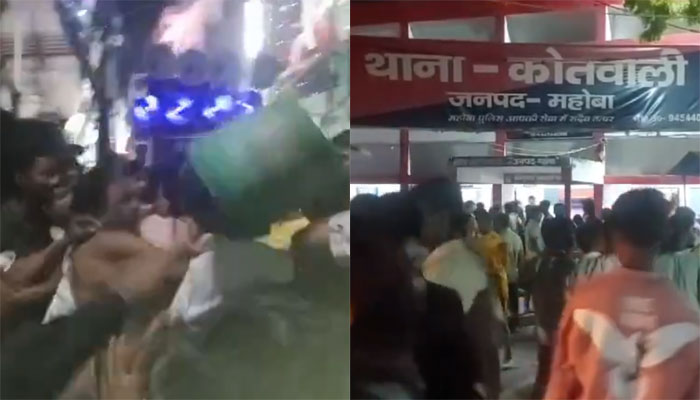
On Thursday, 22nd August, Madhya Pradesh police took strict action against Islamists who pelted stones and created a ruckus in Chhatarpur Kotwali police station on Wednesday afternoon. The Muslims are believed to have protested against Ramgiri Maharaj from Maharashtra who allegedly made derogatory remarks about Prophet Mohammed last week.
The police registered a case against 150 people involved in the ruckus after the orders were issued by CM Mohan Yadav. The FIR includes 50 named and 100 other people who pelted stones at the police station injuring two officers. After this, Chief Minister of the state, Dr Mohan Yadav directed the police to take strict action against the culprits of this incident. Reportedly, the state administration began demolishing the houses of the accused who pelted stones at the Police at Kotwali Police Station.
As per the local reports, the bulldozer action is underway amid heavy police force and administration team present on the spot. As notified to the media, accused Haji Shahzad Ali’s house in Mastan Sahab Colony of Chhatarpur city was being demolished with the help of a bulldozer at the time of writing of this report.
Chief Minister Mohan Yadav wrote on X, ”Today an unfortunate incident took place in Chhattarpur district in which on receiving information about some policemen getting injured, I immediately got information about the incident from higher officials and gave instructions for proper treatment of the jawans. Madhya Pradesh is a ‘State of Peace’, anyone taking the law into their own hands in a planned manner will not be tolerated at all. I have given clear instructions to the senior police officials to identify the culprits quickly and take strict action against them so that such incidents do not recur in the future. It is our priority to maintain peace and harmony in the state.”
It is important to note that the members of the Muslim community in Chhatarpur demonstrated against Ramgiri Maharaj at around 4 pm on Wednesday. During this, the Muslims resorted to stone pelting and rioting, damaging some vehicles and injuring two police officers. Ramgiri Maharaj had allegedly made objectionable remarks targeting Prophet Mohammad and Islam last week. The Hindu saint during one of his sermons in Nashik, indicated that several Islamists have disrespected women in the past because of the religious doctrine they follow. The remarks sparked wide outrage in several districts of Maharashtra including Chhatrapati Sambhajinagar, Nashik, Mumbai, and Pune with several Islamist leaders and organizations filing FIRs against Ramgiri Maharaj for allegedly hurting the religious sentiments of Muslims.
Chhatarpur DIG Lalit Shakyawar said that about 300-400 people led by religious leaders Syed Haji Ali and Syed Javed Ali had come to the police station to submit a memorandum on Wednesday, 21st August. They were demanding to register a case against Ramgiri Maharaj, against whom several FIRs are already registered in Maharashtra.
Shakyawar said that the crowd suddenly became aggressive and started pelting stones, which continued for about ten minutes, after which the police had to fire tear gas shells to disperse the protesters. The DIG said that due to stone pelting, Kotwali police station in-charge Arvind Kujur has suffered serious injuries in his hand and head. He is undergoing treatment. Constable Bhupendra Prajapati has also been injured.