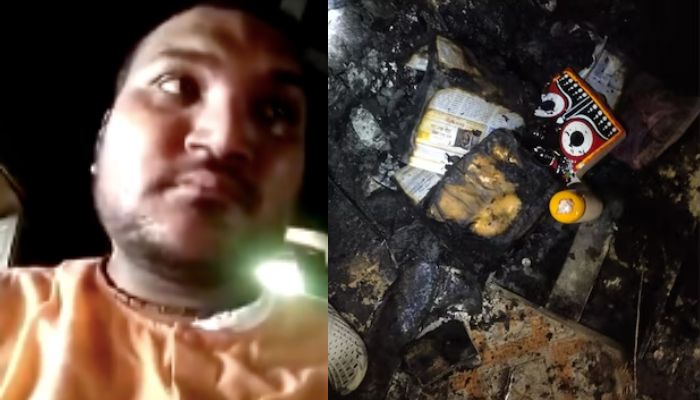
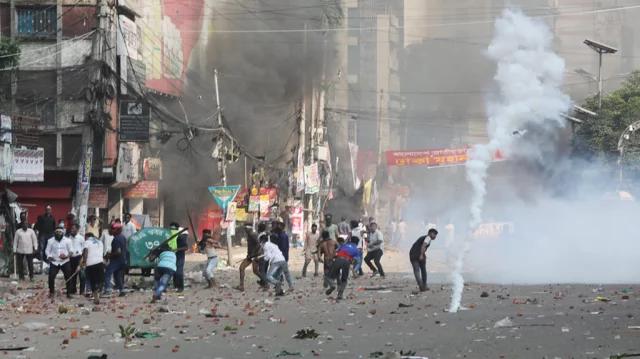
As Hindu houses and temples are being targeted in a violence-hit Bangladesh, Meherpur ISKCON Temple’s spokesperson Sumohan Mukunda Das shared the horrific details of the situation prevailing there. Notably, the Meherpur ISKCON Temple was vandalised and idols were smashed by the Islamist mob on 5th August.
Speaking to AajTak, Das said that the current situation for Bangladeshi Hindus is akin to how it was in the 1970s. He said that Hindu politicians, traders and Mandirs are being targeted by the Islamist mobs.
“They targeted our ISKCON Temple and vandalised it. A bomb was also hurled inside the temple. For the whole night, we had to hide in the jungle as when we sought refuge in someone’s house they said that if we allowed you in, they [the Islamists] would burn our house also. I am still hiding but to tell the truth to the world, I spoke to you. Hindus are always targeted. From 1971 to 2024, Hindus have always been tortured,” Das said.
Hindu Temples were attacked in Bangladesh.
Listen to Hindus of ISKCON Temple.
LKFC @zoo_bear called it RW propaganda. Showed few pics of Muslim safeguarding temples for propaganda.
Similarly, another ISKCON Bangladesh spokesperson Yudhisthir Govinda Das said, “As per the info I have received, one of our ISKCON centres (rented) in Meherpur was burnt including with the deities of Lord Jagannath, Baladev, and Subhadra Devi. Three devotees who lived in the centre somehow managed to escape & survived.”
Meanwhile, Chinmoy Krishnan Das, President of ISKCON Pundarik Dham in Chittagong, has expressed serious worries about the safety of Hindu temples in the aftermath of these attacks. He stated that appeals for assistance from the police and Rapid Action Battalion in Chittagong had gone unmet, with security forces reportedly escaping the area in civilian dresses.
“Three temples in Chittagong are under threat, but the Hindu community, along with some members of the Muslim community, have protected them so far. Many Hindus and other minorities are feeling unsafe and are fleeing to India through West Bengal and Tripura,” Chinmoy Das said.
As reported earlier in the day, the Bangladesh Hindu Buddhist Christian Unity Council released a list of attacks that took place on Hindu temples, houses and establishments on Monday that belonged to the Hindu community in the country.
The attacks happened amidst the political turmoil taking place in Bangladesh. These attacks were reported to have happened within five hours. Notably, the actual number of attacks could be much higher than reported in the list below. The document has listed 54 attacks.
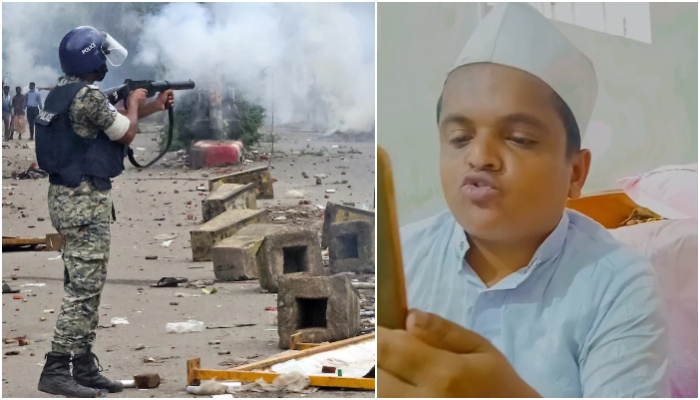
On Tuesday, 6th August, an Islamist hate preacher Rafiqul Islam Madani, who was arrested in the year 2021 for inciting violence and making objectionable remarks against the government uploaded a video on Facebook amid the ongoing Bangladesh political crisis. He attempted to spread lies and incite hate by claiming that Senior Jail Superintendent Subrata Kumar Bala of the Kashimpur High-Security Central Jail in Gazipur had open-fired at the prisoners. He, however, failed to provide any evidence to support his claims.
He said that Bala had opened fire at the prisoners resulting in many casualties. He also said that one of the prisoners had been ‘martyred’ during the fire. Madani who has a history of spreading violence further referred to Bala as an ISKCON member and ‘Sheikh Hasina’s Dalal’ and indicated that he, a Hindu was deliberately targeting the prisoners at Kashimpur High-Security Central Jail in Gazipur of Bangladesh.
After Sheikh Hasina’s resignation as the Prime Minister of Bangladesh, several Hindu temples have been attacked at the hands of Muslims. Also, more than 50 attacks have happened against Hindus. According to X handle Voice of Bangladeshi Hindus, these attacks happened within five hours of Sheikh Hasina’s resignation. Notably, the actual number of attacks could be much higher than reported in the list below. The document has listed 54 attacks.
— Voice of Bangladeshi Hindus ?? (@VoiceofHindu71) August 5, 2024
Amid this, Madani’s deliberate hate spread could fuel the attacks. Madani is followed by lacs of Islamists across the country who might get provoked by such hate spread against Hindus posing danger to the minority community. Madani allegedly in an attempt to justify attacks on minorities, claimed that Bala, a Hindu religious preacher had opened fire at prisoners at Gazipur.
Notably, no proof of such claims was provided by Madani.
In April 2021, Madani was arrested from his residence in Netrokona in the Mymensingh Division of Bangladesh for inciting violence and making objectionable remarks against the government. A case was lodged against the preacher at the Gaccha police station in Gazipur. On preliminary investigation, the RAB found adult content on his mobile phone and said that it proved that Madani was a ‘fraud’ preacher.
The 29-year-old Hefazat-e-Islam preacher rose to national prominence in Bangladesh through his fiery speeches against the Awami League government on YouTube. He hails from Ledirkanda village in Purbadhala Upazila. A midget by height, Rafiqul Islam Madani is known as shishu bokta (child preacher). Born into a poor family, he studied at the Jamia Hussainia Malni Madrasa and completed his master’s degree in Islamic studies (Dawra-e-Hadith) from Jamia Madani Madrasa in Dhaka in 2019.
Rafiqul Islam Madani decided to become an orator and soon reached thousands of followers through social media. He operated two madrassas in Gazipur and Netrokona. He received legal notice for using the title ‘Madani’ despite not being a graduate of the Islamic University of Madinah in Saudi Arabia. He was earlier detained in March 2021 in the Motijheel area over inciting people to lead violent protests against PM Narendra Modi’s visit to Dhaka.
In many of his videos uploaded on social media, Madani is seen provoking Muslims to die for Islam. “We have to free this country and Isla, from the hands of the Mafia government and infidels…There must be one religious Head for all Islamic institutions. Under his directions, we will paralyze the government system and free this country from the hands of the mafias. If necessary, we will cede power to the army,” he could be heard saying in one of his videos.
Furthermore, he once instigated his followers by alleging that the student wing of the Awami League would kill him and other such preachers. Since then, several such rebellious clerics have been under the surveillance of the Intelligence agencies of Bangladesh.
Rafiqul Islam Madani condemned Prime Minister Modi’s visit to Bangladesh that year, warning that his actions would prove his power or Modi’s stooges. Madani provoked Muslims to stop Modi from entering the soil of Bangladesh and to die if necessary, leading to widespread violence and destruction of Hindu temples. He also threatened to capture Delhi stating that no power or fence could stop his plans. Madani urged Muslims to keep their faith strong and face martyrdom if needed.
He incited the Muslims by saying that Sheikh Hasina was working on the terms of Hindutva and that whatever Modi wanted, happened in Bangladesh. “Today, all temples are being upgraded and the mosques here are dying. This means whoever will speak against Modi will be tortured and jailed… In the name of lockdown, they will shut down mosques and madrassas. We will not follow anything… We want this country to be a true Islamic Republic,” Rafiqul Islam Madani said.
In the current scenario too, Madani is trying to spread hate against Hindus using social media. He, however, fails to provide any evidence to support his claims.
The bloody protests that started in June as an anti-quota movement have been plaguing Bangladesh for almost two months. On 5th August things took a significant turn as Prime Minister Sheikh Hasina Wazed resigned and departed the nation. She has since landed at the Hindon air base in India, where National Security Advisor (NSA) Ajit Doval met her. The army is now in charge of the neighbouring country and has installed an “interim government” composed of judges, doctors and former military personnel as announced by Army Chief Waker-uz-Zaman.
Meanwhile, the extremists backed by Begum Khaleda Zia’s Bangladesh Nationalist Party and the outlawed Bangladesh Jamaat-e-Islami have taken over the streets. The agitation, which began under the garb of democratic student rallies, has since degenerated into a violent display of unrest, hatred for minorities, especially Hindus, death and devastation. There is nothing democratic about the current state of affairs in Bangladesh, rather, it is shockingly brutal and provides the fundamentalists carte blanche.
Islamists don’t need a reason to target minorities in any country and likewise, they are “saving democracy” in Bangladesh by going after the Hindus there with impunity. Their counterparts in the Indian media are also dutifully covering up the former’s violent deeds, precisely as they always have. Mohammed Zubair, co-founder of Alt News who has always been at the forefront to assist his ideological and religious brethren, has once again stepped in to defend their murderous actions.
Interestingly, despite his unwavering commitment, he is clearly running out of creative ways to advocate for the Islamic zealots. On 6th August, he posted a long thread about Muslims in Bangladesh allegedly ‘protecting Hindus’ including the customary “forming a human chain to safeguard temples.” Anyone will undoubtedly have a deja vu moment because Islamists and their cheerleaders do this routinely to attempt to manipulate public opinion in their favour by portraying Muslims as peaceful and secular people who guard temples and protect Hindus during critical times while ignoring the violent acts of Islamists. However, they never address the reasons or the individuals from whom the Hindus or their temples needed protection as it would expose their bogus narrative.
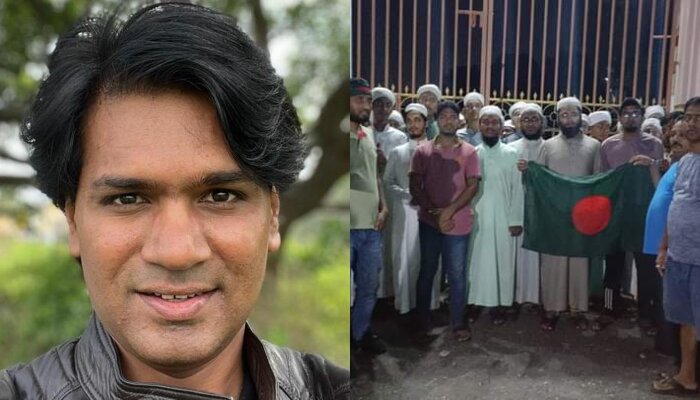
Mohammed Zubair shared multiple posts showing Muslims standing outside temples, including the prominent Dhakeshwari Temple, to guard them in an effort to downplay the ongoing killings and rapes of Hindus as well as the vandalism of their religious places by Islamists . He also mentioned about an alleged appeal from a group called ‘Students Against Discrimination’ from a mosque to “maintain communal harmony” and “protect Hindu minorities and their wealth from miscreants and evil forces.”
A Special Announcement on a loudspeaker from inside the Mosque in Bangladesh.
"Dear Citizens, We 'Students Against Discrimination' are requesting you, during this period of unrest in the country, We all must maintain communal harmony. We should protect Hindu minorities.… pic.twitter.com/AszMMk2gyN
These uploads are reminiscent of similar incidents including the infamous episode when 100 Muslim youths reportedly formed a ‘human chain’ outside a Hanuman temple located near Shampura main road to protect it from arsonists after Islamists wreaked havoc and specifically assaulted Hindus in Bengaluru in 2020.
Strangely, Mohammad Zubair and his fellow apologists never mention who or what the Hindu temples and homes are being protected from.
The perpetrators were projected as good guys as their crimes were conveniently excused and whitewashed in the name of a “human chain” by Mohammad Zubair, who in his desperation to shield the extremists cited a Bangladeshi Islamist account that referred to Hindu females as bitches after a Hindu woman was attacked by a police official in Dhaka and has been spreading hatred against the community for years.
Zubair is quoting Basherkalla to whitewash the communal atrocities against Bangladesh Hindus.
Basherkalla is the same Bangladeshi Islamist group that had called Hindu women 'bitch'. pic.twitter.com/LTDsPtOLQY
Liberal-Islamist ecosystem and its deceiving methods of depicting Muslim rioters as good samaritans
Taking a cue from the Nazi handbook and Adolf Hitler who once stated, “All propaganda must be confined to a few bare necessities and then must be expressed in a few stereotyped formulas. Only constant repetition will finally succeed in imprinting an idea upon the memory of a crowd,” the Liberal-Islamist ecosystem and their affiliate media have aced the art of crafting a straightforward narrative that is laced with deception and falsehoods. It then circulates the same lies repeatedly to discredit the persecution of Hindus or insinuate that their suffering is ‘collateral damage’ and not a product of Islamic oppression while simultaneously depicting the jihadis as kindhearted people.
Mohammad Zubair who unleashed a ruthless Islamists after former Bharatiya Janata Party (BJP) spokesperson Nupur Sharma for merely quoting a religious text in response to a jibe on Kashi Vishwanath Temple has a similar habit of whitewashing crimes of bigotry perpetrated by Islamists by selectively amplifying the photo-op good samaritanism.
Violence broke out in the state of Maharashtra in 2021 when protests and rallies were held across the state by some Muslim organizations in the aftermath of claims of attack on mosques in Tripura. Two journalists disseminated false information and alleged that a copy of the Quran had been burned and a mosque had been vandalized in Tripura, which set off a chain of violent incidents. The Muslim community even threw stones and indulged in violence when the BJP organized a nonviolent demonstration. However, the media protected the former and blamed the saffron party as well as the Hindus during the entire ordeal.
Similarly, in 2020 Muslims claimed that the Prophet Muhammad was disrespected and they marched to the streets, igniting chaos in Bengaluru. Hundreds of Muslims armed with sharp metal objects, sticks, iron rods, and other weapons congregated in the vicinity of Dalit Congress MLA Akhanda Srinivasamurthy’s home and stormed inside in reaction to an alleged insulting tweet posted by his relative. They pelted stones and set fire to nearby cars, ATMs (Automated teller machines) and stores as well as burned down a police station amidst chants of “Allahu Akbar” and “Naara e Takbeer.” Some media posts indicated that the riots were not spontaneous but prearranged. Meanwhile, the media was busy defending the rioters by amplifying a video of Muslim men ‘forming a human chain’ to protect a temple in the area.
Delhi’s anti-Hindu riots were also followed by the same events when news articles surfaced detailing how Muslims in the national capital established human chains in an attempt to “save temples.” Such “human chains” also appeared during demonstrations against the National Register of Citizens (NRC) and the Citizenship Amendment Act (CAA).
Similar impressions were created and spread during the communal unrest in Delhi Hauz Qazi after the destruction of a Hindu temple nearby. A manufactured narrative that promoted “secularism” and the “bond of brotherhood” was published in the media, alleging that Muslims were assisting Hindus in “installing the idols” and providing meals. As it happened, the reports were refuted by the Hindu activists in the area, who maintained that Muslims were merely providing food for “photo-ops.”
Conclusion
The Liberal-Islamist ecosystem repeats the same trope every single time to condition the masses to elicit a particular kind of social reaction. The first and foremost is to never blame the Muslims or hold them accountable for the mayhem they cause as they are merely a victim of their circumstances. They never initiate any violence and only respond to the events that are thrust upon them. Even when it occurs at the hands of Muslims, the bloodshed simply unfolds as a result of the situation and they are not responsible for it. Hence, anyone could be blamed including the administration, the state, and even the Hindus who are usually victims during such times, but never the Muslims. Lastly, fabricate tales to demonstrate that the Muslim community was not only innocent but was defending Hindus and their holy places to bend the propaganda to the advantage of the former. Notably, in the scenario, the rioters don’t have any religion but the ‘human chain’ always does.
Terming India as a “big power” and “important country” Iran’s Ambassador to India, Iraj Elahi on Tuesday said that there is an expectation that New Delhi can and should play a more active role in the current crisis in West Asia.
Speaking to ANI, Elahi stated that India has good ties with Israel and can use its influence to stop the genocide in this region and Gaza and keep the peace in Palestine.
On being asked about India’s role amid the ongoing crisis in West Asia, the Iranian envoy said, “Since the beginning of the tragic events and crimes of Israel in Gaza, I repeatedly mentioned that India is an important country, is a big power and influential country in the international community. Beside this, it has good relations with Israel and Iran and also India, as a non-aligned movement founder had supported Palestine case in the history of the region.”
“So, there is an expectation that India can and should play more active role in the current crisis in the region and tensions in the region. You know, the government of India has very good relation with the ruling party in Israel and the government of Israel. So, it can use its influence to convince them to stop this genocide in the region and in Gaza and stop crimes and keep the peace in Palestine. From the Iranian side, we are in collaboration with India in many cases and we hope that, you know, we are trying to convince India to keep peace in the region,” he said.
Over 2000 Hamas terrorists breached Israeli borders on October 7, killing 1200 Israelis and taking around 250 as hostages, out of whom around 120 are still in Hamas captivity, with many of them feared dead. Following this, Israel launched a strong counteroffensive, carrying out military operations against Hamas in the Gaza Strip with the aim of “completely eliminating” the group.
The tensions in West Asia have further escalated after Hamas’ political bureau chief Ismail Haniyeh was killed in Iran’s capital, Tehran on July 31.
On July 31, the Islamic Revolutionary Guard Corps (IRGC) said that Ismail Haniyeh had been killed in an attack in Tehran. A projectile hit a residence allocated to war veterans in Tehran at 2 am (local time), according to a Press TV report.
Haniyeh, who was based in Qatar, travelled to Tehran to attend the swearing-in ceremony of the Iranian President-elect, Masoud Pezeshkian, according to a Press TV report.
On August 1, the Israel Defence Forces (IDF) on Thursday announced that Hamas military wing commander Mohammed Deif had been killed in an airstrike in the southern Gaza Strip on July 13.
In a post on X, IDF stated, “We can now confirm: Mohammed Deif was eliminated.”The Israeli military said that it obtained intelligence confirming his death in the past few hours. Deif was targeted in a strike at Hamas’ Khan Younis Brigade commander Rafa’a Salameh’s compound in Khan Younis area on July 13, The Times of Israel reported.
A day later, the IDF confirmed the death of Salameh. However, it did not have final information on Deif. The IDF believed that its intelligence indicated that Deif visiting the compound belonging to Salameh was highly accurate and the two Hamas military officials were together in the building that was hit with several heavy munitions, according to The Times of Israel report.
Meanwhile, the IDF said that top Hezbollah commander Fuad Shukr was killed in the Israeli strike in southern Lebanon on Tuesday (local time).The IDF said Shukr was “responsible for the majority of Hezbollah’s most advanced weaponry, including precise-guided missiles, cruise missiles, anti-ship missiles, long-range rockets, and UAVs” and for the terror group’s “force build-up, planning, and execution of terror attacks against the State of Israel,” The Times of Israel reported.
On July 30, Israeli Prime Minister Benjamin Netanyahu said that his nation has delivered “crushing blows” to enemies in the last few days, CNN reported. He made the remarks hours after the deaths of Hamas political leader Ismail Haniyeh and senior Hezbollah commander Fuad Shukr.
(This news report is published from a syndicated feed. Except for the headline, the content has not been written or edited by OpIndia staff)
Immediately after Bangladesh PM Sheikh Hasina resigned and fled the country, scenes of thousands of violent protesters storming the compound of her residence, stealing her utensils, sarees, undergarments and flashing them as war booty and subsequently scaling the iconic parliament building brought us a glimpse of the ominous times that lies ahead for Bangladesh, another nation where democracy was snuffed out by rampaging Islamists, only to give way for a military rule.
General Waker-Uz-Zaman, the army chief of Bangladesh, announced on Monday that an interim government would assume control. He assured that the military would “step back” and commit to initiating an investigation into the fatal crackdown on student protesters.
“There is a crisis in the country. I have met Opposition leaders, and we have decided to form an interim government to run this country. I take all responsibility and promise to protect your life and property. Your demands will be fulfilled. Please support us and stop the violence. If you work with us, we can move towards a proper solution. We cannot achieve anything through violence,” he said.
Anarchy and lawlessness reign supreme
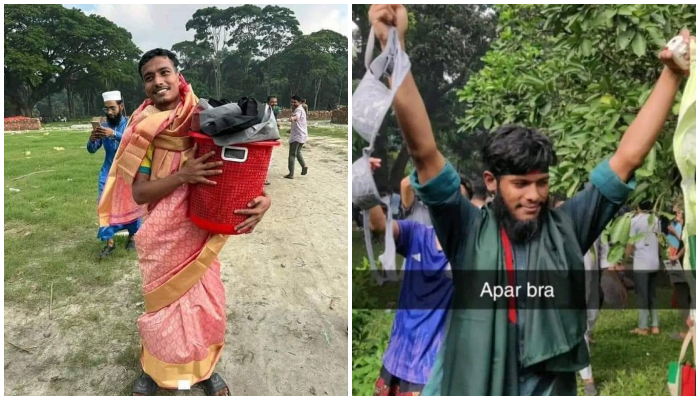
On Monday, August 5, 2024, Bangladesh PM Sheikh Hasina resigned and fled as ongoing nationwide protests turned violent. Hundreds of protesters stormed her official residence, waving flags and raising slogans against her, shortly after she fled, stealing utensils, sarees, and other belongings from her residence.
SHOCKING?: Radicals looted bra, fish, saree, blouse, even dustbins from #Banglade's PM Sheikh Hasina's residence.
After resigning as Prime Minister, Sheikh Hasina left Bangladesh and arrived at the Hindon Air Base near Delhi. She was expected to fly to London, reports said.
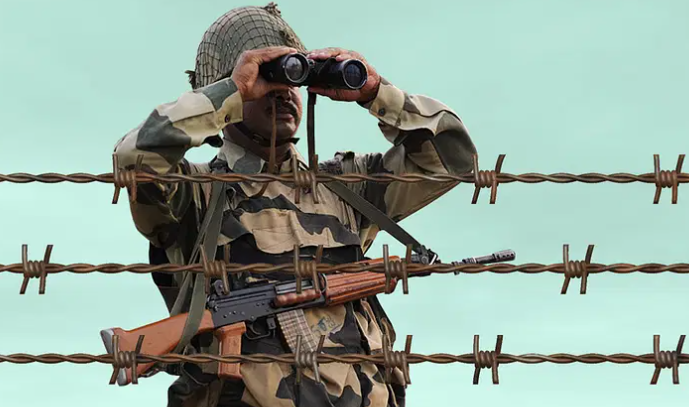
Due to the unrest in Bangladesh, the BSF issued a high alert along the India-Bangladesh border. As a result, both passenger and freight train services heading towards the border areas have been suspended.
Islamic fundamentalists set to become stronger with Sheikh Hasina’s exit
Nevertheless, Sheikh Hasina’s resignation as Prime Minister of Bangladesh has created a power vacuum that Islamist groups could exploit to gain control. Throughout her tenure, Hasina, a potent symbol of secularism in a country plagued with Islamists, dealt Islamic fundamentalists with an iron fist, including those from the main opposition party BNP, which has connections to the terror group Al Qaeda. While this strategy temporarily consolidated her authority, the students’ protests, however, provided an outlet for these extremist groups to harness the growing resentment to dislodge the Sheikh Hasina government and empower themselves, leading to a more significant presence in Bangladesh’s political landscape.
After Hasina’s resignation amid widespread protests, Islamist groups, which played a key role in the demonstrations, are now in a position to gain greater political influence. Forming an interim government in this unstable environment could allow these factions to shape policies and advance their agenda, which would inevitably pivot around religious bigotry and persecution of minorities, which has only accelerated following the exit of Sheikh Hasina.
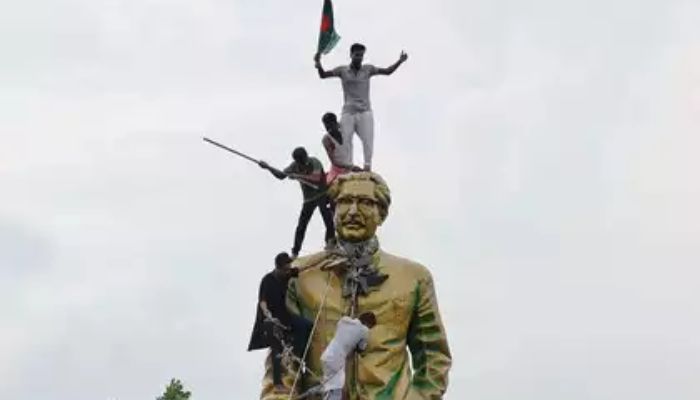
In the wake of Sheikh Hasina’s ouster, hundreds of protesters pulled down the bust of Sheikh Mujibur Rahman, the founding father of Bangladesh, in Dhaka. The visuals symbolised what lies ahead for Bangladesh as Islamists and fundamentalists seek to wrest control of the country’s many institutions and hit the last nail in the coffin of its relatively new democratic journey.
Moreover, Hasina’s departure has created a power vacuum that could heighten instability as various political forces, including Islamist groups, compete for control. This situation mirrors a regional trend where Islamist movements exploit political crises to increase their influence, often resulting in substantial changes in national policies and governance structures.
BNP and its alliance with Jihadis
The Bangladesh Nationalist Party (BNP) has faced criticism for its religious bigotry and ties with Islamist groups. Historically, the BNP has had a complicated relationship with religion. Founded on Bangladeshi nationalism principles, which included a moderate religious stance, its alliances with Islamist parties like Jamaat-e-Islami have raised concerns, with its members openly subscribing to the puritanical version of Islam and its innate antagonism for non-believers, especially Hindus or idol-worshippers.
From 2001 to 2006, the BNP enacted policies favouring Islamist groups and conservative madrassahs, which critics argue increased the influence of Islamist factions in politics, leading to greater religious intolerance and fundamentalism. The BNP’s coalition with Jamaat-e-Islami and other Islamist groups strengthened these factions’ political power, often resulting in violence against religious minorities, especially the Hindu community, perceived as supporting rival parties like the Awami League.
Additionally, the BNP’s political stance has shifted over time towards more right-wing and conservative positions, moving away from its earlier centrist and liberal positions. This shift has been marked by rhetoric and actions perceived as catering to Islamist sentiments, further alienating religious and ethnic minorities in Bangladesh. The shift would inevitably lead to forced demographic change as witnessed in Pakistan, where Hindus,
Targeted attacks against Hindus in Muslim-majority Bangladesh
As the turmoil engulfs Bangladesh, Hindus residing in the country were once again subjected to targeted persecution as the Bangladesh Hindu Buddhist Christian Unity Council released a list of attacks that took place on Hindu temples, houses and establishments that belonged to the Hindu community in the country.
The attacks happened amidst the political turmoil taking place in Bangladesh. According to X handle Voice of Bangladeshi Hindus, these attacks happened within five hours. Notably, the actual number of attacks could be much higher than reported in the list below. The document has listed 54 attacks.
— Voice of Bangladeshi Hindus ?? (@VoiceofHindu71) August 5, 2024
According to the list, in Sherpur, the house of the president of the Sribardi Upazila Youth Unity Council was attacked, vandalised and looted.
In Khulna, the houses of Shyamal Kumar Das and Swajan Kumar Das in Highgate village of Rupsa Thana area, houses of Biman Bihari Amit, president of the Khulna District Unity Council and Animesh Sarkar Rinku, president of the Youth Unity Council in Tootpara of Khulna city, house of Jayanta Gain in Amtali Banisanta, Dacope, and houses of the minority community in Darpara, Koyra were attacked, vandalised and looted.
At the time of Bangladesh’s creation in 1971, pro-Pakistani militias and armed forces killed thousands of Hindus on the pretext of their alleged support for the secession of East Pakistan. Now, over fifty-three years later, as the country faces another churn, with its secular and democratic ethos emphatically shunned, the threat of targeted persecution of Hindus and other minorities has only heightened as Islamists and their cohorts in the BNP seek to undermine secular laws governing the country in their pursuit of establishing a nation ruled by Sharia, where minorities are treated as second-class citizens, a fair game for the rampaging mobs of Islamist bloodhounds, determined to turn it into a homogenous society.
Bangladesh has descended into utter chaos as Islamists have taken over the country after Prime Minister Sheikh Hasina resigned from her post and left the country. While violent protests and vandalism have been rampant since July, on the 5th of August, the violent protestors destroyed several Bangladeshi historical heritage sites in their bid to wipe out the legacy of “Bangabandhu” Sheikh Mujibur Rahman.
Several heritage sites associated with Bangladesh’s founding father, Sheikh Mujibur Rahman, were vandalised during the recent conflict.
On Monday, the unruly mob destroyed the Bangabandhu Memorial Museum in the Dhanmondi area in Dhaka. This museum was dedicated to Hasina’s father, Sheikh Mujibur Rahman, who was assassinated in 1975.
Source: AFP
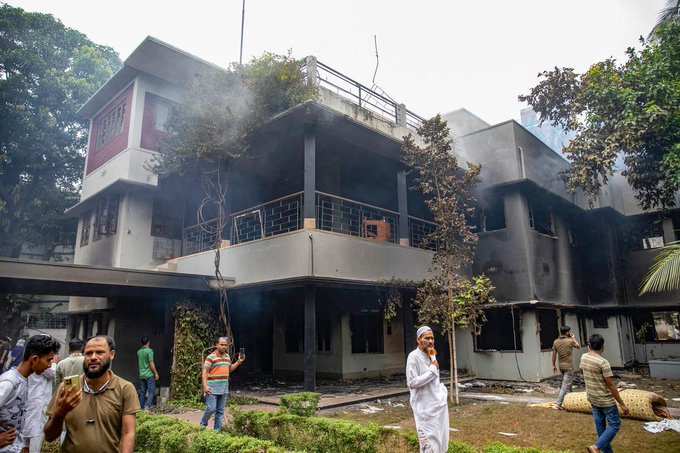
Rahman’s residence “Bangabandhu Bhaban” was also attacked by the protestors
"Bangabandhu Bhaban", the residence #Bangaldesh's founding father Sheikh Mujibur Rahman has been vandalized & set to fire. Bagabandhu was assassinated at this very house on August 15, 1975
— Indrajit Kundu | ইন্দ্রজিৎ (@iindrojit) August 5, 2024
Similarly, the protesters in Dhaka climbed atop a large statue of former Prime Minister Sheikh Hasina’s father and hammered the statue’s head with an axe. Who would have thought that one day the very people Mujibur Rahman sought freedom for would destroy his legacy?
Video shows the moment protesters in Bangladesh’s Dhaka climbed atop a large statue of former Prime Minister Sheikh Hasina's father, and hammered the statue's head with an axe. pic.twitter.com/1ocSkKguR0
Notably, back in 2020, it was reported that two Madarsa students vandalised Sheikh Mujibur Rahman’s statue in Kushtia after being influenced by the anti-sculpture statements from Hefajat-e-Islam leaders Mamunul Haque and Faizul Haque. Clearly, the ideology behind the assassination of Rahman was very much active in the country over the years and has ultimately taken over Bangladesh.
The unrest, which started as a student movement against the quota system, soon witnessed the involvement of opposition parties like Jamaat-e-Islami and the Bangladesh Nationalist Party (BNP), fuelling widespread chaos and destruction.
Bangladesh was established in 1971 to escape the horrors committed by Pakistan’s military and Islamist radicals during the Liberation War. The ongoing vandalism of Sheikh Mujibur Rahman’s legacy contrasts sharply with Pakistan’s attitude towards its historical and cultural heritage. Pakistan, motivated by Islamist fundamentalism, frequently targets and destroys its ancient heritage sites, even ancient monuments thousands of years old, because the Islamists believe idols are ‘haram’.
Interestingly, while the usual suspects describe Sheikh Hasina’s departure as a “democratic takeover” and “liberation,” it is in reality, Pakistan’s ultimate victory. After decades of teaching false history to pat its own back despite no military achievement whatsoever, Pakistan finally has a victory to boast. Bangladesh was not liberated on the 5th of August 2024, but rather trapped back under the shackles of Islamist terrorism, communal hatred, discrimination, anarchy, and destruction.
Bangladesh is becoming everything it fought against, turning back into the very Pakistan it fought against for “liberation”. In just one day, the unruly protestors vandalised the statues and buildings linked to the “Bangabandhu”.
Pakistan, since its birth in 1947 has been tirelessly wiping out its Hindu, Buddhist and Sikh heritage. The ideology, the mindset behind destruction in both countries is one, Islamic fanaticism. It is pertinent to mention here how the Islamic State destroyed the heritage sites like the ancient city walls, the Tomb of Jonah, and the Mosul Museum since they called the artefacts in this museum “idolatrous”.
The Islamic Republic of Pakistan was created out of hatred for Hindus and other non-Muslim communities and since then, its identity has always been intertwined with its hostility towards India, consistently overshadowing its extensive Hindu heritage. In its attempt to create an Islamist identity, Pakistan has neglected and even systematically destroyed ancient sites, similar to the Taliban’s infamous destruction of the Bamiyan Buddhas in Afghanistan, which shares ideological roots with certain Pakistani Islamist groups. This destruction is driven by Islamists and backed by government and Pakistani military establishments, reflecting their broader designs of cultural and religious erasure.
The Islamist mob have over the years destroyed several pre-partition era Hindu temples. OpIndia has time and again reported such incidents. Be it the 100-year-old Hanuman Temple in Pakistan’s Lyari, the desecration of the historic Hinglaj Mata Temple, or that of Mata Bahtiyani Devi Temple and more, the third or fourth-generation Islamist converts have targeted historic Hindu temples to vent out their hatred against kafirs and erase Pakistan’s Hindu history.
Other than vandalism, the ancient Hindu and Jain temples have also been taken over and repurposed for commercial use. In this vein, a Jain Temple in Lahore’s Anarkali Bazaar and the Prahladpuri Temple in Multan were damaged after the Babri structure demolition in Ayodhya. This Jain temple’s one part was later used for commercial use and in the other, a Madarsa was opened. Similarly, many churches and Sikh heritage sites have also been attacked by Islamists in Pakistan.
Back in 2021, OpIndia reported how the nine feet tall statue of Maharaja Ranjit Singh, the first emperor of the Sikh Empire at the Lahore Fort was vandalised by Tehreek-e-Labbaik Pakistan (an Islamist political party) workers. Back then, the TLP workers also chanted slogans against the former ruler of Punjab. The police informed that the attackers were of the view that it was against Islam to erect a statue of a Sikh ruler in a Muslim country.
The demolition of heritage sites is more than just a physical assault; it is a systematic attempt to obliterate the country’s cultural and historical identity. It shows an intolerant and Islamic fanatic view of the so-called “Riyasat-e-Medina” that does not allow room for the country’s ancient heritage to exist in glory.
Besides, vandalism and attack, deliberate neglect by the Pakistani authorities has also contributed in the destruction of ancient heritage sites that went to Pakistan after partition. Mohenjo-daro, one of the most important archaeological monuments of the Indus Valley Civilisation, is in catastrophic condition. Despite being a UNESCO World Heritage site, the ruins face degradation due lack of funding to ensure proper conservation. Similarly, Taxila, another UNESCO World Heritage site, once a hub of Hindu and Buddhist learning is now poorly maintained, with parts of it encroached on for illegal construction threatening its integrity.
Pakistan’s founding ideology, which was premised on an autonomous Muslim identity separate from Hindu-majority India, has evolved into a broader narrative in which antagonism towards India is a fundamental aspect. Pakistani political leaders and “Ghazwa-e-Hind enthusiasts frequently use this animosity to gain public support, divert attention away from internal issues, and justify the military’s enormous control over civilian affairs.
Following Sheikh Hasina’s resignation, Bangladesh demonstrated signs that it is sliding towards Islamic fanaticism with BNP and jihadist Jamat-e-Islami set to grab power, similar to Pakistan’s political trajectory. The ousting of Hasina, who was renowned for her somewhat secular and pro-India position, represents a major shift towards a more hardline attitude.
The destruction of Mujibur Rahman’s heritage sites in Bangladesh is a cruel irony: a country founded on the need to escape Islamist tyranny is now grappling with similar elements of fanaticism and violence.
Social media is rife with Bangladeshi ‘protestors’ saying that the Quran will be the new ‘constitution’ of the country. While it may be taken as an unofficial confirmation, the demolition of Mujibur Rahman’s statue and the Bangladeshi military’s silence on this is no less than an official confirmation that Bangladesh is becoming the new Pakistan. “The East Pakistan”.
BREAKING: Convenor of 'Anti-Discrimination Student Movement' Sarjis Alam has declared that Bangladesh will be turned into an Islamic Country after Sheikh Hasina ouster.
"Tomorrow's nation will be Islam, constitution will be Al QurAn – InshaAllah".
On the 25th of March, 1971, the Pakistan Army launched Operation Searchlight, a brutal crackdown on East Pakistan’s nationalist movement after Bangabandhu Sheikh Mujibur Rahman’s Awami League won 160 out of 162 seats in the East registering an absolute majority. He was, however, denied power. The genocide and rape of the Bengali people of the then East Pakistan was spearheaded by former Army chief General Yahya Khan. Even as per the conservative estimates, over 200,000 Bengalis were killed and in a deliberate campaign of genocidal rape, Pakistani military personnel and the Razakars raped between 200,000 and 400,000 Bengali women and girls.
Although India helped Bangladesh achieve freedom from Pakistan after the Pakistani army’s genocide of the Bengali population in the then East Pakistan, the present day Bangladesh has witnessed a surge in anti-India sentiments. Much like in Pakistan where India’s name is invoked to deflect attention from internal issues and exploit antagonism towards India to influence narratives, in Bangladesh, the anti-India BNP and JeI ran the vicious “India Out” campaign calling for boycotting Indian goods. In the latest display of hatred for India, the ‘protestors’ damaged the Indira Gandhi Cultural Centre (IGCC) in Dhaka. As the era of Sheikh Hasina ends and the legacy of Sheikh Mujibur Rahman is destroyed, with Bangladesh falling into the hands of Islamists, the country has become identical to its erstwhile Islamist oppressor.
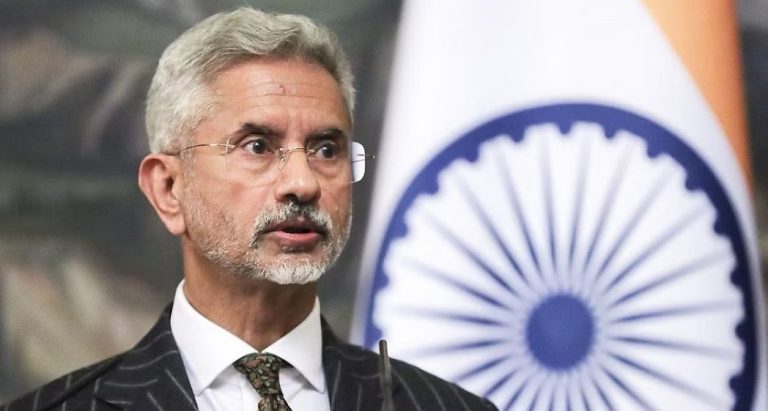
External Affairs Minister S Jaishankar made a statement on the situation in Bangladesh in the Parliament on Tuesday, August 6. Speaking in Rajya Sabha first, the External Affairs Minister said that the concern about voilence and instability in the neighbouring country is shared across the political spectrum in India.
Dr Jaishankar mentioned that what is particularly worrying about the developments in Bangladesh is that minorities, their businesses and temples have come under attack at various locations in Bangladesh.
The EAM also highlighted that there have been considerable tensions, deep divides, and growing polarisation in Bangladesh politics since the last general election in January 2024.
Breaking: Full statement by India's external affairs minister Dr S Jaishankar to Parliament on Bangladesh situation pic.twitter.com/3yryhFUxr3
Earlier in the day, the External Affairs Minister while briefing an all-party meeting on the Bangladesh situation told members that Sheikh Hasina had moved to India and that India has assured all possible help to the Bangladeshi leader.
Stating that the embattled former prime minister of Bangladesh Shiekh Hasina is in India and the Indian government wants to give her time to let the Indian government know what her future course of action would be.
Taking to X, Jaishankar stated, “Briefed an All-Party meeting in Parliament today about the ongoing developments in Bangladesh. Appreciate the unanimous support and understanding that was extended.”
During the meeting, Jaishankar informed the leaders that the central government was in touch with the Bangladesh Army as well. He said that it is a prevailing situation and the government will take appropriate action at the right time, according to sources.
According to sources, the leaders at the party meeting were informed that there are 20000 Indian nationals in Bangladesh.
According to sources, so far 8000 Indian nationals have returned. Jaishankar informed the meeting that the Indian government is in touch with Indian nationals and the High Commission there continues to operate.
The leaders were informed that the focus is on minorities and that they should be protected, sources from the all-party meeting told ANI. During the all-party meeting, the Leader of the Opposition in Lok Sabha, Rahul Gandhi inquired about India’s long-term and short-term strategy and the government stated that this was a progressive situation and they would continue to analyse it.
Rahul Gandhi also sought to know from the government on the possible involvement of a foreign hand. The central government said that all possible angles were being looked into. After being briefed by the government, Rahul Gandhi expressed his support for the measures taken in the national interest.
Bangladesh is facing a fluid political situation after Sheikh Hasina resigned from her post in the wake of mounting protests. The protests, majorly led by students demanding an end to a quota system for government jobs, took the shape of anti-government protests.
In Dhaka, the leaders of the Anti-Discrimination Student Movement have proposed an interim government led by Nobel Laureate Muhammad Yunus, in a bid to address Bangladesh’s ongoing challenges.
Sheikh Hasina arrived in India on Monday evening after tendering her resignation. It is not clear if Sheikh Hasina will continue to stay in Delhi or move to another location later.
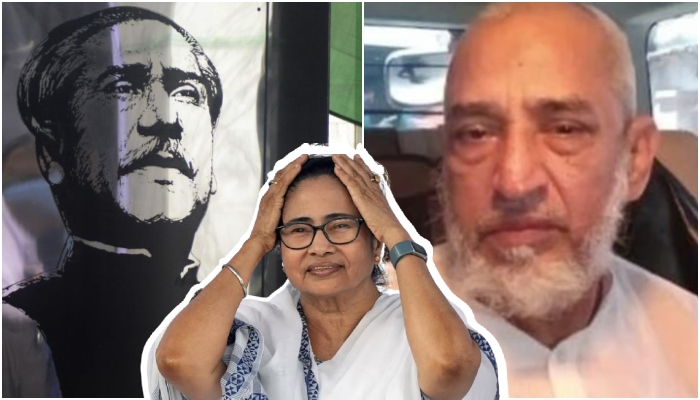
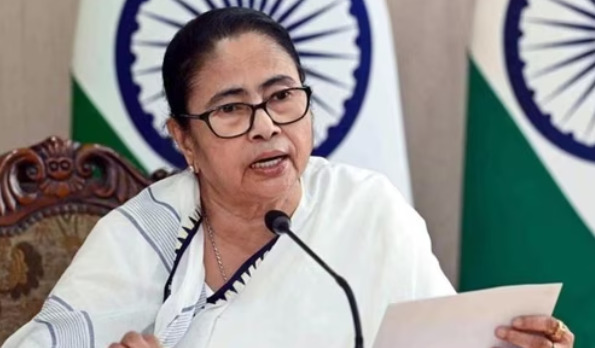
As Bangladesh erupted in violence, West Bengal Chief Minister Mamta Banerjee appealed to the citizens to maintain peace and end violence. She, with folded hands, appealed to the citizens saying that escalating provocations would not calm the situation.
“I would appeal to all citizens of West Bengal to maintain peace and avoid all forms of provocation. I appeal to people of all communities with folded hands to remain calm and not engage in any communal behavior or take the law into their own hands,” she said. She also urged the leaders to not comment anything on social media regarding the Bangladesh situation which may disrupt peace in the state. However, the state itself has been acting against the Bangladesh government which recently got uprooted.
West Bengal CM Mamta Banerjee (Hindustan Times
One of the murderers of Bangladesh’s founding father Sheikh Mujibur Rahman had been hiding in India’s West Bengal for 22 years before his arrest in the year 2020. The accused, identified as Abdul Majed, had possessed fake Indian documents and had been hiding in West Bengal’s capital city, Kolkata. Majed also confessed during his arrest that he had been hiding in West Bengal, however, he failed to provide details about his activities in hiding.
Majed, a former Bangladeshi military officer, was arrested in April 2020 after he moved to Bangladesh’s Dhaka during the COVID-19 pandemic. His arrest was welcomed by many national leaders who termed Majed’s arrest as the biggest gift to Bangladesh during that period. The accused, one of 15 awarded the death penalty by the Dhaka sessions judge’s court, was executed on 12th April 2020.
Targeted killing of Sheikh Mujibar Rahman and Bangladesh Awami League leaders
In the year 1975, Majed and other Bangladeshi military officers looted weapons from the Bengal Lancers armory after which around 21 members of Sheikh Mujibar Rahman’s party were killed by them. Only two members of Rahman’s family survived, daughter Sheikh Hasina, the recently ousted PM, and her sister Sheikh Rehana, who were in Germany at that time.
After the assassination, Majed and his associates then formed the government and decided to carry out the targeted killing of around 4 national leaders of the Bangladesh Awami League. In 1998, a Dhaka session judge’s court convicted 15 persons and sentenced them to death in the case of the assassination of Sheikh Mujibur Rahman. In 2001, the High Court acquitted three but affirmed the death sentences of twelve. In 2010, five persons who admitted to taking part in Rahman’s assassination were executed. Another man died of natural causes in Zimbabwe, leaving six, including Majed. Majed was executed on 12th April 2020 days after his arrest.
Accused Majed (The New Indian Express)
Majed is believed to have fled to West Bengal after Sheikh Hasina was elected as the prime minister of Bangladesh. Since then, he was residing in Kolkata using fake Indian identity documents.
Apart from Majed, two other assassins fled from Bangladesh. One identified as Noor Chowdhury fled to Canada and one Rashed Chowdhury went to the United States. Both were most wanted in Bangladesh and justice still awaits them.
As per Padma Shri Lieutenant Colonel (Retd) Qazi Sajjad Ali Zahir, a decorated officer who served in the Bangladeshi Army, Sheikh Hasina, when in power, made all the efforts through requests, diplomatic channels, and meetings at the highest level to appeal to Canada and the US for their extradition, but the governments continue to shield the duo.
West Bengal: Safe den for Bangladeshi criminals
While it can be said that Canada is a haven for terrorists, murderers, and other such criminals for whom justice is waiting in their home country, the state of West Bengal has also become a den for criminals from Bangladesh. Many of the criminals who are most wanted in Bangladesh come and take refuge in the state of West Bengal.
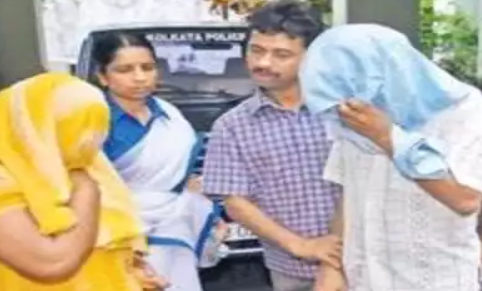
In the year 2007, around 8 Bangladeshi criminals most wanted in their country were arrested by CID from West Bengal. These included murderers, rapists, smugglers, and even local criminals. One of these was Harris Ahmed who was wanted in 40 murder cases and dozens of extortion cases in Bangladesh. He had been hiding in West Bengal using fake identity documents and ran a garment shop during the period. Moreover, he continued to run his extortion business over the phone from Bengal.
Bangladeshi criminal arrested (Mumbai Mirror)
Tanvir-ul Islam aka Joy was also arrested from North 24-Parganas in 2007. He was wanted in Bangladesh for the 2004 grenade attack on an Awami League rally in Dhaka that killed 24 people, including two Awami leaders.
Further, recently in the year 2023, it had come to the fore that Bangladesh Awami League MP Anwarul Azim Anar’s murderer, Howladar had been hiding in West Bengal’s Kolkata since the incident in March 2023.
As per the authorities, several criminals infiltrate Bengal and settle in the state using fake identity documents. They obtain fake documents by using their connections to local political leaders within the state. They set up their businesses, at times marry Indian women, and start living normal lives. However, they continue to commit crimes like human trafficking, smuggling, etc across the border. The pattern was exposed in the year 2007 after which the Bangladesh government and the Indian government began cracking down on the criminals and illegal infiltrators.
The CBI later revealed that Bangladeshi criminals having political implications in Dhaka were usually found to have been hiding in West Bengal.
Apart from this, for the past twenty years, crime syndicates in Bengal have been employing Bangladeshi criminals, with this trend escalating in recent years. These hired criminals from Bangladesh have been involved in serious offenses such as kidnappings for ransom and murders over the past few years. Few have been apprehended because they conceal their identities, even from the crime lords in Bengal who hire them, and flee to Bangladesh after committing the crimes. Due to their unknown identities, Bangladeshi police too have at times faced significant challenges in tracking and arresting them.
Bangladeshi criminals target villages along the border
India, taking cognizance of the situation has increased the deployment of the Border Security Forces (BSF) in the suspected areas. The reason behind such deployment is to stop illegal infiltration into the country. However, officers deployed at South Bengal Frontier Headquarters in Kolkata confirm that criminals at times cut the fences use bamboo poles to vault over the fence, and enter or exit India.
“Many portions of the border like the riverine areas are unfenced and it is humanly impossible to keep watch 24×7 on every inch of such unfenced portions of the border. Also, at times, the criminals cut through the fence or use bamboo poles to vault over the fence and enter or exit India. We manage to catch some and hand them over to the Border Guards Bangladesh (BGB), but most manage to evade our vigil,” the BSF officer was quoted as saying to Swarajya Mag.
BSF at South Bengal Frontier Headquarters in Kolkata (Swarajya Mag)
“They assume fake names when they come in. And once they return to their side of the border, they simply cannot be traced. They are also more fearless and display a lot of daring, perhaps because they are more desperate. The Bangladeshi criminals are also more experienced in robberies and dacoities and that expertise comes in handy here,” he adds.
These criminals target the villages along the border, rob them, and also harass them. There have been reports stating that Hindus along the border are also deliberately targeted by such criminals. The West Bengal Police however for years have possibly failed to curb the menace causing alleged trouble for the residents along the border. The local political party in the state has failed to take action against such criminals as a part of its Muslim appeasement policy. Instead, many local party leaders have been providing fake identity documents to criminals.
With the current situation in Bangladesh, the fear of increased Bangladeshi infiltration cannot be denied. The threat is expected to escalate, with security experts cautioning that it is only a matter of time. The state along with appealing for peace should concentrate on taking measures to reduce the threat of possible increased illegal infiltration. If not, Indians residing along the border might have to face the consequences, and the currently ruling Indian government would not tolerate that.
On Monday, August 5, a successful coup was orchestrated in Bangladesh which led to the removal of democratically elected PM Sheikh Hasina and installation of an interim government. Following the coup that led India’s eastern neighbours into chaos, there were speculations that the Hindu community in the country can come under attack from an alien power.
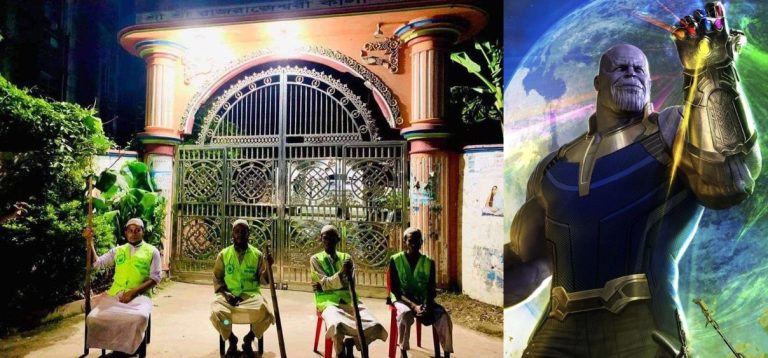
OpIndia can now exclusively report that the threat was from the Eternal–Deviant warlord from the moon Titan, Thanos. Notably, Thanos is recognised as one of the most powerful beings in the entire Universe, and he likes to destroy civilisations, and apparently, Hindu civilisation is on the top of his agenda.
However, once Bangladeshi Muslim community members came to know about the evil plans of Thanos, they decided that they will protect Hindus in the country. Bangladeshi Muslims stationed themselves outside 2 temples in the country to make sure none of the Hindu temples in the country are attacked. However, after getting their photos clicked outside those 2 temples, the Bangladeshi Muslim community members disappeared somewhere, we are trying to locate them.
However, this photo session didn’t go unnoticed, and several prominent citizens lauded them for taking a photo outside those 2 temples to stop Thanos from attacking Hindus in Bangladesh.
Several netizens took to X (formerly Twitter) to laud their bravery in conducting a photo-op outside the temples.
A lot of Indian Right wing accounts are spreading communal propaganda. Here are images of local Muslims stepping in to protect the temples in Bangladesh. pic.twitter.com/WJZNer4ntc
Every Hindu Temple is safe in Bangladesh. Currently the general people of the country is guarding the temples. Please I request to the Indian people to not spread false news. Everyone is safe.
Muslims are protecting hindu Temple. They're all awake the whole night. Please don't create discrimination between Hindu and Muslims. We're here protecting each other, helping each other.. Hasina can't sell our country to India. Bangladesh is for all religion. ?? pic.twitter.com/dAQSg7NcC7
Thanks to these brave social media warriors, world now knows that Bangladeshi Muslims bravely stepped up to face a camera for a photo-op in order to protect the country’s Hindus from the wrath of the mad Titan Thanos.
However, not everyone agrees that the Bangladeshi Muslim community was protecting the temples from Thanos. Some were of the opinion that the Hindu temples were being protected from Darth Vader, long enough for Luke Skywalker to destroy the death star and save Bangladeshi Hindu community.
Meanwhile, Bangladesh’s leading newspaper Daily Star reported that Hindus and Hindu temples have been attacked in 27 districts of the country, so maybe Thanos couldn’t be stopped with a staged photo-op.
On the afternoon of Monday, August 5, Bangladesh’s 5-time Prime Minister Sheikh Hasina left the country, probably never to return again. News of her tendering resignation and preparing to leave Dhaka were just pouring in when a video surfaced on social media, the daughter of Sheikh Mujibur Rahman, Bangladesh’s founding father, getting down from a vehicle and embarking on a helicopter.
After weeks of violent protests in Bangladesh that started as student protests against a court-ordered quota in government jobs for the descendants of freedom fighters, after hundreds of deaths, rampant violence, and murders of police personnel at the hands of violent protestors operated by Jamat-e-Islami, Hasina probably knew her time was up when the Army turned against her.
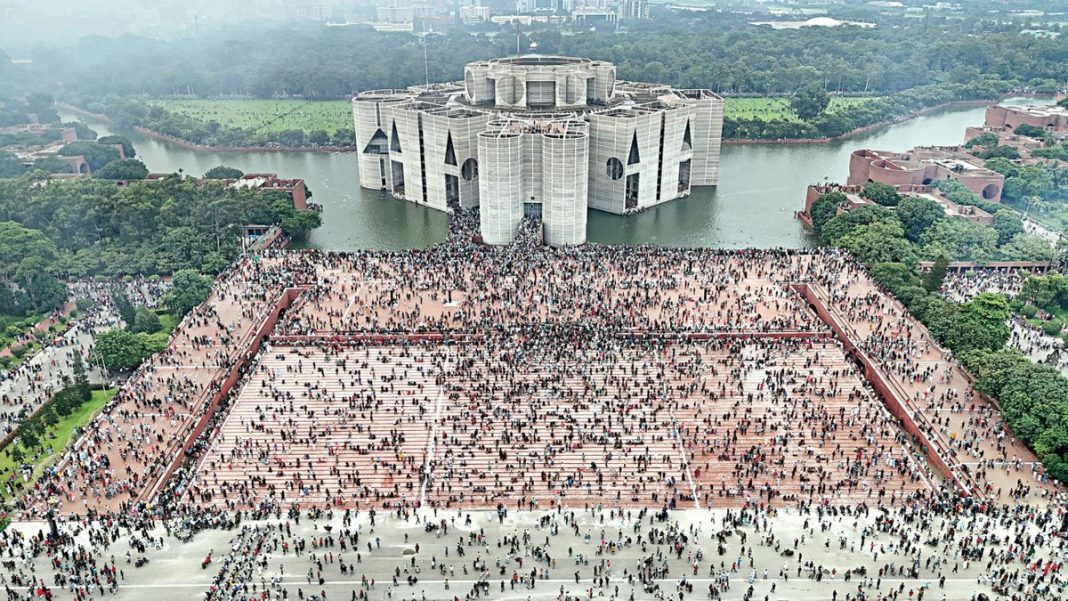
As violent protestors filled the streets of Dhaka, marching towards the PM’s residence and the Jatiya Sangshad Bhavan, the national parliament, cards were falling fast. Just after 2 pm, ahead of reports of an address by the military chief, news came in that Sheikh Hasina has left Dhaka.
Protestors storming into Bangladesh parliament, Image captured by Naimur Rahman of The Daily Star
Within minutes, hundreds of protestors swarmed into the Ganobhavan, the official residence of the Prime Minister in Bangladesh. Those people were not there to protest, they were there to loot, vandalise and display the state of anarchy that has finally won in Bangladesh.
Ganabhaban, the official residence of Bangladesh PM Hasina stormed by protestors pic.twitter.com/aMbp3KIBEn
The pictures soon turned into a macabre dance of human depravity. Men, unhinged, uncontrollable men, with a strange glee on their faces, leaping with joy as they stormed the residence of their Prime Minister, only to barge into her rooms, loot her wardrobe, vandalise her furniture, and show to the whole world how they defile and destroy the last symbols of a shattered democracy. Dhaka fell on August 5.
SHOCKING?: Radicals looted bra, fish, saree, blouse, even dustbins from #Banglade's PM Sheikh Hasina's residence.
Among the visuals of looted furniture, stolen sarees, and men ransacking the PM’s residence, one video stood out. A man had stolen undergarments, bras from the PM’s residence, and a mad crowd was going berserk at the sight of the undergarments. They had hoisted the man on their shoulders, and hooting, cheering as he displayed the bras as trophies.
Just look at these radical vulture like protestors they are cheering for the guy who stole the 'Bra' of PM Sheikh Hasina.
The mad crowd cheering for the stolen bras from a woman Prime Minister’s residence was not just the shameless display of anarchy that has befallen Bangladesh, it was a macabre announcement of what awaited the woman and her family had she stayed.
The crowd was not there to mark the triumph of the people’s revolution against the elected leader, they were there to loot, rape and lynch. Had they found Hasina or any of her family members at Ganobhavan, or anywhere in Dhaka, they would have dragged them out, and lynched them to death in all the revolutionary fury, and just as it happens everywhere when law and order fails, the women would have been raped first.
The men hooting and cheering, waving the bras as trophy were declaring their naked intention, that they didn’t just want Sheikh Hasina’s resignation, they wanted her humiliated and hurt. The Islamist ideology that has fanned and mobilised these protests hates democracy and equality, it prides itself in keeping women under its boots. Islamists loathe a strong democratic leader who prioritises growth and development over radical Islam, they hate it even more when that leader is a woman.