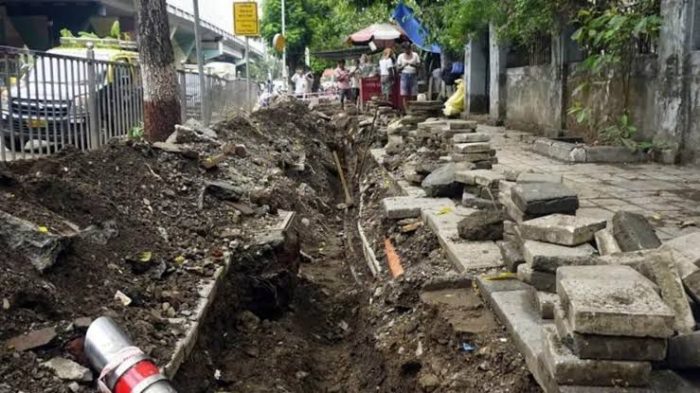
Construction in a city like Mumbai is a never-ending exercise, and so is the road works. Dug up roads are a common sight in India’s financial capital and nobody bats an eye when they see a road or footpath being dug up, now robbers seem to be taking advantage of that attitude. A bizarre case of theft has come to light from Dadar area of Mumbai where robbers dug up a footpath and stole Copper wire worth Rs 6 to 7 lakhs from cables buried underneath.
A regular follow-up over uprooted paver blocks on a footpath on the Dadar-Matunga stretch of Dr Babasaheb Ambedkar Road led to the discovery of theft of copper wire from utility cables laid under the footpath. People assumed it was regular work being carried out by Mumbai Metropolitan Region Development Authority (MMRDA), but it turned out to be a case of theft.
The thieves dug up the footpath alongside the road and stole Copper worth several lakhs from MTNL’s cables buried underneath. The brazen theft came to light after a local noticed something amiss.
Interestingly, Brihanmumbai Municipal Corporation (BMC), Mumbai’s civic body, had carried out work on the same footpath for almost a fortnight and had levelled it up before it was dug up again. After the residents brought this to the BMC’s notice, the civic body sent its staff to check what was happening. That is when it discovered that thieves were stealing copper wires from the utility cables under the footpath. Later, MTNL also complained that over 400 phone lines tripped in Dadar-Matunga area, apparently due to the stealing of Wires.
The Matunga police have already arrested five men for this theft of Copper that costs ₹845 per kg in market. Now there is suspicion that similar thefts could be occurring in other areas of Mumbai where roads have been dug up.
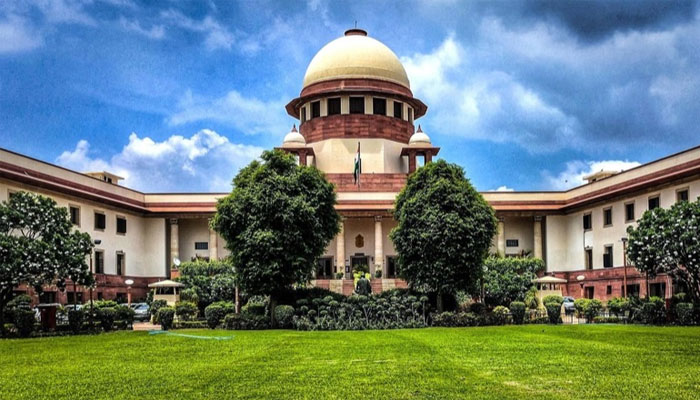
On Tuesday, 11th June, the Supreme Court of India refused to stay the counselling for admission of students to the medical colleges after allegations of paper leak and irregularities in the National Eligibility cum Entrance Test (NEET) undergraduate (UG) examination 2024 surfaced. The vacation Bench comprising of Justice Vikram Nath and Justice Ahsanuddin Amanullah issued a notice to the National Testing Agency (NTA) on one of the petitions seeking cancellation of the exams. Furthermore, the petitioner sought an investigation into the alleged paper leak.
SC: Issue notice. Let the matter be heard on July 8. Tag this with the plea coming up. Let reply be filed by NTA
The court said, “We will not stop the counselling. If you argue further, we will dismiss this.” The remarks came during the hearing of a batch of petitions seeking cancellation of the NEET-UG 2024 exam that was held in May 2024, over an alleged paper leak and other regularities. Similar petitions are pending in different High Courts including Delhi High Court and Calcutta High Court.
One of the petitions filed at the apex court specifically mentioned the allegations that the paper was leaked in Patna. Furthermore, it was alleged that the wrong question papers were given to the students in Rajasthan. The results of the NEET exam were announced in June 2024. Media reports alleged that an extraordinarily large number of candidates who appeared for NEET got a perfect score raising questions over the authenticity of the examination.
The candidates alleged irregularities in the award of compensatory or grace marks to students for the loss of time as well. Earlier, a three-judge bench of Chief Justice of India DY Chandrachud, Justice JB Pardiwala and Justice Manoj Misra had declined to stay the publication of the results of NEET-UG 2024.
NEET results marred with controversies
the NEET UG 2024 results have sparked widespread controversy and debate, with suspicions of inflated marks and other anomalies. Following the release of the National Eligibility Cum Entrance Test (NEET-UG) results on 4th June, it was revealed that as many as 67 students received a perfect score of 720/720 marks to share the All-India Rank (AIR) 1. A large number of medical aspirants and their parents raised numerous concerns about glitches, alleged malpractices, ambiguous implementation of grace marks, above all an alleged paper leak. It is notable that 23,33,297 candidates from all over India appeared for the prestigious exam this year. OpIndia’s detailed report on what has happened with NEET exam can be checked here.
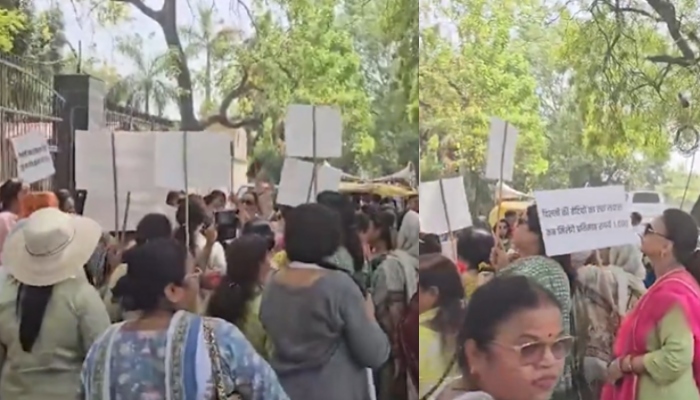
On Tuesday (11th June), several women in Delhi held protests outside the residence of Delhi Minister Atishi Marlena to get Rs 1000 per month which was promised by Arvind Kejriwal ahead of the Lok Sabha elections 2024. The women held placards and raised slogans against Arvind Kejriwal and AAP alleging that the AAP had cheated them by making fake promises.
The video of the protests went viral over the internet in which the protesters could be seen criticizing Kejriwal and his party for making fake promises. “Arvind Kejriwal had promised before the election that every sister would be given one thousand rupees, which has not been fulfilled. This protest is being held on this issue by the Women’s Forum,” a woman protesting outside Atishi Marlena’s residence was quoted as saying.
While talking to the media, the other woman protester said that AAP had promised the women that Rs 1000 would be given to every woman above 18 each month. “He promised us and expected us to vote for him. But now we want our money. Where is our money? People are getting free liquor bottles and here we are struggling to get the money promised. This is injustice. We want justice,” the protester said.
Delhi: "A demonstration is being held by the Women's Forum. Arvind Kejriwal had promised before the election that every sister would be given one thousand rupees, which has not been fulfilled. This protest is being held on this issue," says a woman protesting outside Atishi… pic.twitter.com/QBbl12SaQU
Another enraged woman said, “The AAP activists had forced us to sign the forms saying that we would get Rs 1000 per month if we vote for AAP in the 2024 elections. We honestly voted for AAP. Now we want our money. Kejriwal is a cheater. He is not trustworthy”
Presenting the Delhi Budget in March 2024 under the theme of establishing ‘Ram Rajya’, Delhi Chief Minister Arvind Kejriwal and Minister Atishi Marlena announced that every woman above the age of 18 years would receive Rs 1,000 per month under the ‘Mukhyamantri Mahila Samman Yojana’.
The state announced an allocation of Rs 2,000 crore for the ‘Mukhyamantri Mahila Samman Yojana’ for the welfare and empowerment of women from 2024-25. “A budget of Rs 2,714 crore has been proposed for these beneficiaries in the budget of 2024-25. Under the Rs 2000 crore for ‘Mukhyamantri Mahila Samman Yojana’ for the welfare and empowerment of women, every woman above 18 years of age will get an amount of Rs 1000 per month,” Atishi was quoted as saying.
However, the condition for women to avail of this benefit was that she should be a Delhi voter, should not be availing benefits under any other government scheme, and should not be an income-tax payer. Notably, there are around 67,30,371 female voters in the national capital.
Even during the campaign event on 10th March, Delhi CM Arvind Kejriwal had promised to provide women over 18 years with Rs 1,000 per month. “Empowerment cannot happen with an empty pocket”, said Chief Minister Arvind Kejriwal had said.
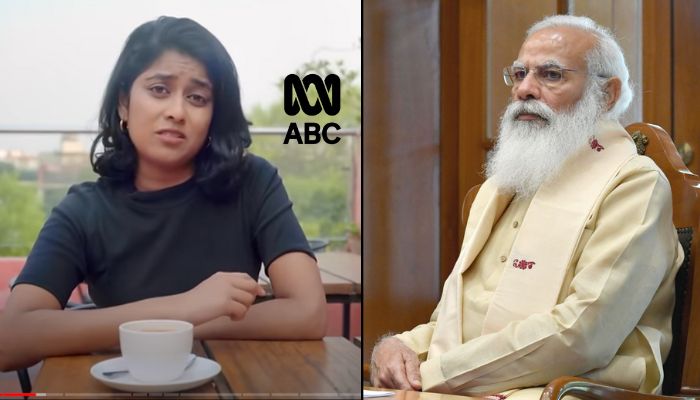
A day after the BJP-led-NDA won the 2024 Lok Sabha elections, Australian Broadcasting Corporation (ABC) News ‘journalist’ Avani Dias on Wednesday (5th June) spread canards about the Indian constitution.
Dias, who had previously lied about her visa being cancelled by the Modi government over ‘critical reporting’, claimed that ‘secularism’ was part of the Indian constitution since the country got independence from the British rule in 1947.
She made the false claims in a video titled ‘The story behind India’s Narendra Modi’ with the objective to portray that India’s secularism was somehow in danger under the leadership of PM Modi.
At about 9:19 minutes into the video, Avani Dias alleged, “Just so you’re across it, when India was founded in 1947 after it got independence from the British, its constitution was written to say India is a secular country, which means it has to be neutral and open to all religions.”
“The word secular is right there on page 33 in capital letters,” she further claimed. In her desperate attempt at furthering her agenda, the ABC News ‘journalist’ forgot one key piece of information – The word secular was not part of the Indian Constitution when it came into force in 1950.
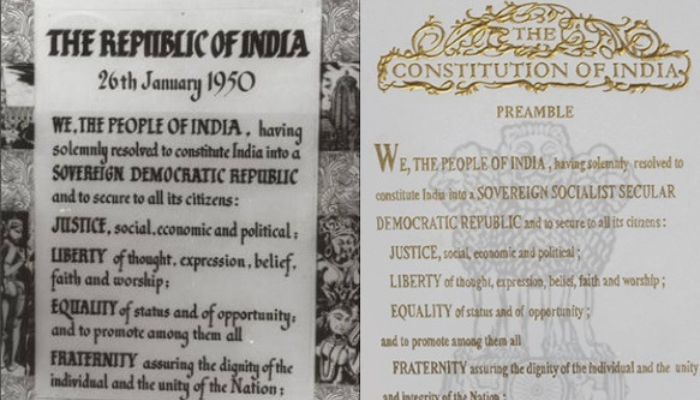
India’s Constitution was not written in 1947 either but three years later in 1950. The word ‘secular’ only became part of the Preamble of the Constitution in 1976 (during the dark days of the Emergency).
Preamble of the Indian Constitution (1950 vs today), image via Constitution Net
The then Prime Minister Indira Gandhi had bypassed the Parliament and enacted the 42nd Constitutional Amendment to insert the word ‘secular’ in the Constitution. Contrary to the claims by Avani Dias, the constitution was not written to state that India was a ‘secular country.’
Throughout the video, the ABC News ‘journalist’ relied on conjectures, surmises and suppositions to tarnish the image of the country on a global scale.
Controversy surrounding Avani Dias
In April this year, Avani Dias took to X (formerly Twitter) to claim that she had to leave India abruptly due to the non-extension of her visa by the Modi government.
The controversial ‘journalist’ also alleged that the Indian government had plans to not allow her accreditation to cover the 2024 Lok Sabha elections. Dias claimed that her visa was extended for a period of 2 months at the last minute, following which she went back to Australia.
She lamented returning to her home country just a day before the first phase of the elections. Thereafter, her employer ABC News published a controversial article (archive) claiming that Dias received a phone call from the Ministry of External Affairs (MEA) and was notified about the denial of her visa extension.
The publication said that MEA informed the ‘journalist’ that she crossed a line with her propaganda-laden YouTube video, which suggested that India was somehow involved in the assassination of Canada-based Khalistani terrorist Hardeep Singh Nijjar.
The 29-minute-long video was deliberately titled ‘Sikhs, Spies and Murder: Investigating India’s alleged hit on foreign soil’ to tarnish the image of India on a global scale and present the nation as a facilitator of extra-territorial killings in foreign countries.
Nonetheless, the Modi government directed YouTube to withhold the anti-India propaganda video by ABC News and its South Asia Bureau Chief Avani Dias. “This content is currently unavailable in this country because of an order from the government related to national security or public order,” reads a message on the YouTube link of the video
Avani Dias was under the false impression that a red carpet would be laid out for her by the Indian government for attempting to sour the diplomatic relations of the nation with its allies and partner countries.
The controversial ‘journalist’ was also seen playing the victim card on X (formerly Twitter) and casting aspersions on the state of Indian democracy under the Narendra Modi regime.
Interestingly, she was able to rope in support from 30-odd foreign correspondents. Later, it surfaced in the media that she lied about her visa extension denial and returned to Australia for her wedding and a new job. Nonetheless, Avani Dias continues to work ABC News’ Four Corners.
She had previously courted controversy for insinuating the role of Hindus in the vandalism of the Shree Laxmi Narayan Temple in Brisbane, attempting to portray the Pran Prathistha ceremony of Ram Mandir as a ‘Hindu supremacist’ event, supporting the wearing of religious attire in government schools, spreading lies about CAA and denouncing the implementation of Prohibition of Unlawful Conversion of Religion Act, 2021 in Uttar Pradesh.
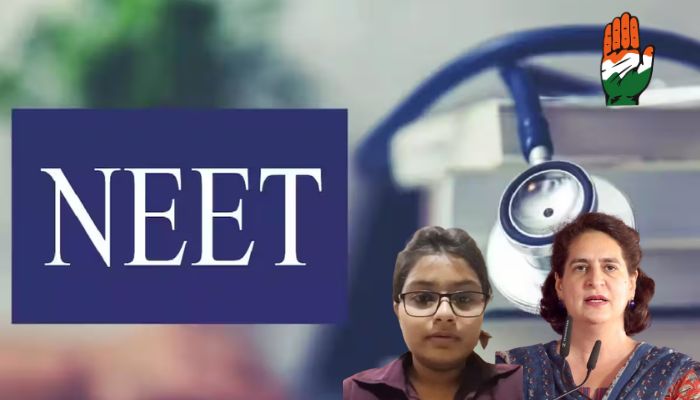
Amidst allegations of irregularities in the NEET examination results, the Congress party has been accused of spreading, endorsing fake news and amplifying the falsehoods of a NEET student who is allegedly exploiting the genuine concerns of the student community to gain popularity. Notably, several Congress leaders and state social media units have peddled claims of tampering with the OMR sheet of one NEET aspirant Ayushi Patel, a resident of Lucknow.
Patel has been in the news for her bizarre claims earlier too. In 2020, she made headlines for claiming that she had discovered a vaccine (for COVID) formula “in her mind.”
Days after NEET aspirants flagged irregularities in marking and alleged paper leak, on 10th June, senior Congress leader Priyanka Gandhi Vadra shared a video of Ayushi Patel without checking the veracity of her claims. Likewise, the Kerala Congress also shared her video and repeated her allegations to attack the newly elected NDA government.
NEET जैसी परीक्षाओं में लाखों बच्चे मेहनत से तैयारी करते हैं और अपनी जिंदगी के सबसे कीमती पल इस तैयारी में लगाते हैं। पूरा परिवार इस प्रयास में अपनी श्रद्धा और शक्ति डालता है। लेकिन साल दर साल इन परीक्षाओं में पेपर लीक, रिजल्ट से जुड़ी गड़बड़ियाँ सामने आई हैं।
— Priyanka Gandhi Vadra (@priyankagandhi) June 10, 2024
This is Ayushi Patel from Lucknow. This was her third attempt of NEET. After the exam she checked the answer key published and calculated that she got a score of 715/720. This means she must have a rank below 100. This means that she was one of best in the country.
Pertinently, in her video statement, Patel claimed that the National Testing Agency, the nodal agency responsible for conducting examinations in India, sent her an email informing her that her OMR sheet was damaged. According to her, the email conveyed that her result could not be generated because the NTA found her OMR sheet torn and damaged. She brazened her allegation stating that her OMR sheet appeared to be ‘deliberately torn.’ However, she stated that the answers she submitted during the examination were visible on the damaged OMR sheet and they totaled 715 out of 720 marks.
She said, “After hearing this, me and my family were shocked. My family saved me from depression. It looks as if the OMR has been deliberately torn. The bubbles (student’s responses to examination questions) are clearly visible and on matching them with the official answer key, my NEET score comes out to be 715 out of 720. We have filed a petition in High Court which is slated to be heard on Tuesday. This was my third attempt. I scored 535 marks on my first attempt and 570 marks on the second attempt.”
She further stated that with the help of her uncle who is a lawyer, they responded to the NTA mail and got to see her OMR.
Speaking with India Today, Ayushi Patel further alleged that her OMR sheet was tampered (with). She said, “Even if this is a scanned image, the thumbprint here is blue which is not possible it should have been black so it’s clear my OMR has been manually tampered (with).” Her claims have been widely covered by mainstream media.
However, NTA has categorically refuted her claims and allegations of OMR tampering and her OMR being torn. They also denied sending any torn OMR answer sheet as claimed by Ayushi Patel.
— National Testing Agency (@NTA_Exams) June 10, 2024
Taking to its official X handle, NTA stated, “Regarding the viral video featuring Ms. Ayushi Patel, claiming discrepancies in NEET (UG) 2024 scoring and receiving of the torn OMR Answer Sheet, NTA clarifies that no torn OMR Answer Sheet was sent via an official NTA ID. OMR Answer Sheet is intact and Scores are accurate as per official records.”
Trying to gain cheap and instant popularity over a serious student issue?
Meanwhile, several X users shared her NEET examination results and accused Patel of exploiting the genuine concerns of NEET aspirants to gain cheap popularity and media limelight by claiming fake victimhood. Several users also slammed Congress for promoting fake news and imposters who exploit the genuine concerns of people for their selfish agendas.
Popular X user, Eminent Intellectual wrote, “Her OMR is intact and she scored only 365, not 715. There are genuine issues with NEET but Congress ONLY promotes fake news and fraudsters. Amazing.”
Her OMR is intact and she scored only 365, not 715. There are genuine issues with NEET but Congress ONLY promotes fake news and fraudsters. Amazing ? pic.twitter.com/zz4by0VwWs
Some users slammed Ayushi Patel for exploiting the NEET irregularities row and urged everyone to spare the hardworking students from politics or exploitative tactics.
Liar Ayushi Patel Sab bahti ganga me haath dho rahe. Please spare genuine and hardworking students please pic.twitter.com/cAe4xf9CkG
Incidentally, NEET aspirant Ayushi Patel was earlier accused of making bizarre claims to garner media limelight. Four years ago, during the COVID pandemic, she made headlines for claiming that she had found the “formula for vaccine” in her mind.
"One day my father asked a something related to Corona and I couldn't answer. I was disheartened. So I studied deep. One day suddenly the formula of vaccine strike in my mind" ~ Ayushi Patel in Oct'20.
The same girl today is going viral for faking NEET score. And Priyanka Gandhi… pic.twitter.com/IhGjbuX31a
A video of from October 2020 has surfaced online after she made allegations of tampering with her OMR sheet which the NTA has refuted. In the October 2020 video, she says, “One day my father asked something related to Corona and I couldn’t answer. I was disheartened. So I studied deeply. One day suddenly the formula of vaccine strikes in my mind.”
It is notable here that no vaccine has just a “chemical formula” per se. Vaccines are developed by a complex biopharmaceutical process that involves isolating an inactive immunogenic component from the pathogen and developing it in laboratories in injectable or oral form. It takes rigorous research and development to develop a vaccine that is stabilised through large-scale production, transport, and administration. It takes months, even years to develop a vaccine that can be safely injected to a large population.
For those unversed, the NEET UG 2024 results have sparked widespread controversy and debate, with suspicions of inflated marks and other anomalies. Following the release of the National Eligibility Cum Entrance Test (NEET-UG) results on 4th June, which announced that as many as 67 students received a perfect score of 720/720 marks to share the All-India Rank (AIR) 1, a large number of medical aspirants and their parents raised numerous concerns about glitches, alleged malpractices, ambiguous implementation of grace marks, above all an alleged paper leak. It is notable that 23,33,297 candidates from all over India appeared for the prestigious exam this year.
Meanwhile, genuine concerns about irregularities in the NEET examination results have also reached the Supreme Court. Hearing the matter, the apex court has sought answers from the testing agency stating that the sanctity of NEET-UG 2024 has been affected.
On 10th June, Elon Musk, the CEO of Tesla and SpaceX, publicly criticised Apple for the announcement regarding its partnership with OpenAI. In a series of posts on social media, Musk expressed his concerns over the potential security risks posed by integrating OpenAI’s technology into Apple’s operating systems. Musk categorically said that if Apple integrates OpenAI into its devices, he would ban Apple devices from his company’s premises.
If Apple integrates OpenAI at the OS level, then Apple devices will be banned at my companies. That is an unacceptable security violation.
Musk’s statement came after Apple announced on 10th June that it has partnered with OpenAI to integrate ChatGPT into its devices. Apple named it the new “Apple Intelligence” system and Tim Cook, CEO of Apple, described it as the “next big step” by the company.
The announcement was made during the annual developer’s conference at Apple. Cook and his team outlined the upgrades that will be seen this year. It includes the use of AI to enhance the Siri experience. More personalised features are expected to come in the upcoming software update.
The partnership with OpenAI will help Apple to develop its own proprietary generative AI features. Cook, while making the announcement, described it as a “new personal intelligence system” based on Apple’s own generative AI models and customised to the user.
To use the power of OpenAI models, Siri will be able to ask questions to the chatbots. However, the user has to provide permission first to Siri to ask OpenAI model queries. The collaboration between Apple and OpenAI aims to integrate OpenAI’s sophisticated AI functionalities into Apple’s ecosystem which will help revolutionise the way users interact with the devices.
Musk’s strong stance on the use of AI
Musk is known for being an advocate for cautious AI development. He did not hold back while criticising Apple for its decision to partner with OpenAI. He threatened that if the collaboration happened, he would ban Apple devices from all his companies including Tesla, SpaceX and others. Criticising Apple for joining hands with OpenAI, Musk said, “It’s patently absurd that Apple isn’t smart enough to make their own AI, yet is somehow capable of ensuring that OpenAI will protect your security & privacy! Apple has no clue what’s actually going on once they hand your data over to OpenAI. They’re selling you down the river.”
It’s patently absurd that Apple isn’t smart enough to make their own AI, yet is somehow capable of ensuring that OpenAI will protect your security & privacy!
Apple has no clue what’s actually going on once they hand your data over to OpenAI. They’re selling you down the river.
The main concern that Elon Musk has revolves around the security implications of embedding advanced AI capabilities directly into the OS of widely used consumer devices. Musk said he believes it could create significant vulnerabilities, potentially exposing users to data breaches and other security threats. Though Musk was fuming over the announcement, he made his point by sharing the Indian Coconut Water sharing meme adding a little humour to the discussion.
Apple has not issued any response to the billionaire’s protest against the former’s decision to join hands with OpenAI. However, the company has a history of prioritising user privacy and security, suggesting that they might have kept in mind the potential security threats AI could have. Apple’s partnership with OpenAI is seen as a strategic move to enhance its AI capabilities and compete with other tech giants like Google and Amazon.
Elon Musk chose public condemnation of Apple’s AI integration plans which showcases the complex challenges and debates the tech industry is facing as it approaches a more integrated world where Artificial Intelligence has a much more practical presence in our lives. Notably, Musk recently has launched X’s own AI model Grok. As companies like Apple and OpenAI push the boundaries of technological innovation, ensuring robust security measures and addressing ethical concerns will be crucial to gaining public trust and acceptance.
In Delhi, getting water has become a daily struggle for survival. As every new day dawns, the tensions surrounding the isolated water pump deepen with residents assembling, their faces lined with exhaustion and anguish, knowing that obtaining even a drop of water is essential for their families’ survival.
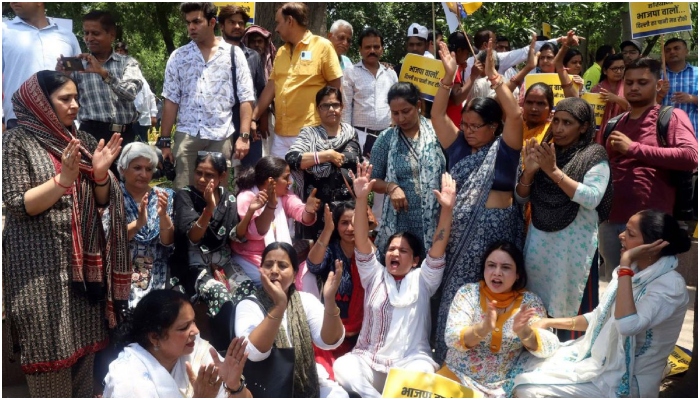
On Monday, June 10th, several Delhi women and AAP leaders staged a protest against the Haryana government alleging that it deprived the national capital of its rightful share of water. Kuldeep Kumar, AAP’s Delhi State Vice-President and MLA, along with colleagues Shiv Charan Goel, Vinayy Mishra, Somdutt Sharma, and Women’s Wing President Sarika Chaudhary, participated in the demonstration next to Haryana Bhawan, Mandi House.
Protesters chanted slogans against the BJP for stripping Delhi of ‘its share’ of water and demanded that the Central and Haryana governments assure the quick release of Delhi’s portion of water. AAP MLA Kuldeep Kumar asserted that the current water crisis in the city is unmanageable. He also stated that the Delhi government had been asking the Haryana and the Himachal Pradesh governments, and also the LG to ensure adequate water for Delhi.
AAP leaders protesting for water outside Haryana Bhavan
He stated that the Delhi government had also approached the Supreme Court. Still, despite the court’s order, the Haryana government was refusing to release 137 cusecs of water from Himachal Pradesh. The AAP claimed that the Haryana government has also halted the flow of 200 cusecs of water from other canals into Delhi. The AAP leaders also added that till the city does not get its full share of water, they would remain on the roads.
Haryana CM says, ‘AAP lying, water being provided as agreed’
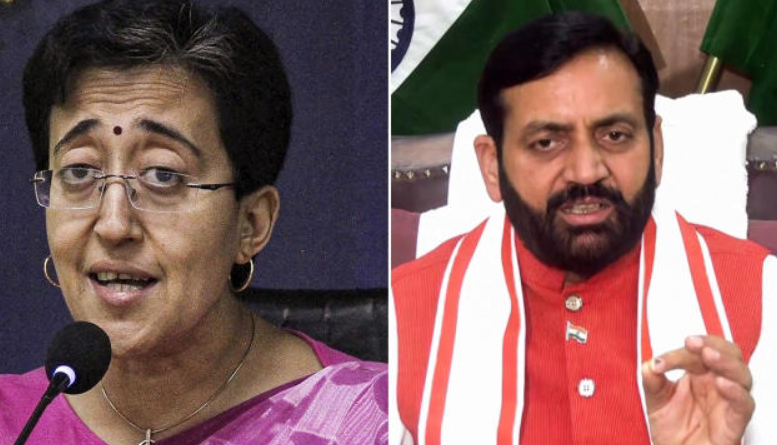
Meanwhile, the Haryana Government slammed the AAP government in Delhi for lying. “Lying is in their DNA,” said CM of Haryana Nayab Singh Saini. He further maintained that the state was releasing water to the national capital, over and above the agreed-upon quantity, and that it was internal mismanagement of the capital that was forcing its residents to beg and protest for water like never before.
He reiterated that the AAP leaders were lying and that Haryana had been issuing water supply to the capital as agreed. “AAP had raised the issue earlier as well but back then also it was found that the state was giving water to the capital as per the signed agreement,” Saini was quoted as saying.
Delhi BJP chief Virendra Sachdeva further held the AAP government responsible for the ongoing water crisis indicating that the government was stealing water from the Munak canal and providing the same via tankers to the locals in exchange for money. “The tanker mafia, run by AAP MLAs and Ministers, steals water from the Munak canal in exchange for which they earn money. This is the main reason for the lack of water in Delhi,” the BJP leader was quoted as saying.
VIDEO | “The tanker mafia, run by AAP MLAs and Ministers, steals water from Munak canal in exchange for which they earn money. This is the main reason for the lack of water in Delhi,” says Delhi BJP chief Virendra Sachdeva (@Virend_Sachdeva) on water crisis in the national… pic.twitter.com/Kn1I5Wjcrt
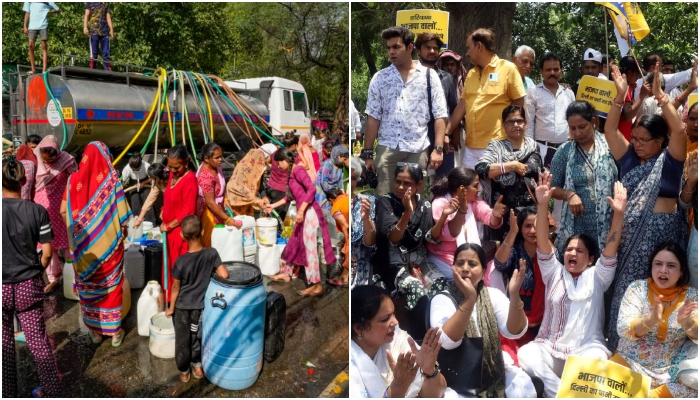
Several parts of Delhi have been affected by a lack of water due to the city’s current heatwave. Slums, resettlement colonies, and villages are particularly hard-struck, forcing residents to purchase water tanks or rely on Delhi Jal Board (DJB) tankers.
#Watch | People in the national capital face severe water crisis. Water is being supplied through tankers
Himachal Pradesh agrees water supply after SC’s directions
Amid extreme heat and temperatures reaching over 50°C, the Delhi government had turned to the Supreme Court (SC) in the first week of June for prompt action to tackle its rising water crisis. It asked that the state of Haryana release additional water to alleviate the issue and bring respite to millions of Delhi residents.
Owing to this request the Supreme Court on 6th June directed the Himachal Pradesh government to release 137 cusecs of surplus water to Delhi. It also instructed Haryana to facilitate the release through the Wazirabad barrage, making sure that the water reached the Capital soon to reduce the shortage of drinking water.
A vacation bench of Justices Prashant Kumar Mishra and KV Viswanathan emphasized the gravity of the situation, calling it as an “existential problem” for Delhi, compounded by excessive heat and rising demand. It stated that as Himachal Pradesh expressed a desire to share 137 cusecs of surplus water with Delhi, Haryana must offer the “right to passage” at the Wazirabad barrage.
“We direct that Himachal Pradesh shall release 137 cusecs from the upstream so that the water reaches the Hathnikund barrage from where it can reach the Wazirabad barrage. As and when surplus water is received by Haryana, Haryana shall facilitate flow of additional water from Hathnikund through Wazirabad uninterruptedly for the citizens of Delhi,” ordered the bench.
Atishi’s repeated plea; Court slamming AAP
The matter was again heard on June 10th, when Delhi’s Water Minister Atishi in her plea again sought immediate and continuous release of water at the Wazirabad barrage, including the surplus provided by Himachal Pradesh. However, the court slammed the AAP government and said that the court proceeding should not be taken for granted.
This was after the court, on June 3rd, had asked the government to rectify defects in a plea seeking a direction to Haryana to release surplus water provided by Himachal Pradesh. The court also scheduled an emergency meeting of the Upper Yamuna River Board on June 5th to resolve the water scarcity issue. Representatives from the Centre, Delhi, Haryana, and Himachal Pradesh decided to hold a meeting to address the problem.
The AAP government submitted affidavits but failed to cure the noticeable defects as a result of which the court said, “Why have you not cured the defect? We will dismiss the petition. On the last date also this was pointed out and you did not remove the defect. Don’t take the court proceedings for granted, however important your case may be.”
Delhi and its noticeable water network
Delhi relies heavily on its bordering states of Himachal Pradesh, Uttarakhand, Punjab, Haryana, and Uttar Pradesh to meet around 90% of its drinking water needs. According to the Delhi Jal Board (DJB), the capital’s supply of unfiltered water is derived from four elementary sources- 40% from the Yamuna, sourced through Haryana, 25% from the Ganga, 22% from the Bhakra Nangal Dam, and the remaining 13% from underneath sources such as wells and tube-wells.
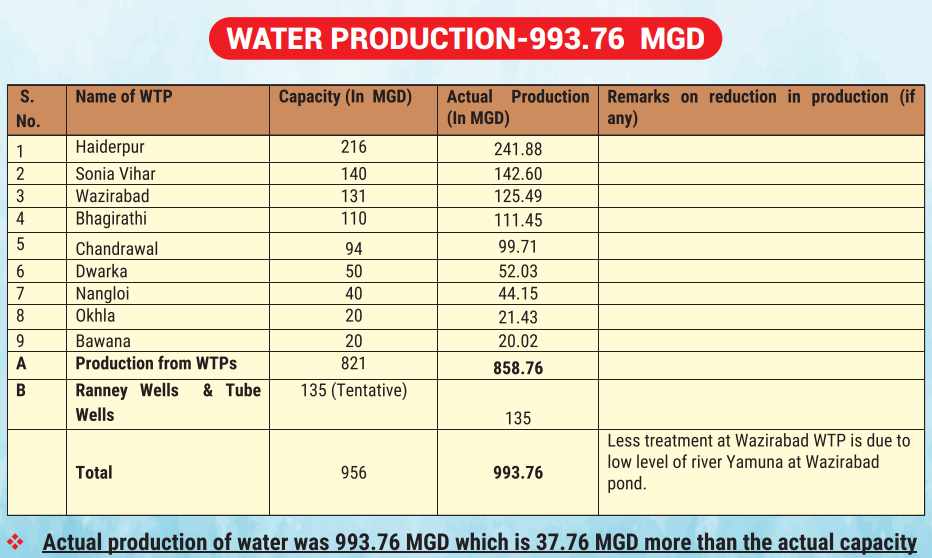
This water is purified at nine water treatment plants (WTPs) and distributed around the city via a 15,473-kilometer pipeline network and underground water reservoirs. According to the DJB’s Summer Bulletin, Delhi’s total water output between May 21 and May 31 ranged between 977.79 and 993.76 million gallons per day (MGD).
Image- Delhi Jal Board
However, this is much lower than the daily demand of 1,290 MGD, or 60 gallons per person. Water quality is also an issue in some locations, with high ammonia levels (more than 2.5 ppm) and hazardous waste from industrial drains polluting the Yamuna. Despite pollution control board scrutiny and interventions by the National Green Tribunal (NGT), the Yamuna remains one of India’s dirtiest rivers, posing a significant threat to Delhi’s clean water provision.
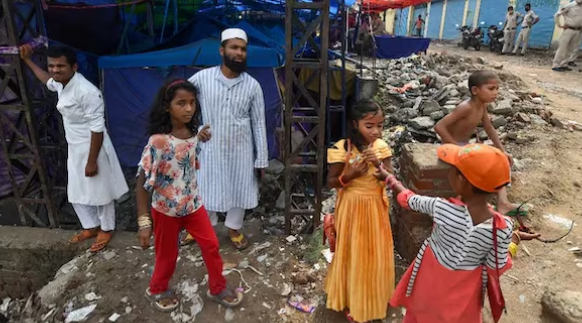
In the midst of the political blame game, it is terrible to see photographs of women, children, and young men endangering their lives while desperately chasing behind water tankers. What’s more distressing is the disparity in water supply between wealthy communities and slums, with the poor bearing the brunt of the scarcity.
VIDEO | “The tanker mafia, run by AAP MLAs and Ministers, steals water from Munak canal in exchange for which they earn money. This is the main reason for the lack of water in Delhi,” says Delhi BJP chief Virendra Sachdeva (@Virend_Sachdeva) on water crisis in the national… pic.twitter.com/Kn1I5Wjcrt
While the wealthy have continual running water in their homes and may afford private water tanks at high prices, the poor do not have this luxury. As a result, poor populations living in unauthorized colonies have to depend on unsafe water sources for their daily needs, which can lead to water-borne diseases such as cholera, diarrhea, dysentery, hepatitis A, and typhoid.
Inadequate water supply further hinders sanitation, hygiene, and social welfare, leading to increased healthcare costs and illness prevalence. It also disrupts productivity, economic stability, and educational opportunities, affecting individuals and governments.
Why is Delhi struggling for water to this level
Many causes contribute to the continuance of this ever-expanding challenge, including excessive groundwater extraction, water source contamination, migrant population increase, negative effects of climate change, ineffective water management techniques, and inter-state water disputes.
In an effort to close the demand-supply gap, the DJB has gradually increased groundwater extraction during the last five years. According to reports, this extraction increased from 86 MGD in 2020 to over 135 MGD in 2024.
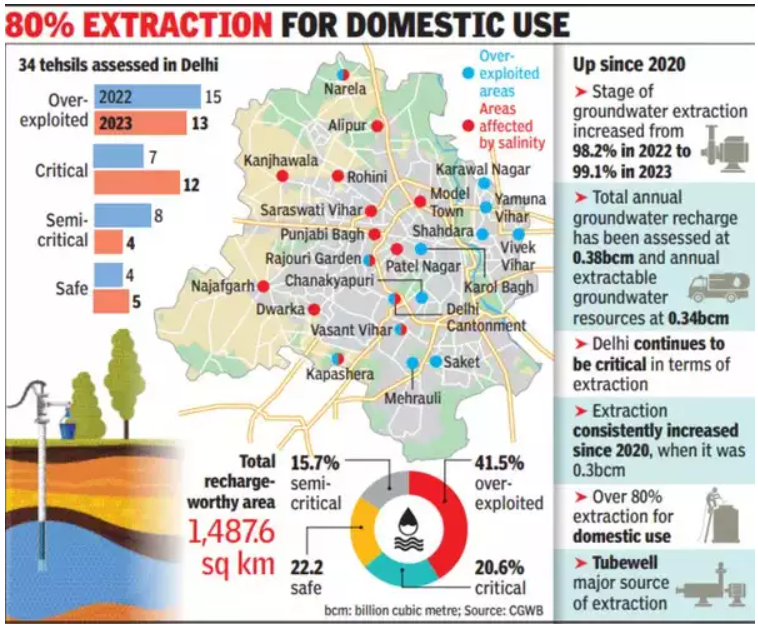
The Central Groundwater Board (CGWB), in its ‘Dynamic Groundwater Resources of India 2023’ report released on December 1, 2023, indicated that around 41.49 percent of Delhi’s territory of 1,487.61 square kilometers is considered “over-exploited” due to excessive levels of groundwater extraction.
The continuous extraction of groundwater exacerbates the depletion of the water table. It should be highlighted that the construction of concrete structures throughout Delhi obstructs natural groundwater recharge zones, creating an alarming imbalance between water recharge and extraction.
Image- Times of India
Notably, the Delhi Master Plan 2041 appropriately recognizes water supply challenges, however, it provides ambiguous policies and lacks specific targets. It fails to lessen dependency on external sources or prioritize rainwater gathering and wastewater reuse. Another critical factor increasing Delhi’s water problem, which is a global phenomenon but is especially acute in highly populated urban areas, is rising temperatures and blistering heat waves. According to the United Nations, every 1°C increase in global temperature is expected to result in a 20% decline in renewable water supplies.
The Yamuna’s pollution levels at the Wazirabad pond have further worsened the situation. Surpassing the permissible ammonia limit in drinking water of 0.5 ppm, according to the Bureau of Indian Standards, the elevated levels have reduced the efficiency of the Wazirabad water treatment plant by approximately 30%, resulting in disruptions in water production and low-pressure water supply. The silt, sand, sediments, weeds, and debris that have collected in the Yamuna’s river bed have an even greater impact on its water quality, flow, and water holding capacity.
Delhi and Haryana’s conflict over water
The most important issue is Delhi’s water-sharing conflict with Haryana. The Delhi administration has frequently chastised the Haryana government for supplying less water than agreed upon in the 1994 MoU. In response, Haryana has asserted that Delhi’s water scarcity is the result of internal mismanagement. Regardless of the legalities, it is apparent that the prolonged political conflict is causing irreparable harm to the population of this country.
Image- India TV
On May 12, 1994, the Chief Ministers of Himachal Pradesh, Haryana, Uttar Pradesh, Rajasthan, and the National Capital Territory of Delhi inked a Memorandum of Understanding (MoU) to allocate the usable surface flow of the River Yamuna up to the Okhla Barrage between the co-basin states. The MoU seeks the creation of the Upper Yamuna River Board (UYRB). which is a subordinate office of the Department of Water Resources, River Development, and Ganga Rejuvenation, Ministry of Jal Shakti, Government of India.
In a country where people frequently migrate and dwell in other states and Union Territories, governments must avoid politicizing the critical problem of water sharing, as the livelihoods of people from other states, including Haryana, who live in Delhi, are dependent on a consistent and adequate water supply.
Delhi shall stop supporting illegal immigrants with free water, ration
Delhi, being the national capital of a diverse country like India has become home to several migrants who shift from various parts of the country given immense opportunities. While the government cannot and should not differentiate between the locals and the migrants given their national identities, it can allegedly stop serving the illegal immigrants who illegally enter the country and settle in the national capital.
Several reports emerge daily highlighting the increasing influx of illegal inhabitants in Delhi who end up calling the place their ‘home’. According to the 2001 census around 3,084,826 people in India came from Bangladesh. In 2011, there were more illegal Afghanis than Pakistanis living in India. The country-wise list provided pointed out that there were over 13,500 illegal immigrants from Afghanistan and about 7,700 from Pakistan. The highest number of immigrants, 32,600 then were from Bangladesh.
illegal immigrants settling in Delhi (India Today)
Many even today continue to live in the capital city without relevant identity documents or with fake identity documents. There still is an organized migration of roughly 40,000 illegal Bangladeshi and Rohingya Muslim immigrants in Delhi, who are considered to pose a national security concern and undermine national cohesion.
These outsiders occupy space in the city, grabbing the share of resources that are meant to be provided to the Delhi locals staying in the miserable conditions. Interestingly, it has been the AAP government in Delhi that has been helping the illegal Rohingyas by distributing free water, electricity, and ration to such inhabitants. The government then also decided to Rohingya Muslims to flats for the economically weaker section (EWS) in the Bakkarwala area in Delhi. However, the Union Home Ministry had denied any such move proposed by the Delhi government merely for vote bank politics.
The Delhi government needs to prioritize its attention toward the locals and stop helping the illegal immigrants with freebies like water, shelter, and ration.
Search for alternate water sources instead of politicizing the matter
According to the United Nations, the right to water entitles everyone to adequate, safe, acceptable, physically accessible, and inexpensive water for personal and household use. This is mirrored in Sustainable Development Goal (SDG) 6, which aims to provide universal access to and sustainable management of clean water and sanitation. Furthermore, judicial precedents have demonstrated the importance of this right.
In addition to the upcoming court verdict, Delhi must make proactive efforts toward self-reliance by implementing sustainable policy and governance reforms such as technological interventions, infrastructure development, and alternative water conservation strategies. Addressing leaks in water distribution pipelines to reduce water waste should be a top concern instead of politicizing the issue and targeting the BJP government.
The Aam Aadmi Party has, over the past couple of weeks, accused the Haryana government of negative politics and stopping water supply in the Yamuna. The AAP government also needs to look into enhancing the internal supply management which is responsible for providing water to the Delhi locals.
Concurrently, people should accept it as their common obligation to preserve water at home by instilling good water usage habits and actively participating in rainwater harvesting efforts. According to a study published in the Journal of Environmental Science and Pollution Research, a 60 m² roof in Delhi may gather 3,64,800 liters of water annually for a family of five. This amount of water is enough to meet home needs and to recharge groundwater.
The next hearing in the case is scheduled on June 12th.
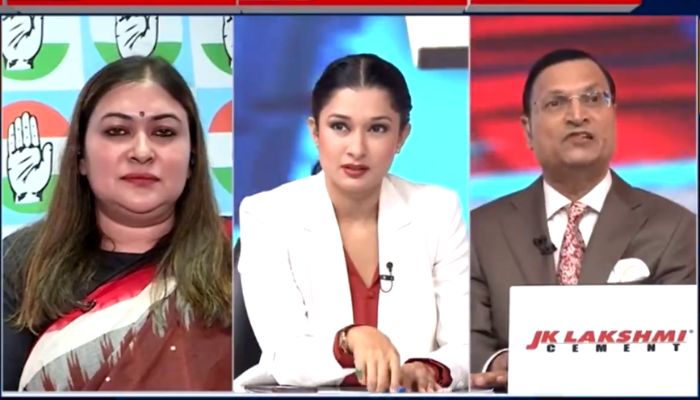
A day after Ragini Nayak, Jairam Ramesh and Pawan Khera accused journalist Rajat Sharma of abusing on-air, India TV issued a statement on Tuesday (10th June) vowing legal action against the Congress leaders.
While issuing a warning to the trio, India TV’s Legal Head Ritika Talvar said, “I am writing to you on behalf of India’s most respected journalist and television presenter Mr. Rajat Sharma, who has been in this profession for more than four decades and has a very high degree of credibility and reputation. Mr. Sharma is known for his cultured and civilised behaviour both on and off air. Television viewers world over appreciate his polite and gentle style of anchoring.”
She further added, “We have seen your posts on social media where you have accused Mr. Sharma of using abusive language on air. The allegations made by you in your posts are absolutely false and lack any basis and foundation whatsoever. They are malicious and defamatory and clearly constitute fake news. You have blatantly violated all limits of public decency by falsely accusing a personality of high repute. We are taking legal advice on this to take further action.”
I am writing to you on behalf of India’s most respected journalist and television presenter Mr. Rajat Sharma, who has been in this profession for more than four decades and has a very high degree of credibility and reputation.…
Ritika Talvar informed that the Congress leaders have been planning to do a press conference and continue to make false claims about Rajat Sharma.
“Meanwhile, we have come to know that you are trying to further compound the imperceivable by proposing a press conference and disseminating the same baseless, false and defamatory news once again. We warn you that you should desist from this. We reiterate that Mr. Sharma has never used abusive language in private or public life. Inference drawn by you from the non-existent and imaginary are per se defamatory. We reserve the right to take further legal action,” she warned.
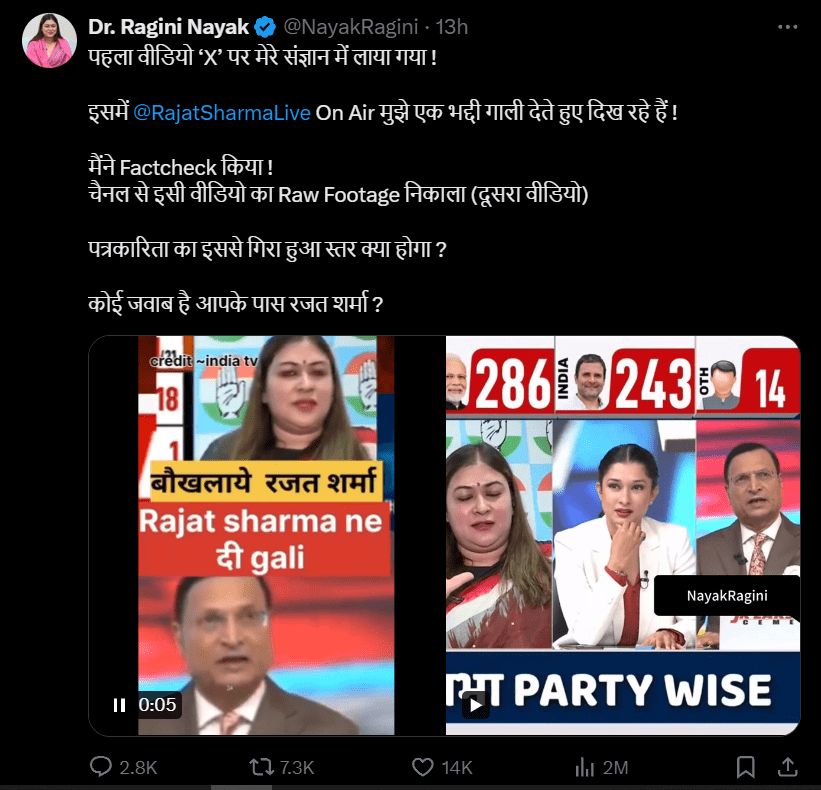
On Monday (10th June), Congress spokesperson Ragini Nayak took to X (formerly Twitter) to allege that Rajat Sharma had verbally abused her on air during a live debate. “What can be lower than this in journalism? Do you have any answer, Rajat Sharma,” she tweeted.
Screengrab of the tweet by Ragini Nayak
The unfounded claim was further amplified by Congress leaders Jairam Ramesh and Pawan Khera.
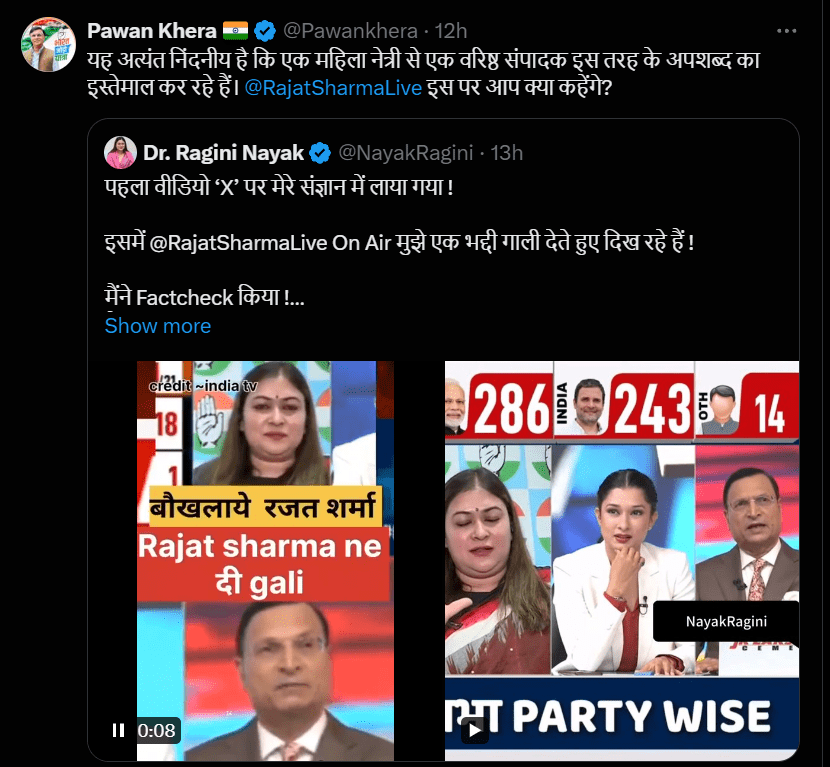
Screengrab of the tweet by Pawan Khera
Pawan Khera tweeted, “This is highly condemnable that a veteran journalist is using derogatory language against a female politician. What will you say about this, Rajat Sharma.”
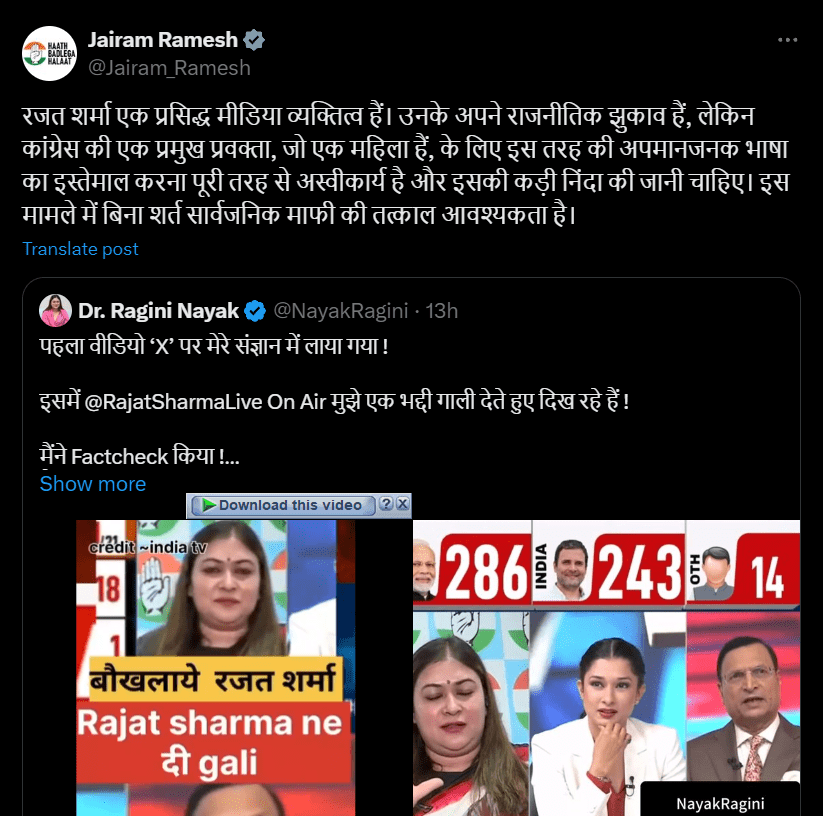
Screengrab of the tweet by Pawan Khera
Congress leader Jairam Ramesh claimed, “Rajat Sharma is a well-known media personality. He has his own political leanings but to use such abusive language for a prominent spokesperson of the Congress, who is a woman, is completely unacceptable and must be strongly condemned. An unconditional public apology is urgently required in this matter.”
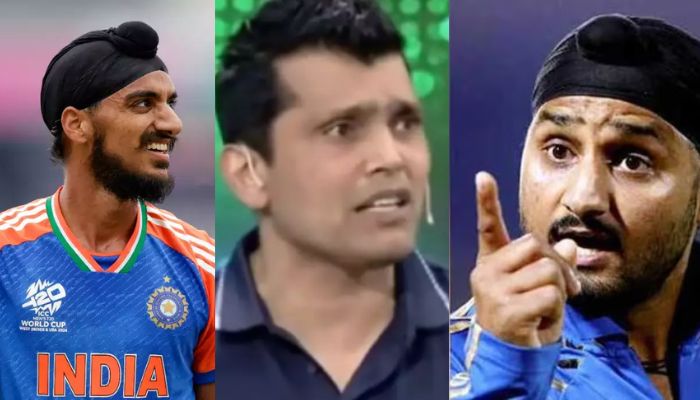
On Monday (10th June), former Indian spinner Harbhajan Singh blasted ex-Pakistan wicketkeeper Kamran Akmal for his outrageous remarks mocking the Indian bowler Arshdeep Singh and the Sikh community after India defeated Pakistan in World Cup contest. Taking to X, Harbhajan Singh asked Akmal to know the history of Sikhs before opening his “filthy mouth”.
“Lakh di laanat tere Kamraan Akhmal.. You should know the history of sikhs before u open ur filthy mouth. We Sikhs saved ur mothers and sisters when they were abducted by invaders, the time invariably was 12 o’clock . Shame on you guys.. Have some Gratitude.”
Lakh di laanat tere Kamraan Akhmal.. You should know the history of sikhs before u open ur filthy mouth. We Sikhs saved ur mothers and sisters when they were abducted by invaders, the time invariably was 12 o’clock . Shame on you guys.. Have some Gratitude @KamiAkmal23 ??? https://t.co/5gim7hOb6f
— Harbhajan Turbanator (@harbhajan_singh) June 10, 2024
Hours after Harbhajan Singh slammed Kamran Akmal for his “12 baj gaye hain” remark, a derogatory slur against Sikhs, the former Pakistani cricketer apologised to Harbhajan Singh instead of apologising to Arshdeep Singh against whom he made the hateful comment.
“I deeply regret my recent comments and sincerely apologize to @harbhajan_singh and the Sikh community. My words were inappropriate and disrespectful. I have the utmost respect for Sikhs all over the world and never intended to hurt anyone. I am truly sorry. #Respect #Apology,” the former Pakistani wicketkeeper-batsman wrote on X.
I deeply regret my recent comments and sincerely apologize to @harbhajan_singh and the Sikh community. My words were inappropriate and disrespectful. I have the utmost respect for Sikhs all over the world and never intended to hurt anyone. I am truly sorry. #Respect#Apology
As reported earlier, on a show on ARY News, where Kamran Akmal was a guest, he took a jibe at Arshdeep Singh and said even though Arshdeep’s rhythm isn’t looking good but ’12 baj gaye hain’, another co-panellist joined in and said no Sikh should be allowed to bowl at 12 o’clock.
Notably, this ’12 baj gaye hain’ is an insult directed towards the Sikh community in the illiterate part of the world. The insult implies that Sikhs don’t behave normally when the clock strikes 12. It is a sort of discrimination against a religion, it is offensive to them, and mostly, it is downright hateful most of the time.
Arshdeep Singh, in his last over yesterday, gave away only 11 runs and picked the wicket of Imad Wasim, sealing victory for India. Maybe Kamran Akmal saw it coming so he started badmouthing Arshdeep before he bowled that last over.
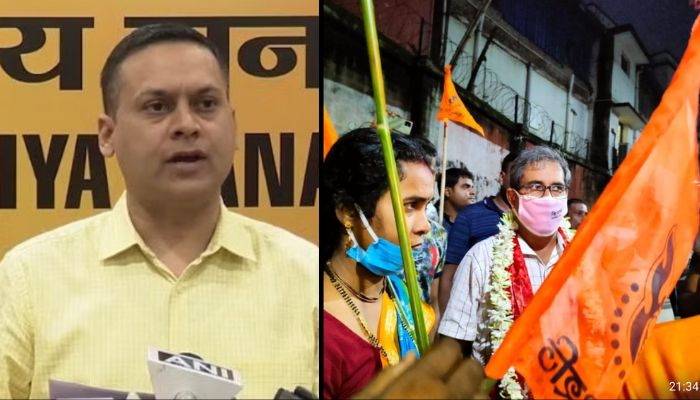
Days after Amit Malviya sent a legal notice to one Santanu Sinha for accusing him of demanding sexual favours from women politicians in West Bengal, the latter has now cried foul over the matter.
Sinha claimed that he did not level sexual harassment allegations against Amit Malviya and that his Facebook post had been deliberately misinterpreted by the Indian National Congress.
He has now issued a statement backtracking from his previous claims but pointed out that he would not delete the controversial post.
The transcript of his statement goes as –
“It is a great chagrin to me that the nastiest and most corrupted political party of the country, the Indian National Congress, being armed with a post in Bengali posted from my Facebook account, is spreading hate campaign against Mr. Amit Malaviya and the Bharatiya Janata Party,
No corner in the post there is any whisper about sexual exploition of women by Mr.Amit Malaviya. Rather I have there expressed my fear if Mr. Malviya will be drawn to honey trap by the unscrupulous leaders of the party to remain clung to their post despite such debacle in the recently held election. We have bitter experience of such honey trap during the tenure of Mr. Kailash Vijoyborgiya, Mr. Siddhartha Nath Sing, Mr. Pradip Joshi and Mr. Shibprasad. To be noted that criminal case arising of that honey trap is still pending against Mr. Kailash Vijoyborgiya, Mr. Pradip Joshi and Mr. Shibprasad. Sushri Mamata Banerjee several times threatened to bring out clips of the honey trap.
But to my extreme astonishment, none from the State BJP has ever tried to know the purport of the post, but played a dubious role. A legal notice sent from the end of Mr. Malviya by his learned Advocate was circulated amongst media, purposely, with a view to create pressure upon me on the one hand, and on the other, to divert their responsibility of the debacle in last parliamentary election in West Bengal. Several press people told me that Mr. Jaganath Chattopadhyay, de-facto president of the state party, is the man behind circulating the legal notice [I have the audio clips which I will bring out when require]. However I am ready to contest cases, civil or criminal, as threatened in the said legal notice, if any, is iniiated.
I want to give a clear message that the post was not aimed to malign Mr. Malviya but as caution not to get entangled in honey trap, which first brought to light by Mr. Tathagata Roy, ex-president of the State unit and former governor of Tripura with the phrase KAMINI KANCHAN.
I, a Sangha Swayam Sevak, former State Secretary of ABVP and contestant in State Assembly election and in the Kolkata Municipal Corporation election, do not want the Bharatiya Janata Party and its office bearers get undermined in any manner by misinterpretation of my post.
Be precious, Rahul is my causin brother. He has been unnecessarily dragged into the controversy. He has no role to play in my Facebook post.
If my post hurts Mr. Malaviya and/or undermines my party for such misinterpretation and edited version, I do express my heart felt sorrow for the same. Since I have not written anything untoward in my post, with the mission to malign anyone, I am not withdrawing the post, the bone of contention.“
The Background of the Controversy
In a post dated 7th June, Santanu Sinha accused Amit Malviya and other senior leadership of BJP of accepting sexual favours from leaders in West Bengal and in exchange providing them positions in the party.
He accused West Bengal BJP leaders of sending women to Malviya and other senior leaders of BJP women in 5-star hotels to secure the president’s posts.
In a press conference on 10th June, Congress’s IT Cell chief Supriya Srinate levelled sexual harassment allegations against BJP’s Amit Malviya based on social media post by Santanu Sinha on Facebook.
On 8th June, Bharatiya Janata Party (BJP) IT Cell Chief Amit Malviya sent a legal notice to one Santanu Sinha from West Bengal for making allegations of sexual misconduct against him.
As per the legal notice, the post against Malviya was published on 7th June 2024 on Facebook. The notice was sent by Supreme Court advocate Abhijeet on behalf of Malviya asking Santanu to take down the post and tender unconditional apology.
The notice pointed out that the post on Facebook by Santanu made “false and defamatory” allegations against Malviya with an “intention to harm his reputation.”
Santanu was asked to remove the post within three days. However, before the notice period could end, Srinate raised the issue in a press conference.