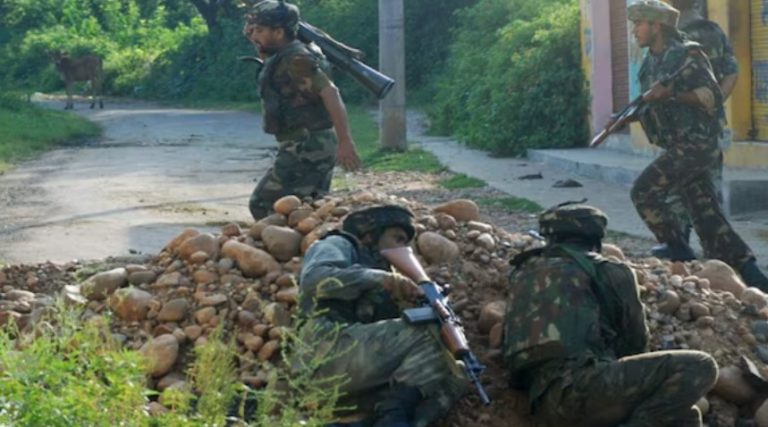
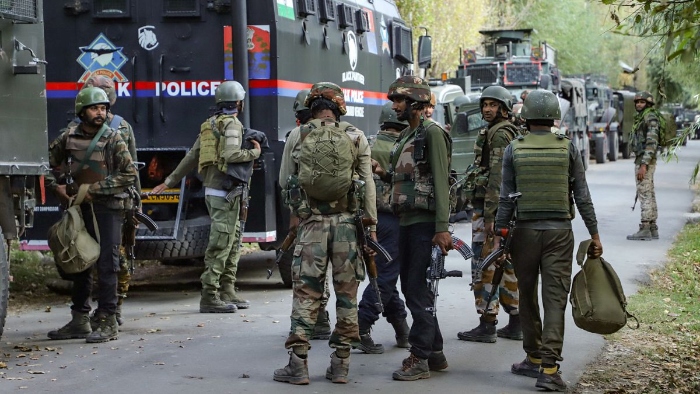
After Reasi and Kathua, terrorists attacked a temporary Indian Army operating base in Jammu and Kashmir’s Doda area on Tuesday, June 11. This is the third such attack in the Jammu region in the last three days.
Operations are underway. One terrorist was neutralised, and a civilian was injured. Five soldiers and a special police officer (SPO) were injured in the shootout.
On the Doda incident, Anand Jain, Additional Director General of Police, Jammu zone, who is supervising the anti-terrorist operation said that late last night, terrorists opened fire on a police and Rashtriya Rifles combined team at an army base in the Chattargala area. An encounter is underway between the security forces and the terrorists in the higher reaches, he said.
ADGP Jammu Anand Jain gives update about terror attack in Kathua & Doda of J&K. 1 terrorist killed in Kathua. 1 more terrorist likely in hiding, search ops launched by forces. 1 civilian injured. In Doda 4 RR & J&K Police Naka came under attack by terrorists. 2 soldiers injured. pic.twitter.com/q0DmyNg4bv
“One terrorist was neutralised, and one civilian was injured but is now out of danger. The operation is still ongoing, and senior officers are at the spot,” he added.
This terrorist attack in the Doda district occurred just hours after terrorists opened fire on a house in the Hiranagar area of Kathua in Jammu and Kashmir.
According to the police, one of the two terrorists who engaged in the attack in Kathua yesterday night has been killed. Drones are currently being used by security personnel in Kathua’s Hiranagar area to search for the second one.
According to the authorities, the locals became suspicious of the terrorists after they asked for water from multiple homes, and they resorted to shooting when someone raised an alarm.
Denying media reports that three people died in the Kathua attack, Jain confirmed that one civilian was injured in the firing.
“There are rumours that many people are injured and three are dead. But only one civilian was injured, other than this all information regarding hostages being held and death, are rumours,” he said.
The Additional Director General of Police, Jammu zone called the Kathua attack a “fresh infiltration” and hinted at Pakistan without explicitly naming it.
The first attack was on June 9, Sunday, at Reasi when the terrorists opened fire at a 53-seater bus when it was en route from Shiv Khori temple to Mata Vaishno Devi shrine at Katra near Teryath village in the Poni area. The bus veered off the road and fell into the steep valley. At least 10 people, including a child and three women, were killed and more than 40 others were injured in the deadly attack.
Hunter Biden, the eldest living son of the US president, has been convicted of all three felony charges related to the purchase of a revolver when, prosecutors argued, the president’s son lied on a mandatory gun-purchase form by saying he was not illegally using or addicted to drugs, CNN reported.
The jury, which deliberated for just under three hours, returned guilty verdicts on all three charges, which stemmed from a revolver Hunter Biden bought in October 2018 at a Delaware gun shop.
The first two counts were for lying about his drug use on a federal background check form, and the third count was for possessing a gun while addicted to, or using, illegal drugs.
His trial on gun charges began on June 3.
According to CNN. the former president’s son is accused of lying on federal documents regarding his drug usage at the time of the weapon’s purchase, obtaining a revolver illegally while under the influence of narcotics.
After the verdict, Hunter left the courtroom with his wife. US District Judge Maryellen Noreika stated that she would set the sentencing date later.
According to reports, on two charges, Hunter may face a sentence of up to 10 years and in the third case, he may face prison for up to five years, as per CNN.
This is the first time that the child of a US president has been tried on criminal charges and convicted.
Hunter Biden could face up to 25 years in prison and a fine of up to USD 750,000 at sentencing, though he likely will receive far less than the maximum as a first-time offender.
Before dismissing the parties, the judge told them sentencing is usually set for 120 days following a verdict, which means it is likely to happen before Election Day.
Prosecutors declined to comment following the verdict. Hunter Biden is expected to issue a written statement, a source familiar with the matter said.
In the moments following the verdict, after court ended, Hunter Biden turned around to his legal team and flashed a brief smile, perhaps stunned by the outcome, before hugging all of his attorneys and patting them on the back.
As he exited, Hunter Biden gave kisses and hugs to family members and friends in the courtroom, almost like a receiving line. His friend and financial backer, Kevin Morris, walked out with his arms crossed. Some of the supporters looked stunned.
Valerie Biden, President Biden’s sister, entered the courtroom a few minutes after the verdict was read.
Leaving the courthouse after the verdict, Hunter Biden shuffled his family members into an elevator as he held hands with his wife. He smiled briefly and left.
(This news report is published from a syndicated feed. Except for the headline, the content has not been written or edited by OpIndia staff)
On Sunday night, June 9, a Hindu Chemist Amarjit Sharma was found dead in Kathua in the Union Territory of Jammu & Kashmir with this throat slit open. Sharma was found dead outside his house in Mela village by his family members after they started searching for him when he didn’t return home, officials said
Following the brutal murder of Amarjit Sharma, his relatives and neighbours demanded immediate arrest of the unidentified culprits who murdered Sharma.
The target klling of Hindus by J1hadi trrorists continues.
A 35-year-old Hindu man named Amarjit Sharma was found dead with his throat s1it outside his house in Mela village, Kathua district. pic.twitter.com/2XYw0XKQYn
Following the murder, hundreds of people, carrying Amarjit Sharma’s body, blocked Jammu-Pathankot highway and the nearby railway track in nearby Hiranagar area on Monday morning. The Police and local authorities assured the protestors that a case has been registered and investigation is on, after that assurance, the protestors dispersed.
The protest ended nearly two hours after it started following the assurance by local authorities.
Notably, in same Hiranagar area of Kathua, gunshots were reportedly heard by villagers on Tuesday, June 11, police said. Upon receiving the information, the police rushed to the spot. Further details are awaited.
Two days after the terror attack in Reasi in which ten pilgrims were killed, gunshots were reportedly heard by villagers in the Hiranagar area of Kathua on Tuesday, police said. Upon receiving the information, the police rushed to the spot. Further details are awaited.
Meanwhile, Reasi Deputy Commissioner Vishesh Mahajan confirmed on Sunday night that at least 10 people were killed in the terror attack and 33 others were injured.
According to officials, the bus, en route from the Shiv Khori shrine to Katra, was targetted by terrorists at around 06.10 pm when it reached Pouni area of Reasi district bordering Rajouri district. “Terrorists opened fire, causing the driver to lose control and the bus to plunge into a gorge,” Senior Superintendent of Police (SSP) Reasi, Mohita Sharma told ANI.
The SSP further said that the rescue operations are complete and the injured have been taken to Naraina and Reasi District hospitals.
Lieutenant Governor of Jammu and Kashmir Manoj Sinha condemned the attack and assured action against those behind it. “I strongly condemn the cowardly terror attack on a bus in Reasi. My condolences to the family members of the martyred civilians. Our security forces and JKP have launched a joint operation to hunt down the terrorists,” the LG said in a post on X.
“PM Narendra Modi Ji took stock of the situation and has asked me to constantly monitor the situation. All those behind this heinous act will be punished soon. PM has also directed that all the injured are provided the best possible medical care & assistance,” the J-K LG added.
(This news report is published from a syndicated feed. Except for the headline, the content has not been written or edited by OpIndia staff)
After high-octane clashes between India and Pakistan in the past, there were often reports from Pakistan about fans breaking their TVs, emotionally breaking down on social media, or the national team changing its captain or coach. However, this time, it has gone to an extreme.
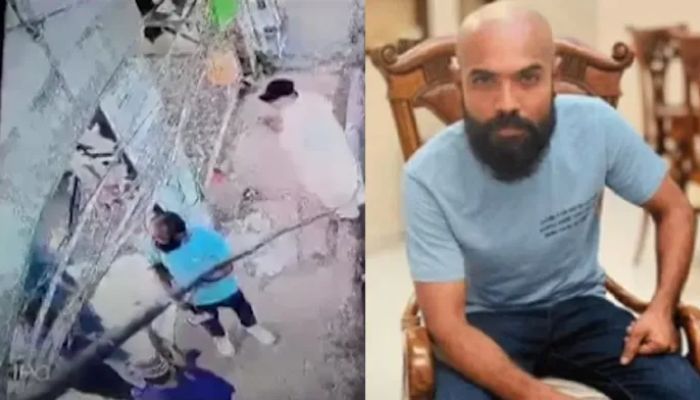
In Karachi, which is considered the economic capital of Pakistan, a security guard killed a YouTuber over a question about the much-hyped cricket match. Notably, the YouTuber was asking people questions about the India-Pakistan match in the T20 Cricket World Cup, but the security guard got angry and ended up shooting him dead.
According to reports, the YouTuber’s name was Saad Ahmed. He was 24 years old and the father of two children. Saad used to make vlogs for his YouTube channel. He was taking video bites from people in Karachi’s mobile market. During this time, he tried to ask the security guard something, but the angry security guard shot him at point-blank range. Saad immediately fell to the ground. People tried to lift and help him for a few seconds and rushed him to the hospital, but he died on the way.
A guard at Sereena Mobile Market shot Saad Ahmed (Youtuber) for filming and interviewing people about the India-Pakistan T20 World Cup match. In Karachi, no one knows if they will return home safely, may his soul rest in peace. pic.twitter.com/LOA3N9TTfU
The police arrested the accused security guard on the same day (5th June). The accused guard claimed that he did not know how the bullet was fired from the gun. He said that he does not know how to use a gun. He also mentioned that he is the father of five children and does not know what will happen to them now. This news from Karachi has left everyone shocked.
It is pertinent to note that this news reached the people of India after the ICC T-20 Cricket World Cup match between India and Pakistan had already concluded. In a close contest, India defeated Pakistan by 6 runs. The Indian batters posted a low score of 119 runs in 20 overs. However, when Pakistan came out to bat, they struggled to chase down a run-a-ball target and scored only 113 runs in their quota of 20 overs. After the humbling defeat at the hands of arch-rivals India, Pakistani cricket fans have been venting their anger at their national team.
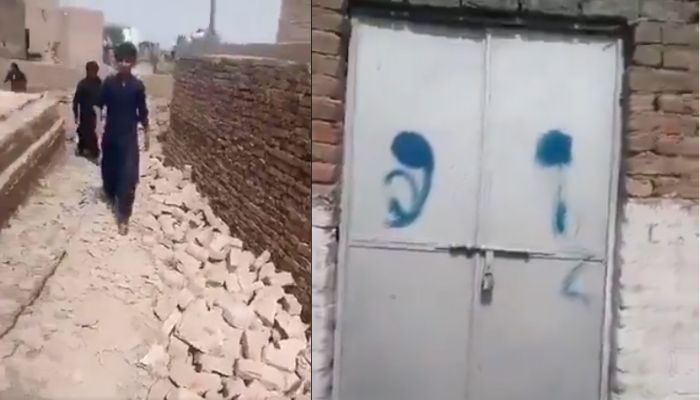
The Islamist attacks on Hindu temples have been rampant in the Islamic Republic of Pakistan, with two major incidents of vandalism and theft being reported in less than a month from the country’s Sindh province. While, Pakistani mainstream media has often blackened out reports of persecution of minorities, according to Rights watchers and minority groups, Islamists didn’t even spare a dilapidated Ram temple in the Kacchi Colony of the Tando Adam area in Sindh.
According to the information received, on 7th June, Islamist miscreants caused vandalism at the dilapidated temple in the Kacchi Colony in an overnight attack. They desecrated the Hindu temple and stole idols of Hindu deities and several copies of Geeta, the Holy Book despite the temple doors being locked. They also covered revered Hindu religious symbols including Om with spray paint.
Last month, Islamists looted and desecrated an ancient Hindu temple in Sochi Pada, Tando Adam which falls in Sindh’s Nawabshah district.
According to reports, the robbers stormed the temple by breaking the main gate and indulged in vandalism. The incident occurred at the revered temple dedicated to Hindu Lord Ramapir. The theft included a silver idol and crown of Lord Ramapir. They also stole jewelry worth lakhs, cash worth around Rs 70,000 from a donation box, and other valuable items. The attack sparked outrage among the local Hindu community and raised concerns about the safety and preservation of religious sites in the region.
A Hindu temple was desecrated by Islamista in Sochi Pada, Tando Adam, District Nawabshah, #Sindh#Pakistan.
Thousands of Rupees, along with jewellery worth rupees lakhs also stolen.
Such attacks adds more to the climate of discrimination and fear for religious minorities in Pak pic.twitter.com/WPviX4u6T4
“Sindh Chief Minister Syed Murad Ali Shah on Friday took notice of the theft of idols and other valuables from the “Rama Pir” temple in Tando Adam and has sought a report from concerned authorities,” Pakistani outlet ARY News reported on 17th May, this year.
According to the ARY News report, Sindh CM Shah directed the IG Police to recover all stolen goods including idols, and sought a report. Murad Ali Shah said that no high-handedness toward minorities would not be tolerated (sic).
The report added that CM Murad Ali Shah also directed the IG Sindh to submit a progress report regarding the recovery of the child abducted three days ago from Pano Aqil. He also sought a report regarding the recovery of the abductees in the last three days.
It is pertinent to note that the Rama Pir temple is one of the third largest pilgrimage sites for the Hindus in Sindh. It is situated in the heart of Tando Allayar in Sindh. Thousands of local Hindus visit the temple to seek blessings.
In the Islamic Republic of Pakistan, Hindu temples have been prone to incidences of looting and desecration, with the Pakistani establishment accused of being in cohorts with the Islamists in these attacks.
It has been reported that Hindu temples have been converted into Mosques, Madrasas, chicken shops, cattle farms, and sometimes even toilets, underscoring the atrocities against minority Hindus and their places of worship.
Amidst a string of attacks on Hindu temples in Pakistan, two major incidents were reported last year. In November 2023, Hinglaj Mata Mandir in Sindh and the UNESCO-recognised site Sharda Peeth Temple were demolished.
Earlier, in July 2023, over 150-year-old Hindu temple was bulldozed to the ground in Karachi, and another Mandir was attacked by ‘rocket launchers’ in Sindh. Both incidents took place within less than 24 hours.
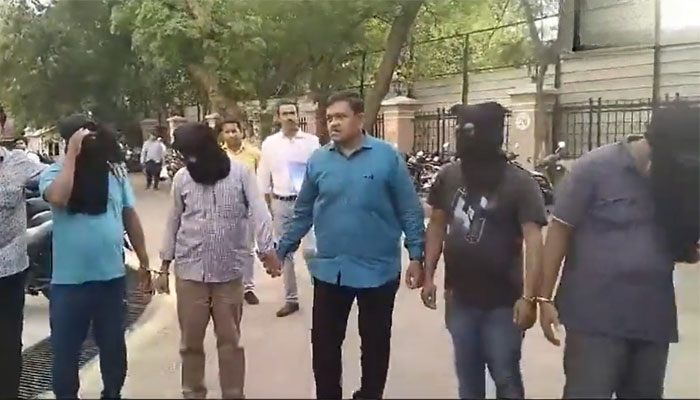
On 11th June, the Mumbai anti-terrorism squad (ATS) arrested four illegal Bangladeshi immigrants living in Mumbai, Maharashtra, who were using fake Indian documents. The accused have been identified as 33-year-old Riyaz Hussain Shaikh, 54-year-old Sultan Siddique Shaikh, 46-year-old Ibrahim Shafiullah Sheikh and 39-year-old Farooq Usmangani Shaikh. All of them hail from Kabit Haat of Moninangar in district Novakhali of Bangladesh.
#UPDATE | ATS presented all four accused before Mazgaon Court. The Court sent three of the accused to judicial custody. Fourth accused sent to ATS custody till 14th June. #Mumbai
The ATS identified five more Bangladeshis living in the city using fake Indian documents. A search operation has been initiated to apprehend them. Reports suggest that the arrested illegal immigrants also obtained voter cards and cast votes in the Lok Sabha Elections 2024. The voter cards were obtained using fake Indian documents.
ATS has booked the illegal immigrants under Sections 465, 468, 471, and 34 of the Indian Penal Code (IPC) and Section 12(1A) of the Indian Passport Act. Reportedly, the case against them has been registered for illegally staying in India. ATS also found out that the illegal Bangladeshis obtained proof that they went to live in Surat, Gujarat. They had obtained passports from Surat. According to ABP News report, they prepared fake documents in Gujarat and shifted to Mumbai. Riyaz and Sultan reportedly voted in Mumbai using the voter cards obtained from fake documents.
One of the five other Bangladeshis for whom ATS is looking for reportedly went to Saudi Arabia using Indian passports obtained using false documents. Rest of them are absconding and the investigating agencies are looking for them.
All of the arrested accused were produced in court by ATS. Three were sent to judicial custody while one of the them was sent to ATS custody till 14th June.
#WATCH | Mumbai ATS arrested 4 Bangladeshi nationals living in Mumbai with fake documents. All four were presented before Mazgaon Court today. The Court sent three of them to judicial custody while the fourth was sent to ATS custody till 14th June.
Nine illegal Bangladeshi women arrested earlier in Mumbai
Earlier, 9 female illegal Bangladeshis were arrested from areas around Mira Road, Mumbai. On 7th June, MBVV (Mira-Bhayandar, Vasai-Virar) police authorities announced that nine Bangladeshi women have been arrested in a major crackdown on illegal immigration for overstaying in India without the necessary documents. Another woman has also been apprehended for providing them with refuge. On 5th June, the Naya Nagar police carried out a raid in the Shanti Nagar and Gita Nagar areas of Mira Road based on confidential information, which led to the action.
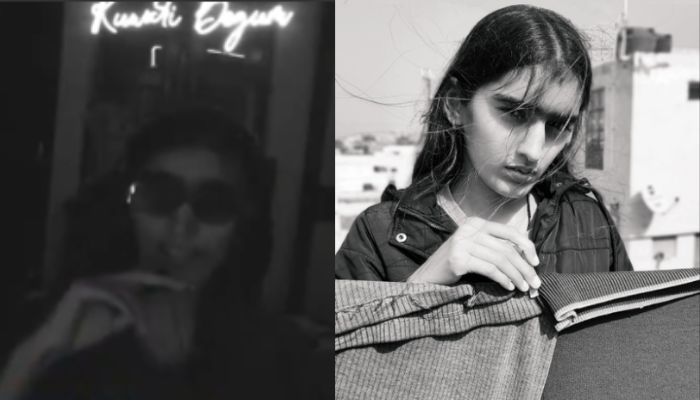
On Monday (10th June), a video of a YouTube creator named Shikha Metray, teaching her followers to sexually abuse infants, went viral on social media.
The accused had posted the disturbing video on her YouTube channel ‘Kuwari Begum.’ In the video, she could be heard saying, “If I had a d*ck, I would have made a tutorial on masturbation. I could have then shared tips on how masturbation can be made to feel better.”
“I would have also explained why you should masturbate. Find an infant who doesn’t even have teeth. Seek permission from the child’s mother to take the child somewhere and do something,” Shikha Metray laid out her ground plan to sexually abuse children.
While scrolling on YT, I came across this channel named – Kuwari Begum and this is what I found where this girl is openly and without any hesitation talking on her stream about CP and how to r*pe an infant. Is this our Indian Gaming Community all about? @TeamYouTube@YouTubeIndiapic.twitter.com/P3xxqO3ueV
“I am not so sorry. If I would have a d*ck, then, I would have tried it. Imagine children without teeth. Wow. It would be one heck of an experience,” she continued.
The revelations were made after a X (formerly Twitter) user named Gagan Chaudhary (@Gagan_772). A screenshot shared by the user showed that Shikha Metray had 2000 followers on YouTube and that she had uploaded about 115 videos (mostly comprising of sexual content).
Gagan also identified a Vogue profile and her account on X (formerly Twitter). OpIndia could find cached versions of her YouTube and Instagram channels, which have been deactivated since the expose by the X user.
I checked her entire channel its all about P*rn and sexual stuff but no gaming. When it is a gaming channel playing Valorant. How it is fine and a girl talks about all these stuffs but if a guy talks about all these he goes into in the jail. pic.twitter.com/IMno2F7aEj
Popular Men’s rights activist, Deepika Narayan Bhardwaj, informed that the accused hails from Ghaziabad in Uttar Pradesh and has graduated from National Institute of Fashion Technology (NIFT).
Okay so got to know that this woman's real name is Shikha Metray. She's from Ghaziabad, NIFT passout. She has deleted all her social media profiles, her YouTube is also not available now.
A Google search on her reveals some disturbing images posted by her earlier too. pic.twitter.com/oeiyoiUOIy
— Deepika Narayan Bhardwaj (@DeepikaBhardwaj) June 11, 2024
Bhardwaj has tagged the Ghaziabad police and also demanded action from National Commission for Protection of Child Rights (NCPCR) chief Priyank Kanoongo.
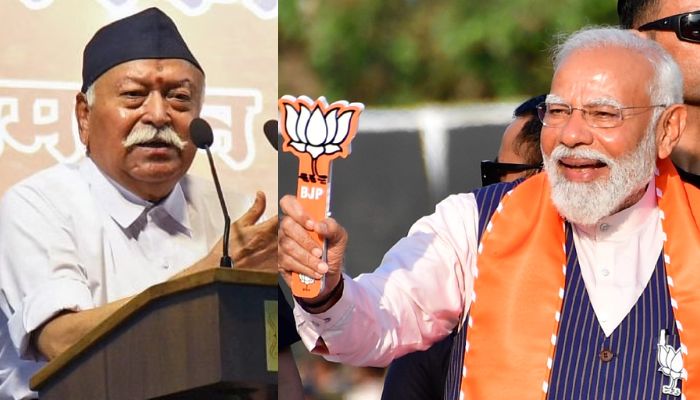
Narendra Modi has become the Prime Minister of India for the third time. The BJP-led NDA has formed the government in Centre with a clear majority. The 2024 Lok Sabha election, however, resulted in a significant drop in the BJP-NDA’s seats with BJP missing the majority 272 mark. On the other hand, the Congress party, though failed to get three-digit seats on its own, has increased its seats from 52 to 99. The opposition’s I.N.D.I. bloc defied all exit poll predictions to bag 233 seats. In his first remark on the election outcomes, Rashtriya Swayamsevak Sangh (RSS) chief Mohan Bhagwat shared his words of wisdom for the new government and the opposition. He addressed a wide range of issues from Manipur to what makes a “true Sevak” alongside deeming the 2024 electoral campaign as “devoid of standards”.
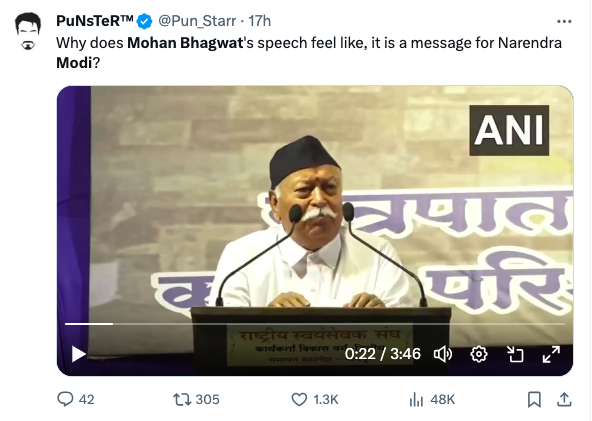
“The outside atmosphere is different after the Lok Sabha elections are over; the new government has also taken shape. Why it has happened, does not concern the Sangh. The Sangh works for refining public opinion in every election, did it this time also but does not get entangled in the analysis of the outcome,” Bhagwat said during his speech at the Karyakarta Vikas Varg programme in Nagpur on 10th June.
Mohan Bhagwat emphasises the importance of building consensus
Addressing an audience of RSS leaders and workers in Nagpur on the day the new BJP-led coalition convened its first Cabinet meeting, Bhagwat emphasised the necessity of creating consensus. “Election is a process of building consensus. Parliament has two sides so that both aspects of any question can be considered…every issue has two sides. If one side is addressed by one party, the Opposition party should address the other dimension, so that we reach the right decision,” Bhagwat said.
RSS chief highlights the qualities of a “true sevak”
Delving into what makes a true “sevak”, the RSS chief quoted a Doha composed by poet Kabir and said, “Nirbandha Bandha Rahe, Bandha nirbandha hoye..Karm kare karta nahi..das kahaye soye…A true sevak maintains decorum while working… The one who maintains decorum does his work, but remains unattached. There is no arrogance that I did this. Only such a person has the right to be called a sevak.”
Emphasising the significance of upholding the “maryada” [decorum], Bhagwat said that elections are a democratic process where the opponents do everything possible to keep themselves ahead of each other, however, even in doing so, decorum should be maintained. He said elections should be seen as a competition and not war.
Speaking about the opposition, Bhagwat said, “I do not call it Virodhi Paksh, I call it Pratipaksh. The Opposition is not an opponent. It is revealing a side of the issues and that must be deliberated upon. If we understand that this is how we must operate, then we must be cognizant of the decorum required in contesting elections. That decorum was not maintained (in the elections).”
The RSS chief further asserted although there can never be 100% alignment of thoughts and ideas, the political leaders across party lines should walk together to build consensus. “Rigveda rishis understood the human mind and accepted that complete unanimity is unattainable. However, when society decides to work with consensus, it achieves Sah-Chitta,” he said.
“Our parliament has two sides so that both sides can be heard. Every coin has two sides. If one side brings an idea, then the other side has to reveal the other perspective. We need to free ourselves of the rhetorical excesses of the elections and think about the future,” Bhagwat added.
Mohan Bhagwat slams political parties for divisive poll campaigns
“The way in which events have unfolded, with each side engaging in below-the-belt attacks, ignoring the divisive impact of campaign strategies, and increasing social and mental fault lines, is concerning. The way no one cared about social divisions being created because of what was being done…RSS was unnecessarily dragged into this. Using technology, absolute falsehoods were spread. Does technology equate to knowledge?” We must move beyond the excitement of elections and focus on the country’s challenge,” the RSS chief said.
It is pertinent to mention here that artificial intelligence was misused by various political parties to peddle fake narratives. Deep fake videos were created to spread fake news and hateful propaganda. A deep fake video of Union Home Minister and BJP leader Amit Shah was also circulated on social media by Congress workers. As a case was registered by Delhi Police, several members of Congress’s social media team were arrested for creating and circulating the fake video. The deep fake video falsely depicting Union Home Minister Amit Shah saying they would end reservations for SC-ST and OBCs was shared by the Telangana Congress’ social media handles.
“Manipur is burning”: RSS chief raises concern over tense situation in Manipur
In response to the ethnic violence in Manipur, Mohan Bhagwat stated that the state has long been waiting for peace, even though it has been peaceful for the past decade.
“Everywhere there is social disharmony. This is not good. For the past year, Manipur has been awaiting peace. It was peaceful for the past one decade. It appeared that the gun culture of yore was gone. But the gun culture that took shape suddenly, or was created, Manipur is still burning. Who is going to pay attention to it? It is a duty to deal with it on priority,” he said.
Notably, the BJP lost the 2024 Lok Sabha Elections in Manipur and the Congress won both seats in the BJP-ruled state.
Mohan Bhagwat lauds the Modi government for its work in the last ten years, and adds NDA is not free from challenges
The RSS chief praised the Modi government for its efforts in leading the country on the path of development and progress especially in the arena of economic growth and defence etc. “The same government, the National Democratic Alliance [NDA], has returned to power. Numerous positive developments have occurred over the past ten years. We have made progress in in last 10 years in various fields such as the economy, defence strategy, sports, culture, and technology. However, this does not imply that we are now free of challenges,” Bhagwat said.
Anti-Modi ecosystem uses Mohan Bhagwat’s speech to attack PM Modi and BJP
The RSS chief’s comments on the Manipur issue have given the opposition and its ‘ecosystem’ ammunition to attack Prime Minister Narendra Modi. On 11th June, Rajya Sabha MP and former Congress leader Kapil Sibal said that it is not in the DNA of PM Modi to listen to the opposition’s advice but he should at least listen to the RSS chief. He further claimed that the BJP created an “us vs them” environment during the election campaign.
“We raised concern about Manipur, Bhagwat ji has also said it now. You don’t listen to us because you are not used to listening to us but listen to him. It is not in your DNA to listen to us. Manipur should be given priority. I had asked for removal of CM N Biren Singh, but you could not remove the former wrestling body chief, what will you do about the CM,” Sibal said.
Modi ji : Attend to :
Rising militancy in Kashmir(Reasi) Manipur Social unrest Unemployment Inflation
You won’t listen to us That’s not in your DNA
At least listen to Bhagwat ji !
And then go to Vivekananda Rock Memorial and do ‘dhyaan’ without a camera !
“I have been saying this for months, with statements, an environment of ‘us versus them’ is being created. We need to take the country forward. I welcome the statement of Mohan Bhagwat…” Sibal added.
Meanwhile, journalist Tavleen Singh claimed that the RSS chief in his speech analysed the reasons behind the BJP’s failure to win a full majority. She insinuated that somehow Bhagwat warned the BJP against arrogance and treating the opposition as enemies.
“The RSS chief has analysed perfectly why Modi failed to win the BJP a full majority. He has warned against arrogance and against treating elections like war and opponents like enemies. Well said Mohan Bhagwat,” Singh posted.
The RSS chief has analysed perfectly why Modi failed to win the BJP a full majority. He has warned against arrogance and against treating elections like war and opponents like enemies. Well said Mohan Bhagwat.??
RSS is the ideological foundation of BJP, no matter what politicians claim
The opposition, its media allies and the extended ecosystem are using Mohan Bhagwat’s speech to fuel a dispute between the BJP and RSS in addition to establishing a narrative that the RSS is upset with the BJP leadership, especially PM Modi. However, the BJP needs serious introspection into what all went wrong in the general elections. While the RSS chief talked about the arrogance displayed by politicians during these elections, he did not name any political leader either from the BJP-NDA or from the I.N.D.I. bloc. Despite this, political leaders, especially those belonging to the BJP can learn a lot from the RSS chief’s speech.
As Bhagwat talked about how a true “sevak” is free from arrogance and upholds the “Maryada”, the BJP candidates who displayed arrogance and did not even try to connect with the people in their constituency and solely relied on PM Modi’s charisma need to stop taking the voters for granted, and instead of being lazy and complacent should become approachable and work for their people.
It is pertinent to recall the BJP president, JP Nadda’s statement last month that the party has become strong enough and does not need the support of RSS in election campaigns. “Initially, we would have been less capable, smaller and needed the RSS. Today, we have grown and we are capable. The BJP runs itself,” Nadda said adding that RSS is the “ideological front”. Although it is a fact that the BJP alone won more seats than the entire opposition alliance could, the party suffered a significant reduction in seats. This, was shocking and embarrassing for the BJP since it fought the election with the “Abki baar 400 paar” ambition.
As the RSS chief stressed, the Modi government in its third term should deal with the Manipur issue more effectively and restore peace in the state. Moreover, the BJP leaders should refrain from making controversial and self-harming statements especially when speaking about the constitution and reservations. It was seen how the opposition used the comments of BJP’s Anant Hegde and Lallu Singh about ‘changing’ the constitution for fear-mongering that the BJP with end reservations.
It is worth noting that many RSS members who had previously participated in ground-level awareness campaigns and even actively tried to encourage citizens to vote remained inactive this time. There were also reports of RSS cadres being neglected by some senior party leaders. RSS is the foundation of the BJP; while they have taken on ideological and political roles, the two are inextricably linked. The BJP’s high command should avoid ignoring RSS, and the Sangh should not abandon the BJP, particularly during elections.
A case of heinous crime against a minor has come to light from Rampur district of Uttar Pradesh. An FIR has been registered against a man named Armaan, son of Shahid. He is accused of sexually assaulting a watchman’s six-year-old boy. Police are carrying out a search operation to apprehend Armaan who has been absconding since an FIR was registered against him. Meanwhile, the minor victim is undergoing medical examination and counseling. The incident occurred on Saturday (8th June 2024).
According to reports, the incident took place in the Swar police station area of Rampur district. On Saturday (8th June), the father of a 6-year-old child lodged a complaint at the police station stating that on the day of the incident, his child was playing outside the house with his friends. At that time, Armaan, who is also from the same village, approached them. He coaxed the victim and took him to the riverbank. At a deserted place, Armaan sexually assaulted the minor victim.
During this time, the child started crying, but it had no effect on Armaan. After committing the heinous act, Armaan let the child go. When the minor victim reached home, he kept crying. Later he narrated his ordeal to his family. When the boy’s father went to Armaan’s house to complain, the accused abused him and threatened to kill him. Subsequently, the boy’s father went directly to the police station and filed a report.
Police have registered an FIR against Armaan under Section 377 of the Indian Penal Code (IPC) and Sections 5(m)/6 of the POCSO Act. After learning about the FIR, the accused Armaan absconded. OpIndia has a copy of the complaint filed by the father of the minor victim.
SHO of Swar Police Station Inspector Sandeep Tyagi told the media that a search operation is underway to apprehend the absconding accused, Armaan. He assured that the accused will be arrested soon. The minor victim has undergone a medical examination and is receiving treatment. Counseling is also being provided. Investigation and other necessary legal actions are being carried out in the case.