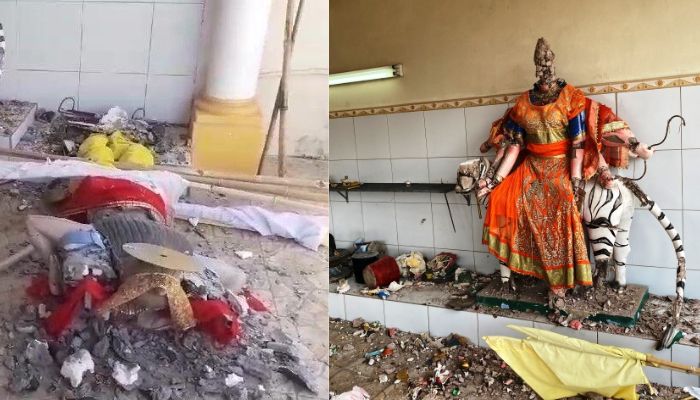
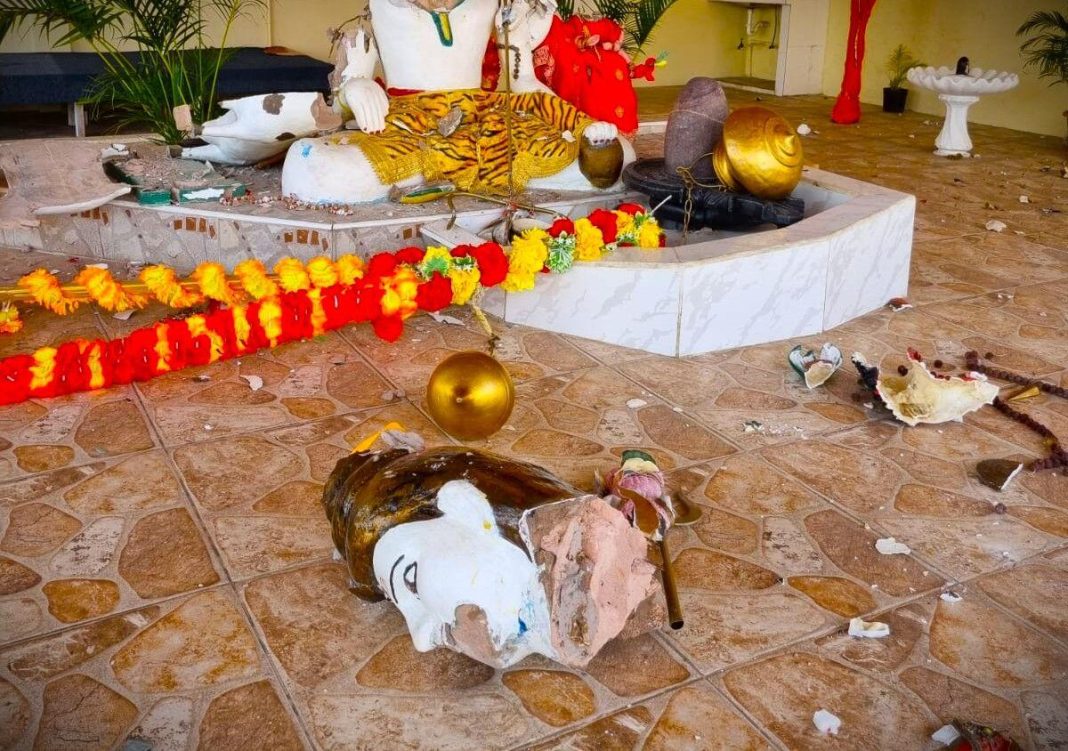
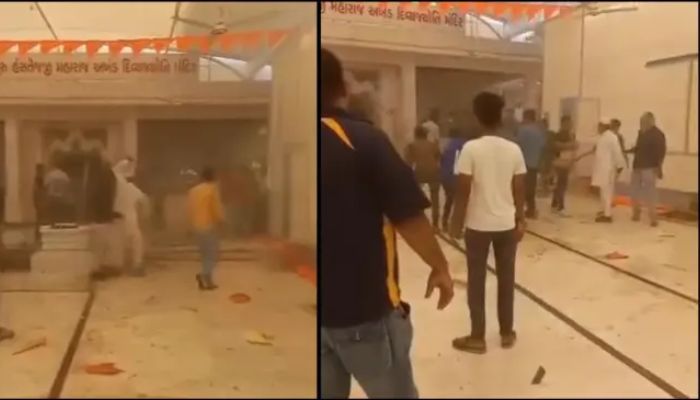
On Wednesday (8th May), several people stormed into the Bharatiya Abhyas Mandali, a Hindu Temple on Watts Street in Curepe, Trinidad and Tobago and vandalised it. The Hindu temple desecrated by the attackers is administered by Sanatan Dharma Maha Sabha. The attackers destroyed six idols. Reports say that the St Joseph Police and CID are investigating the incident.
Meanwhile, Sanatan Dharma Maha Sabha said: “Six murtis sized four feet were destroyed, and smashed to pieces in the most violent manner. Once again a place of worship was attacked. Obviously, this is not the unholy work of a vagrant or a band of vagrants.”
Source: Trinidad Express
SDMS General Secretary Vijay Maharaj described the attack on the Hindu temple as the “worst form of sacrilege committed”.
This, however, is not the first time that a Hindu temple has been vandalised. In December last year, the Munroe Road Temple was also attacked and donation boxes with cash were stolen along with gold jewellery placed on Hundi murtis.
On the 15th of October last year, the Kali Maa Temple in Carli Bay was desecrated, with acid reportedly poured on the floor and the Kali Maa murti. In the same month, some people vandalised the Sanatan Dharma Maha Sabha (SDMS) D’Abadie Maha Vishnu Mandir on Mausica Road.
In another incident of violence against Hindus and an attack on their temple in October last year, stones were hurled at the Pranavananda Ashram at Temple Street off Beaucarro Road in Freeport, when Hindus were performing Kanya Kumari pooja during Navratri festival. It was reported that some youths while were hurling objects from the temple’s rooftop. The attackers also damaged five vehicles.
This incident had sparked an outrage in Trinidad and Tobago with opposition MP Indra Singh calling it the “latest anti-Hindu attack in South Couva. Just two days before this attack, a popular Ramleela site, Tarouba Recreation Grounds was targeted. The attackers stole the tents and destroyed props created for use in the Ramleela production. In September last year, the Williamsville Hindu temple was vandalised.
On 28th September 2022, the Kali Mata temple in Carli Bay in Couva was vandalised and desecrated by unknown miscreants. The vandals had broken into the temple in the night and damaged the idol of Goddess Kali. They also smeared olive oil on the idol. The attackers wrote a verse from the Bible on the walls of the temple, which contains a warning against non-Christians. They wrote ‘Read Exodus 20:3-4’ in big red letters on the outer walls of the temple.
This attack came just a week after a Ganesh Mandir was vandalised in Penal on the night of 22 September 2022. It was found that a Ganesh murti was broken, clothes were pulled out from other murtis, and a cigarette butt was left behind.
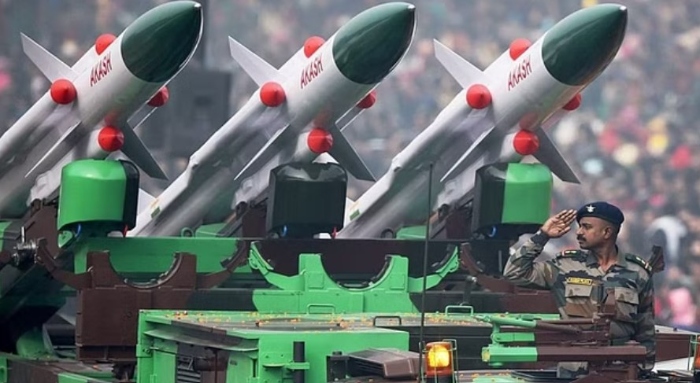
According to a senior procurement officer, the Indian Army will stop importing ammunition in the upcoming fiscal year since its domestic industry has increased its production capacity to satisfy the military’s requirements.
The Indian Army’s Additional Director General (Procurement), Major General V.K. Sharma, said that although the army had previously placed a significant emphasis on imports to meet its yearly ammunition needs, it has now found domestic suppliers for about 150 of the 175 types of ammunition it uses.
“In the next financial year, we will not have any import of ammunition, except in cases where the quantity required is too low for domestic production to be economically viable,” Maj Gen Sharma said during a seminar on ammunition production organised by the PHD Chamber of Commerce and Industry (PHDCCI).
The Indian Army plans to stop all imports of ammunition from the next financial year, as the domestic industry has increased its capacity to meet demands and potentially gain a share of the global market. @adgpi@ajitkdubeypic.twitter.com/sUNXL1cLL1
The army currently spends between Rs 6,000 and Rs 8,000 crore a year on ammunition, all of which would now come from Indian manufacturers.
As a result of a gradual implementation of a negative import list or positive indigenisation lists, foreign producers currently supply only 5–10% of the army’s ammunition requirements.
Positive indigenisation lists are lists of items released by the Indian Ministry of Defence (MoD) that India has the capacity to make domestically and will not be imported.
The capacity for domestic manufacturing has risen due to the establishment of new ammunition plants by a number of private sector enterprises in recent years, in addition to the recently corporatized Ordnance Factories.
The largest ammunition complex in Asia was opened by Adani in Kanpur two months ago, in February 2024. Thousands of rockets, missiles, small- and large-calibre ammunition, and artillery rounds will be produced at the site for the security forces.
In addition, Tata became the first private aircraft producer in India, aside from the government-owned Hindustan Aeronautics Limited, when it started assembling the Airbus C-295 transport plane.
The aim is to stop all ammunition imports by 2025-26.
The security forces have released the photographs of all three terrorists, captured on CCTV footage, who are believed to have attacked the Indian Air Force convoy in Jammu and Kashmir’s Poonch district last week. The attack had claimed the life of Corporal Vikky Pahade while four of his colleagues were injured.
As per reports, all three terrorists used high-powered assault rifles, United States-made M4s and Russian-made AK-47s, in the attack. So far the investigation has revealed that an Ex-Pakistani Army commando and a Pakistani terrorist were involved in the Poonch terror attack.
The security forces have identified the three terrorists as Illiyas, a former Pakistan Army commando, a Pakistani terrorist named Hadoon (or Hadun), and Abu Hamza, the code-name of the commander of the banned terror outfit Lashkar-e-Taiba (LeT). Notably, the former Pakistani Army commando, Illiyas also goes by the code name ‘Fauji’.
Earlier, the security forces released the sketches of two terrorists involved in the Poonch attack on the IAF convoy. According to the sketch released by the J&K Police, Hamza is a man aged between 30 to 32 years, of medium build, and fair complexion, with a neatly trimmed haircut. He was last spotted dressed in a Pathani suit accompanied by a brown shawl and carrying an orange bag. A reward of ₹ 10 lakh has been announced for any information that leads to his arrest.
India Today citing sources reported that the terrorists carried out attacks for the People’s Anti-Fascist Front (PAFF), an affiliate of the Jaish-e-Mohammed. Sources added that a massive search operation is underway in the forests of Rajouri and Poonch to track the terrorists down. So far, the officials have narrowed down on several suspects and have questioned multiple persons over their links with the three terrorists.
Notably, the PAFF is a Jaish-backed terror group. It also claimed responsibility for the attack on an Army vehicle that killed four soldiers in Poonch in December last year.
The assault on the IAF convoy on May 4th came after a series of terrorist incidents in the Poonch and Rajouri regions in recent weeks. Among these attacks was one in the Shadra Sharief area of Rajouri, where a 40-year-old government employee was fatally shot outside a mosque.
The 40-year-old man identified as Mohammad Razak worked with the social welfare department. It was revealed that his attackers used a United States-made M4 assault rifle and also a pistol. When the attack unfolded, Md Razak was accompanied by his brother who is a soldier in the Territorial Army.
A senior officer said that the terrorists tried to kidnap him but he managed to escape unhurt. According to security officials, the terrorist code-named Abu Hamza was behind that attack.
Prior to these attacks, two non-locals – a migrant worker from Bihar and a man from Dehradun – were targeted in the Anantnag and Herpora areas of Shopian district.
Meanwhile, in a major crackdown on terrorism, Kashmir Police on 7th May killed the most wanted commander of The Resistance Front (TRF) Basit Ahmed Dar in an encounter in Redwani Payeen of south Kashmir’s Kulgam district. He was classified as an ‘A’ category terrorist and the NIA had announced a Rs 10 Lakh reward for details leading to his arrest. Kashmir Zone IGP, V K Birdhi stated that Basit was involved in more than 18 cases of killing of police personnel and civilians.
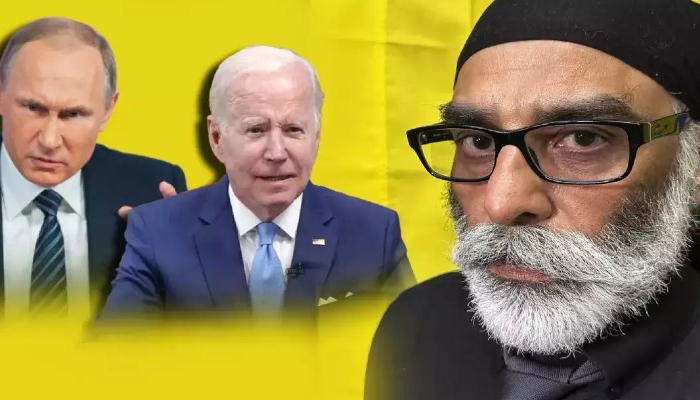
Rubbishing the allegations by the US on India for a foiled assassination plot against pro-Khalistan radical Gurpatwant Singh Pannun, the Russian Foreign Ministry said that Washington has not yet provided any reliable evidence of the involvement of Indian citizens in the case.
“According to the information we have, Washington has not yet provided any reliable evidence of the involvement of Indian citizens in the preparation of the murder of a certain GS Pannun. Speculation on this topic in the absence of evidence is unacceptable,” the official spokeswoman of the Russian Foreign Ministry, Maria Zakharova said at a briefing on Wednesday (local time).
She said that the US does not understand the national mentality, as well as the historical context of the development of the Indian state and it disrespects India as a state.
Zakharova’s remarks came in response to a media query on Moscow’s reaction to accusations against an Indian official of a foiled “assassination” plot, and the American news publication ‘The Washington Post’ stating that India is trying to do the same as Russia and Saudi Arabia against its enemy.
“‘The Washington Post’, it seems to me, should use the term “repressive regime” and everything you quoted in relation to Washington. It is difficult to imagine a more repressive regime than Washington, both in domestic and international affairs. Now directly about your question,” Zakharova said, according to the readout of the briefing released by the Russian Foreign Ministry.
“Regular unfounded accusations by the United States against New Delhi (we see that they groundlessly accuse not only India but also many other states) of violating religious freedoms are a reflection of the United States’ misunderstanding of the national mentality, the historical context of the development of the Indian state and disrespect for India as a state. I am sure that this also comes from the neocolonial mentality, the mentality of the colonial period, the period of the slave trade, and imperialism,” she said.
“This does not only apply to India. The reason is the desire to unbalance the internal political situation in India in order to complicate the general parliamentary elections taking place in the country. Of course, this is part of interference in India’s internal affairs,” she added.
Gurpatwant Singh Pannun is an India-designated terrorist who holds American and Canadian citizenship. Earlier in November, the US Justice Department unsealed an indictment against an Indian national for his alleged involvement in a foiled plot to assassinate Pannun.
The External Affairs Ministry, in April, had rejected a report in The Washington Post naming Indian Research and Analysis Wing (RAW) official’s involvement in the alleged post to kill Khalistani terrorist Gurpatwant Singh Pannun in the US.
Describing it as an “unwarranted and unsubstantiated” imputation on a “serious matter” that is under investigation, Ministry of External Affairs (MEA) official spokesperson Randhir Jaiswal said the US media report was “speculative and irresponsible”.
In response to media queries on the report that appeared in the Washington Post, a US national daily, Jaiswal said that a High-Level Committee set up by the Indian government is carrying out an investigation into the security concerns shared by the US government on networks of organized criminals, terrorists, and others.
“The report in question makes unwarranted and unsubstantiated imputations on a serious matter. There is an ongoing investigation of the High-Level Committee set up by the Government of India to look into the security concerns shared by the US government on networks of organised criminals, terrorists and others. Speculative and irresponsible comments on it are not helpful.”
Citing officials and a US indictment, the Washington Post report claimed that the RAW official identified as Vikram Yadav had directed Indian businessman Nikhil Gupta, to hire a hitman to kill Pannun outside his New York residence.
Gupta, now in custody in the Czech Republic has a pending extradition to the US to stand trial in the case. As per the report in the US Daily, the operation targeting Pannun was approved by then-RAW chief Samant Goel.
Notably, as per the US Justice Department indictment, Indian national, Nikhil Gupta, who is currently in custody, has been charged with the murder-for-hire of Pannun.
The US Justice Department has claimed that an Indian government employee (named CC-1), who was not identified in the indictment filed in a federal court in Manhattan, recruited an Indian national named Nikhil Gupta to hire a hitman to carry out the assassination, which was foiled by US authorities, according to prosecutors.
Gupta has been charged with murder-for-hire, which carries a maximum sentence of 10 years in prison. Czech authorities arrested and detained Gupta on June 30, pursuant to the bilateral extradition treaty between the United States and the Czech Republic.
Following this, MEA said that a case filed against an individual in a US court and allegedly linking him to an Indian official is a “matter of concern” and is contrary to government policy.
India has also set up a high-level committee to probe the matter.
(This news report is published from a syndicated feed. Except for the headline, the content has not been written or edited by OpIndia staff)
On Wednesday evening (8th May), the Prerna Peeth Nishkalki Temple at Pirana in Ahmedabad came under attack by an Islamist mob. The video of the incident is going viral on social media in which several miscreants are seen wearing skull caps. In the viral videos, the Islamist mob is seen holding sticks and iron rods. According to the Vishwa Hindu Parishad, it was a pre-planned attack in which the Islamist mob vandalised several Murtis (idols) of Hindu deities.
It is pertinent to note that a controversy has been going on around this Prerna Peeth temple for years. While the Muslim party has been alleging that it is a shrine, the Hindu side maintains that it is a temple.
Shocking news coming from Karnavati : Some "oppressed miscreants" attacked a temple & destroyed idols of Hindu gods/goddesses.
— Mr Sinha (Modi's family) (@MrSinha_) May 8, 2024
As per reports, there was a rumour that some graves were removed from the site. Subsequently, local Muslims gathered around the place in large numbers as the rumour about the removal of the graves spread. In the pandemonium, one such Islamist mob forcibly entered the temple. It is alleged that the miscreants also damaged the wall within the temple premises. The miscreants who can be seen holding wooden sticks and iron batons then launched an attack and vandalised the place.
A video of the Muslim community attacking the Prernapeeth Pirana Nishkalkan temple in Ahmedabad is going viral.
According to a post by the Vishwa Hindu Parishad, several idols of gods and goddesses in the temple were vandalised in the pre-planned attack.
A video of the attack was posted on the official Instagram account of Vishwa Hindu Parishad, Gujarat. In the post, VHP claimed that the attack was pre-planned. It further claimed that several idols of Hindu Gods and Goddesses installed inside the temple were broken in the attack. OpIndia tried to contact the VHP in this regard but failed.
Additionally, Bajrang Dal’s Gujarat unit also posted videos of the mob attack. It wrote in Hindi, “In this video, it is clearly visible that a large number of atheists broke the wall of the temple premises and entered inside and created a ruckus.”
Following the incident, the Ahmedabad rural district police station and police convoy including SOG, and LCB also rushed to the spot in Pirana. They immediately brought the situation under control. Further investigation is currently underway in this matter.
This report will be updated as more information comes to light.
Between 1950 and 2015, the population share of Hindus in India declined sharply by 7.8% while Muslim share grew by 43.15%, Christians by 5.38%, and Sikhs by 6.58%, as revealed by a recent report submitted by the Economic Advisory Council to the Prime Minister of India, Narendra Modi (EAC-PM). However, the share of Jain and Parsi communities in the population mix has decreased in the last 65 years which is equivalent to three generations.
The study titled, Share of Religious Minorities – A Cross-Country Analysis (1950-2015)was released in May 2024. It has been co-authored by Shamika Ravi, Abraham Jose, and Apurv Kumar Mishra. It assessed the global trends of the demographic shift in 167 countries where a religious denomination/group was in the “majority”.
(Study by the PM-Economic Advisory Council notes that change in religious demography is a marked global phenomenon)
According to the study, the share of Hindus in India’s population saw a decrease from 84% in 1950 to 78% in 2015, while that of Muslims witnessed an increase from 9.84% to 14.09% in the same period.
Contrasting India’s demographic shift with our neighbourhood
While India’s performance is “consistent with the larger global trends”, the country’s population growth story is starkly different from nations in its immediate neighbourhood. As stated above, Hindus, the majority community in India, registered a decline of 7.8% between 1950 and 2015.
However, in neighbouring countries where Muslims (or their sect) constitute more than 50% – a majority, the community’s share witnessed an increase in the demographic mix. Bangladesh saw the steepest increase of 18.5%, followed by Pakistan (3.75%) and Afghanistan (0.29%).
According to the study, Pakistan witnessed an increase of 3.75% in the share of the majority religious denomination (Hanafi Muslim) and a 10% increase in the share of the total Muslim population despite the creation of Bangladesh in 1971. Pertinent to note that while Muslims’ share increased by 10%, the study registers the rise of Pakistan’s majority as 3.75% as Hanafi Muslims constitute the majority ID in Pakistan, as per the study.
However, Hindus’ decline by 7.8% in India is the second most significant decline in the immediate neighbourhood, just after Myanmar’s 10%. Myanmar saw the highest decline in the majority community’s share in the overall population of the country.
In Myanmar, the majority population of Theravada Buddhists declined by 10% in 65 years. According to the study, just like India, Nepal’s majority community (Hindus) saw a 3.6% decline in its share of the country’s population.
India’s neighbours with a majority Buddhist population, Bhutan and Sri Lanka, also saw an increase of 17.6% and 5.25%, respectively. However, in the Maldives, the share of the majority group (Shafi’i Sunnis) declined by 1.47%, as per the study by PM’s EAC.
An increase in minority population reveals an overall favourable environment for ‘minority’ in that particular country: Study by PM-EAC lauds India’s track record on safeguarding minorities
According to the study, a reducing majority i.e. a negative rate of change in the share of the majority population (and an increase in the share of the minority population) from 1950-2015 means that it can be safely concluded that there exists an overall favourable environment for increasing diversity in the country.
The study noted, “Contrary to the noise in several quarters, careful analysis of the data shows that minorities are not just protected, but indeed thriving in India. Contrary to the noise in several quarters, 28 careful analyses of the data show that minorities are not just protected but indeed thriving in India. This is particularly remarkable given the wider context within the South Asian neighbourhood where the share of the majority religious denomination has increased and minority populations have shrunk alarmingly across countries like Bangladesh, Pakistan, Sri Lanka, Bhutan, and Afghanistan.”
The study further stated that a decrease in the share of the majority population and a consequent increase in the share of minorities suggests that the net result of all policy actions, political decisions, and societal processes is to provide a conducive environment for increasing diversity in society. It added that India’s trend suggests “there is a conducive environment to foster diversity in the society”.
The study asserts the outcomes of these progressive policies and inclusive institutions are reflected in the growing number of minority populations within India.
The study lauds India for being one of the few countries that has legally defined and provided protection to the “minorities”.
It stated, “By way of illustration, India is one of the few countries that has a legal definition of minorities and provides constitutionally protected rights for them. The outcomes of these progressive policies and inclusive institutions are reflected in the growing number of minority populations within India.”
Highlighting the same, it explains the reason why India has been the favoured nation in our neighboured as persecuted minorities find shelter in India and run towards India during times of duress.
It emphasises, “It is not surprising, therefore, that minority populations from across the neighbourhood come to India during times of duress. India has been a nourishing environment for the Tibetian Buddhists who had to escape from China and have found a comfortable home in India in the last six decades. Similarly, Matuas who took refuge in India due to religious persecution in Bangladesh have been assimilated into Indian society. India also hosts a significant population of refugees from Sri Lanka, Pakistan, Myanmar and Afghanistan. Given its plural, liberal and democratic nature, India has continued its civilizational tradition of harbouring persecuted populations from several countries over the last six decades.”
Global Trend in Demographic Shift
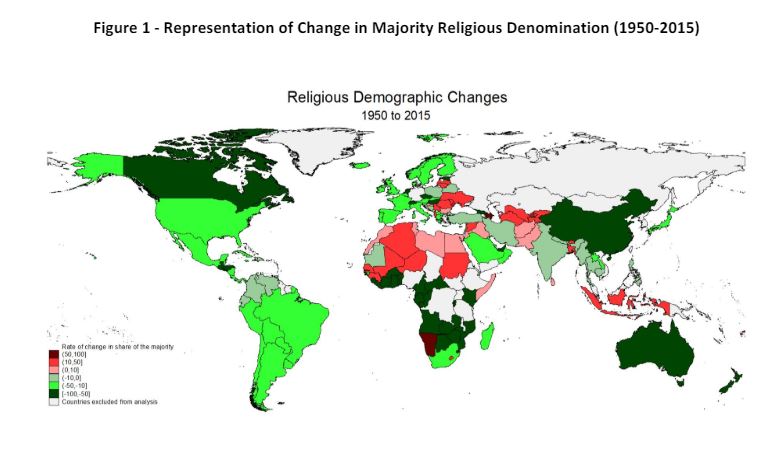
According to the study, India’s population growth story or demographic shift is “consistent with the larger global trends”. As per the study, the world has become more heterogeneous in the previous six decades. In 1950, the share of the majority population in society was 75 per cent. However, the share of the majority religion in countries around the world has reduced by 22 per cent from 1950 to 2015.
As per the study, 123 countries experienced a decrease in the share of the majority religious group while its share increased in 44 countries. The change varies from a 99% decrease in Liberia to an 80% increase in Namibia.
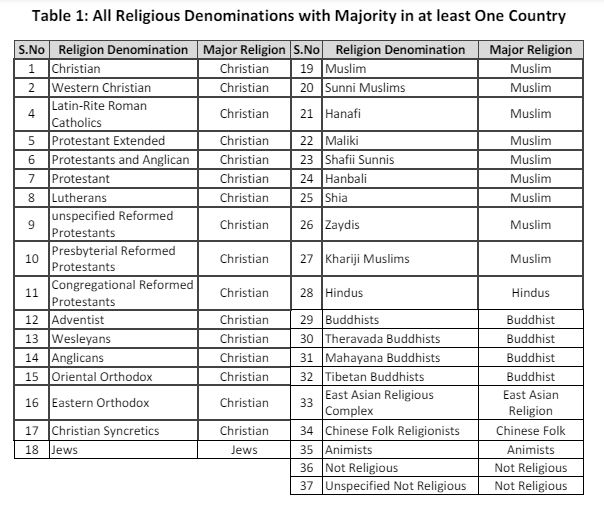
(All Religious Denominations with Majority in at least One Country, Source – Study by PM’s EAC)
The above table points out that sixteen different subcategories of Christianity are a majority in at least one country. Similarly, eight subcategories of Islam and three denominations of Buddhism constitute the majority population in at least one country.
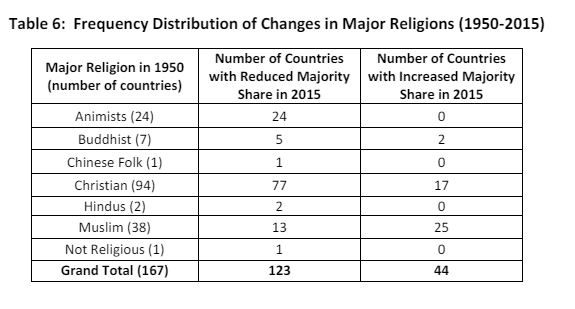
In 1950, Animism, according to the RCS-Dem Dataset, was the predominant religion in 24 countries. However, by 2015, it no longer held the majority status in any of them. Among the 94 countries where Christianity was the majority religion in 1950, 77 experienced a decrease in its share in the overall population mix. Contrarily, during the same period, 25 out of the 38 countries with a Muslim majority saw an increase in the share of their majority religion. Interestingly, there are only two countries where Hindus constitute the majority, and in both cases, their share of the population has declined over the past 65 years.
(Frequency Distribution of Changes in Major Religions (1950-2015), Source – PM-EAC study on demographic shift across the globe)
In most continents, more countries saw a decrease in the share of the main religion group than an increase. Africa had the most extreme demographic shift, with 21 out of 40 countries experiencing significant shifts. Among 35 high-income OECD nations, the decline in the main religion’s dominance was higher at 29%, compared to the global average of 22%.
Possible reasons for demographic shift
The study points out that the change in the religious composition of a population is a complex phenomenon because several factors contribute to it, such as migration, conversion, differences in fertility rates, and variation in territorial boundaries as a result of political processes.
However, it categorically notes that it has not refrained from commenting on reasons for this shift as it has multiple variables but focuses on the share of the minority population as a cumulative outcome measure of their well-being.
Source for the data and Methodology
One major reason that academic study on the relationship between religion and outcomes within and between states has been relatively neglected is the lack of credible, granular, and timely datasets on religious demographics for countries around the world, the study notes explain the need for such an elaborate study about the changing demographic shift across the globe with a well-defined categorisation of the majority community.
The study, conducted by PM-EAC, relies on demographic data from the RCS-Dem dataset by ARDA, published in 2019. It asserts that RCS-Dem provides more comprehensive and consistent religious demographic data compared to other sources like WRD, WRP, and Pew Research Center’s Religious Landscape Studies. RCS-Dem records population numbers for 97 religious denominations from the early 1800s onwards.
(The focus of the study is on the rate of change of the majority community’s share in that country’s total population mix)
The study focuses on the rate of change of the majority community’s share in a country’s population due to the absence of an internationally accepted definition of “minority” or “religious minority.” It defines a majority community as a religion or denomination comprising over 50% of a country’s total population in 1950, with subsects identified as the majority if they exceed 50%.
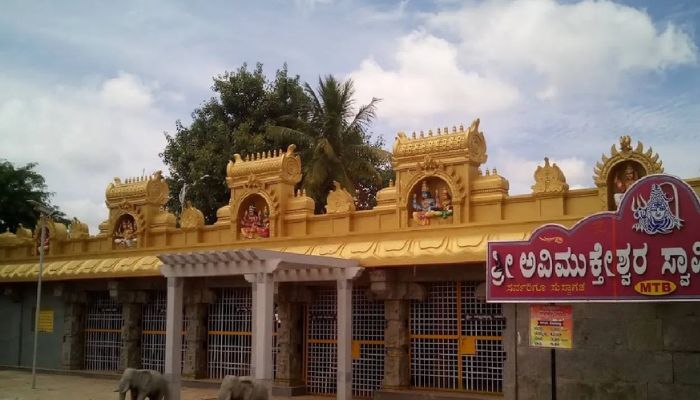
On Wednesday (8th May), the Karnataka BJP lashed out at the state Congress government for appointing a non-Hindu person as a member of the Avimukeshwara Swamy Temple’s Brahmarathotsava Samiti which is located in Hoskote Town Fort in Bengaluru Rural District. Notably, the newly formed committee to oversee events of the temples includes a Muslim man named ‘Nawaz’ which has sparked outrage. The opposition party, BJP, and Hindu devotees have raised questions as to why non-Hindus are being appointed to oversee Hindu mandirs.
As per reports, Hoskote MLA Sarath Bache Gowda, who hails from the Congress party, had requested the government to form a committee for the development of Avimukeshwara Brahmarathotsav in Hoskote town fort in Bengaluru rural district.
Based on his request, the state government through a circular from the Tehsildar’s office has appointed a committee of 12 members. The BJP has expressed outrage stating that a Muslim named Nawaz has also been selected among these 12 people.
Taking to X, the state BJP unit has shared an official memorandum of the office bearers of the temple committee. Slamming the Congress government over the appointment of non-Hindus in temple management, the Karnataka BJP alleged that the Hindu-hating CM Siddaramaiah after attempting to loot Hindu temples, now seeks to control temples and their resources.
The tweet read, “Congress appointed ‘Nawaz’ to oversee the Brahmotsavam event at the Shri Avimukteshwara Swamy Temple in Hoskote. After attempting to loot our temples, the Hindu-hating CM @siddaramaiah now seeks to control temples & their resources by appointing non-Hindus.”
Slamming Rahul Gandhi’s wealth redistribution plan and appeasement politics, the Karnataka BJP further stated, “Congress govt in Karnataka appears to be in a hurry to implementing Rahul Gandhi’s delusional ideas of stripping Hindus of their rights, to favour one particular community. Today it’s just one temple in Karnataka, tomorrow it might be every temple in India. Beware of Congress!”
The appointment of non-Hindus to temple management has stirred widespread outrage among believers with several netizens demanding answers as to how can believers of other faiths organise or oversee events of the Hindu temples.
Mr. Nawaz has been appointed to the committee responsible for overseeing the Brahmotsavam festivities of Shri Avimukteshwara Swamy in Hoskote, located in the Bangalore Rural District.
A lawyer affiliated with VHP, Girish Bharadwaj wrote, “Mr. Nawaz has been appointed to the committee responsible for overseeing the Brahmotsavam festivities of Shri Avimukteshwara Swamy in Hoskote, located in the Bangalore Rural District. I would request Shri @RLR_BTM, Endowments minister to clarify if “Nawaz” is a Hindu name. How can a “Muslim” organise Temple Brahmotsava?”
The issue of the appointment of people of other faiths to the management board of Hindu temples as well as several state governments unaccountably controlling the temple activities have been a cause for concern for Hindu devotees. Additionally, several lawyers have approached top courts in the country to free temples from government control.
Earlier yesterday (May 6), former Somaiya School Principal Parveen Shaikh was handed over a termination letter by Somaiya Vidyavihar, weeks after OpIndia published an expose detailing her controversial social media behaviour, which involved liking pro-Hamas tweets, pro-Zakir Naik posts among other things.
In a statement issued by Somaiya Trust, the prestigious Mumbai-based school said, “Recently, it has come to our attention that the personal social media activities of Ms Parveen Shaikh, who holds a leadership position at The Somaiya School, have been starkly misaligned with the values we cherish.”
“Given the gravity of these concerns, and after careful consideration, the management has discontinued Ms Parveen Shaikh’s association with Somaiya Vidyavihar to ensure that our ethos of unity and inclusivity is not compromised,” the statement released by Somaiya Trust said.
The statement added, “Somaiya Vidyavihar remains dedicated to providing a nurturing educational environment that honours and respects all cultures and beliefs, contributing positively to society and our nation.”
The development came days after the Somaiya management sought an explanation from Parveen Shaikh over a report published by OpIndia on April 24 that tracked the Islamist views of the former principal and her bent towards anti-Indian elements on social media. She frequently liked Hamas pronouncements endorsing their ‘resistance’ against Israel along with those supporting its senior leadership such as terrorist Ismail Haniyeh. From her social media activity, she came across as an ardent advocate of Hamas who rationalised all the atrocities it commits as ‘resistance’ or ‘retaliation.’
But no sooner did OpIndia publish its first report detailing the problematic behaviour of the former Somaiya School principal, than a bevvy of left-leaning liberals and ultra-leftist propaganda portals, namely Scroll and The Wire, came to the defence of Ms Shaikh, using cliched tropes to downplay allegations against her and paint her as a victim of “online bullying and trolling.”
Reports published by Scroll and The Wire described OpIndia as a ‘Hindutva portal’ in a bid to discredit the serious allegations levelled against Ms Shaikh, an educator who was tasked with the responsibility of managing one of the notable knowledge centres in the country’s finance capital.
These portals then went on to invoke the time-tested formula that leftists often resort to when they are boxed into a corner and find themselves entangled in a situation from which extrication is almost impossible: feign victimhood. These portals claimed Ms Shaikh supported Palestinians against the bloody war inflicted upon them by Israel.
However, as is their wont, they remain economical with the truth and don’t hesitate to peddle lies if it comply with their agenda. They would either not mention the trigger that compelled Israel to mount an unprecedented attack against Gaza or allude to it as a passing reference. Even worse, they would conveniently distort support for Hamas as solidarity for Palestinians and condemnation of Hamas for the October 7 attacks as grounds for rationalising the aggression of “occupying force”, which they use for Israel, depending upon whether they want to protect one of them or peddle propaganda against their opponents.
Since it was to protect Ms Shaikh in this case, several leftwing trolls and portals such as Scroll and The Wire pulled out the victim card, asserting that Ms Shaikh was hounded for merely championing the Palestinian cause, and has now lost her job for expressing solidarity for the Palestinians who are at the receiving end of Israel-Hamas conflict.
This, of course, is a straw man argument since the sacking of Parveen Shaikh is not about any ’cause’ but Islamofascism, a supranational Islamic fundamentalism epitomised by Hamas, whose central aim is to destroy Israel, the Jewish land, and create a Palestinian country in its stead.
Since its inception in December 1987, Hamas has utilised militant interpretations of Islam to lead a Sunni extremist movement dedicated to the destruction of Israel. Hamas distinguished itself from the Palestine Liberation Organization (PLO), a longstanding coalition of Palestinian groups with diverse ideologies, by promoting resistance within the religious framework of jihad, or a sacred struggle and martyrdom.
In its initial statement in the late 1980s, Hamas declared, “Jihad is its path and death for the sake of Allah is the loftiest of its wishes.” Predominantly Shiite Iran has provided support to Hamas since the late 1980s, primarily due to its opposition to Israel and shared Islamic ideology.
Hamas, an Arabic acronym for the Islamic Resistance Movement, has urged adherents of Judaism and Christianity to acknowledge Islamic hegemony in the Middle East. It stated that followers of other religions should refrain from challenging Islamic authority in the region, warning of potential violence, displacement, and terror if they were to assume control. Additionally, Hamas firmly opposed any prospects for peace or coexistence with Israel, dismissing diplomatic efforts as futile endeavours.
This support for Islamic hegemony and intolerance towards adherents of other faiths is evident in the constant attacks it mounts against the Jewish nation. The dastardly October 7 attacks, in which over 1,200 Israelis, including elderly, women, and children, were killed by Hamas terrorists who raided the border villages, were the most recent testament to the Islamist group’s depravity in fulfilling its fantasy of taking control of Israel and subsequently imposing a Sharia rule within its geographical contours.
Manifestly, Hamas is not a benign organisation that is fighting for the rights and safety of Palestinians and whose sole aim of existence is the governance of the Gaza Strip. Its religious and organisational goals go much beyond the borders of Gaza, as the cowardly October 7 attacks demonstrated. It aims to establish an Islamic theocratic nation governed by Sharia rule where non-Muslims are treated as second-class citizens, something which ISIS failed to accomplish in its neighbourhood in Syria and Iraq.
The Islamists and Hamas sympathisers in India wailing over Parveen Shaikh’s termination lament that she was sacked for merely standing in solidarity with Palestine. However, let us not be fooled by these leftist tropes that she was “targeted” for her support of Palestinians. The leftist apparatchiks and its propaganda machinery can cry a sea over it, but that does not change the facts on the ground.
Ms Shaikh was fired not because of any run-of-the-mill ’cause’ that her supporters would have us believe; she was sacked because she appeared to endorse the Islamofascism championed by Hamas, and was quite unapologetic about it. After all, no flourishing secular and democratic nation can afford to bestow the power of influencing and informing the worldview of the nation’s future—the young and impressionable children—in the hands of Hamas simpers.
According to Military Intelligence, over 50,000 infiltrators from Bangladesh, Sri Lanka and Myanmar are lodging in Kerala with fictitious Aadhaar cards, reported Onmanorama. The report unveiled that the Aadhaar centres in Madhupur and Nagaon in Assam, Kalimpong, Nadia and Uttar Dinajpur in West Bengal and Perumbavoor in Kerala were all compromised to create the phoney cards. Furthermore, it mentioned that Indian nationals who are being prosecuted for crimes are also creating fake Aadhaar cards to abscond from the country.
The Border Security Force (BSF) increased monitoring in the border states in response to the military wing’s findings. Additionally, the Indian Coast Guard increased the scope of its monitoring in Kerala and other coastal states. Interestingly, central intelligence services had also reported a year prior that foreigners were using fraudulent Aadhaar cards to infiltrate Kerala.
Fifty Aadhaar cards were created, based on the central intelligence agency, after hackers gained access to an internet system at an Akshaya Kendra in Triprangode, Malappuram. West Bengal and Jharkhand internet protocol addresses were employed to access the system. Moreover, it was discovered that faux Aadhaar centres in Perumbavoor’s “bhai markets,” which are areas frequented by temporary labourers, produced counterfeit cards using identical pictures but with different names and addresses.
The anti-terrorism unit of the Kerala police found several bogus Aadhaar cards the other day. The Aadhaar Act of 2016 penalizes forging or misusing Aadhaar cards. It would result in a fine of between Rs 10,000 and Rs 1 lakh along with a maximum sentence of three years in prison. Earlier reports have disclosed that illegal Rohingya infiltrators were using the identity of the deceased individuals in India and entering from the Bangladesh border. National Investigation Agency looked into this matter as well. Some people were arrested in this case in Tamil Nadu.
On 31st January, the agency submitted two charge sheets against three citizens of Bangladesh in a case involving the entry of Rohingya and Bangladeshi individuals into India as a component of a large-scale trafficking network. Shahabuddin Hossain, Munna also known as Noor Karim, and Muhammad Soriful, alias Babu Mian were the people named in the charge sheets. According to the NIA, the accused in the “Tamil Nadu Human Trafficking” case were deliberately involved in the falsification of Indian documents to conceal their true identities.
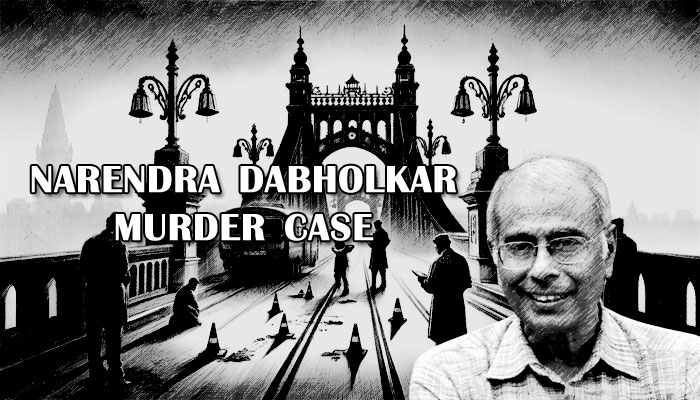
On 20th August 2013, Dr Narendra Dabholkar, who called himself a ‘rationalist’, was murdered on Pune Omkareshwar Bridge. Dabholkar was an atheist and anti-superstition ‘activist’. He spent most of his life advocating a ban on religious practices which he believed were “irrational religious” practices. His murder case is most likely concluding on 10th May 2024. Information in this report is extracted from author Amit Thadani’s book ‘The Rationalist Murders: Diary of a Ruined Investigation’.
Dabholkar and anti-superstition bill
Dr Narendra Dabholkar was a medical doctor by profession who transitioned to activism. He founded the organisation named Maharashtra Andhashraddha Nirmoolan Samiti (MANS) which campaigned against practices that they believed were harmful and superstitious. Because of his activism, he was often at odds with religious groups, especially Hindu groups as most of his campaigns were against Hindu religious practices. In 2003, he proposed an anti-superstition bill in the Maharashtra Assembly aimed at criminalising acts of black magic, sacrifices and other practices termed as religious rituals.
Notably, the bill talked about animal sacrifices in front of the idols but left out animal sacrifices on the Islamic festival Eid as they were not slaughtered in front of an idol. Several provisions directly targeted Hindu practices resulting in criticism and opposition by several Hindu groups that argued that the bill targeted their religious practices.
Religious sentiments of millions of Hindus were hurt because of the criminalised provisions against the wari (yatra) where lakhs of devotees walk barefoot, Karnavedha (a Hindu tradition of piercing ears), and homas / havans.
Because of the opposition faced by the religious groups, the then-Congress-led Government of Maharashtra removed 17 out of 28 original provisions to alleviate the protests. However, the bill remained a point of contention and was often seen as an attack on Hindu traditions. The aim of the bill should have been to protect the public from exploitation but Dabholkar, his organisation and the state government failed to take religious groups into confidence mostly due to targeted attacks on Hindu practices.
Accusations against Narendra Dabhokar’s organisation
It has to be noted that though Urban Naxal is a relatively new term, in 2011, the MANS’s (or ANiS) name appeared as the 50th number in the list of 62 organisations that support the Naxal movement. Notably, the report came out when Congress was in power in Maharashtra. The organisations and people who found their place in that list are often called “Urban Naxals” in modern terminology.
Furthermore, ANiS was also accused of accepting massive foreign funding. There were financial irregularities leading to the cancellation of their FCRA licence by the Modi government. Also, the Assistant Charity Commissioner, District Satara sent his proposal for the conduct of a special audit of Anis to the Joint Charity Commissioner for a final decision, since two of the subordinate officers had pointed out financial irregularities and the Joint Charity Commissioner has called for an explanation from the trust as to why special audit should not be conducted and administrator not be appointed. The issue is still pending before the Joint Charity Commissioner, Pune.
Surprisingly, the statements issued by Dr Narendra Dabholkar (before his death), and those issued by the trustees were contradictory. Even though it was suspicious, the agencies investigating the Dr Dabholkar murder case have not investigated this discrepancy and its connection with the case.
Murder of Narendra Dabholkar
On the morning of 20th August 2013, Dabholkar was on his regular morning walk. Two assailants came on a motorcycle and fatally shot him from behind. It was an execution-style killing that led to the belief that it was a premeditated attack. The assailants managed to escape despite the presence of a police nakabandi and chowki nearby indicating there was a possible lapse in security or surveillance in the area.
Accusations against Hindu groups and targeting Sanatan Sanstha
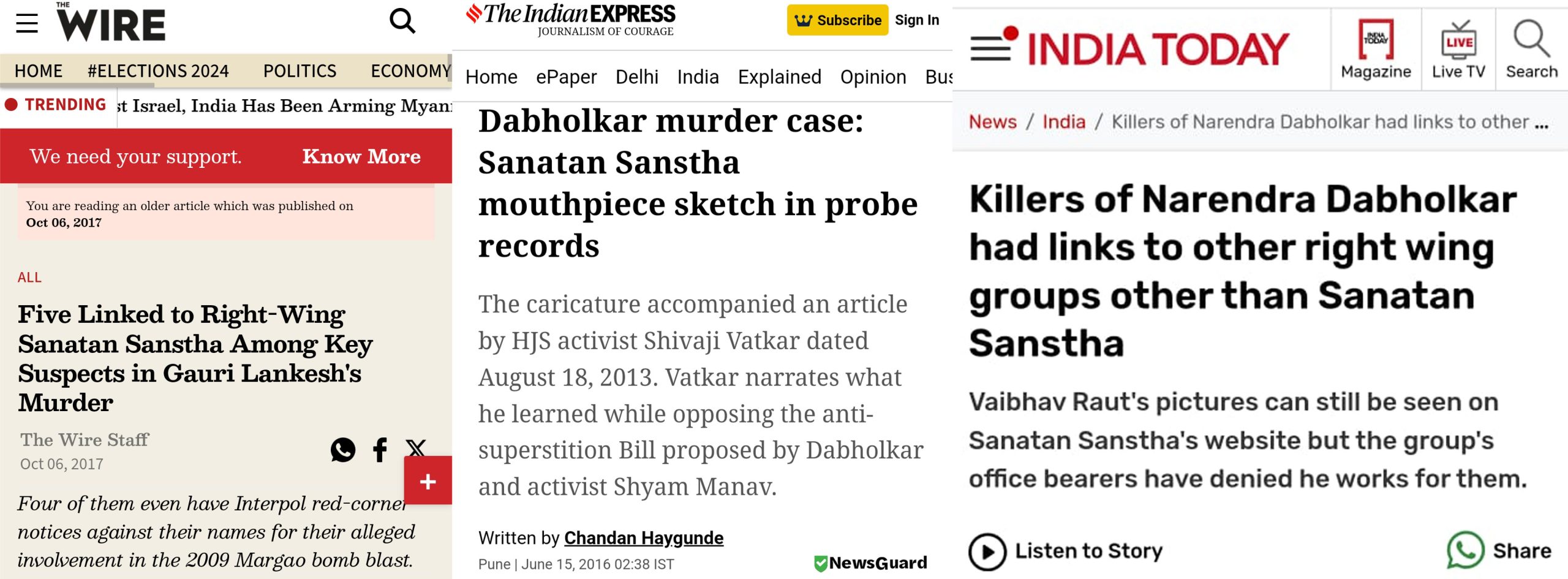
Almost immediately after the murder, Sanatan Sanstha became the prime target of the media trial. Sanatan Sanstha had vehemently opposed the anti-superstition bill and was previously linked to other violent acts. However, the accusations against the Hindu organisation were based primarily on ideological conflicts rather than concrete evidence. It led to widespread criticism of the investigating agencies and experts believed there was bias in the investigative approach.
Investigation and its discontents
Initially, the investigation was handled by the Pune Police. Before UPA went out of power, the investigation was handed over the to Central Bureau of Investigation (CBI) on 9th May 2014 on the directions of Bombay High Court.
The first two arrests made in the case were of Vikas Khandelwal and Manish Nagori based on ballistic evidence that linked the two to the murder weapon. The Murder weapon was found in their custody. However, the link was later deemed inconclusive. Furthermore, the witnesses present at the scene of the crime failed to identify the two leading to their release.
On 1st June 2016, CBI raided Sanatan Ashram and Dr Virendrasingh Tawade’s house in Panvel and Mr Sarang Akolkar’s locked house in Pune. Virendra Singh Tawade was summoned for ten days between 1st June 2016 to 10th June 2016 by the investigating agency for questioning. He was arrested on the last day.
As per CBI, one of the witnesses Sanjay Sadwilkar claimed Virendrasingh approached him to make a pistol. When he showed reluctance, he asked him to procure bullets. All this, according to Sadwilkar, happened between April 2013 and June 2013.
Notably, Sadwilkar, a silversmith from Kolhapur, was named in a corruption case exposed by Hindu Janajagruti Samiti and other Hindu Organizations in 2015. In March 2016, he came forward as a witness in the case. He confessed before the court that he harboured animosity towards the Hindu Janajagruti Samiti. Initially, he claimed there was a heated argument between Narendra Dabholkar and Tawade during an event however later he confessed nothing like that happened.
During the investigation and trial, it was evident that his statements, at best, remained a personal opinion due to his suspicion and bias.
Over the years, CBI shifted its focus among several suspects including Dr Virendrasingh Tawade and two individuals who were linked to Madgoan Blast Case and were said to be absconding i.e. Sarang Akolkar and Vinay Pawar. It was claimed that this two persons shot Dabholkar dead. Each time the shift of the investigation was more of a reactive one rather than based on thorough investigation.
The eyewitnesses also remained inconsistent in their testimonies and failed to reliably identify the suspects. The credibility of witnesses like Kiran Kamble and Vinay Kelkar was among those that came under scrutiny.
How killers and masterminds changed over time
In 2014, Pune Police released Vikas Khandelwal and Manish Nagori. CBI SP and investigation officer SR Singh faced questions during cross-examination on why no investigation was conducted on this aspect and it was only thereafter that a closure report was filed in 2023 providing clean chit to both of them without rational explanation.
In 2016, CBI claimed Sarang Akolkar and Vinay Pawar were the shooters since Kamble and Kelkar allegedly identified them and Tawade was the mastermind.
In 2018, after a series of arrests in the Gauri Lankesh murder case, the CBI claimed Sachin Andhure and Sharad Kalaskar were shooters in the Narendra Dabholkar Murder case while Tawade remained the mastermind. Interestingly, their photographs were identified by the same witnesses who named other accused as shooters in 2016.
In 2019, CBI arrested advocate Sanjiv Punalekar claiming he advised Sharad Kalaskar to throw away the pistol used in the crime. Sharad was also later arrested in accused the Gauri Lankesh murder case. CBI also claimed he confessed before police commissioner Abhinav Khare but he was never presented before the Pune Court. Later, Punalekar was released on bail.
Throughout the investigation, there were multiple procedural lapses including improper handling of evidence and failure of the investigation agency to conduct the necessary identification parades as per the CBI manual.
Media trials and public perception
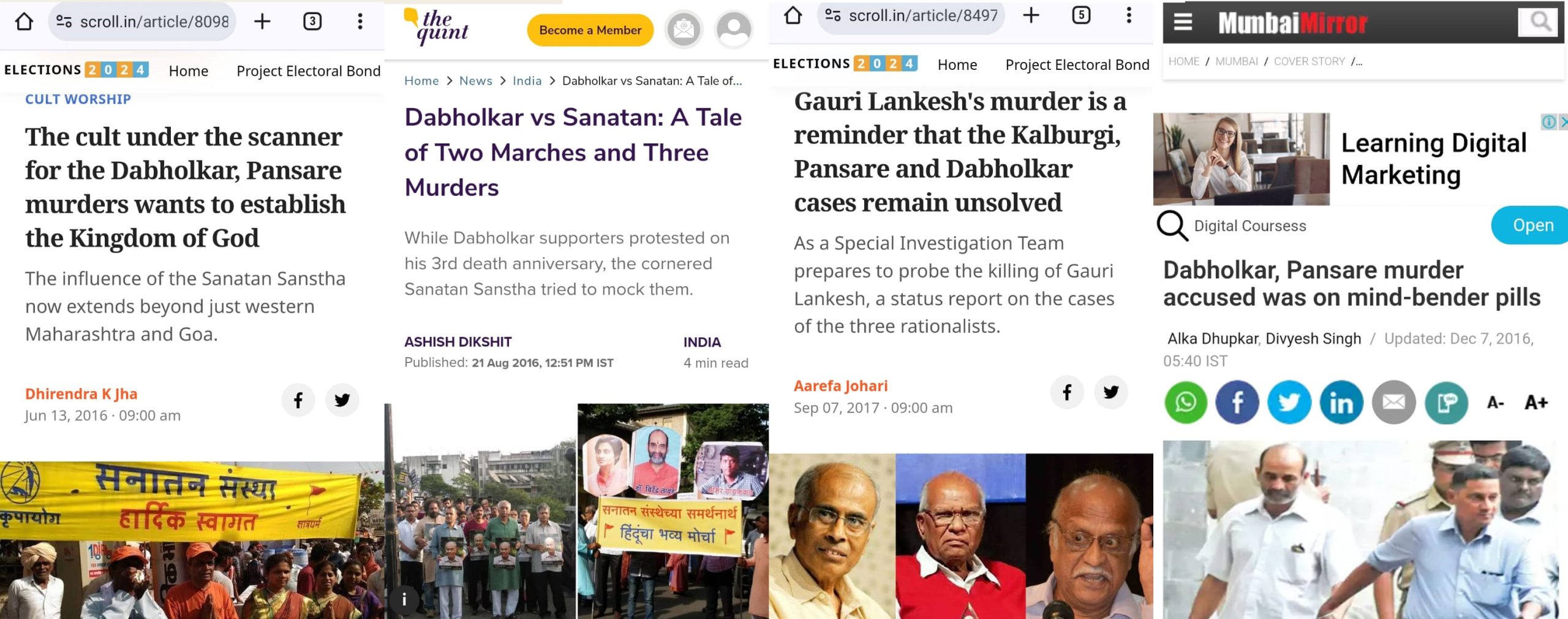
It has to be noted that the entire case was heavily influenced by the media coverage. It was more over sensationalism than ethical journalism. Notably, there was a planchette session organised by a journalist where it was claimed that they invoked the spirit of Dr Dabholkar’s spirit to identify his killers. . A sting operation was organised by then-Aam Aadmi Party (AAP) leader Ashish Khetan. Reportedly, he carried out a “sting operation” where Dabholkar’s ghost was seen claiming via a planchette medium that Sanatan Sanstha was behind his murder. The video was shared with the public.
Source: Wire/IndianExpress/IndiaToday
It was an irony that they organised such a session to find the killers of someone who spent his whole life opposing such paranormal sessions. It was widely criticised for undermining the seriousness of the investigation and illustrated a widely accepted trial-by-media phenomenon.
Source: Scroll/Quint/Mmumbai Mirror
Unresolved questions and judicial oversight
There have been several unresolved questions throughout the investigation. Several leads and pieces of evidence were mishandled or ignored by the investigating agencies. The question about the handling of ballistic evidence, the mysterious presence of foreign materials at the crime scene and the ultimate disposal of the murder weapon never found a proper investigative conclusion. It highlighted that there were significant gaps in the investigative process and suggested that either there was incompetence or deliberate obstruction.