Home Blog Page 1315

‘Need to book water tankers two days in advance’: Bengaluru braces for water scarcity, know why India’s tech capital is dry and thirsty

0

Bengaluru is experiencing a severe water shortage this year, months before peak summer, causing many residents of “India’s Silicon Valley” to ration their water consumption and pay nearly double the regular price to satisfy their daily water demands.

Notably, people in Bengaluru have begun to experience a 24-hour water supply disruption beginning at 6 am on 27th February. According to the reports, the shortage will last until 6 am on 28th February. This is as the Bangalore Water Supply and Sewerage Board (BWSSB) has announced a shutdown to perform vital maintenance and install Unaccounted For Water (UFW) bulk flow meters.

The water shortage is expected to affect several areas in South Bengaluru including BHEL Layout, Nandini Layout, Srinivasa Nagar, Jaimaruthi Nagar, Badavane, Sakamma Layout, Narasimha Swamy Layout, Muneshwara Nagar, Jnana Jyothi Nagar, Jnanaganganagar, Mallathahalli, NGEF Layout and also East and North Bengaluru.

Weak southwest monsoon rains have impacted groundwater levels and reduced water levels in the Cauvery River basin reservoirs that supply the southern Indian city, which is home to over 14 million people and thousands of IT enterprises and start-ups, according to a report. 

This is causing city residents to pay rising water tanker costs even before the peak summer season begins. Water tanker merchants also in some sections of Bengaluru are now asking up to 2,000 rupees ($24.11) for a 12,000-litre tanker, up from 1,200 rupees ($14.47) a month ago.

“We now need to book water tankers two days in advance, my plants are dying and I’m taking alternate-day showers,” said Santhosh C.A., a resident of Horamavu, in north Bengaluru, as quoted by Reuters. “The worry now is that despite paying, the tanker vendors won’t show up due to scarcity of groundwater,” added another Bengaluru resident.

The Bangalore Water Supply and Sewerage Board (BWSSB), the city’s water supply agency, gets the majority of its water from the Cauvery River, which originates at Talakaveri in Karnataka and flows through neighboring Tamil Nadu before draining into the Bay of Bengal.

In order to shore up its supply in the coming months, the BWSSB has asked authorities for more water from the Cauvery basin.

Explaining the water shortage crisis in Bengaluru a little deeper, one of the Twitter users named Raj Bhagat said that the city of Bengaluru depends on the Cauvery River for water due to its height. “Bengaluru is unofficially a hill station which is located nearly a kilometre above sea level. Being at the top of a ridge line, the city is partly within the Kaveri watershed and partly in Ponnaiyar (Dakshina Pinakini watershed). Being on top, water from elsewhere doesn’t flow through Bengaluru but flows outward from the city. Bengaluru right now depends on the Kaveri River for water supply. Because of its height, Water is pumped for a height of 1000 feet from the river 100km away from the city,” he wrote posting maps in a series of posts on X.

As per Bhagat’s study, Kaveri is overexploited and must be conserved in all sectors (mainly agriculture) in both Karnataka and Tamil Nadu. Any year with normal or below-average rainfall will result in a drought or water crisis, not just in Bengaluru.

Bengaluru is overcrowded given its topography, and growth across the country and within the state must be spread to next-tier cities, which would necessitate expenditures in the same direction.

Probable solutions suggested by BJP MP to the ongoing water problem in the city

Notably, the National President of BJP Yuva Morcha, Tejasvi Surya who is also the MP for Bengaluru South Lok Sabha Constituency commented on the issue and urged the citizens to come together to solve this growing problem of water shortage. “Water shortage in Bengaluru is a result of multiple factors,” he said adding that around 40% of the borewells in the city had dried.

“Bengaluru has 11,000 borewells under the control of BWSSB & a whopping 4.5 lakh private borewells. Of these, close to 40% have either dried up or have precariously low levels of water. Mindless white topping of roads is further reducing the groundwater level in the areas. Unbridled construction, unprecedented migration, deterioration of the lake ecosystem & mindless white topping and concretization of the city preventing adequate recharge, have all contributed to the current water crisis,” he added.

Surya further suggested that the city cannot completely depend upon the Cauvery water and has to make efforts to focus on increasing groundwater levels and sustaining the lake ecosystem. He said that digging borewells and operationalizing the Cauvery Phase 5 project would help the city cope with the problem of water shortage.

He further highlighted the grave discrepancy between the demand and supply which has caused the surge in the water crisis in India’s tech capital.

“In the period between 2017 & 2024, while the supply of Cauvery has remained at 1450 MLD, the demand has drastically increased at unprecedented levels. More than 1.5 lakh new water connections, including to large apartments, have come up within this period itself,” the BJP MP pointed out.

“To add to the current crisis, water tankers which were earlier available for Rs 700- Rs 800 per tanker, are now being sold at Rs 2000- Rs 3000 per tanker. Government must provide water to low-income areas for free and cap the prices of tankers for other areas,” the BJP leader added.

“Bengaluru’s population was slated to touch 1.5 crore by 2030 to BWSSB estimates. However, we have breached this mark in 2024 itself. Therefore, our efforts to safeguard the city’s water requirements must be extremely aggressive with practical targets. What was once the city of 1000 lakes, parks, and rivers like Vrishabhavati and Arkavathi, now stares at a bleak future. This is the time to wake up, avoid petty political tussles, and address this issue in unison on a war footing,” he said in a post on X on 26th February.

Cauvery water dispute

It is important to note that the states of Karnataka and Tamil Nadu have been fighting for a long time over the supply of Cauvery water. This long-running issue, known as the Cauvery water dispute, has its roots in past agreements and competing water-related demands.

On 16th February 2018, the Supreme Court issued a unanimous decision that reduced Karnataka’s yearly water releases from 192 TMC (Thousand Million Cubic Feet) to 177.25 TMC. This decision also resulted in a decrease in Tamil Nadu’s allocation of water.

Following the court’s directions, the Indian government established the Cauvery Water Management Authority on 1st June 2018, to oversee the implementation of the Supreme Court’s decision.

Recently on 14th August 2023, the Tamil Nadu government petitioned the Supreme Court for its involvement in forcing Karnataka to immediately release 24,000 cubic feet per second (cusecs) of water from its reservoirs. Tamil Nadu petitioned the Court to direct Karnataka to deliver 36.76 TMC of water by September 2023, as mandated by the Cauvery Water Disputes Tribunal’s (CWDT) final verdict in 2007.

Karnataka claimed that a drop in rainfall in the Cauvery catchment area, which includes parts of Kerala, caused insufficient inflow into its reservoirs. The state CM then emphasized that historically, whenever there was excess water in the reservoirs, Karnataka freely donated it to Tamil Nadu. However, this year’s poor weather has prevented Karnataka from fulfilling its goal.

On 18th September, the Cauvery Water Management Authority reaffirmed the requirement for Karnataka to continue releasing 5,000 cusecs (cubic feet per second) of water to Tamil Nadu for 15 days, following an earlier order given by the Cauvery Water Regulation Committee on 12th September.

Several protests were reportedly carried out by various organizations in Karnataka and Tamil Nadu. The detailed reports of the same can be read here.

Bengaluru to implement new property tax system from April 1

Earlier, it was reported how the Bruhat Bengaluru Mahanagara Palike’s guideline value-based property tax, which is set to take effect on the 1st of April, would impose an additional cost on landlords who have rented out their houses for residential and commercial purposes in the city of Bengaluru.

This significant increase in property tax values is anticipated to raise rents for tenants who are already paying higher prices for renting. The new tax system requires rented-out properties to pay twice the property tax as property occupied by owners themselves. Additionally, tariffs have been increased 3-5 times for different commercial structures.
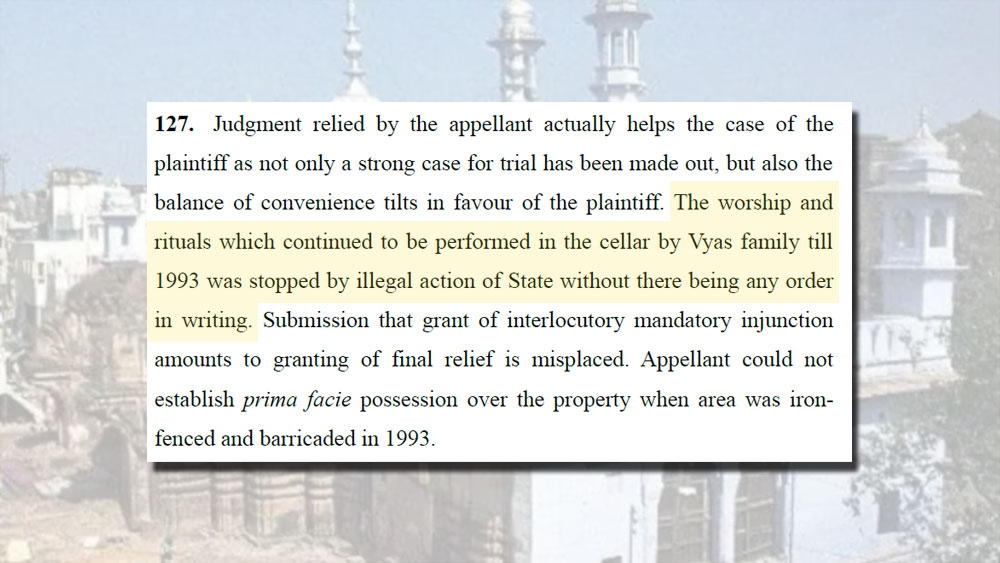
Mulayam Singh Yadav-led UP government’s decision to stop Hindu worship in Vyas Tehkhana at Gyanvapi illegal – Allahabad High Court

0

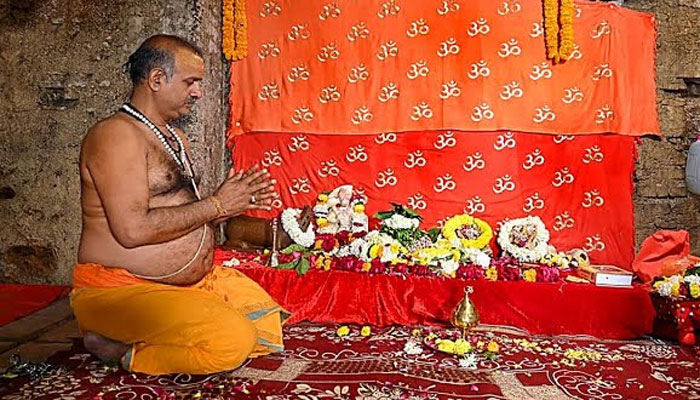
On Monday, 26th February, the Allahabad High Court stated that the order passed by Mulayam Singh Yadav-led Uttar Pradesh government to stop Hindu worship rituals in Vyas Ka Tehkhana in 1993 was illegal. The court dismissed the plea of Anjuman Intezamia Masjid Committee challenging the Varanasi District Court’s 31st January order allowing regular Puja at the Vyas Ka Tehkhana in the disputed structure of Gyanvapi.

In its observation, the court stated that the state [under Mulayam Yadav] stopped the worship rituals without an order in writing, thus it is illegal.

Excerpt from Allahabad High Court judgment

In 1993, Assembly Elections took place in UP after Kalyan Singh government was dismissed following the demolition of illegal Babri structure, and Mulayam Singh Yadav of the Samajwadi Party became the Chief Minister of Uttar Pradesh. Soon after assuming the office, Yadav sealed the cellar, citing law and order concerns. The court said, “The act of the State Government since 1993, restraining the Vyas family from performing religious worship and rituals and also by the devotees, was a continuous wrong being perpetuated.”

The court further stated in its observation that stopping worship and performing rituals by the devotees “would be against their interest”. Furthermore, citing Article 25 of the Constitution of India, the court said that the citizen’s rights protected under the constitution cannot be “arbitrarily revoked” by the state. The court noted that Vyas’s family has the religious freedom to conduct worship and rituals in their cellar, and it cannot be stopped based on the government’s oral orders.

Notably, on 1st February, the Anjuman Intezamia Masjid Committee moved to the Supreme Court with their plea against the Varanasi District Court’s order. However, the Supreme Court refused to entertain their plea and asked them to approach the Allahabad High Court. Reportedly, hours after the Varanasi court delivered the verdict allowing the worship of Hindu deities in the Vyas Ji Ka Tehkhana (the basement cellar of the Vyas family), the Committee of Management, Anjuman Intezamia Masajid, Varanasi filed an urgent application on 31st January seeking status quo at the disputed site. However, the Supreme Court rejected this plea and refused to accept the petition, asking the Masjid Committee to approach the High Court instead.

Uttarakhand: Md Shafi and Khatoon Jahan kill minor daughter over love affair, tried to bury body to cover up the crime, arrested

0

In the Rudrapur district in Uttarakhand, Mohammad Shafi and Khatoon Jahan strangulated and killed their 17-year-old daughter over a love affair. The parents tried to pass off the murder as suicide and also tried to bury the body to cover up their crime. However, when they were preparing to send the body to Rampur in Uttar Pradesh for burying, police reached the house and took custody of the body. Later, it was sent for post-mortem and as per the autopsy report, the girl was strangulated to death.

The incident happened on Friday, February 23 but the Uttarakhand police got the information on Saturday, February 24, after which they launched an investigation and arrested the two accused.

Uttarakhand police found signs of assault on the minor’s body

A report by the Times of India quoted ASP Neeharika Tomar as saying, “An informant approached us on Saturday and informed the officers that Shabana had been in a relationship with a married man for three years and she was allegedly strangled to death by her parents Mohammad Shafi (50) and Khatoon Jahan (45) on Friday night.”

The ASP added that the family tried to bury her body in UP’s Rampur district to cover up the crime. “Police intercepted them and found signs of assault on the body, particularly around the mouth and neck. An autopsy confirmed that she was strangled to death.”

The police arrested the accused from the Pahargang Mohalla and recovered the murder weapon. The duo confessed to the crime during interrogation. They said that they were against the relationship which is why they killed their daughter.

Honour killing in Pakistan

Last year, an incident of honour killing was reported from Pakistan where an 18-year-old girl fell victim to the abhorrent practice in Kolai-Palas district of Khyber Pakhtunkhwa’s (KP) Kohistan on 26 November. The horrific act was performed by the victim’s family members following the directives from a local jirga (council of elders) in the Barsharyal village, 150 kilometres northwest of Mansehra.

The instance took place after a video that showed her and another girl dancing with some boys gained traction on social media.

Gujarat: Orphan minor girl living at aunt’s house in Surendranagar raped by uncle Rehman and four others, case registered under POCSO Act

0

A shocking case of rape of a minor girl has come to the fore from Vadhwan in Gujarat’s Surendranagar district. In the incident, an orphan girl from a Muslim family was brutally raped by her uncle and other acquaintances. The girl has allegedly been raped for several months. The girl became pregnant as a result of continued sexual exploitation.

The rape of the minor girl in Vadhwan has caused a stir in the area. The accused in the case has been identified as the victim’s uncle (the husband of her father’s sister/fufa) Rehman (name changed).

According to the reports, a girl from a Muslim family in Vadhawan, Surendranagar, stayed at her aunt’s house after her parents passed away. The 16-year-old orphan girl was raped by her own uncle Rehman.

Following this, Salman, Amir, Abdul, and Mohammad (all names changed to protect the minor victim’s identity) also sexually assaulted the minor. Salman and Amir are also accused of frequently taking the girl on a bike to various locations and raping her. The horrific crimes of the accused persons came to light after the girl was found six months pregnant.

Minor girl found pregnant after prolonged sexual exploitation, more names expected to emerge in the investigation

Notably, the girl has been a victim of rape for the past 8 months. The incident came to light when the victim was found 6 months pregnant. When it turned out that the girl was pregnant, the Surendranagar police filed a complaint against the accused under various provisions, including intimidation, POCSO, and rape, and launched an investigation into the case.

According to preliminary investigations, the girl was raped by five persons, including her uncle (fufa). However, according to a report by Sandesh, the names of several more people are likely to come out after a further investigation into the incident.

Meanwhile, OpIndia contacted the Surendranagar District Police to fetch more details. Our team was then informed that the accused had not yet been arrested and that necessary action had been initiated. We will update this report as soon as we receive additional information regarding the case.


Nitasha Kaul’s statements on Kashmir aided Pakistan’s anti-India propaganda, was deported based on preventive lookout circular against her

0

Reports quoting government sources have said that the anti-India British academician Nitasha Kaul was deported upon arrival at Bengaluru airport based on a preventive lookout circular issued against her.

The circular was issued after Indian agencies flagged her “pro-separatist” comments and statements and “anti-India” line stand on Kashmir taken on various public forums.

Moreover, it has reportedly come to light that Kaul’s statements on Kashmir have been amplified by Pakistan’s ISI as part of its anti-India propaganda.

“Preventive LOC is issued on request of a law enforcement agency, based on assessment and analysis of background of a subject particularly any history of statements or publicly-stated views challenging sovereigny, unity or integrity of India, and possibility of the person taking a similar line when in India,” an officer reportedly said.

On Monday, 26th February, Kaul took to X claiming that she was denied entry into India on the orders of the Central Government. Her post was followed by a long thread wherein she likened her work to defending democracy while berating words like “Hindutva” and “saffron”.

Kaul was invited by the Congress-led Karnataka government for the two-day event ‘Constitution and National Unity Convention-2024’ on 24 and 25 February in Bengaluru. She was denied entry and put on the next flight back to UK.

Nitasha Kaul is an ‘Overseas Citizen of India’ (OCI) cardholder and is eligible for lifelong visa-free travel to India.

Reports quoting sources stated that the lookout circular against Kaul was meant to prevent her from repeating her anti-India views on Indian soil. There is also a possibility that she may be blacklisted on the same grounds.

Kaul has also justified terrorism in Kashmir terming it an “armed struggle for freedom” and denying the genocide of Kashmiri Pandits.

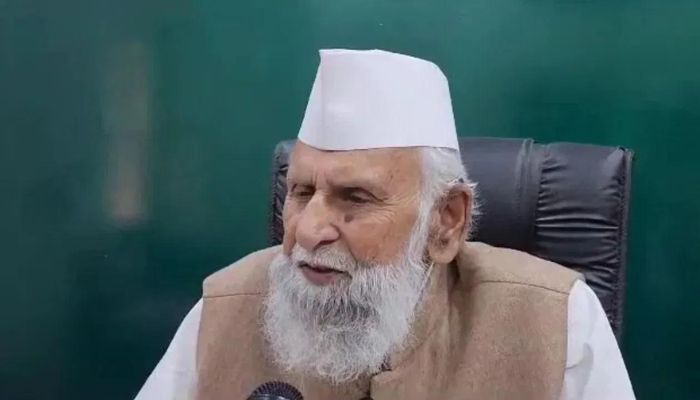
Samajwadi Party MP Shafiqur Rehman Barq, who wanted Quran in NCERT syllabus, dies at 93

Controversial Samajwadi party leader, Shafiqur Rehman Barq, passed away on Tuesday (27th February). He was 93 years old at the time of his death.

As per reports, Shafiqur Rehman Barq was admitted to the Intensive Care Unit (ICU) of a private hospital in Moradabad due to health-related ailments. He passed away during the treatment.

It must be mentioned that the Samajwadi party leader was elected from the Sambhal constituency in Uttar Pradesh and was the oldest Parliamentarian at the time of death.

During his lifetime, Barq had expressed open support for terror outfits and attempts to Islamise the country. In November last year, he called for the inclusion of the Quran in the NCERT syllabus and hailed it as the ‘greatest book.’

A month earlier, he claimed that Hamas is not a terror organisation. In February 2023, he asserted that India has never been and would never be a ‘Hindu Rashtra’ and claimed that Islam is the only true religion.

In October 2022, Shafiqur Rahman Barq went on a misgynistic rant and claimed that allowed women to walk without a burqa in public would only enhance wildness and promiscuity in men. He had also asserted that chanting Vande Mataram was against the tenets of Islam.

The Samajwadi party leader was earlier booked for hailing Taliban and comparing the radical Islamist outfit to Indian freedom fighters. He was also booked in conenction to violent protests against the Citizenship Amendment Act (CAA) in Sambhal district of Uttar Pradesh.

Extortion, land encroachment, illegal sale of property of tribals: Angry villagers attack the house of TMC leader in Bermajur, Sandeshkhali

On Monday (26th February), angry villagers in Bermajur in Sandeshkhali vandalised the house of a local Trinamool Congress leader named Shankar Sardar over allegations of illegal land encroachment.

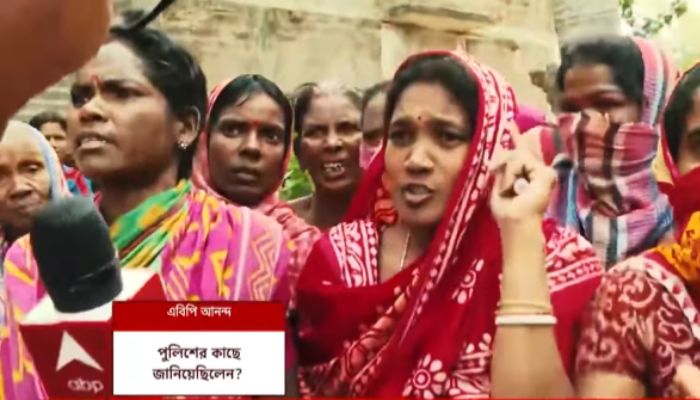
The house of the accused is located within a distance of 100 metres from the residence of now-arrested TMC politician Ajit Maity. As per a report by ABP Ananda, local women gathered outside the house of Sardar with slippers and sticks.

They attempt to break the roof of the house and throw the utensils kept in the kitchen. The angry villagers were seen destroying the fence and entrance door of the house of Shankar Sardar.

They informed that Shankar Sardar was involved in grabbing the land of tribal families of Bermajur and selling their properties without their consent.

“How did he dare to take our land? He conspired with (Sheikh) Sirajuddin and prepared forged documents of our land. We want strict punishment for Shankar Sardar and demand his immediate arrest,” one woman wielding a stick told ABP News.

“We are not able to stay in peace at home…and this man is resting in his pucca house…Police won’t do anything,” a woman was heard saying. One victim narrated, “They have forcibly taken our land and our right to vote too.”

Villagers allege extortion, wife of Shankar Srdar denies allegations

Another woman narrated how Shankar Sardar and Ajit Maity tried to extort ₹15000 from her husband by intimidating him with goons. “We have not been given any relief by the police,” she emphasised.

In the meantime, the wife of the accused Trinamool Congress leader has cried foul over the matter. She alleged that her husband was not involved in any wrongdoing but the villagers vandalised her house.

“Why are they doing this?” she asked. On receiving information about the matter, a large contingent of police reached the spot and brought the law and order situation under control. The team was led by DIG Bhaskar Mukherjee.

“Leave this place. We are requesting you. Do not force us to take stringent measures,” a cop was heard warning the villagers. Several people were later detained by the police.

Property of Sheikh Sirajuddin attacked

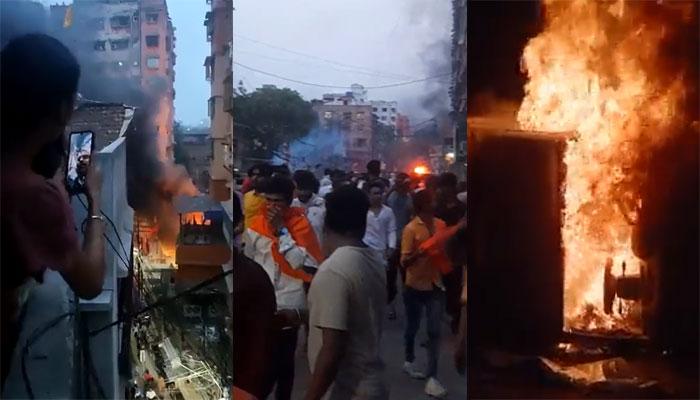
The Sandeshkhali protests in West Bengal turned violent on 23rd February as angry people torched the properties of Sheikh Sirajuddin.

Armed with sticks, the protesters set ablaze thatched structures near a fishing yard in Sandeshkhali’s Belmajur area and vented their anger against TMC leader Shahjahan Sheikh and his brother Siraj.

Unrest in Sandeshkhali

On 8th February this year, hundreds of women in Sandeshkhali took to the streets to protest against land grabbing, non-payment of wages and sexual violence committed by Trinamool Congress goon Sheikh Shahjahan and his two aides Shiba Prasad Hazra and Uttam Sardar.

The women attacked his illicitly obtained properties and set fire to a poultry farm owned by TMC leader Shiba Prasad Hazra. They also surrounded the Sandeshkali police station and demanded the immediate arrest of the trio. The agitation in the village lasted for 3 days. 

While Shiba Prasad Hazra and Uttam Sardar have been arrested, the primary accused Sheikh Shahjahan is still on the run from the law enforcement authorities.

Attack on Hindus on Ram Navami in West Bengal: NIA arrests Afroj, Ashraf, Mohammad Pappu and 13 others

On 26th February, the National Investigation Agency (NIA) issued a press release announcing the arrest of 16 persons for conspiring and carrying out an attack on Hindus during Ram Navami in Dalkhola of district Uttar Dinajpur, West Bengal.

The arrested persons have been identified as Afroj Alam, Ashraf, Imtiaz Alam, Irfan Alam, Kaiser, Farid Alam, Furkan Alam, Mohammad Pappu, Suleman, Sarjan, Nurul Hoda, Wasim Arya, Salahuddin, Jannath, Wasim Akram and Tanweer Alam. All of them are residents of Dalkhola.

As per the press release, NIA arrested the accused of the Ram Navami attack in West Bengal based on the revelations that came to light during the investigation. The accused were identified based on the video footage seized by the investigating agency during the court of the investigation. The attack on Hindus took place on 30th March 2023 during the Ram Navami procession. NIA stated that the accused were among the attackers.

Initially, West Bengal police registered a case against 162 persons following the attack on Hindus at Tajamul Chawk, Uttar Dalkhola. Later, on 27th April 2023, the Calcutta High Court ordered the transfer of the cases to NIA, and subsequently, the investigation agency took up six such cases. Further investigation into the matter is underway.

Attack on Hindus on Ram Navami in Dalkhola, West Bengal

On 31st March 2023, clashes broke out between two communities during a Ram Navami procession in the Dalkhola area of Islampur town of North Dinajpur. One person was killed and 5-6 policemen were injured in clashes in a Muslim-dominated area. The Bengal Police stated that the cause of the young man’s death was a heart attack. In 2023 alone, 29 instances of attacks on Hindu processions took place. OpIndia’s detailed report can be checked here.

Nepali Congress to hold discussions with other parties to declare Nepal ‘Hindu state’, says party

0

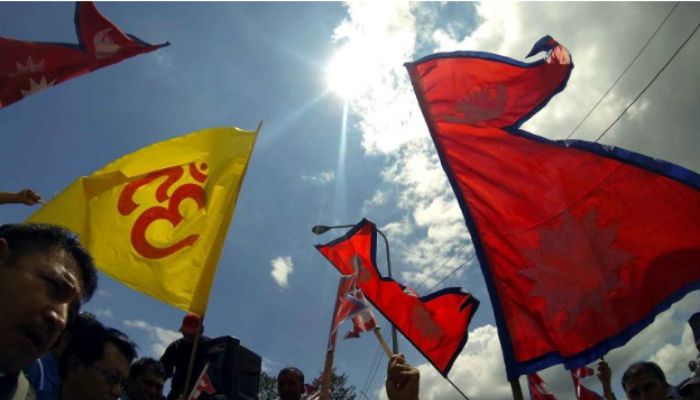
The Nepali Congress will hold discussions with other parties and work to declare Nepal a Vedic Sanatan Hindu state, party leader and member of Parliament Shankar Bhandari said.

In an interview with ANI, Shankar Bhandari, who has been leading the “Vedic Sanatan Hindu Rastra establishment campaign” within the Nepali Congress, claimed reinstatement of the Hindu state would be a course correction in Nepali politics.

“What we believe, attempt and request with all existing parties in the Federal Parliament would be to hold discussion with them. We have also been informed that the Nepal Communist Party is also worried about increasing conversion, and it is counterproductive. We all should work together for Vedic Sanatan Hinduism, other parties have also noticed this, and we are confident about it,” Bhandari said.

He further said that they will soon start a national debate over it and hold discussions with political parties, adding that they need a two-third majority to declare a Hindu state.

“As per our constitutional provision, we need a two-third majority (to declare Hindu state); serious error which was made at the time of promulgation of constitution- intentional or out of ignorance, we should not be late to rectify those errors, we are determined on it. We will soon start a national debate over it and hold conversations with political parties,” he said.

The campaign launched by Bhandari gained popularity during the five-day Maha Samiti meeting held in Godawari, Lalitpur, on February 19.

Bhandari’s campaign to collect signatures to pressure the party’s top leaders managed to get the signatures of about 1100 participants out of the 1950 designated members of the Maha Samiti meeting.

During the concluding session of the party’s mass meeting, Bhandari submitted the collected signatures to party President Sher Bahadur Deuba, who then promised to take the issue to the Central Committee meeting.

Among those 42 signatories are the central members of Nepal’s largest party in parliament, which includes former General Secretary, Shashank Koirala.

However, the agenda for a Hindu nation was not deliberated upon during the Maha Samiti meeting.

After the 2006 People’s Movement-II, Nepal reinstated democracy, overthrowing centuries-old monarchies. In successive years, it became a republican nation and adopted a new democratic and republican constitution in September 2015.

After the overthrow of the monarchy, Nepal became a secular state, changing its status from a Hindu state where the monarch or the king were worshipped and regarded as the reincarnation of Lord Narayan.

Upon being asked whether the Nepali Congress in the long term is aiming to reinstate the monarchy in the Himalayan nation, the leader rejected the claims and said, “It (monarchy) came on as a practice from the past, but there is no mention of the king being worshipped as God in any of the Hindu scriptures, there are different theories and policies regarding it.”

He further said that since the 16th century, Hinduism in Nepal has been targeted.

“Since the 16th century, the eternal Hinduism of Nepal has continued to remain a target, as per my knowledge. There have been attempts to hinder it by linking it with monarchy, the intervention of foreign nations, and raising tensions alleging it to be against ethnic groups. We have already taken note of this and we will hold a ground-level discussion in case it is needed, explain to all, in between the political parties and make them clear that it is not against any ethnic groups or personal freedom,” he added.

Notably, demands for a Hindu state have been rising in Nepal, as other parties have also continued to stage protests and agitations demanding the reinstatement of the religious identity of the nation.

The Rastriya Prajatantra Party, a pro-monarch faction, has also launched their campaign for a Hindu state, with the reinstatement of monarchy as their demand.

Congress leader Bhandari clarified that his party would only support the demands of the Hindu state but not the constitutional monarchy to achieve the aim.

During the previous Mahasamiti meeting, 714 individuals expressed their support for a Hindu nation by signing a petition, which was then submitted to the party president.

Additionally, 22 central members presented their signatures to President Deuba, urging for the inclusion of the Hindu nation agenda in the Mahasamiti meeting discussions.

Moreover, Hinduism is the most followed religion in the Himalayan nation, which stands at 81 per cent out of the total population, i.e., 291 million, 64 thousand and 578, as per the census of 2021.

Similarly, 23,93,549 people, i.e., 8.21 per cent, follow Buddhism, 5.09 per cent follow Islam, 3.17 per cent follow Kirant and 1.76 per cent follow Christianity. (ANI)

(This news report is published from a syndicated feed. Except for the headline, the content has not been written or edited by OpIndia staff)

“To me, this is misuse of freedom of speech”: EAM Jaishankar on space given to Khalistani elements by Canada & other countries

0

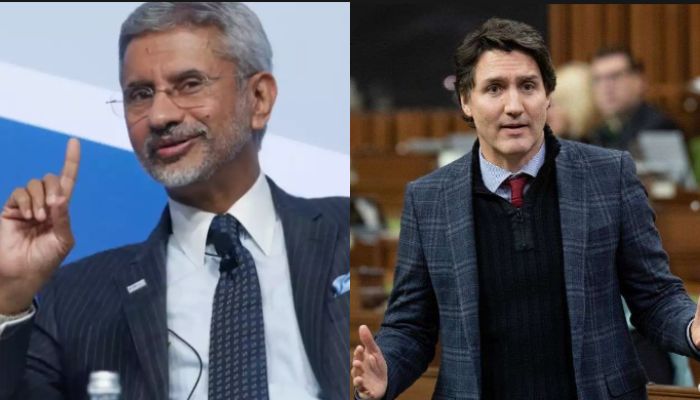
External Affairs Minister S Jaishankar called out the space given to extremist Khalistani elements in foreign countries and said this is not freedom of speech, but a misuse of it.

He said it is not good for any country to send that kind of message for their own reputation and expressed hope that action will be taken against those who attacked Indian missions.

The EAM was speaking at the event ‘The Rise of the Global South’ at TV9 Bharatvarsh Conclave on Monday.

Speaking about the situation in Canada, Jaishankar said, “We had to suspend the issue of visas in Canada because our diplomats were not safe going to work, they were repeatedly threatened, intimidated, and got very little comfort from the Canadian system at that time…which has improved since then.”

“We reached a stage, where, as a minister, I could not risk exposing my diplomats to the kind of violence prevalent there. That part of it has been rectified, so today our visa operations are pretty much normal,” he added.

The EAM further called out the argument of ‘freedom of expression’ stating that throwing smoke bombs at missions and advocating violence is a “misuse” of freedom of speech.

“Regarding the space that is being given to extremists, they keep saying us, ‘There is freedom of speech, democracy’. Freedom of speech can’t extend to intimidating diplomats, throwing smoke bombs in embassies and consulates, advocating violence and separatism against a friendly state. To me, this is not freedom of speech. This is a misuse of freedom of speech,” Jaishankar said.

Recalling the vandalism incident on the Indian High Commission in the UK, he said that the mission didn’t get the protection New Delhi had expected.

“To the point of someone climbing on to our HC and bringing down our Indian flag. I asked my colleagues ‘Let’s put us in each other’s shoes’. How would you react if a mob attacked your premises anywhere in the world? You will not say freedom of speech and expression, you will be jumping up and down. But, things have improved in the UK,” the EAM said.

In a stern message, Jaishankar said that if a country is not taking action against someone attacking foreign missions, “there is a message in it.”

“We have had a much firmer response in Australia and the US. We had an arson attack in the US, but that is under investigation. If the receiving state does not take action against someone who attacks an embassy or a consulate, there’s a message in it. Now, I don’t think it’s good for any country to send that kind of message for their own reputation. That’s why we want action to be taken against those who attacked our missions,” Jaishankar added.

Notably, there has been a rise in Khalistani extremism in several countries like Canada, Australia, the US and the UK.

After the killing of the designated terrorist Hardeep Singh Nijjar last June, the Khalistani extremists targeted Indian diplomats in several countries and issued threats against them.

Especially in Canada, multiple incidents of Khalistan extremism were reported lately. In June this year, a tableau parade was organised in Canada celebrating the assassination of former PM Indira Gandhi, which drew severe criticism from New Delhi. Multiple temples were also vandalised in Canada by pro-Khalistani protestors, with anti-India graffiti.

Amid strained ties, India stopped issuing visas to Canada amid concerns over the safety of Indian envoys there. Later, the e-visa service was resumed, and physical visa was also started in multiple categories.

In the UK, a group of extremist elements attacked the Indian High Commission in London last March.

Similarly, in the US, the Consulate General of India in San Francisco was attacked on March 19 by a group of assailants. Subsequently, on July 2, at midnight, a few people attempted to set the Consulate building on fire. The case is being probed by the National Investigation Agency. (ANI)

(This news report is published from a syndicated feed. Except for the headline, the content has not been written or edited by OpIndia staff)