Home Blog Page 1353

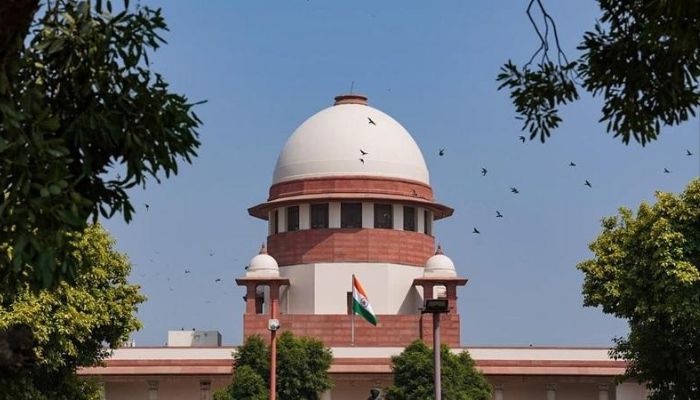
Supreme Court strikes down Electoral Bonds Scheme as unconstitutional, orders full disclosure of funding to political parties

Delivering the verdict on the validity of the electoral bonds, the Supreme Court ruled that the anonymous electoral bonds scheme is violative of Article 19(1)(a) and the Right to Information Act.

The 5-judge bench ruled that the Electoral bonds scheme has to be struct down as unconstitutional.

The judgment was delivered by a 5-judge bench of Chief Justice of India (CJI) DY Chandrachud, Justices Sanjiv Khanna, BR Gavai, JB Pardiwala & Manoj Misra. The bench delivered two separate but unanimous verdicts.

The Supreme Court has called for the disclosure of funding to political parties “as it curbs corruption whereas non-disclosure affects exercise of electoral vote”.

The CJI while pronouncing the judgment, stated that the Union of India had “failed to establish least restrictive measures of the Electoral bonds scheme for political funding.”

The bench ruled that the Electoral Bonds Scheme vis a vis the Companies Act, Finance Act and Representation of the People’s Act is violative of Article 19(1)(a).

In this context, the Supreme Court directed banks to stop the issuance of Electoral Bonds and ordered the State Bank of India (SBI) to disclose information on electoral bonds issued and cashed out and share it with the ECI within three weeks.

The ECI has been ordered to publish the said details on the website by 31st March 2024.

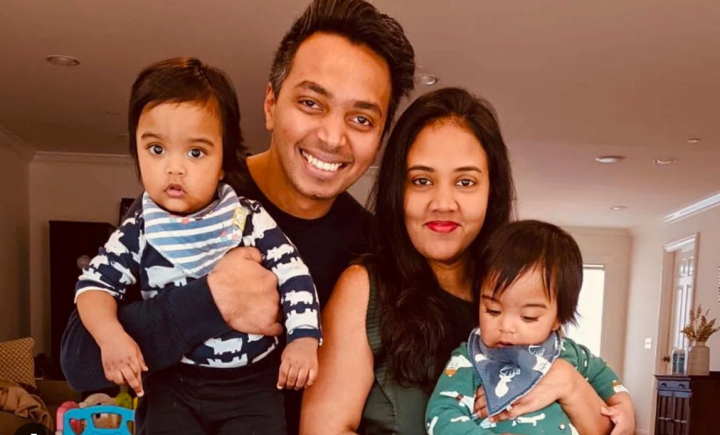
USA: Indian origin family found dead in their home in California, gunshot wounds on bodies of husband and wife

 An Indian-origin family was found dead in their apartment in California, United States.

This marks another unfortunate incident involving Indians or people of Indian origin living in the US in the last couple of weeks.

The family comprised of four members, who have been identified as namely; Anand Sujith Henry, his wife Alice Priyanka, and their twin children Noah and Neithan.

San Mateo police confirmed the death of the family on February 13.

The police had arrived for a welfare check but after receiving no response, they entered the house and located the bodies of the four deceased.

“San Mateo Police officers were dispatched to the 4100 block of Alameda de las Pulgas on the report of a welfare check. After arriving officers were met with no response, they searched the perimeter of the home and did not see any signs of forced entry into the house. Finding an unlocked window, officers entered the home and located four people dead; 1 adult male, 1 adult female, and two children,” the police statement read.

The police stated that the couple was found inside the bathroom with gunshot wounds, while the cause of death of the two children is being investigated.

“Tragically, the two children were found deceased inside a bedroom. Their cause of death is still under investigation. The male and female were located deceased from gunshot wounds inside a bathroom. A 9mm pistol and a loaded magazine were also found in the bathroom,” the statement read.

However, the police also said that this appears to be an “isolated incident” with no danger to the public as the person responsible was located “within the home”.

Further investigation is underway in the case, as detectives are working to gather evidence and speak to witnesses and family members, and determine a possible ‘motive’, the San Mateo Police added.

Last week, a 41-year-old Indian-origin man, identified as Vivek Taneja died in the United States, days after suffering life-threatening injuries as a result of an assault in downtown Washington, local police said.

The incident occurred on February 2 following which Taneja was rushed to the hospital for treatment, but he succumbed to his injuries on February 7.

Another distressing incident earlier this month showed an Indian student named Syed Mazahir Ali, facing a brutal attack in Chicago on February 7. Videos on social media that surfaced showed Ali bleeding heavily as he described the horrific incident.

The Indian Consulate in Chicago stated that it is in touch with the victim as well as his wife in India.

Earlier, 23-year-old Indian student Sameer Kamath was found dead in Warren County. He was a doctoral candidate in mechanical engineering at Purdue University.

On January 29, another Indian student, identified as Vivek Saini, was brutally killed with repeated blows from a hammer by a homeless man inside a store in Lithonia, Georgia, US.

Shreyas Reddy, Neel Acharya, and Akul Dhawan were other Indian students killed in the US this year. 

(This news report is published from a syndicated feed. Except for the headline, the content has not been written or edited by OpIndia staff)

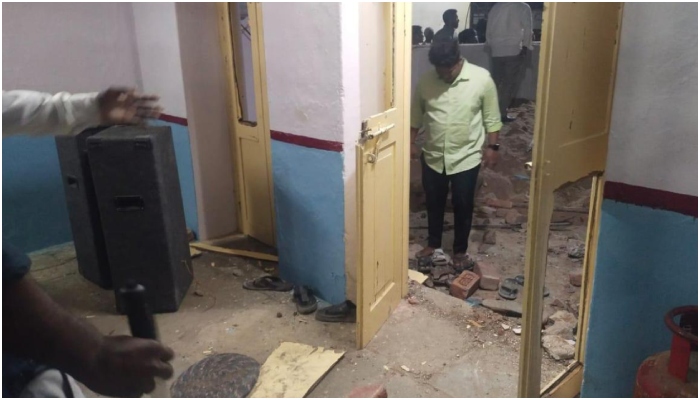
Telangana: Clashes in Janwada between Methodist Church and villagers over widening of road in front of the Church, 14 injured

0

At least 11 people suffered injuries and a Church got damaged after clashes over road widening at Telangana’s Janwada village in Mokilla on Tuesday (13th February) night. Police enforced section 144 of CrPC after the clashes, which outlaws assembly of 5 or more individuals, from Wednesday (14th February) evening till 11 PM on 21st February.

The problem started around 7 PM when members of the Methodist Church objected to road widening by HMDA, calling it encroachment. They insisted the road encroached on the Church land, while the local villagers insisted on road work.

The dispute resulted in clashes between the two parties, which quickly escalated into stone pelting from both sides. As many as 14 people are said to have suffered injuries.

“There was intense pelting of stones. One community was more aggressive as they were the bigger group,” the police said. 

Telangana United Christian Pastors Association (TUCPA) general secretary Goneh Solomon Raj, who along with a group of Christian leaders visited the victims at the hospital, said the confrontations began over installing a cement road that purportedly crossed the church premises.

“The villagers wanted to extend eight feet into the church’s land, and an argument rose between the village sarpanch, Mandal Praja Parishad (MPP), the Ward members, and the members of the church,” he said.

“A large mob barged into the church and started to attack the congregation of about 30 people with stones, cement bricks, and sticks, and broke the church doors. A girl was also injured in the attack,” he claimed.

Meanwhile, the villagers have lodged a police complaint against the church members. The accused persons have been booked under provisions of the SC and ST (Prevention of Atrocities) Act, under the IPC. S 143 (unlawful assembly), S. 147 and 148 (Rioting), S. 224 (resistance or obstruction to arrest), and S. 503 (criminal intimidation).

The injured, from both communities, with head injuries have been admitted to Gandhi Hospital. They are currently undergoing treatment.

Throughout the day, tensions rose in Janwada as church members protested at the village crossroads on the Shankerpally highway, demanding the arrest of all those engaged in the attack.

So far, the Mokila police have registered two criminal cases on charges of rioting, promoting enmity between two communities, and violation of the SC & ST Act.  “Our priority is to restore peace. We will act against those who resorted to violence,” police said.

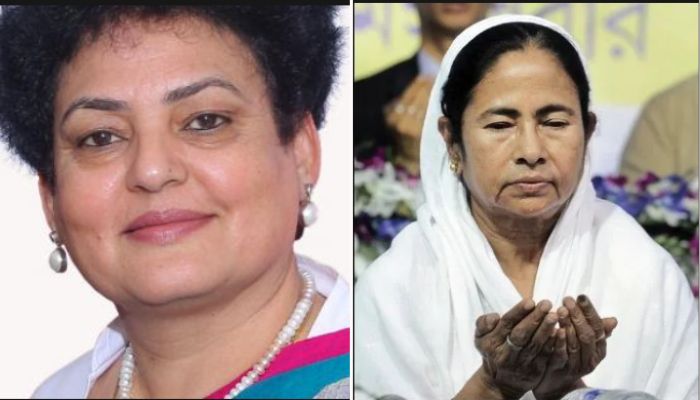
Sandeshkhali: NCW chair says media twisted statement of its member to give clean chit to WB govt, police had used version to dismiss victim’s charge

The National Commission for Women (NCW) has expressed its concerns over the lack of accurate and responsible media coverage in the Sadeshkhali case. The women’s rights body took to X resharing a post that alleged that “fake news” was being spread by mainstream media.

In the post, a clipping from the Trinamool Congress (TMC) briefing was shared where the party used a report by a media channel that claimed that the delegation of NCW had not received any complaint of physical torture from the victims of Sandeshkhali.

The same was then reshared by the NCW expressing concerns over the lack of accurate and responsible media coverage in the case.

“NCW is concerned by the lack of accurate and responsible media coverage in the Sandeshkhali case. Our inquiry committee found that the victim in West Bengal is being threatened by local police, deterring them from coming out and reporting instances of sexual and physical harassment,” the commission said.

NCW Chairperson Rekha Sharma also took to X saying that some media houses in West Bengal were twisting the statement of NCW member Delina to give a clean chit to the state government.

An NCW team headed by Delina Khongdup is in West Bengal to do the inquiry on Sandeshkhali violence.

The NCW chair’s charge came shortly after the West Bengal police used a report by a mainstream media channel to dismiss the allegations of the victims.

On 14th February, the West Bengal Police through its X handle reiterated that “no allegations about rape of women have so far been received,” even as victims have narrated their ordeal to the media.

“During the enquiries since conducted by the State Women’s Commission, an all-women 10-member fact-finding team led by DIG CID, and also the district police. The representatives of the National Women’s Commission, following a recent visit to Sandeshkhali, have also corroborated this, saying that they did not receive any complaints of rape of local women during their enquiry,” the police wrote on its X handle.

Resharing the media report in question, the West Bengal police said that it will initiate legal action against sections of the media for spreading unfounded misinformation.

This is not the first time that the West Bengal police have insulted the victims of rape. They have been accused of shielding shielding the accused TMC leaders, instead of taking action.

It has emerged that instead of taking action against the accused, police have filed cases against relatives of victims for making complaints. This was revealed by Rekha Sharma, the chairperson of National Commission for Women.

The tweeted, “According to my team who has visited Sandeshkali, police has filed complaints against the relatives of women victims instead of filing their complaints. Villagers are been terrified equally by goons and by the police.”

She tweeted, “According to my team who has visited Sandeshkali, police has filed complaints against the relatives of women victims instead of filing their complaints. Villagers are been terrified equally by goons and by the police.”

The NCW chief further added, ‘This is the way Mamta didi treats women in West Bengal.’

Sandeshkhali rapes and protests

For last one week, women in several areas in Sandeshkhali of North 24 Parganas district in West Bengal have been protesting, demanding the arrest of TMC leader Sheikh Shahjahan and others, narrating how the women in the area have been sexually exploited for a long time.

The protests led to violence in the area, after which heavy police force have been deployed in the area.

Several women from Sandeshkhali have come forward to narrate how the women in the area are being raped by Sheikh Shahjahan, the mastermind behind the attack on ED team, and other TMC workers and their aides.

Out-on-bail gangster Lakha Sidhana releases video from farmer protests site calling for rebellion against Modi govt, Delhi police on high alert

Gangster-turned-pro-Khalistan activist Lakha Sidhana has been seen at farmer protest sites encouraging the farmer groups to break the barricades. On 14th February, he released a video claiming the ongoing protests are not just about farmer protests. His presence has put the security agencies on high alert.

Notably, Sidhana is out of bail in the matter linked to a riot-like situation in Delhi on 26th February 2021 when protesting “farmers” forcefully entered Delhi and hoisted alien flags on the Red Fort. Several police personnel were injured in violent attacks, and properties were damaged on that day. Last week, he was booked for attacking police personnel and damaging police vehicles in separate cases.

In a video of over 5 minutes, Lakha Sidhana claimed that the fight is not limited to the farmers’ demands. He said, “The way new laws are being implemented, they [the government] will snatch away your land, water and everything. Your history will be destroyed. It is now a question of our existence.”

Calling it a “new world order,” he claimed that people around the world, including Western countries, are fighting against it. Sidhana made a shocking demand in the video. He asked his supporters to provide JCB and other heavy-duty machines for the protests. Understandably, they want to use heavy machinery to remove the barricades that the police have placed to stop them from entering Delhi. Notably, they have already procured one JCB, visible in the video.

“We have to break the barricades and enter Delhi. Now, it is the question of our dignity and existence. It is the question of our future generations,” he added.

Speaking to PRO Punjab TV, Sidhana openly called for regime change and said PM Modi should not return to power. Speaking about the protests, he claimed there are amendments in the laws that ensure NSA and UAPA on protesters. He said, “Their men are posing as protesters and damaging properties. We have caught a man yesterday and one today.”

He also spoke against digitisation and claimed with digital currency, the government wants to control where you spend your money, and if you protest against it, they will come after you. Speaking on private players entering the agriculture sector, he said large machines and robots will take away the jobs of labourers. In essence, Sidhana has a problem with everything linked to modernisation.

Who is Lakha Sidhana?

Lakha Sidhana is a gangster-turned-radical who poses as a political leader. He is one of the accused in the 26th January violence in Delhi and is currently out on bail. He contested the Punjab Assembly Elections 2022 as an independent, where he secured 28,091 votes but lost the election of Aam Aadmi Party’s candidate Sukhveer Singh Maiserkhana, who secured 63,099 votes. As per an affidavit filed by Sidhana during the Assembly Elections, there were 14 pending cases against him, and in two cases, he was convicted. Sidhana also tried his hands in politics in the 2012 elections but failed.

Farmers protest: Farmers to block trains under ‘Rail Roko’ campaign in Punjab ahead of talks with central ministers

As the farmers’ protests enter the third day, the Bharatiya Kisan Union-Ugrahan (BKU-Ugrahan) is planning to block trains in Punjab today. Meanwhile, on Thursday evening (15th February), three Union ministers will meet with farmer leaders to discuss their demands.

BKU (Ugrahan) general secretary Sukhdev Singh Kokri Kalan said, “We stand with them in solidarity. To prove it, our supporters will hold rail roko (stop trains) at as many places as we can. The organisation will block rail tracks in Punjab from 12 PM to 4 PM on Thursday, a day before they are set to hold a nationwide strike scheduled for 16th February.

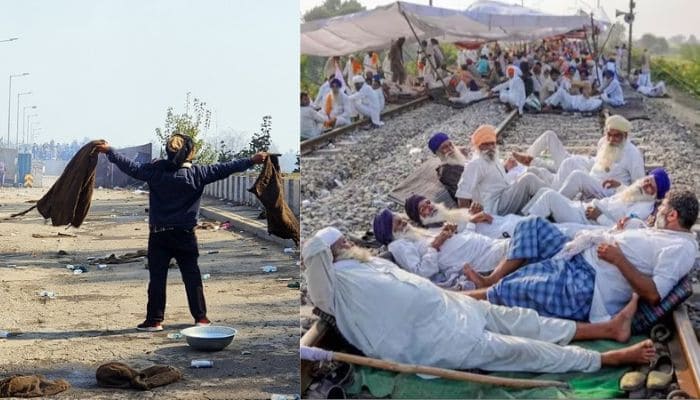
According to reports, about ten protest sites have been finalised for the rail roko protest, in which the BKU Ugrahan and BKU Dakaunda (Dhaner faction) would participate together, with more locations expected to be added by the evening.

The sites marked for the rail roko protest are Rajpura, Sunam (near the Shambu and Khanauri borders, respectively), Jethuke hamlet in Bathinda, Moga, Mansa, Malaut, Valla railway crossing in Amritsar, Barnala, Sangrur, and Budhlada. The BKU (Ugrahan) leader said that this will affect the Amritsar-Jalandhar-Delhi line, the Mansa-Bathinda-Delhi line, the Ludhiana-Ferozepur line, and many more areas.

Meanwhile, a panel of three Union ministers will meet with protesting farmer leaders in Chandigarh on Thursday, February 15. Agriculture and Farmer Welfare Minister Arjun Munda, Minister of Commerce and Industry Piyush Goyal, and Minister of State for Home Affairs Nityanand Rai will meet with farmer leaders at 5 PM in Punjab’s capital to discuss their many demands, including a law ensuring a minimum support price for crops.

When asked about Bharatiya Kisan Union leader Rakesh Tikait’s announcement of ‘Bharat Bandh’ on February 16, BJP leader Dilip Ghosh said, “PM Modi is continuously working towards helping the farmers and improving their situations. Fertiliser prices have been reduced, and ‘Kisan Samman Nidhi (PM-KISAN)’ has been launched. Farmers are happy all over the country. They (referring to Tikait) are doing this only to show off their leadership.”

On Wednesday, the government invited farmer representatives to a third round of talks in a week, after two previous meetings on 8th and 12th February remained inconclusive. The offer for talks came as protesting farmers stayed at the Shambhu and Khanauri borders of Punjab and Haryana to march to Delhi to pressurise the Centre to fulfil their demands.

Speaking about the scheduled meeting with the ministers, Punjab Kisan Mazdoor Sangharsh Committee General Secretary Sarwan Singh Pandher on Wednesday said that the meeting with the Centre will be held tomorrow at 5 PM and the farmers want to resolve all issues peacefully. “Even in this position, we are thinking that we will not leave the way of talks. If the Centre comes up with a solution, then we are ready. We don’t want any kind of conflict. We want to resolve all issues through dialogue. The meeting with the Centre will be held at 5 pm tomorrow. We are saying again, that tomorrow also we will sit peacefully,” he said.

“…We are going to attend the meeting in a completely positive mood today and we have full confidence that a positive solution will emerge from this meeting…” Pandher added.

Meanwhile, SKM Punjab has said that they will hold protests at toll plazas for three hours on 15th February from 11 am to 1 PM. Manjit Singh Dhaner, President of BKU Dakaunda has informed that this act is a form of protest against the police action of Haryana against protesting farmers at Shambhu and Khanauri (Dhaner).

Balbir Singh Rajewal, state president of BKU (Rajewal), a constituent of SKM, said “The central government is projecting that the farmer unions in Punjab are divided, but the reality is that we all rally behind each other when it comes to the rights of farmers. The call to make tolls across the state free for three hours is completely in solidarity with agitating farmers. If required, we will intensify our support.”

Farmers protest and their demands

On Tuesday (13th February), a large number of farmers marched towards the national capital. In addition to drafting a law on MSP, the protesting farmers undertaking the ‘Delhi Chalo’ march have been demanding that India should quit the World Trade Organisation (WTO), halt trade agreements with other nations, and a monthly pension of Rs 10,000 to farmers who attain the age of 60 years among others. The protest has been called by Sanyukt Kisan Morcha and Punjab Kisan Mazdoor Sangharsh Committee, led by farmer union leaders Jagjeet Singh Dallewal and Sarwan Singh Pandher.


Tripura: ‘Vulgar’ depiction of Saraswati idol in Govt Art and Craft college sparks row, ABVP protests against authorities

0

Akhil Bharatiya Vidyarthi Parishad (ABVP) staged a protest at the Tripura Government College of Art and Craft on Wednesday over purported vulgarity in an idol of Goddess Saraswati being worshipped at the college premises.

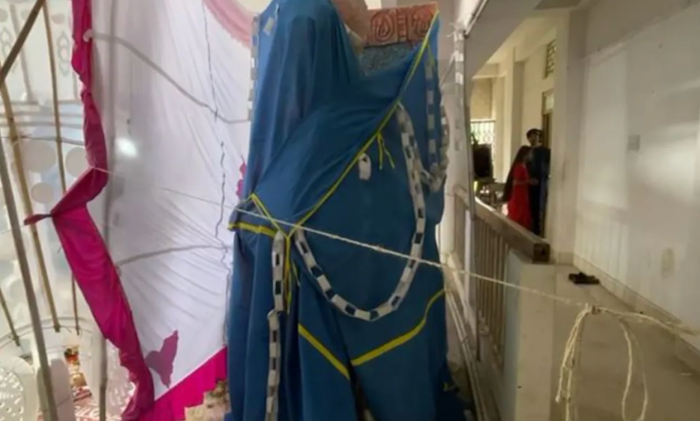
Members of the Rashtriya Swayamsevak Sangh (RSS)-affiliated student body ABVP protested against the idol of Goddess Saraswati placed in the government institute at Lichubagan, claiming that it was “vulgar” and contrary to the spirit of Indian culture and religious sentiments, and compelled the institute authorities to drape the idol with a saree.

Dibakar Acharjee, Joint Secretary of the ABVP unit of the state, said that the organisation strongly opposed any such initiative by educational institutions, hurting religious sentiment.

“As we all know, today is Basant Panchami and Goddess Saraswati is worshipped all over the country. In the very morning, we all got news that in the Government Art and Craft College, the idol of Goddess Saraswati was sculptured in a very wrong and vulgar way.

We instantly reached the location and started our protest. We bound the college authority to stop the worship there and forced the students to rap a saree on the idol. We strongly protest against this type of initiative in any educational institution,” he said.
He further demanded Tripura Chief Minister Manik Saha take strict action against the college authority.

“It’s our demand to the CM Dr Manik Saha to take strict action against the college authority and dismiss the principal too,” he added. 

(This news report is published from a syndicated feed. Except for the headline, the content has not been written or edited by OpIndia staff)

Didn’t expect my candidature: Karsevak Ajit Gopchade, who was in Ayodhya for karseva in 1992, on Rajya Sabha nomination from BJP

0

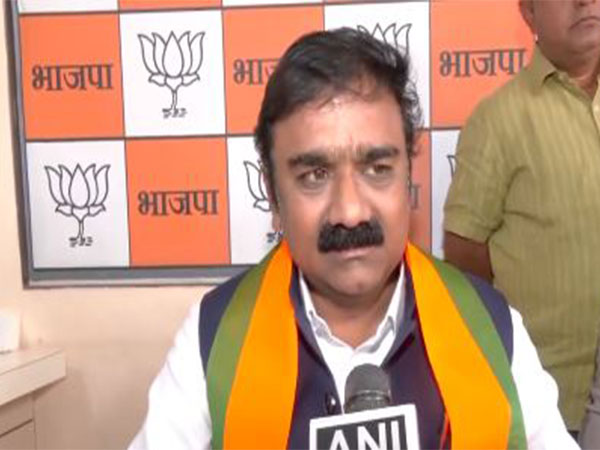
Ajit Gopchade, who has been nominated as a BJP candidate for the upcoming Rajya Sabha elections in Maharashtra on Wednesday, said that the decision took him by ‘surprise.’

Speaking to ANI, Ajit Gopchade thanked Prime Minister Narendra Modi, Union Minister Amit Shah, and party national president JP Nadda for announcing him as a candidate.

“I am an ordinary party worker. I didn’t know I was being nominated. I did not expect that I would be nominated for the Rajya Sabha. I have been in the BJP for the past 25-30 years. I want to work in the areas of medical education and research,” he said.

The BJP on Wednesday announced three candidates for the Rajya Sabha from Maharashtra, including former Congress chief minister Ashok Chavan, former MLA Medha Kulkarni, and Ajit Gopchade.

While Chavan’s nomination was a foregone conclusion, the party sprung a surprise by fielding Kulkarni and Gopchade.
A doctor, Gopchade hails from Nanded district and has enjoyed a long association with the RSS/BJP.

In 1992, Ajit Gopchade, who had then completed his MBBS, set out for karseva at Ayodhya. He proactively participated in the Ramjanmabhoomi movement. Gopchade was among those who were present at the site on the day the Babri Masjid demolition took place.

Speaking about the moment during the Babri Masjid demolition, he said, “I went there as a karsevak. There were many respected people with me at that time. We paid our service for Lord Ram that day.”

The official list released by the central BJP only listed three names. A day after joining the BJP, Ashok Chavan, who hails from Maharashtra’s Nanded district, made it to the party’s Rajya Sabha list.

A Maratha leader with a 38-year-long political career in Congress, Chavan’s shift to the BJP was long awaited. He represented Nanded in the Lok Sabha from 1987-89, was elected to the state Legislative Council in 1992, and the state Assembly from 1999 to 2004 (Mudkhed constituency) and from 2009 to 2024 (Bokhar constituency).

(This news report is published from a syndicated feed. Except for the headline, the content has not been written or edited by OpIndia staff)

51 crore accounts, 35 crore rupee cards, Rs 2 lakh crore deposit: The corruption-free and crucial benefits provided to the poor by Pradhan Mantri Jan Dhan Yojana

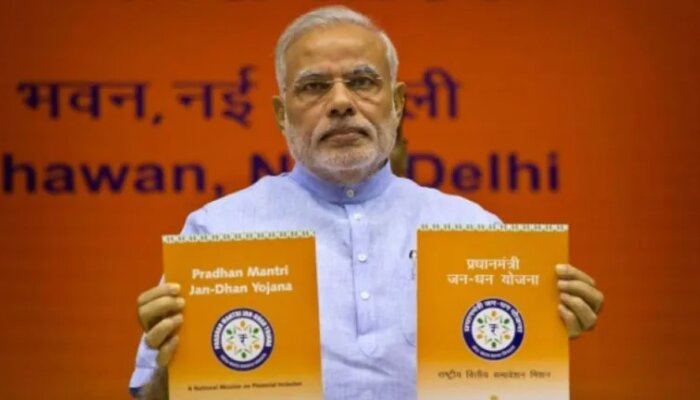
The nation is about to experience its greatest celebration, which occurs every five years which is the general elections. The last ten years of Prime Minister Narendra Modi’s administration are nearly over. He is currently contending for a third term. PM Modi is vying for the public’s support considering the effectiveness of his policies. OpIndia in the next few days will inform you about the extent to which the government has succeeded in implementing the initiatives. The Pradhan Mantri Jan Dhan Yojana (PMJDY) is the first one in the series.

Furthermore, there is a rationale behind the initial selection of the Pradhan Mantri Jan Dhan Yojana. The reason is that shortly after assuming office, Prime Minister Narendra Modi launched this enormous endeavour. He unveiled the scheme on 15th August 2014, from the Red Fort’s ramparts.

On 28th August 2014, the program was formally introduced. Its objective was to guarantee that every household in the nation had at least one bank account. In light of this, the government intended to roll out additional measures which also proved beneficial.

Why was PM Jan Dhan Yojana introduced

Prime Minister Modi was aware that reducing corruption would need direct government assistance to the populace and bank accounts were required to fulfil this objective. Many people still lacked access to banking services even after the nation’s independence for over seven decades and the nationalization of institutions. According to a World Bank estimate, around 70% of Indians lacked access to a bank account as of 2011.

A significant proportion of the populace was unable to open an account because they lacked the required minimum deposit. This was the largest challenge along this route. Individuals in the country did not have even accounts, let alone access to facilities like ATMs. Our nation lagged well behind the rest of the world’s emerging markets in this regard as well.

Things began to change gradually

The Modi administration started the Jan Dhan Yojana on 28th August 2014, with the intention of addressing all of these issues with a single program. It was also remarkable that a plan materialized in the span of two weeks after it was announced. Public sector banks established their camps in villages for this purpose. ‘Bank Mitras’ (friends) were tasked with opening accounts and educating the impoverished and disadvantaged about the matter.

The government eliminated the obligation to have a minimum amount to open an account under the system. Banks only utilised Aadhaar and other identity cards to open accounts. The Jan Dhan Yojana was instantly successful. Villages started to witness the impact of the camps. According to Jan Dhan Yojana reports, within a month after the program’s introduction, over 3.3 crore accounts were created. More than 1.8 crore of these accounts were opened in rural regions.

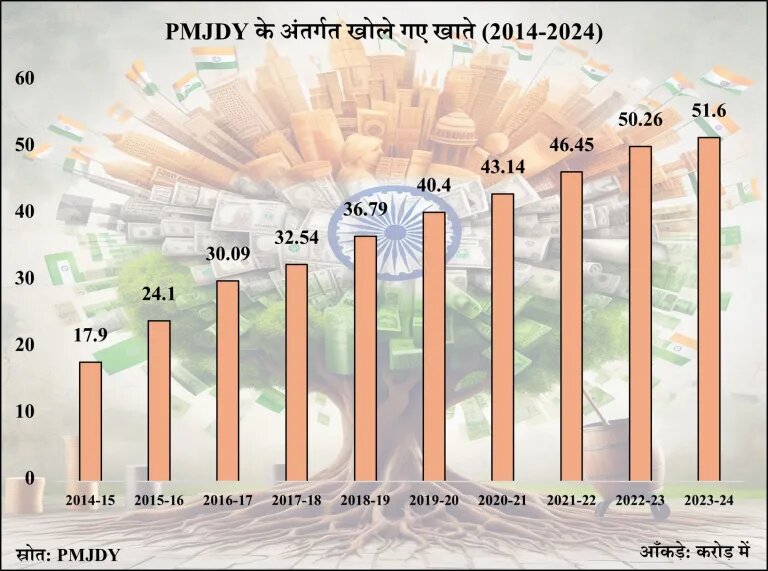
The number of accounts under the scheme grew every year. (OpIndia Hindi)

The Jan Dhan Yojana enabled the inception of 17.9 crore accounts in just one year. The fact that 60% of these accounts were set up in rural regions makes them even more productive. One crore people in the country received Rupay ATM cards in less than a month. Approximately 18 crore accounts were generated in the country under the aforementioned scheme by the end of the first year. Around 11 crore of these accounts were opened in rural regions.

At present, the Jan Dhan Yojana has resulted in the debut of around 51 crore accounts throughout the nation. A sizable portion of the citizens in the nation now own bank accounts and ATMs. More than 35 crore Rupay ATMs have been issued nationally under this program. Common people no longer have to pay annual fees for these cards which renders them unique compared to previous cards issued by foreign firms that required annual costs.

Direct support is available upon account opening

The country’s common people have benefited most from Jan Dhan accounts by receiving government incentives. The government’s direct deposit of benefits into their accounts has grown dramatically during the past ten years. Only 10.8 crore people, per the report, were directly benefited by Direct Benefit Transfer (DBT) from 2013 to 2014. This amount also reached 98 crores during the COVID-19 period at the same time. Guidance was provided under various schemes to 98 crore recipients. It only became possible because now they all had a bank account.

Jan Dhan Yojana improved the condition of banks

Pradhan Mantri Jan Dhan Yojana has not only prospered the people but also the banks. The small savings that customers are making in the banks is bringing in more capital. According to the data, the nation’s citizens have deposited over Rs 2 lakh crore into accounts founded under the Jan Dhan Yojana. The ability of banks to function has been facilitated by the arrival of the funds.

This program not only helps individuals save more money and brings them into banks, but also allows them access to numerous other programs including the Toilet Yojana, Kisan Samman Nidhi and Pradhan Mantri Awas Yojana. It has been largely responsible for India’s financial revolution.

Protesting farmers keep Haryana CID officer hostage alleging he was ‘spying’ on them, announce rail blockade in Punjab

0

The alleged farmers’ protest is growing more violent each day. In a shocking development, a Crime Investigation Department (CID) officer of Haryana Police named Satendra Pal was held captive by the agitators in Haryana’s Jind on 14th February. The incident transpired at the Datta Singhwala border. The officer is posted at Garhi police station.

The farmers accused that he was there to collect information on them. They took him hostage based on their suspicion. However, no official confirmation on the same has been provided by the district or the state administration so far.

The farmers alleged that the CID officer was taking pictures of the protest site and sending the images to senior officials. Farmer leader Baldev Sirsa said that the officer is an employee of Haryana Police. The farmer leader said that they have also seized the phone of the said officer, in which it is seen that he has been getting calls from the officers minute by minute. Sirsa further claimed that they found some audio on the phone, in which Satendra Pal could be heard sharing information about the protest with the officials.

Later the farmers handed over the officer to Punjab Police along with his phone.

Meanwhile, the Bharatiya Kisan Union-Ugrahan and Bharatiya Kisan Union Dakaunda (Dhaner faction) on 14th February declared that farmers will demonstrate their support for the march towards Delhi by blocking the railway tracks in Punjab on 15th February from 12:00 noon to 4:00 pm. The union officials confirmed that the protest will commence at ten locations and other places could be added by the evening. 

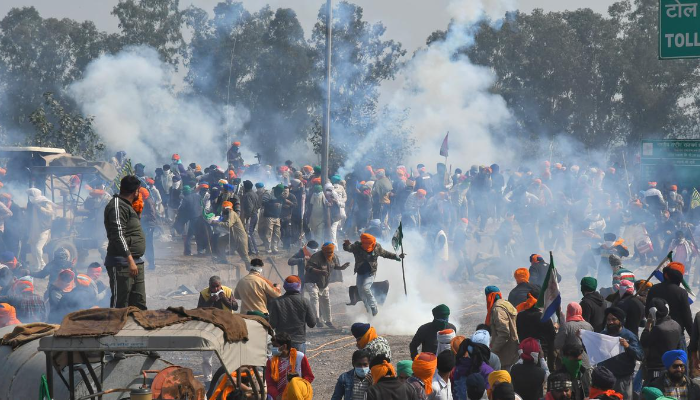
Sukhdev Singh Kokrikalan, the general secretary of BKU-Ugrahan stated, “This protest is against the repression by the Haryana government against the farmers of a few unions who had to go to Delhi as part of their Dilli Chalo protest call. Farmers have been attacked with tear gas shells, rubber bullets and water cannons and are getting injured. Hence, we are extending support to them.”

Rajpura, Sunam (close to Shambu and Khanauri borders, respectively), Jethuke village in Bathinda, Moga, Mansa, Malaut, Valla railway crossing in Amritsar, Barnala, Sangrur, Budhlada have been finalised till now. Sukhdev Singh Kokrikalan mentioned, “This will affect the Amritsar-Jalandhar-Delhi line, the Mansa-Bathinda-Delhi line, Ludhiana-Ferozepur line, and many other locations.” He responded, “Our rail roko will still continue as per the announcement because it is against the repression of the Haryana government against the farmers, which they have already done,’ when questioned if the matter gets resolved during the discussions between farmers and the union ministers in Chandigarh.

Furthermore, there will be a 4-hour chakka jam on state and national highways from 12 noon to 4 pm in response to the Grameen Bharat Bandh call by Samyukt Kisan Morcha (SKM) and Central Trade Unions (CTU) on 16th February. Public buses would be off the road from 6 am to 4 pm.

SKM Punjab has announced that toll plazas will be free of charge for the general public for three hours on 15th February from 11 am to 1 pm. Manjit Singh Dhaner, President of BKU Dakaunda has informed that this act is a form of protest against the police action of Haryana against protesting farmers at Shambhu and Khanauri (Dhaner).

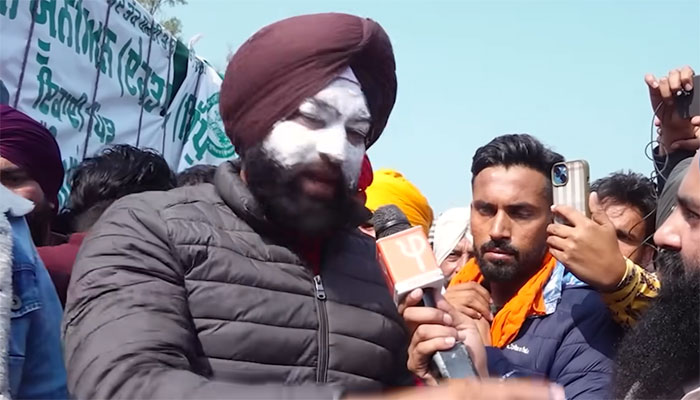
Farmers near the Shambhu border have taken significant steps to prepare for their move forward. They are putting multani mitti on their faces to lessen the impact of tear gas. Furthermore, a lot of them are donning body armour. Farmers soaked sacks in water to combat tear gas shells. At the same time, they have initiated the process of equipping tractors with spraying tanks. Roadway buses from Jind to Delhi are reportedly no longer running. Farmers even pelted stones during clashes with police personnel injuring many people including journalists.

The protests have already been exposed as desire for a separate nation ‘Khalistan’ with an open border with Pakistan as well as overt displays of Hinduphobia and demands for conversion to Sikhism have been vocalised by the radical elements.