Home Blog Page 1368

Rekindling national pride- Rejuvenation of Ayodhya and the resilient spirit of Bharat: RSS Sarsanghchalak Mohan Bhagwat

0

On 21st January, RSS published a compelling piece by Dr Mohan Bhagwat, the Sarsanghchalak of Rashtriya Swayamsevak Sangh (RSS), where he reflected on the historical narrative of India and emphasised the nation’s long-lasting resilience against various invasions. Dr Bhagwat particularly pointed out the destructive impact of invasions in the name of Islam from the West. He stated that these invasions aimed to decimate Bharat’s social and cultural fabric. The invaders specifically targeted religious structures, including temples, in an attempt to demoralise and weaken the Indian society.

Dr Bhagwat discussed the saga of the Bhavya Ram Mandir in Ayodhya, which symbolised the relentless spirit of Indian society that never succumbed to external pressures or invasions. Despite repeated destructions and efforts to suppress the Hinduness in the heart of Indians, the commitment to restore the Bhavya Ram Mandir signified that the people of India have unwavering faith and resistance towards the atrocities.

In his article, Dr Bhagwat highlighted the significant turning point in Indian history when, in 1857, the people of India envisioned a society free from external domination and emphasised issues like the liberation of Ram Janmbhoomi. Though the 1857 revolt did not succeed in ending British Rule, it fuelled the continuous struggle for the Ram Mandir in Ayodhya.

According to Dr Bhagwat, the post-independence political landscape failed to honour the collective will of the Hindu society regarding the Ram Mandir issue. He categorically praised the perseverance of the Hindu society that resulted in significant milestones in the history of constructing Ram Mandir. The talks of building Ram Mandir started as Somnath Mandir regained its glory post-independence.

It started with Bhagwan Ram Lalla’s idol appearing at Janmbhoomi in 1949. The court ordered the unlocking of the temple in 1986, which became another milestone for the demand for the Ram Mandir. Furthermore, the relentless efforts of Hindus and their sacrifices during Ram Janmbhoomi movement in the early 1990s finally culminated in the Supreme Court’s balanced verdict in 2019, where the apex court gave the disputed land to Hindus and ordered the government to allot a 5-acre piece of land to Muslims to construct a Mosque.

The verdict paved the way for Mandir’s construction, and Bhoomi Pujan finally took place in August 2020, leading to the upcoming grand ceremony of Pran Pratishtha of Bhagwan Ram Lalla in Bhavya Ram Mandir on 22nd January 2024.

Dr Mohan Bhagwat pointed out that the Ayodhya issue symbolises the national conscience and the collective ethos of the Indian society that honours Bhagwan Ram. This figure embodies justice, compassion and the ideal way of life. He called for an end to all disputes and bitterness surrounding the issue and advocated for societal introspection to ensure harmony.

Dr Bhagwat said that the construction of the Bhavya Ram Mandir in Ayodhya is not just about religious devotion. It represents the restoration of the national pride. It affirms the Indian way of life rooted in dignity, discipline and unity. His message is clear. The Bhavya Ram Mandir is undoubtedly a beacon of national pride that reflects the values of Bhagwan Ram, which is deeply ingrained in the psyche of every true Indian. He called for active participation in the journey of national resurgence marked by the construction of Bhavya Ram Mandir as a moment of collective awakening and commitment to rebuild not just a monument but the very spirit of Bharat, that is, India.

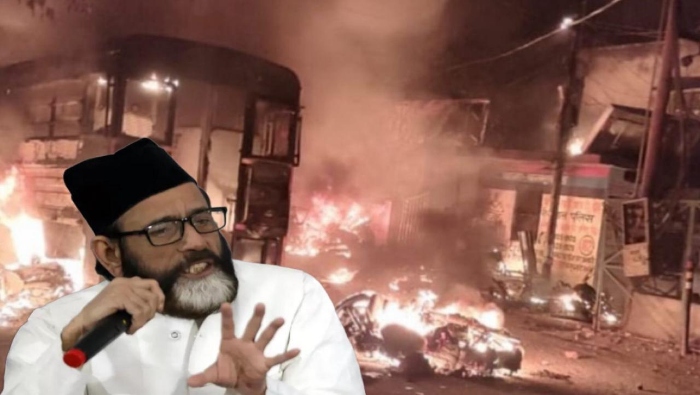
Men belonging to ex-MP Munnan Khan, man eulogised by leftist media outlet ‘The Wire’, posed as police and opened fire on unarmed karsevaks in 1990

The historic day of the Pran Pratishtha of the Ram Mandir in Ayodhya is near. On January 22, Ram lalla will be seated in the sanctum sanctorum of the temple being built on his birthplace. This historic occasion has created an atmosphere of joy and the spirit of devotion for Bhagwan Ram. Amidst the happiness over the “return of the king”, the Hindu society remembers all the Karsevaks who sacrificed their lives for the Ramjanmabhoomi from the era of Mughals to Mulayam Yadav. Back in 1990, the Mulayam Singh-led government inflicted more brutalities on the devotees of Lord Ram than even the Mughal tyrant Babur.

OpIndia undertook an on-the-ground investigation concerning those defenceless kar sevaks who were shot chanting the divine name of Bhagwan Ram and showed cruelty even towards the corpses. In this particular instance, the names of two paramilitary officers, Bhullar and Usman, are much discussed. The name Munnan Khan, however, was the most shocking revelation to emerge from the horrific adversity orchestrated by the then-Mulayam government. Four years earlier, the leftist propaganda portal ‘The Wire’ defended the same Munnan Khan. While playing the victim card, The Wire included a slew of misleading and inaccurate facts in their piece.

Karsevaks were massacred by a private gang

OpIndia was the first to reveal, citing a police officer stationed in Ayodhya in 1990, that Munnan Khan was somehow involved in the massacre of the unarmed devotees of Lord Ram. Following this finding, numerous surviving Karsevaks and family members of martyred karsevaks have stated that they learned in 1990 that a leader named Munnan Khan had been actively involved in the massacre. Kali Sahay, the son of martyr Ram Bahadur Verma of Sultanpur district, says that Munnan Khan was even provided with a helicopter to fire bullets on karsevaks.

According to Kali Sahay, the local people were aware in 1990 that Munnan Khan orchestrated the grisly murder of Ram Bhakts through his ‘private gang’. Kali Sahay also voiced suspicion that the bore of the bullets used to kill karsevaks was not official.

Uncertain if the attack was carried out by real or fake police

OpIndia talked to Rambhakt Raghuveer Singh, who participated in Karseva in 1990. Raghuveer Singh was injured in the lathicharge at that time. He stated that during Karseva, he heard the name Munnan Khan of Gonda. Raghuveer Singh said, “I had heard that Munnan Khan had ordered 2-3 trucks full of criminals in police uniforms to open fire there.”

Raghuveer remains unsure whether he was attacked by real police or Munnan Khan’s ‘police’ since defending his life was his first concern at the time. Raghuveer claims that during the chaos, he could not read anyone’s badge or nameplate.

Come to Ayodhya, you will get rewards there

In a conversation with OpIndia, Ram devotee Rajesh Kumar Sahu, who participated in the 1990 Ayodhya Karseva, also mentioned the name of Munnan Khan. He stated that when he returned from Ayodhya, locals informed him that Munnan Khan had taken his men, disguised in police uniforms, from the opposite road. It is said that Munnan Khan roamed in a government roadways bus with his accomplices in places where the movement of karsevaks was strictly prohibited. Rajesh Sahu’s neighbours informed him that Munnan Khan was telling the kar sevaks, “Chalo Ayodhya, wahin par phal milega (Come to Ayodhya, you will get reward there).” Rajesh said that Munnan Khan was also carrying weapons.

Fake PAC battalion involved in the massacre of defenceless karsevaks

Murari Lal Gupta, who was also involved in Ayodha Karseva in 1990, told OpIndia that he later found out that Munnan Khan had assembled a whole battalion of fake PAC to massacre the devotees of Lord Ram. Murari Lal Gupta also stated that the Munnan Khan he is referring to served as the Member of Parliament for Gonda. According to Murari Lal, these imposter PAC men opened fire on Ram devotees by climbing on to the roofs of temples around Hanuman Garhi. The ensuing shooting culminated in the martyrdom of dozens of karsevaks.

“Munnan Khan killed my father”: karsevak Ram Achal Gupta’s son says

Speaking to OpIndia, Sanjay, the son of Karsevak Ram Achal Gupta, who was gunned down at Ayodhya on November 2, 1990, said that as a child, he heard about Munnan Khan massacring Ram bhakts while wearing a police uniform. Sanjay said that his father was also a victim of the bullet fired by Munnan Khan.

Munnan Khan’s name written on the walls

Seema, the daughter of Ram devotee Vasudev Gupta, who was martyred on October 30, 1990, told OpIndia that she was very young when her father was shot, but she recalls that, in addition to paramilitary staff, the name of Munnan Khan came up for killing kar sevaks. Seema Gupta said that at that time, Munnan Khan’s name was seen written on walls at many places.

Chief Minister should order a probe into Munnan’s crimes

Martyred karsevak Aam Achal Gupta’s son Sanjay Gupta wrote a letter to Uttar Pradesh Chief Minister Yogi Adityanath on January 11, 2024. In this letter, Sanjay said he has convincing proof demonstrating that Munnan Khan had a hand in the 1990 karsevak massacre. Sanjay Gupta stated in the letter that if the 1987 Hashimpura incident in Meerut could be probed, why not the 1990 Karsevak massacre.

It is worth noting that in the Hashimpur incident, after 40 years, the police officers accused of shooting people from Meerut’s Muslim community in 1987 were sentenced by the court. Many of the then-police officers had died, and many had grown old.

Letter sent by Sanjay Gupta to DM Ayodhya, Chief Minister and UP Police

Everyone bowed before Munnan Khan’s political might

OpIndia tracked out a police officer assigned to Ayodhya in 1990. According to the policeman, who spoke on the condition of anonymity, the Territorial Police Force unleashed lathi charge on Ram devotees. The policeman stated that discussions about Munnan Khan’s attack on Ram followers and his associates near the Saryu River were ubiquitous at the time. Due to this attack, numerous Ram bhakts jumped into the swollen Saryu river, and their remains were never found.

The police personnel posted in Ayodhya further stated that at the time, many people, including the government and administration, were aware of Munnan Khan’s misdeeds, but his political standing was so strong that no action could be taken.

Who was Munnan Khan

Munnan Khan’s full name was Fasiur Rehman Munnan Khan. He was born on January 7, 1945, in Gonda, Uttar Pradesh. Gonda is a district that borders Ayodhya. Balrampur district was formerly part of Gonda. Many elderly people in Gonda believe Munnan Khan began his criminal career in the 1970s. Soon after, his network had expanded to Nepal. Meanwhile, in 1985, he ran for election on a Lok Dal ticket from the Katra assembly constituency in Gonda district. He won the election. After his five-year term ended in 1989, Munnan contested as an independent candidate for the Balrampur parliamentary seat and won the election.

Despite being a public representative, Munnan Khan’s criminal activities continued unabated. Accusations of land grabbing and inciting riots were levelled against him from time to time. In spite of this, owing to his political patronage, not just intersections but also villages in Gonda district have been named after him. Munnan Khan was also a father to five sons and two daughters. His son, Qasim, is also a history-sheeting criminal. OpIndia will soon publish a second exposé detailing Munnan and his family’s criminal and dark exploits.

When ‘The Wire’ became Munnan Khan’s shield

Unsurprisingly, in 2019, the Islamist sympathising leftist propaganda portal ‘The Wire’ eulogised Munnan Khan and gave him a clean chit whitewashing his crimes. Then, journalist Krishna Pratap Singh of ‘The Wire’ described Munnan Khan’s name as a figment of certain journalists’ imagination. In an article published on November 9, 2019, The Wire labelled the then-media persons who exposed Munnan Khan’s crimes in 1990 as ‘Hindu journalists’. In the same piece, The Wire described Munnan Khan as a ‘dominant socialist leader’ close to Mulayam Singh but cleared him of any offences.

The Wire’s propaganda report

In its report loaded with a fabricated narrative, ‘The Wire’ did not care to speak to the surviving Karsevaks or their families. 

Another lie peddled by ‘The Wire’ in the name of Hindu-Muslim

Krishna Pratap, the communist writer of ‘The Wire’, has shrewdly shifted all of the blame for the firing on karsevaks from Munnan, and the then-Mulayam government, to the then-journalists. In the said report, he claimed that no Muslim officers were posted in Ayodhya during the 1990 firing. About a month and a quarter after The Wire’s story was published, TV9 Bharatvarsha journalist Hemant Sharma stated in one of his reports that CRPF Deputy Commandant Usman was among those who opened fire on the unarmed Karsevaks.

The Wire’s proactive reports against repressed truths

The Wire has also claimed that Munnan Khan’s dominant persona irked the Vishwa Hindu Parishad. However, The Wire did not mention that Muslim leaders such as Azimul Haq alias Pehalwan of the then-Faizabad (now Ayodhya) district and Zulfikarullah of the adjoining Sultanpur district had significant influence during Munnan Khan’s era. The obvious question here arises why would Vishwa Hindu Parishad or any nationalist journalist be inclined to use the name of a Muslim leader from a remote district rather than Ayodhya or a nearby district?

However, it said that around 2019, the Ram Mandir issue in the Supreme Court reached its climax and conclusive point. In such a case, with the prospect of hidden facts being exposed, outlets like ‘The Wire’ had made preparations in advance to come to the defence of their favourites at the right time. 

An excerpt from The Wire’s propaganda report

Many hidden cases involving Munnan Khan, are yet to come to the fore. The relatives of the killed Ram devotees also want to expose the involvement of not only leader Munnan Khan, but also officials like Usman, in the 1990 massacre. All the suffering Karsevaks who talked about Munnan Khan’s wrongdoings are still alive. Many of the journalists from that time are still around. All of them have also stated that they will actively cooperate in the probe if initiated. The people of Bharat want to know the truth about the three-decade-old episode that caused the Saryu River to turn red with the blood of karsevaks.

ISRO’s National Remote Sensing Centre releases satellite images of Ayodhya Ram Mandir ahead of Pran Pratishtha

0

As Bharat is immersed in the devotional fervour ahead of the “return of the emperor of all emperors” Lord Ram, India’s own indigenous satellites provided a space view of the magnificent Ram Mandir in Ayodhya. Indian Space Research Organisation (ISRO) has given the world the first darshan of Ram Mandir from space before the consecration ceremony. 

The 2.7-acre Ram Mandir premises can be seen in the image captured by the Indian Remote Sensing series of satellites. According to the National Remote Sensing Centre (NRSC), Indian satellites captured the under-construction temple on December 16, 2023, about a month before the pran pratishtha ceremony.

Satellite image of Ram Mandir in Ayodhya (Image credit: NRSC)

Satellite pictures show the redeveloped Dashrath Mahal and the Sarayu River near the Ram Mandir.

Satellite image of Shri Ram Mandir and Dashrath Mahal (Image credit: NRSC)

The photographs released by the NRSC also show the newly renovated Ayodhya Dham Junction railway station.

Satellite image of Ayodhya Dham Junction railway station (Image credit: NRSC)

When science meets spirituality: How ISRO helped in the construction of Ram Mandir

The construction of Ram Lalla’s holy abode has been a precise fusion of traditional Indian heritage architecture with advanced science, ensuring its longevity for over a thousand years. The three-floor temple has been constructed without using steel or iron as iron’s life is limited to 80-90 years.

Speaking to NDTV, Alok Sharma, the International Working President of Vishwa Hindu Parishad (VHP) said that once the Babri structure was demolished in 1992, 40 feet of debris covered the site where Ram Lalla is said to have been born. Larsen & Toubro constructors employed Differential Global Positioning System (GPS) coordinates to determine the precise location for the installation of the new idol of Ram Lalla. In addition, exact location signals were obtained from India’s indigenous navigation system, ‘Navigation with Indian Constellation’ or the NavIC satellite constellation.

Notably, NavIC is a satellite-based navigational system that allows users to find their precise geographic location and track their route anywhere in India and up to 1500 km beyond the territorial boundaries.

Ram Mandir: Epitome of Indian architectural marvel

Interestingly, the main architectural feature of a Hindu temple is the Garbhagriha (sanctum sanctorum), a small room where the temple’s principal god or deities reside. Mandapa—the portico or hall at the temple’s entrance that is typically built to accommodate a large number of visitors. The Hindu temples are incomplete with a Shikhara, a mountain-like spire with various intricate patterns, from pyramidal to curvilinear. Traditional Hindu temples also feature Vahana, which is the mount of the consecrated deity, and it is generally visible from Garbhagriha.

The majestic temple in Ayodhya has been constructed in the Nagara temple architecture style, distinguished by towering shikhara. The temple is 2.77 acres in size and constructed out of pink sandstone. The temple is encircled by a huge courtyard with several smaller shrines dedicated to various Hindu deities. The Shaligram stone, a non-anthropomorphic representation of Lord Vishnu has been imported from Nepal’s Gandaki River and is to be used in the making of the idols of Bhagwan Ram and Mata Janaki. 

As per Shri Ram Mandir Teerth Kshetra’s website, the temple measures 360 feet long, 235 feet broad, and 161 feet high. Teak wood (Sagwan/Sagaun) from Maharashtra’s Chandrapur is being used to construct the windows and doors. Teak is a unique wood with a lifespan of more than 100 years. The temple is designed by Chandrakant Bhai Sompura, whose grandfather, Prabhakarji Sompura, collaborated with his son, Ashish Sompura, on the Somnath Temple.

The temple has around 3,000 light fixtures that are carefully positioned on walls, columns, and ceilings. The specific placing of these fixtures is due to their peculiar beam angle, which draws focus to the temple’s spell-bounding carvings.

Interior lighting in Ayodhya’s Ram Mandir (Image credit: HindustanTimes)

Moreover, the ramps and sculptures have been optimally illuminated with step lights, profile LED strips, and a variety of aesthetic fixtures.

Ram Mandir illuminated with LED lights (Image credit: AmarUjala)

Ram Mandir Pran Pratishtha

The consecration ceremony on 22nd January is set to be a grand affair, with a series of rituals and traditions taking place to mark the Pran Pratishtha of Ram Lalla and the official opening of the temple in the presence of Prime Minister Narendra Modi. Over 7,000 guests comprising 3,000 VIPs have received invites from the Ram Mandir Trust. There will also be an invitation sent to the families of the karsevaks who lost their lives in the temple movement.

On Sunday (21st January), the seven-day-long Vedic rituals ahead of the consecration enter their sixth day, with the “divine bath” in which the child form of Lord Ram will be bathed with 125 urns and “Shayadhivas” of Ram Lalla taking place today.

Bhagwant Mann guilty of religious misconduct, indiscriminate firing by Punjab police: Akal Takht rules in 2023 Kapurthala gurdwara clash

Punjab Chief Minister Bhagwant Mann has been found guilty of religious misconduct by Sri Akal Takht Sahib Jathedar Giani Raghbir Singh in relation to the gunfire incident that occurred in November 2023 at Gurudwara Akal Bunga in Kapurthala between the Punjab Police and a group of Nihangs, reported The Indian Express.

A statement released on Sunday (21st January) by the Shri Akal Takht Sahib Secretariat declared as much. The early-morning clash on 24th November last year left several wounded and claimed the life of a Punjab Police home guard.

The Shiromani Gurdwara Parbandhak Committee (SGPC) subcommittee report regarding the police’s claimed infraction of decorum at the Gurdwara Akal Bunga Cantonment Nihang Singhan in Sultanpur Lodhi, Kapurthala served as the basis for the Jathedar’s decision.

The Shri Akal Takht Sahib Secretariat stated that after reviewing the report, the facts and assertions contained within demonstrate that the police attacked the gurdwara on a huge scale without any kind of justification.

The Jathedar proclaimed, “Firing, breaking the dignity by entering the Gurdwara Sahib with the police wearing shoes and disrupting the Sri Akhand Path Sahib going on inside the Gurdwara Sahib by releasing tear gas shells was an act that deeply hurt Sikh sentiments by disrupting decency and sanctity,” in a statement.

He added, ‘“According to the report of the sub-committee, Punjab Chief Minister Bhagwant Mann, as the head of the Ministry of Home Affairs, is responsible for the act of the police. The CM has been found directly guilty of religious misconduct for breach of decorum and indiscriminate firing.”

Investigators alleged that the incident happened when a police squad went to the gurdwara to settle a quarrel between two Nihang factions.

Subsequently, the chief minister announced that the family of the late home guard, Jaspal Singh, who was from Maniala in Kapurthala would receive Rs 2 crore in compensation.

Jai Shree Ram, temple only possible under PM Modi’s leadership: New Zealand Minister David Seymour

Ayodhya has been decked up with all sorts of decorations to welcome visitors as well as Prime Minister Narendra Modi for the “Pran Pratishtha” (consecration ceremony) of Ram Mandir on 22nd January. As well-wishes stream in from all across the world, David Seymour, the Minister for Regulation in New Zealand has also stepped out to greet Hindus on the historic occasion.

He stated, “I am very pleased to be here today. Jai Shri Ram to the entire planet and what a wonderful celebration of a monument that will last a thousand years. I want to congratulate everybody in India including and especially Prime Minister Narendra Modi for his leadership that has made this construction possible after 500 years, ready to last another 1000 years. It’s a testament to what people can do.”

He added, “I wish PM Modi courage and wisdom as he helps over a billion people in India navigate the challenges of the world today. I hope that he will have strength and faith that allow him to see the challenges before they become crucial and wisely help the Indian nation navigate through them. I’d be delighted to visit the Ram Temple. I am very happy to discuss any opportunities with the Indian government. Wish you all the very best for a wonderful celebration.”

More than 100 private aircraft are expected to land at the recently opened Maharshi Valmiki International Airport, Ayodhyadham (MVIAA) and other nearby airports as the holy city of Ayodhya gets ready to host the inauguration event.

Operational since 30th December 2023, the recently opened airport features eight bays or aprons, that can hold smaller aircraft and single-aisle 200-seaters. The festivities which are expected to draw over 8,000 VIPs, celebrities, actors, businesspeople, saints, seers, and other notable guests are slated to be presided over by Prime Minister Narendra Modi.

On 19th January, images of Lord Ram’s idol that was placed on the marble mandapa in the sanctum sanctorum of the temple’s garbhagriha surfaced online. The idol is crafted from ‘shyamal’ (dark) stone which shows the deity as a five-year-old boy standing on a lotus composed of the same stone.

The 150 kg and 51-inch idol sculpted by popular Mysuru artist Arun Yogiraj was brought to the temple on the night of 17th January accompanied by the chanting of prayers and placed on the marble pedestal in the Garbhagriha in the Ram Janmabhoomi Teerth Kshetra in his presence.

Not Indian plane, incorrect news circulating online: Indian authorities dismiss the rumours, confirm that the plane crashed in Afghanistan is not Indian

On 21st January (Sunday), the Ministry of Civil Aviation officially dismissed fake news following an unfortunate plane crash in Afghanistan. Within minutes of reports that a plane had crashed in the mountainous region of Afghanistan, a concerted effort was made to spread fearmongering claiming that it was an Indian flight. Several netizens also claimed that a large number of casualties might have taken place. 

Quoting an Afghan media report, Congress sympathiser Tehseen Poonawala tweeted, “This is terrible news. It is not a scheduled flight…I also really hope this is NOT a chartered flight … Just hoping and sending pleas to the universe.”

There were several other tweets repeating the claims.

Several social media users also peddled reports adding to the fearmongering that an Indian flight had suffered a tragic crash in Afghanistan. Incidentally, several journalists had also initially shared the same fear about an Indian flight crashing in Afghanistan, but it was soon pointed out that it was not an Indian flight and initial Afghanistani media reports had ambiguous or wrong details. 

Importantly, clearing the air, the Ministry of Civil Aviation categorically noted that the flight that had crashed recently in Afghanistan was neither an Indian flight scheduled nor a non-scheduled/Charter aircraft. According to the information, it was a Moroccan small aircraft.    

The Ministry tweeted, “The unfortunate plane crash that has just occurred in Afghanistan is neither an Indian Scheduled Aircraft nor a Non-Scheduled (NSOP)/Charter aircraft. It is a Moroccan-registered small aircraft. More details are awaited.” 

Additionally, the Director General of Civil Aviation also confirmed that it was not an Indian plane as certain netizens had maliciously peddled on social media. 

According to DGCA officials, a plane had crashed in the mountains of Topkhana near the districts of Kuran-Munjan and Zibak of Badakhshan province. It was a Moroccan-registered DF 10 aircraft. 

According to a Reuters report, the Russian Aviation Authorities had stated that a Russian-registered plane with six people thought to be on board disappeared from radar screens over Afghanistan on Saturday (20th January) evening. The plane was a French-made Dassault Falcon 10 jet. The plane was a charter flight travelling from India via Uzbekistan to Moscow.

The announcement by Russia’s aviation watchdog Rosaviatsia came after local Afghan police had stated that they had received reports of a crash the previous night.

Meanwhile, the clarification from Indian authorities came at a time when there was a slew of tweets that tried to spread fearmongering over the unfortunate incident. Based on initial and unconfirmed news reports in Afghanistan media, several netizens shared posts peddling misinformation and unconfirmed reports leading to fearmongering of a large number of casualties in an Indian flight. While more details are awaited about the reported plane crash, the authorities cleared misinformation claiming it to be an Indian flight.

Holiday for employees, hotel constructions, direct flights to Ayodhya: Corporate India gears up for Ram Mandir Pran Prathistha

In the lead-up to the consecration of the Ram Mandir in Ayodhya on 22nd January, corporate India is seizing the opportunity to connect with the masses in an unparalleled marketing extravaganza. The excitement surrounding the event has prompted major companies to employ creative marketing strategies and contribute to the celebrations.

India’s largest conglomerate, Reliance Industries, has declared a nationwide holiday on 22nd January, aligning with the Maharashtra government’s decision to observe it as a public holiday.

The consecration, expected to be witnessed by millions in India and abroad, has prompted a surge in corporate initiatives, ranging from the hospitality industry’s expansion with new hotels to airlines swiftly adding Ayodhya to their destinations.

With over 50 hotel construction projects underway, major players like Taj Hotels, Marriott International, Sarovar Hotels, and the Park Inn are establishing their presence in the city. The recently inaugurated Maharshi Valmiki International Airport has attracted carriers such as IndiGo, Air India, Akasa, and SpiceJet, connecting Ayodhya with major cities.

The hospitality industry isn’t the only sector capitalising on the Ayodhya Ram Mandir wave; FMCG and retail giants are also making significant contributions.

According to reports, Dabur India has pledged to donate a portion of its profits from Dabur products sold until 31st January to Shri Ram Janmabhoomi Teertha Kshetra. Dabur is strategically increasing product distribution in Ayodhya, anticipating a surge in demand for daily essentials, and creating experience zones for visitors to interact with products like Real juices, Dabur Amla hair oil, and Dabur Vedic Tea.

Adani Group’s Fortune Brand plans to distribute over 25,000 jalebis shaped in the form of their ‘Bloom’ logo, along with Fortune Special Pakoda Platte and Fortune Mega-Bhog for devotees. Additionally, ITC’s Agarbatti brand Mangaldeep has donated its flagship dhoop, “Mangaldeep 3 in 1 Dhoop,” for six months to facilitate daily puja rituals.

Beyond consumer goods, corporate contributions extend to infrastructure and services. Reliance Industries has set up a water distribution stall providing free packaged water to devotees, while its telecom arm, Jio, has upgraded its network in Ayodhya.

Coca-Cola is actively placing vending machines and supporting local shopkeepers by placing coolers in their stores. Ride-hailing firm Uber has introduced its electric auto-rickshaw service in Ayodhya, catering to the growing travel demand and aiming to provide enhanced mobility options for tourists and pilgrims.

As the corporate world aligns with the consecration ceremony of the Ram Mandir in Ayodhya, the spiritual merchandise market is experiencing an unprecedented surge. T-shirts bearing the slogan ‘Jai Shri Ram,’ flags adorned with images of Hanuman, and replicas of the Ram Mandir are witnessing a significant boost in sales.

E-commerce platforms like Flipkart and Amazon are featuring these items prominently, with sales of spiritual merchandise doubling or even tripling compared to regular days. Ayodhya-related products have become an ‘open IP,’ allowing numerous sellers on e-commerce platforms and in general trade to capitalize on the event for merchandise sales.

The spiritualism and cultural significance associated with the Pran Pratishtha ceremony of the Ram Mandir in Ayodhya have not only stimulated sales but also prompted companies to leverage the occasion across various categories.

With expectations of a substantial increase in visitors, airlines like SpiceJet are introducing special flight services, and marketplaces in cities like Delhi are gearing up for celebrations akin to “Diwali”, featuring special programs in over 100 retail and wholesale markets.

As the countdown to the consecration continues, corporate India’s multifaceted involvement reflects the scale and significance of the Pran Pratishtha of Ram Mandir in Ayodhya.

Tamil Nadu: PM Modi reaches Ram Setu’s origin point ‘Arichal Munai’ ahead of Ram Mandir Pran Prathistha in Ayodhya

Prime Minister Narendra Modi visited Arichal Munai point in Dhanushkodi on 21st January before the Pran Pratishtha (consecration ceremony) of the Ram Mandir at Ayodhya. Arichal Munai is believed to be the origin point of the Ram Setu.

He practised ‘anulom vilom’ and offered flowers at the site. He also performed meditation and Yoga at Arichal Munai.

Furthermore, the prime minister performed pooja at the Sri Kothandarama Swamy temple in Dhanushkodi. The name Kothandarama means Lord Ram with the bow.

Dhanushkodi is the place where Lord Ram is believed to have taken the vow to defeat Ravana and proceeded to Lanka. It is stated that Vibhishana, the brother of King Ravana encountered Lord Ram here for the first time and implored him for refuge.

According to sacred texts and legends, this is also the location where Lord Ram conducted Vibhishana’s coronation. The Prime Minister prayed at Sri Ranganathaswamy Temple in Tiruchirappalli and Sri Arulmigu Ramanathaswamy Temple in Rameswaram in the southern state earlier on 20th January.

He is visiting the holy places as part of his spiritual journey before the temple’s landmark inauguration event. He conveyed, “As we prepare for the auspicious occasion of the consecration of the Shri Ram temple in Ayodhya, it is heartening to visit these temples that hold deep religious and cultural significance.

Congress’ war on Lord Ram

During the tenure of the United Progressive Alliance (UPA)-I led by the Congress party in 2007, the government used an affidavit to claim that there was no historical evidence to establish the existence of Lord Ram or any of the other characters in the Ramayana. It stressed, “The petitioner while seeking relief have primarily relied upon the contents of the Valmiki Ramayana, the Ram Charit Manas by Tulsidas and mythological texts, which formed an important part of ancient Indian literature, but which cannot be said to be historical records to incontrovertibly prove the existence of the characters or the occurrence of the event, depicted therein.”

The administration asserted that the Ram Setu was the result of naturally occurring formations “caused by tidal action and sedimentation.” The Archaeological Survey of India (ASI) maintained that Ram Setu could not be regarded as a historical or archaeological monument and for the same reason unworthy to be declared as a protected monument based on the premise of corralling theory which would suggest that it was not a manmade structure.

It alleged, “The Ramcharitmanas by Tulsidas, the Valmiki Ramayana, and other mythological texts, which admittedly form an ancient part of Indian literature, cannot be claimed to be historical records that prove incontrovertibly the characters and events depicted therein existed or occurred,” in the affidavit while claiming that its major objective is to research human history scientifically.

While it proclaimed that the ASI acknowledged and appropriately honoured the profound religious significance that the Hindu community throughout the world has bestowed upon these texts, it further contended that the study of human history, which was the ASI’s main focus, must be conducted in a scientific manner with the use of current technological tools and that its conclusions must be supported by verifiable material evidence. Regarding the Ramayana, an allegation was made that there was no “historical record” that could definitively demonstrate the existence of the character or the events it describes.

In addition to the obvious denial that the Ramayana is historical, a closer examination of the UPA Government’s affidavit disclosed that great attempts were made to reduce Lord Ram to the status of “a character” alone. Additionally, it was purposefully stated that the religious works of Tulsidas’ Ramacharitmanas and Valmiki’s Ramayana were on par with “other mythological texts forming an important part of ancient Indian literature.”

As a result, the UPA government was forced to withdraw the affidavit and endure public outrage across India. The Ministry of Culture allegedly proposed the removal of at least three clauses from the affidavit, however, only two of these clauses were eliminated. One of the unremoved statements mentioned that the Ramayana was not historically accurate, a charge that was soon refuted.

Punjab: Jalandhar Police arrest two members of Lawrence Bishnoi gang after early morning encounter

0

On 21st January (Sunday), Jalandhar Police engaged two members of the Lawrence Bishnoi gang in an early morning encounter. In the exchange of fire, both members of the Bishnoi gang suffered critical injuries. Subsequently, the Police arrested the duo and rushed them to hospital for treatment. As per reports, a police officer also sustained injuries during the encounter. 

Informing about the operation, Police officials said that two members of the Lawrence Bishnoi gang were injured during an encounter with the Jalandhar Police on Sunday morning. The early-morning encounter took place in the Gulmohar Colony, Jalandhar, which falls in the Bhargo Camp police station area.

According to the officials, a police officer also sustained injuries during the encounter. Both critically injured gangsters were rushed to hospital. Several videos of the purported incidents have surfaced online in which smashed window panels of the Police vehicle and two gangsters could be seen being taken away by the officials in their vehicle. 

Jalandhar Commissioner of Police Swapan Sharma led the early morning operation. Notably, Sharma, the former DIG of the Jalandhar Range had played a major role during the manhunt against Khalistani separatist ‘Waris Punjab De’ chief Amritpal Singh who was arrested in April, last year. 

Meanwhile, the two gangsters of the Lawrence Bishnoi gang arrested by the police were involved in a host of illegal activities including murder, extortion, contract killing, and drug smuggling, as per the officials.

As per reports citing sources, a CIA team had received specific intel and subsequently decided to conduct a raid at Nakha Wala Bagh near Gulmohar Colony in the early hours of this morning. During their raid, the cops found a suspicious car parked on a road. They soon encircled the suspicious vehicle. 

Following the encirclement, the suspects opened fire at the CIA team from inside the vehicle and a bullet hit a police officer’s turban. In the retaliatory police firing, both of the assailants were hit and sustained serious injuries. 

The officials added that weapons and other items were recovered from them following the encounter. 

According to CIA in-charge Surinder Singh Kamboj, the accused were associated with the Lawrence Bishnoi gang and were wanted in multiple cases registered with the Jalandhar Commissionerate.

It is important to note that Lawrence Bishnoi is a gangster who has over two dozen criminal cases against him, including for targeted killing and extortion. Additionally, his gang had repeatedly sent threatening warnings to Bollywood actor Salman Khan about the latter’s alleged involvement in the black buck case.  

Chhattisgarh: BJP government cancels Rs 218 crore contracts awarded to former Congress minister Mohammad Akbar’s brother due to irregularities

Housing and environment minister of Chhattisgarh, Om Prakash Choudhary, has issued an order to revoke ten projects worth a total of Rs 218 crore that were awarded to ‘Raipur Construction Limited’ which is owned by Mohammad Asghar, the brother of former Congress cabinet minister Mohammad Akbar.

The BJP minister stated that poor performance and a protracted delay in concluding the construction project work, most of which is to be completed under the smart city project in Chhattisgarh’s new capital, Nava Raipur-Atal Nagar, were the reasons for withdrawing the agreement.

Choudhary said, “The agreements of Rs 218 crore for 10 major works have been cancelled. The contracts were awarded to an executing agency Raipur Construction Ltd, which is managed by a relative of a former senior Congress minister. The Congress government had been giving extension after extension to the firm that was also served with notices to conclude the given projects in the given target time. But it didn’t comply, so we took stringent action against the agency revoking the contract work orders.”

The minister announced that his administration would not put up with sub-par work from any business or contractors. He noted that extra caution needs to be taken to guarantee that all initiatives are completed on time.

When asked if the company was connected to Mohammad Akbar’s family who had previously served as state housing and environment minister in the Bhupesh Baghel administration, the BJP minister responded that it was a serious concern. He said that he learned about it and had an internal team look into the matter thoroughly before deciding to cancel the Rs 218 crore projects.

Furthermore, Mohammad Asghar was hired despite breaking the guidelines.

The newly elected BJP government has given orders to wrap up all projects by their respective deadlines and appears to be moving swiftly to create Nava Raipur, the new smart city capital. The deadline for finishing the outstanding projects in various cities under the Smart City Mission has been extended by the Center until June 2024. The administration headed by Chief Minister Vishnu Deo Sai issued directions to complete all projects by the due date.

Greater Raipur will serve as the model for the development of Nava Raipur, Raipur, and Durg-Bhilai. The State Capital Region is planned to be structured similarly to the National Capital Region. A plan has been formulated and the government decided to move forward with the project which will facilitate easy access from Nava Raipur to Raipur and Durg-Bhilai. Residential and commercial sectors will be constructed in conjunction with the development of the area’s infrastructure.