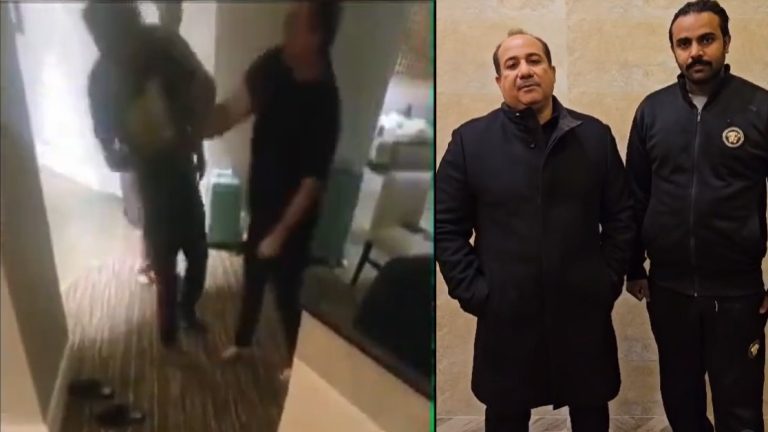
In a shocking incident, well-known Pakistani Sufi singer Rahat Fateh Ali Khan assaulted his domestic help mercilessly over a liquor bottle. In a video that appeared online, Rahat Fateh Ali Khan was seen hitting his servant with shoes, slapping and kicking him repeatedly.
The poor servant was pleading for mercy, only to fall on deaf ears of the singer.
As per a report by the Pakistani news channel Samaa TV, Rahat Fateh Ali Khan assaulted the man after a liquor bottle went missing from his bar in his house. While hitting the servant, Khan was asking where his bottle is, suspecting him of stealing the bottle of alcoholic beverage.
He was asking, asking, “Where is my bottle?” while simultaneously raining down punches and curses on his domestic employee.
The report said that while Rahat Fateh Ali Khan was beating the servant, nobody dared to come forward to stop him and protect the servant.
A reporter of the channel said that the singer often misbehaves with his staff, and had assaulted his driver once. The report states that while Rahat Fateh Ali Khan presents a very pleasant image during his one-hour performance, he changes completely during his off-screen hours. The channel said that there are several footage of his atrocities which can’t be aired.
“Sources suggest that such violent behavior among singer, often attributed to substance abuse, has become a worrying trend. The incident serves as a stark reminder of the complexities behind the glamorous façade of the music industry, where even celebrated artists like Rahat Fateh Ali Khan are not immune to allegations of misconduct and abuse,” Samaa TV added.
However, after the video went viral, the assaulted employee made a statement saying that the video was made by a blackmailer to defame the singer. Four videos were posted on Rahat Fateh Ali Khan’s Instagram page, in which the employee, whose name seemed to be Naved Usmain, said that it was just a matter of missing bottle, there was nothing wrong with what his boss did with him.
Rahet appeared with the man and his father in a video, it was an internal matter between him and his disciple, and someone was blowing the matter out of proportion. He also said that he had immediately apologized after the act.
The employee’s father also supported the singer, saying that he has done a lot for them, and it was a minor incident. Rahet also got his driver to say that he has never misbehaved with him.
In another video, Rahat Fateh Ali Khan said that he had already apologized to his staff, and again apologising on the record. To this the employee said that Rahet is like his father figure and he can do whatever he wants. He said that the singer had just reacted strongly for the missing bottle, and whoever made the video and leaked it did it to blackmail and defame the singer.
The employee said that he has working with Rahet for 40 years, and he has always loved him.
The employee also appeared in two more videos, in which he said that he had lost a bottle, leading to the incident. He said that Rahat Fateh Ali Khan is his ustad, he can beat him and abuse him, there is nothing wrong, and the man who made the video of the assault is a big blackmailer.
The employee further said that he is embarrassed that the singer came to him to apologise to him. He said that he is sorry that Rahet had to apologise to him, and he has no objection to the way the singer assaulted him. He reiterated that Rahet can do whatever he wants with him, as he is like a father figure and he loves them very much.
A day after a Houthi missile struck a British oil tanker with 22 Indians onboard, the Indian Navy confirmed that it had deployed its guided missile destroyer INS Visakhapatnam to rescue lives at the high sea. The vessel named the Marlin Luanda was attacked by the Yemen-based terror outfit, Houthis on 26th January. Reportedly, all the crew onboard the merchant vessel are said to be safe.
The Indian Navy is assisting in the firefighting efforts and leading the rescue operation in the Gulf of Aden after it received a distress call from the oil tanker on the night of January 26.
Taking to X, the Spokesperson of the Indian Navy informed the nation stating, “#IndianNavy’s Guided-missile destroyer, #INSVisakhapatnam, deployed in the #GulfofAden responded to a distress call from MV #MarlinLuanda on the night of #26Jan 24. The firefighting efforts onboard the distressed Merchant Vessel is being augmented by the NBCD team along with firefighting equipment, deployed by #INSVisakhapatnam to assist the crew onboard the MV.”
Stating that the vessel has Indians as well as Bangladeshi crew onboard, the Navy added, “The MV has 22 #Indian & 01 Bangladeshi crew onboard. #IndianNavy remains steadfast & committed to safeguarding MVs & ensuring the safety of life at sea.”
As per reports, the fuel tanker was operated on behalf of the trading firm Trafigura. Confirming the attack, the company stated that a missile struck the Marlin Luanda as it transited the Red Sea.
Apart from the British oil tanker, a US warship, the destroyer USS Carney was also reportedly attacked by the Houthis.
The Yemeni terror outfit said that it targeted the Marlin Luanda on Friday evening, as reported by BBC.
Speaking with BBC, Operator Trafigura said that the strike caused a fire in one of the ship’s cargo tanks and firefighting equipment was being used to contain it.
The tanker was hit by an anti-ship ballistic missile and a naval ship was responding to its distress signal, as per US officials. However, they added that no injuries or casualties were reported in the missile strike.
According to UK Maritime Trade Operations (UKMTO), the recent attack on the British merchant vessel by the Houthis in and around the Red Sea, took place 60 nautical miles south-east of Aden.
Later, the US Central Command announced that its forces had conducted a strike at 3:45 local time on Saturday “against a Houthi anti-ship missile aimed into the Red Sea and which was prepared to launch”. The CentCom said that they “destroyed the missile in self-defence”.
U.S. Conducts Self-Defense Strike Against Houthi Anti-Ship Missile
On Jan. 27 at approximately 3:45 a.m. (Sanaa time), U.S. Central Command Forces conducted a strike against a Houthi anti-ship missile aimed into the Red Sea and which was prepared to launch. U.S. Forces… pic.twitter.com/UcHqDiyT1I
Taking to X, CentCom wrote, “Houthis Strike M/V Marlin Luanda Operating in the Gulf of Aden. On Jan. 26, at approximately 7:45 p.m. (Sanaa time), Iranian-backed Houthi terrorists fired one anti-ship ballistic missile from Houthi-controlled areas of Yemen and struck the Marshall Islands-flagged oil tanker M/V Marlin Luanda.”
Earlier in January, INS Visakhapatnam addressed a distress call from the Marshall Island-flagged MV Genco Picardy. It was hit by a drone attack on the night of 17th January 17. INS Visakhapatnam has been currently on an anti-piracy mission in the Gulf of Aden. It promptly acknowledged the distress call by MV Genco Picardy. Subsequently, the destroyer intercepted the vessels at midnight on 18th January 2024, to provide immediate assistance.
Previously, the Houthis had attacked an oil tanker that had Indians aboard. On 24th December 2023, an oil tanker that had 25 Indians onboard was hit by a drone attack by the Houthis in the Red Sea.
Since last November, the Houthis have been carrying out assaults on oil tankers, attributing their actions to Israel’s military operations in Palestine.
Following a Court’s order, the ASI report on Gyanvapi complex was recently made available for both Hindu and Muslim petitioners as well as to the media. The report has categorically said that a large Hindu temple existed at the place where the present structure is located. In the 850-page long detailed report, the Archaeological Survey of India (ASI) has revealed that efforts were made to erase parts of the inscription of Aurangzeb’s order to make the mosque in place of the temple.
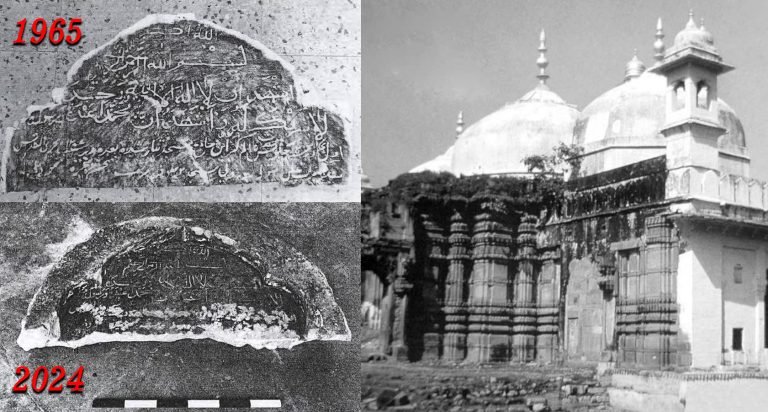
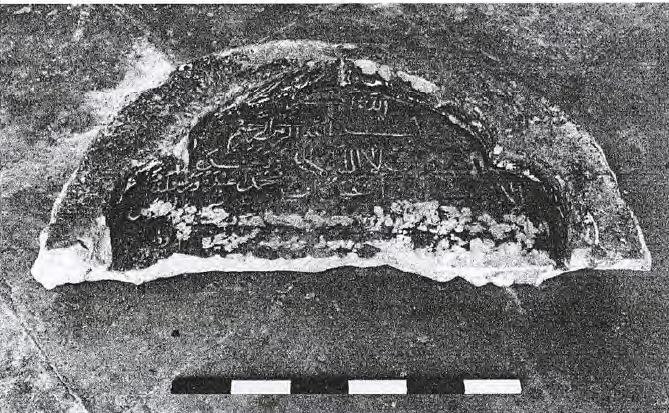
The inscription was found on a loose stone slab of sandstone recovered from the lower room of the south corridor. It contains Arabic and Persian scripts and the text says, Allahu Akbar, Bismillahi – Ar- Rahman-Ar-Rahim, and other such text. However, in the 6-line text on the slab, the lower two lines have been erased.
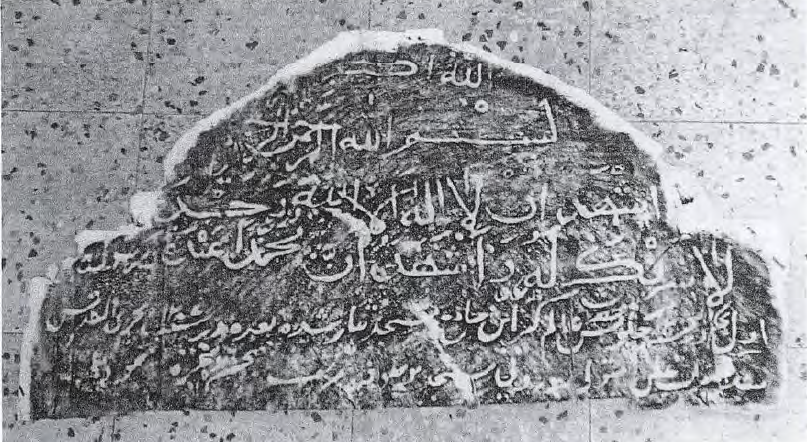
But the ASI had photographed the same slab earlier in 1965, in which all the text was intact. The report noted that the photograph of this stone inscription was recorded in ASI records in the year 1965-66. Which shows that the slab has been damaged after 1965.
According to the detailed ASI report, the erased inscription conveyed information about Aurangzeb’s order and mentioned the timeline, that is, in which year the construction of the now-existing structure took place and when expansions to the existing structure were carried out.
As per the records, the construction of the mosque took place in 1676-77 CE. The mosque was later repaired with sahan in around 1792-93 CE.
On comparing the two inscriptions, it was established that “attempt was made to erase last two lines of the inscription mentioning about the construction and expansion of the mosque.”
In simple terms, the report noted that during the recent survey, this stone with inscription was recovered from a room in the mosque. However, the lines relating to construction of the mosque and its expansion have been scratched out.
The ASI report says, “This Arabic and Persian inscription comes from a loose slab and runs in 6 lines of which last two lines have been mutilated purposefully. The inscription states that this mosque was constructed in the 20 regnal year of Aurangzeb Alamgir corresponding to 1676-77 CE and was repaired with Verandah and other parts in 1207 Hijri corresponding to 1792-93 CE.”
Inscription with lower two lines erased
The report mentions that the “Office of the Director Epigraphy, Arabic and Persian inscription, Archaeological Survey of India, Nagpur had copied this inscription in 1965-66. Its estampage is preserved in ASl records and the transcript and gist were published in Annual Report on Indian Epigraphy, Appendix – D, no. 611, 1965-66.”
The translation of the original inscription recorded in 1965-66 is as follows:
God is great
In the name of Allah (God), most merciful most compassionate
I witness that there is no god but Allah who is one and alone.
He is without partner and I witness that Muhammad is his slave and messenger.
By the order in the 20th regnal year of the Hadrat Alamgir i.e. Mughal Emperor Aurangzeb, this mosque was built. In 1207 Hijri (1792-93 CE)
The said mosque came to be repaired with Verandah and like that by Sayyid Mirath Ali Mutawalli.
However, in the slab recovered now, the last two lines have been scratched out.
Image of the slab taken in 1965-66 with no erased text
“This is also brought out by the biography of Emperor Aurangzeb, Maasir-i-Alamgiri, which mentions that Aurangzeb ‘issued orders to the governors of all the provinces to demolish the schools and temples of the infidels’ (Jadu-Nath Sarkar (tr.) 1947, Maasir-i-Alamgiri, pp. 51-52). On 2nd September, 1669 ‘it was reported that, according to the Emperor’s command his officers had demolished the temple of Viswanath at Kashi’ (Jadu-Nath Sarkar (tr.) 1947, Maasir-i-Alamgiri, p. 55),” the ASI report added.
In the brief findings of the Survey, the ASI report states, “The Arabic-Persian inscription found inside a room mentions that the mosque was built in the 20th regnal year of Aurangzeb (1676-77 CE). Hence, the pre-existing structure appears to have been destroyed in the 17th century, during the reign of Aurangzeb, and part of it was modified and reused in the existing structure.”
Further, as per the ASI, animal figurines or carvings in the pre-existing structure — Hindu temple as affirmed by ASI findings – were mutilated, removed, chopped off or covered with stone works. Notably, pictures, idols or any form of depiction is considered ‘haram’, that is unIslamic as per Muslim law.
What the detailed order states about the timeline, whether ‘Existing structure was built on Pre-existing Hindu temple?’ and other key findings
Notably, the ASI carried out investigation to find out the constructional phases of the structure in compliance of the order of Hon’ble Court.
The scientific investigation aimed to find answers to the Court’s query – “whether the existing structure” has been constructed over a pre-existing structure of Hindu temple.
In its reply to the observations of the Court, the ASI stated that based on the studies carried out, observations made on the existing structures, exposed features, and artefacts studied –
It can be concluded that there existed a large Hindu temple prior to the construction of the existing structure.
The ASI report added, “This temple had a big central chamber and based on the study of the existing structures and available evidence it can be concluded that it had at least one chamber to the north, south, east and west respectively. Remains of three chambers to the north, south and west can still be seen but the remains of the chamber to the east and any further extension of it cannot be ascertained physically, as the area to the east is covered under solid functional platform with stone flooring.”
According to the ASI, several materials of the Pre-existing structure (Hindu Temple) were used after they were “made suitable” by either destroying, chopping, or hiding carvings and figurines in the existing structure.
Evidently, the report added, “Entrance to the central chamber of the temple was from the west which has been blocked by stone masonry. Its western chamber was also connected with north and south chambers through a corridor accessible from its north and south entrances respectively. Main entrance to the central chamber was tastefully decorated with carvings of animals and birds and an ornamental torana. Figure carved on the lalatbimba has been chopped off and most of it is covered with stones, bricks and mortar which is used to block the entrance. Remains of a bird figure carved on the door sill, and part of which survived at the northern side, appears to be of a cock.”
Regarding the adulteration or efforts to erase the timeline, the ASI stated, “An inscription kept in the lower room made in south corridor of the existing structure records the construction of the mosque in the 20th regnal year of the Hadrat Alamgir, i.e. Mughal Emperor Aurangzeb (corresponding to A.H. 1087 = 1676-77 CE). The same inscription also records that in the year A.H. 1207 (1792-93 CE) the mosque was repaired with sahan, etc.”
It further noted, “Comparison of the inscription found in the lower room inside the existing structure, with a copy which was made by the ASI in 1965-66, establishes that attempt was made to erase last two lines of the inscription mentioning about the construction and expansion of the mosque.”
Detailing the materials that have been reused, the ASI added, “In the 17th century, part of the pre-existing structure was modified and reused in the existing structure. Animal figures carved on the pre-existing structure were not suitable for this purpose and therefore they were removed. A part of the pre-existing structure was utilised as the core of the existing structure.”
“For the enlargement of the mosque and constructing sahan, pillared verandah, parts of the pre-existing temple such as pillars, pilasters, etc. were reused with little modifications as per the requirement of the changed use,” the report further added.
The report stated that during this expansion of the structure a series of cellars were also constructed to the east, north and south to create additional space and to make a large platform in front of the mosque for accommodating large number of people for prayers.
A row of chambers to the east of it was also later merged with the platform by covering and converting the open corridor in cellars with entrances from north and south.
Artifacts recovered during the ASI’s scientific survey establishes Pre-existing structure as a Hindu Temple
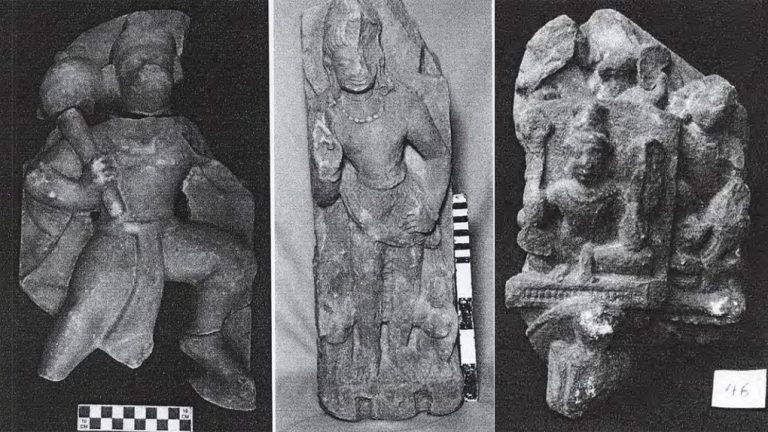
According to reports, the ASI team recovered sculptural remains that represented Hindudeities Vishnu, Shaiva Dwarpala, Shiva linga, Yonipatta without Shiva linga, Krishna, Ganesh, Hanuman, attendant figures, vyala, Nandi, etc. While some of the artifacts could not been identified as they were defaced, mutilated or only fragmented body parts were recovered.
The report pointed out, “Apart from architectural members, good numbers of stone sculptural remains were also found from different locations within the fenced area. The sculptural representations of Vishnu, Shaiva Dwarpala, Shiva linga, Yonipatta without Shiva linga, Krishna, Ganesh, Hanuman, attendant figures, vyala, Nandi, etc. have been identified. Several specimens could not be identified with certainty as they were either too fragmentary like body parts or defaced and worn out. A miniature shrine with sculptural depiction of deities is another noteworthy find.”
“Among the different sculptural specimens Shiva linga and Yonipatta were in good number and mostly found from the cellar S2 and western wall area. Two sculptures of Vishnu were also recorded from cellar S2. Among the two, one is a complete image and another one is only the parikara part of an image depicting the figure of seated Vishnu. Two fragmentary images of Krishna were also found from cellar S2. A head of Ganesh made of marble was found from the cellar S2”, it added.
Further, the report stated that two damaged sculptures of Nandi were also found during the debris clearance in the western chamber. One schist stone sculptural fragment of a head of an image was also found from the cellar N3. Lower part of the Varaha image was found from the debris in the cellar N2. In addition, more than 25 different sculptural fragments of different deities were recorded from study area.
The detailed report could be downloaded from the link given in the below mentioned tweet.
Ok! It seems all my google drive link have exhausted capacity.
So here’s a wetransfer link for the ASI survey report of Gyanvapi. It’ll be valid for 7 days. Download away! https://t.co/rswJTxO27Q
Notably, the ASI conducted a detailed survey in compliance of the order dated 21.07.2023 of the Hon’ble District Court, Varanasi. It carried out scientific investigation/ survey between 24.07.2023 and 02.11.2023 at Settlement Plot No. 9130, Varanasi to comply with the directions (a) to (1) given in the said order.
Further, Archaeologists, Epigraphists, Chemists, Engineers, Surveyors, Photographers, and other officials of the ASI and the scientists of the National Geophysical Research Institute (NGRI), Hyderabad carried out the investigations and collected data, which was systematically analysed.
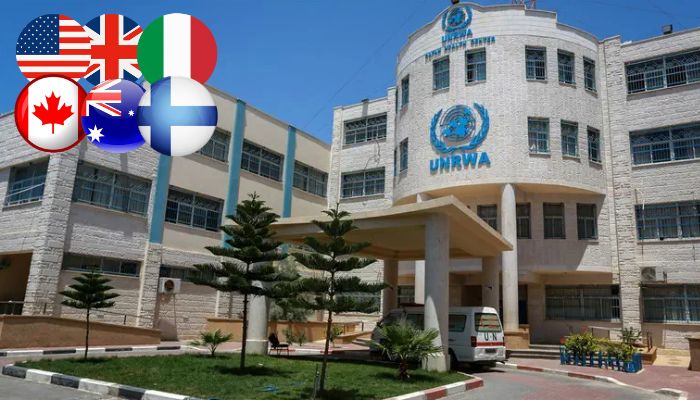
Following Israel’s allegations against UNRWA staffers, around six Western nations have suspended their funding to the United Nations Relief and Works Agency for Palestine Refugees in the Near East (UNRWA). It was created by the United Nations General Assembly in 1949.
The Western nations that have so far taken action against the UN body include the US, the UK, Italy, Australia, Canada, and Finland.
Notably, on Friday (26th January), UNRWA Commissioner-General Philippe Lazzarini revealed that Israel has accused a dozen UNRWA staffers of being involved in the 7th October terrorist attack on Israel by Hamas. He added that the agency has terminated the contract of these employees and launched an investigation into this case.
On Friday, an adviser to the Israeli prime minister stated that the 7th October Hamas attacks had involved “people who are on their [UNRWA] salaries”, as reported by BBC.
Mark Regev said that there was information showing teachers working in UNRWA schools had “openly celebrated” the 7th October terror attacks.
He also referred to an Israeli hostage who, after getting released from Hamas captivity, said that she had been “held in the house of someone who worked for UNRWA”.
He added, “They have a union which is controlled by Hamas and I think it’s high time that the UN investigated these links between UNRWA and Hamas.”
The serious allegations labelled by Israel kicked off a domino effect among UNRWA donors including the biggest funder US.
The scathing responses by UNRWA donors announcing the suspension of financing for the agency
Earlier, the US State Department announced that it was suspending additional funding to the UN agency. The department added that it was “extremely troubled” by the allegations that UN staff were also involved in the 7th October terror attacks on Israel.
The European Union stated that it would assess further steps “based on the result of the full and comprehensive investigation”.
Following the US footsteps, Canada also announced the suspension of funding to the UN agency.
Taking to X, Canada’s Minister of International Development Ahmed Hussen wrote, “Canada unequivocally condemns the October 7th attack on Israel. I am deeply troubled by the allegations relating to some UNRWA employees. I have instructed Global Affairs Canada to pause all additional funding to UNRWA pending the outcome of the investigation.”
Unidentified Iranian gunmen killed nine Pakistani nationals along the Iran-Pakistan border, severely exacerbating already strained relations between the two nations. The development transpired more than a week after the neighbours exchanged deadly cross-border fire. Pakistan’s ambassador to Iran, Mudassir Tipu also confirmed the incident on social media and wrote, “Deeply shocked by the horrifying killing of 9 Pakistanis in Saravan. The embassy will extend full support to bereaved families. Counsel Zahidan is already on his way to the incident site & hospital where the injured are under treatment. We called upon Iran to extend full cooperation in the matter.”
Deeply shocked by horrifying killing of 9 Pakistanis in Saravan. Embassy will extend full support to bereaved families. Counsel Zahidan is already on his way to incident site & hospital where injured are under treatment.We called upon ?? to extend full cooperation in the matter.
The Mehr news agency in Sistan-Baluchistan province reported, “According to witnesses, this morning unknown armed men killed nine non-Iranians in a house in the Sirkan neighbourhood of Saravan city.” According to it, no group or individual has taken responsibility for the assault so far. Baluch rights group Haalvash proclaimed that the victims were labourers from Pakistan who resided at the car repair business where they were employed. It claimed three more people were wounded.
Sistan-Baluchistan is one of the few provinces in Shiite-dominated Iran that is primarily Sunni Muslim. The shootings took place as Iranian state media reported that the ambassadors of Iran and Pakistan had resumed their posts following their recall following last week’s missile exchange between the two nations that struck what they purported to be militant targets.
Conflicts between security forces and separatist militants as well as smugglers transporting opium from Afghanistan, the world’s largest producer of the drug, have long occurred in the impoverished region. Iran has among of the lowest gasoline prices in the world, which has encouraged the smuggling of petroleum into Afghanistan and Pakistan.
Notably, the lethal strike comes after infrequent military activity in the disputed border province of Baluchistan, which is divided between the two countries, which aggravated regional tensions already heightened by the conflict between Israel and Hamas. On 18th January, Pakistan launched air strikes on “militant targets” in Iran, two days after the latter had conducted strikes on its territory.
Tehran declared that it had aimed Jaish al-Adl, a jihadist outfit that has killed numerous people in terror assaults in Iran in recent months. Iran has placed the 2012-founded alleged non-governmental organisation (NGO) on a blacklist as a “terrorist” group. Islamabad reacted sharply to the Iranian strikes and recalled its ambassador from Tehran as well as expelled Iran’s envoy. Tehran also summoned Islamabad’s charge d’affaires over Pakistan’s strikes, which left at least nine people dead.
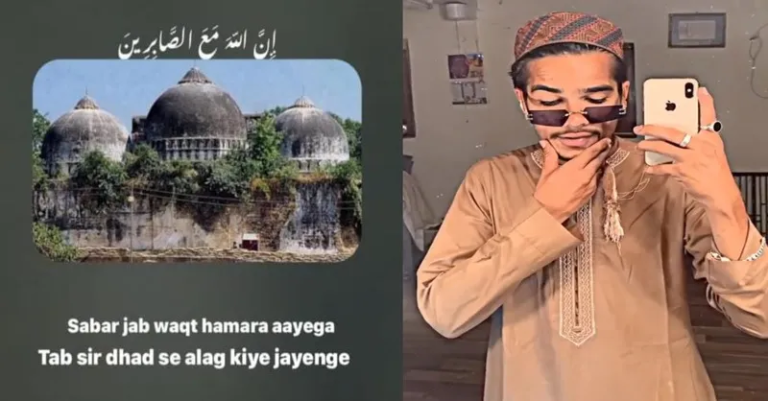
The Pran Pratishtha of Bhagwan Ram Lalla was a moment of immense joy for the countless devotees of Lord Ram, however, several hateful and threatening social media posts by Islamists have also surfaced. In one such incident in Daman, some Muslim youths posted a picture of the Babri structure on Instagram with the caption, “Jab waqt hamara aayega, tab sar dhad se alag kiye jayenge”. The police filed a FIR against the three and arrested them. Four youths, including one Asif Khan, are among the accused.
As per the information received, the four accused posted a photo of the Babri structure with the caption, “Sabar Jab Wakt Hamara Ayega, Tab Sar Dhad Se Alg Kiye Jayenge” (Wait until our time comes, heads will be severed from bodies). After issuing a ‘Sar Tan Se Juda’ threat, the accused posted another story in which they rode on a scooter to Jampore Beach in Big Daman. The accused uploaded a video in which they were seen waving the Islamic flag. ‘Hum momin mard mujahid hai, tauhit pe jite marte hai, hum jangju kaum ke bete hai, hum marne se nahi darte hai’ was added along with ‘Free Palestine’ posters, as well as a religious song.
The local police took cognisance of the matter after a screen recording of the outrageous posts went viral. Given the gravity of the situation, the police took swift action and began proceedings against the accused persons. Four people have been arrested in connection with a complaint filed under Sections 295-A, 153-A, 298, 504, 505(c), and 120(b) of the IPC, as well as Sections 34 and 66 of the IT Act at the Moti Daman Police Station.
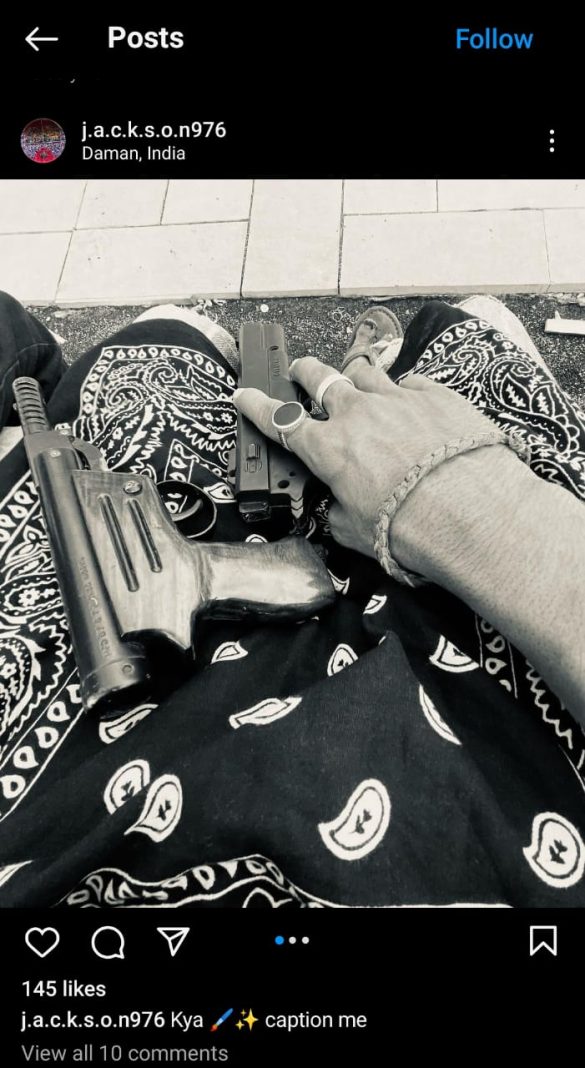
Notably, Asif has an Instagram account with the username ‘Jackson976’. He has also posted pictures of various weapons on this account. In one such post, a pistol and various pistol-like weaponry are seen. It is unclear whether those were real or prop guns. Along with Daman resident Asif Khan, three others have been arrested for issuing ‘Sar Tan Se Juda’ threat.
Screenshot of photos of the weapon shared by the accused
In Vadodara, Hamja, Faizan, and Junaid threaten to demolish Ram Mandir
In Gujarat’s Vadodara, a similar incident was reported wherein Islamists identified as Hamja Khatri, Faizan Nanio, and Junaid Qureshi from Sadhli village in Vadodara made inflammatory posts on the Ram temple and threatened the beheading of Hindus. The police took swift action in the case and launched an inquiry after the post went viral over the internet.
The Ram Mandir Pran Pratishtha ceremony in Ayodhya on 22nd January brought tears of joy and pride in the eyes of every Hindu as the community welcomed Lord Ram to his home after about 500 years. However, the grand event in Ayodhya did not sit well with Islamists who rushed to attack Hindus immersed in celebrating the homecoming of their God after 5 centuries. Reports of Islamists launching attacks on Hindu devotees came in from Gujarat’s Mehsana, Vadodara, Maharashtra’s Solapur district, and also from Mumbai’s Mira Road region.
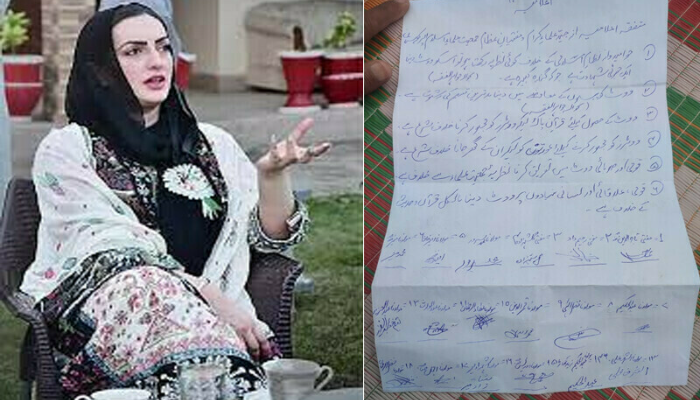
A group of religious leaders from Khyber Pakhtunkhwa’s Kohistan primarily affiliated with the Jamiat Ulema-i-Islam-Fazl released a fatwa (Islamic decree) on 26th January pronouncing it unlawful for women to campaign for polls. Addressing a gathering, arranged at the outfit’s central office in Kohistan’s Kamila town, JUI-F’s Mufti Gul Shahzada of Upper Kohistan district’s Kandia region proclaimed, “The women’s act of going from door to door to solicit votes is against sharia (Islamic laws).”
According to him, the statement was issued by thirty recognized religious scholars and supported by attendees at the event who included around four hundred clerics from the Kohistan area. He laid up six ordinances in front of them, all related to the upcoming generals which are scheduled to occur on 8th February in Pakistan.
For the first time in the district’s history, two female candidates supported by the Pakistan Tehreek-e-Insaf (PTI) Tehmina Faheem from PK-31 Kohistan-I and former lawmaker Momina Basit as well as Sanaya Sabeel, an independent from PK-33 Kolai-Palas are running for office.
The assembly was informed by Mufti Shahzada that all directives had been issued considering the circumstances at hand. He asserted that these were derived from various religious texts and based on Islamic precepts. He noted that disobeying the fatwa was sinful. Additionally, he stated that locals shouldn’t vote along ethnic lines because it is prohibited by Islamic law.
He warned, “If anybody votes against Islamic ideology, it means he is testifying to an untrue and biased statement, which is a grave sin and also against Islamic sharia.” The clergy pointed out that using the Quran as a means of forcing someone to vote is a sacrilegious act that ought never to be done. The mufti voiced, “Those casting votes on the linguistic, regional and clan grounds are also negating Islamic teachings and no such exercise should be carried out in this district.”
Interestingly, a local political leader countered that anti-feminist sentiment was not the driving force for the fatwa. Rather, its goal was to stop women in Kohistan culture from abusing their alleged position of power.
According to the fatwa, it is forbidden to bring women to voters’ houses to do canvassing. Furthermore, it stated that it was a severe sin to vote for a candidate who opposed the Islamic form of government since doing so would be equivalent to endorsing a falsehood. The edict observed that it is also against sharia to make voters swear allegiance to the Quran under oath.
It mentioned that voting based on national, regional, or racial divisions is against the Quran and Hadith and voting for financial benefit is the worst kind of bribery. The order further stipulated that it was against the ideology of the Muslim scholars to differentiate between votes for national and regional legislatures. At least eighteen religious scholars have signed the order with their names on it.
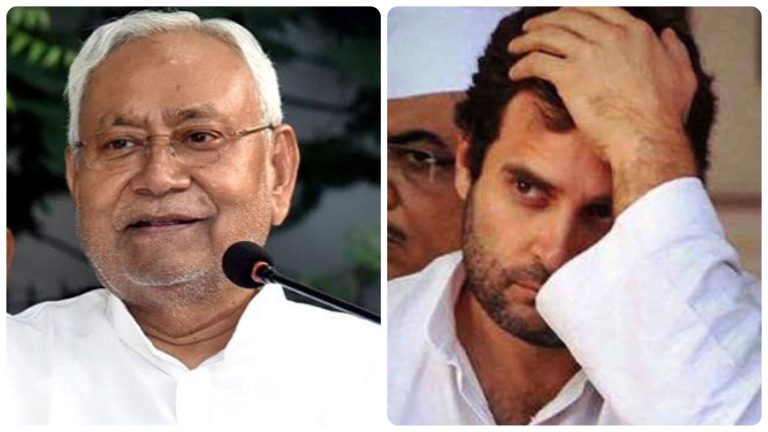
Amid reports of Nitish Kumar possibly snapping ties with the I.N.D.I. alliance, Janata Dal (United)’s political adviser and spokesperson KC Tyagi blamed the Congress party for the widening rifts in the opposition bloc. He added that the I.N.D.I.A. bloc is on the brink of a collapse with several alliance partners ending ties including in key states like West Bengal, Bihar, and Punjab.
Tyagi accused Congress leaders of repeatedly “insulting” Nitish Kumar. According to him, Nitish Kumar never hankered after a position in the alliance but a section of the Congress leadership repeatedly insulted him.
He also accused Congress of undoing efforts made by the Bihar Chief Minister to consolidate non-Congressi parties under one banner.
“The effort and intention with which Nitish Kumar had formed the INDIA alliance is on the verge of breaking due to the irresponsible and obstinate attitude of Congress,” he said.
According to Tyagi, the I.N.D.I.A. bloc is on the verge of collapse. He added that Kumar could not see how the INDIA bloc parties could fight the “all-powerful” BJP.
Tyagi added, “The INDIA bloc is on the verge of collapse. The alliance of INDIA bloc parties is almost over in Punjab, West Bengal, and Bihar. Kumar never hankered after a position in the alliance but a section of the Congress leadership repeatedly insulted him.”
VIDEO | Bihar political turmoil: "The INDIA alliance is on the brink of a collapse. We had succeeded in bringing all non-Congress parties together but the (alliance) is falling apart. In Punjab and Bihar, the (INDIA) alliance has nearly collapsed. Similarly, in West Bengal, the… pic.twitter.com/dPTX2EUqfc
He also added that Kumar was “misunderstood”. Further slamming the I.N.D.I.A. alliance partner, Tyagi added that Nitish Kumar succeeded in bringing together several parties in Patna but the entire process became so limp that the I.N.D.I.A. bloc held no joint meetings on leadership and agenda even though the Lok Sabha elections neared.
“There is a big possibility of Akali Dal and BJP coming together in Punjab and the possibility of a fight between Congress and AAP. Similarly, Akhilesh Yadav is also unhappy with the attitude of the Congress Party and has also suggested that they should behave more responsibly. The worst situation is in West Bengal where Congress leaders want to hand over TMC’s elected government to President’s rule. Chief Minister Mamata has further increased the controversy by not allowing Rahul Gandhi’s Bharat Jodo Nyay Yatra. The I.N.D.I.A. alliance that we had is now tattered and is headed towards its decline,” Tyagi further added.
His remarks come amid reports that JD(U) Chief could jump ship and form government in Bihar with BJP after snapping ties with the ruling ‘Mahagathbandhan’.
If the reports indeed come out to be true, it will be the fourth time that Nitish Kumar switched sides in the past decade and the second this term.
Meanwhile, on Saturday (27th January), BJP leader and Union Minister Ashwini Kumar Choubey participated in the foundation laying ceremony of development works with CM Nitish Kumar at Bihar’s Buxar.
The Union Minister said that whatever will happen, will happen according to “God’s wish”. He said, “Whatever is God’s wish, will happen. The first time around, I only brought him (Nitish Kumar) here, and today also I have brought him.”
Woes intensifying for the I.N.D.I.A. bloc, particularly for Congress
A minister of the Dravida Munnetra Kazhagam (DMK) government in Tamil Nadu took a dig at the Congress saying that the party was running only to get the seats for its own in the upcoming Lok Sabha elections.
Calling the Congress party “big and old”, DMK Minister Raja Kannappan said that the party had now “lost its strength”.
Earlier, the alliance suffered huge setbacks when the Trinamool Congress in West Bengal and the Aam Aadmi Party in Punjab deserted the alliance.
Earlier on 24th January, All India Trinamool Congress head and West Bengal Chief Minister Mamata Banerjee snapped ties with Congress and announced that her party would fight alone in the state.
“I gave many proposals but they rejected them from the beginning. From then, we have decided to fight the elections in Bengal alone,” Ms Banerjee had said.
The Bengal Chief Minister also claimed she was not informed of Rahul Gandhi’s Nyay Yatra passing through Bengal, contrary to claims by the Congress that they had invited I.N.D.I.A. bloc parties to join the Yatra. The TMC also later denied permission for the Yatra to enter Siliguri.
It was followed by Punjab Chief Minister Bhagwant Mann who delivered a further setback to the I.N.D.I. alliance. He declared that AAP will not form a coalition with the Congress party in the state and contest on all 13 seats in the state.
However, in a slight relief for the Congress party and I.N.D.I.A. bloc, Samajwadi Party Chief Akhilesh Yadav on Saturday announced that his party is ready to give 11 seats to contest for the Congress party. However, as per media reports, the Uttar Pradesh unit of the Congress party has rejected the deal, adding that it is not the Congress’ decision but rather taken by Akhilesh Yadav.
The Archaeological Survey of India (ASI) report on the Gyanvapi structure released on 25 January has made it clear that a large Hindu temple existed in the past where the current mosque structure is present. The over 800-page report gives a very detailed accounts of the structure and the artefacts found in it, proving that it was a Hindu temple dedicated to Lord Shiva.
Shockingly but not surprisingly, the report states that several artefacts related to the temple were deliberately kept hidden, they were found in cellars which were blocked by debris and walls. As per the ASI report, on the Eastern part of the complex, there are six cellars, three on southern side and three on the northern side on the both sides of the sealed area. There are two more cellars on the north, closer to the structure.
The cellars were made below the ground level when the pre-existing structure was modified and extended towards the east, the report states. The underground cellars were used for various purposes, however most of the cellars were found blocked, either completely or partially. For the study, ASI cleaned the cellars and removed a large amount of debris, recovering several signs of a pre-existing Hindu temple.
The most important artefacts were found in the southern cellars, S1, S2 and S3. ASI says that there are five entrances from S2 to S1, but all of them were blocked with lakhauri bricks and/ or stone blocks set in lime mortar. Similarly, all four entrances to S3 were blocked filling soil or keeping stones and architectural materials.
When the ASI teams entered cellar S3 by clearing the entrances, the found that the cellar was deliberately filled with soil and debris. Holes were make on the ceilings and soils and debris were dumped through that holes, blocking the cellar.
The report says that cellar S2 was used as a dumping place of large number of diverse things ranging from bamboos, to terracotta and metal pots, doors and windows, architectural members, etc. A number of architectural members were found stacked over the blocked entrances of the western wall.
When the debris was removed from the cellar, several things purposefully buried were exposed. This included a miniature temple, sculptures of Vishnu, Shaiva Dwarpala, Hanuman and other stone objects as well as terracotta figurines. “A miniature shrine with sculptural depiction of deities is another noteworthy find,” the ASI report says, talking about the miniature temple found in S2.
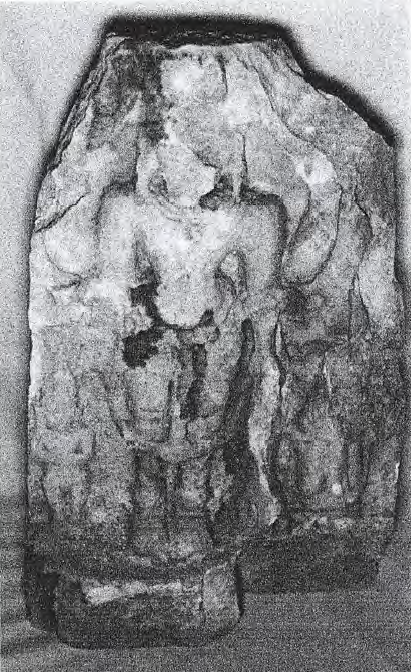
The report added that Shiva linga and Yonipatta in good numbers were doing in cellar S2 and the western wall area. It states that Two sculptures of Vishnu were also recorded from cellar S2, one of which is a complete image and another one is only the parikara part of an image depicting the figure of seated Vishnu.
Vishnu idol in S2 cellar
Two fragmentary images of Krishna and a head of Ganesh made of marble was found from the cellar S2. Two damaged sculptures of Nandi were also found during the debris clearance in the western chamber. Apart from these, several specimens could not be identified with certainty as they were either too fragmentary like body parts or defaced and worn out.
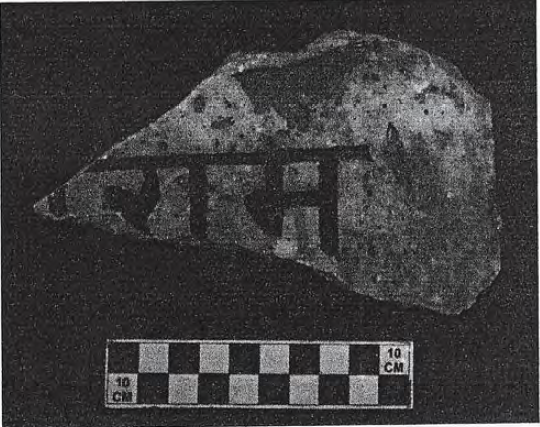
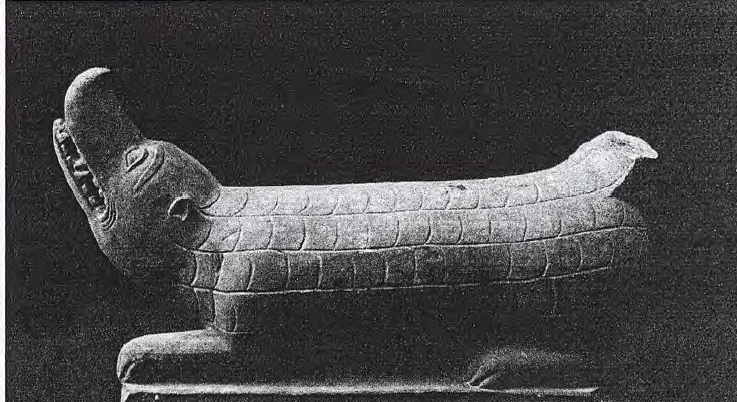
A broken part of a marble slab inscribed with ‘Ram’ in Devnagari script and painted with black was also found in S3. A makara depicted in seated posture on a pedestal with its raised snout was found in very condition.
A headless deity that appears to be Krishna, and the torso of another deity were found buried in S2.
Other items found in S2 included a larger number of broken pots such as chillum, hookah base, miniature pots, lamps, etc.
A larger number of pottery and terracotta items were found in S3, apart from S2. It is notable that as the Hindu side, the S3 cellar could not be searched fully as it was filled with debris to the ceiling and there was not approval for excavation. As a result, it is possible that more artefacts related to the Hindu temple are buried in the cellar.
One small stone Shiva Linga was also found during debris cleaning on the east side of the structure.
The cellars were made of stone pillars, with stone slabs placed on them supported by stone beams. Later masonry pillars were also added in some cellars to support the ceilings. ASI has found that pillars from an earlier Hindu temple were used to make these cellars.
The artefacts found in the cellars are just part of massive evidence of the Hindu temple found by ASI at the Gyanvapi structure. The ASI report has concluded that large Hindu temple existed at the place prior to the construction of the existing structure. This temple had a big central chamber, surrounded by four chambers on north, south, east and west. Remains of three chambers to the north, south and west can still be seen.
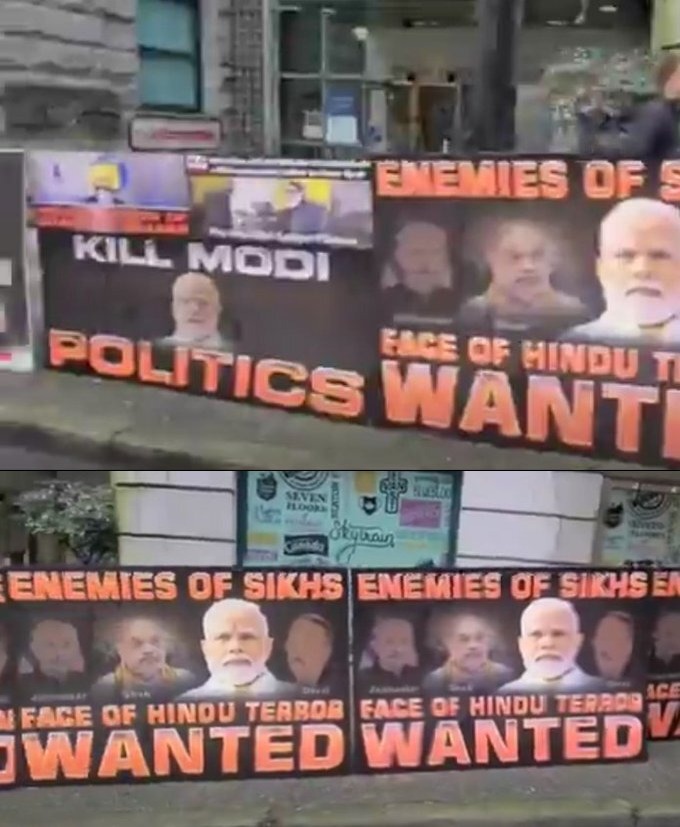
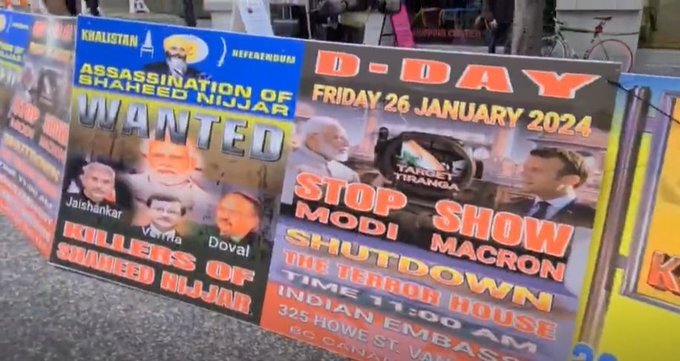
On 26th January, India celebrated its 75th Republic Day with much nationalistic zeal. However, on the same day, the Khalistani elements outside the Indian Consulate on Howe Street in Vancouver, Canada, staged anti-India and anti-Modi protests. As seen in the videos of the protest, several posters reading “Kill Modi”, and “D-Day, Shut Down The Terror House” with pictures of PM Modi and French President Emmanuel Macron were put up. It is to be noted that the French President was the chief guest for India’s 75th Republic Day.
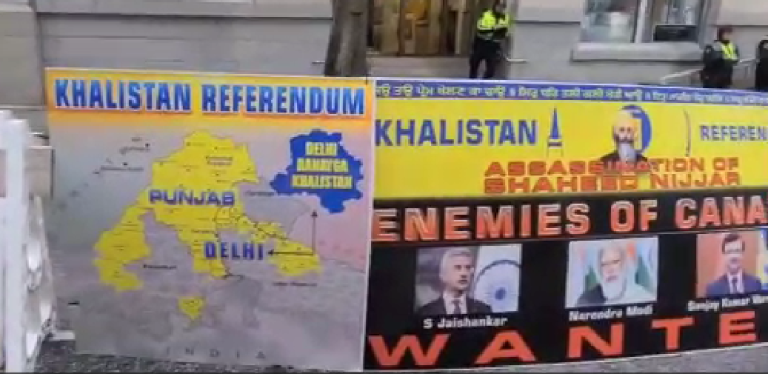
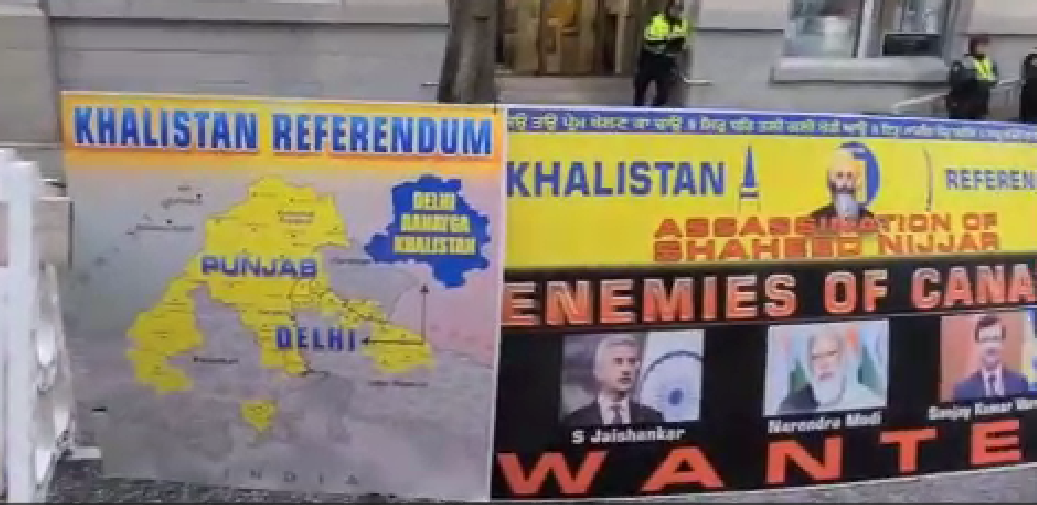
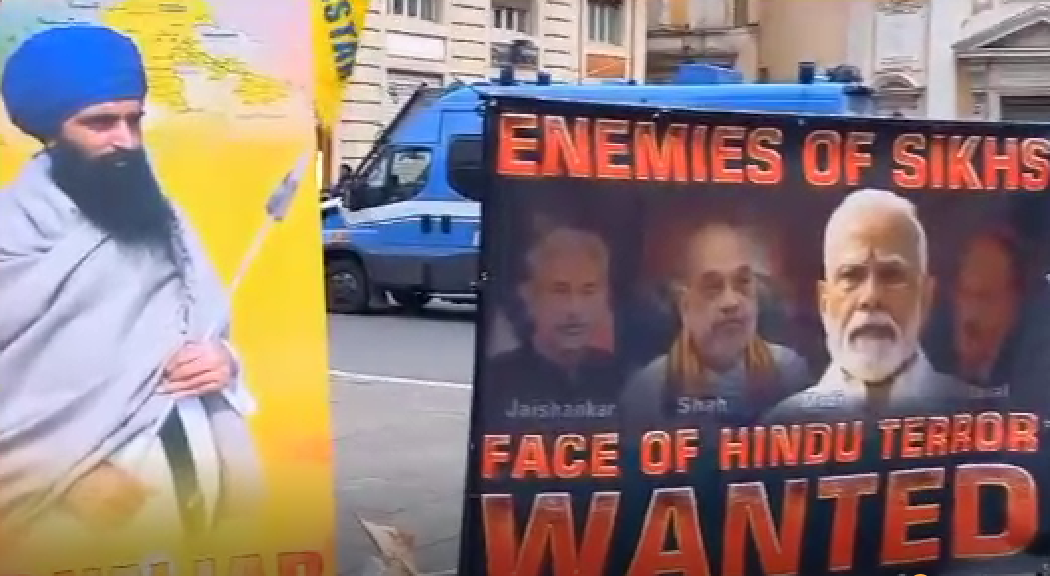
The Khalistan sympathisers also displayed posters showing Prime Minister Narendra Modi, External Affairs Minister S Jaishankar, National Security Advisor Ajit Doval and Indian High Commissioner to Canada, Sanjay Kumar as, “Enemies of Sikhs, Face of Hindu Terror Wanted” and “Wanted-Killers of Shaheed Nijjar”.
“D-Day, Shut Down The Terror House” banner seen during anti-India protest in Vancouver
Posters with the text “Khalistan Referendum”, “Delhi Banayga Khalistan”, and “Assassination of Shaheed Nijjar, Enemies of Canada” were also seen during the protest in Vancouver.
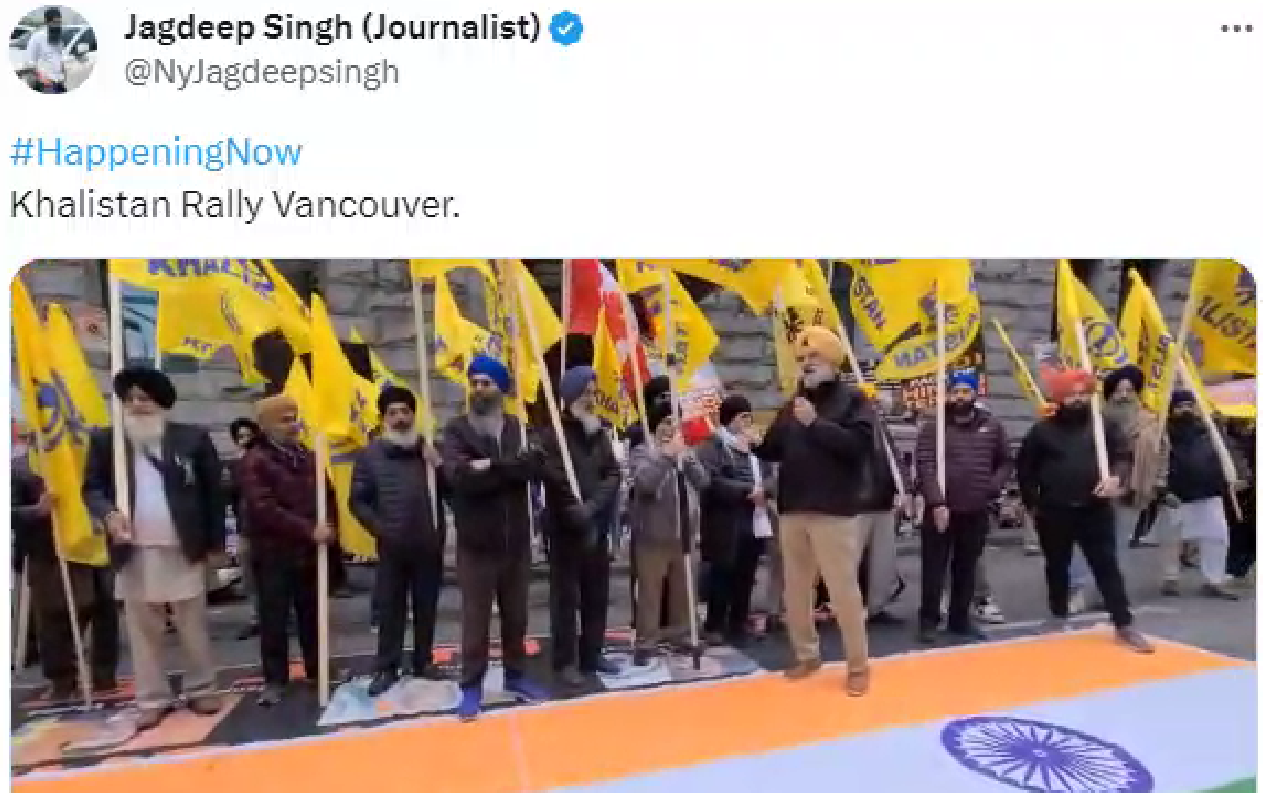
OpIndia accessed several videos recorded during the anti-India protests in Vancouver in which Khalistani elements were seen giving inciting speeches and used derogatory language for Indian Prime Minister, EAM S Jaishankar and NSA Ajit Doval. Moreover, Indian flags were also disrespected during the protests.
In one such video accessed by OpIndia, anti-India sloganeering can also be heard.
Canada: Khalistan supporters protest outside the Indian embassy in Vancouver on Republic Day pic.twitter.com/aj0tKIErAM
It is worth noting that ahead of the Republic Day celebrations, Indian missions in Canada had asked the Canadian authorities to upkeep the security of its diplomatic premises on 26th January due to the threat of protests by pro-Khalistan terrorists. “We have sensitized Canadian authorities about the requirement of safety and security of the Indian High Commission and Consulates,” India’s High Commissioner to Ottawa Sanjay Kumar Verma said.
Pertinently, in June 2023, Khalistani terrorist Hardeep Singh Nijjar was killed in Canada by unknown assailants probably as a result of a gang war. However, in September 2023, the Prime Minister of Canada, Justin Trudeau, accused India of being involved in the murder. Following the accusations, Canada also expelled a senior Indian diplomat. India categorically denied any involvement in the murder and expelled a senior Canadian diplomat in retaliation. Furthermore, 41 more diplomats were asked to leave the country and warned to strip them of their diplomatic immunity. In October, the diplomats of Canada left India.
Notably, similar anti-India protests and rallies were taken out in the United States and Italy. In San Francisco, a car rally was taken out with Khalistani flags to the Indian Consulate.
Huge Khalistan Car Rally heading Towards the Indian Consulate in San Francisco. pic.twitter.com/ZaRDQUx5iw
During the protests, posters of slain Khalistani terrorist Jarnail Singh Bhindrawale were also seen.
A similar pro-Khalistan protest was held outside the Indian Consulate in Washington D.C. with posters targeting Indian bureaucrats including Ambassador Taranjit Singh Sandhu and Prime Minister Modi. In one of the highly outrageous videos of the protest, the Khalistani terrorist put up a garland of slippers on the effigy of PM Modi.
Reportedly, a pro-Khalistan protest was organised in Rome, Italy on 26th January by Khalistani terrorist group Sikhs for Justice (SFJ). Earlier, Pakistani media reports said that Khalistani terrorist Gurpal Singh is planning to organise a Khalistan Freedom Rally in Rome. It was said that Singh was allegedly “warned” by people linked to the Indian High Commissioner there to stop Khalistan Referendum propaganda.
Notably, the Khalistani terrorist has announced to conduct a ‘voting’ in San Francisco on 28th January as part of its farcical ‘Khalistan Referendum’. As per the website of the ‘Punjab Referendum Commission’, the voting in San Francisco, California will take place at Civic Center Plaza, 2 Polk Street, San Francisco, CA 94102 (Opposite City Hall).