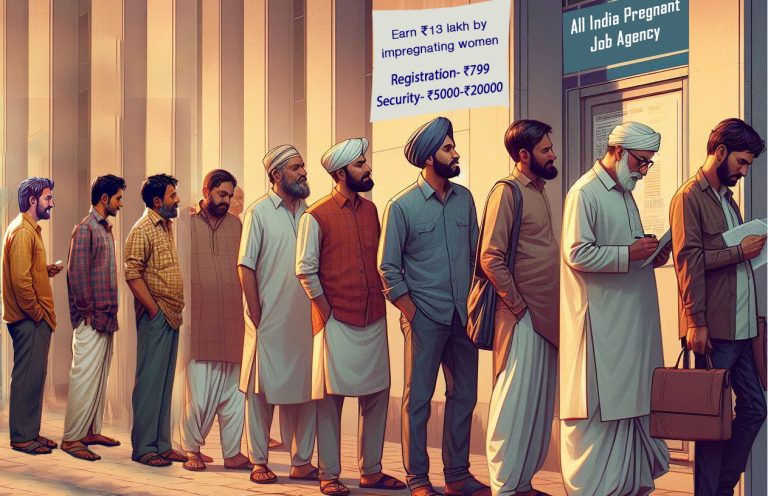
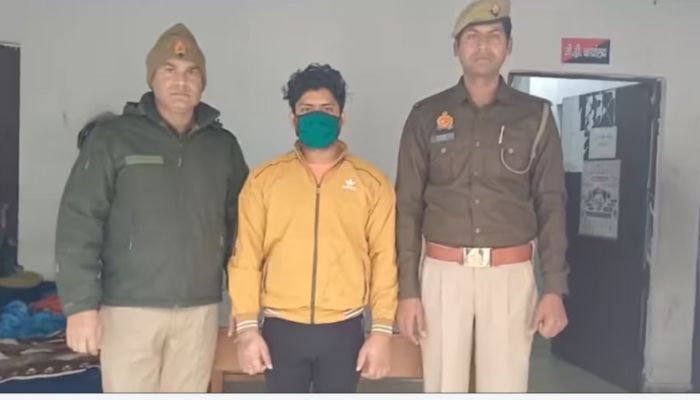
On 29th December, a group of eight persons were taken into custody in the Nawada region of Bihar for operating an unconventional recruitment service to ‘impregnate’ childless women in return for a bountiful payout in an attempt to trick unsuspecting consumers who would fall for the enticing offer. However, Munna Kumar, the brains behind the racket was able to abscond.
The accused ran “All India Pregnant Job Agency” and solicited clients to deposit a nominal registration fee of Rs 799 for the reward of Rs 13 lakh after impregnating females who were unable to bear a child with their men. Deputy Superintendent of Police (DSP) Kalyan Anand informed that those who wished to assist these females in need had to register and submit the money to sign up after which they were told that they were going to receive images of multiple women to choose the one they wished to impregnate.
The strategy involved contacting naive folks via WhatsApp for assistance in getting ‘unfortunate’ ladies who were unable to become mothers through their respective husbands or partners. When people who fall for the scheme register by paying Rs 799, they are asked to cough up a ‘security deposit’ that could vary anywhere from Rs 5,000 to Rs 20,000. The official stated that the prettier the woman, the higher the amount to be paid.
The men were assured by the cyberthugs that they would receive Rs 13 lakh as ‘prize money’ upon successful conception. They were promised a ‘consolation prize’ of Rs 5 lakh which would be credited to their bank accounts even if they were not successful, according to the police. However, in reality, there was no such woman to impregnate, and the victims lost the registration and security deposit to the thugs.
Nine cell phones, two printers and numerous data sheets were confiscated from them by the authorities. Police said that the investigation in the case is on, and more arrests could be made.
A case of love jihad took place in Ghaziabad in the state of Uttar Pradesh where Ali Siddiqui posed as Monu Yadav to lure a minor Hindu girl into a love trap. Ali Siddiqui eloped with the girl on 25th November 2023, luring her on the pretext of marriage and then raped the girl after taking her to his house. Ali was arrested by the Kavinagar police station’s team on 29th December 2023. The accused in this case of love jihad is booked under relevant sections of POCSO and sections of rape.
On 25th November 2023, a family living in the Kavi Nagar police station jurisdiction reported that their daughter is missing. CCTV footage later revealed the girl, a 10th-grade student, being taken away from her home on a motorcycle. The investigation led to the discovery that the bike was registered under the name of Ali Siddiqui. Armed with this information, the family approached the police.
The police initiated an investigation and launched an extensive search for the young female victim. During one attempt near Sanjay Nagar, they nearly apprehended the suspect. However, he managed to escape after abandoning the girl in Sanjay Nagar. On Friday (29th December), the authorities successfully arrested the accused.
— POLICE COMMISSIONERATE GHAZIABAD (@ghaziabadpolice) December 29, 2023
The individual apprehended by the police is 22-year-old Ali Siddiqui, who resides in Saare Home Society, Mansarovar Park, Wave City area near Lalkuan. Investigations revealed that approximately one and a half months back, he had initiated contact with the student via social media, using the pseudonym Monu Yadav. This interaction eventually led to the two forming a friendship.
Ali, posing as Monu Yadav, deceived the minor girl by feigning romantic interest and promising marriage, ultimately leading her away from her home. He then raped the girl. Police authorities reported that the girl was rescued and had undergone a medical examination. Her statement was also recorded. The police are now proceeding with the case by applying charges under the Protection of Children from Sexual Offences (POCSO) Act and rape charges.
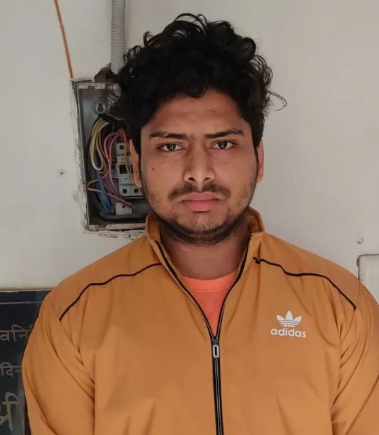
Accused Ali Siddiqui posed as Monu Yadav. Image Source: Dainik Jagran
The teenager became so ensnared by the accused’s deceitful persuasion that once she left with him, she was reluctant to return home. Upon interrogation, Ali Siddiqui confessed that he had assumed the identity of Monu Yadav to gain the teenager’s trust and befriend her.
Abhishek Srivastava – ACP of the Kavinagar police station in Ghaziabad – said, “On 25th November 2023, a complaint was received at the Kavinagar police station against a person Monu Yadav. The complaint stated that he had lured a minor girl and fled away with her. A case under relevant sections was immediately filed here based on this complaint and an investigation was launched by forming various teams.”
— POLICE COMMISSIONERATE GHAZIABAD (@ghaziabadpolice) December 29, 2023
The ACP added, “On 29th December, the team of police personnel from the Kavinagar police station arrested the accused Monu Yadav. The interrogation revealed that his real name is Ali Siddiqui. He is the son of Imtiaz Ali. He took the pseudonym Monu Yadav to gain the trust of the victim and befriend her. Based on the interrogation and all other evidence in this case, we are filing the charge sheet to be submitted in front of the honourable court. We are committed to ensuring further legal action against him.”
On 9th December this year, a Hindu man was mercilessly beaten by a mob of 18-20 Islamists for accompanying a Muslim girl on his motorcycle. The incident took place in Davanagere city of Karnataka.
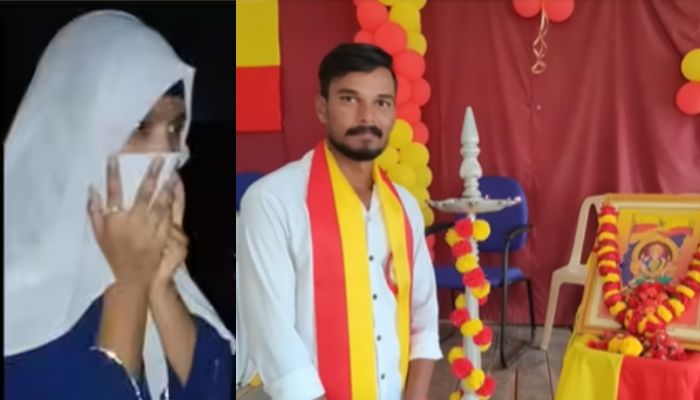
As per reports, the victim was identified as a 26-year-old Srinivas. He is a resident of Jolly Nagara in Davanagere and belongs to the Dalit community. Islamists brutally assaulted him for giving a ride to a 17-year-old hijabi girl.
Srinivas was taken to a banquet hall (Shadi Mahal) and kept there against his will at night. He was then dumped by the mob of Islamists in a secluded place on the morning of 10th December. At that time, the victim was in an unconscious state.
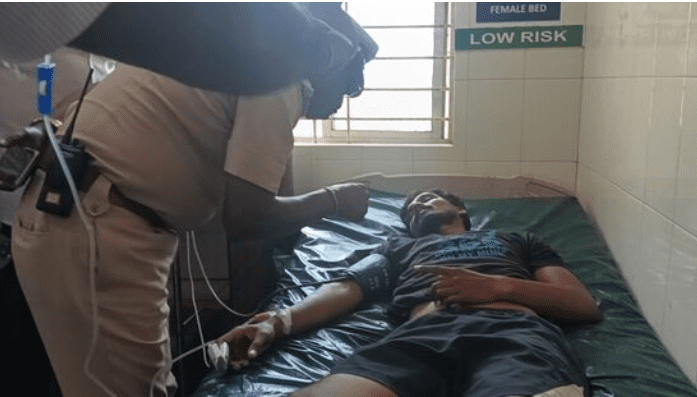
Srinivas being treated at the hospital, image via HT Kannada
During the assault, the Islamists accused him of being in an affair with the Muslim girl. Nonetheless, on regaining consciousness, Srinivas dialled his mother using a stranger’s phone and narrated his ordeal.
The victim was thereafter admitted to Davangere district hospital. A case was registered against the Islamists under Indian Penal Code (IPC) Section 143 (unlawful assembly), 147 (rioting), 307 (attempt to murder), 323 (voluntarily hurt) and relevant provisions of the SC/ST (Prevention of Atrocities) Act.
In 2023 alone, India has witnessed 100s of cases where Hindu-Muslim couples/ friends were doxxed, assaulted and harassed in the name of combating ‘Bhagwa love trap’ – a conspiracy theory of Hindus luring impressionable Muslim women into their love trap.
ಸದರಿ ಘಟನೆ ಸಂಬಂಧ ಈಗಾಗಲೇ ದಾವಣಗೆರೆ ನಗರದ women police station and basavanagara ಪೊಲೀಸ್ ಠಾಣೆಯಲ್ಲಿ ಪ್ರಕರಣಗಳು ದಾಖಲಾಗಿದ್ದು, ಸದರಿ ಪ್ರಕರಣ ಸಂಬಂಧ ಎರಡು ಕಡೆ ಆರೋಪಿತರನ್ನು ಬಂಧಿಸಲಾಗಿದೆ. ಪ್ರಕರಣದ ತನಿಖೆ ಪ್ರಗತಿಯಲ್ಲಿದೆ.
In a tweet on 14th December, the Davangere district police took to X (formerly Twitter) to inform that two people have been arrested in connection to the case.
Video of the assault goes viral
In the meantime, a video of the Islamist mob harassing Srinivas and the 17-year-old girl went viral on social media. They were seen manhandling the victim and even attempting to remove the hijab of the Muslim girl.
The Islamists were also seen intimidating the girl and forcing her to give the cell phone number of her family members to them. “Dikha na (show me),” one man said while trying to remove her hijab.
The accused men also recorded the video of the assault, which was later shared on multiple local news media channels. Srinivas’ only fault was that he chose to give a ride home to the Muslim girl at her request.
Muslim girl’s mother alleges ‘rape’ by Srinivas
In a shocking turn of events, the girl’s mother filed a complaint against the Hindu man for rape. A case was thus registered against the victim under the Indian Penal Code (IPC) Section 376(2) and Prevention of Child Sexual Offences (POCSO) Act.
The development was confirmed to Hindustan Times by Women police station inspector Noor Ahmed. This was despite the fact that the Muslim girl was trying to persuade the Islamists to not hurt Srinivas.
As evident from the video footage, some of her co-religionists were trying to remove her hijab and capture her face in front of the camera. If it was a case of rape, then, the assault would have been limited to Srinivas and not extended to the girl (who is now being regarded as the ‘rape’ victim).
This discrepancy between the viral footage and the POCSO case has been pointed out in a report published by Asianet News.
Hindu organisations support the victim, Muslim girl’s family goes missing
Local Hindu organisations have extended their support to the victim Srinivas. They pointed out that the ‘rape allegations’ are a part of the conspiracy to falsely implicate the victim. They also demanded immediate action against the Islamists for mercilessly beating the victim.
On 11th December, Hindu Jagaran Manch leader Satish Pujari informed that the Muslim girl’s family went off the radar after filing the POCSO case.
”The girl who got the drop filed a rape case, and the girl’s family has been missing since. In this case, the police are not acting impartially.He complained that despite the fact that hundreds of people were attacked, only three benami were identified,” he was heard saying.
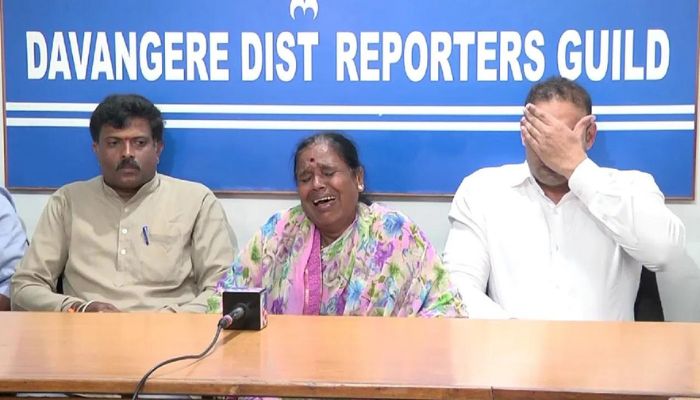
Mother of Srinivas along with other Hindu activists
Srinivas’ mother along with local Hindus conducted a press conference and demanded justice for his son.
Media channels amplify dubious claims of misbehaviour
Although Srinivas happens to be the victim in the case, his image was tarnished by the media. It is mind-boggling that certain media portals chose to believe that Srinivas committed ‘misbehaviour’ when the supposed victim (aka the Muslim girl) was seen trying to protect him from her radical co-religionists.
It is also important to note that if it was a case of ‘mob justice’, then, why did the same mob assault the supposed victim? While conveniently ignoring video footage and ‘common sense’, several media portals published headlines describing Srinivas as the perpetrator.
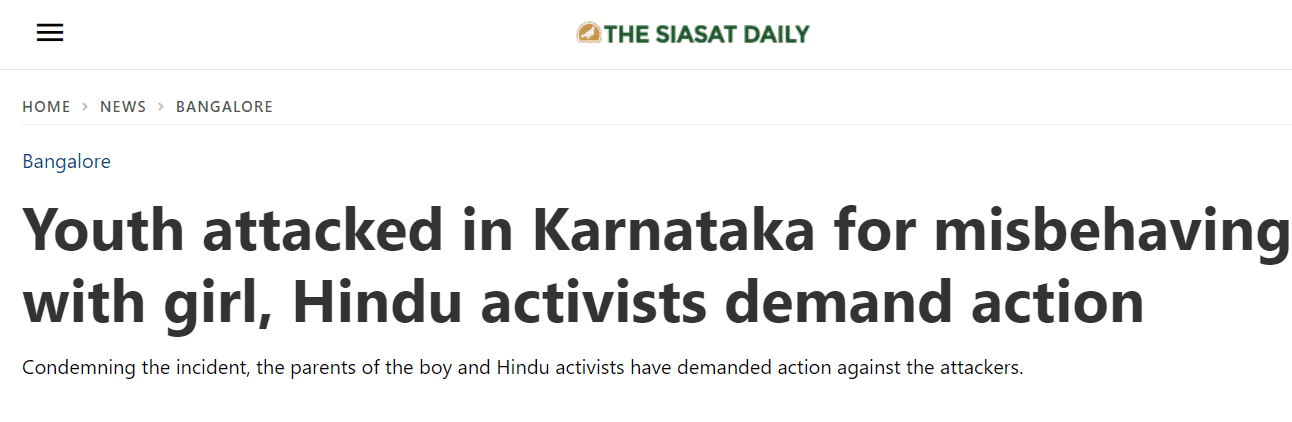
Hindu groups were also maligned as elements supporting a man accused of misbehaviour against a woman. “Youth attacked in Karnataka for misbehaving with girl, Hindu activists demand action,” wrote The Siasat Daily.
Screengrab of the article by the Siasat Daily
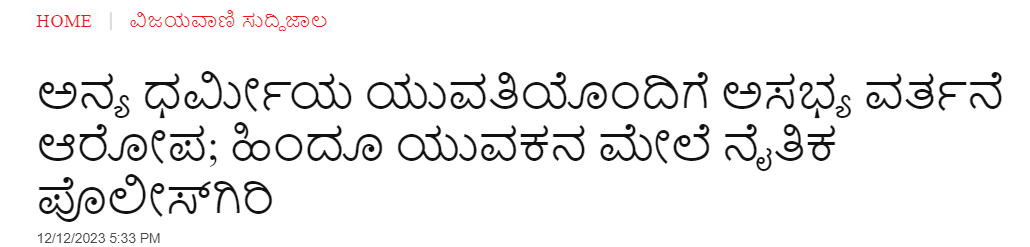
Similar claims were made by Kannada-language newspaper ‘Vijayvani’ in an article published on 12th December this year.
Screengrab of the article by Vijayvani
It should be mentioned that the initial reports by Hindustan Times, Asianet News, and TV9 Kannada nowhere mentioned any case of ‘misbehaviour.’
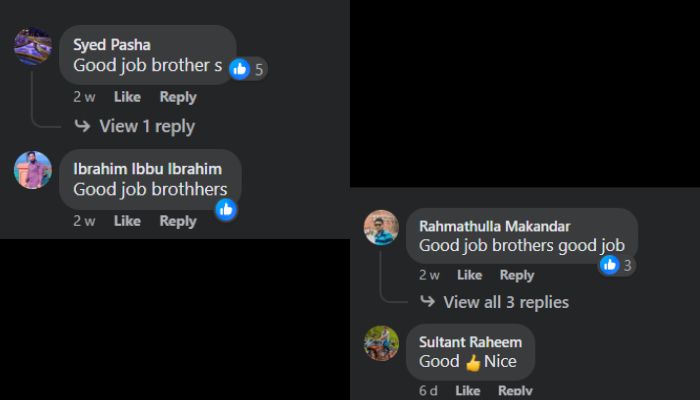
As expected, Islamists were seen celebrating the attack on Hindu Dalit man on social media. “Good job,” they wrote on Facebook.
Islamists on social media hail attack on Srinivas
Moral policing cases in Karnataka
On 26th August this year, the Bengaluru police arrested a man named Jakir Ahamad after he harassed a burqa-clad Muslim woman for travelling with a Hindu man.
The matter came to light a day earlier on Friday (August 25) when a popular Twitter user (@BefittingFacts) shared the video of the moral policing on X (formerly Twitter).
Jakir had stopped the woman travelling on a bike with a Hindu man and abused her with the choicest of expletives. “What is your name? Roam without this burqa…remove your burqa,” the accused was seen engaging in moral policing.
The 21-year-old woman stood her ground and retorted back by saying ‘Meri Marzi (My wish to be with this Hindu man).’ However, the abuses and expletives continued.
In his tweet, ‘Befitting Facts’ wrote, “This is happening in Bangalore. Priyank Kharge, a lady in Burqa is being harassed by Muslims for roaming with a Hindu man. See the language being used against her. They are literally asking her to remove her burqa. @BlrCityPolice Please take strict action against them.”
On Sunday (August 27), the Bengaluru police informed that the accused was nabbed within 24 hours. As per a report by Telangana Today, the accused was identified as Jakir Ahamad. A case was lodged against him East Cyber Economic and Narcotics (CEN) Police Station.
‘Bhagwa love trap’ conspiracy theory and its aftermath
‘Bhagwa Love trap’ is a baseless theory about Hindu outfits, supposedly training Hindu youth to lure, and entrap Muslim women and turn them into non-Muslims. OpIndia has reported that an Islamic cleric by the name of Sajjad Nomani has been making such outrageous claims since 2021.
The conspiracy theory soon took the form of a social media hashtag, which Islamists used to share videos of random hijab-wearing Muslim women and their male Hindu friends/ acquaintances and partners without their consent.
The posts are often accompanied by emotional messages and seek public help in identifying the couples. Soon after, social media was rife with videos of Islamist mobs ambushing random Hindu-Muslim couples.
This would then be followed by heated arguments, physical assault on Hindu men, and even molestation of Muslim women. The victims have been targeted on roads, restaurants, eateries, and even hotels.
Based on local reports and social media videos, OpIndia has compiled several cases (here, here and here) where Hindu men and Muslim women were attacked by extremists under the pretext of the ‘Bhagwa love trap.’
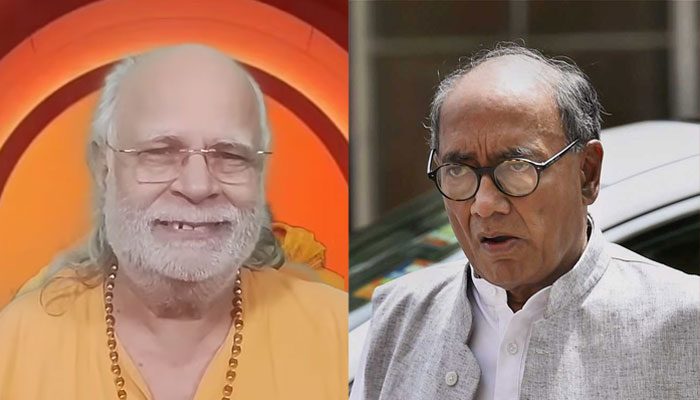
On 31st December, Congress leader and former Madhya Pradesh Chief Minister Digvijaya Singh criticised Electronic Voting Machines (EVMs), the Election Commission, and Prime Minister Narendra Modi. In a post on X (formerly Twitter), Singh voiced his “concerns” over possible hacking of EVM machines while quoting a video of controversial YouTuber Manmohan Mishra. Expressing his gratitude to Manmohan for his “outspokenness” on the issue, Singh called for returning to ballot papers for the 2024 Lok Sabha Elections.
धन्यवाद मुनमोहन जी महाराज। आपने EVM चुनाव आयोग व मोदी जी पर बोल कर जो साहस दिखाया है आपके चरणों में प्रणाम। मैं २००३ से कह रहा हूँ मुझे EVM पर भरोसा नहीं है। मैं जहां वोट देना चाहता हूँ मुझे यही पता नहीं पड़ता मेरा वोट कहाँ गया। ऐंसी कोई मशीन विश्व में नहीं है जिसमें चिप डाला हो…
In his statement, Singh said he has voiced his concerns over EVMs since 2003. He lost his Chief Minister post to Bharatiya Janata Party (BJP) leader Uma Bharti. After Uma Bharti, Babulal Gaur became CM of the state, followed by Shivraj Singh Chouhan. Madhya Pradesh has been under BJP rule since 2003 except for two years when Congress leader Kamal Nath became Chief Minister. However, due to internal politics, the Congress-led government fell like a house of cards.
In his statement, Digvijaya Singh questioned the reliability of EVMs and claimed he is always uncertain about the destination of his vote. He further claimed that as EVM is a machine with a “chip,” it is not immune to hacking. He claimed if a voter selects one option on EVM, the software may direct it to register a different option. Digvijaya Singh also raised apprehensions about Voter Verified Paper Audit Trails (VVPATs), which display the selected candidate’s symbol. He claimed that VVPAT may show one symbol but print another.
Singh called for a return to ballot papers for elections to “instil trust in voters” that their choices are “accurately recorded”. As an alternate, he suggested that the voters should get the VVPAT slip and be allowed to drop them in a box themselves, eliminating any doubts.
Manmohan Majaraj’s rant against PM Modi, the Election Commission and EVMs
Digvijaya Singh referred to the video from controversial YouTuber Manmohan Mishra’s channel. In his video, Mishra claimed that Prime Minister Narendra Modi used hacked EVMs in the Assembly Elections of Madhya Pradesh, Rajasthan and Chhattisgarh. He claimed that the hacked EVMs were used as there was dissent against PM Modi in these states. Manmohan Mishra further claimed that these victories were manufactured since people were shocked how BJP won in these three states. He highlighted that there has been a growing demand for a return to ballot papers in the country.
Mishra accused PM Modi of manipulative tactics. He also claimed that Vice President and Chairperson of Rajya Sabha, Jagdeep Dhankar, suspended the Members of Parliament (MPs) on PM Modi’s instructions as he wanted several bills to be passed. He also argued that by changing the process to select Election Commission officials laid down by the Supreme Court, PM Modi has created a lack of impartiality in the commission.
Mishra has been making anti-Modi and anti-BJP videos for a long time. In August 2021, he was arrested by UP Police for making derogatory remarks against CM Yogi Adityanath.
Leaders must learn to respect the mandate.
A disturbing trend has emerged since PM Modi and the BJP started winning elections in 2014. In the aftermath of the elections, the opposition leaders of Congress, CPI, AAP, SP, and others hastily claimed that EVMs were tampered with. The knee-jerk reaction is not only a blunt refusal to accept defeat but an insult to the democratic choice of the voters.
When the leaders cry “EVM hacking” without any substantial proof, they undermine the foundation of democracy. These allegations suggest that the choice of the voters was invalid or manipulated. The narrative is dangerous and erodes trust in the democratic institutions. Interestingly, even in Mishra’s video, he claimed the hacking was done only in the states where BJP won. In Telangana and Manipur, the BJP did not hack the EVMs, according to Mishra and others who cry EVM hacking after every election.
These claims often lack credible evidence. It is more of a face-saving tactic after a shameful defeat at the hands of the BJP. It is high time that the leaders learn to accept defeat with grace and respect the voters’ choice. Democracy is based on the principles of fair play and respect for the electorate’s verdict. If the opposition fails to acknowledge that, the voters will throw them out of the election process to the point of no return.
Before Digvijaya, Prashant Bhushan, YouTuber Pragya Mishra, Shiv Sena leader Sanjay Raut, Congress leader Anshu Awasthi and many others have raised irresponsible claims against EVMs and VVPATs.
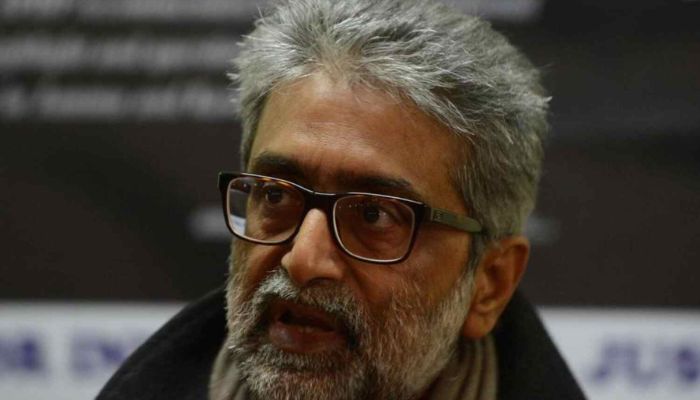
Urban Naxal Gautam Navlakha was questioned by a Delhi Police team on Saturday (30th December) at his residence in Navi Mumbai regarding the NewsClick foreign funding case. This interrogation came amid ongoing investigations into the propaganda portal’s alleged involvement in anti-India activities and receiving foreign funds from China.
Gautam Navlakha, currently under house arrest following his bail on 19th December in the Elgar Parishad-Maoist links case, was questioned about his association with NewsClick’s founder and Editor-in-Chief Prabir Purkayastha, as well as his shareholding in the company, PPK NewsClick Studio Pvt Ltd. The interrogation, led by an officer of the assistant commissioner of police level, lasted three hours.
The Delhi Police team’s visit follows the FIR registered in August by the special cell under the Unlawful Activities (Prevention) Act (UAPA) against NewsClick, Purkayastha, and others. This FIR alleged substantial funding from China to NewsClick with intentions to “disrupt the sovereignty of India and cause disaffection against the country”. Purkayastha, along with the human resources department head Amit Chakravarty, was arrested on 3rd October 2023 and is currently in judicial custody.
The FIR also claimed that the Chinese funds were distributed to various individuals, including Navlakha and associates like activists Teesta Seetalvad, her husband Javed Anand, and journalists Urmilesh, Aratrika Halder, Paranjoy Guha Thakurta, and Abhisar Sharma. It further accused Purkayastha of conspiring with the People’s Alliance for Democracy and Secularism (PADS) to sabotage the 2019 Lok Sabha elections.
Gautam Navlakha has been linked with Purkayastha since 1991 and has been a shareholder in NewsClick since its inception in 2018. He is one of the 15 accused in the Elgar Parishad-Bhima Koregaon violence case, which was registered based on a complaint alleging that Maoist-linked individuals incited violence through provocative acts at the Elgar Parishad event in 2017.
In a media interaction, Gautam Navlakha’s partner Sahba Hussain said, “I was not with him at the time, as I am out presently. I hence do not have the gist of what has happened as yet. I will get to know only once I speak to him. But I understand the special cell team was there for over three hours to investigate the Newsclick issue.”
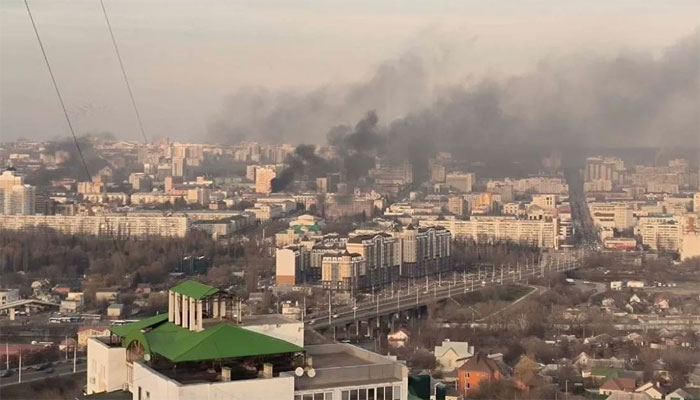
On 30th December (local time), Ukraine launched an “indiscriminate” strike on the Russian provincial capital of Belgorod, killing at least 20 people, including two children, and injuring over 110. In a statement, Russia vowed to retaliate against the Ukrainian strike.
Belgorod region is adjacent to northern Ukraine. Since the war broke out between the two countries, Russian regions close to the Ukrainian border, including Belgorod, have suffered shelling and drone attacks. However, previous attacks were not at such a large scale.
The moment unguided Ukrainian MLRS rockets started killing civilians in the middle of Belgorod.
This is 100% an intentional attack against the population, and it is the true colours of Ukraine that our media isn’t too keen to share. pic.twitter.com/SZpX3sZr5N
As per Kommersant newspaper’s sources close to the Russian Investigative Committee, the missiles fired at Belgorod came from multiple rocket launcher stations in the Kharkiv region of Ukraine. A Skating Rink on the central Cathedral Square, residential buildings and a shopping centre were attacked.
Ukrainians launched a terror attack against the civilian population in Belgorod killing several people, including 2 children.
While Russian strikes aim at military targets but get deviated by air defense, Ukrainians purposefully aim for civilians, often in retaliation. pic.twitter.com/7i3AV6P4eH
Following the attack on Belgorod, Russia’s mission to the United Nations in New York requested a meeting of the Security Council.
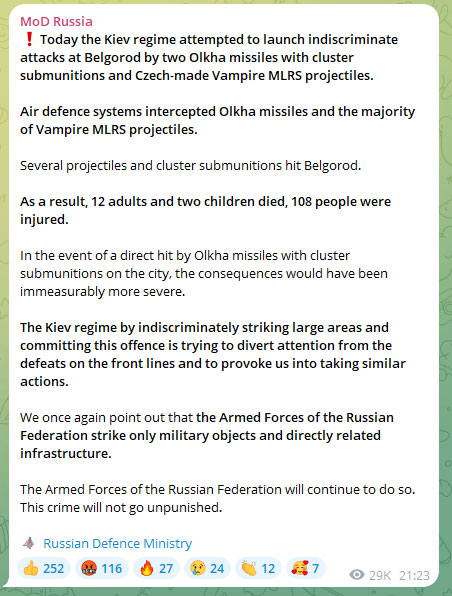
In a post on Telegram, the Russian Defence Ministry said, “Today the Kyiv regime attempted to launch indiscriminate attacks at Belgorod by two Olkha missiles with cluster submunitions and Czech-made Vampire MLRS projectiles. Air defence systems intercepted Olkha missiles and the majority of Vampire MLRS projectiles. Several projectiles and cluster submunitions hit Belgorod.”
Source: MoD Russia/Telegram
In the event of a direct hit by Olkha missiles with cluster submunitions on the city, the consequences would have been immeasurably more severe. The Kyiv regime, by indiscriminately striking large areas and committing this offence, is trying to divert attention from the defeats on the front lines and to provoke us into taking similar actions.
The Ukrainian Army, funded, led and armed by NATO has just bombed the Civilian centre of the Russian city of Belgorod.
They have directly targeted the city centre to kill innocent civilians. There is no military infrastructure here. I've been here myself. This is murder. pic.twitter.com/niWTYR9TB0
Though there has been no official statement from Russia, RBC-Ukraine quoted unnamed sources claiming the attack was a “retaliation” for the Russian bombardment of Ukrainian cities a day earlier.
Attack on Apartments and shops by Ukraine
Reports suggest that the majority of the rockets, including “Olkha” missiles, were shot down by Russia, resulting in fewer casualties. Governor of Belgorod Oblast, Vyacheslav Gladkov, said in a statement that 22 apartment buildings suffered damage in the attack. Several commercial properties were damaged, including shopping centres, shops, and over 100 vehicles.
Ukraine attempted an attack on Friday
Russia said its anti-aircraft units destroyed 13 rockets originated from Ukraine over the Belgorod region on 29th December. Furthermore, 32 drones over the nearby Bryansk, Oryol and Kursk regions and the Moscow region were also destroyed by Russia.
Foreign Ministry spokesperson Maria Zakharova accused Britain and the US of inciting Ukraine to carry out terrorist acts against Russia. She added that the European Union countries must be blamed for supplying weapons to Ukraine.
President Vladimir Putin rushed a team of health and emergency workers to the affected region.
Russia Ukraine War
On 22nd February 2022, Russia launched a military operation on Ukraine. Western powers, including the United States, the United Kingdom, European Nations and others, came in support of Ukraine and have been supplying funds and weapons since then. Several sanctions were imposed on Russia following the war broke out between the two countries. OpIndia’s detailed coverage of the Russia-Ukraine War can be seen here.
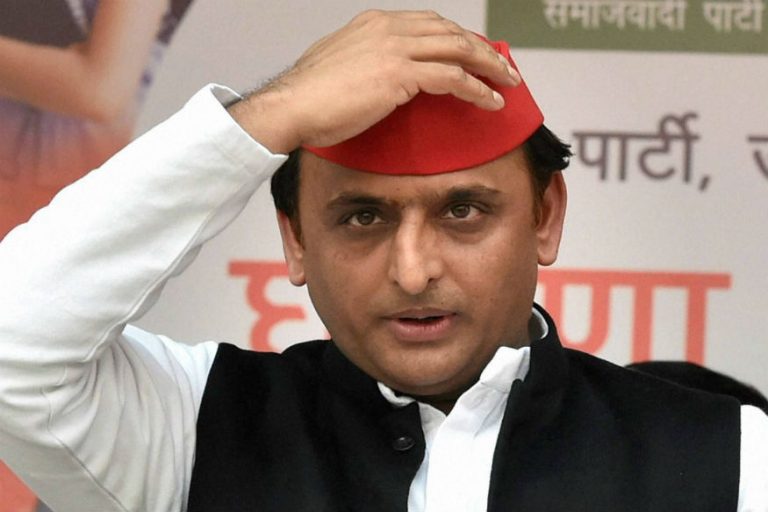
On Saturday (December 30th), Prime Minister Narendra Modi inaugurated the new airport and the revamped railway station in Ayodhya. PM Modi also flagged off 2 Amrit Bharat and 6 Vande Bharat trains. PM Modi’s Ayodhya visit, however, did not go down well with Samajwadi Party supremo Akhilesh Yadav as he said on Saturday that as people from all over the country would come to Ayodhya, it would cause a surge in expenses.
During a program in Etah, SP chief Akhilesh Yadav said, “Prime Minister Modi is telling this Yatra, that Yatra…but he did not tell that all these Yatras are going to be expensive now. He talked about the Yatras in the entire country… Sabarimala Yatra, Arunachal Yatra, the Chaudah Kosi Yatra, people from Calcutta will come, people will come from Rameshwaram… he told about all these Yatras, but he did not tell you how much your expenses will increase due to these Yatras.
#WATCH एटा, उत्तर प्रदेश: सपा अध्यक्ष अखिलेश यादव ने कहा, "प्रधानमंत्री मोदी बता रहे हैं ये यात्रा, वो यात्रा लेकिन उन्होंने ये नहीं बताया कि ये सभी यात्राएं अब महंगी होने जा रही हैं… महंगाई चरम सीमा पर है, लोगों के हाथ में रोजगार नहीं हैं। लोग नौकरी और रोजगार ना मांगे इसलिए ये… pic.twitter.com/qpcLzlgUPC
Moreover, the former chief minister of Uttar Pradesh asked, “Tell me whether tea will become expensive or not, whether bricks will become expensive or not? Inflation is at its peak, and people do not have employment.”
The Samajwadi Party supremo further said that these programs are being organised so that people do not ask for jobs and employment.
Notably, Prime Minister Modi’s Ayodhya visit came weeks before the much-awaited consecration ceremony of the Ram Mandir on 22nd January. In his address on Saturday, PM Narendra Modi appealed to all 140 crore Indians to light a Shri Ram Jyoti in their homes on 22nd January 2024 when the Ram temple consecration takes place in Ayodhya.
PM Modi received a thunderous welcome from the people of Ayodhya during his visit ahead of the Ram Mandir inauguration. He also paid a surprise visit to the house of Meera Majhi, the tenth-crore beneficiary of the Centre’s flagship Ujjwala Yojana.
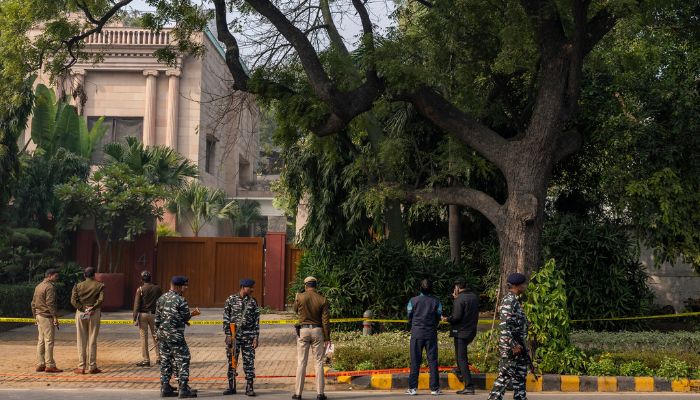
In a significant development in the investigation of the blast near the Israeli Embassy, the Delhi Police registered an FIR against unidentified persons on 30th December 2023. The blast took place in the Israeli Embassy in New Delhi on 26th December 2023. The FIR is filed under Section 3 of the Explosive Substances Act at the Tughlaq Road police station.
The police has interrogated six suspects and 14 auto drivers to date. A meticulous examination of the routes from Jamia to the Israeli embassy is underway, involving the scrutiny of footage from approximately 150 CCTVs. The focus of suspicion has been drawn to a person of tall stature, flagged as behaving suspiciously in the CCTV footage.
The technical team of the Delhi Police has been actively analysing dump data, leading to the identification of over 100 suspicious phone numbers. Efforts are underway to glean more information about these numbers, some of which were recently deactivated.
Samples of leaves and soil from the blast site were collected by forensic experts from the National Security Guard (NSG) and the Delhi Police. The NSG bomb squad team is also expected to submit a detailed sealed report to the Delhi Police, which would provide critical insights into the case.
Eyewitness accounts have been pivotal in shaping the investigation. A security official stationed near the embassy vividly recalled the incident, stating, “I heard a loud noise at around 5 p.m. The noise was similar to a tyre burst. I also saw smoke near a tree.”
Moreover, two individuals were initially singled out as suspects based on CCTV footage, but their involvement in the incident remains unconfirmed. The investigation team, which includes the Delhi Police, the Special Cell, the Dog Squad, and officials from the NIA, continues to probe various angles to establish a concrete link to the blast.
The incident, which fortunately did not result in any injuries, has drawn parallels with a similar explosion near the embassy in 2021. In light of this and ongoing tensions between Israel and Hamas, security measures around the Israeli embassy have been significantly heightened.
Israel’s Deputy Ambassador to India, Ohad Nakash Kaynar, assured the safety of embassy personnel, saying, “All our workers are safe, and all our diplomats are safe. Our security teams are working in full cooperation with the local Delhi security and they will investigate the matter further.”
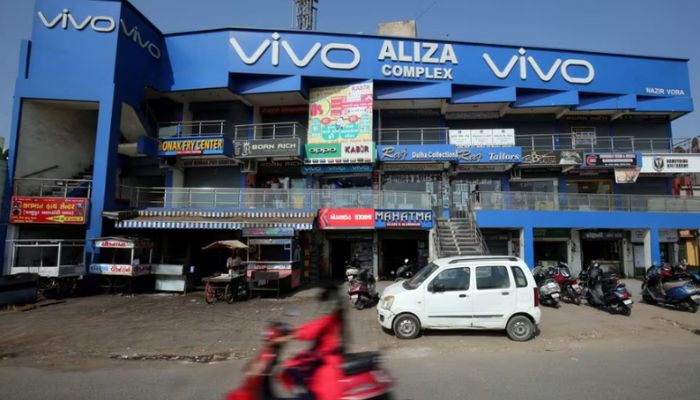
On Saturday (30th December), a Delhi court ordered the release of 3 employees of Chinese smartphone manufacturer Vivo, who were arrested by the Enforcement Directorate (ED) in connection to a money laundering case.
As per reports, the three arrested individuals include Vivo India’s Chief Executive Officer (CEO) Hong Xuquan, Chief Financial Officer (CFO) Harinder Dahiya and consultant Hemant Munjal.
They were arrested on 21st December this year by the ED and had been in custody for over a week. On Saturday (30th December), a Delhi court dubbed their arrest as ‘illegal and void’, adding that the Vivo employees were not produced before the court within 24 hours of arrest.
#WATCH | Vivo money laundering case accused Hong Xuquan, Harinder Dahiya and Hemant Munjal, released by Patiala Court. pic.twitter.com/PldzxEzPzM
The court directed Hong Xuquan, Harinder Dahiya and Hemant Munjal to furnish personal bonds of ₹2 lakhs and ordered their release. The trio has been asked to not tamper with evidence, leave India without exclusive permission of the trial court and surrender their passports in the court.
The Enforcement Directorate, in its remand application, informed that the accused ViVo employees were working without legit visas and cheated the Union government by setting up an elaborate Chinese-controlled network in India to carry out prejudicial activities against the country’s sovereignty.
The Background of the Case
In October this year, the ED arrested four people in connection to the case. The arrested individuals include Hari Om Rai, the Managing Director of Lava International, a competing mobile company; Guangwen, also known as Andrew Kuang, a Chinese national; and two chartered accountants, Nitin Garg and Rajan Malik.
The ED’s investigation has brought to light allegations of a significant financial subterfuge orchestrated by Vivo. Reports suggest that the company siphoned off a staggering Rs 1 lakh crore from India between 2014 and 2021.
This was allegedly facilitated through a network of shell companies, purportedly established at the behest of Vivo’s Chinese parent company Vivo Mobile Communication Co. These shell entities, numbering 19, were set up to create an elaborate front, allowing Vivo to gain a stronghold in India violating foreign direct investment rules.
Further, the ED’s probe unearthed that Vivo India had remitted nearly Rs 62476 crore to China, constituting almost 50% of its turnover, ostensibly to avoid taxes in India. This has raised serious concerns about the economic sovereignty of India.
The agency’s investigation also revealed a pattern of alleged deceit involving the use of forged documents and falsified addresses. One of the companies under scrutiny, Grand Prospect International Communication Pvt. Ltd. (GPICPL), reportedly used government buildings and a senior bureaucrat’s house as its registered addresses.
The matter has drawn significant attention, considering the scale of the alleged financial irregularities and their implications on India’s economic interests. The case continues to unfold as the ED delves deeper into the intricate web of transactions and corporate structures set up by Vivo and its associates.
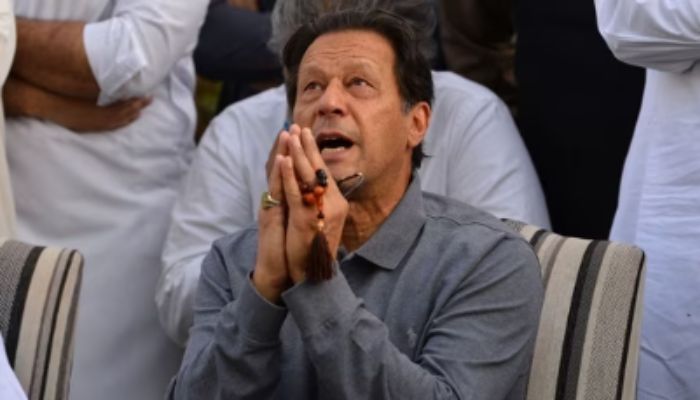
On 30th December (Saturday), Pakistan’s provincial election commission confirmed that Pakistan Tehreek-e-Insaf (PTI) founder Imran Khan’s nomination papers were rejected for National Assembly constituencies from Punjab’s capital Lahore and his home city, Mianwali, Pakistan’s Geo News reported.
(Video Courtesy – Pakistan’s Geo News)
As per reports, in a major crackdown against Imran Khan-led PTI, the electoral body has also rejected the nomination papers of other senior leaders of the party as well. Taking to X, PTI alleged that the Election Commission rejected nomination papers of nearly 90% of their leadership while it accepted 100% nomination papers of other parties.
Almost 90% of the nomination papers of PTI's important leaders including Imran Khan were rejected, 100% of the nomination papers of other parties were accepted.
ROs, police, caretakers and ECP have played the role of facilitators for Nawaz Sharif in the first phase of elections…
Strikingly, their nomination papers have been rejected on the last day of the scrutiny phase. However, Geo News reported that the PTI can appeal against the string of rejections by 3rd January which will be decided by the Appellate Tribunal by 10th January. Subsequently, the electoral body will publish the revised list of candidates on 11th January.
Interestingly, the country’s Election body accepted papers of Pakistan Muslim League-Nawaz (PML-N) supremo Nawaz Sharif for NA-130 in Lahore. Sharif Senior had recently returned to Pakistan following years in exile to avoid punitive actions.
Meanwhile, ahead of the upcoming General polls in Pakistan on 8th February 2024, Khan had filed his nomination papers from Lahore’s NA-122 and Mianwali’s NA-89 constituencies.
Geo News further reported that PML-N’s Mian Naseer had raised multiple objections against Khan’s nomination papers. The objections had referred to Khan’s five-year disqualification in the Toshakhana case wherein the electoral body had found him guilty of corrupt practices under Section 167 of the Elections Act, 2017.
As per the objections, Khan’s proposer and seconder didn’t hail from NA-122. Additionally, there were multiple other objections including his disqualification in the Toshakhana case, allegedly having an illegitimate daughter, and defaulting on Rs 3.6 million social security funds. Concurring with the objections, the returning officer rejected Khan’s nomination papers.
Explaining the basis for his decision, the returning officer (RO) assigned to scrutinise the nomination papers of the NA-122 constituency said, “The PTI founder has been convicted.”
The PTI leadership has been facing multiple cases particularly ones related to the 9th May rioting case which was triggered after Khan’s arrest in a graft case and saw military installations being vandalised.
In the wake of multiple cases, PTI senior leaders, including Vice Chairman Shah Mahmood Qureshi and others have been behind bars.
Election Commission clamps down on PTI leadership, goes after its Election symbol as well
Apart from Imran Khan, the Election Commission of Pakistan (ECP) also rejected PTI Vice Chairman Qureshi’s nomination papers from Multan’s NA-150, NA-151, PP-218, and Tharparkar’s NA-214. Similarly, they also rejected former federal minister and PTI leader Hammad Azhar’s nomination papers from PP-172, Geo News report added.
Earlier in the day, it had rejected the nomination papers of Azam Swati and Zulfi Bukhari.
Additionally, in a clampdown against PTI functionaries, hundreds of Maintenance of Public Order (3-MPO) notifications had been issued against workers and leaders in relation to their alleged involvement in the May 9 incidents.
Further, the former ruling party, PTI could also lose its electoral symbol “bat” before the crucial elections in February.
On Saturday (30th December), Pakistan’s EC filed a review petition in the Peshawar High Court (PHC) challenging its earlier order that reinstated the party’s electoral symbol. The Election body had stripped PTI of its electoral symbol ‘bat’ alleging irregularities in intra-party polls.
Now, the ECP had filed this review petition to strip PTI’s bat symbol, further worsening PTI’s legal and political battle.