Home Blog Page 151

Muslim League conspired to assassinate Sardar Patel in Bhavnagar, weapons were recovered from mosque: Read about this forgotten chapter of Indian history

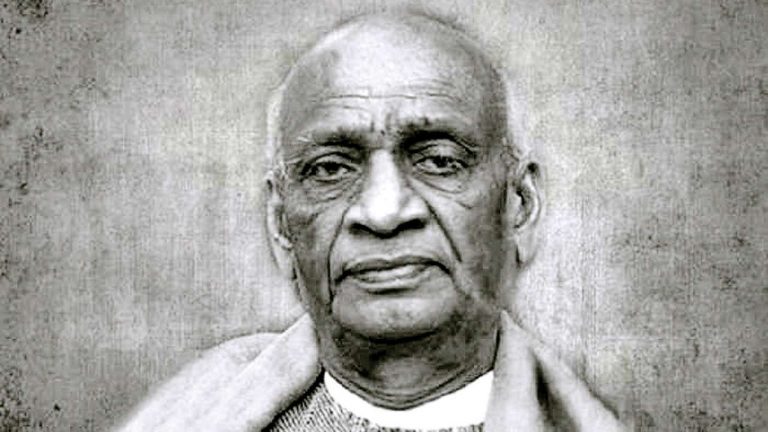
Sardar Patel had a deep and old connection with Gujarat’s Bhavnagar. The “Ironman of India” shared a great bond with Maharaja Krishnakumarsinhji. While Sardar Patel had many interesting memories associated with Bhavnagar, two of them particularly stand out. First, is important for the newly drawn map of the country after independence.  But the other memory is one that is buried deep in a dilapidated memorial of Bhavnagar today. An incident worth remembering that has been forgotten.

It was 1939, Bharat was still under the British colonial rule. However,  the Bhavnagar Rajvi had announced that Bhavnagar would be the first state to join independent India. Sardar Vallabhbhai Patel had increased his presence in Bhavnagar to discuss this issue. Meanwhile, on 14th and 15th May 1939, the fifth session of the Bhavnagar State Council was held at Bhavnagar under the chairmanship of Sardar Patel. Maharaja Krishnakumarsinhji had also extended an invitation to Sardar Patel. 

Sardar Patel came to Bhavnagar on May 14th, 1939, accepting the invitation, and his procession started from the railway station in an open jeep. The Muslim League had already hatched a conspiracy to target Sardar Patel’s journey. Local radical Muslims, under the auspices of the Muslim League, had started preparations in the mosque and even planned to assassinate Sardar Patel. 

The arrival of Sardar Patel and the deadly attack by Islamic fanatics

Sardar Patel was coming from the railway station in an open jeep, greeting everyone. As soon as the procession reached Khargate Chowk, a commotion started near Nagina Masjid. A large number of Muslim fundamentalists who were sitting in the mosque as part of a pre-planned conspiracy, brandished their weapons and came out and ran towards Sardar Patel’s jeep. The fundamentalists were moving towards Sardar Patel’s jeep with sharp weapons like swords, knives, axes and machetes.

However, before he could attack Sardar Patel, a young man from Kanbiwad, Bachubhai Patel, and Dakshinamurthy and Lokbharti founder Nanabhai Bhatt both climbed onto Sardar Patel’s jeep and became Sardar Patel’s shield. Meanwhile, all the blows of the Muslim extremists fell on these Hindu youths.  Consequently, Bachubhai Patel was seriously injured and died on the spot. Nanabhai Bhatt was also shifted to the hospital for treatment and fortunately he survived. 

As soon as the incident was reported, the police constables of Bhavnagar state reached the Nagina Mosque with spears and weapons and dispersed the crowd. But if these Muslim extremists had succeeded in their plan, the history of the country after independence would have been different. The attempt to assassinate Sardar Patel had left the city of Bhavnagar speechless and terrified. In the meeting of the council, Sardar Patel himself had said, “This is not an act done in a momentary rage, there is an intelligent conspiracy behind this that was planned in advance.” 

‘The conspiracy was pre-planned’ – then police officer

A case was also filed in the then court of Bhavnagar in this entire matter. In which a total of 14 people were made accused. Their names are recorded as Waras Ali, Bilal Ibrahim, Abdul Sattar Musa, Abdullah Sidi, Usman Khan Mohammad Khan, Usman Nurmiya, Abdul Gafur, Abdul Kader, Aliwad, Musa Abdul, Kasam, Muhammad Suleman, Islamil and Alarakhan Ibrahim. On July 12th, 1939, the then newspaper ‘The Kathiawad Times’ published a detailed report based on the testimony given in the court by the then police officer Popatbhai. 

Source: OpIndia Gujarati

In his testimony, Popatbhai told the court that before the program, some people from the Muslim League had submitted a petition demanding that musical instruments not be played. Later, it was found that the petition was written by a person named Abdul Kader Lakhani on the instructions of the Vice President of the Muslim League. Later, Popatbhai informed the secretary of the Parishad, Jadavji Modi, and asked him not to play musical instruments outside the Nagina Masjid. In addition, there was also talk of deploying a heavy police force there. Later, he also spoke to a prominent Muslim leader, Rajumiya, and Rajumiya assured him that the Muslims would not riot and that he would also be present at the reception of Sardar Patel on May 14th, 1939. 

Source: OpIndia Gujarati

The following information is based on Popatbhai’s testimony in court:

On May 13th at 9:30 pm, the police were informed through telephone that weapons including sticks, swords and stones had been collected in the Nagina Mosque and that five hundred and one Muslims had also gathered. However, the police said that there was no basis for this information and therefore no order was given to raid the mosque. The next morning, Sardar Patel arrived in Bhavnagar. On the other hand, a heavy security force was deployed in front of the Nagina Mosque.

Source: OpIndia Gujarati

As mentioned earlier, even though no musical instruments were played in front of the mosque, the Muslim fanatics got angry and attacked the Hindus standing outside. A sound was heard, and immediately, Muslim fanatics from all sides attacked the Hindus standing there, shouting, ‘hit me, hit me’. The attackers came with sticks, swords, clubs, umbrellas and knives and started beating the Hindus. 

Here, the police officers used their time and saved Hemkhem by requesting Sardar Patel to take another route. Later, more police force was sent and the situation was brought under control. Later, the rioters were also arrested.

Sardar Patel paid tribute to the departed

The Gujarat Mitra newspaper of May 21st, 1939 also talked about this incident and said that one volunteer died and many were seriously injured in the attack by Muslim fanatics. Due to this commotion, the program was also canceled and Sardar Patel was taken directly to his residence. After this incident, spearmen and infantry troops were deployed at important places in the city and Nagina Masjid was surrounded from all sides. 

The police searched the mosque and recovered several weapons. Following this, several Islamists were arrested across the city. A number of injured men were taken to Sir Takhtsinhji Hospital and Sardar Patel also visited the men undergoing treatment in the hospital. Meanwhile, due to the intense heat, Maharaja Krishnakumarsinhji, who was staying in Mahuva, was informed about the incident. 

Source: OpIndia Gujarati

A bandh was observed in the entire Bhavnagar in honor of Bachubhai Patel, who himself passed away after saving Sardar Patel’s life, and condolences were expressed. A funeral procession was taken out in the evening, in which more than 20 thousand people participated. Sardar Patel was also present during this. While paying tribute, he said, “Such deaths are rare.” Regarding the conspiracy of the Muslim League, he said, “I will not be afraid of such hooliganism in the sacrifice of national service.” 

It was shocking that an attempt was made to assassinate Sardar Patel in a progressive and liberal state like Bhavnagar at that time. Had this attempt had been successful, Bhavnagar would have been blackened with national disgrace and the history or even the map of independent India would have been different. Such numerous conspiracies of the Muslim League have always been erased from history and due to this, such attacks on Sardar Patel are never known or read about anywhere.

(This report was originally written in Gujarati. Click this link to read it.)
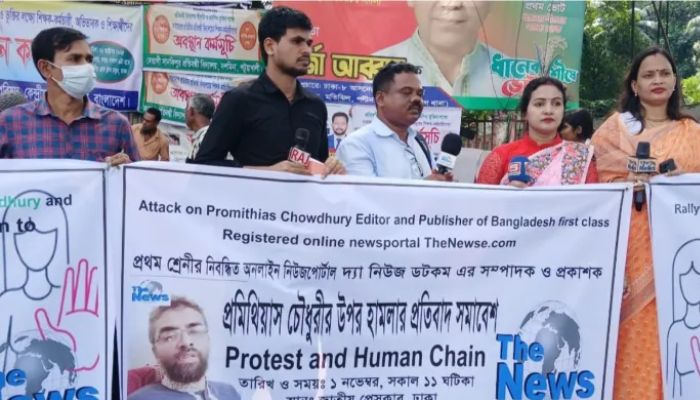
“Get her gang-raped by an Islamic gang”: Hindu journalist tells OpIndia about chilling threats she’s facing in Bangladesh for exposing atrocities against Hindus

Ever since the Mohammad Yunus-led interim government took control of power in Bangladesh, Hindus have been a constant target of Islamists. After a female Hindu journalist reported about the atrocities being committed against Hindu minorities in Bangladesh, Islamists have threatened to gangrape her. Her husband has also been assaulted, and instead of nabbing the Islamists, the police threatening the Hindu Hindus.

Promithias Chowdhury and his wife, Trina Roy Chowdhury, run a news portal in Bangladesh called TheNewse.com. Promithias is its editor and publisher, while Trina is the portal’s news editor. They live in West Goil village in Barisal district, about 150 kilometres from the capital, Dhaka. The couple has also established an ashram called Anand Lok, through which they help Hindus in the surrounding area. Their fierce journalism and support of Hindus have angered Islamic fundamentalists.

Bangladeshi Hindu journalist Trina Roy speaks to OpIndia about the Islamists targeting her

Speaking to OpIndia, Trina Roy Chowdhury said that she often clashes with local extremists, but on October 29th, things escalated to assault and rape threats. “On the afternoon of October 29th, my husband, Promithias, was called to Nazim Mulla’s shop by Nazim Mulla,” Trina Roy said.

She added, “Nazim and Promithias studied together and were friends, so he thought they were calling for a casual conversation. But when he arrived at the shop, Nazim was arguing with Shaheen over money. Nazim was demanding that Shaheen borrow 3.5 lakh taka.”

“When Promithias arrived, they confronted him. Nazim and Shaheen started saying, ‘You will give us money, you belong to ISKCON.’ When Promithias protested, he was assaulted. He was slapped and beaten.” Trina Roy says, “When Promithias told them, ‘I am your friend,’ they both said to him, ‘You are a Kafir Hindu, how can you be a friend? Bangladesh is ours; we are letting you stay out of kindness. Get out of Bangladesh,” Trina Roy continued.

Trina Roy further told OpIndia that the Islamic fundamentalists also threatened to gangrape her. “They also threatened to gangrape me. They told my husband, ‘Your wife is more dangerous, she doesn’t like us. Get her gangraped by Muslims, so she’ll start liking us and understand what we are,” she said.

The matter, however, did not end there. Promithias was assaulted, forced to sign a stamp paper, and a check was taken. Fakhrul Islam was present at the scene and provided instructions on how to torture Prometheus.

Why are Islamists enraged with the Hindu journalist?

Trina Roy explains that Islamists have a long-standing grudge against her and her husband. Recently, during Navratri, they had a clash with Muslims. She said, “Muslims came near the temple and started smoking cigarettes. When we objected, they resorted to violence and threats. The matter was later resolved after police intervention.”

Moreover, the Islamic fundamentalists in the neighborhood are irritated by their work for Hindus. According to Triya, as a journalist, she writes openly about the atrocities committed by Islamic fundamentalists in Bangladesh. Furthermore, she openly reports on the oppression of Hindus, which irritates the fundamentalists. Triya and Prometheus have done many such stories that have exposed the fundamentalists, and they are looking for an excuse to take revenge on them.

The Police are not helping: Trina tells OpIndia

Trina says she reported the matter to the police on October 29th, but the police have taken no action so far; instead, she is being threatened. “The station in-charge is Muslim, so he’s putting pressure on us,” she says. “When we included the ISKCON issue in our complaint, we were told not to mention it, as it could incite riots.”

She added  said that instead of taking action on the complaint, the police have now threatened to file false charges against her husband. She said, “The police told Prometheus, ‘We will file a case against you, saying you are inciting people to demolish the mosque.’ This threat was given to silence us and prevent us from demanding action against Islamic fundamentalists.”

Bangladeshi Hindu journalist further stated that she her entire family are terrified because fundamentalists are keeping an eye on their home. Visitors are being monitored. On October 31st, when some fellow journalists were visiting her, they were also stopped by fundamentalists. They too were threatened. They were told that they would vandalize the house of the person they were visiting.

After this incident, several journalists have been protesting across various places in Bangladesh. They are demanding action against the accused, but the police have fallen on deaf ears. Women say that it has become increasingly difficult for them to live in Bangladesh. In recent years, attacks, rapes, and murders against Hindus and other minorities have been on the rise. The plight of Hindus in Bangladesh is worsening day by day.

India’s crude imports from Russia rebound in October: Read what drives the monthly fluctuations in India’s energy procurement strategy amid US tariffs pressure

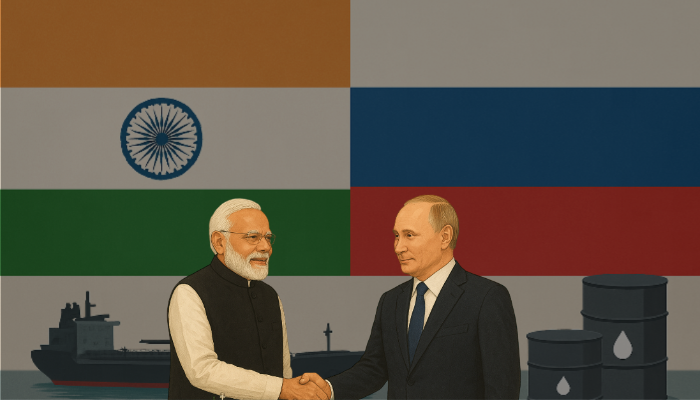
India’s importation of Russian oil has led to significant turmoil in international diplomacy, particularly concerning United States as President Donald Trump imposed a 50% tariff, including an additional 25% for failing to comply with his demand to cease purchases. The White House and its officials implied a range of pressure tactics to influence New Delhi which did not relent.

Trump even claimed that Prime Minister Narendra Modi assured him he would halt energy purchases from Moscow, last month. However, Ministry of External Affairs (MEA) countered that no phone call took place between the two leaders. Now, preliminary ship-tracking data provided by Kpler and OilX suggested that India’s crude oil imports from Russia have grown in October relative to the prior month, serving as further evidence of the Modi government’s resolute stance in the face of persistent pressure from Washington.

According to Kpler data, India’s intake of Russian oil increased from 1.44 million barrels per day (bpd) in September to approximately 1.48 million bpd in October, reported Reuters. OilX estimated the supplies to be at the same level and disclosed that September imports were 1.43 million barrels per day. Russian-exported oil from Kazakhstan was not included in the figures.

Furthermore, India’s main refiner resumed the consumption of Russian oil, acquiring five cargoes for December arrival from non-sanctioned firms, according to the media house. According to one of the trade sources, Indian Oil Corporation (IOC), the nation’s largest refiner, purchased roughly 3.5 million barrels of ESPO (Eastern Siberia-Pacific Ocean) crude oil at prices equal to those from Dubai for delivery at a port in eastern India in December.

Anuj Jain, head of finance at IOC earlier mentioned that Russian oil continues to be available on the spot market at a discount of $2 to $3 a barrel to Dubai for transport to Indian ports, based on the media outlet. “We never stopped it (buying Russian crude). We are already buying for October, November,” he expressed and added, “There was a dip in buy because our inventory levels were high, so we wanted to optimise our inventory levels also. That was one of major factors.”

Procurement of Russian oil experiences monthly variations

The buying patterns varied each month and have not been uniform or similar. The ship monitoring data conveyed that the imports of climbed up during the first half of October, reversing a three-month decline in arrivals that occurred during July and September as refineries resumed operations to fulfil festival demand.

The imports fell from more than 2 million barrels per day in June to 1.6 million barrels per day in September. However, early October analysis pointed to a recovery as shipments of Russian grades, including Urals, to India increased due to shipping flexibility and new discounts amid weak demand in Western markets.

Global trade analytics company Kpler’s initial findings indicated that October shipments were tracking at about 1.8 million barrels per day up about 250,000 bpd from the previous month. Additionally, Indian refiners attested that they never received orders from the government to stop importing Russian oil.

India’s acquisition of Russian oil increased to 2 million barrels per day, in August as refiners maintained a focus on economic factors in their procurement choices. Russia accounted for up to 38% of the 5.2 million barrels of crude oil imported daily in the first half of August, per global real-time data and analytics provider Kpler. The imports grew from 1.6 million barrels per day in July to 2 million barrels per day.

Notably, the Trump administration issued an official notification slapping tariffs of up to 50%, which included a 25% penalty for obtaining Russian oil during the same month. According to the Helsinki-based Centre for Research on Energy and Clean Air, India received €2.9 billion worth of crude oil from Russia in August as compared to €2.7 billion in July.

IOC chairman Arvinder Singh Sahney outlined, “Neither we are being told to buy nor told not to buy. We are not making extra effort to either increase or decrease the share of Russian crude.” He further asserted, “Russian oil accounted for about 22% of the crude processed by IOC in April-June and the volumes are expected to remain the same in the near future.”

Trade sources and data unveiled that Indian appetite for fuel usually drops during the monsoon season and hence the country’s imports of Russian oil fell in July after soaring the month before as some refiners suspended purchases because of lower discounts, outlined Reuters. India grabbed 1.5 million barrels of Russian oil per day in July, a 24.5% decrease from the previous month.

34% of India’s total imports of 4.44 million bpd in July came from Russia. Reliance, the operator of the largest refining complex in the world, cut its purchases of Russian oil by almost 19% in July from a high base in the previous month, owing to the data which contributed to the decline.

Russian oil imports see steady increase for sometime

India’s imports of crude oil from Russia soared to an 11-month high in June, as domestic refiners expanded their purchases to boost stockpiles amid heightened geopolitical tensions between Israel and Iran, based on analysts. According to Kpler vessel tracking data, Russian oil imports to India were at the highest point since July 2024 in June, totalling 2.08 million barrels per day (bpd).

These were between 2.1 and 2.2 million barrels per day between 1st and 19th June, maintaining Russia’s share of India’s total crude imports at above 35%. “While India’s global imports of crude oil dropped by 6% in June, Russian volumes saw an 8% month-on-month rise to their highest levels since July 2024,” pronounced a European think tank named the “Centre for Research on Energy and Clean Air.”

According to Kpler, the sustained availability of Russian crude oil at lower prices than international benchmarks caused India’s imports to climb to a 10-month high of 1.96 million bpd in May, per a report in The Times of India. India, bought about 5.1 million barrels per day of crude during the month. Russia remained India’s largest supplier, making up more than 38% of all imports.

April witnessed a nine-month peak in Russian oil supplies to India, reported The Indian Express. Kpler stated that India’s imports of Russian oil increased 2.1% in April compared to March to 1.92 million barrels per day, despite the fact that overall oil imports plummeted 7.3% sequentially to 4.88 million bpd. The proportion of Russian crude in India’s oil import basket surged from 35.7% in March to 39.3% in April.

The data from analytics firm Kpler highlighted that India’s imports of Russian oil, primarily Urals crude, were 1.54 million bpd in March after dropping to 1.1 million to 1.2 million bpd over the preceding three months, revealed Reuters. Sources noted that greater supplies were available for Asian markets as a result of Turkey’s biggest oil refiner’s decision to stop importing Russian oil.

According to the sources, Russian oil discounts were down from approximately $2.50 to $3 per barrel last month to between $2.60 and $2.80 per barrel to dated Brent for cargoes loading in March for delivery to Indian ports in April.

The International Energy Agency informed that India has become the largest purchaser of seaborn Russian crude oil, acquiring 1.9 million barrels per day in the first nine months of 2025 or about 40% of Russia’s total exports after Western sanctions over 2022 Ukraine war. Domestic refineries then turn this crude into fuels like petrol and diesel.

Factors influencing the evolving purchasing behavior

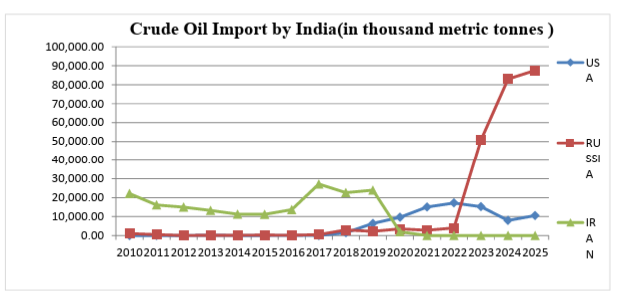
The shift in buying trends is apparent not only each month but also over the span of years. Ministry of Commerce and Industry informed that Russia was India’s top supplier of crude oil in 2024-2025, contributing around 36% of all imports, according to International Journal for Multidisciplinary Research. However, this was not always the case as Russia’s proportion of the nations that export crude oil to India was less than 1% in 2009-10.

Image via International Journal for Multidisciplinary Research

Only over 2% of crude oil imports came from Russia even in 2021-2022. The change was triggered by two factors. The first was the US embargo on Iran, which led to Iran’s percentage of India’s overall oil import basket to drop precipitously. The war between Russia and Ukraine which began in 2022 was the second reason. Diplomacy, energy trade flows and global energy dynamics transformed as a result of the conflict.

The previously mentioned reason was instrumental in India’s energy acquisition from Russia. Likewise, commercial, logistical and geopolitical factors contribute to India’s monthly fluctuations in its purchases of Russian oil with the economic considerations of Indian refiners playing a major role.

India’s Ministry of External Affairs explained its position on importing Russian crude oil in light of shifting dynamics in the world oil market. The altering dynamics of the global oil market have an impact on India’s decisions on its acquisition of crude oil. New Delhi stresses flexibility in energy procurement to satisfy the requirements of its 1.4 billion people and is even contemplating the effects of recent US sanctions on Russian oil corporations. The necessity to obtain reasonably priced energy from a variety of sources motivates Modi government’s strategy.

IOC head Sahney emphasised that Russian crude oil is bought for economic reasons. “We continue to buy, purely based on economic considerations, that is to say if the pricing and characteristics of the crude make sense in our scheme of processing, we buy,” he clarified.

Additionally, the reductions have narrowed to $1.5 per barrel which has resulted in lower imports in July, according to Vetsa Ramakrishna Gupta, Director (Finance) at Bharat Petroleum Corporation Ltd (BPCL). The discount fell substantially to $2.70/barrel in August while it was as high as $40/barrel.

Sahney pointed out that the discounts on Russian crude grades, such as Urals, could cause monthly fluctuations in purchase volumes and stressed that Indian Oil has not been told to cut or boost purchases in reaction to the US tariffs. It is clear that the US tariffs did not play any role and although the current sanctions on Russian oil companies could have an impact, the main impetus for these decisions is the economic feasibility.

More underlying reasons affecting the variations

Turnarounds or periodic maintenance are carried out in Indian oil refineries, which might temporarily lower their processing capacity and intake of crude oil. Monthly and refinery-specific variations in these maintenance schedules cause swings in the total demand for Russian crude.

Provisional government data showed that the crude throughput of Indian refiners fell 4.4% month over month to 5.27 million barrels per day (22.29 million metric tonnes), in August.

“Refinery throughput declined in August compared to July, primarily due to seasonal monsoon-related disruptions, scheduled maintenance shutdowns, and one of the refineries operating at reduced capacity,” voiced Prashant Vasisht, vice president and co-head of corporate ratings at Investment Information and Credit Rating Agency (ICRA).

India imported 18.6 million metric tonnes (MMT) of crude oil in July, a dip from 19.4 MMT the previous year, according to figures from the government’s Petroleum Planning & Analysis Cell (PPAC) owing to scheduled refinery maintenance shutdowns alongside relatively lower demand from the monsoon.

The availability of shipping and insurance services, among other logistical issues might be affected by sanctions or other market conditions, resulting in inconsistency. The Eastern Maritime Corridor between Chennai and Vladivostok serves as a prime example of a new route that would eventually affect viability as well as reliability and the same stands true for the Northern Sea Route.

The availability of shipping and insurance services, among other logistical issues might be affected by sanctions or other market conditions, resulting in inconsistency. The Eastern Maritime Corridor between Chennai and Vladivostok serves as a prime example of a new route that would eventually affect viability as well as reliability and the same stands true for the Northern Sea Route.

Indian refiners are aggressively diversifying their crude oil sources, looking into choices from other regions of the world to improve energy reliability and adaptability. This increases their pool of suppliers and inevitably also causes the monthly share of Russian oil to vary.

According to the Indian Ministry of External Affairs, protecting the interests of Indian customers in a volatile energy environment is New Delhi’s top priority. MEA spokesperson Randhir Jaiswal declared, “Ensuring stable energy prices and secured supplies have been the twin goals of our energy policy. This includes broad basing our energy sourcing and diversifying as appropriate to meet market conditions.”

Contracting for oil usually occurs four to six and even eight weeks as well as months before delivery. The volumes that arrive weeks later are determined by decisions made during these deals which are based on the pricing and conditions that are in effect at the time, adding to the monthly disparity in imports.

There are evidently numerous aspects and circumstances that account for the varying quantities of Russian oil arriving in India. Some play a critical role while others are secondary, yet they all impact the imports in one way or another.

Rahul Gandhi’s ’10 per cent of India controls Army’ shocker: How Congress leader is weaponising caste rhetoric to undermine India, one institution at a time

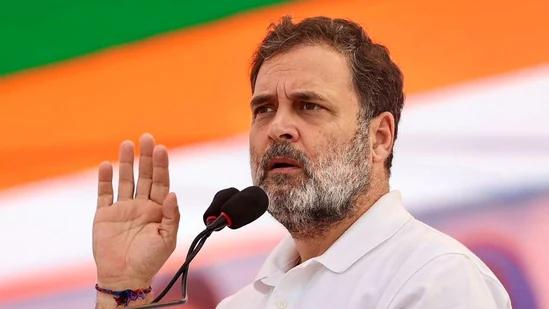
When Rahul Gandhi took the stage in Bihar’s Kutumba on November 4, 2025, he wasn’t speaking as a reformer addressing India’s economic or governance challenges. He was playing the part of a political provocateur, wielding caste as both shield and sword. His claim that “10 per cent of the country’s population controls the judiciary, bureaucracy, business and even the Army” was not merely a factual exaggeration; it was a deliberate act of fear-mongering. Gandhi’s remarks, aimed squarely at fuelling caste divisions ahead of Bihar’s Assembly elections, were less about social justice and more about electoral arithmetic.

Gandhi’s speech painted India in stark binaries: a privileged 10 per cent allegedly lording over the remaining 90 per cent, who he claimed were Dalits, Mahadalits, backward castes, tribals and minorities. He declared that the “most backwards” form the overwhelming majority of India, yet remain invisible in every sphere of power, from business boardrooms to army barracks.

“All the jobs go to them. They have control over the armed forces. You won’t find the remaining 90 per cent population represented anywhere,” he said. The phrasing was not accidental. It was calculated to incite resentment, to turn a complex social structure into a simplistic morality play where a small elite oppresses a vast underclass.

But politics built on grievance rather than governance eventually consumes itself. Gandhi’s claim was not backed by any credible data. There is no official caste-wise record of the Indian Army’s composition, nor any basis to assert that the judiciary or private industry is monopolised by a particular caste bloc. The Indian judiciary, for instance, currently has Justice B.R. Gavai, himself from a Scheduled Caste background, serving as Chief Justice of India. To say that Dalits or backward classes “have no representation” when the nation’s top judge comes from a marginalised community is not just inaccurate; it’s willfully misleading. It reveals not ignorance, but a conscious choice to twist reality for rhetorical effect.

Dragging the Indian Army into caste politics

More disturbingly, by dragging the Indian Armed Forces into this caste narrative, Gandhi crossed a line that even his political opponents have seldom breached. The Indian Army is one of the few institutions that has, for decades, stood as a model of unity beyond caste, religion, or region. Soldiers share rations and risk lives for each other, bound by uniform and duty towards protecting nation, not by social hierarchy. To insinuate that the Armed Forces is somehow “controlled” by a particular caste elite is to plant seeds of distrust where none existed. It undermines morale, disrespects service, and insults the very ethos of “Nation First” that defines our forces.

This isn’t the first time Rahul Gandhi has made such reckless remarks about the military. Only months ago, during his Bharat Jodo Yatra, he alleged that Chinese troops were “thrashing Indian soldiers in Arunachal Pradesh”, a statement that drew a stern rebuke from the Supreme Court. A bench led by Justice Dipankar Datta had then remarked, “If you are a true Indian, you would not say all this.” Clearly, the reprimand failed to instil any restraint. Gandhi’s latest comments are merely a continuation of that pattern: denigrating national institutions to serve a transient political narrative.

The deeper question, however, is why Rahul Gandhi persists with this divisive rhetoric. Bihar, with its entrenched caste-based voting patterns, offers a tempting laboratory for his experiment. The Congress, having lost its traditional appeal among upper castes and struggling to reclaim relevance in the Hindi heartland, has found in “caste consciousness” a convenient substitute for ideology. By amplifying the “90 per cent versus 10 per cent” narrative, Gandhi hopes to mobilise Dalits, Extremely Backward Castes, and minorities under the Congress umbrella. It is the politics of arithmetic masquerading as the politics of social justice. But it is likely to end up being a colossal failure, much like Mr Gandhi’s political journey thus far.

Undermining institutions, dividing India to reverse political fortunes

Nevertheless, the problem is that such politics corrodes the moral core of leadership. A genuine reformer would use data, policy and dialogue to address underrepresentation. He would advocate education reforms, targeted economic support, and inclusion programmes that uplift marginalised communities. Instead, Rahul Gandhi opts for a language of resentment. His words are not a call for reform, they are a declaration of division. In one sweeping generalisation, he has branded entire institutions as casteist and delegitimised the competence of thousands who have risen through merit, sacrifice, and service.

Ironically, this is the same leader whose party’s government in Karnataka has failed to make its own caste survey public. For all his fiery demands of a nationwide caste census, Gandhi’s own state units cannot demonstrate transparency or follow-through. It exposes the hollowness of his advocacy. When data doesn’t align with the narrative, Congress simply abandons the data. What remains is rhetoric. Loud, emotive, and manipulative.

The contradictions don’t end there. Rahul Gandhi’s lament about the “underrepresentation” of Dalits and backward castes in industry ignores the vast network of welfare schemes, reservations, and educational reforms that have been systematically implemented over decades, many of which were either initiated or supported by the same Congress governments he now accuses of perpetuating elitism. In fact, it is a scathing indictment of the reservations system, implemented under his party’s government after India became independent. Is he suggesting that reservations system has that his party leaders fleshed out hadn’t benefitted the marginalized community at all?

His father, grandmother, and great-grandfather presided over decades of Congress rule. If indeed only “10 per cent” control India, it happened under their watch. In effect, Rahul Gandhi’s speech was an indictment of his own political lineage. If one were to come at this conclusion, it is not the upper caste groups, but incompetent Congress leaders who should be held accountable for coming up with a system that has failed in its core objective: bringing equality and ensuring social justice.

Yet he appears unbothered by irony or accountability. His obsession with polarising narratives has become his only tool for political relevance. Bereft of economic ideas, administrative vision, or coherent ideology, he defaults to divisive themes where caste, religion, class, language are each wielded selectively depending on the state he’s addressing. In Kerala, he plays the secular progressive; in Karnataka, the OBC crusader; in Bihar, the caste warrior. The shape of his politics changes, but its essence remains the same: pit one group against another, and hope to reap electoral dividends from the chaos.

Sow social distrust and reap political dividends

What makes his latest attack particularly dangerous is that it normalises distrust in institutions. When a leading opposition figure tells citizens that the judiciary, the Army, and business are all “captured” by a privileged few, he is not just criticising the government; he is delegitimising the Republic itself. It erodes faith in the very systems that keep India stable and functioning. If people begin to believe that justice, defence, and governance are all caste conspiracies, what remains of national unity?

The caste faultlines Gandhi seeks to exploit are real, but they are not insurmountable. India’s trajectory since Independence has been one of slow but undeniable upward mobility across social categories. Educational institutions, public service commissions, and affirmative action policies have opened doors that were once sealed. Yet, progress does not make for good soundbites. For Gandhi, it’s easier to deny progress entirely, to declare that “90 per cent” are invisible and oppressed. That narrative may earn applause at a rally, but it insults the millions of Indians from humble backgrounds who have risen through hard work, education, and perseverance.

It is also telling that Gandhi’s idea of empowerment seems to rely entirely on victimhood. He speaks not of ambition or innovation, but of exclusion. He tells communities that they are not represented, that they are helpless, that the system is stacked against them. Such rhetoric breeds fatalism, not empowerment. A truly transformative politics would inspire people to transcend barriers, not wallow in them. But Gandhi’s speeches seem crafted to cultivate grievance rather than grit.

The Congress once prided itself as a party of national unity of bringing diverse strands of Indian society together under a common banner of nation-building. That vision has long since faded. Today’s Congress, under Rahul Gandhi’s stewardship, is a party that survives on identity politics, on fragmenting the social fabric into electorally convenient pieces. His “10 per cent vs 90 per cent” theory is not just a political argument; it’s a moral regression. It replaces aspiration with envy, solidarity with suspicion, and merit with group victimhood.

If the Congress were genuinely committed to increasing representation, it could have proposed data-backed reforms, perhaps an institutional audit, scholarship expansions, or training pipelines for marginalised candidates in civil services and judiciary. It could have offered constructive criticism of existing systems and suggested policy solutions. Instead, what we witnessed in Bihar was a speech crafted to inflame, not inform. It was theatre, not statesmanship.

Rahul Gandhi’s constant descent into divisive populism also reflects his deeper insecurity. Having failed to present himself as a credible alternative to PM Modi on matters of governance, economy, or foreign policy, he now seeks to become the voice of “the excluded”. But this voice lacks conviction and evidence. When a politician who comes from the country’s most elite political dynasty speaks of “10 per cent controlling everything,” it reeks of hypocrisy. Gandhi himself is the embodiment of privilege, a product of dynastic politics, not social struggle. To see him brand others as “elite” is almost comical.

Desperate for relevance, Rahul Gandhi turns caste into a weapon of political survival

Ultimately, Rahul Gandhi’s November 4 speech in Bihar is symptomatic of a larger malaise within the Congress ecosystem, a complete disconnect from ground reality. Instead of addressing issues like infrastructure, education, or job creation, Gandhi’s politics thrives on emotional manipulation. His call for an India where “90 per cent live with dignity” sounds noble until one realises he’s constructing that dignity atop falsehoods and insinuations.

In a country as complex as India, leadership demands responsibility. It requires empathy tempered by evidence, and criticism grounded in facts. Rahul Gandhi’s words fail this test on all counts. His “10 per cent” remark is not just misleading; it is corrosive. It insults the institutions that protect our democracy and denigrates the people who serve within them. Worse, it seeks to turn fellow Indians against one another on the basis of caste identity, a weapon as old as politics itself, and just as destructive.

Rahul Gandhi’s latest outburst should therefore be seen for what it is: not an act of courage, but of desperation. Unable to inspire confidence through vision, he resorts to sowing doubt through division. In doing so, he risks undoing decades of social progress achieved through dialogue, reform, and representation. His politics may win applause from a partisan crowd, but it does disservice to the idea of India as one nation bound by shared destiny.

For a man who claims to be “uniting India” through his travels and rhetoric, Rahul Gandhi seems alarmingly eager to divide it whenever elections approach. The “10 per cent versus 90 per cent” speech was not a gaffe; it was a glimpse into his political instinct. And that instinct, sadly, is not to heal India’s wounds, but to reopen them for votes.

Gujarat Farmer Relief: AAP accused of ‘Propaganda’ and ‘Creating Noise’ as State Government conducts crop damage surveys

In Gujarat, Aam Aadmi Party (AAP) leaders are holding daily press conferences, blaming the state government for ignoring farmers’ problems. They are asking why the relief package hasn’t been announced yet and are demanding quick results.

Poet Dushyant Kumar once said “सिर्फ हंगामा खड़ा करना मेरा मकसद नहीं, मेरी कोशिश है कि ये सूरत बदलनी चाहिए।” which trabslates to “creating chaos is not my goal, but to change things for the better“. Looking at AAP’s politics in Gujarat today, it seems the party’s goal is only to create noise. Instead of working for real outcomes.

AAP’s mixed history in Gujarat

Over the years, AAP has tried hard to gain a place in Gujarat politics. In the 2022 Assembly elections, the party made a big push but could win only five seats. Even those victories were more about individual candidates than the party’s strength. After that, the organisation has hardly been active. It has not made much impact in local or national polls. Now, with only two years left for the next Assembly election, the party seems to be trying again with a slightly changed strategy.

AAP seems to be running politics based on community targets. The Patidar community has always played a strong role in Gujarat’s elections. Farmers, too, are an influential group. Recently, AAP raised a big issue of “kad-da pratha” in the Botad APMC and organised what it called a “Kisan Mahapanchayat.” The event turned violent, and some AAP leaders ended up in jail. Many people who joined the protest are now seeking bail. Even when unseasonal rains hit Gujarat, the party turned it into another opportunity to target the government.

More focus on politics than solutions

AAP leaders often project themselves as the protectors of farmers, but they rarely talk about real solutions. Their actions clearly show that the goal is to turn farmers’ issues into political points. The reality of these problems and finding long-term answers don’t seem to interest them much.

The government’s ongoing survey on crop damage

At the end of October, several parts of Gujarat were hit by unseasonal rain and cyclone effects. Many farmers suffered heavy crop losses. Such situations have occurred before, and previous governments also took the necessary steps each time, since it’s the government’s duty to do so.

After such events, the process of paying compensation to farmers begins only after surveys are done. These surveys take time because Gujarat has 34 districts and thousands of villages. It’s not something that can be done overnight.

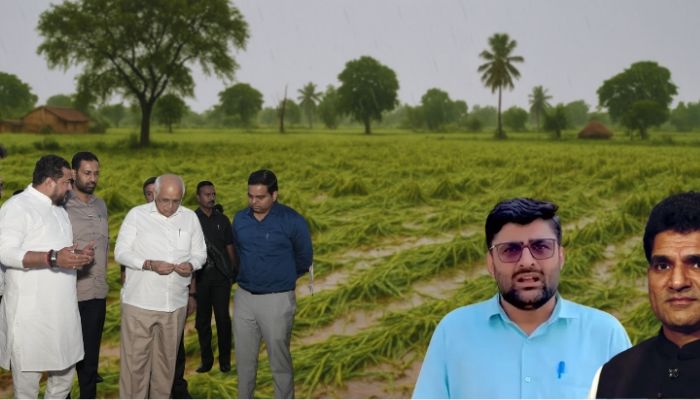
Right now, the survey is happening across the state. Ministers are visiting affected areas. Even Chief Minister Bhupendra Patel has personally gone to some villages to review the damage. The government has said that once the survey and reports are complete, it will announce a relief package for farmers without delay.

The state government has ordered surveys across all districts. Ministers in charge of each district are supervising them. Officials are visiting villages, working with sarpanchs and local leaders to assess the losses. Once all reports reach the government, the cabinet will decide the relief amount and how to deliver it to farmers.  

AAP’s propaganda and misinformation

Meanwhile, AAP continues to hold press meets every day. They twist facts to show that the government is idle. They claim that without AAP’s pressure, farmers’ voices would go unheard. But even before AAP came into existence in Gujarat, surveys and relief packages were regularly done after crop loss.

AAP keeps demanding instant relief. But if the government had declared a package without a survey, these same leaders would have accused it of acting carelessly without understanding the ground reality.

AAP MLA from Visavadar, Gopal Italia, recently said that industrialists’ loans worth 16 lakh crore rupees were forgiven without surveys, but for farmers, surveys are required. The fact, however, is that these loans were not waived off; they were only written off. That means banks do not expect early repayment and remove the amount from profit-loss calculations. They can still recover the money through legal steps. The Finance Minister’s statement in Parliament had made this clear, but Gopal Italia left out that part since it didn’t suit his story.

AAP supporters and YouTube content creators recently tried another trick. When Gandevi MLA and minister Naresh Patel visited a damaged field, he said, “The crops smell so bad,” showing sympathy toward the farmers’ pain. But some self-proclaimed journalists cut the video, twisted it, and circulated it as if the minister was insulting farmers. Gopal Italia then made another video on the same, and AAP propaganda pages spread it widely.

The pattern is clear

All this clearly shows that AAP is trying hard to prove that it alone cares for farmers and that others are indifferent. In reality, the government is still in the middle of the survey process, which naturally takes time. AAP leaders, with little other work at hand, are simply busy holding press conferences and making noise.

It won’t be surprising if, on the day the government announces the relief package, the same leaders rush to take the credit. You can almost be sure of that.

(This report was originally written in Gujarati. Click this link to read it.)

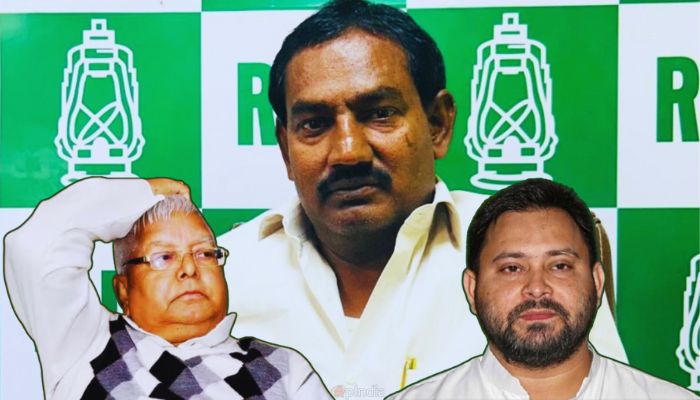
Meet Ritlal Yadav: Jailed RJD candidate with over 40 criminal cases for whom Lalu Yadav conducted roadshow in Bihar

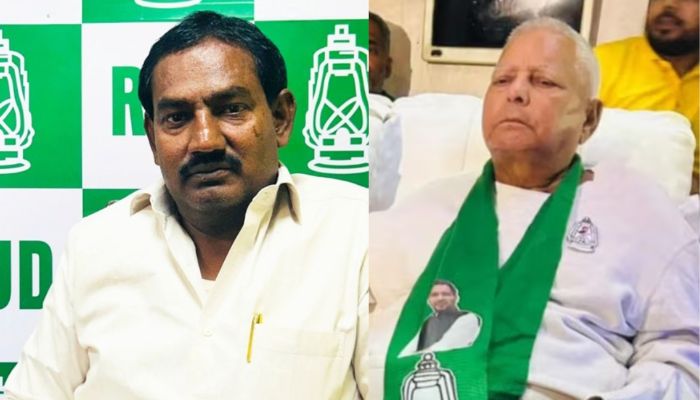
On 3rd November 2025, Rashtriya Janata Dal supremo Lalu Yadav held a roadshow in the Danapur constituency in Bihar for his party’s MLA candidate, Ritlal Rai alias Ritlal Yadav. The RJD candidate is currently lodged in Bhagalpur jail. The out-on-bail RJD patriarch began his roadshow from Digha and ended it in Khagaul, covering 15 kilometres.

Lalu Yadav was accompanied by his daughter Misa Bharti. In an apparent bid to garner sympathy for Ritlal Yadav, the RJD candidate’s daughter also joined the roadshow. She has also been interacting with the media and seeking votes for her jailed father.

Ritlal Yadav contesting the Danapur assembly seat from jail: From don to politician

Ritlal Yadav, also spelt Ritlal Ray or Rit Lal Roy, has been incarcerated in Bhagalpur Jail since April 2025. Yadav is accused of demanding Rs 50 lakh and threatening a builder named Kumar Gaurav. An FIR was registered against Ritlal Yadav at the Khagaul Police Station. On 17th April 2025, Ritlal surrendered before the police and was sent to Beur Jail in Patna. Later, he was moved to Bhagalpur’s special central jail. In October, the RJD MLA came out in police custody to file his nomination from the Danapur constituency.

His arrest came days after Police Police, after a court order, conducted simultaneous raids at 11 of his locations linked to Ritlal Yadav. The police recovered lakhs of rupees in cash and blank checks worth Rs 77.5 lakh. During the multi-location raid, the police also confiscated Police around Rs 11 lakh in cash, a note-counting machine, three guns, old stamp papers, land-related documents, and blank checks from Ritlal Yadav’s residence.

The incarcerated RJD leader, for whom Lalu Yadav himself came out to seek votes, also has a case registered against him for allegedly killing BJP leader Satyanarayan Sinha in the Khagaul area during one of RJD’s rallies in 2005. The RJD candidate is booked in over 40 criminal cases, with charges including murder, extortion, rioting and criminal intimidation.

Lalu Yadav’s roadshow to garner support for Ritlal Yadav’s candidacy came after the Patna High Court denied Ritlal’s plea for temporary release to campaign in the assembly elections on 31st October 2025.

RJD patriarch Lalu Yadav’s roadshow in support of Ritlal Yadav comes across as a well-planned strategic move, as Ritlal’s victory will play a crucial role in paving the way for Misa Bharti’s political future. The Danapur assembly constituency is part of Misa Bharti’s Pataliputra Lok Sabha constituency, where she defeated Lalu’s son-in-law, Ramkripal Yadav, who has now joined the Bhartiya Janata Party (BJP).

The Yadav voters constitute approximately 22% of Danapur voters, followed by approximately 20% Forward Classes, approximately 15% Dalits, 20-25% EBCs, and 6-8% Muslims. Yadav’s vote seemed divided in Danpur as both BJP’s Ramkripal Yadav and RJD’s Ritlal Yadav enjoy support among their caste group. Lalu Yadav, who began his politics on Yadav caste supremacist politics and gave ‘Bhoora Baal Saaf Karo’, wanted to consolidate the Yadav votebank behind Ritlal Yadav.

Recently, Ritlal Yadav’s wife, Rinku Devi, came under investigation for campaigning for her husband even though she is a government school headmaster in Patna. Despite being a government servant, Rinku Devi was allegedly doing election campaigning for Ritlal Yadav during school hours.

Earlier in July 2025, authorities launched a probe against Rinku Devi for allegedly holding a partnership in a construction company in violation of service rules, as she is a government employee.

Hailing from the dominant Yadav caste background, which aligns with RJD’s core voter base and caste supremacist politics, Ritlal Yadav navigated his way to power after rising as a strongman/Bahubali in Patna’s Danapur. Despite his criminal antecedents, the 53-year-old RJD leader enjoys influence in Patna’s rural and semi-rural pockets, especially Danapur. This constituency has been politically volatile and has a history of caste-based as well as muscle-power-driven elections.

Ritlal Yadav’s journey began as a local don in the early 2000s during Lalu Yadav’s “Tel Pilavan, Lathi Ghumavan” rally. It was during this rally in July 2003 that BJP leader Satyanarayan Sinha, who unsuccessfully contested the Danapur bypolls that year, was killed near Jamauddin Chak on the Khagaul-Bihta Road.

Ritlal leveraged his Yadav caste and alleged control over lucrative resources like sand mining and land in Patna. Ritlal Yadav earned notoriety by clashing with BJP leaders and is accused of BJP MLA Satyanarayan Sinha.

Yadav surrendered before the 2010 assembly elections. Ritlal Yadav contested the election from jail as an independent candidate and lost. During the 2020 Bihar elections, Yadav was released from jail after a year and contested the election from Danapur on an RJD ticket. He registered a decisive victory over the BJP candidate. This win boosted RJD’s confidence in the ‘Bahubali’ strategy for reclaiming strongholds.

Although Ritlal Yadav was recently granted bail in the murder case of BJP leader Satyanarayan Sinha, he returned to jail in the extortion case and filed his nomination while in police custody.

According to his election affidavit, Ritlal Yadav owns assets worth Rs 13 crore. He is a 12th pass and faces multiple cases with charges ranging from criminal intimidation, extortion, dacoity-related sections, abetting or conspiring organised crime syndicates, murder, and undue influence in elections, among others.

In his affidavit, Ritlal Yadav has declared 11 pending criminal cases filed against him involving violations of laws pertaining to the Arms Act and the Money Laundering Act, among others.

Ritlal’s name has been linked to several other serious allegations, including the murder of railway contractors on a moving train in Bakhtiyarpur, the murder of his rival Chunnu Singh on the occasion of Chhath, land grabbing and illegal sand mining.

Back in 2023, Ritlal Yadav issued a controversial statement regarding the Ramcharitmanas. He claimed that the Hindu holy text was written in a mosque. He also accused the Bharatiya Janata Party of creating a rift in society in the name of Hindutva, saying that Hindutva wasn’t in danger back when the Mughals ruled over India for such a long duration

The don-turned-politician also has a knack for theatrics, and during a court appearance in July this year, Ritlal Yadav appealed for “euthanasia”, alleging that he faces threats from ‘powerful forces’. This sympathy-garnering tactic is also being employed by his family, who claim that the police are somehow threatening them against seeking votes.

The Lalu family has long been shielding and fostering criminals for political gains. From Shahabuddin and Taslimuddin to Rajballabh Yadav and now Ritlal Yadav, the RJD continues its trademark politics of playing caste, violence and Bahubalis.

OpIndia Exclusive: Modi govt spent over Rs 630 crore to modernise the police force in Naxal-affected states. Read full RTI details

In a reply to an RTI filed by OpIndia, the Ministry of Home Affairs’ Left-Wing Extremism (LWE) Division revealed that funds worth over Rs 630 crore have been released to Naxal-affected states under the Special Infrastructure Scheme (SIS). The scheme is a key component of the Umbrella Scheme for Modernisation of Police Force (MPF).

This RTI reply has added a crucial layer to the picture that emerged from a previous revelation where MHA data showed thousands of Naxals surrendered or neutralised, and record anti-LWE operations since May 2014, when Prime Minister Narendra Modi took charge of office for his first term.

Together, the two replies illustrate how the Modi government’s strategy combined ground-level offensives with systematic modernisation of the state police apparatus.

What the RTI reply says

In its reply, the MHA said, “Under the umbrella scheme of ‘Modernization of Police Forces’, the state-wise and year-wise fund released to the LWE-affected states under Special Infrastructure Scheme (SIS) is enclosed as per Annexure ‘A’. The funds are released to the States after completion of approved projects and submission of the Bills to MHA, on a reimbursement basis. There is no concept of submission of Utilization Certificate by the States under the SIS scheme.”

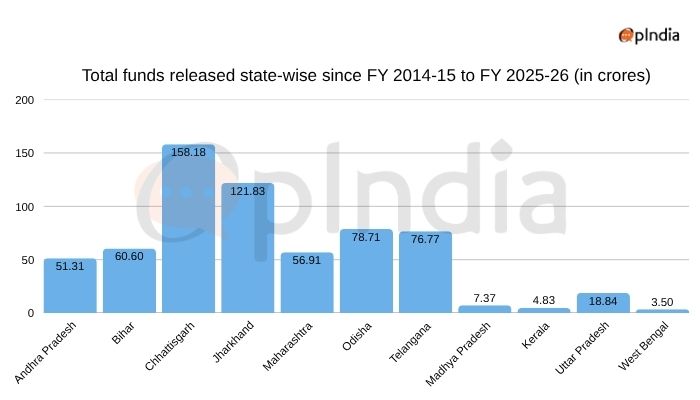
State-wise funds released under SIS (Source: Ministry of Home Affairs, LWE Division)

The details have been provided for ten states, including the most affected states such as Chhattisgarh, Jharkhand, Odisha, Bihar, Telangana, Andhra Pradesh, Maharashtra and West Bengal.

Chhattisgarh, Jharkhand among top beneficiaries

The data show that the bulk of allocations went to Chhattisgarh (Rs 158.18 crore) and Jharkhand (Rs 121.83). These two states have historically witnessed the highest Naxal activity. The funding pattern mirrors the intensity of operations on the ground, where these states also recorded the highest numbers of surrenders and encounters.

The consistent funding shows how central assistance has been used to strengthen Special Task Forces, training facilities, and communication networks in remote LWE-affected districts, improving coordination between central and state security agencies.

Funds linked to project completion and reimbursement

The Ministry of Home Affairs has clarified that the funds under SIS are released only after the states complete approved projects and submit bills for reimbursement. This ensures accountability and implementation-based release rather than upfront disbursement.

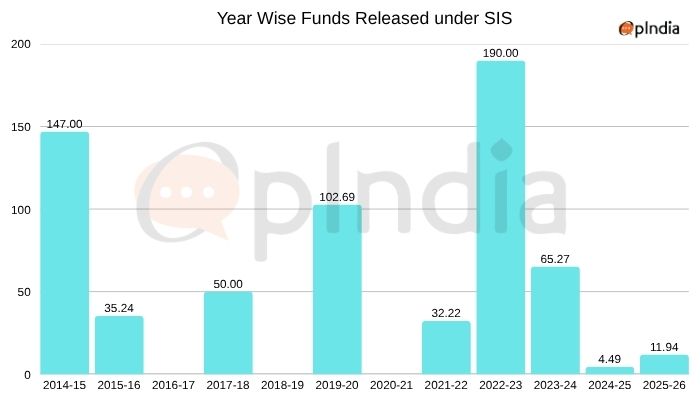
Year-wise total funds released by MHA under SIS. (Source: Ministry of Home Affairs, LWE Division)

The MHA also confirmed that no Utilisation Certificates are required under the SIS scheme, as funds are sanctioned post-verification of project completion. This model enables faster execution and avoids bureaucratic delays that often plague centrally sponsored schemes.

The Special Infrastructure Scheme explained

The Special Infrastructure Scheme (SIS) is designed to strengthen critical police and operational infrastructure in LWE-affected states. It covers modern weapons, fortified police stations, mobility, communication equipment, and specialised training for anti-Naxal operations.

According to information provided by the MHA in the Lok Sabha, SIS is implemented on a fund-sharing basis, out of which 60% is paid by the Central Government and 40% by the State Government. This scheme is being implemented as a sub-scheme of the Umbrella Scheme ‘Modernization of Police Forces’.

While the data on released funds show that a total of Rs 638.85 crore has been released, the MHA’s website clarifies that projects and works worth Rs 1,741 crore have been sanctioned. The sanctioned works include 306 fortified police stations, of which 210 have been constructed.

The information is in sync with the fact that SIS payments are released only after completion of the approved project. The SIS has been a key pillar in improving state preparedness against Naxal attacks, particularly in deep-forest and high-risk zones.

A decades-long war nearing its conclusion

Union Home Minister Amit Shah has, on several occasions, asserted that the menace of Naxalism will be completely eradicated by March 2026 under Operation Kagar. The RTI data accessed by OpIndia, from surrenders to sustained modernisation funding, clearly indicates that the government is progressing rapidly towards achieving that goal. Notably, HM Shah categorically denied requests for ceasefire and talks, pushing for either surrender or encounter of the LWEs, which has left virtually no room for Naxals to continue their armed movement.

Music is haram in Islam and now so in Bangladesh: Read how Yunus govt is pandering to radicals by scrapping recruitment of music teachers

The Yunus regime is not leaving any stone unturned to throw Bangladesh into the jaws of radical Islamism. A country, which once boasted of the songs of Kazi Nazrul Islam and Rabindranath Tagore, has now stopped the recruitment of music teachers.

The interim government headed by Muhammad Yunus has scapped the posts of assistant teachers for music and physical education in primary schools. The decision was confirmed by a gazette notification on Monday (3rd November).

Yunus has effectively amended the Government Primary School Teacher Recruitment Rules of 2025 and removed the positions for music teachers.

In a statement, additional secretary Masud Akhtar Khan stated, “Although the rules issued last August had four categories of posts, two categories have been included in the amendment. The posts of assistant teachers for music and physical education are not in the new rules.”

Mullahs up-in-arms against music

It must be mentioned that radical Islamist outfits in Bangladesh had been campaigning for the recruitment of Islamic scholars instead of music teachers.

Bangladesh Jamaat-e-Islami leader Mia Golam Parwar had lashed out at the decision to recruit music and dance teachers. He dubbed it ‘completely unacceptable’ and ‘suicidal move for the nation’.

Another Jamaat leader Mujibur Rahman called for recruitment of Mullahs in schools to teach ‘religion’ based on Dawra-e-Hadith degrees and Fazil degrees from madrassas.

Later, other radical outfits such Islami Andolon Bangladesh (IAB) and Khelafat Majlish conducted seminars denouncing music in schools as promoting ‘atheism’, making next generation ‘faithless’. 

IAB’s Ameer Syed Rezaul Karim threatened to unleash chaos on the streets if Islamic scholars were not appointed as teachers.

Bangladesh Khelafat Majlish leader Maulana Jalal Uddin Ahmad claimed that absence of ‘Deeni Taleem’ in Bangladeshi schools was ‘shameful’ despite being a Muslim-majority country.

Yunus, who has a history of appeasing Islamists, gave in to their demands and sidelined music education and cultural inclusion in primary schools of Bangladesh.

Music is Haram in Islam

Music is considered Haram (prohibited) in Islam based on the sayings of the Prophet Muhammad (Hadiths) and certain Quranic verses.

Surah Al-Isra, Verse 64:

[In this verse, Allah warns Satan:] “And incite [to senselessness] whoever you can among them with your voice (bisawtika), and assault them with your cavalry and your infantry, and be a partner with them in wealth and children, and promise them. But Satan does not promise them except delusion.”

Surah An-Najm, Verses 59-61:

“Then at this statement do you wonder? And you laugh and do not weep, While you are engaged in vain amusement/ saamidoon (polytheists’ practice of singing, playing instruments, and making noise)?”

Sahih al-Bukhari:

The Prophet Muhammad said: “From among my followers there will be some people who will consider illegal sexual intercourse, the wearing of silk, the drinking of alcoholic drinks and the use of musical instruments (ma’aazif), as lawful.”

Sunan Ibn Maajah:

The Prophet said: “A people of my Ummah will drink wine, calling it by other than its real name. Merriment will be made for them through the playing of musical instruments and the singing of female singers. Allah will cleave the earth under them and turn others into apes and swine.”

Abdullah ibn Mas’ud (Companion of Prophet Muhammad):

“Singing germinates hypocrisy (nifaaq) in the heart just as water causes crops to grow.”

Muhammad Yunus and his appeasement of Islamic extremists

Bangladesh witnessed a drastic rise in Islamism after Yunus came to power. He first revoked the ban on the radical Islamist outfit ‘Jamaat-e-Islami.’

Thereafter, he released the leader of the radical outfit ‘Ansarullah Bangla Team (ABT)’ Muhammad Jasimuddin Rahmani.

At the same time, Muhammad Yunus downplayed the targeted attacks on the Hindu community by violent Muslim mobs. He has gone on record from lamenting about attacks on Hindus to saying that the claims of atrocities are ‘exaggerated‘.

In that way, the controversial US asset was able to placate Islamic extremists. Given that Awami Legaue was against Islamism, the interim government first banned its student wing ‘Chhatra League,’ and then the parent party.

Under the watch of Muhammad Yunus, Bangladesh saw a drastic rise in vigilante Muslim mobs, which unleashed violence under the pretext of protecting the tenets of Islam.

These mobs were largely unorganised and called themselves ‘Tawhidi Janata (meaning Revolutionary People).’ They came under the spotlight over acts of vandalism and harassment of people.

The Yunus regime introduced new textbooks for primary and secondary students, which falsely claimed that the first declaration of independence of Bangladesh was made by Ziaur Rehman (a favourite icon of Muslim hardliners in Bangladesh).

The interim government also appointed a Hizb ut-Tahrir terrorist named Mohammad Azaz as the administrator for the Dhaka North City Corporation (DNCC).

The situation had become so grim that Bangladeshi ambassador to Morocco Mohammad Harun Al Rashid was forced to slam the Muhammad Yunus-led interim government in a scathing Facebook post in March 2025.

Descent of Bangladesh into the darkness of Islamism

In July this year, the ‘Bangladesh Bank’ gave a Talibani farman (diktat) barring female employees from wearing ‘short dresses’, ‘short sleeves’ and ‘leggings’. The directive by the Central Bank of Bangladesh also recommended that women wear headscarves and hijab.

‘Bangladesh Bank’ also warned of disciplinary actions against employees who refuse to adhere to the new guidelines. The outrageous directive has drawn flak from women groups.

Fauzia Moslem, who serves as the President of the Bangladesh Mahila Parishad pointed out, “I’ve never seen such a directive before. But considering everything happening now, it’s not hard to guess why this guideline was introduced. A certain cultural sphere is being shaped, and this directive reflects that effort.”

This diktat by ‘Bangladesh Bank’ bore an uncanny resemblance to the orders by the Taliban regime in Afghanistan, restricting women from wearing clothes of their choice. Islamists had previously unleashed havoc on university teachers in Bangladesh by labelling them as ‘anti-hijab.’ 

In July 2025, an Islamic outfit named ‘Jamaat-Char Monai’ announced its plans to turn Bangladesh into a Sharia-compliant nation like Afghanistan. It also vowed to follow the model implemented by the Taliban regime.

The organisation’s leader Mufti Syed Muhammad Faizul Karim declared, “If govt is formed by winning the national election, the Islamic Movement Bangladesh will introduce Sharia law in the country.”

In April this year, Muslims belonging to the radical outfit ‘Hefazat-e-Islam’ hung the effigy of a woman, stripped and defiled it with shoes to demand the abolishment of the Women Affairs Reform Commission in Bangladesh.

The incident occurred at the campus of the University of Dhaka near the iconic ‘Anti Terrorism Raju Memorial’ sculpture. In a deleted video shared by Khoborer Kagoj, Muslims were seen assaulting an effigy of a woman, defiling and kicking it and thrashing it with shoes to display their angst. The effigy of the woman was draped in a saree (the kind that Hindu women wear) with its hands tied behind.

In March 2025, a librarian at Dhaka University, identified as Asif Sardar Arnab, sexually harassed a female student. Although he was initially arrested, Asif was quickly released on bail.

He was cheered and greeted with garlands by a radical Muslim mob, aligned with his behaviour. In the meantime, the victim had been subjected to violent threats for speaking out against the accused.

Asif sexually harassed the female student, claiming that her dress did not ‘sufficiently cover’ her breasts. His action was praised by Muslims for enforcing Islamic morality.

Screengrab of the report

In January this year, a Muslim mob laid siege to the Tilakpur High School in Joypurhat district of Bangladesh. The extremists, comprising madrassa students, carried out vandalism to protest against a friendly football match between two women’s teams.

The match was scheduled to take place on 29th January at the playground of the Tilakpur High School between the Joypurhat and Rangpur women’s football teams.

In visuals that have surfaced on social media, the Muslim mob could be seen vandalising the tin fence of the school. Prior to carrying out the attack, they gathered outside the Tilakpur railway station and gave provocative speeches.

Muslims carry out vandalism, destroy tin fence of Tilakpur High School

The mob demanded the cancellation of the women’s football match, alleging non-observance of purdah. Thereafter, the extremists made their way to the Tilakpur High School and unleashed mayhem.

A radical Muslim declared, “I want to warn those who want to earn money by exposing our women. Be careful. Stop all women’s games in the future. If you don’t stop, then we will show our resistance.”

OpIndia had previously reported on the alarming rise of rape cases in Bangladesh under the watch of Muhammad Yunus. In the meantime, Islamists who committed heinous crimes against women were freed by the top court of the country.

Ahead of Bihar elections, Lalu Prasad Yadav campaigns for party leader jailed in extortion case: A reminder of his long record of backing criminals

With each passing day, the Rashtriya Janata Dal (RJD) is making it clear that its agenda for the coming Bihar state assembly election is to bring back the wretched “Jungle Raj” era of the 1990s. After using songs glorifying guns, kidnappings and ‘Yadav’ supremacy, and re-mainstreaming the genocidal ‘Bhura Baal Saaf Karo’ slogan, RJD supremo Lalu Prasad Yadav is campaigning for his party’s jailed leader Ritlal Rai alias Ritlal Yadav.

On 3rd November 2025, Lalu Yadav held a roadshow in the Danapur constituency for his party MLA candidate, Ritlal Yadav, who is currently lodged in Bhagalpur jail. Starting from Digha and ending in Khagaul, the roadshow covered 15 kilometres. Lalu Yadav was accompanied by his daughter Misa Bharti and Ritlal Yadav’s daughter.

Notably, Ritlal Yadav is accused of demanding Rs 50 lakh and threatening a builder named Kumar Gaurav. An FIR was registered against Ritlal Yadav at the Khagaul Police Station. On 17th April 2025, Ritlal surrendered before the police and was sent to Beur Jail in Patna. Later, he was moved to Bhagalpur’s special central jail.

Ritlal Yadav, whom Lalu Yadav wants to be voted by the people of Danapur to serve them, also has a case registered against him for allegedly killing BJP leader Satyanarayan Sinha in the Khagaul area during one of RJD’s rallies in 2005. The RJD candidate is booked in over 40 criminal cases, with charges including murder, extortion, rioting and criminal intimidation.

RJD leader and former deputy Chief Minister of Bihar, Tejashwi Yadav, also campaigned for Ritlal Yadav separately.

Many of the locals of Danapur say that they have been victims of Ritlal Yadav’s network and fear over what would happen if he wins the election. Some say that since Ritlal became the MLA, crime and snatching have increased.

Despite his criminal background and bad image, Ritlal Yadav enjoys great influence in the RJD and such is Lalu Yadav’s political compulsion to make a proper balance of caste dynamics since Danapur has a significant Yadav population, mollycoddling criminal strongmen and winnability that he has no qualms in not only giving ticket to a person with 40 criminal cases against him but also do roadshows for him with family.

Mohammad Shahabuddin then, Ritlal Yadav now: RJD’s playbook of backing vote-multiplier criminals

This, however, is not surprising given Lalu Yadav has built much of his political empire on the foundation that blends caste and crime. In fact, the higher the criminal records the better the prospect of getting ticket from the RJD.

Who can forget Mohammad Shahabuddin, the ‘Bahubali’ mafia from the Siwan constituency, who had over 40 criminal cases, including murder and kidnapping, against him. His crimes and terror did not deter Lalu Yadav’s steadfast support from the 1990s through the 2000s. Mohammad Shahabuddin was not only tolerated as a ‘Bahubali’ but the RJD also used him as their vote multiplier, who delivered the loyalty of his supporters, mobilised Muslim votes for Lalu’s party in exchange for impunity during the infamous ‘Jungle Raj’ when Lalu Yadav was the Chief Minister of Bihar.

Shahabuddin was a former member of the National Executive Committee of the Janata Dal and the Rashtriya Janata Dal. He was disqualified from contesting elections following his conviction for the kidnapping and disappearance of Chote Lal Gupta, an activist of the Communist Party of India (Marxist–Leninist) Liberation, for which he was serving a life sentence. He was also accused of killing 15 other Communist Party activists, including the former student leader Chandrashekhar Prasad.

RJD leader Mohammad Shahabuddin ran parallel government with impunity since he had the blessing of Lalu Yadav. He was resolving family and land conflicts through khap panchayats, setting the costs for medical consultations and mediating marital disagreements.

Shahabuddin kidnapped Girish and Satish, the two sons of Chandrakeshwar Prasad, also known as Chanda Babu, for refusing to pay extortion money and for refusing to hand over their land to Shahabuddin. They were then taken to Shahabuddin’s mansion in Pratappur, his village. The brutal orgy that unfolded there on August 16, 2004, shook the entire nation. The two brothers were doused with acid until they died in agony.

Chanda Babu’s third son, Rajiv Roshan, was a witness in this case, but he was also murdered on his way to court. An FIR was filed based on the complaint of Kalavati, the mother of the three sons. However, it took five years for Shahabuddin to be named as an accused in this case. Eventually, Shahabuddin and the other accused were sentenced to life imprisonment. The case went through the local court and the High Court and then reached the Supreme Court, where, within minutes, then-CJI Ranjan Gogoi dismissed Shahabuddin’s petition and upheld the verdict.

Back 2005, Shahabuddin’s home in Pratappur village was raided by the police, and the authorities recovered AK-47s as well as other military hardware that could only be obtained by the army, such as night-vision goggles and laser-guided guns. Shahabuddin’s connection with Pakistan’s intelligence agency, ISI, also emerged as several of the weapons had the marks of Pakistani ordnance companies. The police also accused him of having links with underworld don Dawood Ibrahim and Pakistan-backed Kashmiri Islamic terrorists.

However, Shahabuddin was not the only ‘Bahubali’ the RJD backed. Mohammad Taslimuddin also ran his fiefdom with impunity in the Lalu Raj. Taslimuddin also served as a union minister both under HD Deve Gowda and Manmohan Singh’s governments. Mohammad Taslimuddin, however, terrorised the local authorities, ostensibly taking up issues of the oppressed, until they finally attached his land in Araria.

Taslimuddin had over sixteen cases of rape, dacoity, arson, and robbery filed against him. At least sixteen cases of rape, dacoity, arson, and robbery were submitted against him. An eyewitness disclosed that the MP and two associates brought a young Santhali girl home, drank wine and “then did the wrong things with the girl all night” in one of the unlawful detention files filed under Indian Penal Code 342. He was booked on charges of cheating, forgery, criminal conspiracy (IPC 419, 420, 467, 468, 471 and 120-b), rape and dacoity.

Rabri Devi, who once succeeded her husband Lalu Yadav as Bihar’s Chief Minister, backed her party’s rape-accused MLA Rajballah Yadav. In  2018, a special court in Patna pronounced Rajballabh Yadav and five others guilty of luring and raping a 15-year-old girl in February 2016. The politician was convicted under various sections of the Indian Penal Code and the Protection of Children from Sexual Offences (POCSO) Act.

The victim was forced to watch porn videos and raped. However, displaying peak shamelessness and support for even rapists, Rabri Devi defended Rajballah Yadav while campaigning for his wife, who was contesting from the Nawada Lok Sabha seat in the 2019 general election. She claimed, “The way Raj Ballabh ji has been convicted and he has been set up by those who wanted to spoil his name, thus Vibha Devi (Raj Ballabh’s wife) is the candidate, and we have to help her win. We have to make her win.”

He surrendered before the police, and after a brief hearing held in the Nalanda court, he was released on bond. RJD expelled the legislator after a major uproar to save itself from embarrassment; however, he immediately arrived at Lalu Prasad Yadav’s Patna home after bail to seek his counsel. Rajballabh Yadav never ceased to enjoy Lalu family’s support despite his criminal activities and conviction in a rape case.

Rajballabh Yadav was not the only rape accused individual the Lalu family backed. In fact, Rabri Devi’s brother Sadhu Yadav was also accused of involvement in the Shilpi-Gautam murder case. The Shilpi-Gautam murder case shook the Bihar government of the time. The case was finally closed as a double suicide, although many remain unconvinced with the investigation.

The 23-year-old Shilpi Jain and her alleged boyfriend Gautam Singh went missing on 2nd July 1999, and the next day their dead bodies were found in a semi-nude state inside a car in a parking near quarter number 12, Frazer Road, Patna. This quarter belonged to RJD leader Sadhu Yadav. The police investigation and handling of this case came under serious questioning. Even before the police could secure the crime scene, the supporters of the MLA reached the scene and created a ruckus.  The CBI asked for the DNA sample of an MLA, who refused to provide the sample. It is suspected that the politician was Sadhu Yadav.

Back in 1994, a Dalit Hindu girl who was sleeping with her mother in the residence under the Triveniganj police station area was visited by Yogendra Narayan Sardar. He abducted her in his car and gangraped her along with other accused.

The discussion around Lalu Yadav’s Jungle Raj and his constant backing of rapists and criminals is incomplete without mentioning the Champa Biswas rape case. One of Lalu Yadav’s close aides and son of Hemlat Yadav, the then chairperson of the Social Welfare Department, where IAS BB Biswas was also posted, Mrityunjay Kumar Yadav and his friends were accused by an IAS officer of raping his 30-year-old wife, Champa Biswas.  It was also alleged that the accused RJD leader also raped her mother, her sister-in-law, two maids and a niece. Champa was subjected to sexual assault multiple times.

Another of Lalu Yadav’s close aides convicted of rape was Yogendra Narayan Sardar, who was an MLA from the Janata Dal. Sardar’s conviction happened in 2020 in a 25-year-old Supaul gangrape case. A district court convicted former Janata Dal MLA Yogendra Narayan Sardar, his son Uma Sardar, Shambhu Singh and Bhupendra Yadav, also known as Bhupen Yadav of violating Sections 376 (rape), 366 (kidnapping), 458 (home trespass), and 324 (voluntary inflicting pain) of the India Penal Code and sentenced them to life in jail. While the lower court convicted Mrityunjay and his mother Hemlata, the High Court acquitted them as the witnesses on Champa’s side backtracked from their statements.

The relationship between criminals and the RJD has only grown stronger and extended to family as in the 2025 Bihar elections, Lalu Yadav’s heir-apparent, Tejashwi Yadav has fielded Osama Shahab, the son of Mohammad Shahabuddin from the Raghunathpur constituency.

Taking his criminal father’s legacy forward, Osama Shahab is accused of involvement in criminal activities. Osama was released from prison only last year, in 2024. The first case was registered regarding 42 kattha land in Chhapiya Buzurg, Hussainganj police station area. Subsequently, an FIR was filed against Osama in Motihari for firing at his brother-in-law over a land dispute. Meanwhile, in 2023, Osama was detained by traffic police in Kota, Rajasthan.

Then, the Hussainganj police arrived in Kota, arrested Osama, and brought him back. He was produced in court in the firing and land dispute cases filed against him. The court sent Osama to the divisional jail. A few days later, Osama was granted bail in the Hussainganj case. However, he remained in jail in the Motihari FIR. His bail plea in this case was rejected in the Motihari Civil Court, after which he was granted bail by the Patna High Court. Osama was finally released from jail in 2024 and is now contesting the election from Raghunathpur on RJD’s ticket.

Recently, a supporter of Osama Shahab, while speaking to OpIndi, said that if the boy who allegedly burnt an ‘I Love Muhammad’ poster was found, Osama Shahab would burn him alive. RJD leaders jumped in to defend Shahab and called him a ‘people’s leader’.

However, RJD and Lalu Yadav’s embrace and endorsement of criminals are not outliers but the norm. Not to forget, most of the RJD candidates in the 2025 Bihar elections carry pending criminal cases.

It is evident that the RJD wants to bring their Jungle Raj of the 1990s back in Bihar. Casteism, glorification of violence and kidnappings, to giving tickets to jailed and accused criminals, RJD has played all its Jungle Raj era cards for the coming elections. However, it is not shocking that Lalu Yadav, who himself was convicted by the court in the Fodder Scam and other corruption cases, is backing criminals.

During 15 -year RJD rule in 1990s and early 2000s, law enforcement collapsed, crimes became rampant, economy decayed, kidnappings for ransom became a thriving industry, mass murders, caste clashes became the new normal. Apparently, by supporting criminals, Lalu Yadav is telling the people of Bihar that his party wants to bring Jungle Raj era back in the state. It remains to be seen what choice the voters make in the coming elections.

Army Jawan stabbed to death by train attendant Juber Memon after heated argument over blanket request: FIR reveals chilling details

In a shocking late-night incident, an Indian Army jawan was fatally stabbed aboard the Jammu Tawi–Sabarmati Express (Train No. 19224) while the train was passing through Rajasthan’s Lunkaransar station in Bikaner district.

The accused, identified as train attendant Juber, allegedly attacked the soldier following a heated argument over a blanket request.

According to the First Information Report (FIR No. 0094/2025) lodged at the Government Railway Police (GRP) Station, Bikaner, the complaint was filed by Devkishan Saran, a Travelling Ticket Examiner (TTE) posted at Bikaner Headquarters. The incident took place around 11 p.m. on November 2, and the FIR was officially registered at 5:45 a.m. on November 3.

As stated in the FIR, TTE Devkishan was on duty on the Sabarmati Express between Bathinda and Bikaner, covering coaches SE-1, SE-2, S-1, S-2, and S-3. When the train departed Lunkaransar station, the pantry car manager, Shiv Kumar, rushed to him, reporting that a violent scuffle had broken out in coach S-2 between a passenger and an attendant from AC coach B-4. On reaching the spot, Devkishan found a man lying unconscious and bleeding heavily between seat numbers 9 and 14 of the sleeper coach.

The pantry car manager informed him that the injured passenger had been involved in a fight with the AC attendant named Juber. On checking the passenger’s ID, the TTE identified the victim as Jigar Kumar Chaudhary, a 27-year-old Indian Army jawan who was travelling from Firozpur Cantt in Punjab to Sabarmati in Gujarat. He was assigned seat number 12 in coach S-3. Devkishan immediately contacted the Commercial Control Office at Bikaner and requested the presence of RPF personnel and medical assistance at the next stop.

When the train reached Bikaner Junction around 1 a.m., the RPF, GRP officers, and a medical team were already waiting. A doctor examined Jigar and declared him dead on arrival, confirming that he had suffered fatal stab injuries to his chest and abdomen. His body was later shifted to Prince Bijay Singh Memorial (PBM) Hospital in Bikaner for post-mortem examination.

The GRP team, led by Inspector Anand Kumar, immediately launched an investigation. All AC coach staff were deboarded and interrogated. Based on witness statements and physical evidence, the police arrested AC attendant Juber under Section 103(1) of the Bharatiya Nyaya Sanhita (BNS), 2023, which pertains to the offence of murder. The police later recovered a blood-stained knife, believed to be the weapon used in the attack, from the train when it reached Merta Road station in Nagaur district early Monday morning.

FIR reveals how the incident unfolded

The FIR’s narrative suggests that the incident stemmed from a seemingly minor argument. Around 12:30 a.m., Jigar Kumar reportedly approached the AC coach attendant and requested a blanket, as the weather had turned cold. The attendant refused, stating that the blankets were meant only for AC passengers. The refusal led to a verbal altercation that quickly escalated into a violent confrontation. In a fit of rage, Juber allegedly pulled out a knife and stabbed Jigar multiple times, leaving him bleeding on the coach floor.

The GRP Bikaner has since sealed the S-2 coach for forensic examination. An FSL team from Jodhpur has been assigned to inspect the compartment and collect biological and physical evidence. Statements from passengers, the pantry manager, and railway staff have been recorded to piece together the sequence of events. Authorities have also informed the Indian Army and the victim’s family in Gujarat, who are expected to arrive in Bikaner for the post-mortem and further legal formalities.

Inspector Anand Kumar, the investigating officer, confirmed that the accused attendant is in custody and being questioned about the events leading up to the murder. “We have recovered the knife used in the crime and recorded multiple eyewitness accounts. A detailed forensic and legal examination is underway,” he said.

The gruesome incident has raised serious concerns about passenger safety and the conduct of outsourced railway staff on long-distance routes. Railway officials have promised a comprehensive internal review of security protocols and staff vetting procedures following the shocking murder of a serving soldier aboard a moving train.