Home Blog Page 1719

‘Don’t teach us Secularism, Hindus respect all but won’t allow some Babar to capture our Mandir under the grab of Secularism:’ Himanta Biswa Sarma

0

Assam CM and BJP leader Himanta Biswa Sarma Wednesday (October 18), tore into the Congress Party saying the grand old party should not teach secularism to the BJP. Addressing a rally in Kawardha Assembly in poll-bound Chhattisgarh, the Assam CM said that building a masjid for Babar after demolishing the Ram temple is not secularism.

“Hindus respect all but we will not allow some Babar to capture our Mandir in the name of Secularism. Bharat was Hindu Rashtra and will remain Hindu Rashtra,” said Himanta Biswa Sarma.

Further alleging that incidents of love jihad and religious conversions were on the rise in the Congress-ruled Chhattisgarh, the Assam CM said that love jihad, conversion and murder of Hindus cannot be justified under the garb of secularism. He further warned that such issues will advance if Congress is brought back to power in Chhattisgarh.

“Love Jihad started during the Congress rule in the country. Tribals in Assam and Chhattisgarh are encouraged daily to get converted (to Christianity). When people raise voices against the act (in Chhattisgarh), Bhupesh Baghel says he is secular,” Himanta Biswa Sarma said.

“Is killing Hindus your concept of secularism? This country belongs to Hindus and it will continue to be of Hindus. Do not teach us the language of secularism. Building a masjid for Babar after demolishing the Ram temple is not called secularism” Sarma said, blasting the Congress party for its appeasement policies.

“Religious conversion is not called secularism. Handing over the land of Mata Kaushalya to Akbar is not secularism. Our concept of secularism has been given by Baba Saheb Ambedkar and our Hindu culture. We know its concept. Secularism does not mean love jihad,” he said.

According to the BJP leader, he encourages Muslims in Assam to marry members of their own community because, if they marry Hindu women what would happen to Muslim women?

Further emphasising the communal bias of the grand old party, the Assam CM said that he recently said in Rajasthan that the Ashok Gehlot government did not do anything after the murder of Udaipur tailor Kanhaiya Lal and if something like that had happened in the eastern state there would have been “retaliation within five minutes”.

“If a similar incident had happened in any of the BJP-ruled states, the government concerned would have settled everything within five minutes. But the Congress does not do anything and keeps on ranting about secularism. Is secularism only for looting Hindus,” he said.

Further slamming the Congress for worshipping Babar (a reference to Muslim invaders) and failing to take action to erect the Ram Mandir in Ayodhya, Himanta Biswa Sarma said, “We had said that we would build Ram temple after coming to power (at the Centre) and in January the temple construction will be completed… Congress remained in power for 60 years but they did nothing to build Ram temple as they always worshipped Babar.”

“These people belong to Babar, not to Lord Sri Ram. Those who belong to Lord Shri Ram, they fulfil their promises. Modi fulfilled all his promises made to the people,” he added.

Sarma urged people to vote for BJP nominee Vijay Sharma and “bid farewell to Akbar to save Chhattisgarh from love jihad and religious conversion”.

Notably, the rally was held ahead of the filing of the nomination of BJP candidate Vijay Sharma in Kawardha. Congress has re-nominated its senior leader and state minister Mohammad Akbar from the Kawardha seat. Congress-governed Chhattisgarh will go to polls in two phases on November 7 and 17. Counting of votes will done on December 3.

Madras HC slams Tamil Nadu govt for denying permission for RSS route march because of mosques and churches on the route: Read what the court said

On Monday (16th October), the Madras High Court instructed the Tamil Nadu state government to grant permission to the Rashtriya Swayamsevak Sangh (RSS) to carry out route marches. The single-judge bench of Justice G Jayachandran observed that the Tamil Nadu state government went against the secular and constitutional principles in the state.

The writ petition was filed by an RSS member S Raja Desingu seeking permission to conduct the procession (Route March) wearing their Uniform (Dark olive brown trousers, white shirt, cap, belt, and black shoes) led by a Musical Band from near Vazhappady bus stand towards Cuddalore Road to Vazhappady Bus Stand towards Cuddalore Road (Via Sadiayappa Gounder Street, Thammampatty Road, Nallathambi Gounder Street, Vathi Padiayatchi Street, Ayya Gounder Street, Paruthi mandi) on 29.10.2023 between 04.00.p.m., and 8.00.p.m., and conduct a public meeting after the march.

Senior Counsel G Rajagopalan represented the RSS in this case. Advocate General R Shanmuga Sundaram, Government Advocate S Santhosh and Ms Shakeena represented the state government. State Public Prosecutor Hasan Mohammed Jinnah appeared for Tamil Nadu’s Director General of Police and other police officials in the areas where the permissions for route march were sought by the RSS.

MK Stalin’s government cited mosques, churches and party offices on the route of the RSS march as reasons to deny permission

The court said, “Considering the questionnaires and the reason stated by the State Administration for rejecting the representations, it is broadly on the ground that, (i). There are Mosques and Churches in the procession route. (ii). There is a possibility of traffic congestion since there are narrow roads. At the same time, the procession on the National Highway road is also shown as a reason for rejection. (iii). In one of the rejection orders, it is stated that the applicant has not disclosed the existence of the Dravidar Kazhagam Office in the procession route.”

The court underlined the inability of the state government to provide means for a secure organisation of the event

The Madras High Court further said, “Invariably, in almost all the rejection orders, the requests made by the V.C.K. Party and Thamizhar Vazhvurimai Kazhagam, to conduct meeting and procession during the said period is also shown as one of the reasons for rejection. Some of the earlier untoward incidents leading to the registration of criminal cases are also mentioned. The chart provided by the learned Advocate General, which was annexed to the judgment, are lame reasons, to say the least. The State to circumvent or defy the mandate of the Hon’ble Supreme Court order to deny permission to the Organization to conduct a rally democratically had listed out reasons and it only exposes the inability of the State machinery.”

The court also noticed the willful opposition to the RSS route march by the state government

The court further indicated that the Tamil Nadu state government is wilfully opposing the RSS route march. The court observed, “The rejection order passed subsequently clearly shows that the State has no intention to permit this Organization to conduct the Rally on 22.10.2023 or 29.10.2023. The reasons stated in their rejection order are not pertinent to the inconvenience of the State to provide protection particular date or time but on the general reasons which will always be in existence at all point in the entire 365 days of the year.”

The court further said, “In a few of the rejection orders, it is stated that Devar Jayanthi is to be conducted on 30.10.2023, therefore, mobilization of the Force to the Southern part of the State is required. Whereas, in the Writ Petitions, this Court finds the Organizers of RSS from the Southern District had sought permission to conduct Procession/meeting only on 22.10.2023, which is about 8 days earlier than the Devar Jayanthi. Hence, this reason does not appear to be genuine or reasonable.”

Madras High Court highlighted the way MK Stalin’s government acted against the secular foundation of the Constitution of India

Underlining that the Tamil Nadu state government’s orders rejecting permissions to RSS route marches were against the secular principles of the constitution of India, the court noted, “The tenure of the rejection order certainly not in tune with Secular or democratic way of governance. It is neither in obedience nor compliance with the Hon’ble Supreme Court of India’s dictum.”

The court added, “By citing the existence of the structures, places of worship of other religions or offices of some organizations, which do not share the same ideology of RSS, the request of RSS to conduct procession and public meetings is rejected. This order is contrary to the principle of Secularism which is the foundation of our Constitution of India.”

Permission granted to the RSS route march

Granting the permission to the RSS route march, the Madras High Court ordered, “The Organizers of the rally who had sought permission for procession and meeting should give an undertaking to the District Superintendent of Police, to whom they sought permission to conduct the rally, that they will scrupulously follow the guidelines of the Hon’ble Supreme Court of India they will not deviate from the guidelines and any other restrictions reasonably laid by the District Administration.”

Instructing the government to make all the necessary arrangements to facilitate the seamless organisation of the route march, the court added, “Having now aware of the route and prospective spots which required concentration and attention, it is the duty and responsibility of the District Administration to make all necessary arrangements for the peaceful conduct of the rally/procession and the public meeting.”

The court also laid certain conditions for the RSS and the government

Closing all the miscellaneous petitions in this regard in a stroke, the Madras High Court laid down guidelines for the organisation of the route marches of RSS and gave instructions to the administration as well as rally organisers. The court said, “The Superintendent of Police of the concerned District, to whom the application is made shall issue permission after having consultation with the Organizers, if necessary. The Organizers of the processions may be amenable to minor changes in the route, if the District Administration feels that, it may be difficult for them to provide bandobust in a particular route. If there is any such difficulty, the District Administration can have a consultation with the Organizers and provide an alternative route.”

The court also foresaw that the state government may impede the RSS route march organisation under the guise of route change and may cite the very court order to support its vicious opposition to the RSS route march. Therefore, the Madras High Court further clarified, “The starting point and ending point shall not be compromised under the guise of changing the route. The permission in writing with necessary restrictions to be issued at least three days prior to the date of rally/meeting.”

The Supreme Court had permitted the route march in April 2023

It is notable that the Tamil Nadu government’s appeal against a Madras High Court decision permitting RSS to organise the march was rejected by the Supreme Court on 11 April 2023. Earlier the MK Stalin government in Tamil Nadu had raised objections and prohibited the RSS route marches from taking place in the state. It filed a plea in the apex court against the Madras High Court orders allowing RSS (Rashtriya Swayamsevak Sangh) to hold marches in the state.

The dispute between RSS and the Tamil Nadu state began in 2022

RSS had been conducting Vijayadasami route marches annually in the State. However, it was unable to plan route marches for the last few years due to the pandemic. Last year (2022), the Hindu outfit approached the state government seeking permission to hold its traditional route march on October 2. It planned to cover 51 locations across the state.

The purpose of the processions was to mark the RSS’s founding day, India’s 75th anniversary of independence, and Dr B R Ambedkar’s birth centennial. In October 2022, the MK Stalin government refused to grant permission after which RSS approached the Madras High Court filling 50 writ petitions to direct the police to grant permission for the same.

The round of court hearings in 2022

What ensued was a protracted legal dispute between the Tamil Nadu DMK administration and the RSS. RSS filed a case with the Madras High Court, seeking direction from the TN government to give permission. The state government, in turn, filed 50 review petitions, which Justice GK Illanthiraiyan of the Madras HC dismissed on September 22, 2022, and permitted the RSS to hold rallies across Tamil Nadu on October 2 with some conditions.

Since the order of HC dated September 22, 2022, was not complied with by the State Govt, RSS Tamil Nadu was forced to file 50 contempt petitions before a Single Judge. During the hearing of the contempt petition, the State Govt filed a status report, in which it stated petrol bomb attacks on RSS and BJP cadres throughout Tamil Nadu as an excuse to not grant permission for the route march to RSS. It argued that RSS rallies would lead to instability and would be difficult to manage.

MK Stalin’s government did not follow the court order when permissions were granted

The Madras HC modified the order dated September 22, 2022, and gave permission for RSS to conduct procession within compounded premises in 23 places and conduct the route marches in 3 other locations. It rejected permission in 24 places. The court also ordered the TN Police to let the RSS hold a rally on November 6 rather than October 2.

Despite Madras HC’s specific orders, MK Stalin only granted permission for route marches in 3 locations while denying permission for other areas. It also went on to file a review petition on September 28 on war foot urgency. Angered by the order of a single Judge for rejecting permission in other places, RSS Tamil Nadu filed 45 appeals to the division bench.

The matter was then resolved in the Supreme Court

On November 2, the division bench set aside the order passed by Single Judge in contempt petition and restored the original order passed by Single Judge order. It rejected the State Government’s review petition. Reprimanding the state police for not allowing rallies only based on information received from the intelligence department, the court once again issued instructions to the state police to allow RSS to hold rallies at 44 locations in the state.

Even while implementing these orders, the MK Stalin government imposed several restrictions on RSS. Later, the MK Stalin government filed an appeal against this order before the Supreme Court of India. After an elaborate hearing of the State Government and RSS, the apex court on April 11, 2023, pronounced its orders allowing the RSS to conduct route marches in Tamil Nadu.

USA: Sikh youth assaulted in a New York bus left ‘shaken and angered’ after his turban was specifically targeted

0

A 19-year-old Sikh boy was left “shaken and angered” after being attacked in a New York City bus in a suspected hate crime on 15th October. On 18th October, he stated that no one should be harassed because of their appearance after he was assaulted by an assailant who attempted to take off his face mask and turban.

“I am shaken and angered by this attack. I believe that no one should be assaulted or harassed because of how they look, and everyone should be able to go about their business in public in peace,” he asserted in a statement released by advocacy and rights group, The Sikh Coalition.

The boy expressed his gratitude to everyone from different communities who spoke out in support of him as well as the authorities who are taking this hate crime seriously. He also desired to remain anonymous at this time. The young man endured assault multiple times while boarding an MTA (Metropolitan Transportation Authority) bus in New York City, according to the statement.

The press release further read, “His turban was specifically targeted, and the perpetrator used xenophobic language throughout the incident.” It has subsequently been communicated with him, according to the Sikh Coalition, to extend legal aid and other forms of support. The organisation continues to converse about the ongoing probe with him and the New York Police Department (NYPD).

“Given that this young Singh’s turban was targeted during the attack, we are heartened that this incident is being investigated as a hate crime,” remarked Sikh Coalition Staff Attorney Amreen Partap Singh Bhasin in a statement.

She maintained that there is no doubt that current domestic and global events are fueling anxiety within the Sikh and other communities. She further brought up the death of six-year-old Wadea Al-Fayoume, a Palestinian American boy, who was stabbed 26 times at home by Joseph Czuba in Illinois in the midst of ongoing tensions between Israel and Palestine.

The Federal Bureau of Investigation (FBI) published its annual report on hate crimes statistics which included data on hate crimes that occurred in 2022. According to the report, victims of hate crimes inspired by religion were at their highest point in USA since 2001, having increased by 17% since 2021. It added that the intelligence and security service had registered 198 anti-Sikh hate crime occurrences, the highest number ever and that the community remained the second most targeted group in the country for incidences of hate crimes motivated by religion.

Delhi Liquor Scam Case: Delhi Court extends Manish Sisodia’s judicial custody till November 22

0

On 19th October, Manish Sisodia, the former deputy chief minister of Delhi, has had his judicial custody in the liquor scam case extended until 22nd November by a Delhi court.

Earlier on 17th October, the Supreme Court told the Enforcement Directorate that if the bribe that was allegedly paid for tweaking the Delhi excise policy is not part of a predicate offence, then it will be difficult for the federal probe agency to prove the charge of money laundering against former deputy chief minister Manish Sisodia.

Manish Sisodia, one of the founding members of AAP, was arrested in the money laundering case following the First Information Report (FIR) registered by the Central Bureau of Investigation (CBI) on 9th March after interrogating him in Tihar Jail.

The CBI had apprehended Manish Sisodia on 26th February in connection with his suspected involvement in the scam and he has been imprisoned ever since. He resigned from the Delhi cabinet on 28th February.

The liquor policy for 2021-22 was put into effect by the Delhi administration on 17th November 2021, however, it was cancelled at the end of September 2022 due to accusations of corruption. The investigating authorities assert that under the new plan of action, for financial reasons. According to the agencies, the new regulation led to monopolisation and gave economic advantages to people who weren’t eligible for liquor licenses.

On the other hand, Manish Sisodia and the Delhi administration have denied any wrongdoing and claimed that the new policy would have increased the state’s excise revenue.

School of Art Institute Chicago ‘transsexual’ professor calls Jews ‘pigs’ and ‘excrement’, apologises after backlash, says she is learning how to ‘better’

On Friday (19th October), one of the associate professors identified as Dr. Mika Tosca at the School of Art Institute in Chicago apologized for calling Israelis ‘pigs’ and ‘bad people’. “I am deeply sorry for writing what I wrote and hurting many people with my words. And I am especially sorry to Israeli people that I broadly placed at fault for the war,” the professor said in an Instagram story.

This comes a day after Dr. Mika used harsh words for Israelis blaming them for the ongoing tensions between Israel and Palestine after Islamic terrorists of Hamas slaughtered over 1500 Jews in Israel, and took hostages, leaving several thousand injured too. “Israelis are pigs. Savages. Very very bad people. Irredeemable excrement. The propaganda has been downright evil. After the past week, if your eyes are not open to the crimes against humanity that Israel is committing and has committed for decades, and will continue to commit, then I suggest you open them. It’s disgusting and grotesque. May they all rot in hell,” she had written in an Instagram post which now stands deleted.

Original post by Dr Mika (source- X @StopAntisemites)

Issuing a public apology directed to the Israelis who were brutally attacked by the terrorist organization Hamas on 7th October 2023, the professor said, “I know that my words perpetuated harmful stereotypes. I allowed my reaction to the violence in Israel and Palestine to take an appropriate and offensive form and I am taking proactive steps to learn how I can do better to be better.”

She added that she realized her mistake and said, “I recognize that my harmful words are an unfortunate distraction from what I feel deep in my heart: all people, no matter their race, religion, sexual orientation, identity or country of origin, deserve to live in peace, free from hate and oppression. To many Israeli and Jewish people who I hurt with my words: I am truly sorry. I own my mistake and promise to be better. I hope you can forgive me.”

It is important to note that the original post in which the professor abused and blamed the Israelis has been deleted. As per the Instagram bio of the professor, she is a ‘transsexual climate scientist’ working at the School of Art Institute in Chicago.

The ongoing conflict between Israel and Palestine marks the most devastating single incident with the terrorist organization Hamas attacking the Jewish state on 7th October and massacring at least 1,400 people.

Updating about the Israel-Hamas war, the Israeli military said on 16th October that it has notified the families of 199 people so far that their loved ones are among those who have been held hostages in the Gaza Strip after they were abducted by Hamas terrorists during the 7th October surprise attack

The Iranian Foreign Ministry claimed that Hamas ‘potentially’ was ready to release the nearly 200 Israeli and other foreign nationals it has held hostage if Israel stops airstrikes on the Gaza Strip, the Times of Israel reported. However, the terrorist group, Hamas hasn’t acknowledged making such an offer.

Israel did not bomb Gaza hospital, it was Islamic Jihad: How media, including AltNews’ Mohammad Zubair, peddled a terror organisation’s claims

On 17th October (local time), a rocket fell on the Al-Ahli al-Arabi Hospital in Gaza. The local media working in Gaza immediately ran reports based on Hamas’ claims that it was an Israeli rocket, and around 500 people died in it.

However, as more information came to light, it was clear that the hospital’s parking lot took the hit, and the hospital building was intact. Furthermore, it was revealed that the rocket that fell on the hospital was not shot by Israel but by an Iran-backed terrorist organisation, Islamic Jihad, that operates from Gaza. The Israel-Hamas war has entered its 12th day.

Initially, media houses like Al Jazeera, the Iranian channel Press TV, and the likes of Alt News co-founder Mohammed Zubair ran propaganda being pushed by Hamas, claiming it was an Israeli rocket.

In a post, Press TV wrote, “More than 500 were martyred in the bombing of the Baptist [Ahli Arab] Hospital in central Gaza.” In the video shared with the post on X (formerly Twitter), the ticker under the video reads, “Over 500 Palestinians murdered after Israeli Warplanes bombed Ahli Hospital in Gaza City”, which was later debunked as a false claim.

Source: X

In several posts, Al Jazeera English claimed Israeli air strikes hit the hospital.

Source: X

Alt News co-founder Mohammed Zubair had a busy day sharing propaganda posts to accuse Israel of the bombing the hospital. In a post, he shared a statement by the ‘Episcopal Diocese of Jerusalem’, which manages the hospital which has accused Israel of the air strike.

Source: X

Replying to his post, in a surprising move, Wall Street Journal columnist Sadanand Dhume questioned the fact-checking capabilities of Alt News and Mohammed Zubair. He wrote, “Question: Now that Hamas’s claims about the Gaza hospital attack have been debunked, do you feel that as a fact-checking site, Alt News owes an explanation to readers for your attempts to discredit (accurate) Israeli denials that they were responsible?” He also tagged the website’s co-founder, Pratik Sinha, to get a quicker answer to his question. Sinha or Zubair have not replied to his query.

Interestingly, while most experts were analyzing the hospital explosion footage, comparing geolocations in maps, studying building damage, and trying to verify facts and claims made by Hamas, the famous ‘fact checker’ was strangely busy fact-checking an old video posted by a satirical handle. While the claims of Hamas that Israel bombed the hospital have now been debunked, Zubair has not tweeted anything about it.

How Alt News and its co-founder Md Zubair work to spread Islamist propaganda and whitewash Islamist crimes

Alt News and its cofounder Md Zubair are habitual offenders when it comes to whitewashing Islamist crimes and using tools like lies, misinformation and obfuscation to spread the Islamist narrative. AltNews keeps up the veneer of fact-checking to make their propaganda far more palatable to their already gullible readers, and that, they have the help of the entire ecosystem for their nefarious plans certainly helps move things along.

There have been numerous occasions on which AltNews has deliberately misled its audience on the actual facts of the matter. When AltNews is not busy lying, misleading its audience, whitewashing crimes and doxxing individuals, it also collaborates with foreign leftwing media to whitewash the crimes of Islamists. A detailed list of the instances of them lying, misleading, and propagating the Islamist narrative can be read here.

How global media believed a terror organisation Hamas and fell into its trap of lies

In a post, Reuters wrote, “An Israeli air strike killed hundreds of Palestinians at a Gaza City hospital crammed with patients and displaced people, health authorities in the besieged enclave said.”

The Associate Press wrote, “BREAKING: The Gaza Health Ministry says at least 500 people killed in an explosion at a hospital that it says was caused by an Israeli airstrike.”

The New York Times ran a similar report and said, “Breaking News: An Israeli airstrike hit a Gaza hospital on Tuesday, killing at least 200 Palestinians, according to the Palestinian Health Ministry, which said the number of casualties was expected to rise.”

The Washington Post published a video claiming they verified it and accused Israel of the strike. The media house wrote, “Video of what Palestinian authorities say was an Israeli strike on al-Ahli Hospital in Gaza shows the moment an explosion hits the hospital grounds. The video, verified by The Washington Post, captures the first sounds of an explosion and then a blast.”

MSNBC ran statement of Palestinian Health Ministry and wrote, “The Palestinian Health Ministry says 200-300 at minimum were killed in an Israeli bombing of a Gaza hospital. Raf Sanchez reports on the scenes of “absolute devastation” and the response from the Israeli military saying in part they are “currently investigating” it.”

CNN wrote, “Palestinian health ministry says 200 to 300 people may have been killed in Israeli strike on hospital in Gaza.”

Hamas claims accusing Israel of strike on hospital debunked

On 17th October, a rocket fell on a hospital in Gaza, resulting in immediate worldwide outrage. Hamas claimed an Israeli rocket fell on the hospital, killing 500 Palestinians. However, Israel denied any involvement in the attack and said that it was a failed rocket launch by the Palestinian Islamic Jihad (PIJ) that resulted in civilian casualties.

Officials from the Israeli Defense Forces (IDF) were quick to point out that this was not an Israeli airstrike but rather a misfired rocket from within Gaza. They revealed that Hamas was aware of the misfire, which occurred at around 6:59 PM local time on the same day as the attack on the Al-Ahli al-Arabi Hospital in Gaza. Despite this knowledge, Hamas still launched a media campaign blaming Israel for the incident.

The IDF presented aerial photographs as evidence during a press briefing, showing that the damage was primarily concentrated outside the hospital, specifically in the parking lot. They also showcased pictures of the hospital’s scorched parking lot and explained that this damage was caused by the rocket’s impact and the large amount of rocket fuel present in the projectile when it fell short of its intended target.

IDF also highlighted the absence of any crater or structural damage to buildings, which are standard in case of airstrikes. IDF bombings in Gaza have been precision strikes targeted at Hamas infrastructure that demolish the buildings within a few seconds. Also, the parking lot in the hospital showed no signs of a crater, and even delicate structures like clay tile roofing and solar panels were intact.

Experts who analysed aerial footage and geolocation data before and after the incident agreed that it was highly likely that a misfired rocket from within Gaza had caused damage to the hospital parking lot. Independent experts emphasized that the blast appeared to originate from within Gaza, in close proximity to the hospital.

Our detailed report on the strike at the hospital can be seen here.

At this point, the claim of 500 dead persons is also disputed, as the parking lot fire does not suggest a large number of casualties.

Haryana: Congress MLA Mamman Khan granted bail in Nuh violence case

0

On Wednesday, 18th October, Congress MLA Mamman Khan was granted regular bail in a case related to the anti-Hindu Nuh violence case. The Congress MLA from Firozpur Jhirka appeared before the court of ADJ Ajay Kumar Sharma who after a proceeding that went on for around seven hours, granted bail to Khan.

According to Khan’s counsel, Tahir Hussain Ruparya, the Ferozepur Jhirka MLA was granted bail by Additional Sessions Judge Ajay Sharma as police could not produce evidence against Khan. The Nuh Police, while opposing the bail application, stated that according to laboratory tests on his two mobile phones, Khan was the administrator of two Whatsapp groups and did not prevent members from updating offensive posts.

The police also claimed that the MLA’s followers were threatening witnesses, implying that he was complicit in the communal riots.

On October 15, Shiv Kumar, a resident of Nagina, was allegedly threatened by two youths claiming to be Mamman Khan supporters and warned not to testify in the communal riots charges, according to the police. The police added that a case was filed in this regard. The police added that the investigation could be jeopardised if Khan is given bail. However, Khan’s counsel maintained that there is no on-the-record evidence for the same.

Out of the four FIRs filed against Mamman Khan, he had already been granted bail in two cases earlier. During the last hearing, Khan was granted interim bail.

MLA Mamman Khan was earlier questioned in connection with cases registered under FIR numbers 137, 148, 149, and 150. On 14th September 2023, late at night, Haryana Police had arrested Congress MLA Mamman Khan. He was arrested on charges related to his alleged involvement in planning the Nuh violence.

As reported earlier, the Haryana government had told the High Court that Congress MLA Khan has also been named as an accused in one of the FIRs lodged in connection with the communal violence that broke out in Nuh on July 31. The police told the court that they had enough evidence against Mamman Khan and he was made an accused after evaluating the evidence. On the other hand, Mamman Khan claimed he was being falsely implicated in the case, as he was not even present in Nuh on the day the violence broke out.

The Nuh violence started after Jalabhishek Yatra, a Hindu religious procession organised by the Bajrang Dal and the Vishwa Hindu Parishad, was attacked by Islamists..

Following that, rumours of religious violence spread throughout the Muslim-majority Nuh district, resulting in more stone-pelting incidents in Sohna, Gurugram, Faridabad, and Palwal. Rioters blocked roads, and there were incidents of arson, with several vehicles and a shop being set ablaze by angry mobs. This violence killed at least six people and injured numerous, including several police officers. The rioting mob also attacked a few temples in the area.

Israel-Hamas War: Historic synagogue in Tunisia burned down by hundreds of rioters, Palestinian flag raised

0

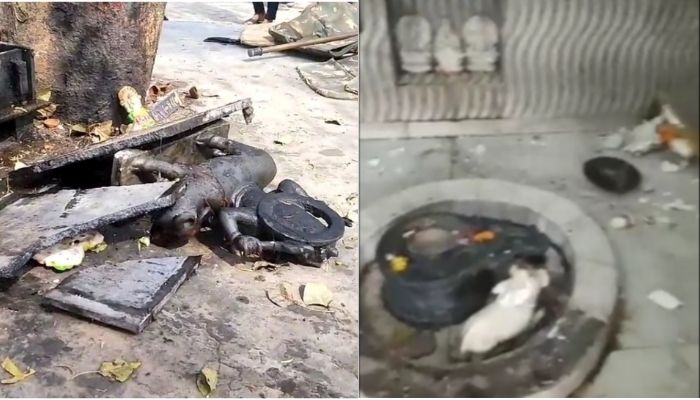
Hundreds of Tunisians reportedly burned down a historic synagogue on the evening of 18th October. The building was reduced to rubble in the midst of widespread unrest following an explosion in a hospital in Gaza that Hamas attributed to Israel. Hordes of demonstrators swarmed the streets shortly after the news of the blast which allegedly killed many people became public. They were seen setting fire to the Jewish synagouge in the centre of Al Hammah.

A number of videos went viral on social media revealing individuals, without any police intervention, placing Palestinian flags and breaking down the stone walls of the structure.

The footage of the arson was posted by some users along with the hashtag ‘#Palestine.’

The attack transpired hours after media stories stated that the Israel Defense Forces had struck the Al-Ahli hospital in Gaza. However, officials from the United States and Israel as well as independent intelligence analysts have determined that the incident was caused by a misfired missile by the terrorist organisation Palestinian Islamic Jihad which is based in Gaza.

The instance, which has destroyed a significant piece of its Jewish history, coincides with attacks on other Jewish and Israeli sites across the globe. The massive protests are in response to Israel’s retaliation for Hamas’s deadly and unprecedented assault on Israel on 7th October in which 1,400 people were massacred, the majority of whom were civilians.

The vandalism was condemned by the American Jewish Committee in a statement. It remarked, “We are horrified by the burning and destruction of the Al Hammah synagogue in Tunisia.” The group conveyed that it was “closely monitoring the situation” and was in contact with leaders of the Tunisian Jewish community.

Large crowds of Tunisians have flocked to the streets in favour of Palestinians since the most recent violence in Israel and Gaza.

Anti-Israel protests at US Capitol Hill turns violent, Islamist Congresswoman Rashida Tlaib accused of inciting pro-Hamas sentiments

On Wednesday (18th October) hundreds of pro-Palestine protestors gathered at the Canon Rotunda on Capitol Hill in Washington DC demanding a “ceasefire” in Gaza amidst the ongoing war between Israel and Hamas terrorists.

The demonstrators, dressed in black T-shirts with the slogans, “Jews say cease fire now” and “Not in our name”. The protestors were clapping and singing on the floor of the Cannon House Office Building’s rotunda, holding huge banners that read “Ceasefire” and “Let Gaza Live.”

Taking to X, the US Capitol Police informed that the protestors did not comply with their warnings and were then arrested. The police said that out of the arrested persons, three were charged with assault on a police officer.

According to the Capitol Police, protests are not permitted within the Capitol. The police said that the protestors entered the building legitimately through visitor security checkpoints, and that they were allowed to gather and congregate, but that they failed to heed police warnings after the protests began. Police estimated that over 300 demonstrators were arrested.

Notably, the protest was spearheaded by the group Jewish Voice for Peace (JVP), a Jewish ‘anti-Zionist’ organization. This left-wing organisation is notorious for undertaking protests and boycott campaigns against Israel. As per its website, JVP is a group led by Jewish leftists to support the Palestinian ‘freedom’ struggle.

Among the many anti-Israel activities of the JVP, it led a No Tech for Apartheid campaign this year aimed at making Amazon and Google scrap their $1.22 billion cloud computing “Project Nimbus”. On August 29 this year, they organised a protest outside the Google Cloud Next conference in San Francisco.

JVP demonstrator holding ‘No Tech for Apartheid’ poster during an anti-Israel protest (Image via JVP website)

It is worth noting that this contract was signed in April 2021 between the Israeli government, Google and Amazon. Project Nimbus is said to be a game changer for the Israeli government and defence forces with its all-encompassing cloud system.

The ‘anti-Zionist’ outfit appears to have turned a blind eye to the heinous slaughter of Israeli civilians by the Palestinian terrorist group Hamas. Leftists all across the world share the tendency to sabotage their own community’s interests, even if it means demonising them and projecting their own oppressed religious community as the oppressor.

Islamist sympathiser Rashida Tlaib incited protests at Cannon House

Before the Jewish Voice for Peace demonstrators staged protests at the Cannon House office building, Congresswoman Rashida Tlaib had given a dramatic speech addressing the protestors. Talking about the recent parking space fire at Al-Ahli Hospital in Gaza, caused by a rocket misfire from within Gaza, that Hamas falsely blamed Israel for, Rashida Tlaib asserted that the hospital was attacked by Israeli forces despite the emerging evidence suggesting otherwise. She also slammed US President Joe Biden for backing Israel against Hamas terrorism.

“To my president, to our president … I want him to know, as a Palestinian American and somebody in Muslim faith, I’m not going to forget this. And I think a lot of people are not going to forget this, Tlaib said.

In what sounded more of a threat, the terror apologist said the pro-Hamas people would not stay quiet.

“President Biden, not all Americans are with you on this one and you need to understand that. We are literally watching people commit genocide and killing the vast majority just like this, and we still stand by and say nothing. We will remember this,” Tlaib said.

Several X users accused Tlaib of inciting a pro-Hamas insurrection inside the US Capitol on 18th October.

Taking to X, Tlaib thanked her Jewish ‘allies’ for joining the protest, which apparently was more intended to garner sympathy for Hamas and spread the pro-Palestine propaganda than calling for a “Ceasefire Now”.

“Thank you to our Jewish allies from across the country who joined in solidarity to call for a #CeasefireNOW. Chanting “Not in Our Name,” Tlaib posted.

Last week, when a US journalist asked the representative for the 12th district of Michigan to condemn Hamas’s brutal onslaught against Israeli civilians, especially the children, Rashida Tlaib decided not to utter a word and escaped without answering the question. Although she later claimed that she grieves the death of both Palestinian and Israeli people, being an Islamist herself she failed to muster the courage to condemn Hamas.

It is pertinent to recall that Tlaib had boycotted Indian Prime Minister Narendra Modi’s address to the joint session of the US Congress during his state visit this year over the alleged violation of the human rights of Indian Muslims.

Tlaib joined a panel of prominent Islamic terror sympathisers and Jihadists in 2021 to spread anti-India propaganda over Kashmir. The panel had links to a Chicago-based organisation called Sound Vision, which is an affiliate of the Islamic Circle of North America (ICNA). The Islamic Circle of North America (ICNA) is a notorious Islamic organisation in North America that has close ties to terror organisations such as Hamas, the Muslim Brotherhood, Jamaat-e-Islami, and other Islamic terror organisations. OpIndia has published detailed reports covering the pro-terrorist activities of Tlaib.

Theory of ‘Basic Structure’ and its impact on NJAC: Why a synthesized NJAC would be better than the Collegium system

The Constitution remains a living document that reflects the will of the people as expressed through its founding principles and values. The Constitution of India is made up of several key components that include the Preamble, Part III & Part IV of the Constitution of India. Additionally, it includes fundamental principles like democracy, secularism, socialism, and sovereignty, which guide the functioning of the Indian state. The Constitution establishes a federal parliamentary structure backed by three concrete independent yet assimilated and synergized pillars of powers separated out as the executive, legislative, and judicial branches.

DISTRIBUTION OF CONSTITUTIONAL & LEGAL POWERS

The Constitution ensures the separation of powers by defining the roles, functions, and limitations of each branch. Additionally, it includes mechanisms to prevent one branch from unduly encroaching upon the powers of another. The specific allocation of powers in the Indian Constitution is a crucial feature that evolved to concretize a balance of power amongst all three domains and simultaneously ensure that one power constituent does not infringe upon the other’s sphere. The separation of powers is a fundamental feature of our Constitution that ensures the allocation of roles, responsibilities and powers to three distinct branches with inbuilt checks and balances.

EXECUTIVE BRANCH

The executive branch consists of two separate sub-branches; one is administrative & the other is political executive. The administrative branch is committed to implementing and enforcing rules and regulations and protects the sanctity of the law of the land. The Political executive is represented by the President of India, the Vice President, and the Council of Ministers (headed by the Prime Minister). The executive branch is expected to run the day-to-day affairs of the government, making policy decisions, and implementing laws passed by the Legislature.

LEGISLATIVE BRANCH

The legislative branch is primarily responsible for formulating laws. The legislative power is demonstrated by two houses – the Lok Sabha and the Rajya Sabha. The Parliament of India has the power to make, amend, and repeal laws on various subjects listed in the Constitution.

JUDICIAL BRANCH

The judiciary is owed with responsibility to dispense justice & also interpret the laws. It is independent of the other two branches.

ARTICLE 13

Article 13 primarily focuses on safeguarding fundamental rights. It states that any law whether pre- or post-Constitution which is found in conflict with or at variance with fundamental rights shall be revoked to the extent of variance. It empowers the judiciary to review laws and, if necessary, strike them down if they violate fundamental rights. Article 13 provides a protective umbrella to maintain the inviolability of fundamental rights due to any legislative or executive action. The term “law” in Article 13 includes not only statutes and legislation passed by Parliament or State Legislatures but also ordinances, regulations, orders, bylaws, rules, and other forms of delegated or subordinate legislation. Article 13(2) empowers the judiciary, especially the Supreme Court and High Courts to review the constitutionality of laws where if any law is assessed to be in violation of fundamental rights and inherent spirits, the same can be suitably declared void to the extent of inconsistency.

The Court held that an amendment under Article 368 is “law” within the meaning of Article 13 of the Constitution and therefore, if an amendment “takes away or abridges” a Fundamental Right conferred by Part III, it is void. In essence, Article 13 serves as a safeguard for the fundamental rights of Indian citizens and ensures that any existing law or new legislation that violates these rights can be declared void by the judiciary, upholding the supremacy of the Constitution. Article 13 is a critical tool in ensuring that fundamental rights are not violated or undermined by any legislative or executive action. It provides a mechanism for citizens to challenge laws that infringe upon their fundamental rights in the courts.

ARTICLE 368

Article 368 of the Constitution of India deals with the power of Parliament to amend the Constitution. It outlines the procedures and mechanisms for amending various parts of the Indian Constitution. It grants Parliament the power to amend various provisions of the Constitution. Article 368 confers upon the Parliament of India the power to amend the Constitution. It can amend any provision of the Constitution including the provisions related to the fundamental rights of citizens.

Amendments can be made by introducing a bill in either house of Parliament (Lok Sabha or Rajya Sabha). Some amendments can be passed by a simple majority of the members present and voting in each house. Certain other amendments, which are not related to the federal structure but still affect significant parts of the Constitution, require a special majority. This means they must be passed by most of the total membership of each house and by a two-thirds majority of the members present and voting. Article 368 itself contains an exception. It specifies that certain provisions of the Constitution, such as the federal structure, Parliamentary form of government etc. cannot be amended without the ratification of most state legislatures. Article 368 is crucial in understanding the process by which the Indian Constitution can be amended. The theory of Basic Structure impinges upon the ambit of amendment to any provisions of the Constitution of India.

THE RELATIONSHIP BETWEEN ARTICLE 13 AND ARTICLE 368 CAN BE UNDERSTOOD AS FOLLOWS

Article 13 acts as a watchdog on the power of Parliament as provided under Article 368. It ensures that while Parliament has the authority to amend the Constitution, it cannot do so in a manner that violates fundamental rights. Article 13 does not make all constitutional amendments invalid. Instead, it applies specifically to amendments that violate fundamental rights. If a constitutional amendment infringes upon fundamental rights, it can be declared void to that extent, as per Article 13. The doctrine of Basic structure limits the amending power of Parliament, is a product of judicial interpretation and was established in the Keshvanand Bharati case (1973). It harmonizes the powers of Article 13 and Article 368 by allowing amendments that do not affect the basic structure of the Constitution and ensuring that fundamental rights are protected. While Article 13 and Article 368 have different purposes, they work together to maintain a balance between amending the Constitution and protecting fundamental rights. The basic structure doctrine which is a judicially evolved concept in the epoch-making Keshwa Nand

The Bharti case is a key element that reconciles by setting limits on the amendment power to prevent any alteration of the core principles of the Constitution. The Basic Structure is however not defined & is left to the interpretation of Justices of the bench, every time it gets constituted.

OVERSTEPPING OF ORGANS

Legislature Overstepping:

The legislature may sometimes pass laws that are in violation of the Constitution. In such cases, the judiciary has the authority to strike down these laws through judicial review.

Executive  Overstepping:

The executive can issue ordinances in exceptional circumstances when Parliament is not in session. However, if the legislature excessively uses ordinances to bypass the normal legislative process, it can be seen as overstepping its authority. The President, on the advice of the Cabinet, can declare a state of emergency under specific circumstances. However, if the executive misuses emergency powers for political gain or to suppress dissent, it can be seen as overstepping its authority.

Judiciary  Overstepping:

While the judiciary’s role includes interpreting the Constitution and protecting fundamental rights, excessive judicial activism, where the judiciary takes on roles that are traditionally the domain of the executive or legislature, can be seen as overstepping. It’s important to note that the allocation of powers in the Indian Constitution is designed to create a delicate balance and each branch has specific checks and balances on the others to prevent overstepping. Additionally, the concept of judicial review allows the judiciary to strike down laws and actions that violate the Constitution, serving as a vital safeguard against overreach by the legislature and executive.

In practice, maintaining this balance is an ongoing challenge, and instances of overstepping can arise. However, the system relies on the vigilance of each branch, as well as public awareness and engagement, to ensure that the principles of democracy and the rule of law are upheld. In any democratic system, including India, there is always the potential for one branch of government to overstep its authority, which can lead to a disruption of the system of checks and balances. Here are some common examples of overstepping of authority by the three branches of government in India: where the judiciary is perceived to have overstepped its boundaries into the legislative and executive domains in India, has been a subject of debate. While the judiciary’s role includes interpreting the Constitution and ensuring the protection of fundamental rights, there have been instances where it has made decisions that some critics argue encroach upon the functions of the other branches of government.

The term “judicial activism” is often used to describe instances where the judiciary takes an active role in shaping public policy and governance. Critics argue that at times, judicial activism has led to the judiciary overstepping its role. For instance, in the case of Vishakha v. State of Rajasthan, the Supreme Court formulated guidelines on workplace sexual harassment even before specific legislation was enacted. While this was seen as a necessary step to protect women’s rights, it raised questions about whether the judiciary was intruding into legislative territory. The judiciary has been actively involved in environmental matters, issuing directives and guidelines to address issues like air pollution, river cleaning, and industrial pollution. While this has been necessary to protect the environment and public health, critics argue that such interventions sometimes bypass the executive’s role in crafting and implementing environmental policies. made by the executive.

The judiciary has been involved in decisions related to religious practices. The Sabarimala temple entry case, where the Supreme Court allowed women of all ages to enter the temple, raised questions about whether the judiciary was infringing on religious traditions and practices, a domain traditionally left to religious authorities. The judiciary has been involved in issues related to reservation policies. In some cases, it has ordered changes in reservation criteria or questioned the implementation of reservation policies, which are primarily within the legislative domain. It’s essential to recognize that these instances of perceived judicial overreach often come with differing interpretations and perspectives.

Some view them as necessary interventions to protect fundamental rights and uphold the rule of law, while others argue that they encroach on the legislative and executive functions. To address concerns about judicial overreach, there have been calls for greater clarity in the separation of powers, the need for well-defined roles and responsibilities of each branch of government, and discussions on judicial reform to ensure that the judiciary respects the boundaries set by the Constitution while upholding the rights and welfare of citizens. While the judiciary’s role includes interpreting the Constitution and protecting fundamental rights, and excessive judicial activism, the judiciary takes on roles that are traditionally the domain of the executive or legislature, which can be seen as overstepping.

While judicial review is a crucial aspect of the separation of powers, an overly broad interpretation of this power can lead to a perception that the judiciary is encroaching on the legislative and executive domains. It’s important to note that the separation of powers in the Indian Constitution is designed to create a delicate balance and each branch has specific checks and balances on the others to prevent overstepping. Additionally, the concept of judicial review allows the judiciary to strike down laws and actions that violate the Constitution, serving as a vital safeguard against overreach by the legislature and executive. In practice, maintaining this balance is an ongoing challenge, and instances of overstepping can arise. However, the system relies on the vigilance of each branch, as well as public awareness and engagement, to ensure that the principles of democracy and the rule of law are upheld.

KESHVANAND BHARTI CASE

In the Keshvanand Bharati case, relief was sought against the Kerala government vis-à-vis two state land reform laws, which imposed restrictions on the management of religious property. Question underlying the case: Was the power of Parliament to amend the Constitution unlimited? In other words, could Parliament alter, amend, or abrogate any part of the Constitution even to the extent of taking away all fundamental rights? The Constitutional Bench in the Keshvanand Bharati case ruled by a 7-6 verdict that Parliament could amend any part of the Constitution so long as it did not alter or amend the basic structure or essential features of the Constitution. However, the court did not define the term ‘basic structure’, and only listed a few principles — federalism, secularism, democracy — as being its part. The ‘basic  structure doctrine has since been interpreted to include:

  • the supremacy of the Constitution,
  • the rule of law,
  • Independence of the judiciary,
  • doctrine of separation of powers,
  • a sovereign democratic republic,
  • the parliamentary system of government,
  • the principle of free and fair elections,
  • welfare state, etc.

BASIC STRUCTURE

The basic structure doctrine was established in Keshvanand Bharati v. State of Kerala in 1973. In this case, the Supreme Court ruled that Parliament has the power to amend the Constitution, however, cannot do so in a manner that violates or alters its basic structure. This doctrine is significant because it places limitations on the amending power of the Indian Parliament, ensuring that the core principles and values of the Constitution remain intact and unaltered. It was developed to determine the limits of the amending power of Parliament (under Article 368) and to protect certain core principles and values of the Constitution. The power of judicial review, which empowers the judiciary to measure the constitutionality of laws and actions including constitutional amendments, is a vital part of the doctrine of Basic Structure. The primary aim of the basic structure doctrine is to ensure that the fundamental principles and essential features of the Constitution, which are vital for maintaining democracy, justice, equality, and the rule of law, are not arbitrarily or substantially altered through constitutional amendments. The basic structure doctrine is a legal principle developed by the Indian judiciary, particularly by the Supreme Court of India.

CHANGE INEVITABLE

The architects of the Indian Constitution granted confirmed powers to Parliament as per the needs and demands of “We the People”. Article 368, which gives Parliament the power to amend the Constitution, can also be amended. The Constitution is an ever-developing index & a reflection of the collective consciousness of the citizens which embodies the spirit of the nation. The dynamism in the Constitution is integral, however, the Doctrine of Basic Structure impedes the dynamism. The impact of the past enriches it now and makes the future richer than the present.” A provision for amending the Constitution has been made to address any challenges “We the People” may face in the future as the Constitution functions since time is not static; it is always changing, just as the political, economic, and social circumstances of the people do.

APPOINTMENT OF JUSTICES PRIOR TO 1993

Before the introduction of the collegium system in 1993, the appointment of judges to the higher Courts in India, including the Supreme Court and High Courts, was primarily made under the provisions of Article 124 and Article 217 of the Indian Constitution. The Chief Justice of India, as the head of the judiciary, would recommend the names of candidates for appointment as judges to the President. These recommendations were often made after consultation with other senior judges, both within the Supreme Court and the concerned High Court.

The President of India, bound by the advice of the Council of Ministers (the executive branch), would make the final appointments based on the recommendations received from the Chief Justice and the Executive. The executive branch played a significant role in the appointment process. The President would consider the recommendations and could seek further information or clarification if necessary.

In practice, the government had a significant say in the appointment process. While the Chief Justice’s recommendations were considered, the government’s role in the final decision often led to allegations of political influence in judicial appointments. The introduction of the collegium system in 1993 marked a significant shift in the appointment process. Under the collegium system, a group of senior judges of the Supreme Court, including the Chief Justice of India, became responsible for recommending candidates for judicial appointments. This system was cited as aimed at enhancing the independence of the judiciary in the appointment process. It means that all appointments of justices up to 1993 were incorrect and subject to legislative and executive interference.

It is assumed that the frailties of the appointment of justice were over with the introduction of a collegium system with necessary transparency and accountability. The question of whether all judicial appointments made before the introduction of the collegium system in 1993 were “incorrect” or subject to legislative and executive interference is a matter of perspective and legal interpretation. The introduction of the collegium system was aimed at addressing certain perceived shortcomings in the earlier appointment process and enhancing the independence of the judiciary, but it does not inherently render all prior appointments “incorrect.”

ADVENT OF COLLEGIUM

The collegium system was introduced through a series of judicial pronouncements and not through a specific legislative enactment. It evolved gradually over several decades. The term “collegium” itself was coined in the 1990s. The idea of judicial consultation in the appointment of judges can be traced back to various judicial precedents. For example, in the 1977 case of S.P. Gupta v. Union of India, commonly known as the “First Judges Case,” the Supreme Court held that the Chief Justice of India (CJI) should consult with a plurality of judges to make recommendations for appointments of Justices. The significant development in the establishment of the collegium system came in the Second Judges Case, also known as the Advocates-on-Record Association v. Union of India (1993).

In this case, the Supreme Court held that the CJI should make recommendations to the President in consultation with a collegium of senior judges. The court ruled that the executive’s role should be limited to appointing judges based on these recommendations. Following the Second Judges Case, the collegium system became the standard practice for judicial appointments in India. The system evolved over time, and the composition of the collegium varied, but it generally included the CJI and a group of senior judges of the Supreme Court. Several other cases and judgments in subsequent years further clarified and reaffirmed the collegium system’s role in the appointments and transfers of judges.

NJAC

National Judicial Appointments Commission (NJAC): The issue of judicial appointments faced significant debate and controversy, leading to attempts to change the appointment process. The National Judicial Appointments Commission (NJAC) Act was passed in 2014 with the aim of introducing a new mechanism for appointments. However, in 2015, the Supreme Court struck down the NJAC Act, asserting that it violated the basic structure of the Constitution and upheld the primacy of the collegium system. NJAC was an attempt to reform the judiciary’s appointment process and may not be seen as legislative overreach per se, the judiciary’s concerns about the potential impact on judicial independence were central to the court’s decision. This complex issue reflects the ongoing debate about the balance between the branches of government and the role of the judiciary in safeguarding the Constitution in India’s democratic system.

EXISTING ARRANGEMENT

It is true that the appointment process before the judiciary evolved into the collegium system, allowing involvement and influence from the executive branch, particularly in the final decision-making stage. This sometimes led to allegations of political interference in judicial appointments. While the introduction of the collegium system was a significant step toward enhancing judicial independence in the appointment process, it does not necessarily render all appointments made before 1993 as “incorrect.” The issue of judicial appointments is complex and has evolved over time in response to various challenges and concerns.

The collegium system is one of the many mechanisms designed to address these concerns, but it is not without its own set of criticisms and debates. While the judiciary plays a vital role in safeguarding the Constitution, it also has its limitations. It cannot directly enforce its decisions, relying on the executive branch to implement them. Leaving the judiciary as the sole custodian may raise questions about democratic accountability. Judges are not elected representatives, and some argue that their power should be checked by elected officials who are directly accountable to the people. The theory of separation of powers suggests that no single branch of government should have unchecked authority. While the judiciary’s independence is crucial, an appropriate balance of powers among the branches is essential for a well-functioning democracy. The power to amend the Constitution (under Article

368) lies with the legislature. If the judiciary was the sole custodian, it could potentially limit the ability of the legislature to make necessary constitutional amendments. In practice, the Indian Constitution is committed to establishing a system of balance among the three branches of government: the executive, the legislature, and the judiciary. While the judiciary plays a significant role in interpreting and upholding the Constitution, it does so within the broader framework of democratic governance.

Ambedkar said, “However good the Constitution is, it might turn out not to be good if the people were administering it bad however bad the Constitution is, it might do its job well if people administering it happen to be good.” “Enlightened statesmen will not always be at the helm” and “if men were angels, no government would be necessary”, we get to an axiomatic idea of checks and balances.

The question of whether the judiciary alone the custodian of the Constitution of India should be is a matter of considerable debate and has been a subject of discussion in legal and political circles.

JUDICIARY AS CUSTODIAN OF THE CONSTITUTION

The judiciary is designed to be an independent branch of government, which is essential for interpreting and upholding the Constitution impartially. Its decisions are not influenced by political considerations.

Judges have legal expertise and training, which makes them well-suited to interpreting and applying the Constitution’s provisions and principles accurately.

The judiciary serves as a check on the actions of the executive and legislative branches to ensure that they are in conformity with the Constitution. This helps prevent potential abuse of power.

The power of judicial review allows the judiciary to strike down laws and actions that violate the Constitution. This is a critical mechanism for protecting individual rights and preserving constitutional values.

COUNTERVIEW OF JUDICIARY AS SINGLE CUSTODIAN OF THE CONSTITUTION

While the judiciary plays a vital role in safeguarding the Constitution, it also has its limitations. It cannot directly enforce its decisions, relying on the executive branch to implement them.

Leaving the judiciary as the sole custodian may raise questions about democratic accountability. Judges are not elected representatives, and some argue that their power should be checked by elected officials who are directly accountable to the people.

The separation of powers doctrine suggests that no single branch of government should have unchecked authority. While the judiciary’s independence is crucial, an appropriate balance of powers among the branches is essential for a well-functioning democracy.

The power to amend the Constitution (under Article 368) lies with the legislature. If the judiciary were the sole custodian, it could potentially limit the ability of the legislature to make necessary constitutional amendments.

The consensus in most democratic systems is that the Constitution should be a shared responsibility, with each branch of government playing a role in its protection and preservation. The exact balance between these branches can vary from one country to another, depending on the specific constitutional framework and historical context.

HERE IS HOW THE APPOINTMENT PROCESS WORKED PRIOR TO THE COLLEGIUM SYSTEM

Before the introduction of the collegium system in 1993, the appointment of judges to the higher courts in India, including the Supreme Court and High Courts, was primarily made by the President of India in consultation with the Chief Justice of India. This method was based on Article 124 and Article 217 of the Indian Constitution. The CJI, SC as the head of the judiciary,

would recommend the names of candidates for appointment as judges to the President. These recommendations were often made after consultation with other senior justices, both within the Supreme Court and the concerned High Court. President’s Decision: The President of India, acting on the advice of the Council of Ministers (the executive branch), would make the final appointments based on the recommendations received from the Chief Justice and the Executive.

The executive branch played a significant role in the appointment process. The President would consider the recommendations and could seek further information or clarification if necessary.

In practice, the government had a significant say in the appointment process. While the Chief Justice’s recommendations were taken into account, the government’s role in the final decision often led to allegations of political influence in judicial appointments.

The introduction of the collegium system in 1993 affected the process of appointment of judges significantly, tilting the weight towards the judiciary. Under the collegium system, a group of senior judges of the Supreme Court, including the Chief Justice of India, became responsible for recommending candidates for judicial appointments. The system was said to be committed to ushering in the independence of the judiciary. It’s important to note that the collegium system itself has faced criticism and debate, with some arguing that it lacks transparency and accountability. The issue of judicial appointments in India has been the subject of ongoing reform discussions, and various proposals for change have been considered over the years.

The question of whether all judicial appointments made before the introduction of the collegium system in 1993 were “incorrect” or subject to legislative and executive interference is a matter of perspective and legal interpretation. The introduction of the collegium system was aimed at addressing certain perceived shortcomings in the earlier appointment process and enhancing the independence of the judiciary, but it does not inherently render all prior appointments “incorrect.”

It is true that the appointment process before the collegium system allowed for involvement and influence from the executive branch, particularly in the final decision-making stage. This sometimes led to allegations of political interference in judicial appointments.

The introduction of the collegium system was one of several reforms aimed at improving the appointment process and reducing the potential for political interference. However, no system is without its own criticisms and challenges.

Appointing judges to the higher courts is a complex and nuanced process. It involves considerations of legal expertise, integrity, experience, and the need to uphold the independence of the judiciary. Different systems and mechanisms have been used to strike the right balance between these considerations.

The collegium system did not retroactively invalidate appointments made before its introduction. Judicial decisions made by judges appointed under the previous system remain valid and legally binding.

The debate over judicial appointments and reforms in this area continues in India. Various proposals and discussions have taken place regarding potential improvements to the appointment process, including increasing transparency and accountability.

In summary, while the introduction of the collegium system was a significant step toward enhancing judicial independence in the appointment process, it does not necessarily render all appointments made before 1993 as “incorrect.” The issue of judicial appointments is complex and has evolved over time in response to various challenges and concerns. The collegium system is one of the many mechanisms designed to address these concerns, but it is not without its own set of criticisms and debates.

The collegium system for the appointment and transfer of judges in India was introduced through a series of judicial pronouncements and not through a specific legislative enactment. It evolved gradually over several decades. The term “collegium” itself was coined in the 1990s.

Following the Second Judges Case, the collegium system became the standard practice for judicial appointments in India. The system evolved over time, and the composition of the collegium varied, but it generally included the CJI and a group of senior judges of the Supreme Court. The collegium system, as it stands today, remains the predominant method for appointing and transferring judges in the higher judiciary in India. It is based on judicial interpretations and pronouncements, making it a unique and distinctive feature of India’s legal system.

The issue of judicial appointments faced significant debate and controversy, leading to attempts to change the appointment process. The National Judicial Appointments Commission (NJAC) Act was passed in 2014 with the aim of introducing a new mechanism for appointments. However, in 2015, the Supreme Court struck down the NJAC Act, asserting that it violated the basic structure of the Constitution and upheld the primacy of the collegium system. The very fact that  the NJAC  was  struck  null  &  void is  itself a  violation  of  the  basic  structure  of  the

Constitution of India as it is nowhere prevalent that justice chooses justice which may lead to favoritism to family members & friends. In the absence of a strict definition of the Basic Structure of the Constitution, it is well nigh appropriate to deduce that the Judiciary overstepped & violated the Basic Structure & tenets associated with it. The provisions as enshrined in Article 124 and Article 217 of the Indian Constitution were inviolable & power & appointment could not have been concentrated within a fold by one of the organs unilaterally.

If that is true, all other constitutional & sensitive appointments may be determined by concerned departments under the same pleas of keeping interference of other organs let it be executive, legislative & judiciary. Judiciary alone cannot be accorded special status as fundamentally deemed non-interfering & neutral pillar out of three pillars. While preserving the independence of the judiciary is a paramount requirement, the NJAC with assimilated & synthesized composition would have offered a better & competent option within the ambit of the Basic Structure.