In a recent development, the President of the World Bank, David Malpass, has expressed concerns over China’s loans to developing countries and the possibility of a “Chinese debt trap” that Beijing is notorious for in asserting its dominance over countries seeking funds to shore up their respective economies.
The statement comes at a time when China is increasing its lending to developing nations, which has raised concerns about the long-term financial sustainability of the countries that are borrowing from China.
China’s expanding economic presence in the developing world has led to increasing concerns over what is commonly referred to as the “Chinese debt trap”. This phenomenon refers to China’s practice of offering large loans to developing countries for infrastructure projects, which are often accompanied by opaque terms and conditions that leave borrowers vulnerable to economic and political pressure leading to a situation where a borrowing country becomes trapped in a cycle of debt due to its inability to repay loans from China. This situation is often caused by the borrowing country’s inability to generate sufficient foreign exchange to service its debt obligations.
Malpass noted that China is one of the largest bilateral lenders to developing countries. While these loans have helped finance much-needed infrastructure projects, they have also saddled many countries with unsustainable debt burdens. In some cases, the debt has been so overwhelming that countries have been forced to hand over control of key assets to China, leading to accusations of “debt-trap diplomacy”.
Malpass emphasized the need for greater transparency and accountability in the lending practices of China and other lenders to ensure that developing countries are not being taken advantage of. He also stressed the importance of debt sustainability and urged borrowers to be more cautious in taking on new debt.
China becomes the leading lender to developing countries
China has become a major player in global lending, with its Belt and Road Initiative (BRI) involving investment in infrastructure projects in over 100 countries. However, the initiative has come under scrutiny for saddling countries with unsustainable debt burdens, leading some to accuse China of using debt as a tool of geopolitical influence.
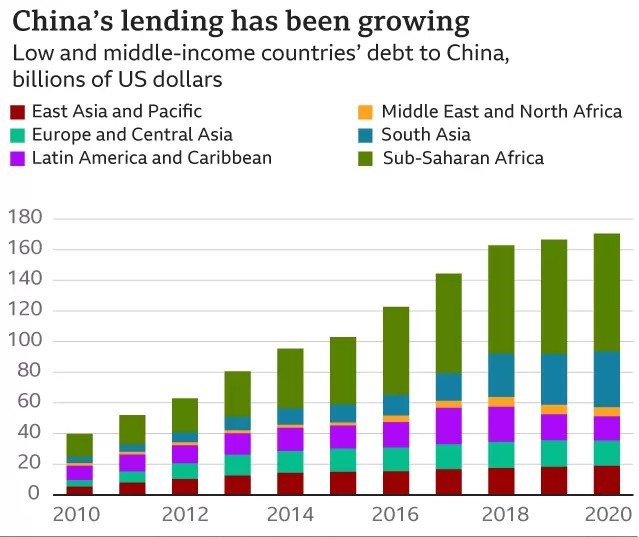
China’s loans to lower and middle-income countries have tripled over the past decade, reaching $170 billion by the end of 2020.
Source: World Bank International Debt Statistics/ BBC
China’s entire credit commitments, however, are probably much higher than these numbers imply. Half of China’s loans to developing nations are not included in official debt data, according to research by AidData, an international development organisation at William & Mary University in the United States. Instead of flowing from one government to another, cash is frequently diverted through joint ventures, private institutions, state-owned businesses, and banks.
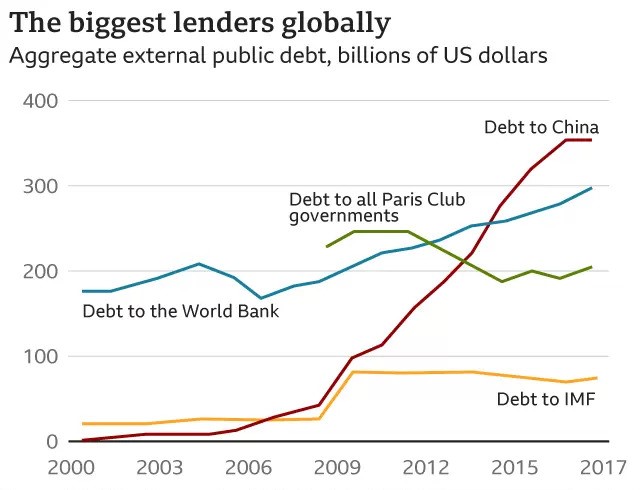
China is the world’s largest lender to developing countries, according to data from the World Bank. This marks a significant shift in global finance, as China has rapidly increased its lending to developing countries over the past decade through its Belt and Road Initiative (BRI).
The BRI is a massive infrastructure development project that claims to seek improvement in connectivity and trade across Asia, Europe, and Africa, but in reality is an instrument to trap countries into Beijing’s geopolitical orbit through the means of “debt trap diplomacy”. As part of this initiative, China has invested heavily in developing countries, providing them with loans for infrastructure projects, energy production, and other areas.
According to data from the World Bank, China’s total lending to developing countries reached $462 billion between 2000 and 2020. This surpasses the lending of traditional lenders such as the World Bank and the International Monetary Fund (IMF). In 2020 alone, China provided $87 billion in loans to developing countries, compared to the World Bank’s $28 billion and the IMF’s $20 billion.
Source: World Bank International Debt Statistics/BBC
Why Chinese loans are difficult to pay
There are several reasons why Chinese debt is difficult to pay off. First and foremost, the loans come with high interest rates, which can make repayment difficult for countries with already limited resources.
Another issue is that many of the projects funded by Chinese loans are not economically viable. These projects are often designed to boost a country’s infrastructure, but they may not generate enough revenue to repay the loans. This leaves countries with a significant debt burden that they cannot sustain.
Another factor that contributes to the difficulty of paying off Chinese debts is the collateral that China requires in exchange for its loans. This collateral often takes the form of natural resources or strategic assets, such as ports or airports. This means that if a developing country is unable to repay its debt, it may have to surrender control of these resources or assets to China. This could have long-term consequences for the country’s economic and strategic interests.
Furthermore, there is often a lack of transparency in China’s lending practices. Many countries do not fully understand the terms of the loans they are taking on, which can lead to unsustainable debt burdens. Additionally, China has been accused of using its loans to gain political leverage and strategic influence in developing countries, which can further complicate the repayment process.
Despite these concerns, China’s lending to developing countries shows no signs of slowing down. The BRI continues to expand, with new projects and investments being announced on a regular basis. This suggests that China’s role as the world’s largest lender to developing countries is likely to continue in the years to come, with significant implications for the global economy and international relations.
On Wednesday, April 5, the Supreme Court refused to entertain a petition brought by fourteen political parties alleging that the central government is using central investigative agencies such as the Enforcement Directorate (ED) and the Central Bureau of Investigation (CBI) in a bid to quell dissent by arresting opposition leaders.
A division bench comprising Chief Justice DY Chandrachud and Justice JB Pardiwala refused to consider the plea, stating that it was impossible to issue general directions without regard to specific factual context. The bench stated that it could only get involved in a specific case. The bench added that politicians could not assert a higher level of immunity than ordinary citizens. The opposition parties had to withdraw their plea as the SC bench refused to entertain their plea.
Senior Lawyer Abhishek Manu Singhvi argued before the court that more “selective and targeted” use of centrally controlled investigating agencies is being made to stifle political opposition and undermine the fundamental premises of representative democracy. The senior advocate claimed that adequate bail guidelines of two sorts: pre and post-arrest.
Guidelines sought for arrest and remand
The petitioners sought that the triple test be applied by police officers, ED officials, and courts alike for the arrest of individuals in any cognizable offences other than those involving significant bodily violence.
If these requirements are not met, alternatives such as house arrest or, at most, scheduled interrogations can be used to satisfy the requirements of the investigation.
Guidelines sought for bail
The petitioner requested that the courts adhere to the principle “bail as rule, jail as exception,” particularly in situations involving non-violent offences. They sought that only in cases where the triple test was not fulfilled should bail be denied.
The petitioners asked for directions to harmonize special legislation like the PMLA, which have strict bail conditions, with Article 21 of the Constitution.
Unless the prerequisites under the triple test are not met, the accused may be released on bail even under special provisions when it appears that the trial will not be finished within six months.
Statistics presented by the petitioners in support of their demands
The petition included certain statistics to support the demands. Raid action rate as measured by complaints submitted after raids decreased from 93% in 2005-2014 to 29% in 2014-2022;
Despite an increase in the number of cases recorded by the ED from 209 in 2013–14 to 981 in 2020–21 and 1180 in 2021–22, only 23 convictions have been obtained to date under the Prevention of Money Laundering Act (PMLA).
43 (less than 60%) of the 72 political figures the CBI investigated between 2004 and 2014 belonged to the opposition. Currently, this figure exceeds 95%, Singhvi stated.
The proportion of opposition leaders among all politicians under investigation by the ED increased from 54% before 2014 to 95% after 2014, Singhvi added in his argument.
‘SC cannot issue special guidelines just for politicians’
To this, CJI Chandrachud stated that although this petition is focused on politicians, they are not entitled to any immunity adding that when cases of financial scams come up how can it be said that they cannot be arrested.
“Even though this petition focuses on political leaders, they don’t enjoy any immunity…day in and day out we get these cases of financial scams. How can we say that they cannot be arrested,” the CJI said.
CJI: Even though this petition focuses on political leaders, they don’t enjoy any immunity.. day in and day out we get these cases of financial scams.. How can we say that they cannot be arrested.
CJI Chandrachud further added, “The problem with this petition is that you are trying to extrapolate statistics into guidelines, where the statistic only apply to politicians.
CJI: The difficulty in your petition is you are trying to extrapolate statistics into binding guidelines.. How can you make them only for politicians..#EnforcementDirectorate#CBI
Ordinary citizens and political leaders share an equal standing in the country, CJI Chandrachud continued. According to the CJI, political leaders cannot claim a higher identity.
The CJI questioned, “How can there be a different set of procedures for them?
The Chief Justice told the petitioners that they can come to the Supreme Court with individual cases or a group of individuals, however, the Supreme Court cannot lay guidelines in an abstract manner as it would be ‘dangerous’ in absence of specific facts. Following this, Advocate Singhvi requested to withdraw the plea, which was thus dismissed as withdrawn.
The petition was submitted by the Indian National Congress (INC), Dravida Munnetra Kazhagam (DMK), Rashtriya Janata Dal (RJD), Bharat Rasthra Samithi (BRS), All Indian Trinamool Congress (TMC), Aam Aadmi Party (AAP), Nationalist Congress Party (NCP), Shiv Sena (UBT), JMM, JD(U), Communist Party of India (Marxist), CPI, Samajwadi Party, J&K National Conference. Advocate Shadan Farasat had drawn and filed the petition on behalf of the India National Congress.
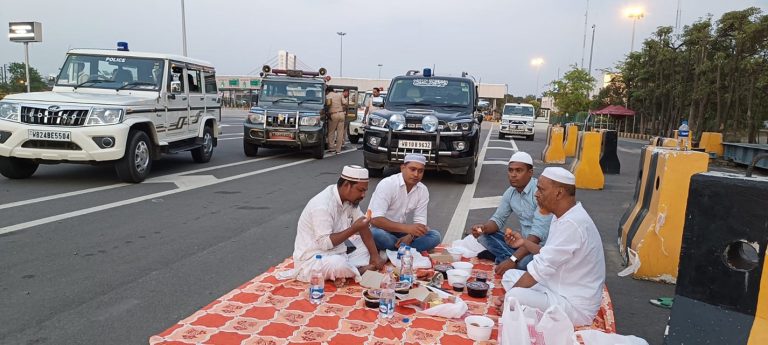
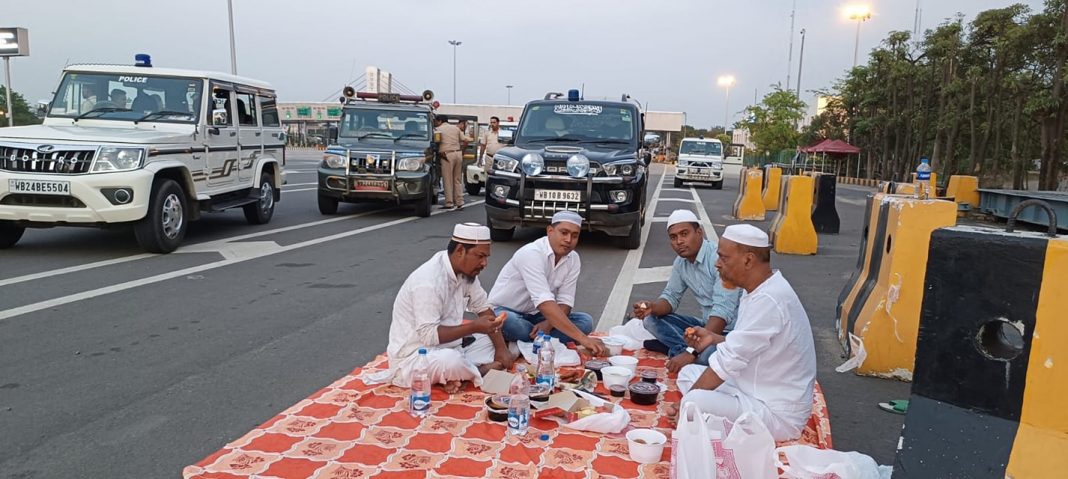
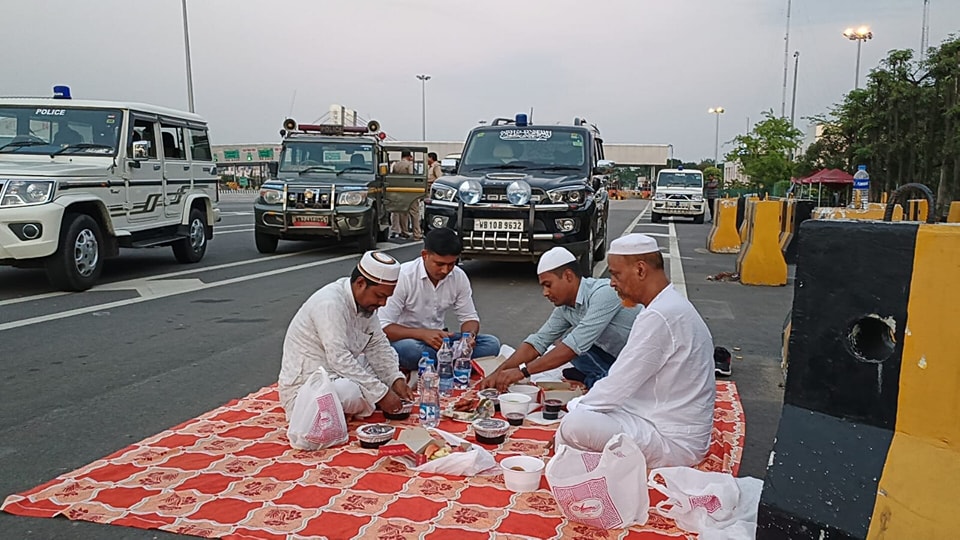
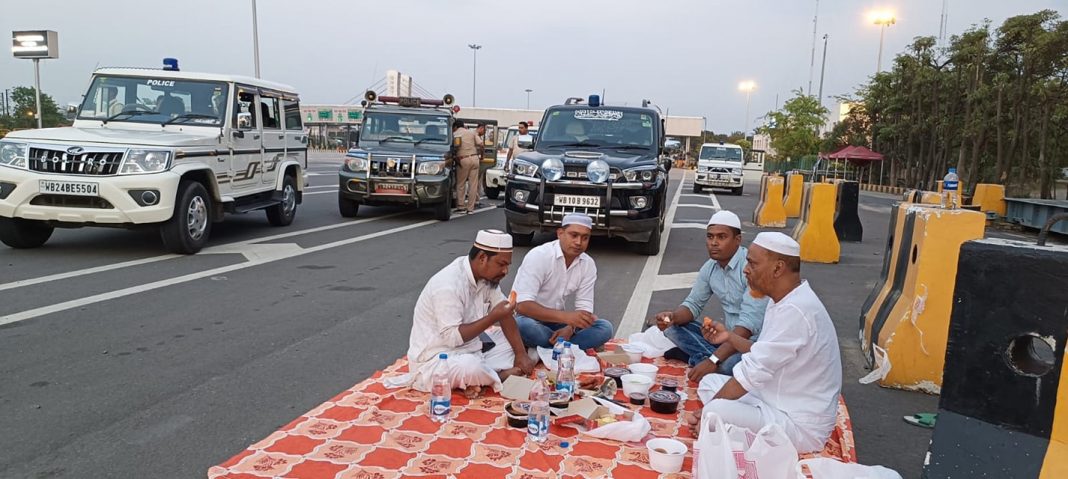
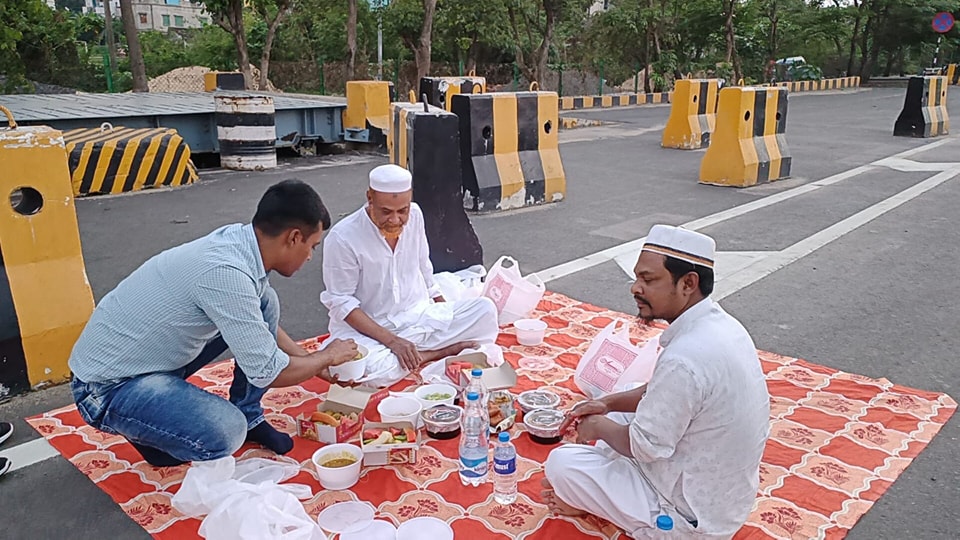
While the controversy around Namaz on roadsand other public places keeps appearing during every Muslim festival, a cleric in West Bengal has moved it a notch higher by now holding iftar on a road. Toha Siddiqui, the Pirzada of Furfura Sharif, a controversial cleric in the state, yesterday took his iftar meal, the meal after the day-long fast during Ramzan, on a road while returning home from somewhere.
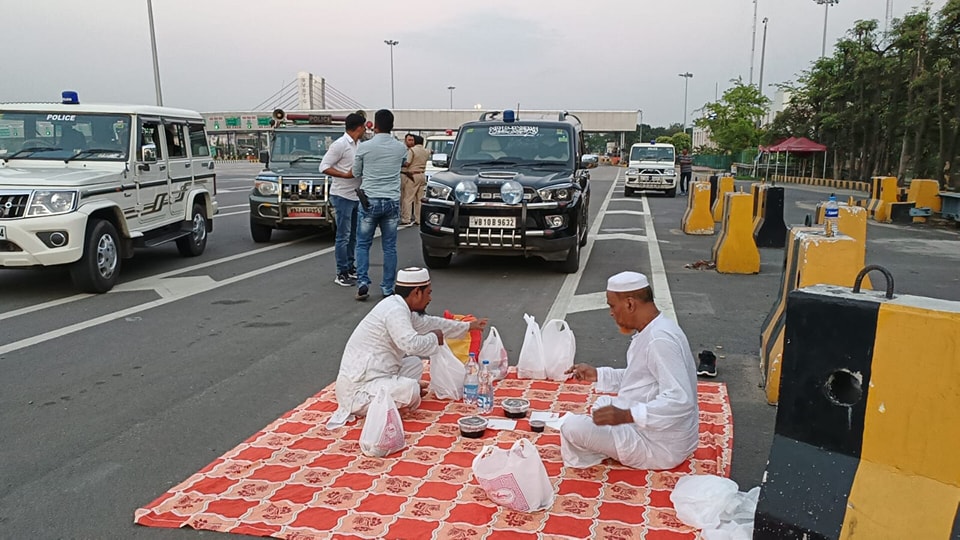
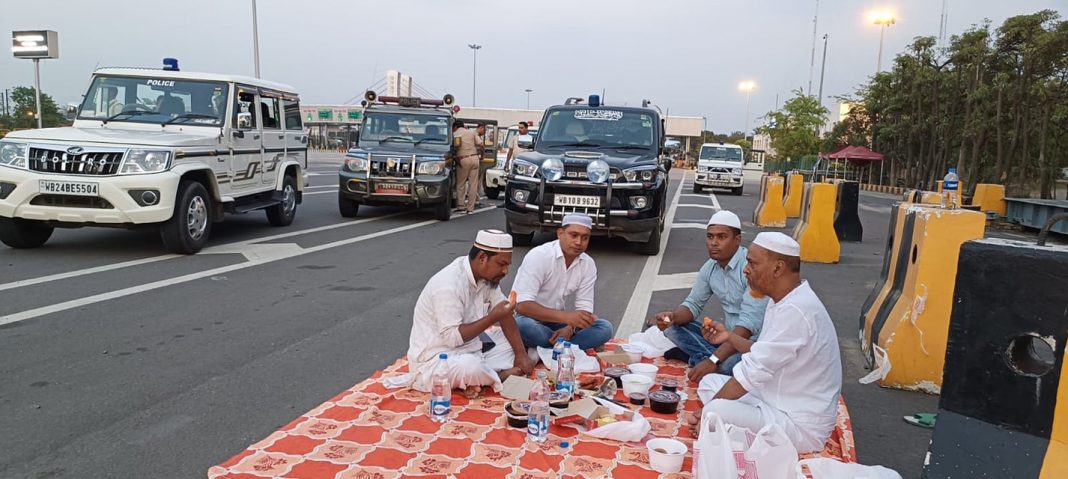
Pirzada Toha Siddiqui informed about this himself on Facebook along with several photographs showing an elaborate iftar feat on a road. He wrote in the post, “Iftar on the road while returning home from a function.” In the photographs, four men, including Toha Siddiqui, are seen sitting on a sheet laid on a wide asphalt road.
Half of the sheet is inside the driveway of the road, while the other half is along the parking area along the wide road. The photos show that they carried several polythene bags containing food packets from some store, which they opened on the road for Iftar.
A Mahindra Scorpio with a beacon on it, presumably belonging to Siddique going by Arabic text written on the windshield, is seen parked near them. Along with this, multiple police vehicles, with cops standing near them, are seen in the pictures.
The fact that he was carrying a sheet and food packets indicates that it was pre-planned. He deliberately chose to organise the iftar on the road instead of some other place.
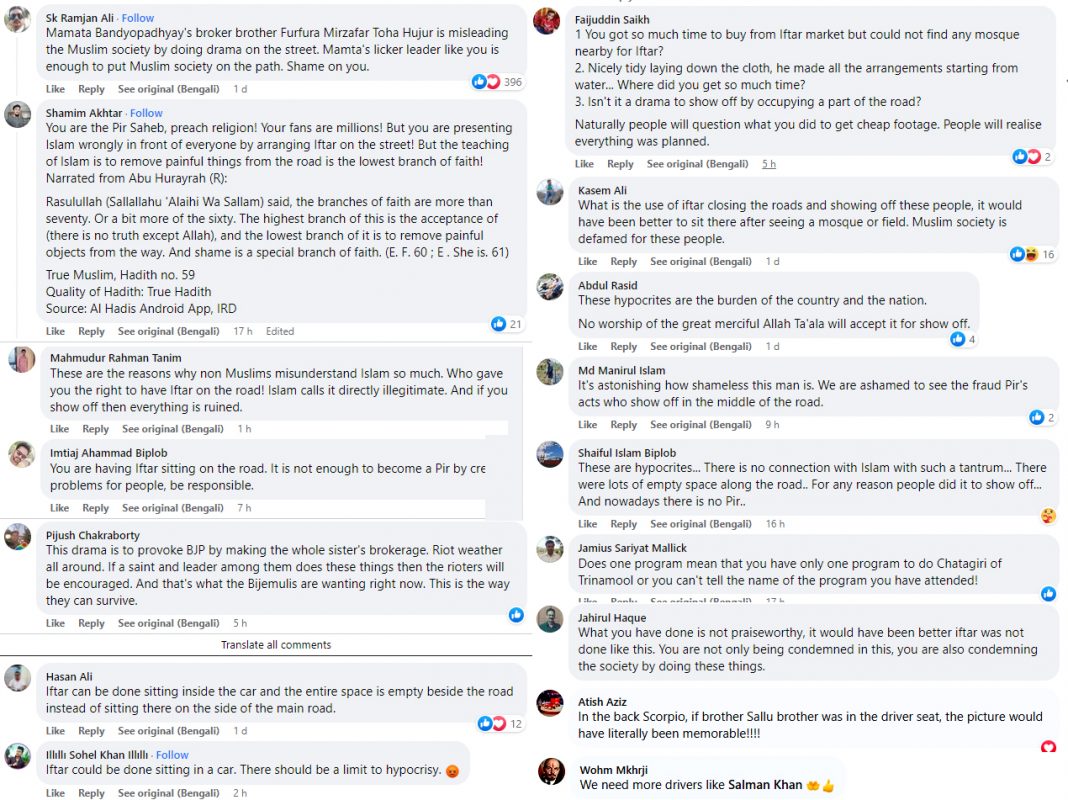
However, Toha Siddiqui’s this ‘iftar on road’ stunt didn’t go well with netizens, including Muslims. His Facebook post has received over 1200 posts till now, almost all of them for misusing his proximity to power to hold iftar on road. Notably, Toha Siddiqui is a close ally of Mamata Banerjee, and he supports her during elections.
Muslim Facebook users commented that due to such acts, the entire community earns a bad name. They also said that it was just a drama by him, and called him a hypocrite, as he routinely comments against Hindu festivals.
Some comments by netizens (Facebook’s machine translation)
The netizens noted that he could have taken the iftar meal in his vehicle, or he could have found a mosque, a roadside stall, or any other suitable place, but he chose the road only for a show off. Many people also said that by holding iftar feast on road and posting the photographs, the cleric was giving ammunition to Hindu fundamentalists which will increase communal tension in the state. A large number of people also called him a broker of Mamata Banerjee.
On March 31, Islamists raised slogans of ‘sar tan se juda’ in Gir Somnath, accusing Kajal Hindustani of giving an anti-Muslim speech during the Ram Navami procession. The videos of the incident have gone viral on social media. The slogans were raised in front of a police station.
Ram Navami procession (Shobhayatra) was taken out on March 30. Following the procession, a public meeting was also held where political and social activist Kajal Hindustani was one of the speakers. She talked about forced religious conversion where Hindu girls are lured into a relationship by non-Hindu men who usually hide their religious identity and eventually force them to convert their faith, demography changes in parts of India and several other issues.
The video of her speech was shared on social media, and as a reaction, thousands of Islamists took to on roads to protest. They demanded action against Kajal while chanting slogans calling for beheading. The protest march calling for beheading took place on Friday, March 31, during the Islamic holy month of Ramzan. The police intervened to maintain law and order.
Several Twitter Caliphs started posting video snippets, directing an Islamist mob against her, claiming that she was spreading hate and asking Hindus to pick up weapons against Muslims.
AltNews’ Zubair, notoriously known for directing an Islamist mob against former BJP spokesperson Nupur Sharma by posting a selective video snipper of her debate and inspiring beheading calls against her globally, posted a short video from another speech by Kajal Hindustani claiming that she was asking Hindus to arm themselves. He tagged Delhi Police and claimed that this was a “provocation to pick up arms” and that they should act against Kajal. He shared a tweet by another notorious Muslim handle called “Hindutva Watch”. The snippet of the speech was one from Delhi. The same handle had also posted snippets of Kajal’s Una speech with provocative claims.
Kajal Singla (Kajal Hindustani) says, “Utho Hinduon shastra apne aap uthao, apni raksha apne aap karo”. Isn’t this provocation to pick up arms? @DelhiPolice ? https://t.co/EETZzknITe
Hindutva Watch was one of the first handles that started dog whistling against Kajal Hindustani on the 1st of April 2023.
Kajal further peddled conspiracy theories demonizing Muslims and told the crowd to “Burn Lanka of Land Jihadis and Love Jihadis.” pic.twitter.com/esuYQyi369
The abuses that Kajal started getting was almost immediate. There were death threats, threats of rape and abuse that were rained down on her.
When Hindutva Watch, AltNews’ Zubair and other Islamists and Leftists started dog-whistling against Kajal, Sar Tan Se Juda slogans had already been raised against her in Una. Zubair used this argument to exonerate himself from the responsibility of inspiring abusive and threatening mobs against Kajal Hindustani, just like he did for Nupur Sharma.
You very well know that the propaganda article by RSS mouthpiece was written a day before I tweeted. But U also knows that ur followers are fools who would RT without cross checking just because your tweet has my name mentioned. ? Also She's booked for hate speech in Gujarat. pic.twitter.com/HPYJ8KhENs
Zubair, in his defence, essentially acknowledged that he knew about the beheading threats being given to Kajal Hindustani, however, as a Muslim himself, instead of condemning the calls to murder, he went ahead and was actively making the situation worse for Kajal Hindustani by tweeted her Delhi speech, with the false claim that she asked Hindus to pick up weapons, without clarifying that she was talking about self defence.
Hindutva Watch, on the other hand, peddled those dangerous, murderous, terrorist slogans as mere “protest” against Kajal by the Muslim community in Una. Knowing fully well the fate that befell Kanhaiya Lal, Umesh Kohle and so many others, Zubair and Hindutva Watch continued to direct mobs against Kajal Hindustani.
While these Islamists and their aides did what they generally do, it becomes important to put Kajal Hindustani’s speech in perspective and understand the takeaways from that speech, given the attempts by Islamists to twist what she said. At the very outset, it would bode well to remember that while Kajal clearly spoke about self-defence, Zubair shared her video with the misleading claim that she was unilaterally asking Hindus to pick up arms – the insinuation was simple – that Kajal was provoking violence by asking Hindus to arm themselves.
Zubair and handles like Hindutva Watch did not mention that she was asking Hindus to defend themselves against Islamist aggression, like the ones we have seen during Ram Navami where mobs went on a rampage, pelting stones at Hindus and committing arson. Self-defence is a natural right of every human being and twisting that as a call to arms is dangerous, especially when beheading enthusiasts follow the handle making such false claims.
Here is an example of a false claim that was made rampantly after Hindutva Watch dog whistled.
So what is that Kajal Hindustani actually said at Una? What was it that was so terrible that it led to beheading calls and apparently, communal violence?
On Hindu Rashtra
On Hindu Rashtra, Kajal Hindustani said, “Brothers, the conversation in India right now is about Hindu Rashtra. I had participated in such a debate and in that, there was a Maulana wearing a skull cap and sporting a beard. He said he will not let India become a Hindu Rashtra. To that, I said that you used to also say that you will not let Ram Mandir get built, but it is getting built now. You used to say Section 370 cannot be removed but it got removed. He then said, “sabhi ka khoon shamil hai is mitti main, ye Hindustan kisi ke baap ka thodi hai”. Here is what I said. I said you are right Maulana Sahab. But those who father in 1947 took Pakistan, they can’t claim Hindustan is theirs. Maulana said this is Hindu terrorism. I said only people who see Abba in their neighbour and ‘Jija’ in Pakistan see Hindu terrorism. Maulana said that I don’t respect Tiranga, she wants to saffronise India. I replied, ‘Listen, Maulana, the Tiranga is my pride the Bhagwa is my identity””.
In this part of the speech, Kajal Hindustani said nothing offensive. She did not speak about changing the character of the Indian State given that Bharat is already a civilisational state with a Hindu consciousness. In the story she narrated, she simply said that for Hindus, saffron is their identity while the Indian flag, representing the sovereign state is their pride. Further, while talking about those who created Pakistan, she alluded to the Islamists who have faith in the transnational concept of Ummah (Muslim brotherhood). Those who have allegiances and loyalties to Islamic states because of their religious purity over the civilisation and nation-state of Bharat are in no position to lecture Hindus about the pride they feel in the Hindu ethos of this great land.
The ‘Lanka jalayenge’ remark about love and land jihad
Kajal Hindustani spoke about the unity that is required within the Hindu community to fight the onslaught that we face on a regular basis. While speaking to the crowd, Kajal said that it is important for Hindus to come together and maintain unity to defeat the nefarious designs of Jihadis, terrorists and those who harbour Talibani mindset. She then asks the crowd if Hindus will defeat these people – “लव जिहाद और लेंड जिहाद की लंका जलायेंगे। बोलो जलायेंगे ना? यह लेंड जिहादियों की लंका जलानी है ना? यह लव जिहादियों की लंका जलानी है ना? तो उसके लिए मेरे भाइयों हमें रामसेना बनानी पड़ेगी और जब यह सेना लड़ने जाएगी तब ये सुधरेंगे।”.
‘Lanka jalana’ is a phrase that is metaphorically used as a reference to the defeat of Adharma, drawing from the epic Ramayana when Lord Ram, with the help of Hanuman, defeated Ravan after he abducted Maa Sita. When Hindus refer to “Lanka Jalana”, they seldom mean lighting literal fire to a town, country or locality, unlike certain other sections. The phrase is often used to talk about the destruction of evil forces and the defeat of those who commit a crime. When Kajal Hindustani spoke about burning the Lanka of land jihadis, love jihadis etc, and spoke about the unity of Hindus, Kajal simply meant that evil forces and Islamists need to be defeated in their nefarious designs as they commit violence against Hindus and for that, Hindus need to come together and ensure we are not a divided house.
It is true that issues like Love Jihad and Land Jihad are a concern, even if some people don’t particularly like the phrases being used to define these crimes. As 2022 drew to a close, at OpIndia, we attempted to analyse 153 cases of “Love Jihad” that we had reported. Every one of them had a religious angle where the Hindu woman was persecuted based on her religion. Some Muslim men pretended to be Hindu, Hindu women were force-fed beef, being converted to Islam or pressured to do so, cases of forced Halala, and so on. In the 153 cases, we saw that in 22 of these cases, the Muslim man had either force-fed beef to the Hindu woman, forced her to wear a hijab, or broken idols, stopping her from following her faith and converting to Islam. In 21 such cases, the Muslim man had threatened to make private videos public and in 3 cases, threatened the Hindu woman with beheading. Out of the 153 cases, 125 cases were those with adult victims whereas 28 were minor victims. As far as land jihad is concerned, there are several documented cases of Jihadists running a rampage against Hindus because they wanted to affect demographic change in the area by driving Hindus out and ghettoising the area. For a community that has been at the receiving end of endless violence, for an activist to say that Hindus need to defeat the forces terrorising them cannot be considered provocative in any way, shape, manner or form.
Contrary to how activists like Kajal Hindustani are painted – like bloodthirsty monsters who are baying for Muslim blood – Kajal actually spoke about coexistence and how the larger community (Hindus) would take care of the ‘sons’ (Muslims – the smaller community) if the violence and outrages against the Hindu community were to stop. While some are focussing on her statement where she warns Muslims not to be the “father” of Hindus, it was made in the context of the violence committed by Islamists and the fact that Hindus, being in the majority, are tolerant but will defend themselves when needed.
Hindu women taking a stand for themselves
Kajal Hindustani further in her speech said that Hindu women need to take a stand for themselves against the menace of Love Jihad and Islamist aggression. She said in this struggle to preserve our own dignity, every Hindu daughter will have to come out of her house and questioned how Islamists have the temerity to abduct Hindu girls. She then asked where is the “Mahila Shakti” (women power) of Bharat. She said that every woman should have the power to protect our daughters who are being brutalised by Islamists.
She further said that now Islamists are often seen capturing our temple lands and that the preservation of this land is in our hands. She said, “They chant slogans saying “We fought for Pakistan but we will smile and capture Hindustan”. What do they mean? What are they smiling about? How? By doing Love Jihad? Land Jihad? By doing forced conversions? We are paying for our mistake in 1947. If we are not careful, our future generations will question us about the kind of country we have left for them”.
While what Kajal said might seem harsh to the Muslim community, it is indeed true that sections of the Muslim community still do owe their allegiance to the Ummah and have sympathy for Pakistan given that it is a land of Islam. In fact, it is also true that sections of the Muslim community harbour dreams of turning India from Dar-al-Harb to Dar-al-Islam. Only recently we discovered the PFI Vision 2047 document that detailed how India was to be turned into an Islamic nation and how the genocide of Hindus was planned to be carried out. We have seen several instances where Pakistan Zindabad slogans have been raised. It is indeed a part of our national memory that the Khilafat movement and the Malabar genocide of Hindus which was a result of it was a movement for the Turkish Caliphate and the dream of establishing a similar Islamic state in Kerala. It is also a fact that Muslims voted overwhelmingly in favour of the creation of Pakistan and tall leaders of our freedom struggle were in support of full population exchange, including Dr BR Ambedkar. That Jawaharlal Nehru and MK Gandhi decided to sign the Nehru-Liaquat pact was widely criticised by national leaders and the communal flux we find India in today is a direct result of that decision. That an opinion sounds unpalatable certainly does not make it untrue. That an opinion sounds harsh also certainly does not mean that it is being made the first time.
Later in the speech, she also said she was equally worried about Muslim women and their plight. She listed several reasons why they should perhaps marry Hindu women so they can escape tyrannical practises like Halala, Triple Talaq, multiple children etc.
On caste discrimination and Hindu unity
Kajal Hindustani said that the disease of caste division has been injected into the Hindu society and that the Hindu society must shun caste considerations and come together as Hindus – united and strong. She said that in the Bhagwad Gita, Shri Krishna says that all 4 Varnas have been made by him according to ‘Guna’ and ‘Karma’, but then, first the Mughals came, then the British and then the Gandhi-Nehru family – they twisted these concepts and created a divide between Hindus.
She then lists the 4 mistakes made by Hindus.
We left it to the Communists to write our history.
We left it to be Christians to educate us.
We left cinema to the Jihadis.
And we left our country to Gandhi-Nehru family.
What Kajal Hindustani said on Hindu-Muslim brotherhood and crimes by Jihadis
Kajal Hindustani in her speech spoke about the rampant violence and stone pelting that has been taking place against Ram Navami Shobha Yatras. She spoke about the stone pelting in Baroda and the murders that have been taking place by Islamists. Talking about this, she then questioned if this is the Hindu-Muslim brotherhood that is often spoken about – where Hindus are murdered by Islamists. She went on to list the states in which stone pelting and violence were unleashed by Islamists against Hindus during Ram Navami and the Hindu girls who have been murdered by Islamists and chopped into pieces.
She said “Last year, there were “Gustakh-e-Rasool ki ek hi saza, sar tan se juda” slogans raised in Una, is this brotherhood? They called our Mahadev a fountain – is this brotherhood?”. She then recited a poem where she spoke about the injustice being met out to Hindus and how this mythical ‘brotherhood’ could go to hell and how she would only speak the truth. In the poem, she spoke about how Hindus were being jailed for reciting Chalisa but Muslims were free to do namaz 5 times a day, how Jihadis brandish swords openly and stone pelt Hindu religious processions and how Lord Shiva is openly insulted but those who raise an objection to that insult are beheaded.
She further questioned how ‘brotherhood’ was possible when we worship the cow and they slaughter it. She further said that while we worship young girls, there is rampant sexual harassment and rape of young girls by Islamists and how we can hope for brotherhood until it stops. She said no matter what one does for Islamists, they will never favour Hindus – that even after Hindus gave them their own country, their own law, Sec 370 in Kashmir and more, they have still refused to coexist and stop their atrocities against Hindus.
Kajal Hindustani is a widely popular Hindu activist who merely stated harsh realities and truths that the Hindu community in particular needs to come to terms with. Nothing she said has not been said before and nothing she said can be factually proven wrong. The fact is that when Nupur Sharma got beheading threats, several Hindus, naively said that she should have avoided making “certain comments” against Islam and its Prophet and if she had, she would not be in this position. That her comments were “unnecessary”. In this speech, Kajal Hindustani has clearly not uttered a word that treads that path, yet, there were beheading calls given against her in Una. Truth is, a Hindu merely standing up for the community’s right to exist will invite calls to murder because the Islamists and Leftists want Hindus to accept their own subjugation without a protest. They want Hindus to accept their own genocide, their own rape, their own murder and violence against their own festivals as the order of the day. Little by little, the fear of violence and the fear of one’s own safety will ensure that the Hindu community stops raising their voice and suffers in silence.
The Islamic community demands constant concessions from Hindus and having received those concessions, demands some more. The question is – how far is the Hindu community willing to go before it says thus far and no further.
Her interview to India TV in the aftermath of her speech can be seen here.
Taking cognisance of recent violence that broke out between two groups in West Bengal and Bihar during the Ram Navami procession, the Union Ministry of Home Affairs (MHA) has issued an advisory to all states to ensure the maintenance of law and order in preparation of Hanuman Jayanti.
The MHA has also advised through its advisory for peaceful observance of the festival, and monitoring of factors that could disturb communal harmony in society. Hanuman Jayanti would be observed on Thursday, April 6.
“The MHA has issued an advisory to all states in preparation for Hanuman Jayanti. The governments are encouraged to ensure the maintenance of law and order, peaceful observance of the festival, and monitoring of any factors that could disturb communal harmony in society,” tweeted the Union Home Ministry.
The advisory has been sent to the Chief Secretaries and the Director Generals of Police of all States, said sources.
The MHA’s move followed recent clashes reported from West Bengal and Bihar when Ram Navami processions were taken out.
In West Bengal, violence broke out in Howrah last week. Similar clashes were reported in Nalanda’s Biharsharif and Sasaram in Rohtas district in Bihar on March 31.
The Home Ministry has asked the West Bengal government to submit a report at the earliest on the incident of violence in Howrah, where several vehicles were torched and shops vandalized last week.
A total of 10 companies of the Central Armed Police Force (CAPF) have been sent to Bihar after violent clashes erupted there during Ram Navami celebrations.
Tension prevailed in Bihar even a day after Ram Navami as fresh violence was reported in Rohtas and Nalanda districts on Saturday, the police had said.
In Nalanda’s Biharsharif, a person was killed and several others injured after clashes broke out between two groups. Six people were injured in a blast in Sasaram town of Rohtas district.
Nalanda Police on Sunday said more than 75 people were arrested in raids after the clash. Bihar Police imposed prohibitory orders in Nalanda to maintain law and order in the region. Clashes were first reported in the two districts of Bihar on Friday.
(This news report is published from a syndicated feed. Except for the headline, the content has not been written or edited by OpIndia staff)
According to a Human Rights Observer 2023 fact sheet in Pakistan, during the year 2022, the amount of anti-minority religious content in curricula and textbooks grew, and several enduring and new issues with the educational system surfaced in the Islamic nation. The Centre for Social Justice (CSJ) issued the annual fact sheet on March 30.
The report addressed five significant issues that have an impact on religious minorities, including prejudice in the educational system, the prevalence of forced conversions to Islam, the misuse of blasphemy laws, the creation of the National Commission for Minorities, and jail remissions for minorities’ prisoners.
‘Blasphemy laws’ claiming dozens of victims
As per the information divulged in the fact sheet, 171 persons have been charged with violating blasphemy laws, with Punjab and Sindh accounting for 65% and 19%, respectively.
Karachi recorded the highest occurrence, which was then followed by Chiniot, Faisalabad, Gujranwala, Dera Ghazi Khan, Nankana Sahib, Lahore, and Sheikhupura. The majority of the victims (88) were Muslims, followed by 75 Ahmadis, four Christians, and two Hindus.
However, the religious identity of the two accused could not be ascertained. Four individuals were executed extrajudicially in 2022, two in Punjab, and one each in Sindh and Khyber Pakhtunkhwa, bringing the total number of such killings from 1987-2022 to 88.
From 1987 and 2022, at least 2,120 people had been charged with blasphemy. In Punjab, the abuse of blasphemy laws has increased by more than 75% overall over the previous 36 years. Despite their modest percentage (3.52%) in Pakistan’s population, 52 per cent of the accused belonged to minority communities.
‘Girls and women from minority communities are being forced to convert to Islam’
The fact sheet examined 124 documented instances of girls and women from minority faiths being forced to change their religious beliefs. Of these, 81 were Hindu, 42 were Christian, and one was Sikh. Merely 12 per cent of the victims were adults, while 28 per cent of the victims’ ages were unknown.
Twenty-three% of the victims were girls under the age of 14 and 36% were females between the ages of 14 and 18. In 2022, 65% of incidents of forced conversion were reported in Sindh, followed by 33% in Punjab and 0.8% in Khyber Pakhtunkhwa and Balochistan, respectively.
Even though this concession has been provided to Muslim convicts since 1978, the fact sheet revealed that no progress had been achieved in giving remission to minority prisoners throughout 2022.
The National Commission for Minorities (NCM), is yet to be established. In March 2023, a poor and imbalanced draught was reportedly presented to parliament, which might lead to more delays and the eventual foundation of the NCM.
Peter Jacob, the executive director at CSJ and editor of the human rights observer, commented that the annual fact sheet contained recommendations to address the problems as well as concrete steps for the realisation and protection of minorities rights. He urged the government to take stock of these problems and uphold the human rights of minorities.
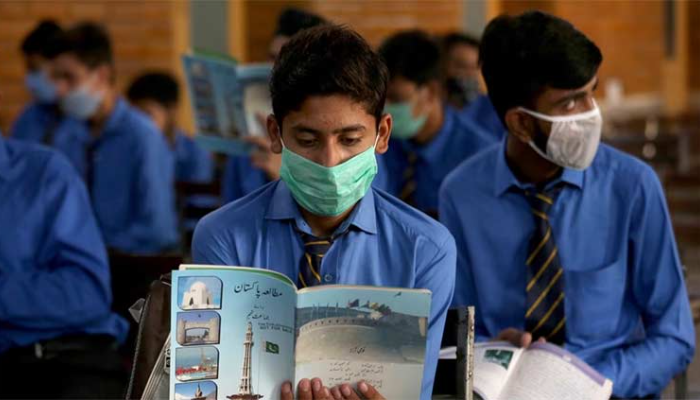
Notably, this is not the first time Pakistan has come under fire for its egregious treatment and appalling condition of religious minorities living in the country. Another similar revelation surfaced earlier this month, exposing the terrible lies Pakistan uses in its textbooks to instil its hate of India and Hindus in the next generation.
According to the report, history textbooks taught in Pakistani schools for grades 8 and 9 are full of material that is anti-India and anti-Hindu, including veiled references to Mahatma Gandhi, accusations, blame, and claims of being ‘Muslim nationalists.’
The textbooks provided to young minds present pupils with an incorrect and antagonistic image of their neighbouring country from the very beginning. They are written and produced by academics of the country in line with its national curriculum.
In 2021, a BBC documentary exposed the blatant anti-Hindu bias in Pakistani textbooks. In the video, several Pakistani Hindus drew attention to the ubiquitous and pervasive anti-Hindu propaganda promoted in the school textbooks and describe the humiliation they suffered at the hands of their friends, coworkers, and classmates just because they were Hindus.
The video additionally demonstrated how anti-Hindu bigotry has become commonplace in Pakistani government-approved school textbooks.
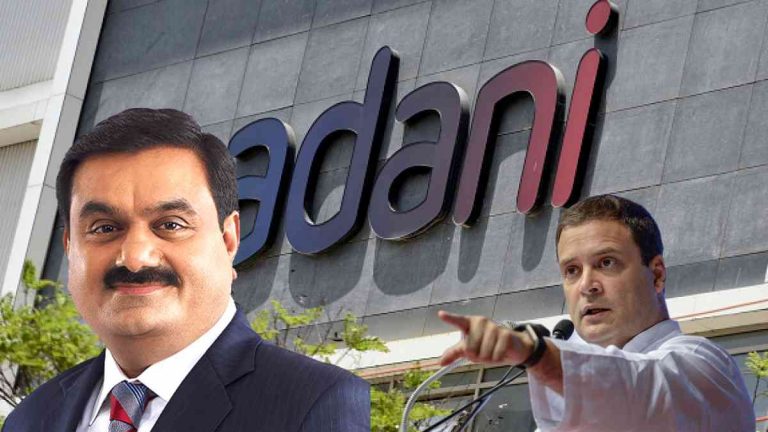
Congress leader and currently disqualified Wayanad MP Rahul Gandhi has been consistently asking one question. “Whose Rs 20,000 money is there in Adani’s shell companies?”
20,000 करोड़ अडानी की शेल कंपनियों में बेनामी पैसे किसके हैं – प्रधानमंत्री चुप, कोई जवाब नहीं!
2000 sq km ज़मीन चीन ने छीन ली, जगहों के नाम भी बदल रहे – प्रधानमंत्री चुप, कोई जवाब नहीं!
When a journalist asked Rahul Gandhi’s comment on taking an entourage of senior Congress leaders for filing an appeal in a Sessions Court in defamation case, Rahul Gandhi got upset and hit back with why was journalist asking what BJP is asking. Which is literally the journalist’s job – to get reactions, comments on allegations.
That apart, Rahul Gandhi questions whose money to the tune of Rs 20,000 crore is lying in the shell companies of Adani? He asserts the money is ‘benami’. As per The Benami Transactions (Prohibition) Act, 1988, “benami transaction means any transaction in which property is transferred to one person for a consideration paid or provided by another person.” The Indian laws specifically prohibit benami transactions and is punishable by law including imprisonment.
So Rahul Gandhi alleged that there is benami money worth Rs 20,000 crore in shell companies of Adani group. Let us break this down and figure out where did he get this exact figure from, since he has not provided any source, and if at all there is this money lying somewhere, where could it have come from.
On March 23, 2023, Rahul Gandhi addressed a press conference after he was convicted in defamation case leading to his disqualification. On March 25, 2023, he shared a snippet of his conference with background music alleging that Gautam Adani is a corrupt man.
मैं सच्चाई बोलता हूं, देश की ख़ातिर बोलता हूं। और आखिरी दम तक सच के रास्ते पर ही चलूंगा।
Rahul Gandhi, in as many words, asserted that PM Modi is ‘saving’ this corrupt man (Adani). He claimed that ‘we have caught Rs 20,000 crore entering Mr Adani’s company. Nobody knows whose money that is. That money cannot be Mr Adani’s money’. He alleged that the defamation case against him for insulting the OBC Modi community over his ‘all Modi surname people are thieves’ is a tactic to distract the panic PM Modi is having over his relationship with Adani being ‘exposed’.
Rahul Gandhi didn’t specify but cast enough aspersions to insinuate that the Rs 20,000 crore money was parked by PM Modi. Congress’ official social media account has also been tweeting wordplays of ‘Modani’ to insinuate that somehow PM Modi is part of some huge financial scam along with Gautam Adani.
So, where did Rahul Gandhi come up with this Rs 20,000 crore figure? You see, while he has been making these allegations, he has not quite given source for this very specific amount. A bit of Google search led us to Leftist propaganda website The Wire which had given an ‘explainer’ of this Rs 20,000 crore figure. Till then, no one knew where this figure came from. As if on cue, The Wire had rushed to explain on behalf of Rahul Gandhi, a task which was earlier carried out by the likes of Rajdeep Sardesai and Ravish Kumar.
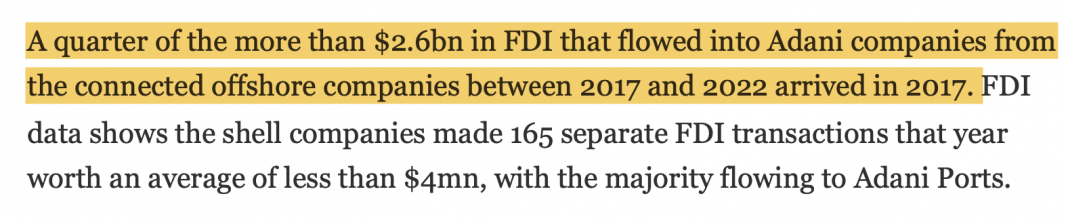
On March 22, 2023, Financial Times (FT) had published a report titled ‘Indian data reveals Adani empire’s reliance on offshore funding’. In the report, FT had claimed offshore companies linked to the Adanis invested at least $2.6 bn in the group between 2017 and 2022.
Snippet from FT report
This, USD 2.6 billion is approximately Rs 21,000/Rs 20,000 crore which Rahul Gandhi is talking about.
Amusingly, FT cites one Harvard Business School associate professor who is upset that Adani has very complex transactions.
HBS associate prof upset at complex transactions
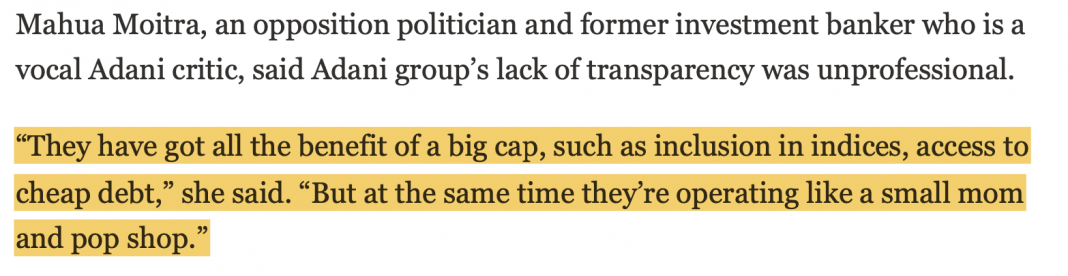
Clearly Prof Heese has not dealt with Indian taxation laws ever. Jokes apart, just because something is complex, it does not mean it is illegal. FT also cites TMC’s Mahua Moitra, who was recently caught lying about State Bank of India (SBI)’s exposure to Adani Group. She deleted her tweet after being called out for blatant lies and misleading citizens.
Mahua’s comment
As long as something is within the purview of the law, I’m quite certain Adani is free to run the business the way he wants.
Now that we know where they mystery figure Rahul Gandhi is citing came from, let us read the rest of FT article to see if they have mentioned source.
Yes, FT mentions that the said USD 2.6 billion came from its offshore companies. FT does not mention where it came up with this figure. FT claims this figure is derived after analysing ‘FDI’ (foreign direct investment) data. But it does not give specifics on which data was used. In its methodology section, FT mentions that it analysed India’s ‘share-based route’ and ‘automatic route for FDI, under which purchases of shares or equity-like debt are reported by Indian entities to India’s Central Bank, which would be the Reserve Bank of India.
Essentially, in absence of specific data used by FT to arrive at the figure, it is difficult to verify the claims by FT on Rs 20,000 crore figure. So, OpIndia cannot verify this figure. We leave it to our readers’ wisdom.
Rahul Gandhi’s next question is whose money is this.
Adani promoter group
Let us assume the Rs 20,000 crore was routed to Adani group companies through offshore companies. The FT report itself claims that this money was routed through companies linked with Adani. As per the FT report, most of these shell companies which are allegedly supplying FDI to Adani Group is disclosed as part of Adani’s ‘promoter group’. Which means, closely tied to Adani or his immediate family. Umm, so if FT is to be believed, this Rs 20,000 crore imaginary figure is Adani’s own money?
So, Rahul Gandhi did not read the article? Did his team not made him aware of facts before he addresses media or tweets things with so much confidence? So, Rs 20,000 crore Rahul Gandhi is claiming to be ‘benami’ is Adani’s own as per FT claims?
Again, to make it clear, OpIndia does not endorse Rahul Gandhi’s allegations of Rs 20,000 crore benami money. Adani Group has not yet reacted to the fresh allegations. Maybe because they did not even think this should be dignified with a response.
Rahul Gandhi and China love-hate relationship
In the same press conference where Rahul Gandhi first raked up the Rs 20,000 crore issue, he had mentioned, “Rs 20,000 crore has suddenly arrived in Adani’s shell companies. Where did the money come from? Whose money is it? Some of these companies are defence companies. Why is the defence ministry not asking the question? Why is nobody asking the question who this Chinese national is?”
I read the FT report at least three times to find out which Chinese national is he talking about. One would assume that the allegations of Chinese national investing in Indian defence sector via Adani Group would be from same source as the Rs 20,000 allegations. Rahul Gandhi has alleged that the Rs 20,000 crore have ‘arrived’ in Adani’s shell companies. He claims no one knows where the money came from and whose is it (FT report mentions it is Adani’s ‘promoter group’ companies, which means Adani’s own money) and then claims that some of these so-called shell companies are ‘defence companies’. He then invokes a Chinese national being involved in all this.
See, the thing is Rahul Gandhi has mixed up two different reports while making allegations. The Rs 20,000 crore shell company bit is from FT, but the ‘Chinese national’ allegation is from Hindenburg report. If you can’t convince them, confuse them seems to be Rahul Gandhi’s mantra.
Rahul Gandhi claims that all this Rs 20,000 crore was routed through shell companies to be invested in Defence sector in India. The Chinese national was seemingly invoked to cast aspersions that through Adani group there is some Chinese investment in Defence sector. This was not said in as many words, but enough to get the tongues of opposition leaders wagging.
You see, after Rahul Gandhi dog-whistled, people like Delhi CM Arvind Kejriwal used their privilege and speaking inside the Delhi Assembly making outlandish allegations against the PM without any proof or backing. Last week, while addressing the Assembly during Budget session, Kejriwal had claimed that PM Modi is the ‘real investor’ and Adani is the front. This came soon after Rahul Gandhi’s Rs 20,000 crore remark. Kejriwal thereby used his privilege as an MLA and within the four walls of the Assembly, which protect him from any legal action, and said what Rahul Gandhi implied.
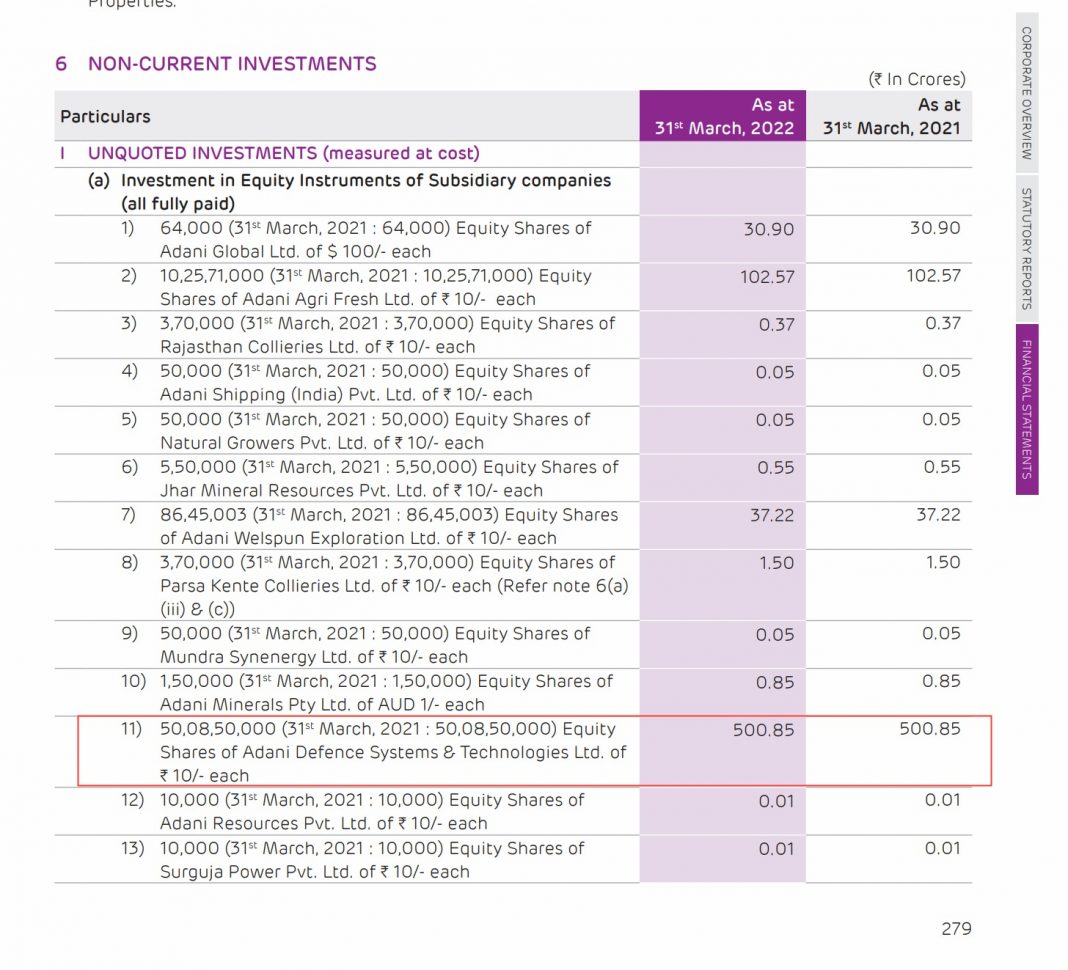
Except, here’s the truth about investment in Defence sector by Adani group. Following is an excerpt of the annual accounts of Adani Enterprise Limited for the year ending March 31, 2022.
Adani group investment in Defence sector
Adani’s investment in its subsidiary Adani Defence Systems & Technologies Ltd is Rs 500.85 crore, about 0.5% of the Rs 20,000 crore Rahul Gandhi keeps talking about.
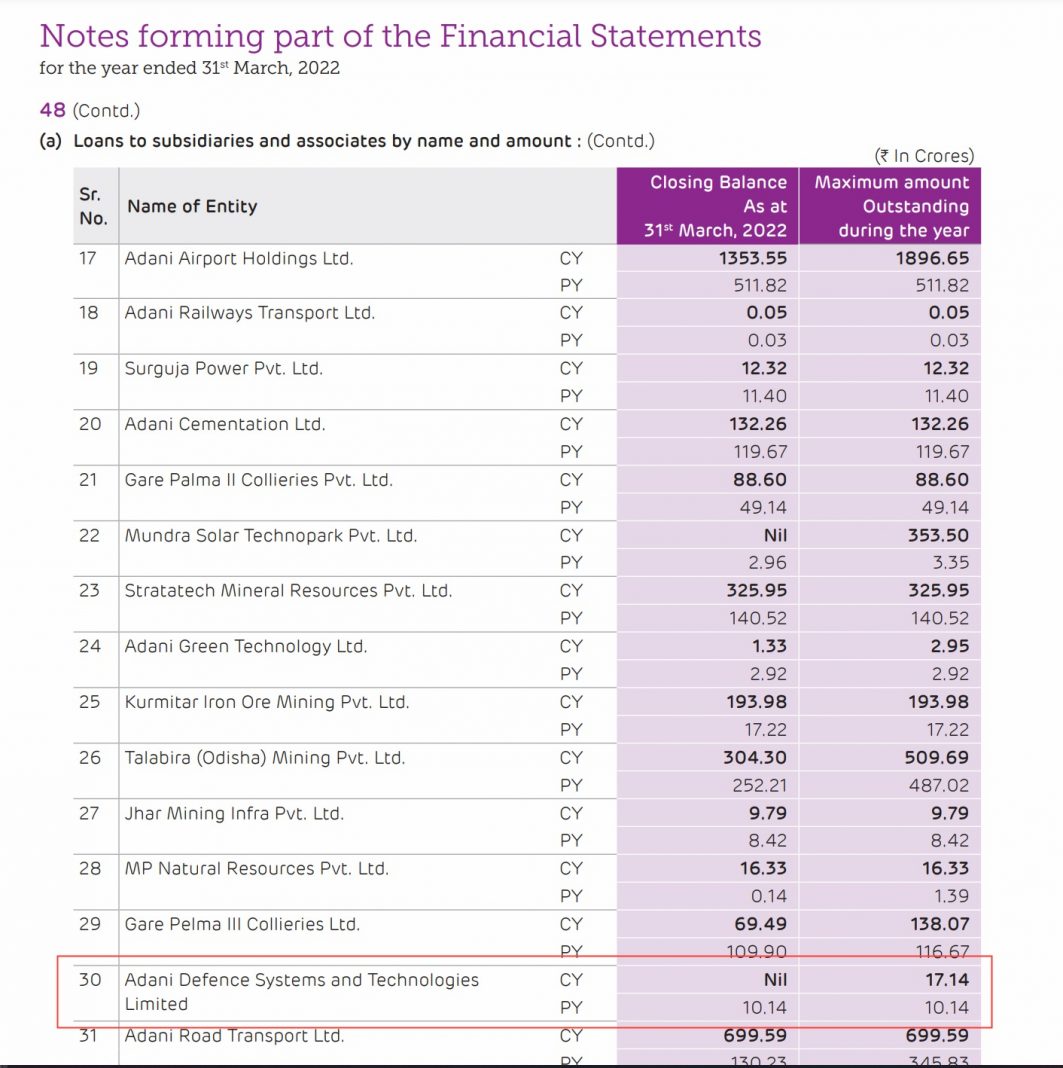
Loans to Adani Defence
Further, the outstanding loans to Adani Defence Systems & Technologies Limited is also nil. So, no money moved from Adani’s parent company to its defence subsidiary.
So what exactly does Rahul Gandhi want Defence Ministry to look into?
To summarise,
1. Rahul Gandhi’s mysterious Rs 20,000 crore is from an FT report.
2. There is no way to verify how FT arrived at this figure.
3. Even if one is to believe the figure to be correct, FT report itself mentions the money from offshore accounts came from Adani promoter group.
4. Complex transaction does not mean illegal transactions.
5. There is no new investment in defence sector subsidiary of Adani group, Chinese or otherwise, as per its annual accounts for the year ending March 31, 2022.
6. Rahul Gandhi took figures from FT and Hindenburg and came up with his own set of conspiracy theories
7. While Adani Group has rejected all allegations by Hindenburg report, it has not considered it worth reacting to FT report. And if for arguments’ sake we consider allegations are correct, which is what Rahul Gandhi believes in, even then, all the money is Adani’s own. Not of ‘Modi’ as Rahul Gandhi seems to insinuate and Kejriwal seems to assert.
8. Rahul Gandhi should consult old guards of Congress, like P Chidambaram and Kapil Sibal before alleging financial irregularities – his socialist lackeys with doctorate in African Studies from JNU are not the brightest bulbs.
Johnson & Johnson offered to pay close to $9 billion to settle the tens of thousands of lawsuits that alleged that its baby powder and other talc-based products cause cancer.
The healthcare behemoth declared it continued to view the allegations as “specious,” but hoped the fresh settlement offer would help put an end to its legal battle. The amount is a significant increase from the $2 billion it originally proposed. Those connected to the case have expressed strong support for the revised offer.
More than 40,000 lawsuits have been filed against the corporation by former customers who claimed that using its talc-based powder caused cancer. Some of the cases also claimed that the product included asbestos, which is known to cause cancer.
Johnson & Johnson has proposed an $8.9 billion settlement to resolve lawsuits that claimed its talcum powder products caused cancer.@eriknjoka tells you more
In 2020, the company discontinued selling its talc-based baby powder in the US, blaming “misinformation” for reducing demand for the item, which was used to reduce diaper rash and for other cosmetic purposes, such as a dry shampoo. It had intentions to halt sales worldwide, the company announced last year.
The company had been selling baby powder for about 130 years before that decision. It continues to market a corn-starch-containing version of the product. Since 2021, when it established a subsidiary to handle the claims, the business has been attempting to settle the litigation in bankruptcy court.
“The company continues to believe that these claims are specious and lack scientific merit,” said Erik Haas, worldwide vice president of litigation for Johnson & Johnson.
But he said, “resolving these cases in the tort system would take decades and impose significant costs on LTL and the system, with most claimants never receiving any compensation.”
“Resolving this matter through the proposed reorganisation plan is both more equitable and more efficient, allows claimants to be compensated promptly, and enables the company to remain focused on our commitment to profoundly and positively impact health for humanity,” Erik further added.
Other the other hand Alicia O’Neill of Watts Guerra, one of the firms representing plaintiffs said “This settlement is a testament to the tens of thousands of women who have battled both cancer and the court system to achieve justice for themselves.” She further added, “These strong women have ensured that no other woman will be exposed to this unnecessary danger, they deserve compensation and closure.”
In the talc litigation it faced, Johnson & Johnson claimed that it had won most of the cases. Yet, it has been saddled with some hefty setbacks, such as one ruling where 22 women received judgements totalling more than $2 billion. According to Johnson & Johnson, around 60,000 current claimants have agreed to approve the revised settlement conditions.
On March 30, the Ram Navami procession (Shobhayatra) was taken out in Una of district Gir Somnath, Gujarat. Following the procession, an event was organised where Hindu activist Kajal Hindusthani was one of the speakers. The local Muslims deemed her speech controversial and took the whole city hostage. There were reports of stone pelting, and the city burnt for two days. Following the incidents of violence, the so-called fact-checker Mohammed Zubair and other Islamists have started targeting Kajal Hindustani.
Notably, reports of violence have come to the fore from Gujarat and other states nationwide. Islamists have started propaganda to blame Hindus for the violence. Amid such attempts, Kajal Hindusthani has become one of their prime targets.
Here is the chronology of events that occurred since violence erupted during the procession detailing how Hindutva Watch and Zubair are making Kajal their scapegoat.
March 30 – Ram Navami Shobhayatra and Dharmsabha
On March 30, Hindus celebrated the birth anniversary of Bhagwan Ram (Ram Navami). As scheduled, a large procession to honour Bhagwan Ram was taken out in Una, district Gir Somnath. Kajal Hindusthani was one of the speakers in the Dharmsabha organised after the procession.
Reports suggest there were around 30,000 Ram devotees in the Shobha Yatra. The Dharmasabha took place at Raavanvadi near Trikon Bagh. During her speech, Kajal raised several issues, including Love Jihad and Land Jihad.
March 31 – Islamists blocked roads and raised ‘sar tan se juda’ slogans
On March 31, thousands of Islamists came to the roads and protested against Kajal Hindusthani’s speech during Dharmsabha. They called it ‘controversial’. Notably, it was Friday when the protests took place. There are videos on social media where Muslims can be seen raising ‘sar tan se juda‘ slogans. They raised ‘gustakh-e-Nabi ki ek saza, sar tan se juda’ slogans before a police station.
Again, Sar tan se juda slogan raised by jihadi radicals in Una, Gujarat Muslim goons raised slogans in front of the police post, @sanghaviharsh now in what language will you answer them? You used to say that you will forget to look at the stone !#HindusUnderAttackpic.twitter.com/uPwCHJ5era
April 1 – Gir Somnath SP attempted to mediate, Islamists pelted stones in the evening
On April 1, keeping the communal tension in mind, Una Police called religious leaders from both communities and tried to pacify the situation. However, both sides started arguing during the meeting. The Muslim leaders left the meeting as the situation got tense. The shopkeepers started shutting down their shops, and the whole city started to shut down.
Later Superintendent of Police (SP) called five-five leaders from both communities and brought them to a compromise. However, the city was under stress amid heavy police presence. Despite the efforts of senior police officials, stone pelting took place in the evening. Miscreants pelted stones in Kumbhwada, Koliwada and Chandrakiran areas. They also threw soda bottles. The police had to intervene to control the situation.
April 2 – 70 rioters arrested, cache of weapons recovered
Following the violence on March 31 and April 1, police started investing in the matter. Around 70 miscreants involved in the riots were arrested by the police. People were allowed to do their daily chores, but the police strictly watched the events. SRP teams have been deployed in the city.
During the investigation, police recovered a large cache of weapons. It is believed that there might be a pre-planned controversy to create a riot-like situation in the city. As per reports, the police recovered swords, axes, knives, razors, iron rods, batons and glass bottles. The police confiscated the weapons.
Kajal Hindusthani came forward to answer the allegations
As there were slogans raised to behead Kajal Hindusthani, people were expecting a strong reply from her. On April 2, Kajal Hindusthani came forward and answered the allegations in an interview with India TV on the show ‘Sawaal to bant-ta hai’. During the interview, she said if Hindu breathing in the country, it is deemed hate speech.
She said, “Muslim women are not getting equal rights and respect in the country. Women have more rights than men in the country, but women are not getting equal rights among Muslims. She said, “I have not said anything against any community, religion or God. What I said was true, and I am not responsible if someone gets offended.”
She added Love Jihad, Land Jihad, and conversions have been happening in the country because of organisations like the Popular Front of India (PFI). She deemed PFI a poisonous organisation that pushes Muslim youth towards extremism, terrorism and separatism.
She said, “I speak against their conspiracies, including Love Jihad and Land Jihad. I do not think I said anything wrong or indulged in giving hate speech.” She added, “When I talk about the benefits of women in the Muslim community and vouch for the Uniform Civil Code, people get offended.”
Notably, Love Jihad is a term used for the incidents when a Muslim or a Christian hides his or her true identity and lures a Hindu man or woman into an affair to get married to convert. Recently, there has been a spike in the cases of Love Jihad.
Similarly, when a Muslim or Christian person hides his or her identity to take control of land, it is called Land Jihad. In many such cases, illegal mosques and dargahs have been built on such lands.
April 3 – complaint against Kajal Hindusthani
During Dharmsabha, Kajal said if Muslim women marry Hindu men, it would benefit them. After her speech, Muslim leaders filed a complaint against her and demanded action. An FIR was registered against Kajal under Section 295A, 153A and 505 of the Indian Penal Code. Amid the controversy, Islamists are gaslighting their followers against Kajal Hindusthani.
April 4 – Ecosystem activated against Kajal, Hindutva Watch and Zubair frontrunners in gaslighting Muslims
As always, Islamists accused Hindus of violence. The conspiracy to blame Hindus and target Hindu leaders started on social media. For some time, low-profile Islamists kept trying to instigate Muslims against Kajal. However, later the infamous players jumped into the game. The controversial Twitter handle Hindutva Watch shared a video of Kakal Hindusthani and wrote, “At Hindu Jagruti Samelan, Kajal Shingla aka Kajal Hindusthani, a repeat offender, delivered hate speech targeting Muslims and called on Hindus to wake up and pick arms to defend themselves.”
Location: New Delhi
At Hindu Jagruti Samelan, Kajal Shingla aka Kajal Hindusthani, a repeat offender, delivered hate speech targeting Muslims and called on Hindus to wake up and pick arms to defend themselves. pic.twitter.com/o8P2aTcvwe
Notably, in the video and as Hindutva Watch wrote, Kajal only talked about self-defence. She never asked Hindus to attack someone. However, her statements were twisted and used for propaganda. The propagandist fact-checker and co-founder of Alt News, Mohammed Zubair, took charge of the conspiracy against Kajal. He shared Hindutva Watch’s video and tagged Delhi Police, saying, “Kajal Singla (Kajal Hindustani) says, “Utho Hinduon shastra apne aap uthao, apni raksha apne aap karo”. Isn’t this provocation to pick up arms? Delhi Police.
Kajal Singla (Kajal Hindustani) says, “Utho Hinduon shastra apne aap uthao, apni raksha apne aap karo”. Isn’t this provocation to pick up arms? @DelhiPolice ? https://t.co/EETZzknITe
Here, Zubair deemed the call of self-defence as a provocation. This is the same person who dog-whistled Islamists against former BJP spokesperson Nupur Sharma on social media leading to ‘sar tan se juda‘ threats against her. Not to forget, Zubair’s dog-whistling led to the murder of several Hindus, including Udaipur resident Kanhaiya Lal and Amravati resident Umesh Kohle, as they supported Nupur Sharma on social media. He employed the same modus operandi to target Hindu activist Kajal Hindusthani and paint a target behind her, triggering violence and riots in several parts of the country.
In the Nupur Sharma case, Zubair had shared an incomplete video of the former BJP spokesperson, alleging that she had blasphemed against Prophet Muhammad. The dog-whistling incited Islamists across the country who went on a rampage, resulting in vandalism, rioting, and arson in many parts of the country. In this case, Zubair twisted a call for self-defence as a “provocation to pick up arms”, painting a target behind Kajal Hindusthani and sending Islamists after her.
Since April 2, Kajal has not posted anything on social media. OpIndia tried to contact her but could not. If you remember, the same format was followed in the case of Nupur Sharma. Only time will tell if Kajal also has to live in hiding amid death threats from Jihadists or if the system will take any steps to safeguard her life and bring to account professional dog whistlers galvanising a bloodthirsty mob by twisting statements.
On Wednesday, April 5, Kerala Police arrived at Shaheen Bagh in New Delhi to visit the residence of Shahrukh Saifi, who is accused of setting his co-passengers on fire in a moving train in Kerala. It is notable that earlier today, with the help of Maharashtra ATS, the Kerala police nabbed Shahrukh Saifi from Ratnagiri railway station. The accused will be handed over to the Kerala Police today and brought to Kochi by this evening.
Delhi | A team of Kerala Police arrives at Shaheen Bagh to visit the residence of the Kozhikode train fire incident suspect, Shahrukh Saifi pic.twitter.com/luw2qmxm8i
Earlier, it was reported that the investigation team collected details of the SIM card used by accused Shahrukh Saifi. The police team had recovered a diary from a bag suspected to belong to the accused. In the diary ‘Shahrukh Saifi carpenter’ was written. Upon investigating the accused’s mobile phone it was found that the SIM card was obtained in the name of Shahrukh Mohammad Fakhruddin, C-8, Faisal Enclave, Shaheen Bagh in South Delh’s Jamia Nagar, as reported by Manorama. The SIM was reportedly switched off on March 31 in Haryana. The police so far have not found evidence suggesting that the accused contacted anyone in Kerala using this SIM card.
Reportedly, two weeks ago the accused was also spotted near Irumpanam in Tripunithura. After the sketch of the accused was released the Kerala ATS received some confidential information and started collecting evidence. Amidst allegations that the Brahmapuram waste fire was started by someone, this development may also be crucial in the Brahmapuram fire case, as per reports.
Kerala DGP, Anil Kant confirmed the arrest of accused Shahrukh Saifi and said that a thorough interrogation of the accused will be conducted.
According to the police, Shahrukh Saifi, a Shaheen Bagh native went missing from his house on March 30. Following this, his parents lodged a missing person complaint on Saturday. Saifi’s attempts to flee to Gujarat were thwarted when the burns on his face worsened, forcing him to stop in Maharashtra instead.
During their visit on Wednesday, the Kerala police team questioned the family of the accused, and searches were also conducted, however, nothing contentious was found. Shahrukh’s parents claimed to have no information about the case.
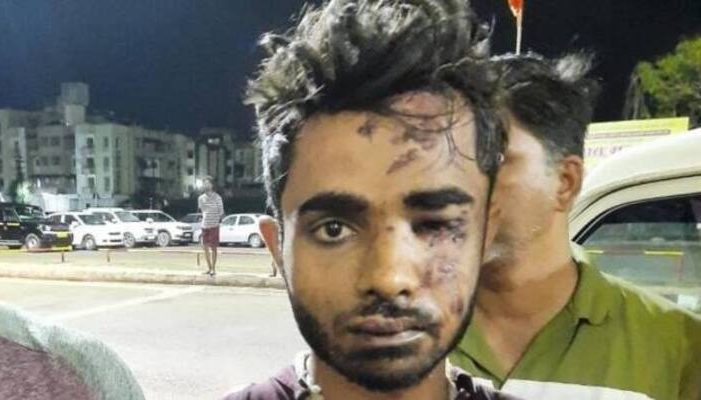
While some media reports say that the accused was arrested at Ratnagiri railway station, others state that Shahrukh Saifi was arrested from a hospital in Ratnagiri where he was receiving medical treatment for his burn injuries during the arson attack on April 2.
According to media reports, 30-year-old Shahrukh Saifi was working in Kerala as a construction worker. Earlier it was reported that a suspect was taken into custody by the UP ATS from Uttar Pradesh’s Bulandshahr. However, UP ATS chief Navin Arora stated that the ATS team only checked his credentials, and the person was neither arrested nor interrogated.
Meanwhile, Union Railways Minister Ashwini Vaishnaw thanked the agencies and the Maharashtra government for prompt action.
#WATCH | Railway Minister Ashwini Vaishnaw on Kozhikode train fire case suspect nabbed by police in Maharashtra pic.twitter.com/FuhPmjvnN9
The perpetrator of this heinous crime has been apprehended in Maharashtra’s Ratnagiri. Minister Vaishnaw stated, “I thank the Maharashtra government, their police, RPF, and NIA who have apprehended him this quickly.
Accused Shahrukh Saifi had reportedly boarded the Alappuzha-Kannur Executive Express train in Kozhikode at around 9.45 pm on Sunday, April 2, to pour an inflammable liquid on fellow passengers in the moving train and set them on fire.
The bodies of a woman, a man, and a child were found on the tracks near the Elathur station after the incident, the police had stated. It is suspected that the 3 persons were trying to get away from the fire and may have fallen or jumped from the train to escape.